Menu

 Find Your
Car
Find New
Car
Local
Pages
Find Your
Car
Find New
Car
Local
Pages
 Pakistan
 Antigua
 Anguilla
 Armenia
 Australia
 Azerbaijan
 Bahamas
 Bangladesh
 Botswana
 Burundi
 Canada
 Chile
Chile
 Costa Rica
 Cyprus
 Dominican Republic
 Fiji
Fiji
 Georgia
 Ghana
Ghana
 Guatemala
 Guyana
 Ireland
 Jamaica
 Kenya
Kenya
 Kyrgyzstan
 Lesotho
 Malawi
 Micronesia
 Mongolia
 Mozambique
 Namibia
 New Zealand
 Nigeria
 Papua New Guinea
 Paraguay
 DR Congo
 Russia
 Rwanda
 Samoa
Samoa
 Solomon Islands
 Somalia
 South Africa
 South Sudan
 Sri Lanka
 Tanzania
 Tonga
Tonga
 Uganda
 Ukraine
 USA
USA
 Zambia
 Zimbabwe
Car
Services
Company
Overview
Reviews
Blogs Categories
Help
Explore Stock
Explore Stock
Explore By Price
Explore By Price
Explore By Make
Explore by
Type
Explore by Year
Explore by
Discount
Inventory
Location
Inventory
Location
Other Categories
Other Categories
Zimbabwe
Car
Services
Company
Overview
Reviews
Blogs Categories
Help
Explore Stock
Explore Stock
Explore By Price
Explore By Price
Explore By Make
Explore by
Type
Explore by Year
Explore by
Discount
Inventory
Location
Inventory
Location
Other Categories
Other Categories
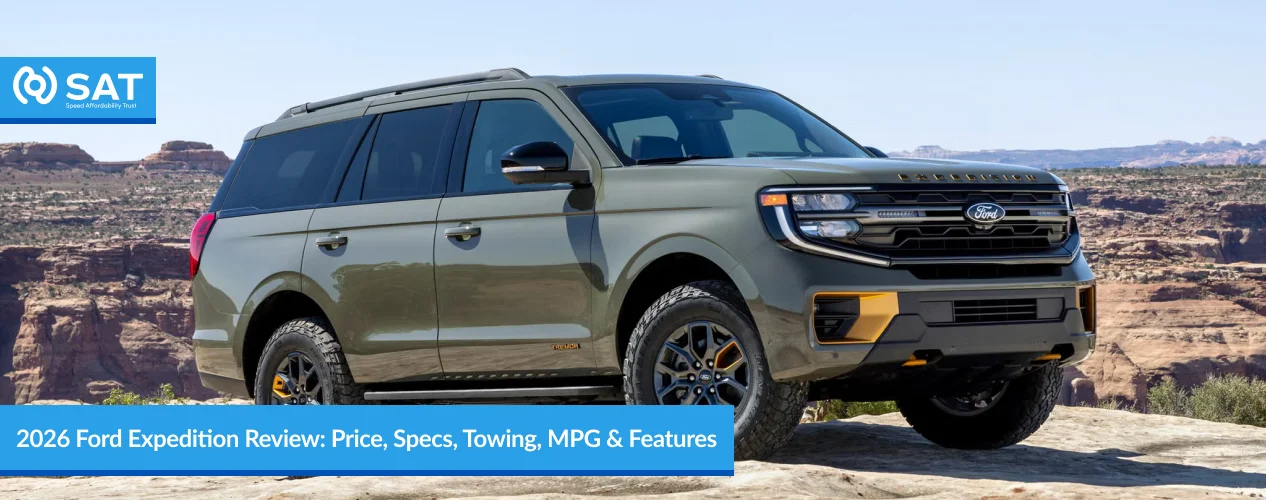
What stands out is how a full-size SUV can fit into a market that's dominated by the Chevrolet Tahoe, GMC Yukon, and Toyota Sequoia. The 2026 Ford Expedition receives one of the most significant updates in the model's history. The SUV also includes innovations for families that go beyond just appearance and is built on Ford's fifth-generation Expedition platform. The class-exclusive Ford Split Gate, a 24-inch panoramic driver display as standard, and the available Flex Powered Console are all new upgrades in the practical day-to-day use by Ford. The lineup has also been streamlined into four trims: Active, Tremor, King Ranch, and Platinum.
In this 2026 Ford Expedition review, we will discuss the price, features, and specs of the 2026 Ford Expedition to find out if Ford's flagship SUV remains a leader in the full-size SUV segment.
In the 2026 Expedition, Ford is placing an emphasis on driving function and utility, rather than styling, with one of the most significant changes since the last major redesign. The biggest change is a brand-new model option called Tremor, which may be the Expedition's first off-road model. The new offering will help make Ford's lineup look a bit more like some adventure-oriented models, such as the Chevrolet Tahoe Z71 and the Jeep Wagoneer.
Ford has introduced a class-exclusive Split Gate tailgate which makes loading gear easier while also creating a convenient seating area for outdoor activities. Another major update reflects Ford's push toward a more digital driving experience; that's the new 24” panoramic display. The available Flex Powered Console can slide nearly 8 inches to provide additional storage flexibility, making it more adjustable if needed. These changes show how Ford is responding to evolving customer expectations by providing customers with practical improvements that make the SUV easier to drive and maintain, rather than simply restyling the SUV.
The new Ford Expedition (2026) will begin at $62,000 (Active) and rise to more than $85,000 (Platinum). Ford has divided the line into four different trim packages: Active, Tremor, King Ranch and Platinum. This will help minimize model overlap and help buyers determine which model is best for them.
The most significant addition may be the new Tremor trim for enthusiasts who thought that only the Chevrolet Tahoe Z71 could be an adventure-oriented SUV. At the top of the lineup, the Platinum pushes the Expedition further into premium territory. Ford is not only competing in the mainstream segment, but it has high-end versions.
This reflects a growing trend in the full-size SUV segment, where there is a desire for trims that meet consumers' lifestyle and choice.
The strongest value in the lineup is the 2026 Ford Expedition Active. Ford has moved many desirable features, including advanced safety technology, modern infotainment, and the twin-turbocharged EcoBoost V6, into lower-priced trims, making the Active a more complete package than entry-level versions from many competitors.
Buyer Priority | Recommended Trim |
Best Overall Value | Active |
Best for Large Families | Active MAX |
Best for Off-Road Use | Tremor |
Best Premium Balance | King Ranch |
Best Luxury Choice | Platinum |
Specification | 2026 Ford Expedition |
Engine | 3.5L Twin-Turbocharged EcoBoost V6 |
Horsepower | 400 hp (standard) / 440 hp (high-output) |
Torque | 480 lb-ft (standard) / 510 lb-ft (high-output) |
Transmission | 10-Speed Automatic with SelectShift |
Drivetrain | Rear-Wheel Drive (RWD) / Available 4WD |
Seating Capacity | Up to 8 Passengers |
Wheelbase | 122.5 inches (Standard) / 131.5 inches (MAX) |
Fuel Type | Regular Unleaded Gasoline |
Maximum Towing Capacity | Up to 9,600 lbs |
Fuel Tank Capacity | Approximately 23.6 gallons |
EPA Fuel Economy (RWD) | Up to 17 City / 23 Highway MPG |
Available Trims | Active, Tremor, King Ranch, Platinum |
Body Style | Full-Size Three-Row SUV |
Cargo Capacity (Max) | Up to 121.5 cu-ft (Expedition MAX) |
The 2026 Ford Expedition stands out in the full-size SUV market thanks to its everyday driving power delivery. It uses a twin-turbocharged 3.5-liter EcoBoost V6 engine with strong low-end torque, helping the SUV to accelerate without the driver having to push on the gas pedal. This helps the Expedition feel more responsive in urban driving conditions and when merging onto a highway than many naturally aspirated V8 competitors.
One of its most significant advantages is the 10-speed automatic transmission, which helps keep the engine in its optimal power range and ensures the SUV accelerates smoothly. Despite weighing more than 5,500 pounds, the Expedition remains composed and quiet at highway speeds.
One often-overlooked strength is steering stability. The Expedition requires fewer steering corrections during long highway drives, which helps to keep drivers from becoming fatigued. This stability and comfort definitely appeal to long-distance travelers.
The 2026 Ford Expedition is also one of the most capable full-size SUVs on the market, towing up to 9,600 pounds with the appropriate equipment. It's a rating higher than that of some of its main competitors, such as the Toyota Sequoia, and it continues to make the Expedition highly competitive against numerous Chevrolet Tahoe configurations.
The impressive towing rating is supported by the Expedition's body-on-frame construction, more often seen in full-size trucks, which is ideal for towing heavier loads. It also has a long wheelbase, which increases the trailer's stability, making it less prone to sway and improving confidence during highway towing.
Ford also makes towing easier with the introduction of Pro Trailer Backup Assist, Trailer Reverse Guidance and an integrated trailer brake controller. These technologies help to make it easier to handle and control, especially when towing larger campers, boats or utility trailers.
Another advantage is that they offer robust towing capacity across a variety of trims, so buyers don't have to opt for the most expensive options.
If you're driving in the city, the 2026 Ford Expedition delivers up to 17 mpg in city driving for rear-wheel-drive models, as determined by EPA testing. Some rivals, such as the Toyota Sequoia, are adopting hybrid technology, but Ford continues to use a twin-turbocharged V6 engine and a 10-speed automatic transmission. This approach helps the Expedition remain competitive in highway fuel economy without the weight and complexity of a hybrid battery system.
One benefit is Ford's decision to go with a twin-turbocharged engine, rather than a bigger naturally aspirated V8. On highways, where most Expedition owners drive, turbocharging enables the vehicle to operate more efficiently. This helps it remain competitive among full-size SUVs compared with some V8-powered models.
One of the advantages that most drivers don't even think of is consistency in driving. The new transmission has helped keep the Expedition's engine RPM down at normal speeds, but full-size SUVs can have a significant impact on fuel economy depending on driving conditions. This remains one of the Expedition's most practical advantages for drivers who regularly travel long distances.
Depending on the model, the 2026 Ford Expedition will hold approximately 23.2 to 23.6 gallons of fuel. Together with its efficient powertrain, this can deliver a range of more than 500 miles under optimal highway driving conditions for many models.
This long driving range is especially convenient for full-size SUVs, which are popular among families who enjoy long road trips. When traveling for long distances, fewer fuel stops can make for an efficient journey.
Unlike some competitors that rely on hybrid powertrains, Ford combines strong highway efficiency with a large fuel tank to deliver impressive driving range. This feature not only makes the ownership experience easier but also offers the longer range many potential full-size SUV buyers are seeking.
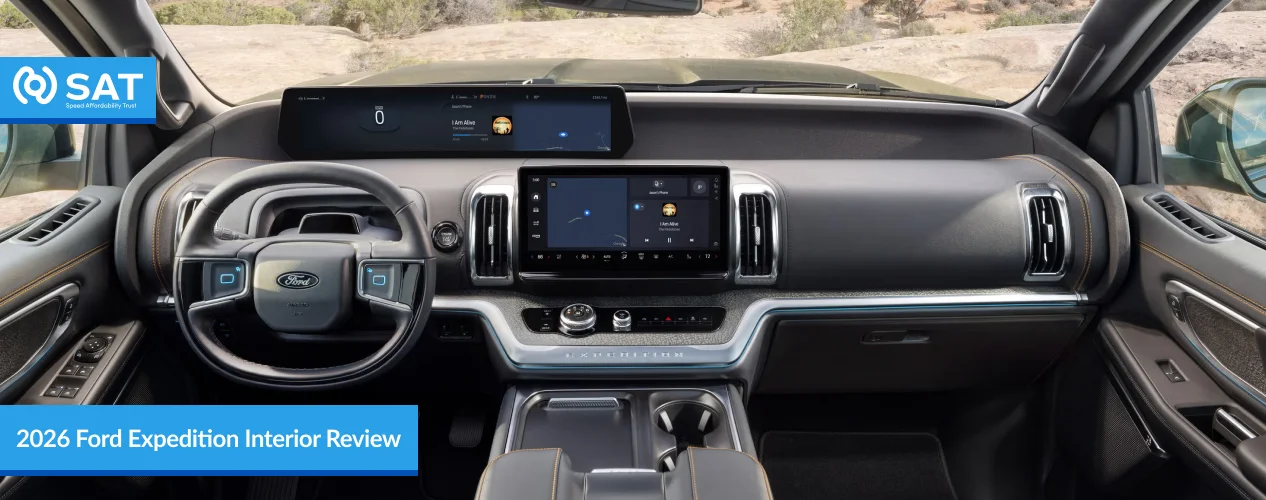
The interior of the 2026 Ford Expedition will be more functional and technology-focused. The largest change is the new 24-inch panoramic driver display positioned near the base of the windshield, so drivers won't have to continually reach down to the instrument panel to view the information they need. Ford's new console is also available and can be extended almost 8 inches to provide versatile room for load and passenger access.
The quality of the materials has been enhanced throughout the line, and the higher specification variants feature leather seats, authentic wood trim and better quality soft-touch materials. Another thoughtful improvement is a redesigned dashboard layout that opens up the area and helps create a cleaner, less cluttered dashboard layout.
There's no doubt about it: the Expedition is different because it combines digital and physical controls. Most of the controls are now on the touchscreen, but Ford still has a few buttons for common settings to keep drivers from getting too distracted to drive.
The 2026 Ford Expedition remains one of the most practical cargo-hauling SUVs in the segment. There are 21.6 cu. ft. of cargo behind the third row seat, 60.8 cu. ft. behind the second row seat, and up to 108.5 cu. ft. with both rear row seats folded. The Expedition MAX provides up to 123.1 cubic feet of cargo space.
What makes the Expedition stand out is the efficient utilization of that space. Ford is also making the loading area easy to access with a large rear door and relatively low load floor, which will come in handy for loading heavy and bulky items, such as bikes, camping gear, or large suitcases. Smaller items are also stored in an extra compartment which is well organized and secure.
This usability is important given many Expedition owners use their SUV not only to carry their children but large amounts of cargo too. In real-world use, of course, cargo figures are not the only factors that matter.
The 2026 Ford Expedition is one of the largest SUVs in its class, standing at approximately 210 inches in length, 80 inches in height, and 85 inches (mirrors included) in width. Those who opt for the Expedition MAX get almost 12 inches more length, to a total of roughly 222 inches. The standard model has a wheelbase of 122.5 inches, while the MAX is as long as 131.5 inches.
These dimensions do more than simply make the Expedition larger. The longer wheelbase is important in straight-line stability, creating a more relaxed experience for the Expedition on the highway. Ford also avoids making the SUV excessively tall, helping it fit into more garages, which is better than some larger body-on-frame models.
Rarely discussed, one overlooked advantage is its balance of size and maneuverability. Its proportions are carefully designed to maximize interior space while remaining manageable to drive in suburban and urban settings.
One of the most high-tech packages offered in the full-size SUV class will be included in the 2026 Ford Expedition. It features a 24-inch panoramic display in front of the dashboard, and a 13.2-inch touchscreen center console platform with Ford's latest digital interface. Wireless Apple CarPlay and Android Auto are standard, enabling hassle-free smartphone connectivity.
The star of the show, however, is the Ford connectivity platform, which is powered by Google and will enable drivers to navigate using Google Maps, use Google Assistant while on the road, and download apps. Over-the-air software updates enable Ford to make improvements to features and functions without having to go to the dealership.
The size of the screen is not what makes the Expedition so special; it's its technology strategy. Many competitors are adding larger screens and extensively utilizing touchscreens. Ford combines digital features with physical controls for commonly used functions, helping reduce menu navigation.
It's a tactic gaining traction in a market that's now turned to the importance of convenience and accessibility over screens on the dashboard.
Specification | 2026 Ford Expedition | 2026 Chevrolet Tahoe | 2026 Toyota Sequoia | 2026 Jeep Wagoneer |
Starting Price | $62,000 | $60,500 | $62,425 | $63,000 |
Engine | 3.5L Twin-Turbo EcoBoost V6 | 5.3L V8 (Std.) | 3.4L Twin-Turbo Hybrid V6 | 3.0L Twin-Turbo Hurricane I6 |
Horsepower | 400–440 hp | 355–420 hp | 437 hp | 420 hp |
Torque | 480–510 lb-ft | 383–495 lb-ft | 583 lb-ft | 468 lb-ft |
Transmission | 10-Speed Automatic | 10-Speed Automatic | 10-Speed Automatic | 8-Speed Automatic |
Drivetrain | RWD / 4WD | RWD / 4WD | RWD / 4WD | RWD / 4WD |
Maximum Towing Capacity | Up to 9,600 lbs | Up to 8,400 lbs | Up to 9,520 lbs | Up to 10,000 lbs |
Fuel Economy (Highway) | Up to 23 MPG | Up to 20 MPG (V8) | Up to 24 MPG | Up to 23 MPG |
Fuel Tank Capacity | 23.2–23.6 gallons | Up to 24 gallons | 22.5 gallons | 26.5 gallons |
Seating Capacity | Up to 8 | Up to 8 | Up to 8 | Up to 8 |
Maximum Cargo Capacity | Up to 123.1 cu-ft (MAX) | Up to 122.9 cu-ft | Up to 86.9 cu-ft | Up to 116.7 cu-ft |
Wheelbase | 122.5 in / 131.5 in (MAX) | 120.9 in | 122.0 in | 123.0 in |
Hands-Free Driving | BlueCruise Available | Super Cruise Available | Not Available | Not Available |
Off-Road Trim | Tremor | Z71 | TRD Pro | Series III Off-Road Package |
Best For | Families needing towing, technology, and cargo versatility | Buyers wanting traditional V8 power | Buyers prioritizing hybrid efficiency | Buyers wanting maximum towing and rear-seat space |
Ford Co-Pilot360 helps keep drivers better aware of their surroundings and reduces workload, and is the latest innovation for the 2026 Ford Expedition. Standard are Automatic Emergency Braking, Blind Spot Information System (BLIS), Lane-Keeping Assist, Rear Cross-Traffic Alert, and rearview camera. Higher trims add technologies such as BlueCruise hands-free highway driving and Intersection Assist.
What stands out is Ford's proactive approach to safety with the Expedition rather than simply reacting to hazards. Many of its systems continuously monitor surrounding traffic and alert you before it gets to a dangerous level. The over-the-air update feature also allows Ford to continually enhance certain software-based safety features.
This reflects a broader industry trend to shift toward software for improving vehicle safety. Long-term support for software updates could be as critical as the number of safety features when the vehicle is sold, as it becomes even more advanced with driver-assistance technology.
Reliability in the Ford Expedition 2026 isn't about getting 100 percent ratings; it's about durability over time. The Expedition has a body-on-frame design based on Ford's trucks, as opposed to many three-row crossovers that are mostly designed for passenger transport. The difference is important because those who purchase full-size SUVs keep them longer, carry heavier loads, and drive them more than the average crossover buyer.
Another overlooked reliability advantage is repair familiarity. The Expedition's engineering components are shared by some of the highest-volume cars at Ford, so most techs are familiar with diagnosing and repairing the platform. Also, over time, parts and service expertise can be as important as reliability ratings.
Long-term serviceability, parts availability, and platform maturity can actually be more influential on ownership satisfaction than short-term dependability scores for buyers planning to keep their vehicles for eight to 10 years or longer.
Having a platform and powertrain that have been improved over several model years is usually a good indicator of long-term reliability, which the 2026 Ford Expedition offers. The official long-term information on the 2026 model isn't available yet, but the previous Expedition models have proven to be rugged enough for a full-size body-on-frame SUV for family travel and heavy-duty daily driving.
The cost of maintenance is similar to that of other large SUVs in the same category. There are things that owners should expect to do regularly, like oil changes, tire changes, brake work, and other regular fluids. The average annual maintenance and repair costs are estimated to be between $900 and $1,200, varying by mileage, driving habits, and geographical location.
One benefit of Ford ownership is the convenience of having a Ford dealership or service center near them, making maintenance and repair easier. Another often-overlooked advantage is strong resale demand. Even large SUVs are still in demand in the used-automotive segment, contributing to long-term value retention for properly maintained models.
Infotainment software glitches: Some systems experience lag, screen freezes, connectivity problems, or system restarts, especially with vehicles increasingly reliant on digital systems.
Intermittent electronic sensor warnings: Some vehicles have experienced intermittent electronic sensor warnings that require recalibration or updating.
Feature malfunctions: With mileage comes the need for power-operated feature repairs, such as powered seats, running boards, and power liftgates.
Inconsistencies in driver-assistance systems: Cameras, radar, and sensors sometimes trigger false alarms or require recalibration after car repairs or windshield replacements.
Suspension wear at higher mileage: As with many large SUVs with a frame, suspension parts may need to be replaced after years of heavy use, towing, and rough roads.
Pros | Cons |
Strong towing power with a maximum of 9,600 pounds | Large size can make parking and maneuvering more challenging in crowded urban areas |
Spacious Expedition MAX model offers up to 123.1 cubic feet of cargo space | The higher trims can cost more than $85,000, putting them on par with luxury SUVs |
The new Tremor trim adds a special off-road package | Fuel consumption is not quite as efficient as some hybrid rivals, particularly in city driving |
Some of the most advanced features in the category include standard and available technology features | The bigger wheels on the top-level trims could lead to harder handling on rough roads |
Ford BlueCruise hands-free driving features improve the convenience of long-distance driving | Some buyers may find the vehicle's overall dimensions intimidating at first. |
There are family-oriented, off-road, premium and luxury versions to choose from, thanks to the wide trim range | The cost of optional packages can be expensive |
Twin turbo EcoBoost V6 provides power with no need for the V8 engine | Some advanced features are only available on higher trim levels |
The digital displays complement physical controls for everyday use in the interior design | Body-on-frame construction can feel less agile than some car-based three-row SUVs. |
The 2026 Ford Expedition is most appropriate for those who frequently require all three of these: third row seating, significant cargo space and genuine towing. While a number of midsize SUVs offer one or two of those attributes, few can offer all three without sacrifice.
The Expedition also appeals to buyers who value family cargo versatility and the latest Ford digital technology, compared to a Chevrolet Tahoe. Compared with the Toyota Sequoia, the Expedition offers much greater cargo capacity and a wider range of trims, while the Sequoia emphasizes hybrid efficiency.
It is also a great choice for owners who like to go on long trips. A long driving range, the option of hands-free highway driving (BlueCruise), and a stable long-wheelbase chassis can help to keep away fatigue on long drives.
For those who seek more than just a big family SUV, the 2026 Ford Expedition has a lot to offer. Ford has done a nice job of tweaking the Expedition to satisfy market demands while maintaining the versatility that has defined it for years. Ford's focus is on real-life practicality and functionality with the new Tremor trim, wide-ranging digital setup, and enhanced cabin features.
The most striking feature is the way the Expedition is able to serve several functions. If you are looking to use your vehicle for the family, long-distance travel, and also a good utility SUV, few vehicles can do this without compromises. Its broad range of capabilities makes its $62,000+ starting price a bit easier to justify in a segment that's seeing many other competitors begin to price themselves in the luxury-SUV range.
If you are an international buyer considering import, companies like SAT Japan can be of great help in the sourcing and export of vehicles from abroad. Overall, the 2026 Ford Expedition is still one of the most complete and well-rounded full-size SUVs available today.

How to Verify the Condition of a Used Japanese Car
Explore the 2026 Volkswagen Jetta: Design, Performance & Specs

What Are the Common Problems with Spoon Engines?

Liam Bennett
I am Liam Bennett, and I have worked as a professional in the automotive industry for over a decade, specializing in customer relations, vehicle sourcing, and pricing strategies. I ensure buyers and sellers get the best value in a transparent deal, helping them feel enabled and confident in their automotive transactions. As a writer, I also share my insights on the industry, providing valuable guidance to automotive enthusiasts and buyers alike.
The 2026 Ford Expedition offers stronger towing capability, more cargo space in MAX form, and a powerful standard engine, while the Chevrolet Tahoe provides more engine choices, including an efficient diesel option.
No, the 2026 Ford Expedition runs on regular unleaded gasoline, although premium fuel can help maximize engine performance.
The Expedition MAX is longer than the standard Expedition and provides significantly more cargo space for families and long-distance travelers.
Yes, the 2026 Ford Expedition is well-suited for road trips thanks to its long driving range, comfortable ride quality, and available hands-free highway driving technology.
While long-term data is not yet available for the 2026 model, the Expedition uses a proven platform and EcoBoost engine that have been refined over several years.
_1733298329.webp)
The Hyundai Palisade has been one of the most favored family cars in the petrol-head community. The Palisade has been known to blend style, efficiency, agility, and performance, all in one car. Coming in 7 different trims, with 4 diverse driving modes, this vehicle holds the solutions to all your adventure troubles, with a comfortable cabin, ample cargo space, and an innovative infotainment system. Moving into 2025, the 2025 Hyundai Palisade is introduced with some fresh updates making the SUV even more favorable for drivers.
Written below are all the incoming updates and changes to the 2025 Hyundai Palisade.
The 2025 Hyundai Palisade has a 3.8 Liter V6 engine that is paired with an 8 speed automatic transmission which delivers an output of 291 horsepower. This vehicle’s powertrain also features a manual control option for the transmission to give the driver more control. All trims come with a front-wheel drive, with an optional all-wheel drive upgrade to kick things up a notch.
The 2025 Hyundai Palisade’s 0-60 miles per hour driving time was tested to be 6.4 seconds, which is impressive for an SUV its size. Additionally, the front wheel drive Palisade has a fuel-economy of 19 mpg in the city and 26 mpg on the highway.
This three-row SUV is one of the most stylish of its kind; with a bold cascading grille, flanked by powerful and elongated LED lights, and sharp lines throughout the exterior for aerodynamic manipulation. The Palisade has a muscular stance giving it a sporty and intimidating look. The Palisade also comes with convenient exterior features such as a power liftgate, additional roof rails, folding third-row seats, and a panoramic sunroof.
The 2025 Hyundai Palisade has an opulent interior with a spacious cabin lined with the finest materials. The interior has a 12.3-inch touchscreen display featuring a dynamic digital cluster, Android Auto, Apple CarPlay, a premium sound system, dual Bluetooth connectivity, and an innovative remote controlling feature by the Hyundai Blue Link app, which gives you lock control from a distance.
The new model of the 2025 Hyundai Palisade has a starting price of $38,215 and it goes all the way up to the highest trim costing $55,515. The base trim, the SE model costs $38, 215; the second SEL model costs $40,965. The XRT trim comes in at about $44,065 while the SEL Premium trim costs $45,565. The Limited trim of the 2025 Hyundai Palisade costs $49,615 and the Caligraphy model costs $52,015. Last but certainly not least, the Calligraphy Night Edition of the Hyundai Palisade costs $55,515.
The 2025 Hyundai Palisade will be featuring 4 diverse driving modes including comfort, Eco, Sport, and Smart driving modes for an optimized and engaging drive:
Comfort: The comfort mode is set to deliver a seamless and smooth driving experience. The suspension and transmission are tuned for daily commuting driving.
Eco: The Eco mode in the 2025 Hyundai Palisade prioritizes the engine’s fuel efficiency, This mode may not deliver the most powerful performance, but the powertrain is adjusted to consume the least amount of gasoline for the more long-lasting output. This keeps the fuel economy high and decreases fuel costs.
Sport: The Sport mode focuses primarily on the speed and performance of the 2025 Hyundai Palisade. The steering and powertrain are tuned to create the maximum output while maintaining the vehicle’s agility.
Smart: The Smart driving mode is an intuitional setting that analyzes your driving style and switches the driving mode accordingly, giving you maneuverability and balance. This driving mode essentially also helps in fuel efficiency.
In comparison to other latest models, the 2025 Hyundai Palisade is relatively more affordable to maintain. The annual repair and maintenance cost for this vehicle begins at $352 and rises every year because of depreciation and can reach up to $739 in the first five years after purchase. Additionally, with high fuel efficiency, annual fuel costs are calculated to be up to $2,380 per year. All-in-all, you can rest assured that the 2025 Hyundai Palisade has a low maintenance and upkeep cost. Here are some factors contributing to this:
Hyundai Durability: Hyundai, like most other Japanese automakers, has a business model of constant improvement and innovation. These vehicles are engineered to be optimized for long-term usage. This rhombus engineering keeps your 2025 Hyundai Palisade away from the mechanic for a long while.
Expected Maintainance: You can rest assured that even if you were to take your Palisade to the mechanic, it would be out of routine, rather than from an unexpected mechanical breakdown. Routine check-ups such as oil changes and tuning will help maintain the longevity of your vehicle.
Visit Now 2025 Hyundai Elantra.
SAT Japan is the ultimate destination for those searching for well-maintained and certified Used Cars for Sale. We offer impressive deals on a wide range of luxury and economy vehicles. Our expert staff on board is dedicated to your ease and our customer-centric services will make the entire process unbelievably simpler. Our convenient services such as our insurance services, 24-month installment payment plan, and doorstep delivery, keep our customers stress-free. We recognize our responsibility to present the best course of action according to your preferences.
Although there are no revolutionary switch-ups in the design or performance of the 2025 Hyundai Palisade, it is one of the most reliable upcoming full-size SUVs in the automotive market. It is no easy feat searching through the endless sea of options to reach a final decision. Our expert staff and customer-centric services at SAT Japan help you make the right decision at every step of the purchasing process. Hence, SAT Japan is the ultimate car enthusiast website where you can find a plethora of well-maintained options for your potential next ride. Head on over to SAT Japan’s website and scroll through our vast inventory to find the perfect Hyundai car for you.

The modern cars coming in the market are capable of remarkable speeds and give you a highly smooth and comfortable experience. The latest cars are also much safer and come up with advanced and autonomous systems that can stop and steer the vehicle for you in an emergency. However, all the safety and advanced features will not do anything if you have bad tires. For example, inside tire wear is an issue that can affect the tires of many cars rolling on the road. It is not just about purchasing low-quality tires; it is also about not ensuring their proper maintenance.
Tire wear is a common problem that can affect your vehicle’s handling, safety, and performance. Although inner tire wear might seem harmless, it can lead to various serious issues, including reduced traction, poor steering response, and even blowouts.
But why do tires wear out from the inside, and how can you prevent it?
By understanding the factors that contribute to inner tire wear, you can increase the life of your tires and keep them performing at their best.
There are several reasons why your tire can wear from the inside. Below we discuss some of the reasons in detail.
Misaligned wheels can lead to irregular tire wear. When the bottom part of the tire is leaning towards the outside, it is called a negative camber. Positive camber is when the top part of the tire is leaning towards the outside.
When there is improper alignment in the tires, the inner part of the tire makes more contact with the road surface. Because of that, you might observe the inside of the front tires wearing down.
Poor wheel alignment can also mess up your camber. You can verify this by cruising on a flat section of asphalt. If your vehicle is not moving straight even after pointing the wheels at a 12 o’clock position, it means your wheels are not aligned properly.
Driving your vehicle aggressively puts a lot of stress on your tires. It can also overheat various components of the tires and wear the thread at a faster pace because of abrasion. Aggressive riding includes running your vehicle at maximum acceleration, hard cornering, and pushing brakes for prolonged periods. Tire wire showing is an indication of your tires being severely damaged.
It is essential to note that, unlike race cars, standard vehicles are not designed to be driven aggressively all the time. The tires in race cars are specifically designed to give maximum gain and resolve steering on the road. However, other tires cannot keep up with constant beating from drifting and fast driving.
For more insights into premium tire options, check out our detailed comparison: Bridgestone vs. Michelin Tires.
The suspension components of a vehicle are designed to not only absorb road shocks and vibration but also to make sure that the vehicle’s shock ride height remains the same. It is important because camber angles are directly affected by it, and it can increase inside tire wear.
Suspension components such as springs can sag through regular use. Faulty or defective springs fail to absorb shocks and vibrations, which can damage other suspension components of the vehicle as well.
Also, the defective spring can lower the vehicle’s stock ride height, which can change the camber angles.
These components are made of rubber or elastomer and serve to link the chassis and steering knuckles. These bushings eliminate excess free movement within the vehicle, which can have a negative effect on camber angles. As a result of frequent use, the control arm bushing wears down gradually, leading to increased movement and more tire wear on the inside.
It is crucial to fix the inner tire wear to avoid further damage to the vehicle’s components, such as ball joints and springs, and ensure more safety.
Get your wheel balanced after every one or two years. If you have installed new tires in the vehicle, you should get them balanced immediately to protect them from wearing out.
If you notice uneven tire wear, check your suspension system. Damage to the suspension system can accelerate the inner tire wear, resulting in future problems such as a decrease in vehicle speed and expensive repairs.
Innerwear on tires occurs when the driver does not maintain their tires regularly. Just like your vehicle, your tires require extra care to give you a safe ride.
Regularly check the tire pressure of your vehicle. It is an important practice because understated tires can cause the sidewall to flex, which can lead to instability at higher speeds. Also, underinflation can cause other problems, including cracked rubber, tread separation, bulges, and more. If the tires are overinflated, they can bulge in the center, causing increased wear in that area.
Therefore, it is preferable to check the tire pressure once every month, especially after large temperature changes.
If you notice damage on any of the suspension components, it is important to get your vehicle inspected by a professional mechanic. Doing that will resolve the issue and your car will also stay safe.
Tire wearing on the inside can also occur as a result of overloading. It is important to adhere to the vehicle weight limits mentioned by the manufacturers. Overloading includes passing extra passengers, carrying excessive cargo, or towing large tailors, which can put stress on the components of the tire.
Tires wearing on the outside and inside can seriously affect the handling and safety of your vehicle. You can avoid internal tire damage with a routine inspection of your suspension system and alignment and by taking proper care of your tire. It is also important to get your vehicle inspected by a professional mechanic every once in a while.

There are a lot of parts that go into making your vehicle run fast and look its best. The engineers have spent years and years tuning car emission systems to personalize the sound a vehicle makes when it’s on the road. However, when it comes to riding, not everyone wants to have a quiet ride, and for that, you can modify your vehicle’s straight pipe exhaust system and alter the sound your engine produces.
A very exciting modification for car owners currently is the straight exhaust system, particularly for people who want to improve the performance of their ride. One reason car owners choose it is its greater functionality in compression compared to stock exhaust. The reduced backpressure supports greater functionality, resulting in increased engine performance.
If you are wondering if a straight-pipe exhaust system is right for you, keep reading to learn the pros and cons of installing one in your vehicle.
Straight pipe exhaust is becoming one of the most common modifications among car fans who enjoy the roar of their engine along with the additional power of their vehicles. Unlike standard exhaust systems, straight-pipe exhaust systems do not have a resonator, muffler, or catalytic converter. You can witness this type of exhaust in racing cars and other high-performance vehicles.
The exhaust system allows the fumes to flow freely from the engine’s exhaust headers, allowing them to go into the atmosphere directly through the exhaust tip. They increase the horsepower of your engine because there are no restrictions on the exhaust, and the gases to flow freely.
Explore our in-depth guide on the straight pipe exhaust system to enhance your car's performance and sound quality.

There are many reasons for considering a straight pipe exhaust for your vehicle, including:
Increased Performance
The prime reason why many people choose straight pipe exhaust is because these systems increase your vehicle’s horsepower and torque. These systems also reduce the back pressure from the engine, allowing the exhaust gases to move freely and assisting the engine to perform without any hindrances. This mode is particularly designed for sports vehicles as it does not hinder gas flow and enhances the car’s performance.
Engine’s Original Sound
The straight pipe lets the true sound of the engine come out. Normally, there are mufflers, catalytic converters, resonators, and other similar components present to reduce the sound of the engine. However, straight pipe exhaust allows the raw and pure sound of the engine to come out.
Less Weight
When a vehicle’s weight is reduced, it becomes faster and more efficient. Mufflers and catalytic converters weigh a lot, and if you love racing, you surely would want to have a lighter vehicle. A straight pipe exhaust weighs much less than the original exhaust.
Aesthetic Appeal
Straight pipes also give an aesthetic look to your vehicle and make it stand out. To make the vehicle look more appealing, you can apply a chrome finish to the exhaust tip. To give additional colors to the tip, various types of welding methods are used. You can even go for a twin-pipe setup for even better aesthetics.
Remarkable Fuel efficiency
Without mufflers and a catalytic converter, the engine creates low back pressure, leading to better combustion. This also means lower fuel consumption.
Straight-pipe exhaust systems also have their own cons, including:
Rampant Emissions
It’s true that straight pipes make a remarkable sound, but they are not great for the environment. In the late 20th century, catalytic converters came into the market to control the harmful gas emissions from cars into the environment. Removing catalytic converters can be really bad for the environment.
Expensive
Installing straight pipes can be expensive. New pipes are not cheap, and finding them at a good price is not easy, so most car enthusiasts go for custom-built exhaust pipes. Also, after installing a straight pipe exhaust system, you have to tune your car according to certain standards to get the most out of it.
It Might Not be Legal
Modifying a vehicle to a straight-pipe exhaust system and removing mufflers and catalytic converters is not legal in many states in the US. However, it varies from state to state. Therefore, before installing an exhaust pipe in your exhaust, you should go through your state’s rules.
Effects Resale Value
Customizing your vehicle can also make it harder to sell it at a high price in the future. An average buyer might not find pipe exhaust to be as valuable as you do. So, you might be forced to spend extra money on reinstalling a standard exhaust system or accept a low price when selling your vehicle.
The total cost of pipe exhausts depends on various factors, including the model of the vehicle, the materials used, and the length of the exhaust. Overall, you might have to pay around $200 to $1000 with a labor cost of about $100 to $600.
Keep in mind that depending upon the customization and the mechanic, the cost can go much higher. Generally, it is preferable to get quotes before choosing a professional.
Subscribe to SAT Japan to get all the latest car news, tips, and tricks for a smooth ride.