Menu

 Find Your
Car
Find New
Car
Local
Pages
Find Your
Car
Find New
Car
Local
Pages
 Pakistan
 Antigua
 Anguilla
 Armenia
 Australia
 Azerbaijan
 Bahamas
 Bangladesh
 Botswana
 Burundi
 Canada
 Chile
Chile
 Costa Rica
 Cyprus
 Dominican Republic
 Fiji
Fiji
 Georgia
 Ghana
Ghana
 Guatemala
 Guyana
 Ireland
 Jamaica
 Kenya
Kenya
 Kyrgyzstan
 Lesotho
 Malawi
 Micronesia
 Mongolia
 Mozambique
 Namibia
 New Zealand
 Nigeria
 Papua New Guinea
 Paraguay
 DR Congo
 Russia
 Rwanda
 Samoa
Samoa
 Solomon Islands
 Somalia
 South Africa
 South Sudan
 Sri Lanka
 Tanzania
 Tonga
Tonga
 Uganda
 Ukraine
 USA
USA
 Zambia
 Zimbabwe
Car
Services
Company
Overview
Reviews
Blogs Categories
Help
Explore Stock
Explore Stock
Explore By Price
Explore By Price
Explore By Make
Explore by
Type
Explore by Year
Explore by
Discount
Inventory
Location
Inventory
Location
Other Categories
Other Categories
Zimbabwe
Car
Services
Company
Overview
Reviews
Blogs Categories
Help
Explore Stock
Explore Stock
Explore By Price
Explore By Price
Explore By Make
Explore by
Type
Explore by Year
Explore by
Discount
Inventory
Location
Inventory
Location
Other Categories
Other Categories
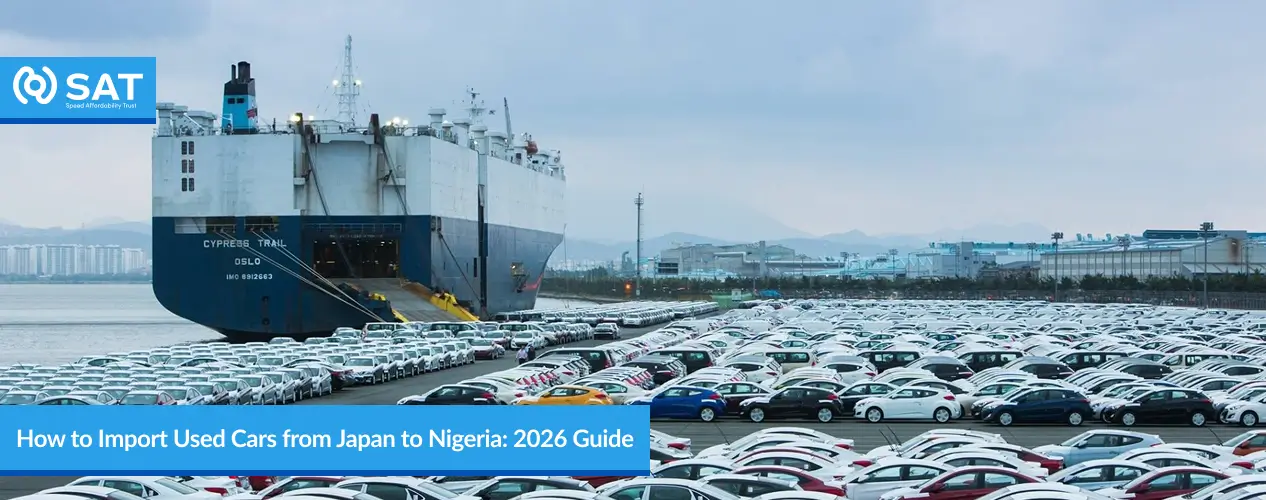
Some of the cleanest used cars on Nigerian roads started their lives in Japan. Better maintenance, detailed auction records, and strong reliability have made Japanese imports a favorite among Nigerian buyers for years. That is why demand for Japanese used cars in Nigeria remains strong among buyers who want cleaner condition and better auction transparency.
The catch? Nigeria's import rules are stricter than many people realize. One mistake with drive side, vehicle age, or customs paperwork can turn an affordable purchase into an expensive headache.
If you're planning to import used cars from Japan to Nigeria in 2026, this guide walks through the rules, costs, paperwork, and common mistakes that catch first-time buyers off guard.
The most important Nigeria car import regulations involve drive side, vehicle age, customs documentation, and port clearance. Nigerians can import Japanese vehicles in 2026 provided the vehicle is Left-Hand Drive (LHD), meets current age requirements, complies with customs regulations, and is cleared through Nigerian ports using Form M and PAAR documentation.
Yes, thousands of Nigerians do it every year. The difficulty isn't importing from Japan; it's that most Japanese domestic cars are right-hand drive, and Nigeria requires left-hand drive. You're not shopping from Japan's general used car market. You need export stock specifically sourced as LHD vehicles.
Most established exporters now keep dedicated LHD inventory for African buyers. That's where your search starts. Today, many buyers prefer to buy Japanese cars online in Nigeria through exporters that list LHD stock, inspection details, and shipping support.
Nothing causes more confusion among first-time importers. Nigeria adopted a left-hand traffic system decades ago, and vehicles are expected to be left-hand drive. Importing a right-hand-drive vehicle is not a shortcut. It creates registration and compliance problems that can become expensive very quickly.
Nigeria's move to left-hand traffic dates back to 1972, and the left-hand-drive requirement remains the standard today. The Federal Road Safety Corps (FRSC) enforces roadworthiness and registration requirements that favor LHD vehicles. For most importers, there is no practical legalization route for a right-hand-drive vehicle intended for normal road use.
That's why experienced importers treat drive side as a deal-breaker. If the vehicle isn't LHD, they move on.
Some buyers assume they can simply convert a right-hand-drive car after arrival. Technically, conversion is possible in some cases. Is it practical? Usually not.
A proper conversion requires steering, dashboard, pedal assembly, wiring, airbag systems, and safety components to be modified correctly. Poor conversions often create reliability and safety issues.
Key Takeaway: Confirm that the vehicle is Left-Hand Drive and eligible for Nigerian registration before discussing price, mileage, or shipping. One verification can prevent the most expensive mistake in the entire import process.
This is where things get interesting. Official guidance widely cited across the industry points to a 12-year age limit. Under that interpretation, the oldest vehicle generally eligible in 2026 would be a 2014 model.
However, multiple reports from importers and clearing professionals indicate stricter enforcement around a 10-year threshold at certain ports. Because enforcement can change, buyers should verify the latest position before purchasing.
Import Year | 12-Year Interpretation | 10-Year Enforcement Reports |
2026 | 2014+ | 2016+ |
2025 | 2013+ | 2015+ |
2024 | 2012+ | 2014+ |
The challenge is that a vehicle may appear eligible when purchased but become problematic if enforcement policies change before it reaches the port.
Factor | Japan | United States | Europe |
Vehicle Condition | Excellent | Good | Good |
Auction Transparency | Very High | Moderate | Moderate |
Service Records | Strong | Varies | Varies |
LHD Availability | Limited but available | Excellent | Excellent |
Parts Familiarity in Nigeria | Excellent | Excellent | Moderate |
Price | Strong | Moderate | Moderate |
Japan's auction system is the real selling point. Grading is detailed, condition reports are honest, and the cars reflect a maintenance culture that shows in the results. The downside is that LHD stock is a smaller slice of what's available; you need an exporter who specifically handles it.
US and European markets have easier LHD availability but less auction transparency. Parts for Japanese brands are well stocked in Nigeria, regardless of where you source them.
Reliable Japanese used car dealers can be easier for first-time buyers because pricing is fixed and the paperwork is usually prepared before payment.
Auction: cheaper, bigger selection, better deals if you're patient. You need a good agent who can bid and inspect properly.
Dealer stock: fixed pricing, faster, no bidding. You pay a bit more and skip the process.
Worth knowing: the cheapest purchase price isn't always the cheapest import. A slightly more expensive car with clean paperwork and confirmed spec can land at a lower total cost than a bargain with complications.
Either way, get these in writing before paying:
Drive side
Model year
Chassis number
Auction grade (if applicable)
Mileage
Export eligibility
Most vehicles enter through Apapa Port or Tin Can Island in Lagos.
RORO | Container | |
Cost | Lower | Higher |
Security | Good | Excellent |
Spare parts with vehicle | No | Yes |
For most buyers, shipping cars from Japan to Nigeria usually means choosing between RORO and container shipping. RORO is standard for most imports; cheaper, straightforward, works fine for a single vehicle. Container costs more but offers better protection and lets you include spare parts in the same shipment. Transit from Japan runs roughly four to eight weeks.
Customs duties and import-related charges are often the largest component of the total landing cost. Nigerian customs duty on imported cars is calculated using customs assessment rules, vehicle type, and CIF value.
Nigeria uses multiple customs charges rather than a single duty. Depending on vehicle type and customs assessment, total statutory charges often land between roughly 35% and 45% of the vehicle's CIF value.
Charge | Typical Rate |
Import Duty | Variable |
Levy | Variable |
VAT | 7.5% |
ETLS | 0.5% |
CISS | 1% |
Additional Charges | Applicable |
Electric vehicle policies and customs incentives can change over time. Buyers considering EV imports should confirm the latest duty concessions and exemptions before making a purchase.
Duty calculations can vary significantly depending on the vehicle type, fuel system, and current government policies.
Nigeria Customs now relies heavily on VIN valuation rather than invoice values alone. Under-declaring purchase prices generally does not produce the savings many buyers expect. Buyers can verify current import procedures, valuation methods, and customs requirements through the official Nigerian Customs Service.
Item | Amount |
Vehicle CIF Value | ₦10,000,000 |
Estimated Customs Charges | ₦3,500,000–₦4,500,000 |
Port & Agent Costs | Additional |
Total Landing Cost | Depends on Final Assessment |
Always obtain a current duty estimate before purchasing.
Documentation matters just as much as the vehicle itself.
Document | Purpose |
Form M | Import authorization |
PAAR | Customs assessment |
Bill of Lading | Shipping record |
Commercial Invoice | Proof of purchase |
Export Certificate | Export compliance |
Vehicle Title | Ownership proof |
Insurance Documents | Cargo protection |
Form M and PAAR matter most at the customs stage. A licensed clearing agent handles this — don't try to do it yourself the first time.
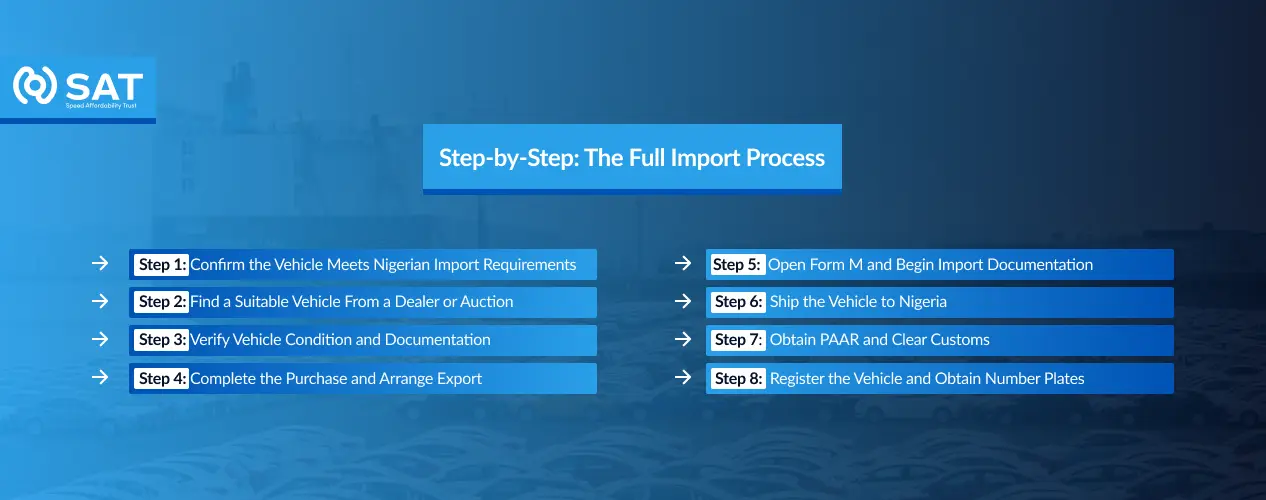
Before spending any money, verify that the vehicle is left-hand drive and falls within Nigeria's current age requirements. Also confirm the VIN, mileage, and export eligibility. This is where most costly mistakes can be avoided.
Choose between dealer stock and a Japanese car auction. Dealer inventory offers fixed pricing and faster purchasing, while auctions provide a larger selection and the possibility of lower prices.
Request the auction sheet, chassis number, service records, and inspection reports. A few minutes spent verifying documents can save thousands of dollars later.
Once the vehicle has been selected, complete payment and obtain the commercial invoice, export certificate, title documents, and shipping instructions from the exporter.
Form M must be processed through an authorized Nigerian bank before customs clearance can proceed. This document forms the foundation of the import process.
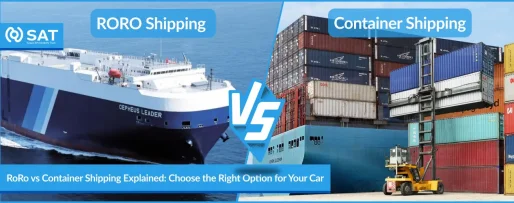
Choose between Roll-On Roll-Off (RORO) and container shipping. Most importers use RORO because it is more affordable, while containers offer additional protection and flexibility.
If you're unsure which method suits your vehicle and budget, read our detailed guide on RoRo vs Container Shipping
Step 7: Obtain PAAR and Clear Customs
After the vehicle arrives at Apapa Port or Tin Can Island Port, your clearing agent will use the PAAR, Bill of Lading, and supporting documents to complete customs procedures and calculate applicable duties.
Once customs clearance is completed, register the vehicle with the relevant authorities and obtain number plates before putting the vehicle on Nigerian roads.
Stage | Estimated Time |
Vehicle Search | 1–7 Days |
Purchase & Documentation | 3–10 Days |
Shipping From Japan | 4–8 Weeks |
Customs Clearance | 3–14 Days |
Registration | 1–5 Days |
Total Estimated Time: Approximately 5–10 weeks from purchase to registration, depending on shipping schedules and customs processing.
Delays during customs clearance can trigger storage and demurrage charges at the port. Having Form M, PAAR, and supporting documents ready before the vehicle arrives can help avoid unnecessary costs.
The same online marketplaces that help buyers find vehicles can also expose them to fraud and costly mistakes.
Verify the VIN before paying anything.
Request auction sheets when available.
Get LHD confirmation in writing.
Check the model year yourself.
Work with exporters who have a track record.
Don't under-declare values; customs VIN checks make this less effective than it used to be.
Don't make decisions from photos alone.
Most problems start before the car leaves Japan, which is also when they're easiest to avoid.

SAT Japan is worth considering if you prefer a more structured import process. The platform lists vehicles with photos, specs, and inspection details. Their Nigeria page also spells out what the import actually requires: left-hand drive vehicles, Form M, Bill of Lading, marine insurance, and the rest of the paperwork stack.
That last part matters more than it sounds. Nigeria has specific rules about what can come in, and buying a car that doesn't meet them before it ships is an expensive mistake. SAT Japan's value is mostly in letting you check stock, confirm vehicle details, and sort out export logistics before anything leaves Japan.
Once the required documents are understood, the import process becomes much easier to manage. You pick a vehicle from stock or auction listings, verify the details, request an invoice, pay, arrange shipping, then receive your export documents. They also cover inspection support, export procedures, and customs-clearance help on the auction side.
For Nigerian buyers, here's how it typically runs:
Find a Left-Hand Drive vehicle that fits your budget.
Check the model year, mileage, chassis number, and inspection grade.
Request a pro forma invoice.
Pay through the agreed channel.
Confirm RORO or container shipping to Lagos.
Collect your export documents: Bill of Lading, export certificate, invoice.
Pass those to your Nigerian clearing agent and work through Form M, PAAR, customs duty, and port clearance.
Register the vehicle after it clears customs.
SAT Japan handles post-sale documentation and provides shipment tracking, which takes some pressure off the Nigerian end of things.
The main advantage is having sourcing, documentation, and shipping support handled through a single provider. Finding a seller, an auction agent, a shipping contact, and a document handler separately is where many buyers run into problems. SAT Japan puts those pieces under one roof.
Their stock covers a wide range of used Japanese cars, with inspection details listed upfront. Export paperwork, shipping coordination, car carrier services, and customer support are part of the same process. They operate in 200+ countries and offer 24/7 support, which is worth confirming directly but is useful if accurate.
For Nigerian buyers, the practical difference comes down to a few things:
Vehicle inspection details are available before you pay, not after.
Export paperwork has support built in rather than being your problem to chase.
Shipping to Lagos RORO or container is coordinated through the same channel.
Documentation arrives in a format your clearing agent can actually work with.
You're not buying from an unknown seller with no paper trail.
You'll still need a solid clearing agent on the Nigerian side. Customs doesn't get easier just because the export side was organized. But fewer moving parts on the Japan end means less that can go wrong before the car even ships.
A low price can save money upfront, but clear documentation can prevent far more expensive problems later. Ask directly: can you supply a Left-Hand Drive vehicle for import into Nigeria? A competent exporter answers that immediately with documentation to back it up. Hesitation on drive side, model year, or export paperwork is a reason to keep looking.
Good Japanese used car exporters should confirm LHD availability, model year, auction grade, and export paperwork before asking for final payment. Companies like SAT Japan work with buyers importing to Nigeria and handle sourcing, inspection reports, export paperwork, and shipping coordination. The standard applies regardless of who you use: When importing a vehicle internationally, accurate documentation should always take priority over the lowest advertised price.

How to Import a Car From Japan to Kenya: Step-by-Step Process?

How to Become an Online Car Dealer With SAT Japan?
RoRo vs Container Shipping Explained: Choose the Right Option for Your Car

Noah Mitchell
I am Noah Mitchell, an experienced automotive journalist with over 9 years covering the dynamic world of cars and transportation. My in-depth analysis and passion for sustainable mobility drive my stories. I regularly contribute to leading publications an
Nigeria generally requires left-hand-drive vehicles for registration and road use. Importing a right-hand-drive vehicle creates significant compliance challenges.
The commonly referenced national rule is 12 years from the manufacturing year. However, reports of stricter 10-year enforcement have emerged at some ports, so verification is essential before purchase.
Many importers budget roughly 35% to 45% of vehicle value for customs-related charges before local handling costs. Actual figures vary by vehicle category and assessment.
Most imported vehicles enter through Apapa Port and Tin Can Island Port in Lagos.
Most shipments arrive within approximately 4 to 8 weeks depending on vessel schedules and shipping routes.
In many cases, yes. Imported vehicles often offer better maintenance history, cleaner condition, and more buying transparency. The final answer depends on total landing cost and vehicle quality.
Importing used cars from Japan to Sri Lanka requires a good understanding of taxes, customs, country regulations, and a bit of patience. But you don’t have to worry much about the import process if you pick an exporter like SAT Japan that takes care of most of the steps. We have a highly professional sales team that ensures you get personalized service when importing your Japanese car to Sri Lanka. With experience handling shipments specifically to Sri Lanka, SAT Japan is well-versed in local procedures and makes the entire process more efficient for you.
Japanese vehicles are some of the most reliable vehicles in the world. They are of high standards, affordable, of exceptional quality, and advanced engineering. Japan has a really advanced automobile industry with a wide range of vehicle choices. Here’s why you should consider importing Japanese vehicles to Sri Lanka:
Exceptional quality and reliability
Cost-effective options
Fuel-efficient vehicles
Easy availability of spare parts
Better resale value
Honda, Nissan, Mazda, Toyota, you name it, all the big automotive brands are housed in Japan. They are all widely recognized worldwide for producing vehicles that last a lifetime. In Sri Lanka, the top-selling used Japanese cars are:
Honda Vezel
Nissan Roox
Suzuki Wagon R
Toyota Raize
Suzuki Alto
Suzuki Every
Toyota Aqua
These vehicles are favored for their low maintenance costs, advanced features, and high resale value. Moreover, the Japanese practice of regular vehicle inspections keeps the cars well-maintained, which is a top reason why they are so in-demand in Sri Lanka.
While most Sri Lankan buyers choose used vehicles due to their affordability and relaxed age restrictions, importing brand-new cars from Japan is also a viable option. This is particularly true for those looking for the latest models, full warranties, and advanced features.
The best part is that you can access the latest models that are not yet available locally. What’s even better is that they have a higher resale value compared to used cars. Having access to technology and newer features through brand-new vehicles is truly a win-win.
You can choose from over 200,000 cars weekly. Yes! Buying Japanese cars through Auction is a popular choice for Sri Lankan buyers due to their reliability and affordability. You can choose from a wide range of vehicles, from compact cars to luxury models. These auctions serve you with a detailed inspection report containing everything from mileage to condition and more. Can there be any more cost-effective and reliable option than this for buyers worldwide?
| Tax Type | Rate |
| Duties | 5% to 35% |
| Motor Vehicle | 25% |
| Ports and Airport Levy (PAL) | 5% of the CIF value, or at a rate between 0% and 2.5% |
| VAT | 12% |
| Ad valorem rates | 1%- 45% (of the CIF value) |
| Nation Building Tax | 2% of the sum of the (CIF value x 110%) excise duty, cess, customs duty, and PAL. |
Only right-hand-drive vehicles are permitted to be imported to Sri Lanka from Japan. No left-hand-drive vehicles will be allowed entry into the country.
Cars: Should be a maximum of 2 years old.
Buses, Jeeps, Motor Cars, Ambulances, Motorbikes, All-Terrain Vehicles: Up to 3 years old.
Single and Double Cabs, Trucks, Lorries, Refrigerated Trucks: 4 years
Vehicles are typically shipped to Sri Lanka via the ports of Colombo and Hambantota.
A seaworthiness certificate from the Japan Auto Appraisal Institute (JAAI) is required for used vehicles imported from Japan.
Register the vehicle within 90 days of the Bill of Entry.
You will need the following import documents for customs clearance:
Bill of Lading: Proof of shipment.
Export Documents: Vehicle's registration details from Japan.
Owner’s passport: Identification of the importer.
Purchase Invoice: Proof of purchase and vehicle value.
Original Registration Certificate: Must include an English translation.
Import License: Authorization to import the vehicle.
Letter of Credit: Proof of payment through a licensed bank
Delivery Order issued by the Shipping Agent
Value Declaration Form: Declaration of the vehicle's value.
Pre-shipment inspection certificate: Issued by an approved inspection agency, such as JAAI.
After clearing customs, the vehicle must be registered with the Department of Motor Traffic within 90 days of the Customs Declaration (CUSDEC) date. Failure to register within this period may result in penalties.
As per the Sri Lankan Ministry of Finance, imported vehicles must be registered within 90 days. Failing to do so will result in a 3% fine on the unregistered vehicle's value, with the penalty capping at 45%. Moreover, if an importer fails to register at least 25% of their imported vehicles within six months, their importation privileges may be suspended.
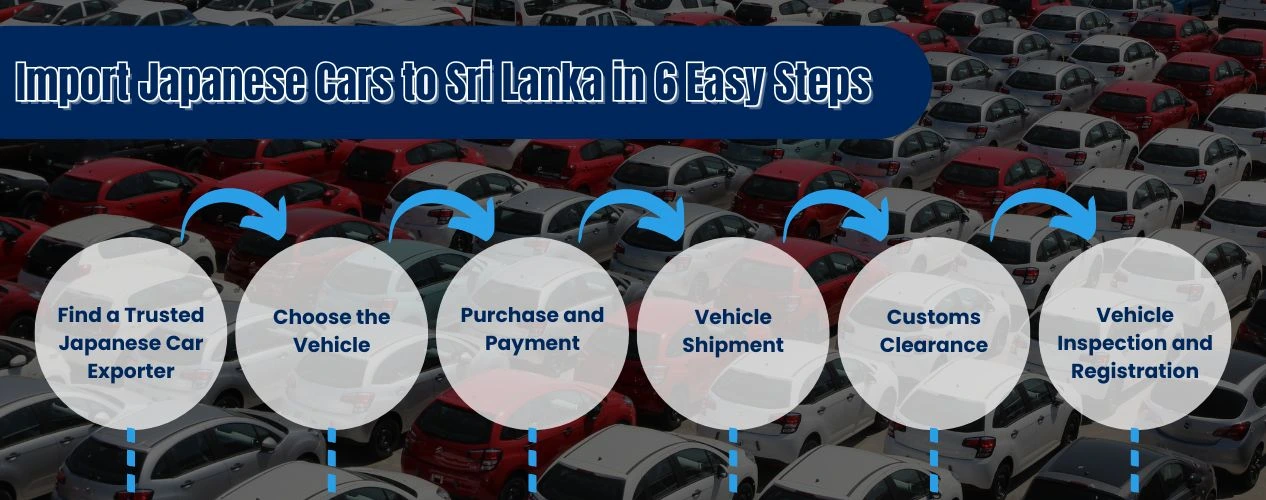
Follow these steps to import Japanese cars to Sri Lanka:
Start by selecting a reputable exporter who can import a Japanese car from Japan to Sri Lanka. For instance, you can rely on SAT Japan for reliable services and extensive inventories of Japanese used cars.
Go through SAT Japan’s online inventory to find a car that suits your preferences and budget. Ensure the vehicle meets Sri Lanka's import regulations, like:
Passenger cars should be no more than 2 years old.
Only right-hand drive (RHD) vehicles are permitted.
The vehicle must pass a roadworthiness inspection by the Japan Auto Appraisal Institute (JAAI).
Once you have your eyes on a vehicle, we will provide you with an invoice detailing the cost of the vehicle. You can open an LC (letter of credit) through your bank to facilitate secure payment. Finally, you can complete the payment as per the agreed terms.
The exporter will arrange for the vehicle to be shipped to Sri Lanka, typically via RoRo vessels to the ports of Colombo or Hambantota. This usually takes 2 to 4 weeks. Meanwhile, you can track your shipment to get real-time updates.
Prepare all the necessary documents mentioned above for the arrival of your vehicle and customs clearance. Be aware of all the applicable charges.
Once you have the Japanese-imported vehicle with you, get it inspected thoroughly to ensure compliance with Sri Lankan standards. Then, register your vehicle with the Department of Motor Traffic within 90 days to avoid any penalties.
There you have it; the best way to import cars from Japan to Sri Lanka, without much hassle.
There’s no doubt that importing a vehicle from Japan to Sri Lanka is worth it and a thoroughly rewarding experience. But it’s always better to stay on top of your preparation to prevent any mishap. Here’s what you can do:
Incomplete or missing documents can result in significant delays during the import process. That said, it’s better to double-check all the required documents and prepare a copy of each to tackle any last moment misplacements.
Logistical issues are another common problem that causes delays in shipments. Since we always provide you with tracking details, you can monitor your vehicle and have peace of mind. However, you need to ensure all the documentation is prepared well on your end to prevent hold-ups at customs.
Importing a Japanese used vehicle to Sri Lanka involves tax and duties that impact the overall cost of shipping. That’s why it’s recommended to familiarize yourself with all the different kinds of taxes and regulations of your country.
Considering the rise in online fraud, we understand it can be difficult to trust a dealership for one of your life’s biggest investments: your car. This is why, at SAT Japan, we provide guidance every step of the way, ensuring transparency. This is done to help you bid with confidence so you get your desired vehicles at the lowest possible prices. You can explore more reviews at Trustpilot and Google to see how we've assisted others in making informed car purchases and how our customers view our brand.
Japanese used cars are popularly sold around the world for their reliability and cost-effectiveness. You, too, can make your dream of having a Japanese car come true by following the right import process.
Visit SAT Japan and choose your vehicle from our wide array of listings. Stay updated on all the regulations and required documents, and stay in touch with our professionals to ensure a smooth and successful vehicle import journey.
Importing a used car from Japan to South Africa is a very reasonable choice, as the vehicles are typically compliant with the South African standards. The import process involves a few basic steps you must take carefully, like clearing the car through customs, obtaining necessary permits, and more. Once you have a checklist of all the required documents, it becomes easier to import a vehicle. So, let’s have a look at the detailed guide that can help you with the import process.
Importing a Japanese vehicle is often more affordable, and you can access unique models that would otherwise be unavailable in your country. Cars from Japan also match South Africa’s road system since both countries use right-hand-drive vehicles. Since Japanese cars come with better features and options, and are often more reliable.
In addition, detailed inspection reports and a wide variety of models help buyers find exactly what they’re looking for, whether a compact city car or a tough 4x4.
Several used Japanese models are especially popular in South Africa. Among the top choices are:
Honda FREED
Nissan MARCH
Nissan SERENA S Hybrid
Nissan JUKE 4WD
Nissan ELGRAND
Toyota HIACE VAN 4WD
Toyota COROLLA AXIO
Toyota PASSO
These vehicles are known for their low maintenance costs, long-lasting engines, and good resale value. These cars are often found in great condition at Japanese auctions, so they remain best-sellers in the South African used car market.
Used Japanese cars are not the only viable option. There is also an option to import new Japanese cars to South Africa, which is truly a great opportunity to source models that are unavailable in the country.
The best part about these vehicles is the high resale value compared to used cars and models. This way, you can have better access to newer models, advanced features, and tech, that too, at such affordable rates.
If you are looking for a vehicle at a price you like, you have the option of car auctions. Japanese car Auctions offer access to over 200,000 vehicles each week. These auctions are a popular choice for many South African buyers because they provide a wide selection, from compact cars to vans and luxury models.
Each vehicle usually comes with a detailed inspection report, which includes information like mileage, condition, and previous use. This helps buyers make informed decisions. Compared to local markets, auction cars from Japan can often be more affordable and better maintained. This is what makes them a practical option for those looking to import a vehicle safely and with more clarity.
| Tax Type | Rate |
| Customs Duty | 30% of vehicle value (20% if the car is more than 20 years old) |
| Ad Valorem Duty Exemption | Vehicles valued below R130,000 are exempt from ad valorem duty |
| Cumulative Tax Estimate | Approx. 70% of the vehicle's market value for a car valued at R200,000 |
| VAT | 15% of the total cost, including CIF and customs duty |
| Ad valorem duty | Based on a sliding scale (0.75% to 20%) depending on vehicle value and engine size |
| Valuation Requirement | If the original invoice is not available, three written valuations are required from Japanese car exporters |
You need to stay compliant with the South African rules and regulations before importing a Japanese car. Here’s what you need to be cautious about:
South Africa follows the right-hand-drive (RHD) system, meaning all vehicles driven on public roads must have the steering wheel on the right side. This is an important regulation when importing a car from Japan, as Japan also uses RHD vehicles.
You must obtain a Letter of Authority (LOA) from the National Regulator for Compulsory Specifications (NRCS). This document ensures that the imported vehicle meets South African safety and technical standards. It should be secured well before the vehicle arrives in the country because without it, you cannot register the vehicle for road use.
To legally import a car from Japan into South Africa, you must apply for an import permit from the International Trade Administration Commission (ITAC). This is done for all the used vehicles being imported to South Africa. The aim is to monitor the number of used vehicles in South Africa.
After the vehicle is cleared through customs and duties, the next step should be registering it with the local traffic department. After the customs clearance, you will receive a Customs Release Notification form, which is needed for the vehicle registration.
You will need the following import documents for customs clearance in South Africa:
Import Permit – Legal entry approval
Letter of Authority (LOA) – Safety & standards clearance
Cancellation Certificate – Japan registration canceled
Bill of Lading – Shipping and delivery record
Commercial Invoice – Purchase and price details
Letter of Authorization – Agent permission document
Identification Document – Passport or valid ID
Permanent Resident Permit - Issued by the Department of Home Affairs (for immigrants only)
Inspection Certificate – Vehicle condition verification
Import permit – Legal entry approval
To import a vehicle in South Africa, you must register with the South African Revenue Service (SARS). This will leave you with an importer’s code. You can visit SARS eFiling to register as an importer. Gather the required documents and complete the form (DA 185) at a SARS office. Once done, you will soon be registered and receive an importer’s code for customs clearance.
First, to clear your car at customs, submit a Customs Clearance Declaration (CCD) with all the needed documents. Then, do a self-check of your payment and paperwork. Customs will look at your documents, like the invoice and shipping papers. They’ll then calculate the taxes and duties you need to pay. Sometimes, they may inspect the car. Once everything is okay, your vehicle is cleared and ready to go.
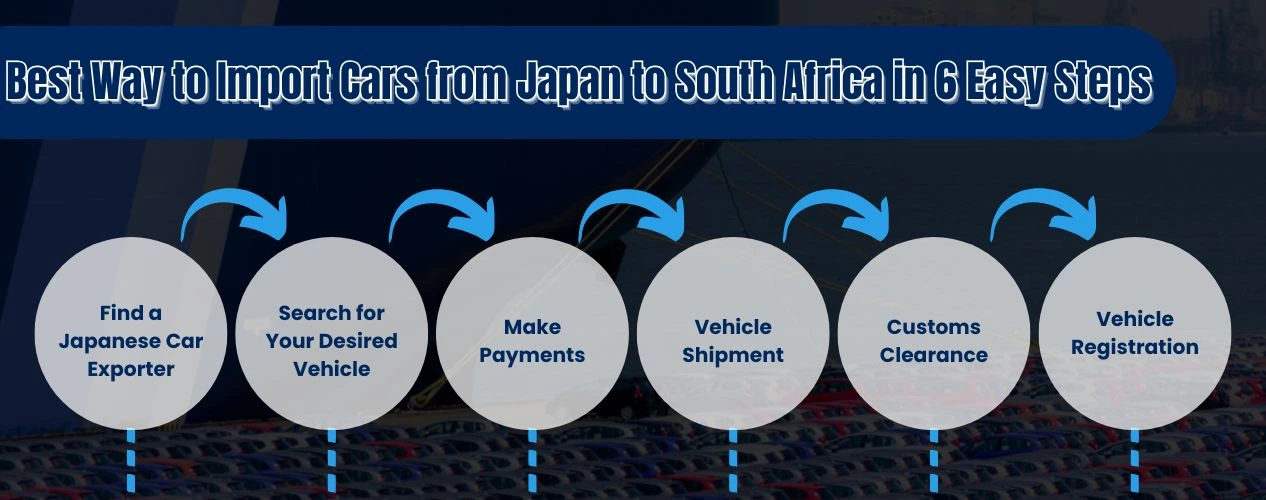
Follow these steps to import a high-quality car from Japan to South Africa.
Start by choosing a trusted exporter in Japan. This is super important! A good exporter like SAT Japan will give you real photos and honest details and help you through the whole process. A dealership with a proper website, contact information, and good reviews tends to be more reliable. Make sure they have experience shipping to South Africa. A friendly and helpful exporter makes everything smoother, and some research goes a long way in avoiding future problems.
Now is the time to browse SAT Japan’s stock online through the listings. You can find the vehicle of your choice by selecting the specific make, model, and year. Compare different available options and finalize the one you think is the right fit for you.
Once done, contact our team to inquire about the car, its photos, and more.
After selecting your vehicle, we will send you an invoice with all costs, including the price of the car and shipping fees. Payments are usually done through a bank transfer. Always keep payment records and ask for confirmation once the money is received. This is really important!
After confirming the payment, our team will make the necessary arrangements to send your chosen vehicle to South Africa. You’ll receive documents like the Bill of Lading that are required at customs. The shipping time may vary, but it usually takes 6 to 8 weeks. You can get shipping updates throughout the process.
Clearing through customs can be a hefty process if you don’t have the right documents prepared at the right time. That’s why it’s important you have all the payments cleared, as it may include checking import duties, paperwork, VAT, and others. Our team will help you with that, as we fully understand the local regulations.
Once you have cleared the vehicle through customs, you need to register it in South Africa. Depending on the local registration process, you may require documents such as customs documents, an ID card, an address, and more.
Avoid the hassle of the import process with these simple tips:
Importing a vehicle from another country is a big step that requires a big investment. So, make sure you buy a car from a trusted exporter only. A reliable exporter will provide you with the pictures of your selected car, inspection sheets, and keep you updated about shipping. You can easily avoid scams by ensuring the company is well-known and has a good reputation. In that case, SAT Japan will prove to be your trusted export partner.
Nothing is as important as being informed during vehicle shipment. Since every country has its own regulations for importing vehicles, you need to do a quick check to save yourself a big headache and lots of money later. For instance, some allow only left-hand drives, others need low mileage, or certain model years. Check age limits, taxes, and paperwork before you buy.
Paperwork may not be fun, but it’s super important. Ensure you get the bill of lading, inspection, and export certificate. That’s because these are the most important documents for imports. You may need additional ones depending on the country or port from which you receive your vehicle.
Shipments need to clear customs before they make their way to you. That’s why you should be prepared well with all the necessary documents and any pending payments. You will need papers for customs and registrations, so make sure you have copies of these documents.
Japanese vehicles are known for their safety and reliability, and for that very reason, hundreds of cars are imported to South Africa every year. However, some fraudulent dealers and scammers trap people in the name of low prices. It’s better you cross-check a dealer before finalizing any purchase. Most of all, consider importing your vehicles through SAT Japan, as we have a long history of successful car imports around the world.
Meanwhile, here’s what you can do to avoid fraud:
Verify the contact details, address, and location of the company to ensure you are dealing with real people with real business.
Always check for reviews on websites like Trustpilot and Google to learn about the company’s credibility.
Prices that seem too good to be true are often a trap. It’s recommended to always check the market price and compare well before making any final decision.
Japan brings high-quality innovative vehicles to the market every time. Unfortunately, not all vehicles make it to South Africa. In such a case, there is no better option than to import your favorite car.
The import process becomes easier with SAT Japan, where you can have your vehicle with you in 6 to 8 weeks. The best part? There is a wide selection of vehicles to choose from. You just need to stay updated on the rules and regulations to have a smooth import experience.

Importing a car from Japan to Pakistan appears to be a complex process, and for many, it indeed is. The paperwork, customs regulations, and finding a reliable exporter make the whole process thoroughly overwhelming. What’s saddening is that many buyers give up before they even get started. But it doesn’t have to be that way.
Thanks to more consumer-friendly import policies introduced by the Government of Pakistan and expert assistance from exporters like SAT Japan, importing a vehicle from Japan to Pakistan has become smoother and far more accessible. SAT Japan handles the tough part so you don’t have to stress.
This Pakistan Japanese car import guide contains everything you need to know. Continue reading till the end.
There is one thing about Japanese cars: they are built to last. Their precise engineering makes the vehicles last long and maintain a high standard of performance for the years to come. Japanese cars are also more affordable due to the country's large economy of scale. Their preference for new and innovative models turns even one-year-old used cars into a valuable asset in the used-car market. Contrary to this, the rising fuel costs in Pakistan have made Japanese hybrid and compact models ideal for every other person.
Imported Japanese cars usually have better resale value due to their condition and brand reputation. Moreover, from sedans and hatchbacks to SUVs and kei cars, Japanese markets offer options to suit every budget and need. All this makes Japanese cars an excellent investment for Pakistani buyers.
Several used Japanese models are especially popular in Pakistan. Among the top choices are:
Daihatsu Mira
Toyota Vitz
Toyota Passo
Toyota Aqua
Toyota Land Cruiser Prado
Suzuki Alto
Toyota Prius
Nissan Dayz
Suzuki Wagon R
Toyota Raize
These vehicles are popularly sold in Pakistan due to their exceptional fuel efficiency, compact size suited for urban roads, and affordable maintenance costs. They are popular and ideal for city driving, offering excellent mileage and making them budget-friendly options.
Not just used cars—many buyers in Pakistan are now importing high-end new models from Japan, such as:
Lexus LX and RX series
Toyota Land Cruiser and Prado
Nissan Elgrand
Honda Odyssey
Mitsubishi Pajero
These models are often loaded with luxurious features and superior technology, making them attractive choices for those looking to stand out.
Do you know what’s the smartest way to buy a Japanese car at affordable rates? Auction.
The Japanese used car auction system is a goldmine for finding quality vehicles at competitive prices. From daily drivers to luxury sedans, there are so many vehicles listed on auctions. Each vehicle has a grading system and an auction sheet for transparency. The best part is that the cost of vehicles at auctions is generally cheaper compared to local dealers.
But how can someone buy used Japanese cars in Pakistan through an Auction? Well, you need to buy through trusted exporters like SAT Japan that offer auction access and bidding services. You can begin by making a deposit to secure your bidding limit. Once done, go ahead and choose from various makes, models, years, and mileage. Meanwhile, you can review the auction sheet to inspect the condition of your chosen vehicle and grading. SAT Japan will bid on your behalf, and once everything is finalized, the company will take care of the logistics and shipping.
| Engine Capacity | Import Duty |
| Up to 1,300cc | 50% |
| 1,301cc – 1,800cc | 65% |
| Above 1,800cc | 75% (reduced from 100%) |
| Engine Capacity | Effective Duty |
| Up to 1,300cc | 2% |
| Manufacturing Year | Depreciation Applied |
| 2020 | 50% |
| 2021 | 39% |
| 2022 | 27% |
| 2023 | 15% |
| 2024 | 3% |
| 2025 | 0% |
| Engine Capacity | Fixed Duty (USD) |
| 1001cc – 1300cc | $13,200 |
| 1301cc – 1500cc | $18,590 |
| 1501cc – 1600cc | $22,550 |
| 1601cc – 1800cc | $27,940 |
| Hybrid Engine Capacity | Duty Waiver |
| Up to 1,800cc | 50% Waiver Applied |
| 1,801cc – 2,500cc | 25% Waiver Applied |
| Scheme | Eligibility & Features |
| Transfer of Residence | For those returning to Pakistan after 6+ months abroad |
| Personal Baggage | Import during a return trip to Pakistan |
Gift Scheme | Can gift cars to parents, siblings, spouse, and children |
Under the gift and personal baggage schemes, you can now import cars that are up to three years old from their date of manufacture. This makes it easier for overseas Pakistanis to bring in newer and better-condition vehicles. If your vehicle is older than that, it won’t be cleared by customs. Therefore, always check the manufacturing year before buying a car to avoid getting stuck at the port or paying unnecessary penalties.
Only right-hand drive (RHD) vehicles are allowed in Pakistan. Left-hand drive (LHD) vehicles are not permitted, even if they meet all other criteria. It is a very strict rule with no exception.
There are three government-approved import schemes:
The “Transfer of Residence” is primarily for overseas Pakistanis relocating from Japan to Pakistan.
You can use one of these schemes every two years.
You must follow customs laws that include accurate declaration of the vehicle’s value, original documents, and payment of all applicable duties and taxes. Vehicles must also meet Euro II emission standards. Any misdeclaration or tampering with chassis or engine numbers can lead to heavy fines or even seizure.
Original Bill of Lading (B/L) – Proof of shipment.
Export Certificate (translated into English) – Confirms vehicle ownership and export details.
Commercial Invoice – Provided by the exporter, showing the price of the vehicle.
Packing List – Details of the vehicle and accessories shipped.
GD (Goods Declaration) Form – Customs clearance form to be filled out online via the WeBOC system.
Import Permission – For schemes like gift, transfer of residence, or personal baggage.
Copy of Passport – Proves your identity and overseas residency.
Copy of NIC or CNIC/NICOP – National identity card (Pakistani).
Proof of Residence Abroad – Visa stamps, utility bills, etc., showing 180+ days abroad.
Bank Payment Proof (TT Receipt) – Shows payment for the car.
Undertaking Form – Declaring compliance with rules.
Customs Duty Payment Challan – Receipt after paying applicable duties and taxes
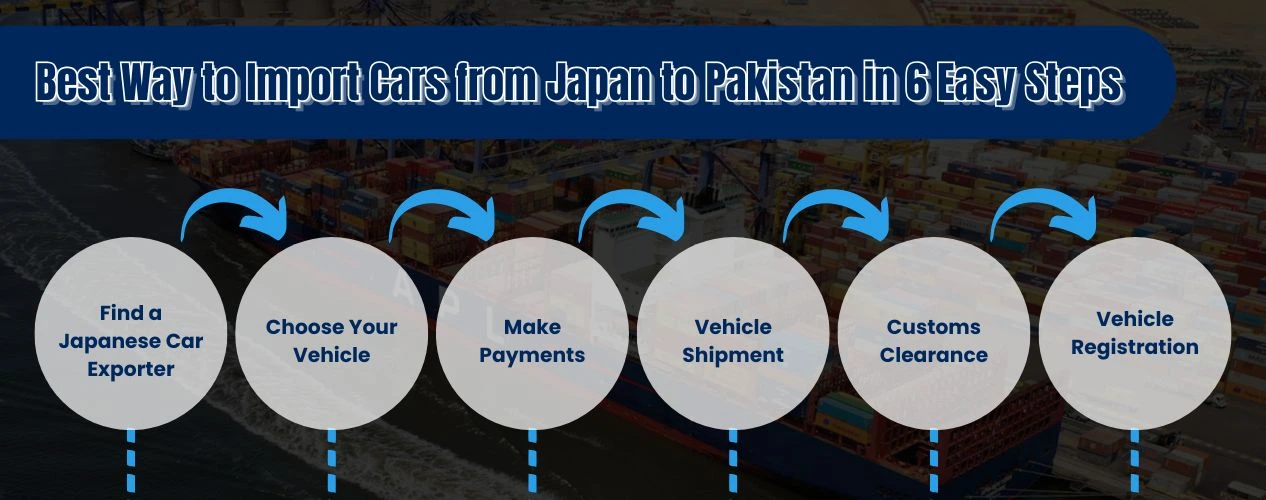
Follow these steps to import a high-quality car from Japan to Pakistan.
Begin by searching for reliable and verified Japanese car exporters. Companies like SAT Japan are popular due to their transparency and vast car inventory. Check customer reviews, export experience, auction access, and if they provide complete documentation. Working with a trustworthy exporter ensures a smooth and safe buying experience.
Browse through SAT Japan’s stock or Japanese auction listings. Select a vehicle that suits your needs, whether it's fuel efficiency, family comfort, or off-road capabilities. Make sure the car is within Pakistan’s import regulations (right-hand drive, less than 3 years old, etc.). Finally, don’t forget to request the auction sheet to check the car's condition, mileage, and history.
Once you finalize the vehicle, SAT Japan will send a Proforma Invoice. You’ll need to transfer the payment. Ensure all payments are properly documented and keep receipts for customs purposes in Pakistan.
After payment confirmation, the exporter arranges the shipment usually by Ro-Ro (Roll-on/Roll-off) or container shipping. You’ll receive the Bill of Lading, Export Certificate, and Invoice, as these are essential for customs clearance. Shipping to Pakistan typically takes 6 to 8 weeks, depending on the port and weather conditions.
When your car arrives at a Pakistani port (like Karachi), you’ll need to get it cleared by Pakistan Customs. You or your customs agent must submit documents including:
Bill of Lading
Import Permission
GD (Goods Declaration) Form
Identity documents
Proof of payment
Export certificate
Duties and taxes will be calculated based on engine capacity, year, and car type. A customs clearance agent can help simplify this process.
Once cleared from customs, the final step is registering the car with your local Excise and Taxation Department. Submit documents like:
NIC
Sales invoice
Custom clearance certificate
Registration application form
Proof of address
You’ll get a registration number and vehicle plates. After this, your imported car is legally ready to drive on Pakistani roads!
The best approach when importing a vehicle is to work with verified exporters that have a good public reputation, such as SAT Japan. This is because verified sellers give you real information, proper papers, and clean deals. Nobody would want their dream car to turn into a nightmare with shady dealers.
Auction sheets are more like a vehicle’s report card. They tell you if it’s been in an accident, its mileage, and overall condition. So, if you are looking for a vehicle from a Japanese auction, you must know how to read an auction sheet. If not, it’s better to get some help.
Some cars are easy to maintain in Pakistan, others not so much. Before buying, see if spare parts are available and if mechanics know the model. A popular car is easier to fix and sells faster if you ever want to upgrade.
Import rules change like the weather! Stay updated with FBR and customs websites so you don’t break any laws. Knowing the rules helps avoid fines, delays, or losing your car. Be smart and always check before you ship.
Pakistan allows cars up to 3 years old for personal use. Anything older is a big no! If you pick an over-aged car, it might get stuck at the port or even be sent back. Stick to the age rule and stay stress-free!
Thousands of Pakistanis, unfortunately, fall for auction sheet fraud when buying a used Japanese car. This type of fraud is more prevalent in Pakistan than you might think. It's because getting away with fraud is easier in Pakistan due to the lack of a legal framework and an official monitoring authority. So here's what fradsters typically do.
Several sellers fabricate the Auction sheet by altering the mileage figures on the sheet. For them, doing this is easy because they only need a basic understanding of Photoshop or Canva to edit the values seamlessly. However, catching them is not an easy job. Simply because if you call the fraudsters out, they’ll show up with the fake, altered verification sheet to cover their fraud. Fake Auction sheet fraud is not the only way fraudsters exploit their customers. There are more.
Another common practice is for sellers to completely change the mileage values in the car. Well, how do they do that? Fraudsters simply remove the vehicle's ECU, connect it to a monitor, and then reverse the mileage. This tricks the buyer into believing in the wrong values. Even if you call the seller out, he would likely come up with a fake or altered verification sheet to cover up his fraud.
Many dealers and sellers also commit paint fraud. What they do is repainted their car locally and claim it to be a genuine body. If you want to detect this kind of fraud, you have to compare the car’s appearance with the auction sheet. If there is a visible difference, then it means that you’ve been successful in catching a Color code scam.
Since millions of sellers engage in this kind of activity, it is nearly impossible to keep a check on everyone. However, there are certain precautionary measures that you can take to protect yourself from such fraudsters.
A rule of thumb is to verify your car from the SAT Japan auction sheet verification. In case the car is not auctioned, you cannot do much about it except for trusting your instinct. SAT Japan’s vehicle inspection system conducts a thorough, detailed inspection to verify whether the mileage on the meter is accurate or not. We’re doing our best to prevent such fraudsters.
To protect yourself from potential fraud, avoid paying your seller in full at once. Legitimate sellers usually accept partial payments or offer secure payment methods. Avoid paying through untraceable services and use services like PayPal or international bank transfers, which involve a legitimate third party.
It is essential to verify the credibility of your seller before initiating the process. Check for red flags, such as a deal that appears too good to be true, or if you notice a lack of documentation. Double-check the vehicle registration and shipping details, and most importantly, ask questions. If a seller is reluctant to answer questions, that is definitely alarming and you should not buy from them.
Importing a vehicle from Pakistan to Japan is indeed an exciting option, particularly for those looking for durability and reliability along with modern tech features. However, the import process is typically lengthy and requires the support of experts to avoid fraud and scams. That’s why we have partnered with some top companies to help our customers navigate the customs process in a matter of a few days.
So, what is holding you back? Choose the vehicle of your choice from SAT Japan’s listings today and start the import process right away!