Menu

 Find Your
Car
Find New
Car
Local
Pages
Find Your
Car
Find New
Car
Local
Pages
 Pakistan
 Antigua
 Anguilla
 Armenia
 Australia
 Azerbaijan
 Bahamas
 Bangladesh
 Botswana
 Burundi
 Canada
 Chile
Chile
 Costa Rica
 Cyprus
 Dominican Republic
 Fiji
Fiji
 Georgia
 Ghana
Ghana
 Guatemala
 Guyana
 Ireland
 Jamaica
 Kenya
Kenya
 Kyrgyzstan
 Lesotho
 Malawi
 Micronesia
 Mongolia
 Mozambique
 Namibia
 New Zealand
 Nigeria
 Papua New Guinea
 Paraguay
 DR Congo
 Russia
 Rwanda
 Samoa
Samoa
 Solomon Islands
 Somalia
 South Africa
 South Sudan
 Sri Lanka
 Tanzania
 Tonga
Tonga
 Uganda
 Ukraine
 USA
USA
 Zambia
 Zimbabwe
Car
Services
Company
Overview
Reviews
Blogs Categories
Help
Explore Stock
Explore Stock
Explore By Price
Explore By Price
Explore By Make
Explore by
Type
Explore by Year
Explore by
Discount
Inventory
Location
Inventory
Location
Other Categories
Other Categories
Zimbabwe
Car
Services
Company
Overview
Reviews
Blogs Categories
Help
Explore Stock
Explore Stock
Explore By Price
Explore By Price
Explore By Make
Explore by
Type
Explore by Year
Explore by
Discount
Inventory
Location
Inventory
Location
Other Categories
Other Categories
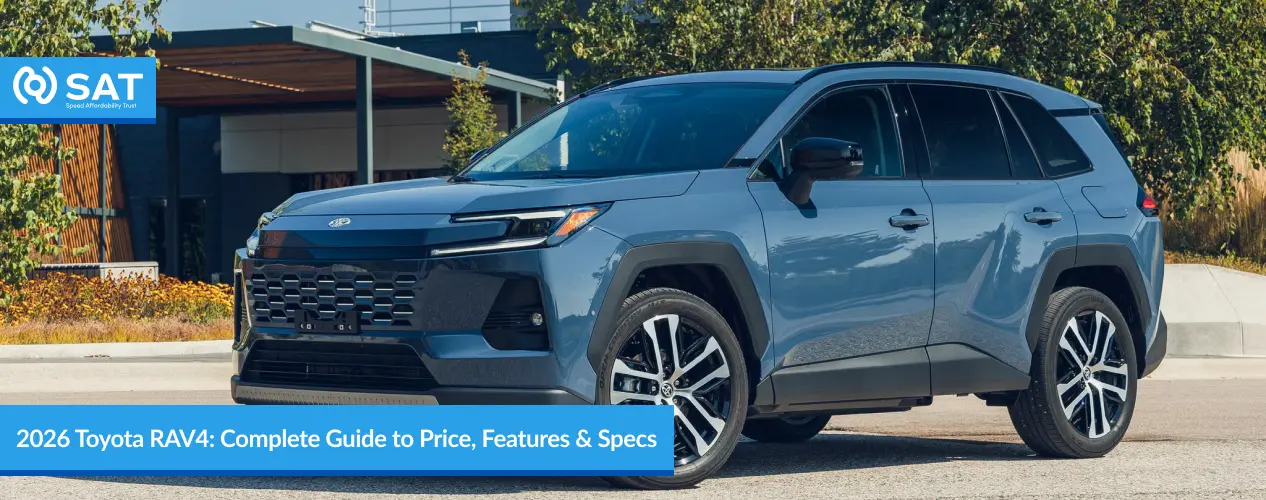
Toyota killed the gas RAV4. That's the actual headline for 2026. You can't buy one without a hybrid badge anymore. Every single trim. The automaker stopped making the gas version, so every 2026 RAV4 is either a hybrid or a plug-in hybrid SUV.
This new model has an updated look, improved fuel economy, increased towing power, and Toyota Safety Sense 4.0. It aims to be better than its rivals, like Honda CR-V Hybrid, Hyundai Tucson Hybrid, and Kia Sportage Hybrid.
The hybrid was the smarter pick. Better MPG. Better resale. Toyota just stopped pretending you had a real choice in the matter. They made it for you, and across a ten-year ownership window, you'll thank them.
This Toyota RAV4 review covers price, trims, mileage, towing, features, and whether it is worth buying. Buyers looking for a 2026 Toyota RAV4 hybrid for sale can browse current RAV4 listings at SAT Japan. Explore Now
The 2026 RAV4 is hybrid only. You pick between the standard hybrid (no plug, no thinking required) or the plug-in hybrid, which charges like an EV and gives you stronger performance plus electric-only driving. The lineup runs from the LE Hybrid at the bottom to the Limited Hybrid and the new GR Sport PHEV at the top.
For most buyers, the XLE Premium Hybrid is the call. It's worth the price. The LE works if you're keeping costs down. The Woodland is the pick if you actually take your SUV camping instead of just dreaming about it.
The hybrid only switch is the big one. But Toyota didn't stop there. Here’s what changed for 2026.
Feature | 2025 Toyota RAV4 | 2026 Toyota RAV4 |
Lineup | Gas, hybrid, and plug-in hybrid options | Hybrid-only lineup with hybrid and plug-in hybrid options |
Platform | Previous TNGA-K setup | Updated TNGA-K platform for the sixth-generation model |
Software | Older Toyota multimedia/software system | New Arene software platform |
PHEV Range | Around 42 miles of EV-only range | Up to 54 miles of EV-only range on selected versions |
Exterior | Fifth-generation design | Redesigned exterior with a sharper and tougher look |
Safety | Toyota Safety Sense 2.5 / 2.5+ | Toyota Safety Sense 4.0 |
Cockpit | More traditional cabin layout | Digital cockpit with 12.3-inch gauge cluster and larger infotainment options |
Sport Trim | No GR Sport PHEV option | New GR Sport Plug-in Hybrid trim |
The LE Hybrid starts at $31,900 before destination. Loaded hybrid trims push into the mid-$40,000 range. The PHEVs kick off at $42,950 for the SE Plug-in Hybrid and run up to $49,950 for the GR Sport PHEV at the top.
These are US numbers only. Japan market pricing and trims differ, sometimes significantly. Don't try to convert US MSRPs and assume that's what you'll pay if you import. Talk to your exporter for the actual landed cost. The lineup now includes:
Practical Entry-Level: The brand has designed entry-level LE and SE versions for buyers who prioritize value, fuel efficiency, everyday usability, and practicality. If you mainly want a reliable SUV for daily driving and family use, this version makes the most sense.
Rugged, Outdoor-Focused: They have built this variant for those who lead an active lifestyle and want a small SUV with a stronger personality. Here, Toyota specifically targets outdoor-oriented customers, road-trip travellers, campers, and hikers.
Upscale, Technology-Oriented: XLE Premium, XSE, and Limited mainly target buyers who want a more refined SUV. This variant is perfect for urban professionals, growing families, and tech-interested buyers.
Performance-Inspired GR Sport Version: Buyers seeking a sportier, more emotionally engaging RAV4 without sacrificing practicality are attracted towards this variant.
Here’s a brief comparison between the different grades of the car.
Trim Level | Powertrain | Drivetrain | Starting MSRP (USD) | Buyer Focus |
LE Hybrid | Standard Hybrid | FWD standard / AWD optional | $31,900 | Budget-conscious buyers want practicality and efficiency |
SE Hybrid | Standard Hybrid | FWD standard / AWD optional | $36,150 | Buyers want sportier styling and better features |
XLE Premium Hybrid | Standard Hybrid | FWD standard / AWD optional | $37,550 | Mainstream family buyers seeking comfort and value |
Woodland Hybrid | Standard Hybrid | AWD standard | $41,350 | Outdoor/adventure-focused buyers |
XSE Hybrid | Standard Hybrid | AWD standard | $42,750 | Premium-oriented buyers wanting a sporty design and tech |
Limited Hybrid | Standard Hybrid | AWD standard | $44,750 | Buyers prioritising luxury-style comfort and technology |
SE Plug-in Hybrid (PHEV) | Plug-in Hybrid | AWD standard | $42,950 | Efficiency-focused buyers wanting EV driving capability |
Woodland Plug-in Hybrid | Plug-in Hybrid | AWD standard | $46,750 | Adventure buyers wanting both EV range and rugged capability |
XSE Plug-in Hybrid | Plug-in Hybrid | AWD standard | $48,650 | Buyers wanting premium features plus stronger PHEV performance |
GR Sport Plug-in Hybrid | Plug-in Hybrid | AWD standard | $49,950 | Enthusiasts wanting the sportiest and most aggressive RAV4 |
For the Japan market angle, read our coverage of the Toyota RAV4 launched in Japan.
If you want a budget-friendly vehicle, the LE Hybrid is best. Want the best value most people will love? XLE Premium Hybrid. Actually, take your SUV off-road? Woodland Hybrid. Got a home charger and want pace? SE PHEV if you're being smart with money, or the GR Sport PHEV if you're being emotional.
One of the biggest reasons people keep coming back to the RAV4 is its fuel economy. The standard 2026 RAV4 Hybrid delivers its best mileage figures in front-wheel-drive versions such as LE, SE, and XLE Premium. These model grades are expected to achieve 47–48 mpg in city driving, 40–42 mpg on the highway, and 43–44 mpg combined.
The standard hybrid variant uses a 2.5-liter four-cylinder engine with Toyota’s latest hybrid-electric system and electronically controlled continuously variable transmission (e-CVT). The front-wheel drive models produce approximately 226 horsepower. The all-wheel-drive models can produce up to 236 horsepower. Toyota’s redesigned hybrid RAV4 models use an improved power control unit and an updated electric motor system to deliver smoother acceleration and quicker response.
Here is a quick look at the car’s engine specs.
Engine Specification | RAV4 Hybrid (FWD) | RAV4 Hybrid (AWD) | RAV4 Plug-in Hybrid/PHEV |
Engine Type | 2.5L Naturally Aspirated Inline-4 Hybrid | 2.5L Naturally Aspirated Inline-4 Hybrid | 2.5L Naturally Aspirated Inline-4 Plug-in Hybrid |
Hybrid System | Toyota Hybrid System | Toyota Hybrid System AWD-i | Toyota Plug-in Hybrid System |
Engine Cycle | Atkinson Cycle | Atkinson Cycle | Atkinson Cycle |
Total Combined Horsepower | 226 hp | 236 hp | 320 hp |
Transmission | Electronic CVT (e-CVT) | Electronic CVT (e-CVT) | Electronic CVT (e-CVT) |
Drivetrain | Front-Wheel Drive | Electronic All-Wheel Drive | Electronic All-Wheel Drive |
Rear Electric Motor | No | Yes | Yes |
Battery Type | Lithium-Ion | Lithium-Ion | Larger Lithium-Ion Battery |
EV-Only Driving Range | — | — | Up to 54 miles |
DC Fast Charging | No | No | Available on selected versions |
Fuel Economy (Est.) | Up to 47 city / 40 highway mpg | Up to 46 city / 40 highway mpg | Up to 41–44 mpg combined |
0–60 mph (Approx.) | ~7.4 sec | ~7.0 sec | ~5.7 sec |
Maximum Towing Capacity | 1,750 lbs | Up to 3,500 lbs | Up to 3,500 lbs |
Buyers comparing the newer hybrid system with the previous generation can also explore the 2025 Toyota RAV4 redesign, specs, range, and speed.
Toyota has given the RAV4 Plug-in Hybrid some major upgrades for 2026. This is not a minor update over the previous generation. Toyota redesigned the battery system, electric motors, charging capability, and hybrid integration to deliver stronger performance, longer electric driving range, and better daily usability.
Upgrade Area | 2026 Improvement |
Total System Output | Increased to 324 hp |
EV-Only Driving Range | Up to 50–54 miles |
Battery Capacity | Larger high-capacity lithium-ion battery |
Charging Technology | Newly available DC fast charging |
Charging Speed | 10%–80% in ~30–35 minutes |
Drivetrain | Standard Electronic AWD |
Acceleration | 0–60 mph in ~5.4 seconds |
PHEV Choices | SE, Woodland, XSE, GR Sport |
Refinement | Quieter and smoother hybrid operation |
Chassis & Suspension | Improved handling and stability |
Interior Packaging | More spacious layout and cargo usability |
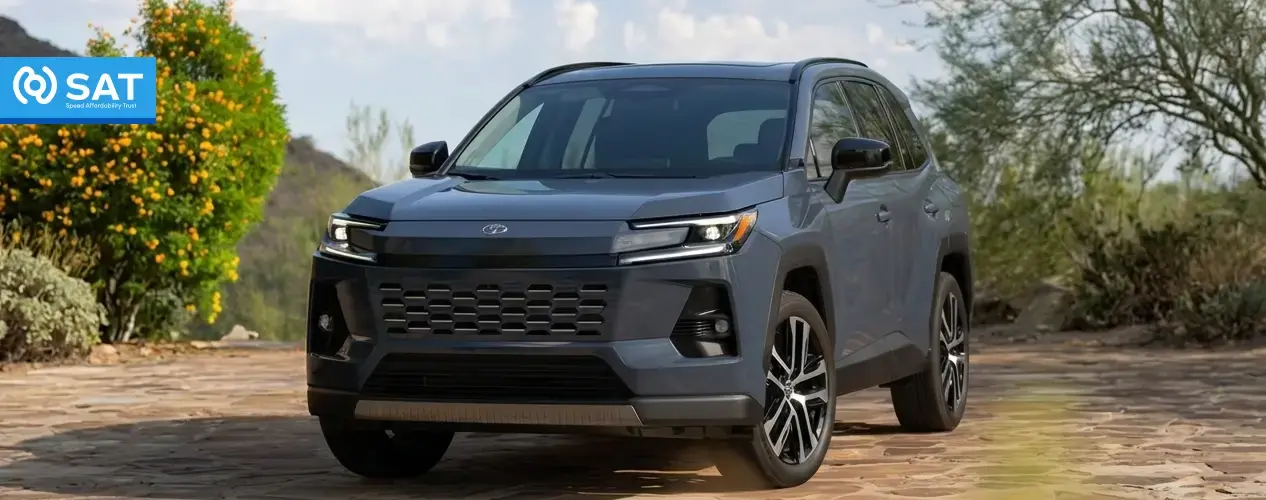
Compact. Five seats. Two rows.
The 2026 RAV4 measures roughly 180.9 to 181.8 inches long, depending on trim, 73 to 74 inches wide, and 66.4 to 67.8 inches tall. The wheelbase is around 105.9 inches. So basically the same footprint as the previous generation. Toyota didn't blow it up to chase the midsize segment.
Cargo space is 37.8 cubic feet behind the second row and 70.4 cubic feet with the rear seats folded down. Rear legroom is 37.8 inches, and rear headroom is 39.5 inches. Two adults are comfortable in the back. Three is doable, but somebody's going to be cranky on a long trip.
Ground clearance ranges from 8.1 to 8.6 inches, depending on the trim. The Woodland sits at the higher end of that range. Most other trims fall in the middle.
The new cabin is far better than the old one. The expected 2026 tech is all in place. Wireless charging, USB-C ports, connected navigation, wireless CarPlay and Android Auto, and over-the-air updates. None of this is groundbreaking. But the previous RAV4 was missing some of it on lower trims, so even the baseline 2026 spec feels like an upgrade.
Higher trims pile on the comfort kit. Ventilated seats, panoramic roof, JBL audio, ambient lighting, better materials. The Limited finally feels worth what Toyota's charging. The lower trims still have hard plastics in places where your hand naturally lands. The CR-V wins this fight pretty consistently. Toyota knows.
The RAV4 is the first Toyota to launch with the new Safety Sense suite. Standard kit includes the pre-collision system with pedestrian detection, lane departure alert with steering assist, lane tracing assist, dynamic radar cruise control, road sign assist, automatic high beams, and proactive driving assist.
If towing matters to you, here’s how much each RAV4 trim can handle.
LE FWD: 1,750 pounds*
LE AWD: 1,750 pounds*
SE FWD: 1,750 pounds*
SE AWD: 3,500 pounds*
XLE Premium FWD: 1,750 pounds*
XLE Premium AWD: 3,500 pounds*
Woodland AWD: 3,500 pounds*
XSE AWD: 3,500 pounds*
Limited AWD: 3,500 pounds*
Digital Cluster: It comes with a standard 12.3-inch fully digital gauge cluster. Redesigned RAV4 variants come with customizable layouts, hybrid system information, navigation guidance, and safety alerts.
Infotainment System: Toyota upgraded the infotainment system for 2026. Model versions like Limited, XSE, and GR Sport feature a larger 12.9-inch display.
New Software Platform: It is the first Toyota vehicle to use the new software platform, "Arene". This system powers the infotainment interface, safety technologies, connected services, and future over-the-air software updates.
Wireless Connectivity: Wireless charging pads, multiple USB-C ports, and cloud-connected navigation come standard.
Interior Features: High-end versions offer ventilated seats, a panoramic roof option, JBL premium audio, ambient interior lighting, and dual wireless chargers.
Drive-Record System: The vehicle features an integrated Drive-Record system that records footage from the vehicle’s exterior camera.
SUV | Where the RAV4 Wins | Where the Rival Wins |
Honda CR-V Hybrid | Better fuel economy, stronger resale value, more proven hybrid system | More refined cabin and smoother ride quality |
Hyundai Tucson Hybrid | Better long-term reliability reputation and resale | More modern interior design and tech presentation |
Kia Sportage Hybrid | Better hybrid efficiency and stronger brand trust | Better value for money and more standard features |
Subaru Forester Hybrid | Better fuel economy and stronger hybrid performance | Better visibility and more confidence on rough roads |
Ford Escape Hybrid | Better resale value and Toyota reliability | Lighter handling and slightly more responsive driving feel |
Like most compact SUVs, the RAV4 has its strengths and a few weak points too.
Pros
It is known for excellent reliability and fuel-efficient hybrid performance.
The RAV4 can be a good investment, as it has a strong resale value.
It has one of the most functional cabins in the compact SUV segment.
The RAV4 comes with a wider range of trims.
Cons
Some variants still have average interior materials.
The engine makes noise under high acceleration.
The 2026 RAV4 has a higher price than older generations.
Some reviewers find the cabin design too plain
This model has built a stronger reputation for reliability over time. The brand’s hybrid system is the most proven and dependable electrified powertrain currently available.
The maintenance cost of the RAV4 is more affordable than many other SUVs. The Japanese automaker gives complimentary ToyotaCare coverage. The plan covers factory-scheduled maintenance for 2 years or 25,000 miles, along with roadside assistance, helping reduce ownership costs in the early years.
The 2026 Toyota RAV4 is one of the best all-around choices in the compact SUV segment. Making the RAV4 hybrid-only was a smart move. This may increase demand for the model while improving technology and refinement. If we talk about the driving experience, it feels more comfortable and composed than previous generations, especially during city driving.
The vehicle combines fuel economy, functionality, technology, and daily usability. These features set the model apart from other compact SUVs. A hybrid-only strategy may slightly increase the starting price, but most automotive reviewers agree that improved efficiency and stronger performance justify the cost over long-term ownership.
If you want an SUV that’s easy to live with every day, fuel-efficient, and dependable long-term, the RAV4 makes a very strong case for itself. Buyers interested in importing or exploring Japanese-market RAV4 models can also explore listings through SAT Japan, which offers both new and used Toyota RAV4 models for international buyers.

Toyota RAV 4 Fuel Capacity and Performance Tips

2025 BMW 2 Series: Redesign, Specs, Range, Speed

10 Reasons Why Car Maintenance is Important

Noah Mitchell
I am Noah Mitchell, an experienced automotive journalist with over 9 years covering the dynamic world of cars and transportation. My in-depth analysis and passion for sustainable mobility drive my stories. I regularly contribute to leading publications an
Yes. Reliable, efficient, easy to live with. The 2026 hybrid-focused lineup is stronger than what came before.
Five seats. No third row option. Hasn't been one for years.
Across model years, the most reported issues are transmission hesitation, occasional battery drain, infotainment glitches, and engine noise under hard acceleration. Reliability overall is still a strong point of the car.
Depending on the market, the 7-seater options are the Highlander, Land Cruiser, Prado, Fortuner, Innova, and Veloz.
No. Compact crossover, two rows of seats.
_1733298329.webp)
The Hyundai Palisade has been one of the most favored family cars in the petrol-head community. The Palisade has been known to blend style, efficiency, agility, and performance, all in one car. Coming in 7 different trims, with 4 diverse driving modes, this vehicle holds the solutions to all your adventure troubles, with a comfortable cabin, ample cargo space, and an innovative infotainment system. Moving into 2025, the 2025 Hyundai Palisade is introduced with some fresh updates making the SUV even more favorable for drivers.
Written below are all the incoming updates and changes to the 2025 Hyundai Palisade.
The 2025 Hyundai Palisade has a 3.8 Liter V6 engine that is paired with an 8 speed automatic transmission which delivers an output of 291 horsepower. This vehicle’s powertrain also features a manual control option for the transmission to give the driver more control. All trims come with a front-wheel drive, with an optional all-wheel drive upgrade to kick things up a notch.
The 2025 Hyundai Palisade’s 0-60 miles per hour driving time was tested to be 6.4 seconds, which is impressive for an SUV its size. Additionally, the front wheel drive Palisade has a fuel-economy of 19 mpg in the city and 26 mpg on the highway.
This three-row SUV is one of the most stylish of its kind; with a bold cascading grille, flanked by powerful and elongated LED lights, and sharp lines throughout the exterior for aerodynamic manipulation. The Palisade has a muscular stance giving it a sporty and intimidating look. The Palisade also comes with convenient exterior features such as a power liftgate, additional roof rails, folding third-row seats, and a panoramic sunroof.
The 2025 Hyundai Palisade has an opulent interior with a spacious cabin lined with the finest materials. The interior has a 12.3-inch touchscreen display featuring a dynamic digital cluster, Android Auto, Apple CarPlay, a premium sound system, dual Bluetooth connectivity, and an innovative remote controlling feature by the Hyundai Blue Link app, which gives you lock control from a distance.
The new model of the 2025 Hyundai Palisade has a starting price of $38,215 and it goes all the way up to the highest trim costing $55,515. The base trim, the SE model costs $38, 215; the second SEL model costs $40,965. The XRT trim comes in at about $44,065 while the SEL Premium trim costs $45,565. The Limited trim of the 2025 Hyundai Palisade costs $49,615 and the Caligraphy model costs $52,015. Last but certainly not least, the Calligraphy Night Edition of the Hyundai Palisade costs $55,515.
The 2025 Hyundai Palisade will be featuring 4 diverse driving modes including comfort, Eco, Sport, and Smart driving modes for an optimized and engaging drive:
Comfort: The comfort mode is set to deliver a seamless and smooth driving experience. The suspension and transmission are tuned for daily commuting driving.
Eco: The Eco mode in the 2025 Hyundai Palisade prioritizes the engine’s fuel efficiency, This mode may not deliver the most powerful performance, but the powertrain is adjusted to consume the least amount of gasoline for the more long-lasting output. This keeps the fuel economy high and decreases fuel costs.
Sport: The Sport mode focuses primarily on the speed and performance of the 2025 Hyundai Palisade. The steering and powertrain are tuned to create the maximum output while maintaining the vehicle’s agility.
Smart: The Smart driving mode is an intuitional setting that analyzes your driving style and switches the driving mode accordingly, giving you maneuverability and balance. This driving mode essentially also helps in fuel efficiency.
In comparison to other latest models, the 2025 Hyundai Palisade is relatively more affordable to maintain. The annual repair and maintenance cost for this vehicle begins at $352 and rises every year because of depreciation and can reach up to $739 in the first five years after purchase. Additionally, with high fuel efficiency, annual fuel costs are calculated to be up to $2,380 per year. All-in-all, you can rest assured that the 2025 Hyundai Palisade has a low maintenance and upkeep cost. Here are some factors contributing to this:
Hyundai Durability: Hyundai, like most other Japanese automakers, has a business model of constant improvement and innovation. These vehicles are engineered to be optimized for long-term usage. This rhombus engineering keeps your 2025 Hyundai Palisade away from the mechanic for a long while.
Expected Maintainance: You can rest assured that even if you were to take your Palisade to the mechanic, it would be out of routine, rather than from an unexpected mechanical breakdown. Routine check-ups such as oil changes and tuning will help maintain the longevity of your vehicle.
Visit Now 2025 Hyundai Elantra.
SAT Japan is the ultimate destination for those searching for well-maintained and certified Used Cars for Sale. We offer impressive deals on a wide range of luxury and economy vehicles. Our expert staff on board is dedicated to your ease and our customer-centric services will make the entire process unbelievably simpler. Our convenient services such as our insurance services, 24-month installment payment plan, and doorstep delivery, keep our customers stress-free. We recognize our responsibility to present the best course of action according to your preferences.
Although there are no revolutionary switch-ups in the design or performance of the 2025 Hyundai Palisade, it is one of the most reliable upcoming full-size SUVs in the automotive market. It is no easy feat searching through the endless sea of options to reach a final decision. Our expert staff and customer-centric services at SAT Japan help you make the right decision at every step of the purchasing process. Hence, SAT Japan is the ultimate car enthusiast website where you can find a plethora of well-maintained options for your potential next ride. Head on over to SAT Japan’s website and scroll through our vast inventory to find the perfect Hyundai car for you.

The modern cars coming in the market are capable of remarkable speeds and give you a highly smooth and comfortable experience. The latest cars are also much safer and come up with advanced and autonomous systems that can stop and steer the vehicle for you in an emergency. However, all the safety and advanced features will not do anything if you have bad tires. For example, inside tire wear is an issue that can affect the tires of many cars rolling on the road. It is not just about purchasing low-quality tires; it is also about not ensuring their proper maintenance.
Tire wear is a common problem that can affect your vehicle’s handling, safety, and performance. Although inner tire wear might seem harmless, it can lead to various serious issues, including reduced traction, poor steering response, and even blowouts.
But why do tires wear out from the inside, and how can you prevent it?
By understanding the factors that contribute to inner tire wear, you can increase the life of your tires and keep them performing at their best.
There are several reasons why your tire can wear from the inside. Below we discuss some of the reasons in detail.
Misaligned wheels can lead to irregular tire wear. When the bottom part of the tire is leaning towards the outside, it is called a negative camber. Positive camber is when the top part of the tire is leaning towards the outside.
When there is improper alignment in the tires, the inner part of the tire makes more contact with the road surface. Because of that, you might observe the inside of the front tires wearing down.
Poor wheel alignment can also mess up your camber. You can verify this by cruising on a flat section of asphalt. If your vehicle is not moving straight even after pointing the wheels at a 12 o’clock position, it means your wheels are not aligned properly.
Driving your vehicle aggressively puts a lot of stress on your tires. It can also overheat various components of the tires and wear the thread at a faster pace because of abrasion. Aggressive riding includes running your vehicle at maximum acceleration, hard cornering, and pushing brakes for prolonged periods. Tire wire showing is an indication of your tires being severely damaged.
It is essential to note that, unlike race cars, standard vehicles are not designed to be driven aggressively all the time. The tires in race cars are specifically designed to give maximum gain and resolve steering on the road. However, other tires cannot keep up with constant beating from drifting and fast driving.
For more insights into premium tire options, check out our detailed comparison: Bridgestone vs. Michelin Tires.
The suspension components of a vehicle are designed to not only absorb road shocks and vibration but also to make sure that the vehicle’s shock ride height remains the same. It is important because camber angles are directly affected by it, and it can increase inside tire wear.
Suspension components such as springs can sag through regular use. Faulty or defective springs fail to absorb shocks and vibrations, which can damage other suspension components of the vehicle as well.
Also, the defective spring can lower the vehicle’s stock ride height, which can change the camber angles.
These components are made of rubber or elastomer and serve to link the chassis and steering knuckles. These bushings eliminate excess free movement within the vehicle, which can have a negative effect on camber angles. As a result of frequent use, the control arm bushing wears down gradually, leading to increased movement and more tire wear on the inside.
It is crucial to fix the inner tire wear to avoid further damage to the vehicle’s components, such as ball joints and springs, and ensure more safety.
Get your wheel balanced after every one or two years. If you have installed new tires in the vehicle, you should get them balanced immediately to protect them from wearing out.
If you notice uneven tire wear, check your suspension system. Damage to the suspension system can accelerate the inner tire wear, resulting in future problems such as a decrease in vehicle speed and expensive repairs.
Innerwear on tires occurs when the driver does not maintain their tires regularly. Just like your vehicle, your tires require extra care to give you a safe ride.
Regularly check the tire pressure of your vehicle. It is an important practice because understated tires can cause the sidewall to flex, which can lead to instability at higher speeds. Also, underinflation can cause other problems, including cracked rubber, tread separation, bulges, and more. If the tires are overinflated, they can bulge in the center, causing increased wear in that area.
Therefore, it is preferable to check the tire pressure once every month, especially after large temperature changes.
If you notice damage on any of the suspension components, it is important to get your vehicle inspected by a professional mechanic. Doing that will resolve the issue and your car will also stay safe.
Tire wearing on the inside can also occur as a result of overloading. It is important to adhere to the vehicle weight limits mentioned by the manufacturers. Overloading includes passing extra passengers, carrying excessive cargo, or towing large tailors, which can put stress on the components of the tire.
Tires wearing on the outside and inside can seriously affect the handling and safety of your vehicle. You can avoid internal tire damage with a routine inspection of your suspension system and alignment and by taking proper care of your tire. It is also important to get your vehicle inspected by a professional mechanic every once in a while.

There are a lot of parts that go into making your vehicle run fast and look its best. The engineers have spent years and years tuning car emission systems to personalize the sound a vehicle makes when it’s on the road. However, when it comes to riding, not everyone wants to have a quiet ride, and for that, you can modify your vehicle’s straight pipe exhaust system and alter the sound your engine produces.
A very exciting modification for car owners currently is the straight exhaust system, particularly for people who want to improve the performance of their ride. One reason car owners choose it is its greater functionality in compression compared to stock exhaust. The reduced backpressure supports greater functionality, resulting in increased engine performance.
If you are wondering if a straight-pipe exhaust system is right for you, keep reading to learn the pros and cons of installing one in your vehicle.
Straight pipe exhaust is becoming one of the most common modifications among car fans who enjoy the roar of their engine along with the additional power of their vehicles. Unlike standard exhaust systems, straight-pipe exhaust systems do not have a resonator, muffler, or catalytic converter. You can witness this type of exhaust in racing cars and other high-performance vehicles.
The exhaust system allows the fumes to flow freely from the engine’s exhaust headers, allowing them to go into the atmosphere directly through the exhaust tip. They increase the horsepower of your engine because there are no restrictions on the exhaust, and the gases to flow freely.
Explore our in-depth guide on the straight pipe exhaust system to enhance your car's performance and sound quality.

There are many reasons for considering a straight pipe exhaust for your vehicle, including:
Increased Performance
The prime reason why many people choose straight pipe exhaust is because these systems increase your vehicle’s horsepower and torque. These systems also reduce the back pressure from the engine, allowing the exhaust gases to move freely and assisting the engine to perform without any hindrances. This mode is particularly designed for sports vehicles as it does not hinder gas flow and enhances the car’s performance.
Engine’s Original Sound
The straight pipe lets the true sound of the engine come out. Normally, there are mufflers, catalytic converters, resonators, and other similar components present to reduce the sound of the engine. However, straight pipe exhaust allows the raw and pure sound of the engine to come out.
Less Weight
When a vehicle’s weight is reduced, it becomes faster and more efficient. Mufflers and catalytic converters weigh a lot, and if you love racing, you surely would want to have a lighter vehicle. A straight pipe exhaust weighs much less than the original exhaust.
Aesthetic Appeal
Straight pipes also give an aesthetic look to your vehicle and make it stand out. To make the vehicle look more appealing, you can apply a chrome finish to the exhaust tip. To give additional colors to the tip, various types of welding methods are used. You can even go for a twin-pipe setup for even better aesthetics.
Remarkable Fuel efficiency
Without mufflers and a catalytic converter, the engine creates low back pressure, leading to better combustion. This also means lower fuel consumption.
Straight-pipe exhaust systems also have their own cons, including:
Rampant Emissions
It’s true that straight pipes make a remarkable sound, but they are not great for the environment. In the late 20th century, catalytic converters came into the market to control the harmful gas emissions from cars into the environment. Removing catalytic converters can be really bad for the environment.
Expensive
Installing straight pipes can be expensive. New pipes are not cheap, and finding them at a good price is not easy, so most car enthusiasts go for custom-built exhaust pipes. Also, after installing a straight pipe exhaust system, you have to tune your car according to certain standards to get the most out of it.
It Might Not be Legal
Modifying a vehicle to a straight-pipe exhaust system and removing mufflers and catalytic converters is not legal in many states in the US. However, it varies from state to state. Therefore, before installing an exhaust pipe in your exhaust, you should go through your state’s rules.
Effects Resale Value
Customizing your vehicle can also make it harder to sell it at a high price in the future. An average buyer might not find pipe exhaust to be as valuable as you do. So, you might be forced to spend extra money on reinstalling a standard exhaust system or accept a low price when selling your vehicle.
The total cost of pipe exhausts depends on various factors, including the model of the vehicle, the materials used, and the length of the exhaust. Overall, you might have to pay around $200 to $1000 with a labor cost of about $100 to $600.
Keep in mind that depending upon the customization and the mechanic, the cost can go much higher. Generally, it is preferable to get quotes before choosing a professional.
Subscribe to SAT Japan to get all the latest car news, tips, and tricks for a smooth ride.