Menu

 Find Your
Car
Find New
Car
Local
Pages
Find Your
Car
Find New
Car
Local
Pages
 Pakistan
 Antigua
 Anguilla
 Armenia
 Australia
 Azerbaijan
 Bahamas
 Bangladesh
 Botswana
 Burundi
 Canada
 Chile
Chile
 Costa Rica
 Cyprus
 Dominican Republic
 Fiji
Fiji
 Georgia
 Ghana
Ghana
 Guatemala
 Guyana
 Ireland
 Jamaica
 Kenya
Kenya
 Kyrgyzstan
 Lesotho
 Malawi
 Micronesia
 Mongolia
 Mozambique
 Namibia
 New Zealand
 Nigeria
 Papua New Guinea
 Paraguay
 DR Congo
 Russia
 Rwanda
 Samoa
Samoa
 Solomon Islands
 Somalia
 South Africa
 South Sudan
 Sri Lanka
 Tanzania
 Tonga
Tonga
 Uganda
 Ukraine
 USA
USA
 Zambia
 Zimbabwe
Car
Services
Company
Overview
Reviews
Blogs Categories
Help
Explore Stock
Explore Stock
Explore By Price
Explore By Price
Explore By Make
Explore by
Type
Explore by Year
Explore by
Discount
Inventory
Location
Inventory
Location
Other Categories
Other Categories
Zimbabwe
Car
Services
Company
Overview
Reviews
Blogs Categories
Help
Explore Stock
Explore Stock
Explore By Price
Explore By Price
Explore By Make
Explore by
Type
Explore by Year
Explore by
Discount
Inventory
Location
Inventory
Location
Other Categories
Other Categories
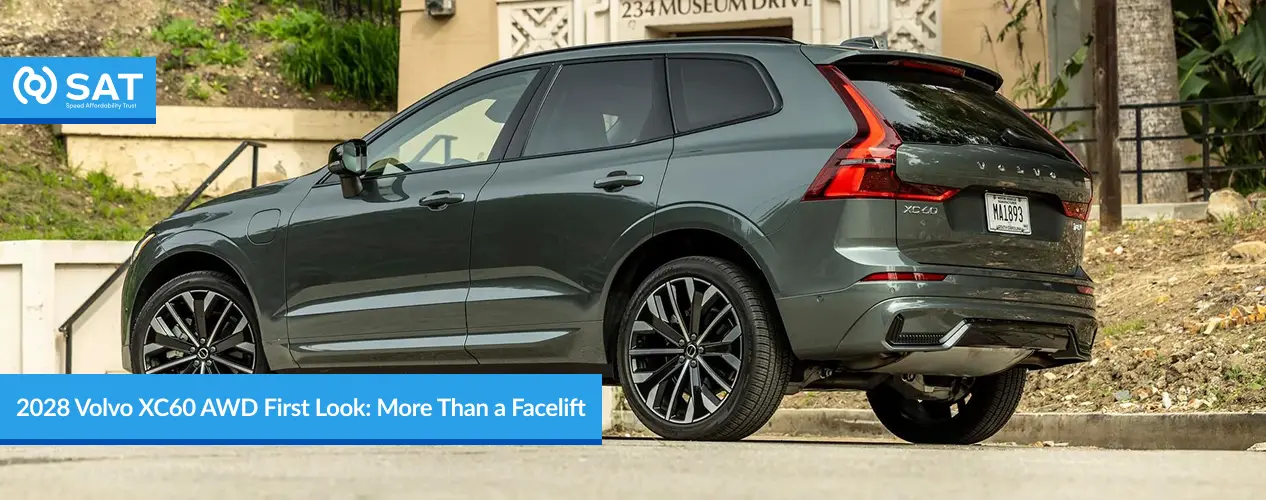
The 2028 Volvo XC60 Hybrid is making a much bigger move toward electric driving. Its new T8 plug-in hybrid is expected to deliver up to 78 miles of electric-only range, more than twice the previous U.S.-market figure of 35 miles.
The answer is simple but profound: Volvo has doubled the capacity of the battery. The new XC60 T8 is equipped with the same, bigger battery, rear electric motor, and 455 horsepower.
The 2028 Volvo XC60 Hybrid gets a 41.2-kWh battery, with 37.9 kWh usable. Volvo claims the XC60 could go across the U.S. on electric power alone, with up to 78 miles, although the official EPA range hasn't been announced yet.
Exterior styling changes are also included, along with new safety hardware, plus new interior details and modifications to the charging system. The T8 is the most high-performance plug-in hybrid in the lineup.
Here are the key figures currently available for the U.S.-market T8.
Specification | 2028 XC60 T8 PHEV |
Powertrain | 2.0L turbocharged 4-cylinder + electric motors |
Drivetrain | AWD |
Combined output | 455 hp |
Combined torque | 523 lb-ft |
Battery capacity | 41.2 kWh |
Usable battery | 37.9 kWh |
Electric range | Up to 78 miles |
Total range | Up to 590 miles |
Transmission | 8-speed automatic + rear electric drive |
Seating | 5 |
Level 2 charging | Up to 7.2 kW |
DC fast charging | Not available |
0–60 mph | About 4.5 seconds |
Expected U.S. arrival | Spring 2027 |
Some figures are Volvo estimates or manufacturer estimates and remain subject to final certification or production specifications.
The battery grows from the previous model's 18.8 kWh to 41.2 kWh. Usable capacity rises to 37.9 kWh. That is more than a small upgrade. The new pack has more than twice the usable energy of the previous system, which lets Volvo push electric range from about 35 miles to a claimed 78 miles.
Volvo also changed the battery's physical layout. Instead of the older long battery arrangement, the new pack sits flat under the floor. That packaging matters because Volvo did not sacrifice passenger space or ground clearance to make room for the larger battery. Curb weight does increase by about 200 pounds.
In contrast to a gas-powered AWD SUV, the Volvo XC60 AWD T8 has an alternative design. The engine is a turbocharged 2.0-liter unit that powers the front wheels, while a rear electric motor powers the rear wheels. Combined, the two systems produce 455 hp and 523 lb-ft of torque.
Volvo has also made the rear electric motor stronger. That matters because the larger battery can provide more energy for electric driving while the motor handles more of the work.
The result is a PHEV that can function much like an EV in normal driving situations, while still retaining gasoline power for extended trips.
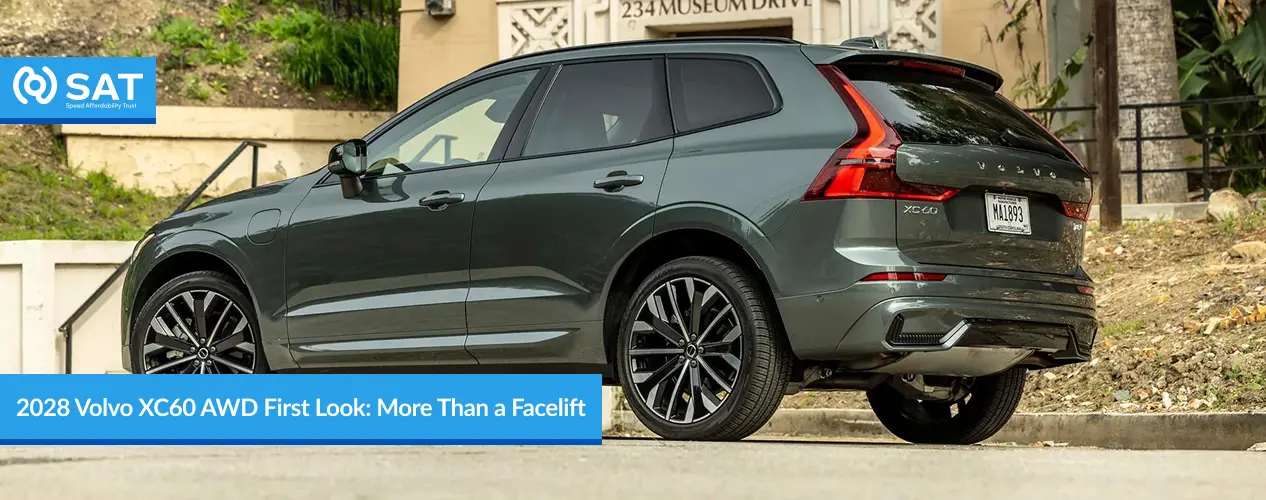
The 100% change isn't as obvious, however, as it is with the powertrain upgrade in the 2028 Volvo XC60 AWD first look. The front end receives a facelift with a new bumper, front fenders, grille, and hood. A new wheel design, along with updated rear lighting, also refreshes the all-but-familiar XC60 line.
Volvo also brings new wood trim and materials inside, plus new dashboard details. Google's Gemini voice assistant remains, as does the 11.2-inch center touchscreen display. Volvo has also added more sensing devices. New radar, ultrasonic sensors, and a camera improve collision avoidance functions, driver assistance, and a 3D camera view.
Volvo estimates up to 78 miles of range in electric-only mode for the U.S.-market XC60 T8. This is not a final EPA result. This is not a final EPA result. According to Volvo's announcement, it will be capable of up to 78 miles, but EPA confirmation is reportedly pending.
Nonetheless, the shift is significant. The previous-generation T8 XC60 was estimated to offer about 35 miles of range between charges in the U.S. With a final EPA estimate of 78 miles, the new XC60 would double the previous model's electric range.
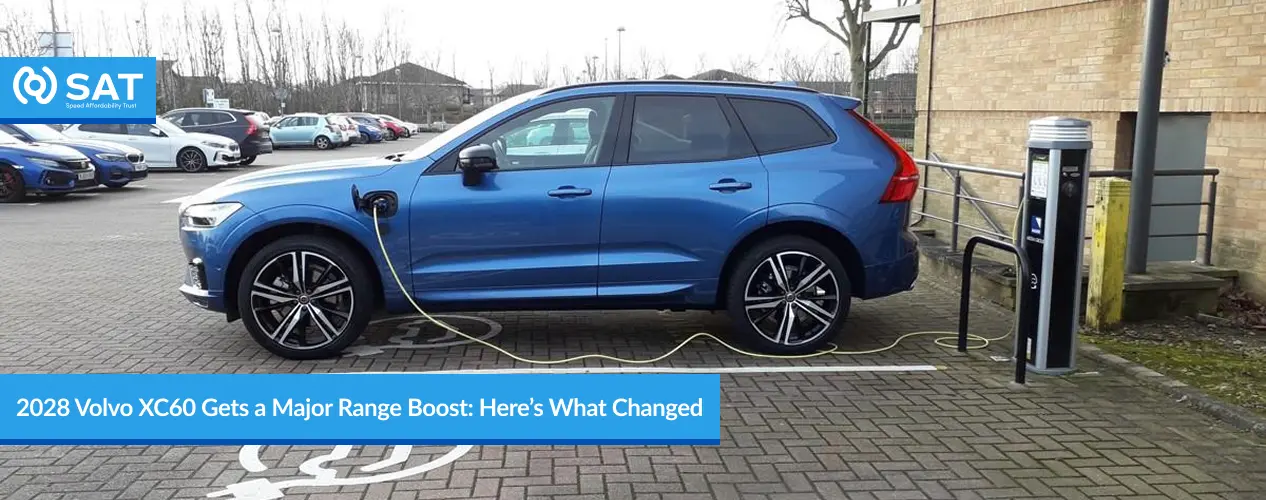
The larger battery uses a Level 2 charging system. The charging power is increased from 3.6 kW to 7.2 kW. The larger battery, by contrast, doesn't mean a much longer overall charge time.
There is one limitation. 2028 XC60 T8 is not equipped with Level 3 DC fast charging. It is still mostly focused on AC charging at home or at destination charging stations.
The plan that the XC60 is designed for is easy to understand: charge at night, power the car with electricity, and keep its gasoline mode for longer trips.
The T8 is estimated to provide up to 590 miles of range, depending on battery and gas power. That is not to be confused with electric range.
The 78-mile number refers to driving with electric power. The 590-mile number is the electric/gas model combined under manufacturer's conditions. This is significant because actual range will vary depending on driving speed, temperature, traffic conditions, terrain, driving habits, and frequency of charging.
Volvo has not fully confirmed the 2028 Volvo XC60 expected price for the U.S. market. The XC60 Hybrid is estimated to cost between $68,000 and $74,000, while other estimates put the 2028 XC60 lineup's base price at about $52,000. The figures should be treated as estimates and not as final prices for T8.
Volvo has said there will be no price changes compared to the current model. Final pricing will be clearer closer to launch.
It seems the base dimensions of the XC60's basic passenger and ground clearance has not been affected by the larger battery.
Dimension | 2028 XC60 |
Length | 185.4 in |
Width | 74.9 in |
Height | 65.2 in |
Wheelbase | 112.8 in |
Seating | 5 |
Cargo space behind second row | 16.5 cu. ft. |
Maximum cargo space | 63.3 cu. ft. |
Cargo figures are indicative and may differ depending on the specific measurement method and configuration.
The initial production is anticipated to start in the latter part of 2026, with deliveries commencing in early 2027.
Spring 2027 is the anticipated U.S. on-sale date. The T8 is said to be produced in Torslanda, Sweden, and the B5S is produced in Charleston, South Carolina. Which basically would allow buyers to see the 2028 XC60 well before the year 2028.
The larger picture of the 2028 Volvo XC60 Hybrid is how the new PHEV might be able to attract buyers outside of Volvo's traditional customer base. In addition to that, its extended electric range will provide international importers with another factor to consider when it gets to export markets.
For buyers looking at the 2028 Volvo XC60 AWD, SAT Japan's existing Volvo inventory provides useful context about how Volvo's SUV appears within Japan's export market.
The 2028 XC60 T8 is likely to enter Japan's export supply soon and may offer a compelling option to foreign customers looking for a more modern version of the Volvo PHEV via a well-known Japanese export channel.
2027 Subaru Getaway EV SUV Revealed: Specs, Range & Price

How to Transfer Car Ownership When Buying a Car?

Honda Reveals New H Logo for EVs and Hybrids Starting 2027



Liam Bennett
I am Liam Bennett, and I have worked as a professional in the automotive industry for over a decade, specializing in customer relations, vehicle sourcing, and pricing strategies. I ensure buyers and sellers get the best value in a transparent deal, helping them feel enabled and confident in their automotive transactions. As a writer, I also share my insights on the industry, providing valuable guidance to automotive enthusiasts and buyers alike.
Volvo says up to 78 miles of electric-only driving range is expected in the U.S. for the 2028 Volvo XC60 T8, though final EPA approval is yet to be confirmed.
Yes. The T8 is an AWD model with a front-wheel-drive gasoline engine and a rear-wheel-drive electric motor. The overall system delivers 455 hp.
The battery holds a total of 41.2kWh with 37.9kWh usable capacity. This is twice the size of the previous 18.8-kWh pack.
No. The T8 features AC charging and a higher charging capacity for Level 2 charging (7.2 kW). Volvo has not included Level 3 DC fast charging for this PHEV.
The T8 has 455 horsepower and 523 lb-ft of combined torque. Volvo still maintains the same powertrain output but boosts the electric aspect.

The history of automobiles is vast and filled with surprises. When was the first car ever made? Many people have wondered about this question, and it has been a controversial topic for over a century. It can be quite challenging to track down the first car ever made in the history of automobiles. Let’s take a closer look at the evolution of vehicles and find the answer to when the first car in the world was manufactured and who may have truly invented it.
When we look at the old resources of automobile history, we find out that many inventions before the first car in the world ran on fuel. For most of the 19th century, there were many cars powered by gas or steam. The first record we have is from 1968, when an astronomer invented a car around 2 feet long, which was a toy for an emperor of China.
The 1700s saw the development of steam engines, and many steam engine vehicles were launched. Amedee Bollee manufactured the first practical steam-driven car in 1878 at Le Mans in France. However, these vehicles had many disadvantages. Firstly, these vehicles could not be used until their furnaces had boiled the water. Secondly, when traveling, these vehicles needed a constant supply of water to turn water into steam and more fuel to heat the furnace. Lastly, they were extremely heavy to manage.
People at that time were also looking for engines smaller than steam engines so they could use them for the Industrial Revolution. Later, in wars, the need to make better cylinders for cannons increased the possibility of making an engine where fuel was burnt inside the cylinder. This way, the first practical vehicle powered by internal combustion engines was invented.
Gottlieb Daimler, in 1885, made the first practical vehicle powered by internal combustion engines – a motorcycle.
Karl Benz produced the first practical car in 1886 in Mannheim, Germany. His vehicle was a three-wheeler, Patent Motorwagen, which was very similar to the current cycle design. The vehicle received power from a single-cylinder engine that produced about 600 watts and used benzene as fuel. This vehicle had one seat and was steered by a tailor.
Later that year, Motorkutsche produced the first four-wheeled car. Though it was an open car, it had two seats. Benz’s 1898 Velo was the first car in the world produced on a production line. It was a four-wheeled open single-seater.
The first automobile that resembled the modern cars today was the 1901 Mercedes, manufactured by the DMG corporation that Daimler had helped to establish. It costed five times as much as the Velo, which Mercedes still sells. It had a four-cylinder engine that produced ten times as much power as the Velo. This vehicle was named after the daughter of the bank, who pressured DMG to produce cars that are faster and can be used in long distances.
The first practical car left a lasting mark in the auto industry. Here is what we know about the first car in the world.
The first ever car was the original collector item, and only 25 versions of the 1886 Patent Motorwagen were manufactured. This all happened right before Benz almost gave up on his masterpiece. But then his wife, Bertha, went on an important road test drive of about 12 hours, which led to the installation of brakes, a two-speed transmission, and other upgrades in this vehicle.
After years of experimentation with two-stroke engines, Benz developed the Patent Motor Car by combining easily accessible technologies, such as the engine, lightweight steel chassis, completely constructed two-seat velocipedes, and driving components, into a single unit. Production lasted from 1886 to 1893 when the Benz Velo supplanted it.
Benz was not totally happy with the four-wheel steering system that was available in 1886, so he went for a three-wheel system. Two rear wheels provided the power, and a front solitary wheel was assigned with steering duties.
This two-seater vehicle had a simple drive system with a 62-inch wheelbase. It also had a pair of chain drives coupled with a basic beam axle that provided power to the back axle. The transmission system consisted of a large leather strap with a single speed. The flywheel in this vehicle was placed horizontally, as Benz had an idea that spinning a heavy mass would generate too much inertia make steering difficult.
Though vehicles were made before the Patent Motorwagen, including automobiles powered by electricity and steam, this was the first with an internal combustion engine. It was also the first vehicle to be ever introduced commercially. This vehicle was powered by a 945cc single cylinder with a stock iron block and head engine. This vehicle was capable of producing 0.9 hp. Building on the foundation of early internal combustion engines, the development of the V8 engine represents a significant milestone in automotive engineering, offering enhanced power and efficiency. Learn more about the fascinating V8 Engine History.
In modern times, starting your vehicle is super easy as you do not even need to turn a key. In some cars, you just need to press a button or use a remote starter. However, things were quite different back in the day. For instance, to start a Benz Patent Motorwagen, you had to spin the large flywheel manually. So, you had to vigorously turn the flywheel at the rear after activating the ignition from the switch under the seat. Then, using the handwheel, you had to regulate the air supply.
It seems like Bertha Benz, the wife of Benz, was more familiar with the vehicle’s designs as she pointed out several improvements in the car’s design in her first test drive. Though the car was already remarkable, Bertha understood the needs and requirements of the real world more closely, which led to various improvements in the design.
She was also the one who took the Benz Patent-Motorwagen to the world’s first long-distance drive. She covered about 11 miles round trip with her two sons, in which the car broke many times, which she fixed each time, and added upgrades like the world’s first brake pad.
The parts and features of this vehicle might be short-lived, but the basic idea behind this vehicle led to the foundation through which all modern cards are built. The parts and details added to the engine of this vehicle formed the essentials of a modern internal combustion engine.
The company, the foundation of which was led by Carl Benz, is still around today and manufactures some of the most well-known and finest cars in the world. With its design, the original car made it possible to revolutionize the automotive industry with hundreds of vehicles manufactured daily. The successor company takes the crown for the most consequential development of auto manufacturing, including superchargers, multi-valve engines, anti-lock braking systems, and so much more.
Carl Benz's invention of the Patent Motorwagen automobile in 1886 marks the emergence of vehicles based on internal combustion engines. With steam and electric-powered motors being experimented on before Benz’s innovations, the first commercially sold vehicle with an internal combustion engine was developed. His pioneering efforts created the foundation for automotive engineering resulting in modern vehicles that are safer, more efficient, and powerful. Today SAT Japan is still continuing this legacy by further advancing innovation

When selecting a car for your family, you want something comfortable, affordable, and, most importantly, reliable. The car must perform well in all conditions, provide enough space for the family, and offer safety and fuel efficiency. This is the reason we provide listings for Used Nissan Cars For Sale. Nissan is famous worldwide for its durable cars and innovative technology on a budget. Whether driving the kids to school, going on a road trip, or commuting to work, a used Nissan can be your ideal partner.
At SAT Japan, we offer high-quality used Japanese Nissan cars for sale with financing options and worldwide delivery. Here are our top 10 family-friendly cars suitable for families of all sizes.

The X-Trail SUV adds comfort to all family trips, including long rides and deeply rooted school runs. Advanced safety gear like bonnet lifting systems, along with a driver assistance technology alert system, is a must for new school families. Adding to these features, it comes in family size, integrating a fuel-efficient engine, nailing the target on adventure-loving families. With its appearance of four-wheel drive and strong safety measures, the appeal of the vehicle augments.

This greatly enhances fuel economy while assisting families needing space and reliability. Nissan Serena encapsulates every goal working for larger families by dynamically positioning fuel-efficient hybrid train power mechanisms that ease everyday driving chores. There also comes a captain's nailing children parting slides, allowing for convenience in getting youngsters in and out of the vehicle. These are in addition to the car's flexible seating arrangement to shield three extra families from broader sight.

A compact hatchback, the Nissan Note is surprisingly spacious and fuel-efficient for its class. Additionally, it provides easy maneuverability for small families living in urban areas. Note that e-POWER models have hybrid efficiency capabilities without losing power. Passengers have plenty of legroom, and the cargo space is generous for a vehicle of this size.

The Nissan Cube's spacious interior and quirky design combine practicality and style, making it stand out from the rest. It is ideal for families that appreciate comfort and individuality. Cube's generous headroom and adjustable seat configuration make it ideal for transporting kids' gear. City driving is a breeze for this fuel-efficient compact, and the rear swing door adds convenience.
.webp)
The Nissan Rogue, or X-Trail in some regions, is an imposing SUV with a striking design and is perfect for a family. Nissan's Safety Shield technologies, which come equipped in the car, include blind-spot spot warning, rear cross-traffic alert, and forward-collision war car. The Rogue has a large, spacious cabin, great fuel economy, superb resale value, and, best of all, it is perfectly suited for growing families.

For a family looking for an efficient compact, the Nissan Dayz has unbelievable features for a kei car. Thanks to its tiny dimensions, navigating through the city becomes much simpler. Along with an impressive fuel economy and low maintenance costs, the Dayz accommodates young families seeking a cost-efficient solution. The model's tall roof guarantees a roomy cabin, while the digital display, advanced climate control, and lane-keep assist add modernity.

A member of one of the more affluent vehicle categories, the Nissan Elgrand is a luxury MPV and makes a great car for those looking for more comfort and ease when traveling as a family. The car can accommodate 7 to 8 passengers, depending on the version, while offering soft, comfortable seating and cruising. Ideal for commuting and long-distance travel, the Elgrand also boasts high-end features like leather seats, dual-zone climate control, and an advanced infotainment system. This vehicle fits a family's transportation needs, but at the same time, it has a touch of class.

Regarding sporty, appealing families, the Nissan Juke is the go-to vehicle. That's because it combines bold design features without compromising practicality. This compact crossover is fun to drive and allows for easy navigation through city traffic. To outperform the competition, the rear seats conveniently fold to expand cargo space, and other practical features have also been added, such as rearview cameras and a control traction system. Compact families will appreciate the Juke due to its unmatched aesthetic appeal without sacrificing performance.

The leg seating space is generous, and the handling is smooth, making driving for both day-to-day activities and excursions during the weekends much easier and enjoyable. The Nissan Tiida is family-oriented because of its dependable hatchback or compact sedan. With respect to its fuel economy, the Tiida offers economic practicality, a feature appreciated by many family buyers, alongside comfort, reliability, and affordability.

Lastly, Lafesta's seat configuration enables up to seven people to be seated, in addition to the sliding rear doors. This makes the Lafesta a compact MPV tailored for convenience and practicality for family needs. The Lafesta is also known for its ease of use in urbanized settings while maintaining good fuel efficiency. It's a practical automobile for families who want more space but don't require a full-sized van yet find a sedan too compact.
SAT Japan focuses on one domain: selling the most reliable used Nissan cars at the most convenient prices. This is especially true when the cars are imported from Japan. Regarding the cars in their inventory, there is assurance that strict inspection was done on performance, mileage, and internal condition. Whether it's a compact hatchback or a spacious SUV for the family, SAT Japan possesses the right vehicle.
They provide global car delivery and easy financing options to other services; they work to ensure your satisfaction every step of the way and guide you throughout the purchase process.
| Model | Body Type | Seats | Fuel Economy (km/L) | Best For |
| Nissan X-Trail | SUV | 5-7 | 12–16 | Road trips, large families |
| Nissan Serena | Minivan | 7–8 | 15–20 | Spacious family use |
| Nissan Note | Hatchback | 5 | 20–25 | City driving, small families |
| Nissan Cube | Hatchback | 5 | 17–22 | Style and practicality |
| Nissan Rogue | SUV | 5 | 12–16 | Safety and style |
| Nissan Dayz | Kei Car | 4 | 25–30 | Urban, fuel efficiency |
| Nissan Elgrand | MPV | 7–8 | 9–13 | Luxury family travel |
| Nissan Juke | Crossover | 5 | 15–20 | Sporty and compact |
| Nissan Tiida | Sedan/Hatch | 5 | 14–18 | Daily commuting |
| Nissan Lafesta | MPV | 7 | 13–18 | Compact family van |
When selecting a family vehicle, comfort, safety, and overall price are extremely important. That is why SAT Japan has a trusted selection of used Nissan cars for sale. From generous SUVs such as the X-Trail to compact city-friendly cars like the Note, you will not be left lacking, as Nissan has something available for everyone.
Visit SAT Japan today to check out the wide range of cars available and drive home the perfect family vehicle.

Cars are complex mechanisms that work on strict principles of chemistry and mechanization. Introducing foreign elements into such a sensitive system will do much harm, and salt is the most dangerous. Although it seems unimaginable to do so, knowing the possible risks and results of putting salt in gas tank could actually be very important information for car owners. This guide will explain salt’s dangers in a gas tank, providing a person with the associated risks and the kind of damage that it can cause, whether out of curiosity or concern.
Salt is a chemical compound—sodium chloride—which can easily dissolve in water and create a saline solution. Salt, when it gets into your gas tank, initiates terror on your vehicle’s fuel system.
Below are the things that can happen when putting salt in gas tank or fuel system :

Salt is well known for its corrosive properties. Dissolved in water, it may enhance the corrosion of metal parts in your fuel system. This includes severe rusting or corrosion in components like the gas tank, fuel lines, fuel injectors, Water Enters your Gas Tank, and even the engine. Eventually, this will cause fuel leaks, lead to clogged injectors, and destroy engine internal components.

Salt particles, and later on the saline solution, may accumulate in this fuel filter. The fuel filter entraps all particles of dirt before they can enter the engine. However, with the addition of salt, the filter fills up quickly and chokes, thereby blocking the fuel supply to the engine. A clogged fuel filter will lead to erratic running, stalling, and might finally make the engine stop running altogether if not taken care of in time.

When salt is introduced to a gas tank, it dissolves in the water that might be present in the fuel. While gasoline and water do not directly mix, the inclusion of water in a fuel tank might be through the presence of condensation or just through low-quality fuel. Once the saltwater solution has been formed, it could then be sucked into the fuel system and contaminate the gas. It thereby reduces its ability to burn. The rest is a problem of loss of power and higher emissions due to inefficient combustion. For a similar destructive effect, consider How Bleach Can Destroy Your Car Engine.
Fuel injectors are made in a way that they need to give out a fine mist of fuel inside the engine’s combustion chambers. Salt particulates are likely to eat out such delicate components of fuel delivery, leading them to fail. This can give way to problems like inferior performance, lowered fuel productivity, and other major problems together with rather costly repairs or overhauling.
The most damaging result of pouring salt into a gas tank is the potential for harm caused to the engine. If the contaminated fuel makes it to the engine, this can cause internal damage through corrosion and wrong combustion. To this extent, the engine may most likely fire out of sequence, run rough, or just not start at all. In the cases like Worst Liquid to Put in Car Gas Tank, engine damage from salt is irreversible; this clearly calls for a new or total engine build.
Even though the idea of putting salt in a gas tank might seem far-fetched, it could happen in a few instances:
A very common reason a gas tank is found with salt could be vandalism. Various harm-intending individuals can pour salt into the gas tank of the vehicle causing destruction. This kind of gross damage calls for big repair expenses for the vehicle owner, who will be disturbed by many inconveniences.
Sometimes, for a joke or due to a completely bizarre misunderstanding of what would happen, salt is put into a gas tank. Again, this is highly dangerous and irresponsible: the results could be major damage to the vehicle.
There have been myths, such as using unconventional elements to repair automotive problems. For instance, some myths suggest that placing salt in a gas tank might just clean the fuel system or somehow rectify a given problem. The same is not true and will only lead to potential damage to the motor vehicle.
Most importantly, the best prevention against the dangers of salt in your gas tank is to prevent vandalism by taking care and being well-protected. Always park your vehicle in a safer place—for instance, in a garage or under a very luminous location— and consider having a locking gas cap to block possible access to your fuel tank from unwanted hands.
You should recognize the symptoms in case you suspect the introduction of salt in your gas tank. These could be poor engine performance, difficulty in engine starting, reduced fuel economy, or noise from the engine. If any of the symptoms are named appear, one should act urgently.
If you believe you have had salt poured into your fuel tank, do not start the engine. Starting the engine may move contaminated fuel throughout the entire system, causing even greater damage. Instead, have your vehicle towed to an auto repair facility equipped to drain your fuel tank, clean the fuel system, and check for other damages. This is similar to the Impact of Coke on your Car Engines, where foreign substances can lead to severe engine damage.
Any salt residue in the fuel system will have to be very carefully flushed by a mechanic from the gas tank, fuel lines, and injectors. In severe cases, components such as the fuel pump, fuel injectors, or even the engine may need repair or replacement. It can be costly, but surely preventive further on in your vehicle’s security.
The dangers of salt in your gas tank are uncountable. That salty-looking substance in the gas tank has the potential for wide distribution in your fuel system, all the way through the engine, costing you a lot of money in repairs and long periods of downtime. Salt in a gas tank, whether put in there through the act of vandalism, a silly prank, or a misunderstanding between the solution to another problem—either way—should not be counted. Take further preventive measures and act promptly if salt is suspected in the vehicle in order to protect it from this kind of dangerous situation and its very costly results. For expert advice on car maintenance and issues, trust SAT Japan to guide you.