Menu

 Find Your
Car
Find New
Car
Local
Pages
Find Your
Car
Find New
Car
Local
Pages
 Pakistan
 Antigua
 Anguilla
 Armenia
 Australia
 Azerbaijan
 Bahamas
 Bangladesh
 Botswana
 Burundi
 Canada
 Chile
Chile
 Costa Rica
 Cyprus
 Dominican Republic
 Fiji
Fiji
 Georgia
 Ghana
Ghana
 Guatemala
 Guyana
 Ireland
 Jamaica
 Kenya
Kenya
 Kyrgyzstan
 Lesotho
 Malawi
 Micronesia
 Mongolia
 Mozambique
 Namibia
 New Zealand
 Nigeria
 Papua New Guinea
 Paraguay
 DR Congo
 Russia
 Rwanda
 Samoa
Samoa
 Solomon Islands
 Somalia
 South Africa
 South Sudan
 Sri Lanka
 Tanzania
 Tonga
Tonga
 Uganda
 Ukraine
 USA
USA
 Zambia
 Zimbabwe
Car
Services
Company
Overview
Reviews
Blogs Categories
Help
Explore Stock
Explore Stock
Explore By Price
Explore By Price
Explore By Make
Explore by
Type
Explore by Year
Explore by
Discount
Inventory
Location
Inventory
Location
Other Categories
Other Categories
Zimbabwe
Car
Services
Company
Overview
Reviews
Blogs Categories
Help
Explore Stock
Explore Stock
Explore By Price
Explore By Price
Explore By Make
Explore by
Type
Explore by Year
Explore by
Discount
Inventory
Location
Inventory
Location
Other Categories
Other Categories



The Odyssey isn't trying to reinvent the family van. It just gets a lot of the important stuff right. This 2026 Honda Odyssey review covers its 280-hp V6, eight seats, useful second-row setup, and a spacious cargo area. There are two catches. U.S. buyers still can't get AWD or a hybrid, and the Sienna gets much better fuel economy. Even with those misses, the Honda Odyssey family car still makes a lot of sense if room and everyday usefulness come first.
Not much, really. Honda did the more noticeable work a year earlier. The 2025 update brought a fresh look outside, a 9-inch touchscreen, wireless Apple CarPlay and Android Auto, plus a bigger 12.8-inch rear entertainment screen on the trims that get it.
For 2026, EX-L, Sport-L, Touring, and Elite are back again. The V6 and 10-speed automatic carry on.
If the price difference is small, buy new. A heavily discounted 2025 is harder to ignore, though, because mechanically and inside the cabin you aren't giving up much.
Whichever 2026 Odyssey you pick, the V6 and 10-speed automatic stay the same.
Specification | 2026 Honda Odyssey |
Engine | 3.5-liter V6 |
Horsepower | 280 hp |
Torque | 262 lb-ft |
Transmission | 10-speed automatic |
Drivetrain | Front-wheel drive |
Seating Capacity | Up to 8 |
City MPG | 19 mpg |
Highway MPG | 28 mpg |
Combined MPG | 22 mpg |
Length | 205.2 inches |
Width | 78.5 inches |
Height | 69.6 inches |
Wheelbase | 118.1 inches |
Cargo Space | 32.8 cu ft behind third row, up to about 155.8 cu ft maximum |
Towing Capacity | Up to 3,500 lb |
The 280-hp Honda Odyssey engine gives this big van plenty of power, while the long, wide body leaves useful room for people and luggage. Those Honda Odyssey dimensions aren't great news in a tight parking bay. For a family trying to fit eight people and their bags, though, the extra size earns its keep.
Driving feels smoother with the Odyssey. The vehicle doesn’t feel short on power. The 3.5-liter V6 makes 280 hp and 262 lb-ft. Independent testing has put the Odyssey at about 6.4 seconds from 0 to 60 mph. That's quicker than you might expect from something built mainly for school runs and family holidays.
Getting onto a fast highway doesn't turn into a long wait for a gap. There's enough power left for passing too, and the 10-speed usually gets the job done without hunting for gears all the time.
If you regularly travel with a full cabin and luggage, I'd take the V6. Saving fuel is nice, but so is having enough power when the van is packed.
You won't forget its size completely, but it doesn't feel like you're steering a bus either.
Tight parking spaces require some care. The driving position and large glass area help because you can see out well, and available parking sensors make the higher trims easier to park.
The steering doesn't feel lazy, and the body doesn't keep leaning around after every turn. Independent road tests also point to a comfortable ride over rougher surfaces.
Its strongest setting is a long highway trip. The van feels stable, relaxed, and much smaller from behind the wheel than its measurements suggest.
If your parking space at home is especially tight, make sure the Odyssey fits before anything else.
This is one area where the old-school V6 shows its age. The figures aren't awful, but a hybrid minivan can do quite a bit better.
C/D 75-mph Highway Fuel-Economy Test: 28 mpg
EPA City Rating: 19 mpg
EPA Highway Rating: 28 mpg
EPA Combined Rating: 22 mpg
Some independent testing got 28 mpg during its 75-mph highway run, right on the EPA highway number. So if most of your miles are steady motorway or highway driving, the Odyssey can do reasonably well. Traffic is another story. Add short journeys, school runs, a full cabin, and lots of stopping, and that V6 has more fuel to feed.
Toyota's hybrid can reach an EPA-estimated 36 mpg combined. Families doing big yearly mileage could feel that gap at the fuel pump.
No. The 2026 U.S. Odyssey still comes with one engine choice, the 3.5-liter V6.
The name causes some confusion because Honda does sell an Odyssey hybrid in Japan. That one uses an e:HEV setup with a 2.0-liter gasoline engine. It isn't simply the American Odyssey with a battery and electric motor added. The Japanese version is a separate model with its own body, cabin, and mechanical setup.
No. Honda sends power only to the front wheels.
It has a Snow mode that changes how the van responds when grip is poor. It doesn't add rear-wheel drive, though.
For somebody living somewhere warm, I'd barely worry about it. Regular snow is different. If winter roads, hills, or trips into the mountains are part of your normal routine, the Toyota Sienna's available AWD gives it a useful advantage.
Yes. This isn't one of those vehicles where the last two seats feel like punishment.
Honda Odyssey seating capacity goes up to eight. Up front there's plenty of space, and the second row is roomy enough for adults instead of being designed mainly around kids.
Very easy. Sliding doors are already a big advantage because you don't need a wide parking space to open a rear door next to another car.
The Odyssey also has several usable child-seat positions. IIHS gives its LATCH system a Good+ ease-of-use rating and notes four complete LATCH positions in the rear seating area.
CabinWatch uses an interior camera so the driver can see rear passengers on the main screen. CabinTalk lets someone in front speak through the vehicle's speakers or connected headphones. Both are useful with young children because you don't have to keep turning around.
Touring and Elite also get Honda's 12.8-inch rear entertainment system. It is much larger than the older unit and makes more sense on long trips than around town.
Would I pay extra purely for entertainment? No. But CabinWatch plus the rear screen makes Touring much easier to justify for families who travel often.
The sliding doors are powered; EX-L comes with a power tailgate, and there are plenty of little places to dump drinks, phones, snacks, and all the other stuff that follows children around.
EX-L also puts USB connections up front, around the center console, and in row two. Higher trims give people farther back more charging points.
None of this sounds exciting on a specification sheet. With children climbing in every morning, it matters far more than another decorative screen or fancy lighting effect.
Yes, a little. It isn't difficult to use, but newer cabins have made the Honda Odyssey infotainment look fairly plain.
A 9-inch touchscreen is standard for 2026, along with wireless Apple CarPlay and Android Auto.
Kia can fill the Carnival's dash with much larger displays. Park the two vans together and the Honda suddenly looks older than its 2025 update suggests.
Would that stop me buying one? Probably not. I'd rather have a smaller screen that doesn't annoy me than a giant one with messy menus.
If giant displays and a more modern-looking cabin are high on your list, the Carnival will probably make the stronger first impression.
Honda Sensing covers automatic emergency braking through the Collision Mitigation Braking System, Road Departure Mitigation, Adaptive Cruise Control with Low-Speed Follow, and lane assistance. Blind Spot Information with Cross Traffic Monitor is included from EX-L upward.
A rearview camera is standard, and Touring and Elite add parking sensors. That's particularly useful on a van of this size.
Driver aids still need supervision. They help reduce workload and warn about danger, but they don't replace an attentive driver.
For 2026, IIHS gives it Good scores in the small-overlap front and updated side tests. Its headlights are rated Acceptable. Pedestrian crash prevention also gets Acceptable, while the LATCH system scores Good+ for ease of use.
The concern is the updated moderate-overlap front test. The Odyssey receives a Poor overall rating. The driver's protection scores well, but rear-passenger protection is weaker, including a Poor head and neck injury measure and a Marginal chest measure.
For a family minivan, that result deserves attention. I wouldn't hide it behind the otherwise strong safety equipment.
EX-L is the starting point, with an official MSRP of $42,795 before Honda adds its $1,495 destination charge.
Trim | Starting Price | Key Features | Best For |
EX-L | $42,795 | Leather, heated front seats, Magic Slide, power tailgate, wireless charging | Best basic value |
Sport-L | $43,895 | 19-inch black wheels, red stitching, sport styling | Buyers who want the look |
Touring | $47,495 | Rear entertainment, CabinWatch, CabinTalk, parking sensors, navigation | Family road trips |
Elite | $51,695 | Ventilated seats, heated wheel, hands-free tailgate, 500-watt audio | Luxury-focused buyers |
The expensive versions don't suddenly become faster or roomier. That's why I'd choose based on the equipment you'll actually use rather than assuming the highest price means the best Odyssey.
The EX-L is the smartest buy for most people.
My personal pick would be Touring if this is your main family travel vehicle. CabinWatch, CabinTalk, the rear entertainment screen, rear sunshades, and parking sensors are features families can actually use.
Sport-L is the awkward middle one for me. Most of what you're paying for is appearance, so I'd only choose it if those black wheels and styling details really matter to you.
Nobody can honestly tell you how a 2026 Odyssey will behave after eight or ten years yet. It simply hasn't been around long enough.
This generation goes back to 2018, and the 2026 van keeps the familiar naturally aspirated 3.5-liter V6 and 10-speed automatic.
I see that mechanical familiarity as a positive, but it isn't proof that every 2026 example will be trouble-free.
There is also a current recall covering certain 2018-2026 Odysseys for a front passenger seat weight sensor that can crack and short-circuit. Buyers should check the VIN.
Honda Odyssey common problems depend heavily on the year, so don't treat every old issue as a problem with a 2026 van.
Certain 2018-2019 Odysseys were included in an official connecting-rod bearing recall that could lead to engine damage. Some 2018-2023 vans were recalled over the MOST communication network because a faulty cable connection could stop the rearview camera image from displaying.
Earlier current-generation vans also had sliding-door recalls. Certain 2018-2019 models had a power sliding-door latch issue, while another action covered some 2018-2020 vehicles for an outer-handle cable problem.
For a used Odyssey, check the VIN for completed recalls rather than relying on general internet problem lists.
Routine costs include oil and filters, tires, brakes, fluids, and normal wear items. The V6 also has longer-term service items such as spark plugs and a timing belt, so buyers keeping the van for many years should budget for more than basic oil changes.
Honda uses its Maintenance Minder system to call for work based on vehicle use.
Honda's new-vehicle limited warranty covers 3 years or 36,000 miles, while the powertrain warranty runs 5 years or 60,000 miles.
A used Odyssey makes the most sense when the price savings justify giving up some new-car warranty.
The best target is often a clean, recent model with a complete service history. A 2025 deserves special attention because Honda refreshed the Odyssey that year, adding the newer 9-inch infotainment system, wireless phone integration, revised styling, and an updated rear entertainment system. The 2026 then arrived with no major changes.
That makes a discounted 2025 especially interesting.
Older vans can cost much less, but year-specific recalls and condition matter more. Don't buy purely because the badge says Honda.
The used price of a Honda Odyssey depends on model year, trim, mileage, service history, accident history, condition, local demand, and equipment.
A Honda Odyssey buying guide should start with history, not shiny paint.
Check:
Complete service records
Smooth transmission operation
Both power sliding doors
Infotainment and rear camera
All removable and folding seats
Open recalls by VIN
Accident and title history
Tires, brakes, and fluid condition
A pre-purchase inspection is money well spent, especially on an older or high-mileage van.
Try every powered item yourself. Sliding doors, cameras, screens, seat functions, and the tailgate can be easy to miss during a quick look around the vehicle.
They share a name, but they are very different vehicles. This distinction matters if you're researching Honda Odyssey Japan listings or looking for a Honda Odyssey hybrid.
Area | U.S./North American Odyssey | Japan-Market Odyssey |
Powertrain | 3.5-liter V6, 280 hp | 2.0-liter e:HEV two-motor hybrid |
Hybrid | No | Yes |
Steering/Drive Configuration | Left-hand drive, FWD | Right-hand drive, FWD |
Seating | Up to 8 | 7 |
Body/Platform | Larger North American minivan | Smaller, separate Odyssey model |
Market | U.S./North America | Japan and selected Asian markets |
Production | North American model | Current Japan model supplied through Guangqi Honda in China |
The Japanese model's electric motor produces 184 PS, while Honda rates the 2.0-liter gasoline engine at 145 PS. It is also shorter and narrower than the American van.
A used Honda Odyssey from Japan can make sense if you want the e:HEV system, seven-seat layout, and right-hand-drive format, but only where your country's import rules allow it.
Check the auction sheet, mileage, service history, accident repairs, battery condition, exact grade, and local parts support before buying. Import rules for age, emissions, safety, and registration vary greatly by country.
U.S. buyers need extra caution. NHTSA says a nonconforming vehicle under 25 years old normally cannot be permanently imported unless it meets a permitted import route and compliance requirements.
So don't assume a recent Japanese Odyssey can simply be shipped and registered anywhere.
Odyssey is strongest for V6 performance and flexible seating, Sienna wins fuel economy and AWD choice, while Carnival has the strongest modern-tech appeal.
Priority | Odyssey | Sienna | Carnival |
Engine/Powertrain | 280-hp V6 | 245-hp hybrid | 287-hp V6 or hybrid |
Fuel Economy | 22 mpg combined | Up to 36 mpg combined | Hybrid about 32 mpg combined |
AWD | No | Available | No |
Interior Space | Excellent | Excellent | Excellent |
Third Row | Very useful | Family-friendly | Family-friendly |
Cargo | Huge maximum space | Very practical | Strong cargo room |
Family Features | Magic Slide, CabinWatch | Strong family equipment | Passenger camera/talk tech |
Technology | Easy but smaller screens | Modern | Strongest screen setup |
Price/Value | Strong EX-L value | Saves fuel | Lower gas-model entry price |
Best Buyer | Space and V6 power | Fuel economy and AWD | Tech and modern cabin |

The Odyssey makes 280 hp and feels much stronger when quick acceleration matters. The Sienna uses a 245-hp hybrid system, but it can return an EPA-estimated 36 mpg combined in FWD form. It also offers AWD.
Choose the Odyssey if you want stronger acceleration, clever Magic Slide seating, and don't mind buying more fuel. Pick the Sienna if you drive a lot, face winter weather, or simply hate frequent fuel stops.
The gas Carnival offers 287 hp, slightly more than the Honda's 280 hp, while Kia also sells a Carnival Hybrid. The hybrid version is rated at 32 mpg combined.
Kia also gives the Carnival a much more modern cabin feel, with available large panoramic displays and plenty of family technology.
Honda fights back with Magic Slide seats, an easy-to-use cabin, strong V6 performance, and a very practical third row.
I'd choose the Carnival if cabin design and screens matter most. For straightforward family usability, the Odyssey remains my preference.
Strong 280-hp V6
Quick for a family minivan
Very usable third row
Clever Magic Slide seats
Huge cargo capacity
Excellent family-focused cabin features
No AWD
No U.S. hybrid
Fuel economy trails Sienna
9-inch screen looks small beside newer rivals
Second-row seats must be removed for maximum cargo room
Poor IIHS updated moderate-overlap result
SAT Japan can also help buyers looking for a Honda Odyssey Japan model rather than the North American V6 van. Current SAT Japan listings include Japanese-market Odyssey options, and its auction service can help buyers search for specific vehicles and grades.
Before choosing one, compare the exact model year, mileage, condition, auction information, and powertrain. SAT Japan also provides information about Japanese auction sheets and pre-export inspection services.
Remember that import and registration rules depend on your destination country.
Check SAT Japan's current Honda Odyssey listings or ask its team to source the exact Odyssey grade that fits your needs.
Yes, the 2026 Odyssey is worth buying if family space and easy everyday use matter more to you than hybrid fuel economy or AWD. This Honda Odyssey is still one of the strongest pure family minivans because its V6, eight-seat cabin, flexible second row, useful third row, and large cargo area solve real family problems.
Buy it if you regularly carry six to eight people, need a genuinely useful third row, want strong highway performance, or constantly move children and child seats around.
For a Honda Odyssey family car, EX-L gives most buyers what they need. Touring is my choice for families who spend a lot of time on road trips.
Choose the Toyota Sienna if fuel economy or AWD is high on your Honda Odyssey buying guide checklist. Its hybrid system is far more efficient.
Look at the Kia Carnival if a newer-looking interior, larger displays, or a hybrid option matters more.
The 2026 Toyota Tacoma review isn't actually a review of a new truck. The 2024 Tacoma has been completely redesigned, and the 2026 model has been released without any significant mechanical changes. Instead, Toyota has made smaller enhancements, such as new colors, black badging on some TRD models, 32-inch all-terrain rubber on some variants, and a standard tow hitch on the SR XtraCab.
That might seem like a downside, but it raises a question buyers are already asking: which Tacoma should I actually buy?
Toyota now offers a wide selection of Tacoma trims, including the $32,545 base SR, the $63,750 Trailhunter, and the $64,750 TRD Pro. There are gasoline and hybrid powertrains, rear- and four-wheel drive, manual and automatic transmissions, two cab styles, and multiple bed choices.
Simply put, the 2026 Tacoma is not a single truck. It's a family of trucks with the same name. The wrong one could cost you thousands for capability that you never use.
There is no significant redesign for 2026. Instead, Toyota has made selective changes to the lineup. Black front logos are added to TRD Off-Road, TRD Sport, and TRD PreRunner models, along with Heritage Blue and the TRD Pro-exclusive Wave Maker color. The SR XtraCab also gains a standard tow hitch.
The takeaway is that if you're hoping for a significantly different truck, it's worth considering the 2024–2025 models, too. The mechanical package is basically the same, so a lightly used Tacoma might be cheaper and still offer much of the same value.
The standard Toyota Tacoma engine is a 2.4-liter turbocharged four-cylinder. It can be configured to deliver 228 or 278 hp, plus up to 317 lb-ft of torque. Selected 4WD models still have a six-speed manual transmission, and most of the line offers an eight-speed automatic transmission.
The hybrid i-FORCE MAX is also on the list. It has 326 horsepower and 465 lb-ft of torque, significantly more than the standard engine. However, the hybrid is not always a sensible option when looking for fuel efficiency.
Toyota reports 22–23 mpg in the city for the hybrid in economy mode, and some gasoline Tacomas can get up to 26 mpg on the highway, depending on configuration. To learn more about the Toyota Tacoma's fuel capacity, check out our detailed guide.
On the other hand, if you frequently carry heavy loads, hike up steep inclines, or just want the highest-available version of the Tacoma, the added torque is more worthwhile than the hybrid as an economy package.

Toyota claims up to 6,500 pounds of towing capacity for the Toyota Tacoma – a number that seems like the one consumers are seeking. But configuration matters.
That maximum applies to certain versions, and Cars.com reports that XtraCab versions can tow up to 6,500 pounds, while crew-cab versions can tow up to 6,400 pounds. More importantly, the i-FORCE MAX hybrid has a maximum towing capacity of only 6,000 lbs. So there's an unusual purchase to make: The most powerful Tacoma doesn't necessarily have the strongest towing ability.
Keep this in mind before buying an extra hybrid. The Tacoma can do the job, but it's not the best. It's more appealing because it's useful, has towing and payload capacity, has off-road hardware, and is very drivable. This is a different scenario than purchasing a pickup for its towing capabilities.
The Toyota Tacoma off-road performance is considerably stronger. Depending on trim, the 4WD, electronically locking rear differential, Bilstein shocks, Multi-Terrain Select, and Crawl Control options are available as extra features. The Trailhunter continues the trend with Old Man Emu suspension components, 33-inch all-terrain tires, and more recovery and overlanding gear. The TRD Pro gets FOX internal-bypass shocks and other specialized hardware.
That's the first important buying tip: don't buy a TRD Pro simply because it appears to be the ultimate Tacoma. If you are going to use it, buy it because it is truly the ultimate Tacoma.
Much of that hardware is hard to justify for an owner who commutes most of the week and hits the gravel trail from time to time. A TRD Off-Road can offer up big on-trail performance without costing a fortune.

Toyota Tacoma's 4th Generation interior marked a modern-day renaissance. Depending on the model, the truck comes with either an 8- or 14-inch touchscreen, wireless smartphone connectivity, and an optional 12.3-inch digital instrument display.
The Tacoma isn't the most spacious midsize pickup in its class. Limited rear-seat space/rear legroom and a loud engine make cab choice more important than it is on a spec sheet. If you have a habit of hauling adults in the rear, the Double Cab is the answer. If rear passengers are not common, the extra storage and 6-foot bed of the XtraCab may prove more useful.
The Toyota Safety Sense 3.0 driver-assistance suite is standard on the Tacoma and includes forward-collision warning, automatic emergency braking, and lane-departure warning/lane-keeping assistance.
That's a bigger question: Toyota Tacoma reliability. The truck has a long history of a strong reputation, but that doesn't necessarily apply to every part of the new generation. Unlike the engines that helped establish Tacoma's reputation, the current turbocharged engines and hybrid system are newer.
This makes long-term ownership data more important. If you're a new buyer, warranty coverage, maintenance history, and configuration should matter more than assuming all Tacomas will be as reliable as older models.
The 2026 Tacoma starts at $32,545 MSRP and goes up to $64,750 for Toyota's TRD Pro. What happens in between is interesting.
The TRD Sport starts at $40,415, and the TRD Off-Road starts at $42,815. This makes the latter a particularly interesting purchase for users who wish to explore trails without spending money on Trailhunter or TRD Pro.
That's where the Tacoma's wide range of models is both its worst and best feature. You can have an expensive product and still not get the best value.
The 2026 Tacoma may not be the only better purchase. The current fourth-generation Tacoma debuted in 2024, and for 2026 the basic powertrains, platform, and mechanical layout carry over with subtle changes.
If the cost difference is substantial, that's a good sign that the used 2024 or 2025 Toyota Tacoma may be a good deal. Toyota made minimal changes to the 2025 model, with the 2026 version adding new color options, black front badging on certain TRD trims, and other trim-specific equipment.
In equation form, that can reward a lightly used Tacoma. Buying a 2025 will provide virtually the same 4th-generation driving experience for almost the same price as a new 2026. Car and Driver also suggests contemplating a Tacoma in this case, since it's still basically the same car.
If you want a certain configuration, the current year's equipment, or a new-car warranty or the current Toyota financing offer, it makes more sense to go with a new 2026. If not, the direct price comparison of a new 2026 vs a low-mileage 2024-2025 might be one of the best moves you can make when purchasing a Tacoma.
Excellent off-road hardware.
Excellent 326 hp hybrid available.
The hybrid torque is 465 lb-ft.
Towing capacity of up to 6,500 pounds.
You can get a manual transmission as an option.
A wide range of cab, bed, and trim options are available.
Some competitors offer more rear-seat space.
Cabin noise may be noticeable.
Maximum towing isn't class-leading.

Is Toyota Tacoma a good choice? Yes, but the smartest Tacoma isn't always the fastest, most expensive, or best-equipped.
That choice makes the 2026 model a true strength. A basic SR can be used as a work truck, and a TRD Off-Road can be a serious trail machine, while the hybrid offers buyers something more powerful without leaving the midsize-pickup segment. There are also other Toyota Tacoma models worth considering available at SAT Japan, offering another way to compare models and used examples for those looking for something other than what is on offer at their local showroom.
Before making the final choice, it's also a good idea to compare a new 2026 with a lightly used Tacoma, especially if you want the most capability for your money. The most important Tacoma spec isn't the horsepower it produces or how much weight it can tow. It's about how well the truck can do the job you want it to do.
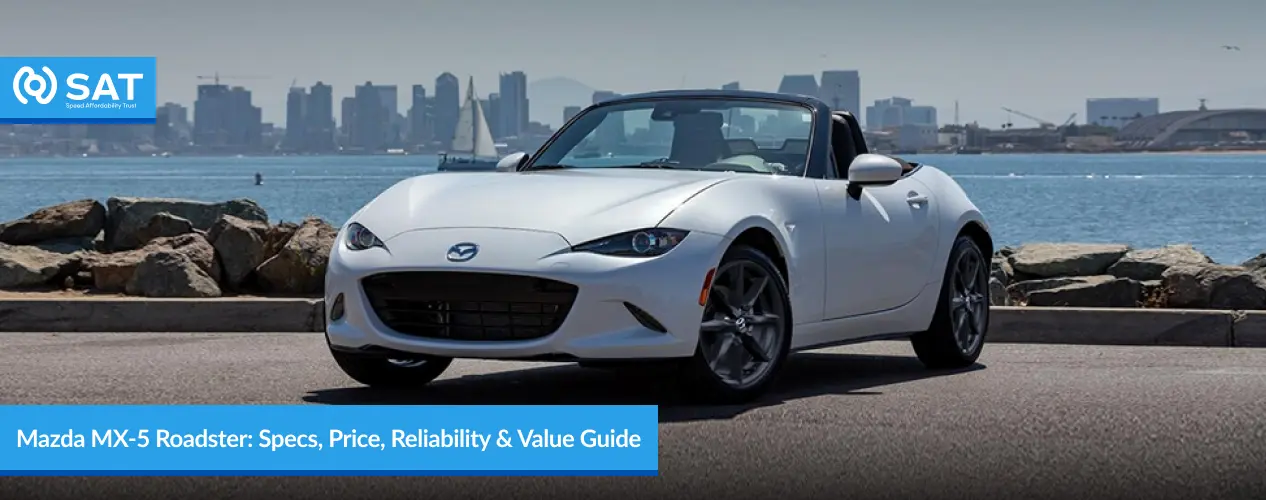
A great sports car doesn't have to impress you; it has to mean every mile. The Mazda MX-5 Roadster extends that idea to two seats, rear-wheel drive, and a driver-centric design.
But horsepower isn't the only thing to consider when choosing the right MX-5. The prices you can expect and the reliability you get depend on the engine, transmission, roof, condition, service history, and generation.
This guide offers you real-world usefulness, automatic vs. manual, parts and accessories, maintenance, and tips for buying an MX-5 Roadster.
The Mazda MX-5 Roadster is a two-seater sports car with just one vision: “the driver should feel attached to the car”. The MX-5's appeal isn't just in its compact size. Mazda has engineered deliberate choices to preserve its character. They explored various options, including front-, rear-, and mid-engine configurations, before settling on rear-wheel drive for its ability to deliver a more agile driving experience and linear handling characteristics.
The engineers also turned down a 2+2 cabin. Instead, they decided on a two-seat layout and a soft top that could be opened and closed manually. All these choices were made to maintain simplicity and excitement, but not to address the overarching weight-control issue.
There's another detail buyers should know. “Lightweight” was no hype word for Mazda. To enhance weight control, steering accuracy, and mechanical feel, the original frame was made out of a rigid powerplant frame; an aluminum hood and a stainless-steel exhaust were also used.
After all, that's the true essence of the MX-5: less hardware, more involvement. It's a roadster built to put normal roads in a class of their own, but without the extreme performance.
Key detail | Mazda MX-5 Roadster |
First introduced | 1989 |
Generations | NA, NB, NC, ND |
Layout | Front-engine, rear-wheel drive |
Seats | 2 |
U.S. launch engine | 1.6L naturally aspirated four-cylinder |
2026 U.S. engine | 2.0L SKYACTIV-G |
2026 U.S. output | 181 hp / 151 lb-ft |
2026 U.S. transmissions | 6-speed manual; 6-speed automatic on Grand Touring |
Roof/body configurations | Soft top and MX-5 RF |
2026 U.S. starting MSRP | $30,430 for Sport soft top |
When comparing an MX-5 Roadster for sale, first confirm the market, generation, model year, engine, transmission, and body style. These details can change the car's equipment and asking price, so comparing listings by badge alone can be misleading.
The MX-5's specifications include several figures that are important for buyers. In the current U.S. specification, Mazda lists a 13.0:1 compression ratio, an 83.5 mm bore, and a 91.2 mm stroke. The longer stroke relative to the bore helps explain the engine’s design, while variable valve timing manages airflow across its operating range.
Fuel capacity is 11.9 gallons, while the recommended fuel is premium unleaded with a 91 AKI rating. Mazda states that regular 87 AKI fuel can be used, but maximum engine performance may be reduced. That is useful information when estimating everyday fuel costs.
Cargo capacity is equally specific. The soft-top MX-5 provides 4.59 cubic feet of trunk space, while the RF offers 4.48 cubic feet. That small difference matters less than the shape of the space, so compact bags are more practical than large suitcases.
The MX-5 also uses a four-wheel disc brake setup with ventilated front and solid rear rotors, rather than mixing front discs with rear drums. Club models equipped with the available Brembo package gain Brembo front brakes, adding another specification worth checking when comparing used listings.
Fuel requirements, ground clearance, luggage space, and brake hardware can all affect day-to-day ownership.
Generation | Production era | Engine options | Key specification change |
NA | 1989–1997 | 1.6L, later 1.8L | Original lightweight two-seat RWD roadster |
NB | 1998–2005 | 1.6L, 1.8L | Revised body, chassis and engine range |
NC | 2005–2015 | 1.8L, 2.0L | Larger platform and increased equipment |
ND | 2015–present | 1.5L, 2.0L | Smaller, lighter modern platform |
Availability varies from country to country, and model year to model year. When quoting an exact vehicle, please use Mazda's official historical and regional specifications.
In a critical aspect, the North American car is different. Mazda's 2026 MX-5 Miata U.S. specifications include a 7,500-rpm redline, 181 hp at 7,000 rpm, and 151 lb-ft of torque at 4,000 rpm from a 2.0-liter, four-cylinder SKYACTIV-G engine.
The six-speed manual transmission is standard across the U.S. range, while the six-speed automatic is available only on the Grand Touring trim. The Sport and Club models are strictly manual-only. If you're looking at an automatic MX-5, that's a significant factor. Not all countries, generations, trims, and model years offer transmission options.
Mazda's U.S. owner's documentation lists the current MX-5 at 3,915 mm (154.1 inches) long and 1,735 mm (68.3 inches) wide, with a 2,310 mm (90.9 inches) wheelbase. The height varies by configuration and wheel size and is quoted here as 1,235 mm to 1,245 mm for the U.S./Canada models.
Those dimensions help explain the MX-5's practicality. This is indeed a compact sports car, not a big 2-seater grand tourer. The short wheelbase and narrow body also make it easier to park on narrow roads and in parking spaces.
Body style and transmission variations cause weight changes. The specifications differ between the hardtop and soft-top versions, and in the Japanese-documented Mazda RF specification sheet, they are listed as 1,110-1,130 kg, depending on grade and transmission.
If you're looking for a reference in the U.S. market, Mazda's manual MX-5 Miata Soft Tops weigh 2,366 lb while the six-speed automatic is 2,405 lb for the Grand Touring Soft Top.
This difference is useful when comparing the two transmissions. The automatic version isn't just another transmission option, either; in the aforementioned U.S. specification, it also adds 39 lb to the curb weight.
The original NA featured double-wishbone suspension at both front and rear, a conscious engineering decision made to achieve dynamic control. To enhance drivetrain response and feedback, Mazda also created a rigid powerplant frame between the transmission and differential.
New models include electronic chassis technology. Mazda's U.S. paperwork explains that Kinematic Posture Control (KPC) is a software-controlled system that uses the rear suspension and brakes to minimize body roll during high-g cornering. The system does this without increasing vehicle weight, Mazda claims.
It's a valuable used-car lesson: factory chassis hardware and the vehicle's current condition are not the same. If the dampers, bushings, tires, and alignment are worn on a used MX-5, the suspension may feel just like it did on a new one, even if the suspension is the same design.
The Mazda documentation currently lists various factory tire sizes depending on configuration, such as 195/50R16 and 205/45R17. This can be very important. The tires are a component of the car's handling system. When examining the tread depth on a used MX-5, make sure to check the brand, model, age, any uneven wear, and whether all four tires are matched.
The best specification for the MX-5 is thus not just one horsepower number. It is the vehicle's full factory setup and condition. These checks help determine whether a used MX-5 has the factory setup and condition you want.
Choosing an MX-5 is not just about choosing an older or cheaper vehicle. The decision depends on your budget, preferred generation, mileage, equipment, and maintenance needs.
With a new Mazda Roadster, you know the specifications, and there is no history of its previous ownership. While a used car may offer you the opportunity to buy at lower prices, its condition can be more important than its age or mileage.
It makes the most sense to buy a new MX-5 if you're looking for the latest spec, factory warranty, and predictable ownership from the get-go. You can also pay for the exact trim, transmission, color, and available equipment instead of settling for what's already available in the used market.
The main drawback is the higher purchase price of a new car. While the most recent model may seem like the best option, if you're more interested in the most MX-5 for your money, it can make more sense to choose a used model carefully.
The greatest benefit of the used purchase is choice through generations. Your budget will open the door to an NA, NB, NC, or ND, each with different engines, chassis, size, equipment, and driving character.
Not every 100,000-mile MX-5 is a poor choice. On the other hand, a car with low mileage but years of poor care and/or modifications should be thoroughly checked.
Begin with Vehicle History and Maintenance records. Check for signs of routine maintenance, past repairs, crashes, changes of ownership, and extensive engine repairs.
As evidence of completed service, Mazda recommends that owners keep maintenance records, receipts, and repair orders. This is particularly important when considering a used example.
Then, check the vehicle itself. Investigate the engine, transmission, manual clutch, brakes, tires, suspension, steering, underbody, lights, fluids, and convertible roof.
In the U.S., the Mazda MX-5 Miata begins at a $30,430 MSRP for the Sport soft top and goes up from there. The Club begins at $33,930, and the Grand Touring begins at $35,730. These figures do not include Mazda's $1,315 destination charge, taxes, title/license, and options.
2026 version | Starting MSRP |
MX-5 Miata Sport 6MT | $30,430 |
MX-5 Miata Club 6MT | $33,930 |
MX-5 Miata Grand Touring 6MT | $35,730 |
MX-5 Miata Grand Touring 6AT | $36,650 |
MX-5 Miata RF Grand Touring 6MT | $38,450 |
MX-5 Miata RF Grand Touring 6AT | $39,420 |
MX-5 Miata RF Club | $41,900 |
The quoted price is the starting price. Destination, taxes, registration, dealer fees, financing, insurance, fuel, tires, scheduled maintenance, and unexpected repairs are all items that can be part of your final purchase price.
Before you make an offer, you should compare at least five things: Generation, Model year, Mileage, Condition, and Specification. Then adjust your estimate for service history and immediate repair needs. When comparing the cost of ownership between two cars with very similar asking prices but one requiring tires, brakes, and suspension work, the true cost of ownership of the car with the required work might be significantly higher.
There is no single “best” MX-5. You will need to choose a suitable generation depending on whether you want a classic character, a more affordable one, contemporary performance, or the latest technology. While the four generations are quite different, basing a purchase on price may not yield the right car.
It is the NA that began the modern history of the MX-5. It was introduced with a pop-up headlight and a two-seater, Rear Wheel Drive. The first U.S. model was fitted with a 1.6-liter engine, and later they switched to a 1.8-liter engine.
If you want the original MX-5 experience and fancy owning a classic, then the NA is most appropriate. But its age alters the buying scenario. The condition, corrosion, previous repairs, and maintenance history are more important than the lowest price!
The NB was introduced in 1998 as the NA's successor and used fixed headlights instead of the NA's pop-up units. In various markets, Mazda also provided 1.6- and 1.8-liter engines – the 1.8-liter with a 6-speed manual transmission in Japan. On applicable models, the soft top has a glass rear window fitted with a rear defroster.
The NB is a good option if you enjoy the older MX-5 design, but are looking for a car that falls somewhere between the original NA and newer generations. Like all older MX-5s, do not take it for granted that age is a good indicator of this vehicle's condition.
The NC launched in 2005 with a newly developed 2.0-liter MZR engine in its North American launch specification. Mazda also worked on weight reduction, weight distribution, and more modern safety and environmental needs to create the NC.
The NC is also significant as the first generation to feature Mazda's Power Retractable Hard Top. This gave buyers a retractable hardtop option within the MX-5 range.
The ND is the fourth generation and is designed in line with Mazda's philosophy of “Innovate to preserve”. According to Mazda, development emphasized the vehicle's sports-car character while meeting many more stringent requirements today for safety and the environment.
In the U.S. market, it's currently powered by a 2.0-liter SKYACTIV-G engine that generates 181 hp and 151 lb-ft of torque. The current Mazda U.S. lineup consists of Sport, Club, and Grand Touring trim levels, with the new retractable-fastback body adding a new level to the lineup.
Do not fall into the trap of thinking the lowest price is the best price. A low-cost NA or NB may need a lot of work; a higher-cost ND may not need work right away. When comparing NC and ND cars, the same rule applies.
If using a used vehicle, add the purchase price to the immediate repairs, tires, brakes, and overdue maintenance. That provides you with a much clearer idea of value than the seller's asking price alone.
The manual MX-5 is the better choice if driving involvement is your priority. The automatic makes more sense if you spend a lot of time in traffic and want easier daily driving. For 2026 U.S.-market cars, Mazda pairs the 181-hp 2.0-liter engine with a six-speed manual across the range, while the six-speed automatic is available only on the Grand Touring.
The six-speed manual transmission leaves the driver in control of every transmission operation. It's a natural preference for people who like driving along curvy roads, switching gears often, and varying engine speed.
There's even a trim-level benefit. The manual version of the 2026 Grand Touring gets performance parts from the Club, such as Bilstein dampers, a front shock tower brace, DSC-Track mode, and an asymmetric limited-slip differential.
The six-speed automatic uses steering-wheel-mounted paddle shifters, giving the driver manual control when desired. It is offered on the 2026 U.S. Grand Touring rather than the Sport or Club.
That makes the automatic especially relevant for buyers who want the MX-5's compact size and open-air character without having to operate a clutch in stop-and-go traffic. The Grand Touring automatic also includes Mazda Radar Cruise Control with Distance and Speed Alert.
The smartest choice is not based on which transmission is “better.” Choose the manual if changing gears is part of the enjoyment for you. Choose the automatic if convenience matters more. With the 2026 U.S. lineup, remember that choosing an automatic also means choosing the Grand Touring trim.
Yes, the MX-5 has been a good car for resale value, but this depends on generation, condition, mileage, and body style. This is particularly appealing to individuals who are concerned about depreciation when purchasing the MX-5. After the Nissan Z, the standard MX-5 placed second among 18 two-seat cars for 5-year car resale value.
Age may not be the only factor. Before setting an asking price, a buyer should consider service records, mileage, accident history, corrosion, roof condition, tire condition, suspension, and modifications.
Generation also matters. An NA with original features may be more appealing to a different buyer than an NC or a nearly new ND. Other factors, such as equipment, transmission, body style, and local demand, may also affect the market value.
Be careful here. An MX-5 can be fun to own with a suspension kit, exhaust, wheels, or engine tuning, but doesn't necessarily translate to more value for any other buyer.
Maintenance, quality repairs, good condition, and desirable factory specifications are better assets than expensive modifications intended to boost resale value, and these have been documented.
Always retain all service invoices and repair records. Prevent issues that can cause significant expense. Avoid poor-quality modifications, keep the soft top or roof (RF) in good shape, and maintain the tires and suspension.
When putting the car on the market, show buyers how it has been cared for rather than just how it looks.
The MX-5 retains surprisingly well over the past five years, but doesn't promise to hold its value. The best advice for any buyer is to look for the right generation, specifications, condition, and maintenance history, rather than assuming that all MX-5s are equal in terms of retained value.
Not all parts of an MX-5 are created equal. Mazda's recommended maintenance plan includes checking steering linkages, suspension, ball joints, wheel bearings, dust boots on the driveshaft, brakes, and the exhaust system. These checks are important because deterioration in these areas affects not only the car's appearance but also its performance.
Pay special attention to tires. Mazda advises adhering to the specified tire size and not mixing different tire types. Mazda cautions that if a vehicle is fitted with a limited-slip differential and the tires are not the correct size or are out of balance, the differential may be subjected to continuous strain. This makes replacing tires a handling and drivetrain problem rather than just a routine purchase.
Another part that is unique to the MX-5 that needs protection is the soft top. Mazda offers separate maintenance instructions for the fabric roof and for the retractable hardtop for RF models. Cleaning and maintaining these parts in proper condition can help avoid costly roof repairs.
Mazda has set replacement frequencies for certain parts as part of routine service. The spark plugs are recommended at 75,000 miles, and the manual transmission oil is recommended at 60,000 miles for normal U.S. operation. Some intervals may be considerably shortened due to heavy use.
The most useful Mazda MX-5 accessories are those that address problems that can arise from the car's small size and open-air design. One of the most beneficial is a windblocker. It lessens rear wind blast as the roof is lowered, resulting in more comfortable open-top driving without altering the car itself.
The cargo tray is also quite a good idea for regular drivers. Mazda has one that will keep the trunk clean from spills and dirt. A matching cargo net will prevent small objects from moving around in the car at high speeds.
If the car is parked outside, a weather-resistant car cover can help protect the vehicle's exterior. The Mazda splash guard protects paint from road debris. These accessories are mainly intended to protect the car rather than change its appearance.
All-weather floor mats are a practical choice, particularly for those who drive in rainy or muddy conditions. Another useful item on Mazda's list is a roadside assistance kit for situations where you're stranded on the side of the road.
Cosmetic improvements require more consideration. Sport pedals, air-vent bezels, spoilers, and exterior trim are available but do not significantly alter either the look or the cabin feel. Mazda's accessory range also shows the difference between practical protection and personal styling.
For many owners, protection and comfort are more useful than cosmetic upgrades. Purchase the correct accessory, not the one that looks expensive.
There is no single reliability verdict that applies to every MX-5. Even though the Miata is a great car, buyers should verify the evidence to make sure it is the right car for them, especially for the model year in question.
See the recent recalls for proof. Mazda has issued a voluntary recall for some 2024-2025 MX-5 models due to a software issue that could prevent the traction control or stability control warning light from coming on when a fault is detected.
The problems with earlier vehicles have been documented, too. The 2024 safety recall by Mazda covers 2016-2023 MX-5s due to the possibility that the airbag control module software may respond to a minor crash with an incorrect deployment. The U.S. had approximately 77,670 cars impacted.
Those recalls do not by themselves mean that every MX-5 is unreliable. It shows model year studies are important. Buyers will want to look for open recalls before purchase, and should verify that recall work has been completed and documented.
Maintenance records provide another hard piece of evidence. Mazda's warranty paperwork states that owners must maintain service records, receipts, repair orders, and invoices as evidence of required maintenance.
So it's not only age or mileage that provides the best reliability signal. It's a particular vehicle that has been properly maintained and has undergone recall service.
The Mazda MX-5 Roadster is part of a small group of inexpensive rear-wheel-drive sports cars, though the cars most similar to the Roadster are not the same as it. The Toyota GR86 and Subaru BRZ are 4-seater, fixed-roof coupes. The MX-5 is open-top and has a much smaller footprint, sacrificing those rear seats. Before comparing the horsepower, the difference should be considered.
The GR86 and BRZ are more convincing options for those who frequently use the rear seats. They also feature a larger 2.4-liter four-cylinder boxer engine. They are a different sort of sports car, more functional and with more power in a straight line.
The MX-5 goes another way. It currently has a manual model in the U.S. that tips the scales at approximately 2,366 lb, and Mazda reports a 53:47 front-to-rear weight distribution on the soft-top model. The RF is heavier, but the basic principle is still the same: keep the car compact, have the chassis do more work.
The roof configuration is another important difference between the MX-5 versions. The MX-5 is offered in a classic soft-top roadster and a retractable hardtop roadster (RF). Mazda claims the opening and closing of the roof take around 13 seconds.
This makes the purchase decision pretty easy. Opt for the MX-5 if open-air driving, compactness, and mass are your top priorities. When more seats and a fixed-roof coupe layout are more beneficial, select the GR86 or BRZ.
The Mazda MX-5 Roadster has a distinct character on its own. Its compact design creates both its strengths and its limitations. Which makes its strengths and weaknesses result from the same choices. Let's take a look at the Mazda MX-5 advantages and disadvantages that you should consider.
The chassis is driver-oriented with a 51:49 front-to-rear weight distribution, independent suspension, and rear-wheel drive. Mazda also employs Kinematic Posture Control technology to help reduce body roll during cornering.
There is the classic soft top as well as a retractable hardtop. It takes approximately 13 seconds to open and close the RF roof, providing the owner with greater versatility between the roadster and coupe styles.
Manual Club models are equipped with Bilstein dampers, DSC-Track, and an asymmetric limited-slip differential. These are working enhancements and not appearance packages.
The two-seat layout limits its usefulness for families or buyers who regularly carry additional passengers.
The cargo space in the current MX-5 is only 4.48 cu.ft. Moving items or large bags, as well as shopping, can become hard.
Performance equipment may not be identical across trims. When looking at used MX-5s, it is important to find out the exact trim and equipment on the car you are considering buying, as cars do not drive the same way.
The Mazda MX-5 Roadster is easiest to understand when you look beyond the headline numbers. Its real strength is decision simplicity: choose the roof, transmission, and trim that match your roads, then spend your budget on condition and ownership costs.
For a new car, compare the final drive-away price, not only MSRP. Mazda’s 2026 pricing confirms that trim and transmission can change the starting point by thousands of dollars. For used cars, build a repair and service reserve before deciding that a cheaper listing is truly cheaper. That saves money.
If you are checking used Mazda through SAT Japan, treat the listing as a research starting point. Verify the exact chassis, model year, grade, equipment, condition, export paperwork, and total landed cost before comparing it with a local car. iSeeCars also reports strong five-year value retention, supporting the MX-5’s long-term appeal.
The Lexus RX is a wildly understated choice in a class full of loud German rivals. It is the SUV that effectively created the luxury crossover segment, and it still plays to those founding strengths of silence, smoothness, and visible build quality. Think of it as the well-made watch rather than a flashy one.
It is comfortable, generously well equipped, and genuinely easy to drive, with sharper styling than the slightly dull models that came before. Owners consistently praise the smooth, quiet ride, strong fuel economy, and more comfortable cabin. This Lexus RX review takes an honest look at how it performs, what it costs to operate, and whether it is worth your money.
Short on time? Here is the Lexus RX in five quick lines. Each point captures something that defines this luxury SUV.
Four powertrains, from a 275-hp turbo four to a 366-hp performance hybrid
The 350h hybrid returns 36 mpg combined, exceptional for a midsize luxury SUV
An exceptionally quiet, beautifully built cabin is the RX’s defining strength
Cargo space of 29.6 cubic feet trails most direct rivals, and there is no seven-seat option
Prices run from about $52,775 to $73,410
The Lexus RX 2026 makes several changes, and refines the 2023 redesign to perfect it. The 2026 model specifically adds:
Wireless phone charging, now standard across every model in the range.
A new Appearance Package, available on F Sport Handling and F Sport Performance grades.
A new Premium grade introduced on the RX 450h+ plug-in hybrid.
Seven grades in total: Standard, Premium, Premium+, Luxury, F Sport Handling, F Sport Performance, and F Sport Design.
The Lexus RX specs vary by powertrain. The range runs from an efficient self-charging hybrid to a performance model with nearly 370 horsepower, and every hybrid gets all-wheel drive as standard.
Specification | RX 350 | RX 350h | RX 450h+ | RX 500h |
|---|---|---|---|---|
Engine | 2.4L turbo four | 2.5L four hybrid | 2.5L four plug-in hybrid | 2.4L turbo hybrid |
Horsepower | 275 hp | 246 hp | 304 hp | 366 hp |
Torque | 317 lb-ft | 233 lb-ft | Not published | 406 lb-ft |
Transmission | 8-speed automatic | CVT | CVT | 6-speed automatic |
Drivetrain | FWD or AWD | AWD standard | AWD standard | AWD standard |
0 to 60 mph | About 7.2 sec (AWD) | About 7.4 sec | About 6.2 sec | About 5.9 sec |
Combined mpg | 24 to 25 | 36 | 38 on gas, 85 MPGe | 27 |
Electric range | None | Short bursts only | Up to 38 miles | None |
Fuel capacity | 17.8 gal | 17.2 gal | 14.5 gal | 17.2 gal |
Max towing | 3,500 lbs | 3,500 lbs | 3,500 lbs | 3,500 lbs |
The Lexus RX measures 192.5 x 75.6 x 67.3 inches placing it squarely in the midsize luxury class, large enough to feel substantial and manageable on a day-to-day basis. It seats five passengers across two rows, compared with rivals that offer seven-seater options.
Length: 192.5 inches
Width: 75.6 inches
Height: 67.3 inches
Wheelbase: 112.2 inches
Ground Clearance: About 8.2 inches
Curb Weight: 4,155 lbs (RX 350)
Buyers who find the RX larger than they should opt for its smaller sibling instead, and our complete guide to the Lexus NX vs. Lexus RX reveals all the differences in detail.
For most buyers, the RX 350h hybrid is the one to choose. It delivers 36 mpg combined, standard all-wheel drive, and the same quiet, well-built cabin as every other version, all for a price close to the entry point of the range. Nothing else in the lineup balances cost and running economy as well.
RX 350: Choose it if you want the lowest entry price or prefer a conventional turbocharged engine with a normal automatic gearbox.
RX 350h: The sensible default, and the best all-round buy for the majority of owners.
RX 450h+: Worth it only if you can charge at home, since up to 38 electric miles covers most daily commutes without using fuel.
RX 500h: The quickest at 5.9 seconds to 60 mph, but it costs far more and does not feel meaningfully different to drive.
Premium+ hits the sweet spot across the seven available grades. It adds the comfort and convenience features most owners actually use without the steep jump in price that the Luxury and F Sport grades bring. The full range runs Standard, Premium, Premium+, Luxury, F Sport Handling, F Sport Performance, and F Sport Design.
The F Sport grades are worth considering only if you want the sharper styling and the adaptive suspension, since they do not transform how the car drives. Luxury is the pick if cabin materials matter more to you than the drive, adding the richest trim in the range.
The starting price for the Lexus RX is about $52,775, giving it a significant advantage over its competitors.
RX 350: $52.775
RX 350h: $55,075
RX 450h+ Premium: $66,780
RX 500h F Sport Performance: $68,450
Current pricing on the used market is easy to check.
Expert Tip: The 350h sits at the sweet spot. A hybrid with a sleek look, 36 mpg fuel economy, plus All Wheel Drive, fitted into a neat package that is reasonably priced.
Lexus RX performance heavily depends on the trim you select, but the character remains consistent across all trims. This car is optimized for an effortless experience, rather than a blunt or inconsistent one.
Every hybrid RX is well suited for driving around town. Two decades of hybrid development reflect how unnoticeable the shifts in the system are when shifting from petrol to electric. Of course, all thanks to its superior sound deadening. Also, short electric-only bursts are possible in this self-charging hybrid, and up to 38 miles with the plug-in.
The RX is genuinely excellent for motorway driving, and this is where it makes the most sense. Refinement is superb, the adaptive cruise control works smoothly, and the seats stay comfortable over long distances. Wind and road noise are kept remarkably low, which makes covering big miles feel effortless rather than tiring.
The calm does break a little under hard acceleration. The CVT sends revs soaring on a slip road, and none of the four-cylinder engines sound especially strained while doing so. There is enough punch that the noise does not last long. Though of course, a six-cylinder rival might be more attractive here.
Buyers wanting a sports SUV should look elsewhere. Body control is decent and the steering is accurate, but the powertrains never encourage you to push, and even the 366-hp 500h does not feel different enough from the standard hybrid to justify its premium despite adaptive suspension, rear-wheel steering, and bigger brakes. A sport mode sharpens the responses without changing the fundamental character.
The RX is the cheapest of its main rivals to buy and the most efficient to run, but it trails them on cargo space, driving engagement, and seating flexibility. It competes in one of the toughest classes on the market, where each alternative has a clear strength of its own. The table below shows where the RX stands.
Model | Starting MSRP | Key strength | Where it beats the RX |
|---|---|---|---|
Lexus RX | $52,775 | Quiet cabin, 36 mpg hybrid, reliability | Fuel economy, price, and dependability |
Acura MDX | $53,250 | Three rows of seating as standard | Passenger capacity and value |
Genesis GV80 | $59,195 | Luxury feel for the money | Cabin design and standard equipment |
Volvo XC90 | $62,445 | Safety focus and three-row layout | Practicality and cabin space |
Audi Q7 | $63,395 | Standard third row and interior tech | Seating flexibility and cargo room |
BMW X5 | $69,750 | Six-cylinder power and sharp handling | Driving engagement and engine refinement |
The pattern is clear. If you want driving thrills, the German options are great. If you need a third row, the MDX, Q7, and XC90 have your back. But on price, quietness, and running costs, the RX remains difficult to beat, since it sells at a lower price in comparison to all its competitors.
The Lexus RX is quite practical with its roomy cabin that comes with smart storage, though its trunk capacity remains modest. Also, the driving position is quite easy to get right thanks to the electric adjustment system for both the seat and steering wheel. Storage is optimized as well, with a deep central console, spacious door bins, and lined cubbies that stop items from rattling.
Rear legroom of 37.4 inches is about average for the class, plus the headroom is generous if you ignore the panoramic roof, which is great for views but reduces headroom. Three adults can fit into the back seats, but it's a squeeze because the sloping roof makes the space feel tighter. Child seats are easy to install, thanks to anchor points and wide door openings.
The RX offers 29.6 cubic feet behind the rear seats, expanding to 46.2 cubic feet with the rear seats folded. Both follow closely behind rivals, some of which offer five or more additional cubic feet behind the second row and much more with the seats down.
The floor is low and usable, and the rear seats fold electrically at the touch of a button, but outright capacity is this car's weakest practical point. People looking for more space than the Lexus RX offers should consider the larger Lexus LX, which trades efficiency for genuine three-row space.
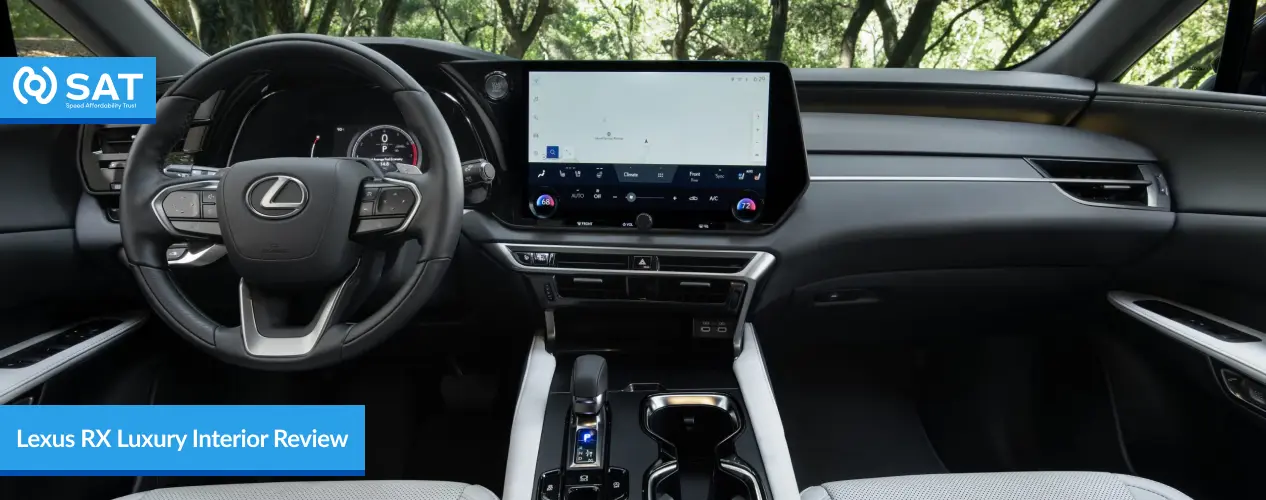
This is where the RX justifies its badge. Material quality is excellent throughout, including the lower cabin areas where rivals typically use scratchy plastics. Entry cars get synthetic leather, higher trims move to proper leather, and the top trim adds real wood inlays and a suede-like headliner.
The seats are the standout, offering tremendous adjustment and enough comfort for genuinely long journeys, though some passengers find them firm. Ambient lighting, a wireless charging pad, heated and ventilated seats feature on higher trims, and the overall effect is calm and expensive rather than showy.
The RX comes with a standard 9.8 inch screen-inch with two physical climate dials, which is quite nice. The higher trims get an upgrade of a 14-inch touchscreen with bright and responsive displays, and it includes wireless smartphone connectivity and multiple USB-C ports.
The interface itself is frustrating. Menus sit far from the driver, so reaching across while driving is awkward, and simple actions take too many taps. The unmarked steering wheel controls add to this, since you must hover a finger and read the head-up display to know what you are about to change.
Expert Tip: Pair your phone on day one and use CarPlay or Android Auto for navigation. The built-in system is the cabin's weakest element, and some connected features require a subscription once the initial period ends.
The RX 350h returns an excellent 36 mpg combined, while the standard RX 350 manages 24-25 mpg. That gap is the single strongest argument for the hybrid. It is rated at 38 mpg city and 34 mpg highway, and testers regularly record real-world figures close to those numbers, with Lexus hybrids often beating their quoted in-town economy.
Fuel economy at a glance:
RX 350: 25 mpg combined with front-wheel drive, 24 mpg with all-wheel drive.
RX 350h: 36 mpg combined, the efficiency leader of the range.
RX 500h: 27 mpg combined, modest given its hybrid badge, and nearer 25 in testing.
RX 450h+: about 85 MPGe, with roughly 35 mpg once the battery is depleted.
The plug-in quite literally rewards discipline. Charge it regularly on a home wallbox, which takes under three hours, and many drivers will rarely touch the petrol engine on a daily commute. Neglect the charging, and you’ll burn through your petrol faster.
Yes, comfort is the RX's core strength, with a smooth ride and outstanding noise cancellation. The suspension absorbs big bumps and shrugs off minor imperfections, which is impressive given that some versions run on 21-inch wheels. Wind and road noise are kept remarkably low. This is a car built for comfort, with no rushing, and it delivers that better than most rivals at any price.
Yes, the Lexus RX proves that safety is its genuine strength. The RX comes standard with a comprehensive suite of driver aids and performs strongly in independent crash testing, earning five stars in side-impact tests and four stars in frontal and rollover assessments, according to NHTSA safety ratings.
Standard safety equipment includes:
Pre-collision warning with pedestrian detection.
Lane departure warning, lane-keeping assist, and sway warning.
Adaptive cruise control and adaptive high beam.
Blind-spot monitoring with rear cross-traffic alert and braking.
Road sign assist, parking sensors, and safe exit assist for the electronic doors.
Safety equipment and ratings vary by trim and model year. Verify what is fitted on the specific vehicle.
Lexus RX reliability is among the strongest arguments for buying one. Lexus has a long-standing reputation for dependability, and the RX has been one of its most consistently reliable models for decades. Its hybrid technology is well-proven, refined over many generations rather than newly introduced, and the model has had very few recalls throughout its history.
Warranty coverage is competitive without being the class leader. The RX carries a 4-year or 50,000-mile basic warranty and a 6-year or 70,000-mile powertrain warranty, with the hybrid battery covered for 10 years or 150,000 miles. Sharing many components with mainstream models also tends to keep servicing costs below those of European alternatives.
Definitely yes, since its depreciation does the hard work for you while its reliability record stays intact. A well-kept model offers most of the new-car experience for considerably less money.
Run through this checklist before you buy:
Confirm a full service history, ideally with hybrid system inspections completed.
Check the hybrid battery health report and the remaining warranty coverage.
Verify which connected features are still active, since some expire after a set period.
Inspect the large alloy wheels and tires, as 21-inch replacements are expensive.
Test every screen function and check that the electric-folding rear seats operate correctly.
Ready to put that checklist to use? The Lexus RX models at SAT Japan have been inspected, with condition reports available for each. Take a look at the service history and mileage on a few before narrowing down your shortlist.
Here is a quick list of pros and cons, drawn from expert road tests and owner feedback. Weigh these trade-offs against how you actually plan to use the car day-to-day.
Pros | Cons |
+ Quiet, comfortable, sleek cabin finish | - Less cargo space in comparison to competitors |
+ Outstanding 36mpg economy | - No seven-seat trim |
+ Strong reliability and proven hybrid tech | - Not engaging to drive even in 500h |
+ Competitive starting price | - Infotainment is a bit clunky and complex |
+ Four powertrains, including a plug-in hybrid | - Four-cylinder engines become strained under hard acceleration |
+ Comfortable, even on larger wheels | - 500h costs more, but isn’t much different |
+ Generous standard safety and equipment levels | - Optional panoramic roof reduces rear headroom |
Whether you choose the standard hybrid or the plug-in, where you make your purchase matters just as much as what you buy. With SAT Japan, this process is straightforward, with the website displaying transparent condition reports and well-inspected vehicles. Take a look at our available stock for Lexus, and reach out whenever the time feels right.
This Lexus RX review leaves the RX with a strong recommendation, though for a specific kind of buyer. Its biggest strengths are cabin quality, quietness, and the 350h hybrid's remarkable 36 mpg economy, all backed by a dependable long-term reputation.
Its biggest weaknesses are modest cargo space, an awkward infotainment interface, and a driving experience that stays comfortable rather than engaging.
The 350h is the version most buyers should choose, pairing the full luxury experience with the best efficiency and standard all-wheel drive. The 500h adds pace, but not character, and the plug-in suits those who can charge at home regularly. If you want a quiet, luxury SUV that will not let you down, the RX remains one of the safest bets in its class.
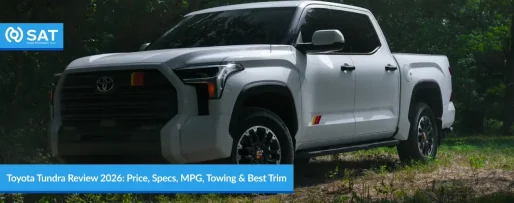
The 2026 Toyota Tundra is a good full-size truck, but not because it beats the Ford F-150 or Chevrolet Silverado 1500 on every number. It doesn't. Its main strengths are its twin-turbo V6, an even stronger hybrid, a comfortable coil-spring rear suspension, and a straightforward range that is easier to understand than some rivals.
The regular i-FORCE makes up to 389 hp and 479 lb-ft of torque. The 2026 Toyota Tundra i-FORCE MAX raises that to 437 hp and 583 lb-ft. Maximum towing is 12,000 pounds, and the range starts at $41,260.
The weak spots are just as clear. The hybrid doesn't save as much fuel as you might expect; the truck feels huge in tight spaces, and Ford offers more towing and payload capacity. To see if this truck is worth buying, read this 2026 Toyota Tundra Review.
The standard i-FORCE twin-turbo V6 makes up to 389 hp and 479 lb-ft of torque.
The i-FORCE MAX hybrid increases output to 437 hp and 583 lb-ft.
Maximum towing capacity reaches 12,000 pounds, while maximum payload is 1,850 pounds.
The Limited offers the best overall balance of price, comfort, technology, and available hybrid power.
The SR5 is the better choice for buyers focused on value.
The hybrid delivers stronger performance, but its fuel-economy advantage is modest in some configurations.
The 2026 model adds useful updates such as a standard 32.2-gallon fuel tank and tow hitch across the range.
Buyers who need class-leading towing, diesel power, or the most luxurious cabin may find stronger alternatives from Ford, GM, or Ram.
Specifications, pricing, equipment, towing, payload, and fuel-economy figures were checked against Toyota's official 2026 Tundra information. Independent performance and real-world driving data were compared with published testing from major automotive publications. Safety and recall information was checked against IIHS and NHTSA records.
The Tundra sits in the heart of the American full-size pickup class alongside the F-150, Ram 1500, Silverado 1500, and GMC Sierra 1500.
Toyota keeps things relatively simple. You get a 3.4-liter twin-turbo V6 or the i-FORCE MAX hybrid version of that engine, a 10-speed automatic, rear-wheel drive or four-wheel drive depending on configuration, and Double Cab or CrewMax bodies.
Bed lengths are 5.5, 6.5, and 8.1 feet. Maximum payload reaches 1,850 pounds, while maximum towing is 12,000 pounds.
What separates the Tundra is its balance. It has serious power without a V8, a composite bed, a comfortable rear suspension, and genuine off-road choices. What it doesn't have is Ford's huge configuration range, Ram's cabin polish, or GM's diesel option.
Looking beyond the Tundra? Browse Toyota cars to compare available models, prices, and options.
Here are the main 2026 Toyota Tundra specs worth knowing.
Specification | 2026 Toyota Tundra |
Vehicle type | Full-size pickup |
Engine | 3.4L twin-turbo V6 |
Hybrid | i-FORCE MAX |
Maximum horsepower | 437 hp |
Maximum torque | 583 lb-ft |
Transmission | 10-speed automatic |
Drive | RWD or 4WD |
Maximum towing | 12,000 lbs |
Maximum payload | 1,850 lbs |
Cab styles | Double Cab / CrewMax |
Bed lengths | 5.5, 6.5, 8.1 ft |
Seating | Up to 5 |
Fuel tank | 32.2 gallons |
Main off-road trim | TRD Pro |
One useful 2026 change is that the 32.2-gallon tank is now standard throughout the range.
The 2026 Tundra is not a redesign. The engines, transmission, and basic platform remain, while Toyota has focused on changes to equipment, comfort, and packaging.
Every 2026 Tundra now gets the larger 32.2-gallon fuel tank. A tow hitch and 7/4-pin trailer connector are standard across the range too, including the entry-level SR.
That sounds less exciting than a new engine, but both changes make the truck more useful. The bigger tank is especially welcome on long trips and when towing.
Limited models now feature leather-trimmed seating with revised black-and-gray designs. Double Cab models gain rear center-console air vents, while trucks with single-zone climate control receive Toyota's Smartflow system.
Capstone gets Shale Premium Textured leather. TRD Pro buyers can also specify ISO Dynamic seats, which use built-in damping to reduce some of the movement that reaches occupants over rough terrain.
Wave Maker joins the range as a TRD Pro-exclusive color. The SX Package receives 20-inch wheels, while Toyota has also revised the combinations available for its TRD-related packages.
The 2026 Tundra is mechanically very similar to the 2025 model. The engines, transmission, basic platform, cab choices, and core capability carry over.
Choose the 2026 if you value the now-standard 32.2-gallon fuel tank and tow hitch, the updated Limited interior, rear console vents on Double Cab models, or the latest TRD Pro options. If those changes don't matter to you, a discounted 2025 Tundra could offer better value.
Dimensions depend on cab and bed choice. Overall length runs from roughly 233.6 to 252.5 inches, while wheelbases range from about 145.7 to 164.6 inches. Width is around 80.2 inches before mirrors.
The practical lesson is simple. The longest Tundra is more than 21 feet long. Make sure it fits where you actually plan to park it.
Front space is generous in both cab styles. Rear space is where the difference appears.
CrewMax is the one to buy if adults or child seats regularly go in the back. Double Cab gives away rear passenger room in exchange for more work-friendly bed combinations.
The 2026 Toyota Tundra price starts at $41,260 MSRP for the SR. Toyota lists the following base prices before options and other applicable charges.
Trim | Starting MSRP | Best For |
SR | $41,260 | Work and lower budgets |
SR5 | $46,510 | Best value |
Limited | $54,860 | Most buyers |
Platinum | $63,695 | Premium daily use |
1794 Edition | $64,380 | Distinctive luxury |
TRD Pro | $72,565 | Serious off-road use |
Capstone | $80,800 | Luxury |
The right Tundra trim depends on whether you prioritize work use, value, comfort, off-road ability, or luxury.
The SR makes sense when the truck is going to work. You still get the composite bed and twin-turbo power without paying for expensive cabin extras. Its V6 uses a lower-output tune with 358 hp and 406 lb-ft.
The SR5 is where the range starts to feel complete without becoming expensive for its own sake. You get the stronger V6 tune and access to useful packages while keeping the price well below the luxury trims.
Limited is easier to recommend for family and daily use. Leather-trimmed seating and the large 14-inch touchscreen make the cabin noticeably better, and this is also where the hybrid becomes available.
Expert Tip: Price an SR5 with the options you actually want before ordering. Once several packages are added, the jump to Limited may make more sense.
Platinum adds comfort and luxury equipment for buyers who spend more time commuting than hauling. It is nice, but above $60,000, the Ram 1500 and GMC Sierra become harder to ignore.
The 1794 Edition takes a different approach to luxury, with details such as Saddle Tan trim and American walnut wood-grain accents. Buy it because you prefer its style rather than because it does something a Platinum cannot.
TRD Pro gets the i-FORCE MAX hybrid, four-wheel drive, FOX shocks, a 1.1-inch front lift, forged BBS wheels, and Falken Wildpeak all-terrain tires.
Capstone sits at the top with semi-aniline leather, 22-inch wheels, JBL audio and standard hybrid power.
At $80,800, though, the cabin needs to compete with some very polished luxury trucks. This is one Tundra we would compare with rivals before signing anything.
The 2026 Tundra offers strong gas and hybrid power, paired with a 10-speed automatic transmission.
2026 Toyota Tundra performance is strong even with the standard gas engine. Most gas versions make 389 hp and 479 lb-ft of torque. The SR gets the lower-output tune. The important number is torque. The regular engine already has enough low-rpm pull for quick merging, passing, and normal towing. You don't need the hybrid simply to make the Tundra feel strong.
The one thing some long-time Tundra owners may miss is character. The turbo V6 cannot reproduce the sound and feel of the old 5.7-liter V8.
The 10-speed keeps the engine in its useful torque range and settles into high gears quickly on the highway. Push harder, and it can drop several ratios to find power. Tow/Haul changes the shift behavior when extra weight is attached.
It generally suits the engine well, although some independent tests have reported occasional rough or busy shifts.
Toyota places an electric motor between the twin-turbo V6 and 10-speed automatic. Together they produce 437 hp and 583 lb-ft of torque.
It still feels like a conventional truck rather than a hybrid built around a CVT. The electric side mainly adds immediate low-speed shove and supports the engine when more power is needed.
It’s for Performance. That is the easiest way to understand i-FORCE MAX. It accelerates harder, responds quickly, and has 104 lb-ft more torque than the regular 389-hp V6.
Fuel economy improves in some configurations, but not enough to make MPG the main reason to buy it.
The table below shows the key differences between the standard i-FORCE gas engine and the i-FORCE MAX hybrid.
i-FORCE Gas | i-FORCE MAX Hybrid | |
Maximum power | 389 hp | 437 hp |
Maximum torque | 479 lb-ft | 583 lb-ft |
Best fuel economy | Up to 18/23 mpg | Up to 20/24 mpg |
Main advantage | Lower cost | More power and torque |
Best for | Value, daily use, towing | Performance and stronger acceleration |
Main trade-off | Less torque | Modest MPG improvement |
Buy the gas Tundra if you want a lower upfront cost and already have enough performance with 389 hp and 479 lb-ft.
Buy the hybrid if you want the strongest Tundra. Its 583 lb-ft makes the biggest difference when accelerating or asking the truck to work hard.
The hybrid has more torque, but Toyota's 12,000-pound figure is the maximum for the Tundra lineup and does not apply to every configuration. Check the towing rating of the exact cab, drivetrain, engine, and configuration you are buying.
It depends on the configuration. The Limited i-FORCE MAX can reach an EPA-estimated 20 mpg city and 24 mpg highway, but the fuel-economy advantage is smaller on some other hybrid trims. The hybrid's main benefit is its extra power and torque rather than a dramatic improvement in MPG.
Independent testing suggests the quicker i-FORCE MAX versions can reach 60 mph in roughly the mid-five-second range, while gas models generally take around six seconds or slightly more. Results vary by trim, drivetrain, and testing conditions.
Yes. The hybrid is properly quick for a large pickup, but the impressive part isn't chasing a stopwatch. It is how easily 583 lb-ft moves a heavy truck when joining a highway or passing slower traffic.
The Tundra uses an independent front suspension and a multi-link coil-spring rear setup rather than the traditional rear leaf springs found on many pickups. That gives it a more settled unloaded ride than older work-focused trucks. It still feels like a large pickup over broken pavement, and TRD tires can add movement and road noise.
The steering is predictable, and the truck feels stable at highway speeds. Body roll is noticeable, which is hardly surprising given its height and weight. Parking is a bigger concern than cornering.
Yes, in tighter areas. At roughly 80 inches wide before mirrors and more than 20 feet long in some forms, the Tundra needs space. A surround-view camera is one option we would actively look for rather than treating it as a luxury.
Here is what buyers can expect from the Tundra's powertrain, suspension, and size in everyday driving.
The engine isn't the difficult part of driving a Tundra in town. The size is. Throttle response is easy to control, and the transmission generally keeps things relaxed. The coil-spring rear suspension also stops an empty truck from feeling unnecessarily crude.
This is where the Tundra feels at home. The regular V6 has enough passing power, while the hybrid needs very little effort to gain speed.
Road noise changes with tires and trim. A Limited on road-focused tires is a much calmer long-distance truck than a TRD Pro on all-terrain rubber.
The suspension handles rough surfaces well for a full-size pickup, though the choice of wheels and tires makes a noticeable difference.
Expert Tip: Don't automatically order the largest wheel. More tire sidewall usually makes better sense on broken roads and can make replacement tires cheaper too.
A normal 4WD Tundra can already handle dirt roads, snow, and moderate trails. The TRD packages take things further.
TRD Off-Road is the sensible option for most recreational buyers. Available equipment includes an electronic locking rear differential, terrain modes, Crawl Control, and off-road suspension upgrades depending on configuration.
TRD Pro goes further with FOX shocks, a front lift, forged wheels, all-terrain tires, Multi-Terrain Select, and an electronic locking rear differential.
TRD Off-Road makes more sense for most people. Buy the TRD Pro if you will use its specialized suspension or simply want a complete factory off-road truck.
The 2026 Toyota Tundra towing capacity reaches 12,000 pounds when properly configured. That is plenty for many boats, campers, and work trailers, but it isn't class-leading.
Both engines have the low-rpm torque a towing truck needs. The hybrid's 583 lb-ft of torque gives it an especially strong response when pulling away or accelerating.
The 10-speed can also hold the engine in a useful range rather than forcing it to work at high rpm constantly.
Maximum payload is 1,850 pounds, but don't assume your Tundra can carry that much.
Cab choice, four-wheel drive, luxury equipment, and hybrid hardware add weight. Passengers, cargo, and trailer tongue weight also count against the available payload.
The 2026 Toyota Tundra fuel economy is acceptable rather than impressive.
Fuel economy varies by engine, drivetrain, and trim. The i-FORCE MAX hybrid can reach an EPA-estimated 20 mpg city, 24 mpg highway, and 22 mpg combined, depending on the configuration. Some gas and hybrid versions return lower figures, especially four-wheel-drive and off-road models.
Independent tests show that real-world fuel economy can vary significantly from the EPA ratings. Edmunds recorded 15.2 mpg from a 4WD Tundra on its evaluation route, while Car and Driver recorded 19 mpg from a gas Limited CrewMax on its 75-mph highway test. Its Tundra Hybrid returned 22 mpg in the same type of highway testing.
Expect towing, all-terrain tires, high speeds, cold weather, and heavy payloads to reduce fuel economy further. Results also vary by engine, drivetrain, trim, and driving conditions.
The new standard 32.2-gallon tank gives the Tundra useful range despite average fuel economy.
At 20 mpg, multiplying 32.2 gallons by 20 gives a theoretical 644 miles. At 18 mpg, that falls to about 580 miles.
Those are calculations, not guaranteed real-world ranges.
The Tundra's cabin changes noticeably by trim, but space, comfort, and straightforward controls are strengths across the range.
The 2026 Toyota Tundra interior is big, simple, and easy to understand. Toyota has kept physical controls where they make sense rather than putting every function behind the touchscreen.
Material quality is fine in SR5 and Limited models. Higher trims are harder to excuse because their prices move into luxury territory without completely changing the basic cabin.
The seating position is high, and visibility ahead is good beyond the tall hood. Better trims add power adjustment, heating, and ventilation.
CrewMax is the clear family choice. Double Cab makes more sense when rear-seat use is occasional and bed space matters more.
There is plenty of space in the center console, doors, and cupholders. Hybrid buyers should remember that battery packaging affects some under-seat storage.
Not outright. Toyota's layout is easy to use, and the 14-inch display is excellent, but Ram has a stronger claim to cabin richness. Ford also offers clever work-focused details that Toyota cannot match.
The 2026 Tundra is available with Double Cab and CrewMax body styles, with bed choices depending on the cab you select.
Feature | Double Cab | CrewMax |
Rear space | Tighter | Much better |
Beds | 6.5 or 8.1 ft | 5.5 or 6.5 ft |
Best for | Work and cargo | Families and daily use |
CrewMax suits most private buyers. Double Cab is the smarter tool if you regularly carry long cargo and rarely put adults in the rear.
The 5.5-foot bed is easiest to live with, particularly for urban and family use. The 6.5-foot bed is the best compromise for mixed use because it adds useful cargo length without making the truck as cumbersome as the 8.1-foot setup. Buyers who regularly carry long materials or prioritize cargo space should consider the 8.1-foot bed.
The standard screen measures 8 inches, while higher specifications get Toyota's much more impressive 14-inch system.
The larger display isn't essential, but it is worth having. Maps are easier to read and, more importantly on a truck this big, camera views are much clearer.
Wireless Apple CarPlay and Android Auto cover everyday phone integration. Higher trims add equipment such as a digital instrument display, JBL audio, and wireless charging.
The best Tundra technology helps you manage the truck rather than simply giving you another screen. A Panoramic View Monitor makes parking easier. Multi-Terrain Monitor views help off-road, while towing cameras are useful when lining up with a trailer.
Start with the surround-view camera. Then prioritize towing cameras if you pull a trailer and the 14-inch display if you use the truck every day. A head-up display is pleasant, but it wouldn't decide which trim we bought.
The Tundra gives you a high seating position and large mirrors, but the hood is tall, and the body is wide. That makes the cameras important around curbs, parking lines, and smaller vehicles.
Yes, provided your daily environment suits a full-size pickup. It is comfortable and powerful enough to make long commutes easy. If most of your driving involves tight garages and narrow city streets, the size becomes tiring.
Toyota Safety Sense 2.5 is standard and includes systems such as forward collision warning, automatic emergency braking, pedestrian detection, adaptive cruise control, lane-departure assistance, Lane Tracing Assist, Road Sign Assist, and automatic high beams.
Available equipment includes blind-spot monitoring, parking assistance, and additional camera technology.
Adaptive cruise is useful on long highway trips, while blind-spot monitoring matters on a truck this wide. For daily use, though, the camera system may be the feature you appreciate most often.
IIHS lists the 2026 Tundra extended cab with Good ratings in its small-overlap front and updated side evaluations. Headlights and the standard pedestrian front-crash-prevention system are rated Acceptable.
These results should be read by body style and individual test rather than turned into one blanket safety claim.
It is too early to call a 2026 truck proven. That matters because the current generation has had genuine engine trouble in earlier model years. Toyota’s strong reputation doesn’t erase those past problems.
The 2026 Tundra is not listed in the current engine-recall documentation discussed below, so it would be inaccurate to say the 2026 model has the same recalled defect. However, the problems affecting earlier current-generation Tundras are still worth considering when judging long-term reliability.
NHTSA has documented recalls involving certain earlier Tundras with the V35A engine because manufacturing debris could contaminate the engine, damage a main bearing, and potentially cause a stall.
A May 2026 recall covers certain 2024 Tundras and expands earlier campaigns. The recall documentation does not list the 2026 Tundra.
Expert Tip: Buying used? Check the VIN through NHTSA. Model year alone won't tell you whether a specific truck was recalled or whether the required work was completed.
Coverage | Term |
Basic warranty | 3 years/36,000 miles |
Powertrain | 5 years/60,000 miles |
Hybrid components | 8 years/100,000 miles |
Hybrid battery | 10 years/150,000 miles |
ToyotaCare | 2 years/25,000 miles |
Roadside assistance | 2 years/unlimited miles |
Yes. ToyotaCare covers normal factory-scheduled maintenance for two years or 25,000 miles, whichever comes first.
Fuel is the obvious expense, but tires deserve attention too. A basic SR5 on sensible wheels will generally be cheaper to keep in rubber than a truck wearing large luxury wheels or specialized off-road tires.
Insurance varies too much by driver, state, and trim to give one meaningful figure.
The hybrid can use less fuel, but the difference is not large enough to assume it will automatically cost less over several years.
The Tundra makes its strongest value argument in the middle of the range.
SR5 gives you the important truck hardware without a luxury price. Limited adds enough comfort and technology to justify spending more if the Tundra will double as a family vehicle.
The argument becomes weaker above $70,000 because the competition gets very good.
Yes, particularly as an SR5 or Limited. Those versions combine strong performance, useful towing ability, a practical bed, and good technology without pushing too far into luxury-truck pricing.
Strong 389-hp gas engine
583 lb-ft from i-FORCE MAX
Comfortable coil-spring rear suspension
Useful composite bed
Excellent available 14-inch touchscreen
Strong TRD off-road choices
12,000-pound towing maximum trails class leaders
Hybrid MPG improvement is modest
Large footprint in tight areas
Expensive upper trims
Some cabin materials feel ordinary for the price
No V8 or diesel choice
See how the 2026 Toyota Tundra compares with its main full-size truck rivals below.
Ford wins on choice and outright capability. The 2026 F-150 offers six engine choices in its towing guide, up to 13,500 pounds of towing capacity, and up to 2,440 pounds of payload.
Toyota's range is easier to understand, and the Tundra offers a composite bed and strong hybrid torque.
If you are looking to buy a Ford 150, look no further than our complete guide on the Ford 150 to see if it's worth buying.
Try the Ram if ride comfort and cabin quality sit above everything else. The Tundra is comfortable, but Ram still sets a high bar for full-size pickup refinement.
Read our latest guide on the Ram 1500 to have complete knowledge of the vehicle before you buy.
Chevrolet offers more engine options, including diesel power. That alone can decide the comparison for long-distance drivers and some towing buyers. The Tundra has a simpler lineup and a stronger identity if you want Toyota's hybrid or TRD hardware.
Check the SAT Japan Chevrolet Silverado listing to buy at the best price.
The Sierra matters most if you are considering Platinum or Capstone. GMC's premium trims make a convincing luxury case.
At $80,800 for a Capstone, we would sit in both before deciding.
Category | Tundra i-FORCE MAX | F-150 PowerBoost |
Horsepower | 437 hp | 420 hp |
Torque | 583 lb-ft | 570 lb-ft |
Maximum towing | Tundra range up to 12,000 lbs | 11,600 lbs |
Maximum payload | Configuration dependent | 1,740 lbs |
Main advantage | Strong torque | Pro Power Onboard |
Ford's 2026 towing guide confirms 420 hp, 570 lb-ft, 11,600 pounds of maximum towing, and 1,740 pounds of maximum payload for PowerBoost.
The Tundra hybrid is the better fit if you want Toyota's off-road hardware and stronger peak torque. The F-150 PowerBoost is more attractive for buyers who will make real use of Ford's Pro Power Onboard generator capability.
The Tundra doesn't need a class-leading number to make sense. Its character comes from putting a torquey engine, coil-spring rear suspension, composite bed, and genuine TRD off-road hardware into one relatively straightforward range.
That simplicity is part of the appeal. Pick the cab and bed you need, decide whether 479 lb-ft is enough or you want the hybrid's 583 lb-ft, then choose the equipment level.
Cab and bed size affect every day of ownership. Decide those before worrying about leather or wheels.
An option-heavy SR5 can get close enough to Limited pricing that moving up becomes worthwhile.
Most recreational off-road buyers don't need to spend $72,565 to get a capable Tundra.
A wide dealership road won't tell you whether the truck fits your daily life.
This is especially important with earlier current-generation Tundras because of the V35A engine recalls.
Best overall: Limited
Best value: SR5
Best work truck: SR
Best hybrid: Limited i-FORCE MAX
Best luxury: Capstone
Best off-road: TRD Pro
The Limited wins overall because it adds the cabin equipment people actually notice without going deep into luxury-truck pricing. It also gives you the choice of gas or i-FORCE MAX power.
If the budget matters more, buy the SR5.
If the Toyota Tundra fits your needs, you can explore Toyota Tundra models for sale at SAT Japan. Compare available model years, trims, mileage, specifications, and prices to find a Tundra that matches your budget and requirements.
Yes. The 2026 Toyota Tundra gets the things most owners use every day right: strong engines, a comfortable ride, a practical bed, good cabin space, and useful technology.
The Limited is our pick because it sits in the best part of the range. The SR5 is the better buy if value matters most.
There are reasons to walk away. Ford can tow more. GM offers diesel engines. Ram has a stronger luxury argument. The Tundra hybrid also doesn't save enough fuel to make the regular V6 irrelevant.
None of that makes the Tundra a poor choice. It simply means you should buy it for what it does well rather than for the Toyota badge alone.
For someone who wants one full-size truck for commuting, family trips, towing, and occasional off-road use, the 2026 Tundra remains a convincing package.
While the 2026 Nissan Murano may be easy to like, it might be more difficult to justify. It's important to remember that an SUV wants you to pay for something that could be a larger or better-equipped car instead.
The actual test is not the number of features that the Murano might have. There's something for everyone to love. The real challenge is whether its specific combination of comfort, technology, space, and everyday use is right for you and your driving style.
That's what we will do here. Rather than list the features, we'll examine the considerations and rationale for buying the Murano. By the end, you'll be able to tell if the Murano is right for you, not just on paper.
Comfort is the Murano’s main selling point. Its strongest appeal is a relaxed, premium-feeling experience rather than sporty performance or heavy-duty utility.
The SL deserves the closest look. It can bridge the gap between the value-focused SV and luxury-oriented Platinum, especially when equipped with the features you actually need.
The right buyer matters more than the spec sheet. The Murano makes the most sense for people who want a comfortable five-seat SUV for commuting and road trips. Its cargo area is useful for everyday needs, but buyers prioritizing maximum cargo versatility, fuel economy, or towing should compare alternatives.
The Murano is best suited for those who value comfort over style, particularly in terms of usability. Again, it seems easy, but it changes people's buying decisions. You're selecting what this SUV will be like on the road day after day, not what it will have on the back of the brochure.
The first question it has is fit. Someone who spends hours on the road might not care as much about the Murano as someone who wants more cargo space, heavy-duty towing, or the best gas mileage. That means that a test drive is more crucial than a simple trim comparison.
Buyers also have an advantage in terms of the timing. The Murano is currently in an unusual inventory situation, with unusually slow turnover, which can allow the buyer to negotiate rather than accept the price as final.
We're not recommending that buyers just rush and purchase the Murano; however, if they're looking for a more comfortable experience, they should definitely consider it.
Compared with the 2025 Nissan Murano, the 2026 model replaces the previous V6 with a 2.0-liter VC-Turbo four-cylinder and switches to standard all-wheel drive across the lineup.
There's no cheaper front-wheel-drive version to start with now – the lineup is now all AWD. That's an important distinction for drivers. It would make sense if all-wheel drive were already something you wanted, since you're getting the drivetrain you want without having to choose it separately. But if you live in a moderate climate, Nissan has taken away the chance to save money by opting for FWD.
What's more interesting is the change in the middle of the lineup. Nissan offers the SL with an available Comfort Package that adds a range of upscale touches to the model's range. This means that the SL is not just a middle tier between SV and Platinum, but could be a sweet option for someone who wants some luxury features without the Platinum level.
Another not-so-obvious purchase consideration is ProPILOT Assist 2.1. The hands-free system isn't standard on the Murano either. It's part of the Platinum technology package, which requires each buyer to choose whether they want that driving convenience.
As such, navigating the 2026 model year requires a close look at how the value was distributed across the new generation. Thus, it becomes more significant to ask what's new when comparing the SV, an SL with the Comfort Package, and the Platinum.
It's not about asking, "Which trim has the best features?" on the 2026 Murano. So, ask yourself, “Which trim offers the features that I will use?” That little change can add up to a lot of value to your purchase price.
The range of models, listed by Nissan at $41,670 for the SV, $46,760 for the SL, and $49,800 for the Platinum, before destination, taxes, and other charges, is capped. The SL is $5,090 higher on an MSRP basis, while the Platinum is $3,040 higher.
Those price rungs give us an important message: The biggest financial move is jumping into SL. Then it's less expensive to switch to Platinum, in absolute terms. The logical question then becomes whether you are getting what you want at the SL level or if it would be better to pay the extra money for Platinum.
For those who do not want the luxury extras, the SV is the logical choice for buyers who value the Murano experience. Several features make the car feel like a complete car already, and going up will largely be more about comfort, convenience, and luxury than completing a base car.
If you don't want the extra comfort features offered at higher trim levels, don't spend the money. If it's all you need every day, then you have no reason to settle for a less expensive option.
The SL sits between the value-focused SV and the luxury-oriented Platinum. It adds more comfort and convenience features than the SV, while an available Comfort Package provides additional upgrades for buyers who want more luxury without moving to the Platinum.
The Comfort Package adds features such as ventilated and massaging front seats and heated rear seats. These should be considered package options rather than standard SL equipment.
Before moving to Platinum, compare the standard SL with an SL equipped with the Comfort Package. This makes it easier to determine whether Platinum's additional features justify the higher price for your needs.
The Platinum is the top trim and is aimed at buyers who want a more luxurious Murano. It adds features such as quilted semi-aniline leather, massaging front seats, a panoramic moonroof, and a head-up display.
For buyers who specifically want these premium features, Platinum can justify the additional cost. For others, the standard SL or an SL equipped with the Comfort Package may provide enough of the features they actually use.
Avoid selecting Platinum just because it's a flagship. Use only the features you really want to make the SL on paper, and then look at Platinum.
The three-step check can show something a standard trim table cannot: the best Murano for you is neither the cheapest nor the most expensive. It is the one where the added equipment ceases to be useful enough to warrant "one more dollar.”
The spec sheet is only a partial record. The figures here illustrate Murano's position: a spacious five-door midsize SUV with more utility in mind than just utility.
Specification | 2026 Murano |
Engine | 2.0L VC-Turbo 4-cylinder |
Horsepower | 241 hp |
Torque | 260 lb-ft |
Transmission | 9-speed automatic |
Drivetrain | AWD |
Seating | 5 |
Wheelbase | 111.2 in. |
Length | 192.9 in. |
Ground clearance | 8.3 in. |
Fuel tank | 18.7 gal. |
Cargo behind rear seats | 32.9 cu. ft. |
Maximum cargo | 63.5 cu. ft. |
Maximum towing | 1,500 lbs. |
The Murano is quite long at 193 inches, and yet it retains 2 rows and 5 seats. It also has a 1,500-pound towing capacity, which indicates its intended use: not for heavy-duty hauling but for everyday driving.
The Murano's performance comes from its driving, not its horsepower figure. It's powered by a 241 hp, 260 lb-ft 2.0-liter VC-Turbo that powers through in a nine-speed automatic transmission.
The question is, when does that power come? The engine is quiet at higher speeds but lacks consistency at low speeds. A few tests have detected a gap before the power comes in and a heavier spike.
This can be confused by a short dealership loop. Stop, take a rolling turn, then pick up speed to around 30 mph and merge onto a highway. Those situations require different work from the engine and the transmission.
That test is also the reason that acceleration can be misleading. Some independent testing has reported 0-60 mph times ranging from 7.2 to 7.4 seconds, but the driving impressions differ. The numbers indicate the rate of acceleration, not how naturally the power is delivered.
The Murano's automatic transmission is a nine-speed automatic rather than the CVT found in the previous generation. That's a good character shift for a driver who likes feeling a different kind of shift.
However, it does not behave exactly as expected. Low-speed shifts can feel busy, while a quick downshift may take longer than expected. This may not be noticeable if you drive smoothly. It is easier to see when it is frequent stop-and-go driving.
The 2026 Murano has a highway fuel economy of 27 miles per gallon, an urban rating of 21 miles per gallon, and a combined rating of 23 miles per gallon. Those numbers take on greater significance when translated into driving range – its 18.7-gallon tank is rated to drive up to 505 miles.
The combined EPA rating comes out to approximately 430 miles per tank. With the highway rating, the theoretical distance increases to about 505 miles. These are projections and not guarantees, as fuel consumption may vary during actual driving.
At 23 mpg, the amount of fuel needed for an annual driving distance of 12,000 miles is approximately 522 gallons per year. If you are driving at 20 mpg, you will use approximately 600 gallons of fuel.
The difference is 78 gallons per year. The amount will depend on your fuel price, but the calculation illustrates why a small MPG difference can make a significant difference to high-mileage drivers.
Independent testing has resulted in ratings lower and in the vicinity of the EPA combined rating; owner experiences vary. The number can vary based on traffic, short trips, weather, tire pressure, driving style, and vehicle load.
So do not look for the Murano each week expecting to buy the EPA number. Set the standard at 23 mpg and measure your own driving against it. The Murano's gas mileage is more relevant if you do a lot of highway driving. When you have short trips to the city in your schedule, this is worth considering.
The Murano's tech is more about eliminating friction than about adding gadgets to the mix. All trims are standard with dual 12.3-inch displays, smartphone connectivity, 4 USB-C charging ports, and wireless charging.
The bigger value split comes higher up. SL includes Google built-in, Wi-Fi, and Bose audio, whereas Platinum includes a head-up display and more advanced connected functions.
There is one aspect worth noting regarding the functioning of the systems. Google built-in can be used, and even voice commands can be used without using your phone at all, while wireless CarPlay and Android Auto will allow you to retain your familiar phone setup.
Precision is the problem the available 3D camera system and Invisible Hood View address. They can make it easier to park and drive at low speeds, particularly in crowded areas.
The most sensible thing to do for most buyers is to simply purchase the technology they would use, not a bunch of features which sound good on paper.
The Murano cabin design is built around one concept: giving the two-row layout more purpose than it appears to have in a mini 3-row SUV. This ensures a comfortable front seat while still providing enough rear legroom for adults.
One thing most customers may overlook is the difference in passenger volume between the trims. Despite the equalized legroom, hip space, and shoulder space, Nissan claims 112.0 cu. ft. for the SV and 107.1 cu. ft. for the SL and Platinum. This renders the volume figures published less relevant to seating sizes than the actual figures when comparing trims.
There's also a compromise with the sleek design of the cabin. Lots of controls are touch-sensitive, and the low, wide dashboard is clean. This can make the interior feel modern; however, it can require much more maintenance for tasks like temperature adjustments.
That is more important than the material for everyday use. The Murano is most effective if you're willing to sacrifice some maximum utility and control simplicity in exchange for a comfortable, premium-feeling cabin.
The smart thing to do is to sit in both rows, adjust to a normal driver's seat position, and test the main controls before purchasing. A cabin looks great in the picture but is terrible in person.
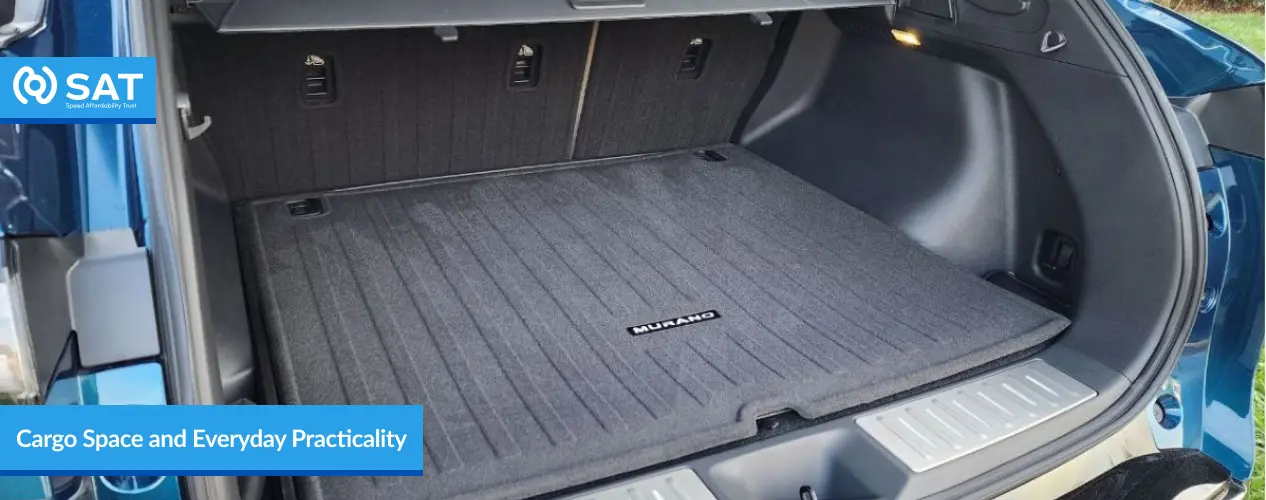
The Murano offers 32.9 cubic feet behind the rear seats and 63.5 cubic feet with the rear seats folded. That is useful cargo capacity for everyday shopping, luggage, strollers, and recreational gear, especially for a five-seat SUV. However, its two-row layout and overall dimensions do not make it a substitute for a larger, more utility-focused SUV when you regularly carry unusually bulky items or tow heavy loads.
Nissan also provides 39.7 inches of cargo-floor length behind the second row and 55.9 inches between the wheel wells. These measurements help put the headline cargo-volume figures into perspective when you're deciding whether the Murano can accommodate the items you actually carry.
Don't purchase anything without measuring the biggest expense. A vehicle can be spacious for cargo and yet fail to accommodate a single large item due to length, width, or height.
There are two layers to the safety story of the Murano. Protection and crash avoidance are the first, and equally key, systems in the lineup. The latter is driver assistance: As you progress through the trims, the experience evolves.
That's why the SV is more interesting than its price value would lead you to believe. It doesn't come with the top trim, but it has automatic emergency braking, blind-spot intervention, rear automatic braking, lane intervention, and adaptive cruise control.
The actual upgrade is ProPILOT Assist 2.1. It can be used with Platinum to offer hands-off, foot-off support in some circumstances. However, a driver-monitoring system continues to monitor attention, and Nissan is emphatic that the driver is responsible at all times.
That makes a difference for those buying, as hands-off isn't necessarily responsible-off. The system can be affected by weather conditions, road markings, traffic, and road surfaces, so it is meant to be used in combination with the driver and not as a replacement for them.
The Murano is also well received by independent safety ratings, such as the IIHS 2026 Top Safety Pick+ award.
Most buyers are getting the safety they need with the standard safety equipment. The Platinum upgrade is more of an opportunity for those who often drive on highways and get value from advanced assistance, not just for the sake of being impressive.
The simplest way to evaluate the Murano's cost of ownership is to divide it into fixed and variable costs. Warranty comes with a set of predetermined parameters. Not fuel, insurance, repairs, resale value, etc.
Nissan offers a basic warranty of 3 years and 36,000 miles, while the powertrain warranty lasts for 5 years or 60,000 miles. Roadside assistance is also valid for 36 months or 36,000 miles. It is easier to measure fuel. If you drive 12,000 miles a year at 23 mpg, you would consume approximately 522 gallons of gasoline per year. If the car gets 20 mpg, then it would use 600 gallons. Your fuel price and driving habits will determine the actual cost.
Depreciation is an area that needs more focus than is typically given. Industry estimates suggest that the Murano could depreciate by approximately 50% over five years, but this will vary with mileage, condition, market demand, and incentives.
This is an important buying rule: Do not just compare monthly payments. Consider the cost you are paying and the fuel, insurance, maintenance, and likely resale value you anticipate over the years you will be driving the car.
For a new model, it is not easy to make a confident long-term reliability judgment. Don't be misled into treating forecasts as guarantees; allow for some budgeting margins to cover costs not included in the warranty.
The Murano has a well-defined identity. The best aspects of its design all contribute to the same goal: to make everyday travel calm, comfortable and less demanding.
It doesn't come standard with the highest trim. The SL offers a solid combination of comfort and driver-assistance features, with the option to install some luxury upgrades without committing to all of Platinum, and it comes with a well-rounded blend of the two.
While it may seem like a minor detail, the two-row design can be a significant benefit for the ideal owner. When you need to transport 5 people or fewer, the Murano won't require you to pay for a third row you may never use. This allows its big footprint to be justified as a comfort vehicle.
Its best qualities work better when combined. They are designed to support the same type of ownership that includes long commutes, road trips, and relaxed daily driving, with comfortable seating, a quiet cabin, standard driver-assistance features, and useful connected technology.
That's what we enjoy the most. The Murano does not have to take all the categories. It's good when your SUV concept makes the miles feel easier.
The Murano's greatest problem is not a single bad attribute. It's the space between its near-luxury aspirations and the day-to-day elements that remain normal.
It's most obvious in the powertrain. It's a good production car, but it may feel less predictable to accelerate than the numbers suggest due to a lack of low-end power. It's the most important thing to look at in traffic, where smooth response is more important than the horsepower in the headliner.
The same balance can be observed inside the cabin. While the Murano is a polished model, a few controls will need extra attention. What seems new and high-tech when out of the car can turn less convenient when you're in the car.
Not to mention the ride. The Murano's seats and cabin are comfort-focused, although its suspension can feel firm over rough pavement.
There's another boundary: Utility. The Murano's two-row layout provides useful space for passengers, luggage, and everyday gear, but its 1,500-pound towing capacity limits it to lighter trailers. Buyers who regularly tow, carry unusually bulky loads, or need maximum cargo flexibility should consider more utility-focused alternatives.
All these compromises should not detract from its strengths; they are worth valuing. They might be comfortable and luxurious if you're looking for luxury and comfort in the cabin. When it comes to easy power, easy controls, a smoother ride, or just utilitarian, they're easier to ignore.
The Murano is easier to understand if you refrain from asking “which SUV is best?” and you ask “which compromise can I live with?” Each competitor offers something that the Murano doesn't.
Opt for the Murano if you rarely need a third row and want the cabin experience to be for about five people. Pick the Santa Fe when extra passengers or family gear take priority over a strict two-row layout.
This is the obvious selection for people who want to use less fuel. The Crown Signia's hybrid system provides it with a significant efficiency boost. In contrast, the Murano may be more suitable for those who prefer a traditional gas engine and a more traditional SUV design.
The Passport is a better option for those who want their SUV to work harder. The Murano better suits owners who like to use it for leisurely commuting and road trips, whereas the stronger engine and focus make it a better fit for owners who want utility.
The CX-70 is the driver's favorite. It's more oriented towards driving, and with its range of powertrains, it's appealing to those who like to handle it. The Murano offers a different deal: less thrill for a more laid-back day-to-day experience.
Need seven seats? Take a look at the Santa Fe.
Looking to save the most fuel? Notice the Crown Signia.
Want a more utility-focused SUV? Compare the Passport.
Looking for more responsive driving? Look at the CX-70.
Looking for a comfortable five-passenger SUV? It is worth considering the Murano.
The Murano is not a winner in all categories. The good thing is that its compromises are easy to explain. This makes it more about finding the SUV whose flaws affect you the least, rather than finding the perfect SUV.
The Nissan Murano is ideal for people who live in a five-seat, two-row environment. When you're traveling with a small group of passengers, a small SUV can be more convenient than a large SUV that lacks your favorite seats.
Also, it is suitable for those who spend a significant amount of time in the car. People who use the vehicle for commuting or road trips tend to value a relaxed cabin more than those who view an SUV as an adventure tool for weekends.
Here is a simple way to test the fit: count your busiest passenger day, not your average day. When family or friends join you on five seatings, the layout of the Murano should not bother you.
Your cargo habits matter as well. Everyday items, luggage, groceries, and regular recreational gear are well suited to the Murano's two-row layout. However, if you regularly carry unusually bulky furniture, large equipment, or a trailer, a more utility-focused SUV may be a better fit.
The Murano makes the most sense if you typically travel with five or fewer people and value cabin comfort, everyday cargo space, and relaxed driving. If your passenger, cargo, or towing needs change frequently, consider a more versatile SUV before making your decision.
Yes, but only if it's the right things you value. If you don't care about maximum fuel efficiency, towing, or sporty performance, the Murano is a good choice for you.
The worst thing you can do is look at the number of features. The more important question is if those features address the problems you're facing. Comfort is the key element of Murano's design, so if you spend long hours commuting, this can make a huge difference. When you need serious utility, you've got to deal with its compromises.
One useful point for Japanese-car shoppers is also worth noting. Although the automaker is Japanese, the current Murano is manufactured in the USA. Now Nissan is scheduled to launch this U.S.-made product in Japan in early 2027.
The distinction is important when comparing it with cars from Japanese exporters like SAT Japan. We have enough Nissan vehicles in stock to suit your driving style. A Japan-market import is not guaranteed to be the same specification, equipment, warranty, or parts support as a North American Murano.
If you prefer it to be comfortable and live that way, then purchase the Murano. Compare the exact trim price, test the powertrain in actual traffic, and review ownership costs before signing. If those three tests apply to you, the Murano is a much easier SUV to recommend.
The 2026 Toyota Sequoia may seem like the solution to a large family's biggest issues, just as long as you don't look beyond its size. Its hybrid powertrain delivers serious muscle, and its body-on-frame chassis reinforces its capabilities for what buyers expect from a full-size SUV. But there's a more interesting story here: how much of that size does help you once you start moving people, luggage, and a trailer? This is what this review examines. We'll dig deeper into Toyota Sequoia specs, fuel economy, towing capacity, performance, price, and trim levels, revealing where the great power of the Toyota Sequoia comes with some compromises.
The 2026 Toyota Sequoia will be a capabilities-focused, hybrid SUV. The 2026 Toyota Sequoia is a hybrid vehicle that's designed to be capable. It has serious towing power, great performance, family-friendliness, and available off-road gear, all in one.
The biggest compromises it has to make are space and value. The third row and cargo area are also less practical than those of some competitors, and upper trims may be overpriced to address these issues.
Select according to your style of driving. The SR5 and Limited are best suited for many drivers; the TRD Pro is best suited to off-road drivers; and Capstone buyers should be interested in luxury, not value.
The 2026 Toyota Sequoia is doing one thing right; it's not asking you if you want serious towing muscle or hybrid power. It has i-FORCE MAX, delivering 437 hp and 583 lb-ft of torque, with the best-rated models capable of 22 mpg combined.
There is one aspect that many buyers overlook. Large SUVs don't necessarily have a huge amount of usable space. The third row and cargo area are the biggest drawbacks of the Sequoia. If you are regularly driving with seven or eight people and equipment, the horsepower number is less important than that.
Strong hybrid powertrain
Excellent towing ability
Good fuel efficiency for its size.
Standard power-folding third-row seats
A variety of trims are available.
Tight third row
The cargo area may disappoint
The large size behind the wheel is evident.
A higher trim increases the cost.
The Sequoia is the best choice for those who tow regularly, desire a strong hybrid, or are seeking a full-size SUV with off-road capability. If your most important objective is maximum passenger and cargo space, it doesn't make much sense.
This is the difference that makes the 2026 Sequoia so special. Its impressive Toyota Sequoia specs, performance, and towing capacity are only half the story. The other half is how effective those strengths are in your daily life.
Specification | 2026 Toyota Sequoia |
Powertrain | i-FORCE MAX twin-turbo V6 hybrid |
Engine | 3.4-liter twin-turbo V6 |
Electric motor | Hybrid motor-generator |
Horsepower | 437 hp |
Torque | 583 lb-ft |
Transmission | 10-speed automatic |
Drivetrain | RWD or 4WD, depending on trim |
Maximum towing capacity | Up to 9,500–9,520 lb |
EPA fuel economy | Up to 21 city / 24 highway / 22 combined mpg |
Cargo space behind 3rd row | 22.3 cu. ft. |
Cargo space behind 2nd row | 49.0 cu. ft. |
Maximum cargo capacity | 86.9 cu. ft. |
Curb weight | About 5,620 lb, configuration dependent |
GVWR | About 7,350 lb, configuration dependent |
The 2026 Toyota Sequoia is not a complete redesign. Toyota retains its powerful hybrid powertrain and body-on-frame platform, and includes helpful comfort and convenience enhancements.
They now have power-folding third-row seats throughout the range.
Limited gets new leather-trimmed seats.
Capstone gets new Shale Premium Textured leather.
Standard massaging front seats are added for the 1794 Edition, Platinum, and Capstone.
TRD Pro features the exclusive Wave Maker exterior color.
The third-row power fold is probably the most useful modification. Not much of a boost to cargo volume, but certainly more convenient for shifting between passenger and cargo, particularly for a vehicle where cargo space at the back is a potential weak point.
The larger narrative is the things that did not change. The 2026 Sequoia features the same 437-hp i-FORCE MAX hybrid system and 10-speed automatic transmission.
Our take: The upgrades in the 2026 are important if you want to reduce the hassle of cargo use, enhance the cabin for easier access and greater comfort, or add upper-trim luxury. If 2025 is available at a large discount, however, the core vehicle is quite similar.
The 2026 Toyota Sequoia price starts at $65,725 for the SR5 and $86,135 for the Capstone. Destination charges, options, and taxes are not included.
Trim | Starting MSRP | Best For |
SR5 | $65,725 | Value |
Limited | $71,495 | Families |
Platinum | $81,735 | Luxury |
TRD Pro | $82,465 | Off-roading |
1794 Edition | $82,550 | Premium comfort |
Capstone | $86,135 | Maximum luxury |
SR5: The best option for buyers looking for Sequoia power and towing without luxury.
Limited: This is our pick for many families. Some comfort and tech upgrades add up to $5,770 more than the SR5.
Platinum: If maximum comfort is more important than value, it's worth considering.
TRD Pro: The choice for serious off-road use.
1794 Edition: Ideal for luxurious cabin styling.
Capstone: The high-end flagship, hard to justify without the best of its offerings.
Buyers should not miss another price note: 4WD adds $3,000 to the price of SR5 and Limited, and is standard on the four higher trims.
So, it is better, therefore, not to ask which is the “best” of the Toyota Sequoia trim levels, but which suits you best. List the features you will use. For most buyers, the SR5 or Limited is the best compromise; those higher trims are warranted only when luxury and/or off-road performance are key selling points.
For the 2026 model year, the Toyota Sequoia is powered by a single powertrain, the i-FORCE MAX hybrid. It pairs a twin-turbo 3.4-liter V6 with an electric motor and a 10-speed automatic to make 437 hp and 583 lb-ft of torque.
This is not a hybrid designed solely to save fuel. The electric motor is mounted into the transmission, providing the Sequoia with good low-end performance, while the twin-turbo V6 provides high-speed power.
It shows up when the tow is on. An independent test with a 4,850-pound trailer found that the Sequoia could reach highway speed uphill with just about half throttle. Fuel economy dropped to 10 mpg when towing, but rose to 22.8 mpg when unloaded on the same route.
The key point here is that the major benefit of the hybrid system is not always fuel savings during towing. It's delivering easy torque without a bigger engine.
The TRD Performance Package adds an engine tune, TRD intake filters, and revised exhaust plumbing. On the hybrid Sequoia, combined output rises from 437 hp to 466 hp, while combined torque remains at 583 lb-ft.
In independent testing, a 2026 Sequoia with the package reached 60 mph in 5.5 seconds, improving by 0.1 second over the same vehicle without the package. Its 50–70 mph passing time improved to 3.9 seconds, showing a more useful gain when accelerating at highway speeds.
The Toyota Sequoia performance doesn't really begin at the 0-60 time. It's the ability to pick up speed when loaded up, on a hill, or on the highway with this big vehicle.
Independent testing was conducted to demonstrate just how powerful its 437-hp hybrid system is, and it showed that the 2026 Capstone reached 60 mph in 5.7 seconds, while the TRD Performance version reached that speed in 5.5 seconds.
The more revealing number is the TRD Performance model's 3.9-second 50-70 mph passing time. This is the sort of acceleration you employ when driving on the road.
The compromise is body control. It's the truck-based design that gives it a bit of roll and dive, particularly compared to car-based models.
The Sequoia is powerful and confident but not sporty. The true strength is its ease of use, not its corner-carving capability.
The best fuel economy for the Toyota Sequoia is 22 mpg combined RWD / 20 mpg combined 4WD. However, those figures can mask the key fuel-saving advantage the Sequoia offers: load changes everything. Independent testing showed that a Sequoia got 22.8 mpg in its base model, but just 10 mpg when towing a 4,850-pound trailer. This is approximately 56% lower fuel economy.
Over 1,000 miles, that equates to approximately 44 gallons for an empty load versus 100 gallons when towing. So, if you are thinking of purchasing the Sequoia hybrid because the towing option will be affordable, think again. Its main benefit is that it delivers good fuel economy when you are driving normally, while still providing instant torque when you need it for heavy work.
If efficiency is the top priority, go with RWD. Switch to 4WD for grip and power, and expect to consume much more fuel when towing.
The 2026 Toyota Sequoia's towing capacity headline is just the beginning. RWD SR5 reaches 9,520 lb; 4WD Capstone is 8,980 lb, with other trims falling between.
The number on the Toyota door-jamb load label is the one to note. That is as significant as the trailer rating is to payload. The weight of a family, bags, and tongue weight can quickly consume your available capacity. Also on the Sequoia are helpful tow-and-haul modes and functions, such as TOW/HAUL and Tow+ modes, an integrated trailer brake controller, and available trailer-camera technology.
Don't buy a trailer based on its empty weight. Apply its full rated weight and the door-label ratings of your Sequoia to create a greater safety margin.
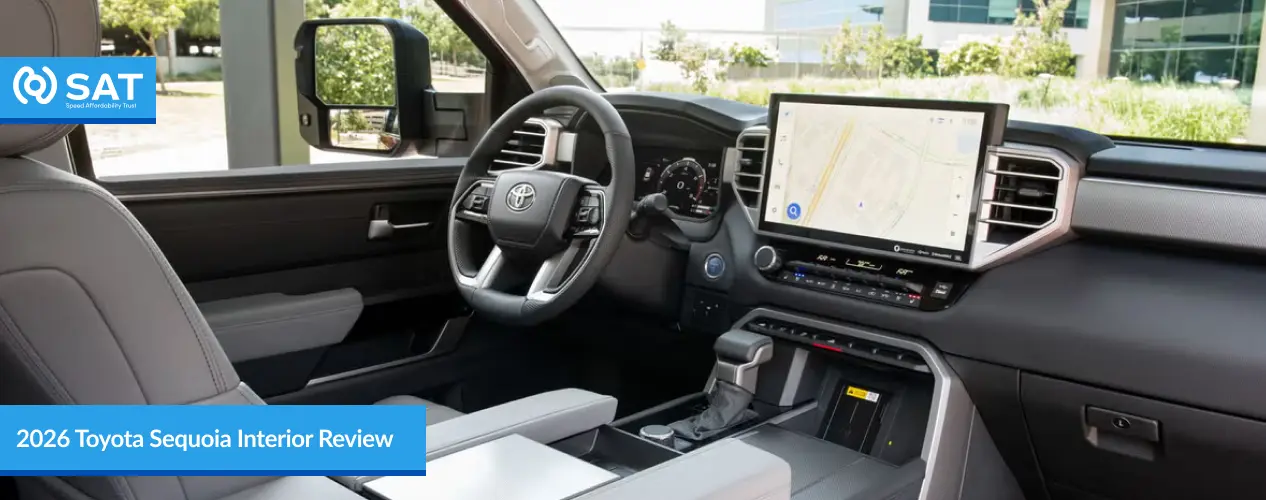
The interior of the Toyota Sequoia is best in the first two rows. The front seats are supportive, visibility is great, and Toyota maintains key climate controls within easy reach. Trims are available with increasingly rich materials, heated and ventilated seats, and massage capabilities.
The second row is the “cabin sweet spot.” A bench seat seats eight, while captain's chairs provide a seven-seat configuration and offer easier third-row access. The third row can be moved to achieve a compromise between the space available for passengers and cargo.
Technology is solid, with a 14-inch touchscreen, digital gauges, wireless smartphone pairing and charging, and a head-up display. But a few testers were less impressed with the screen size, and some noted connectivity issues.
The most surprising is cargo usability. Folded seats don't form a flat surface, and the hybrid battery raises the floor. A 2026 test by an independent party found the broad rear opening useful, whereas heavier cases were more difficult to lift and stack. That's when you have to think about the "most useful" way to evaluate this cabin: not just by the cubic feet, but how easy it is to load the items you really have to carry.
It's comfortable and well-appointed, but don't expect much living space in the Sequoia, given its size. Families should test the third-row seat and their real suitcases before purchasing.
The third row of the 2026 Sequoia is flexible, and it's not really big. It offers up to 33.7 inches of legroom and can slide almost 6 inches, balancing comfort and cargo space. The raised seats enable children to see forward, and reclining seats make long journeys easier. Second-row captain's chairs make it easier, too, as they clear the way to the back.
However, the narrow legroom and high floor are more apparent for adults. The third row is moved forward to gain more cargo space, which can make it uncomfortable for taller passengers. Another compromise is that sliding the seats forward boosts cargo capacity from an estimated 11.5 to 22.3 cubic feet, but the folded third row still doesn't create a level load floor.
The third row is good for children, teens, and sometimes adults. If three rows of adults are on your daily schedule, you'll find a bit more room for rear-row passengers on cars like the Tahoe and Wagoneer.
The 2026 Toyota Sequoia's rear cargo area capacity is 86.9 cu. ft. when the rear seats are folded, but this figure doesn't paint the full picture. The third row has a capacity range of 11.5 to 22.3 cu ft due to the slide-away seats. This gives a helpful option: provide a bit more legroom for passengers or reduce legroom to accommodate extra suitcases.
Rear opening is wide and square; great for bulky items. The issue below is that folded seats create an uneven surface, and the hybrid battery lifts the floor. Lifting heavy cases is more difficult, and stacking hard cases securely may be more difficult. Toyota's multi-level adjustable cargo shelf provides convenient cargo flexibility for groceries, bags, and smaller items.
The best way to determine this space is not based on the number of cubic feet. The layout might be cumbersome for contractors, photographers, or anyone carrying heavy, rigid equipment daily. Soft luggage and family gear should fit well.
Our verdict: Sequoia offers some good cargo volume, but it's not the cargo space itself; it's the cargo geometry.
The 2026 Sequoia's technology is more than just screens. It comes in the base SR5 model with an 8-inch touchscreen, and higher trims feature a 14-inch touchscreen. Using the phone is simple with wireless Apple CarPlay and Android Auto.
The standard digital instrument cluster is 12.3". The 800-watt JBL 14-speaker audio system, wireless charging, and digital rearview mirror are available as options on the base model, while a head-up display is available on the higher-trim models. Useful features include cloud navigation, Remote Connect, ‘Hey Toyota’ voice commands, 120-volt power, and USB-C charging ports.
It's operating with the smartest tech. Panoramic View Monitor, Multi-Terrain Monitor, Trailer Reverse Guidance, and Straight Path Assist can help with parking, off-roading, and backing up trailers. Be aware that the huge 14" screen may be impressive, but it can be more difficult to access while in the driver's seat. Edmunds has also experienced some connectivity problems.
The biggest screen is not the best technology on the Sequoia. It's the gear that provides greater confidence in visibility, communication, charging, and towing.
The 2026 Toyota Sequoia safety package is more than driver aids. Toyota Safety Sense 2.5 is standard on all trims. It includes automatic emergency braking with pedestrian detection, intersection support, emergency steering assist, adaptive cruise control, Lane Tracing Assist, Lane Departure Alert with Steering Assist, Road Sign Assist, and Automatic High Beams.
Standard features also include Blind Spot Monitor, Rear Cross-Traffic Alert, eight airbags, LATCH anchors, rear-seat reminders and parking assist with automatic braking. There are additional aids for owners who tow, which are specific to trailers.
Cameras available include Panoramic View Monitor and Multi-Terrain Monitor, and Trailer Backup Guidance and Straight Path Assist can make reversing a trailer much easier.
The biggest takeaway for customers is that there is a difference in safety between trims. Limited can get the Premium Auto-Leveling LED Headlights package and then receives the Good-rated setup. The Poor rating applies to the standard SR5/Limited reflector headlights. IIHS gives the standard vehicle-to-vehicle system a Marginal rating and pedestrian prevention a Good rating.
The Sequoia's safety equipment is strong, but it's more important to know what trim you're getting.
The 2026 Toyota Sequoia TRD Pro isn't a mere appearance package. It's a much more serious trail machine, but still retains Toyota's three-row cabin and hybrid powertrain. Standard features include 4WD, a two-speed transfer case, a locking rear differential, Multi-Terrain Select, Multi-Terrain Monitor, Crawl Control, and Downhill Assist.
Not to mention the hardware, which includes 2.5-inch FOX shocks, a 1.1-inch front lift, forged 18-inch BBS wheels, all-terrain tires, TRD skid protection, and a front stabilizer bar. The TRD Pro is not only an interesting build but also one that does a remarkable job of balancing the trade-off of being big and heavy yet still fun off-road. New, independent testing of the Sequoia revealed it to be surprisingly composed on a tough desert course.
However, there's a catch to that power. It is more rigid and noisier to drive on paved roads, and the Sequoia's width may make narrow trails more difficult than on a smaller off-roader. With all these features, inside the cabin is a family-friendly space with heated and ventilated front seats, second-row captain's chairs, a 14-inch touchscreen, JBL audio, wireless charging, and panoramic camera technology.
The TRD Pro is best for customers who want one SUV for work commutes and extreme weekend fun. If you don't often drive off-road, the lower-cost trims are better. If you're looking for a three-row hybrid that can actually handle off-road conditions, the TRD Pro is the Sequoia to go for.
Toyota is attempting to turn a rugged, truck-based SUV into a luxury family hauler with the 2026 Toyota Sequoia Capstone. It starts at $86,135 and includes some Shale premium-textured leather, walnut trim, 22-inch wheels, power running boards, acoustic glass, a 10-inch head-up display, and more.
The comfort suite is quite remarkable. Front seats come with heating, ventilation, and massage, and second-row seats come with heating and ventilation. A 14-inch touchscreen, 12.3-inch digital gauges, 14-speaker JBL audio, wireless charging, and a digital rearview mirror are also included.
However, there's a problem: the Capstone's luxury doesn't solve the Sequoia's packaging problem. It's tighter in its third row than some competitors, and heavy gear can be more difficult to load on the raised cargo floor.
The 22-inch wheels also look great and can give the drive a stiffer feel. Yes, optional adaptive suspension makes it better, but it's still an SUV, not a soft luxury crossover.
If you are looking for Toyota durability, hybrid power, towing capability, and true comfort in a single car, the Capstone is for you. If the focus is more on getting as much cabin space or luxury value for your money, then make sure you do a detailed comparison with the Platinum or other full-sized competitors before you spend money.
The 2026 Sequoia hasn't been proven to be reliable yet. It has a more complicated twin-turbo hybrid system, making it difficult to find long-term owner data.
The bigger confidence point is Toyota's coverage. The hybrid battery is covered for 10 years or 150,000 miles, while the powertrain is covered for 5 years/60,000 miles. ToyotaCare also provides scheduled maintenance for 2 years/25,000 miles.
The overall Sequoia history is helpful, but don't mistake data from the prior generation of repairs for information on the 2026 model.
The warranty coverage is reassuring for the 2026 Sequoia, though years of owner data will be required to truly assess its long-term reliability. This is a truer response than just saying all Toyotas are ‘bulletproof’.
Unfortunately, the 2026 Sequoia is still too new to have a definitive list of common failures. 9 NHTSA owner complaints, 0 recalls, and 0 investigations were listed at the time checked. These complaints are reports, not confirmed defects.
Reported areas are airbags, seats, steering, driver assistance, suspension, seat belts, visibility, and body structure. There have been a few reports of sunroof glass breaking and a few reports of a second-row seat-belt release issue, but these are individual reports and not an indication of a widespread defect.
There is one confirmed service concern: front brake squealing. Toyota's T-SB-0022-25 applies to the 2023-2026 Toyota Sequoia Hybrid models and includes a repair procedure. A service bulletin is not a safety recall. Older Sequoias also require context. For instance, the software recall for the rear camera applied to 2023-25 Sequoia Hybrid models, but not to 2026 models.
There are some early warning signs to be considered, but there's not enough evidence to suggest that the 2026 Sequoia is generally troublesome. Refer to the VIN for any recall information and keep an eye out for new patterns as more owners get miles on these SUVs.
The 2026 Toyota Sequoia doesn't come out on top in every category. For this reason, the comparison is important. The key benefits are the standard hybrid powertrain, decent towing capacity, and optional off-road equipment. Its biggest weakness is interior and cargo packaging.
Buyer Priority | Sequoia | Tahoe | Expedition | Yukon | Wagoneer |
Hybrid power | Standard | Available | Available | Available | Available |
Max towing | 9,500 lbs. | Up to 8,400 lbs. | Up to 9,600 lbs. | Up to 8,400 lbs. | Up to 10,000 lbs. |
Fuel economy focus | Strong | Good | Good | Good | Lower |
Third-row space | Fair | Excellent | Excellent | Excellent | Excellent |
Cargo flexibility | Fair | Excellent | Excellent | Excellent | Excellent |
Off-road ability | Excellent with TRD Pro | Good | Good | Good | Good |
Luxury focus | Strong in Capstone | Strong | Strong | Excellent | Excellent |
Best reason to buy | Hybrid + capability | Space | Family comfort | Luxury + space | Luxury + towing |
Choose the Sequoia for its hybrid power, hybrid torque, towing, and off-road capability.
Choose Tahoe, Expedition, or Yukon when more space for passengers and cargo is important.
Choose the Wagoneer when fuel efficiency is less of a concern and space and luxury are more important.
So the best comparison is not who's the best or the worst. The Sequoia is best at handling multiple challenging tasks, while its competitors excel in interior space or luxury enhancements.
The 2026 Toyota Sequoia is impressive in that it attempts to do several things all at once. However, there are some drawbacks to every great strength. That's what's important in determining if it's right for you.
Standard hybrid powertrain: High performance and very good full-size SUV fuel efficiency.
True towing capability: Designed for boat, camper, and heavy trailer owners.
Real off-road hardware: TRD Pro provides some serious upgrades to the trail—it's not all about the looks.
Flexible third row: Sliding and power-folding seats make switching between people and cargo easier.
Strong Technology: Equipped with available luxury features, connectivity, and towing aids.
Premium upper trims: Capstone delivers a unique blend of luxury comfort and truck-tough capability.
Cargo packaging: Hybrid battery creates a raised, uneven loading floor.
Space in the third row: Good for children and sometimes for adults.
Wide spaces: Can be a challenge to fit in narrow trails, parking lots, or narrow streets.
Ride quality: Ride-focused hardware can sacrifice comfort on road surfaces.
Top heavyweight design: Higher trims are entering the luxury-SUV category without addressing the lack of space.
Towing diminishes MPG: Large trailers can significantly reduce the hybrid system's advantages.
If you really need a tow, hybrid power and off-road capability in the same car, the Sequoia is the most practical choice. A rival might be a better choice if you're primarily interested in getting the most space for your family or luxurious comfort.
Yes, but only if those are the strengths that are right for you. The 2026 Sequoia is one of the few vehicles that combine a hybrid powertrain, power, and fuel-efficient performance in a single full-size SUV that can also handle some off-road work. Its compromises are no less significant. The third row isn't the best for tall adults, the extra level of loading floor isn't convenient, and the truck ride can be hard on pavement.
The Toyota Sequoia SR5 or Limited are the strongest value choices for many buyers. Select TRD Pro if you intend to use its off-road equipment. Select Capstone for its luxury features only.
Buy it for: hybrid functionality, towing, off-road power, and long-distance family duty.
Think twice if: maximum cargo space, third-row comfort, and luxury refinement are paramount.
Final verdict: The Sequoia isn't the best at everything. It's a winner because it combines features that few full-size SUVs come with.
Once you've seen the 2026 Sequoia in its entirety, purchase it for what you need in it and not just because of the Toyota brand. The most interesting aspect is the combination of family-friendly features, heavy-duty performance, and hybrid technology. The biggest question is whether you're comfortable with the space and packaging limitations.
Just as much care should be put into the buying process as into the actual SUV. SAT Japan can source vehicles from our inventory of Japanese new and used vehicles or from Japanese auctions. We provide auction sheets and clear photos, and arrange shipping and customs clearance services.
The Sequoia is a good solution when it offers more than other options. If you're importing via SAT Japan, first complete the paperwork and land cost calculations, then determine whether this large hybrid SUV belongs in your driveway.
If you are buying a Yaris, remember that this car is best for city driving, suburban areas, or heavy traffic. The hybrid feels at home because it glides away, sips fuel, and operates without needing a plug-in. The catch is the price. Rear space is tight, and hard acceleration brings plenty of engine noise. Explore the 2026 Toyota Yaris review to find out if this car is worth buying.
Buyer question | Quick answer |
What is it? | Five-door hybrid hatchback; no plug needed |
Toyota Yaris price | From £23,995 to about £31,245 before options |
Toyota Yaris engine size | 1.5-litre petrol hybrid |
Toyota Yaris horsepower | 116hp or 130hp total system output |
Toyota Yaris fuel economy | Officially 61.4 to 70.6mpg, depending on version |
Toyota Yaris dimensions | 3,955mm long, 1,745mm wide, 1,500mm high |
Toyota Yaris boot size | 286 litres with rear seats up |
Best for | Urban and suburban driving |
Think twice if | You need a large boot or frequent motorway comfort |
Overall Verdict: Good
Buy it for: Low fuel use in town, easy manners in traffic, strong safety kit and Toyota’s long warranty potential.
Think twice if: Tall adults use the back seats often, or your boot regularly carries a large buggy plus luggage.
Best version for most buyers: The Yaris Design. It sits in the sweet spot before prices climb sharply.
The UK car is now sold as the MY26 model, but this is not a clean-sheet redesign. Toyota has carried over the important changes from the recent update rather than introducing new bodywork or a new hybrid system.
You still get two versions of the same 1.5-litre hybrid. Icon and Design use Hybrid 116; Excel and GR Sport get Hybrid 130. The newer car also carries the improved digital cabin introduced on the updated Yaris, with larger displays available on higher trims, updated connected services and Toyota Safety Sense driver-assistance technology.
The trim range remains Icon, Design, Excel and GR Sport. If you already own a 2024 or 2025 Yaris, the 2026 car gives you little mechanical reason to trade up. A clean approved-used Design or Excel may be the smarter buy, particularly with a full Toyota history and useful warranty cover left.
This review is about the normal five-door Yaris hatchback. It is the sensible small hybrid for daily use.
The Yaris Cross takes the same small-car idea and stretches it into a compact SUV. You get more height and space. Whereas the GR Yaris shares the name, not the character. It is a turbocharged 1.6-litre, four-wheel-drive hot hatch and sits in a completely different performance class from the normal Yaris hybrid. Buyers often mix them up, usually after seeing the badge and assuming Toyota has made one very enthusiastic shopping car.
If you prefer the higher driving position and extra practicality, compare used Toyota Yaris Cross models available through SAT Japan.
Trim | Starting price | Key equipment | Key features | Who should buy it | Skip it if |
Icon | £23,995 | 16-inch wheels, reversing camera, phone connection, air conditioning and core safety kit | Core safety kit, reversing camera, smartphone connection, 16-inch wheels | Anyone focused on keeping the new-car price down | You want a more upmarket cabin or stronger engine |
Design | £24,910 | More styling choice, upgraded cabin details and extra convenience equipment | More visual appeal and useful comfort upgrades | Most private buyers | You only care about the cheapest monthly payment |
Excel | £28,645 | Hybrid 130, larger screens, more comfort and safety equipment | Hybrid 130, larger displays and more convenience features | Buyers who want more power and equipment | You could use that money for a larger car |
GR Sport | £30,095 | Hybrid 130, sportier suspension, sport seats and styling | Hybrid 130, sport styling, sports seats and firmer setup | Buyers who genuinely prefer the appearance and firmer feel | Comfort and value matter more than appearance |
The Icon is not stripped out. It has the basics that matter, including a reversing camera and modern safety equipment. That makes it a sensible lease car or a buyer’s choice when the monthly payment is the priority.
The Design is the better long-term buy for most people. The price gap from the Icon is small enough to justify if you value a nicer-looking car and more daily-use equipment.
Excel costs much more, and its extra power is welcome, but it is hard to ignore that you are getting close to larger-car money.
GR Sport offers a sporty shape with an aggressive grille and can be heavy on your pocket for daily use.
With SAT Japan Car Financing, the Yaris becomes affordable. Compare the deposit, monthly payment, total amount payable, and optional final payment. Do not judge a deal by the monthly figure alone. A big deposit or an unrealistic mileage limit can wipe out the apparent savings.
If we talk about Leasing, it suits people who want predictable costs and a new car every few years, but there is no car to keep at the end.
Used values are normally a Yaris strength. Toyota’s reputation, demand for hybrids and available warranty support help it hold value well. Still, do not pay nearly-new money for an older car when a new-car finance contribution narrows the gap.
The Yaris Design is the best choice for most buyers. It avoids the bare-minimum feel without drifting too far into the price territory of larger hatchbacks.
The Icon is a valid choice if a good finance or lease offer makes it clearly cheaper. Excel is good, but its premium is difficult to defend unless you specifically want the 130hp hybrid and the extra equipment. GR Sport is the emotional choice. That is fine, but it is not the rational one.
The Toyota Yaris is available with two hybrid power outputs, both designed around efficiency and easy everyday driving. The main difference is how much performance you want for faster roads and overtaking.
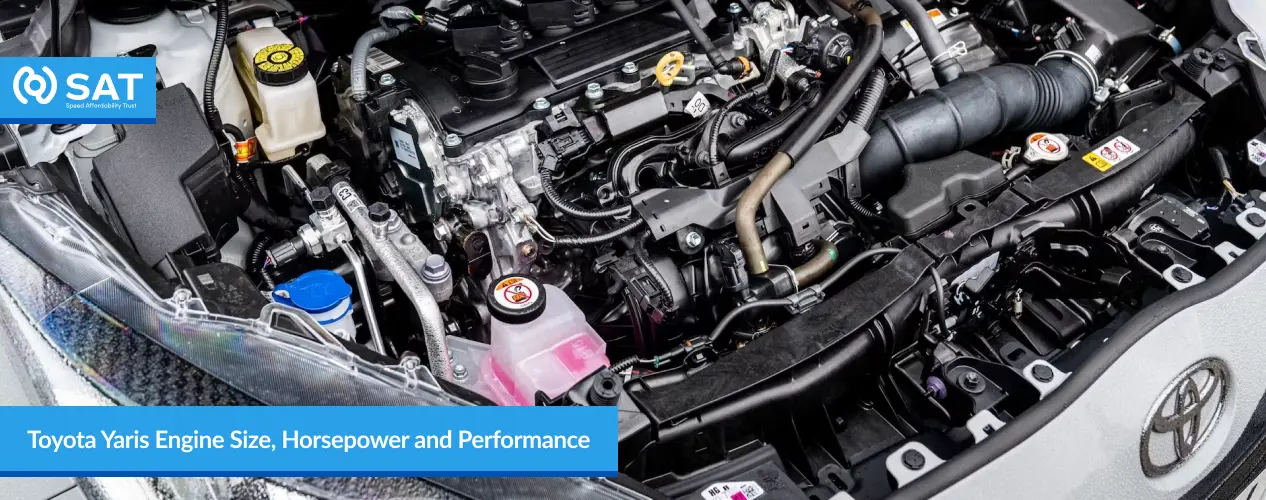
What Engine Does the Toyota Yaris Have?
1.5-litre hybrid with 116hp or 130hp
Under the bonnet is a 1.5-litre three-cylinder petrol engine working with an electric motor and a small battery. There is no charging cable to worry about; the Yaris is a self-charging hybrid.
It recovers energy when you slow down or brake, then uses that stored energy to help the car at low speed. In town, the Yaris can cover short stretches on electric power alone. That is why it feels particularly calm to leave junctions and crawl through queues.
It uses an e-CVT automatic transmission. It does not behave like a normal stepped automatic. Instead, it keeps the engine at the required revs. That is smooth in gentle driving, though the engine note can rise sharply if you accelerate hard.
The petrol engine’s power figure is not the same as the car’s total hybrid output. The combined system output is the useful number here because it reflects what the whole hybrid setup can deliver.
Buyers interested in the Japanese-market hybrid can also explore the Toyota Yaris Hybrid Z through SAT Japan.
Version | Engine size | Total horsepower | 0- 60 mph | Top speed | Best for |
Hybrid 116 | 1.5 litres | 116hp | About 9.7 seconds to 62mph | About 109mph | Town, commuting and lower running costs |
Hybrid 130 | 1.5 litres | 130hp | About 9.2 seconds to 62mph | About 109mph | Drivers wanting stronger overtaking response |
The 130hp car does not suddenly feel quick, but it has more breathing room when the road speeds up. Joining a fast road, passing slower traffic, or climbing with passengers on board takes less effort.
Verdict: Good
Key point: Strongest in town; motorway refinement is only average
Yes, especially the Hybrid 130. Around town, even the 116hp version feels lively enough because the electric motor responds straight away. It steps away from lights cleanly and fills gaps in traffic without feeling hesitant.
The limitation appears when you demand more. Press the accelerator firmly for a motorway slip road or an overtake, and the e-CVT lets the engine rev hard. Progress is still adequate, but it sounds busier than the speed suggests.
Still, anyone who spends most of the week at 70mph should try one before committing. The Yaris is in its element in town; as a small long-distance cruiser, it is merely okay.
The Yaris is neat rather than playful. It changes direction without fuss, keeps its body in check through bends and never feels tall or clumsy. The regular suspension is also the better fit for everyday roads than the firmer GR Sport setup.
That matters in the UK. Broken town roads, potholes, and speed bumps are more common than smooth test tracks. On rough roads, the standard setup takes the edge off potholes reasonably well. GR Sport tightens body movements slightly, but most buyers will notice the firmer ride more often than the added control.
It is not a sporty hatch as a Ford Fiesta once was, but it is more pleasant to drive than many small hybrids. The steering gives enough confidence, and the compact body makes it enjoyable on a twisty B-road without pretending to be a performance car.
For occasional motorway work, yes. For a heavy weekly commute, there are better small cars.
At speed, it stays composed, and adaptive cruise takes some of the work out of long runs. The 130hp car has a bit more reserve when joining traffic, but a Clio, Polo or Fabia keeps road and engine noise farther in the background.
Refinement is the issue. Ask for more speed on a hill or during an overtake and the engine becomes loud enough to dominate the cabin. If 200-mile motorway weeks are normal for you, a Corolla or a larger hatchback will be easier company.
Fuel economy is one of the Toyota Yaris’s biggest strengths, especially for drivers who spend most of their time in town. Running costs can also stay relatively low, although your actual fuel use will depend heavily on where and how you drive.
Toyota quotes 61.4-70.6 mpg on the WLTP cycle, depending on the version. The Yaris is most efficient at low speeds and with frequent braking; sustained motorway running is where the number drops.
Driving type | Expected result | Why it changes |
Town | 60 to 70mpg is achievable with gentle town driving | The electric motor works most often, and braking recovers energy |
Mixed roads | Around 55 to 65mpg is a sensible expectation | The hybrid can still help often, but speed varies |
Motorway | Around 45 to 55mpg is more realistic | At steady high speeds, the petrol engine carries more of the load |
CO2 output is officially 91-99g/km, depending on the version. That is useful for running costs, but road tax and company car tax still depend on the exact car, its registration date, and your circumstances.
Expert tip: The Yaris makes the strongest financial sense when your driving includes traffic, school runs and short urban trips. Buy it for motorway driving alone, and you are paying for a hybrid system that gets fewer chances to show off.
Verdict: Average
Key point: Easy to park, but rear space and the 286-litre boot are limited
Measurement | Toyota Yaris |
Length | 3,955mm |
Width | 1,745mm |
Height | 1,500mm |
Wheelbase | 2,560mm |
Turning circle | Around 10.4 metres |
At 3,955mm long, the Yaris is genuinely easy to fit into small garages and tight parking bays. The useful bit is that it still feels like a normal car from the driver’s seat, not something tiny and compromised.
For one or two adults, the cabin is plenty big enough. A young family can make it work too. There is good front-seat adjustment, and the low dashboard helps the cabin feel open rather than boxed in.
Rear space is where the compromise begins. Children fit in the back without much trouble. Taller adults will notice the shortage of knee room on a longer trip, though two can manage a short journey. Three is best treated as an emergency arrangement. Storage is fine rather than clever; the Honda Jazz does a better job of finding useful places for small stuff.
Space | Capacity | What it handles in real life |
Boot with rear seats up | 286 litres | Groceries, a few cabin bags or a compact buggy |
Boot with seats folded | Up to 947 litres loaded to roof | Flat-pack furniture, larger shopping loads and occasional bulky items |
Load opening | Fairly narrow and has a noticeable lip | Fine for bags, less pleasant for heavy or awkward boxes |
The Toyota Yaris boot size is average rather than impressive. Two small suitcases or several cabin bags are manageable. A compact stroller can fit, although parents should try their own buggy before buying, as bulky travel systems quickly use up the available space.
For an airport run with four adults and four full-size cases, the Yaris is not the right vehicle. The Polo, Fabia and Jazz all make more sense if luggage is a regular part of your life.
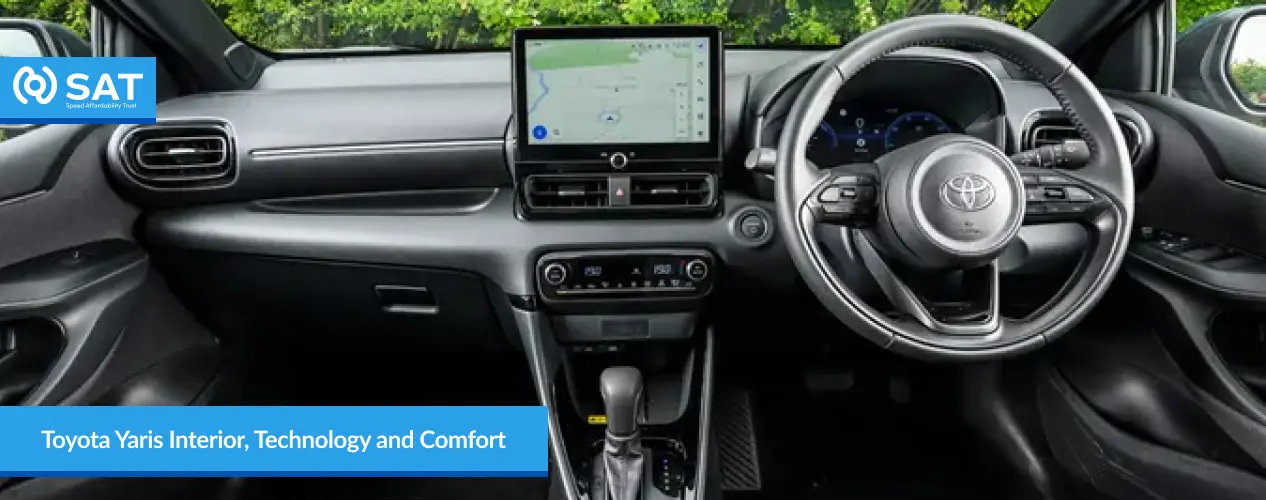
Inside, the Yaris has to balance small-car practicality with the expectations that come with its price. That makes the cabin an important part of the buying decision, especially when comparing it with similarly priced rivals.
The interior is well put together, and the driving position feels more grown-up than the car’s size suggests. The main controls are sensible, and Toyota has avoided burying every basic function inside a touchscreen.
Materials are mixed. The areas you touch most often feel solid, but there is still hard plastic lower down and around parts of the cabin. That is acceptable in a supermini. It is less acceptable once the price moves toward £30,000. The front seats are supportive enough for normal use. GR Sport seats look the part, but their value depends on whether you like the styling.
Screen size and equipment depend on trim. The entry Icon gets a smaller central display, while higher models can have a 10.5-inch multimedia screen and a 12.3-inch digital driver display. Apple CarPlay and Android Auto are available, and higher trims add useful extras such as wireless phone charging, navigation, upgraded audio and dual-zone climate control.
The equipment you should not compromise on: smartphone connection, reversing camera, adaptive cruise control and a specification with the safety features you want. Those make a bigger difference to daily ownership than sportier wheels or trim badges.
Strong safety kit and warranty support; used cars still need proper checks
The current Yaris has a strong set of standard driver-assistance features. Toyota Safety Sense includes a pre-collision system that can detect vehicles, pedestrians, cyclists, and motorcyclists, as well as lane support and adaptive cruise control. Higher trims can add features such as blind-spot monitoring, rear cross-traffic alert, and parking assistance. The Yaris earned a four-star Euro NCAP rating in 2025.
The Yaris has a good reputation for reliability, and Toyota’s warranty structure is a real advantage. A full Toyota service history can keep Service Activated Warranty cover running up to 10 years or 100,000 miles, subject to the scheme terms.
Hybrid technology is not automatically something to fear. Toyota has used it for many years, and the Yaris does not have a clutch, a starter motor, or a conventional automatic gearbox in the usual sense. Fewer traditional wear items can be helpful over time.
That said, reliability depends on the individual car. Check service records, recalls, and warning lights before buying used. A trusted badge is useful, but it is not a substitute for inspection.
There is no single universal Toyota Yaris problem that affects every car. On recent models, owners most often report minor electrical and convenience issues rather than major engine failures.
The 12-volt battery can cause trouble when a car is used only for very short trips or left standing. Infotainment and phone-connection glitches can also occur. Brakes may look rusty because the hybrid system uses regenerative braking and does not always rely heavily on the friction brakes.
Hybrid warning lights need proper diagnosis rather than guesswork. A warning can relate to many things, from a low 12-volt battery to a sensor or system issue. Do not buy a car with a warning light because the seller says it “just needs resetting.”
Before buying a used Yaris Hybrid, check:
A full service history, preferably with Toyota or a recognised hybrid specialist
Toyota hybrid health-check records where available
Outstanding recalls using the vehicle identification number
Any warning lights, especially hybrid-system or engine warnings
Infotainment, Bluetooth, air conditioning and driver-assistance functions
Tyre wear, brake condition and kerbed alloy wheels
Also take a proper test drive. It should start cleanly, move away smoothly, and switch between electric and petrol power without unusual warnings or harsh noises.
Rival | Better than the Yaris for | Worse than the Yaris for | Choose it if |
Honda Jazz | Rear-seat flexibility and practicality | Style and driving feel | You need more cabin space |
Renault Clio | Interior feel and comfort | Hybrid ownership confidence | You want a more polished cabin |
MG3 Hybrid | Value, power and equipment | Long-term ownership confidence | You want maximum kit for the money |
Suzuki Swift | Lightness and price | Hybrid sophistication | You want a simpler, cheaper small car |
Mazda 2 Hybrid | Similar hybrid setup | Differentiation is limited | The deal is better than the Toyota |
Volkswagen Polo / Skoda Fabia | Space and boot capacity | Hybrid town economy | You need a larger-feeling hatchback |
If you drive in heavy urban traffic every day, choose the Toyota. If your budget is tighter and you enjoy a lighter, more traditional small hatchback, choose the Suzuki.
The Toyota Yaris is better for buyers who want an automatic hybrid, strong town economy, and Toyota’s established ownership support. The Suzuki Swift is better for buyers who want a lower purchase price, lighter handling, and a simpler small car.
Choose the Yaris for compact-city convenience. Choose the Jazz when space matters more than style.
The Honda Jazz is the practical winner. Its rear-seat space, clever folding seats and tall cabin make it far easier to use as a small family car. The Yaris feels more stylish and a little more engaging through bends.
Choose the Clio for cabin feel and motorway comfort. Choose the Toyota if low-stress hybrid commuting and long-term confidence matter more.
The Renault Clio has a more polished interior and often feels more comfortable on longer journeys. It is also a better answer for buyers who want a small car that does not feel too small.
The Yaris has the stronger hybrid ownership story and is especially convincing in slow traffic.
The MG3 Hybrid is difficult to ignore because it offers more power, plenty of equipment and a lower starting price. It is the value choice.
The Yaris is the safer long-term bet. Toyota has deeper hybrid experience, a more established dealer network, and a better resale reputation. The MG3 is worth a serious test drive if value is the deciding factor. The Yaris is better if you are buying for the next five to ten years rather than just the first monthly payment.
These cars are closely related. The Mazda 2 Hybrid is effectively a Yaris with Mazda badges and small styling differences.
Do not overthink this one. Compare the exact specification, price, finance offer, local dealer experience, and warranty terms. Choose the better deal. There is no prize for paying more for almost the same car.
Reasons to buy | Reasons to think twice |
Excellent urban fuel economy | Average boot capacity |
Easy to park and drive | Limited rear-seat room |
Good standard safety equipment | Can get noisy under acceleration |
Strong reliability reputation | Some rivals offer better value |
Good resale potential | Not the strongest motorway car in its class |
Excellent in town, less convincing for space and motorway comfort
Yes, but for quite specific reasons. It is an easy, efficient small car rather than a bargain or a space champion.
Town driving is where it earns its keep. The car eases away on electric power, brings the petrol engine in without much fuss, and deals with stop-start traffic without clutch work or gear changes. It also has a good safety package and a reassuring warranty arrangement.
The weak point is space. Adults are fine up front. The rear bench is much better suited to children than taller grown-ups. The 286-litre boot is useful for weekly shopping, but it trails the Volkswagen Polo and Skoda Fabia. A Honda Jazz is much better if you need a small car that can regularly carry people and things.
A city or suburban commuter
A first-time hybrid buyer
A solo driver, couple, or small family with modest luggage needs
Someone who values reliability and resale
A buyer wanting a small automatic with low fuel costs
Expert tip: Buy the Design if it fits your budget. It is normally the sweet spot, while Excel and GR Sport ask a lot more money for upgrades many owners will not need.
Carrying adults in the rear often
Regularly transporting a large buggy or several suitcases
Driving long motorway distances every week
Looking for the lowest upfront price
Wanting a sporty or premium-feeling small car
Expert tip: Test the Honda Jazz if space is your priority. Test the MG3 Hybrid if price and equipment are your deciding factors.
If you are considering a used Toyota Yaris, it is also worth checking the Japanese import market. SAT Japan offers used Toyota models sourced from Japan, giving buyers another place to compare available cars, mileage, specifications, and prices. As with any used Yaris, check the vehicle details, condition, and available inspection information carefully before making a decision. To check all models of Toyota Yaris. Look at our Yaris inventory.
Yes, the Toyota Yaris is worth buying if you want a small automatic hybrid for town and suburban life. Its strongest advantage is simple: it makes daily driving easy while using very little fuel. It is also backed by a warranty arrangement that gives many buyers real peace of mind.
Its biggest compromise is practicality. The rear seats and 286-litre boot are adequate, not generous, and the engine becomes noisy when pushed hard on a motorway. Buy the Yaris Design for the best blend of price and equipment. Before signing, test-drive the Honda Jazz as well. It is less stylish, but it is much more useful if family space is likely to matter.
If you are considering a Japanese import, SAT Japan lists a wide range of used Toyota cars. Compare the model year, mileage, specifications, and condition before deciding which car offers the best value.
The cheapest Japanese car to import isn't always the best bargain. The important thing is what you receive after shipping, taxes, registration, and UK prep, and how that final price compares to the price of a similar car already in the country. That's why this guide takes a different approach. We've identified 10 of the very best Japanese used cars for real ownership in the UK. We will review reliability, running costs, parts availability, resale value, importability, and hidden costs for each car. By the end, you will not only know which car is best but also whether you should purchase it in the UK or import it from Japan.
Don't just pick the car because of its price. The ideal Japanese used car is the one that is right for your driving requirements, budget, and long-term ownership in the UK.
There are many benefits to Japanese imports. For example, the Toyota Vellfire and Jimny Sierra, and the Alphard and Sienta, can make more exotic cars or variants available to UK buyers.
Remember that the price is not the only thing to consider. Before considering a Japanese car to be good value, investigate its history, import prices, UK compliance, servicing and parts availability, and its resale value.
Choosing the best Japanese used cars in the UK market isn't simply about assessing reliability ratings and popularity. A car that performs well in Japan is not necessarily the best for British drivers.
The market in the UK is different: driving conditions, different insurance requirements, parts availability, emissions legislation, servicing networks, and different resale expectations. Each vehicle has been rated against a set of criteria which assess its performance across the entire vehicle ownership lifecycle.
The following 8 areas were assessed for each vehicle:
Category | Assessment Criteria |
Reliability | Engineering reputation, known faults, durability and long-term ownership experience |
UK suitability | Environment, road surface, usability and convenience of use |
Ownership costs | Fuel economy, servicing/repair needs and insurance and maintenance requirements |
Parts and support | Access to components, specialist and technical expertise in the UK |
Value proposition | Compare the price of the purchase with features, condition and alternatives |
Resale potential | The UK market demand and ease of selling in the future. |
Practicality | Passenger capacity, comfort suitability, storage and lifestyle suitability |
Import opportunity | Whether it is really an advantage to import the vehicle from Japan. |
No matter how well-engineered a car is, it won't be a good purchase if it is poorly supported in the UK, has high specialist repair costs, and/or has low resale value. Similarly, if a Japanese import offers features, configuration or vehicle types which are not available in Britain, this can be a huge opportunity to get exceptional value.
For imported vehicles, we also took into account the total cost of ownership: vehicle cost, import costs, preparation, maintenance needs, and resale value.
This is one way to find out which cars have true lasting value rather than just pretty face value.
Not all Japanese used cars are the most cost-effective or the best car. But a smart buyer must move beyond the badge and learn how the car will perform as soon as it hits UK roads. Our top picks are:
Toyota C-HR
Toyota Prius
Toyota Sienta Hybrid
Suzuki Jimny
Toyota Vellfire
Toyota Alphard
Nissan Serena
Toyota Vitz
Toyota Aqua
Nissan Note
The ranking is based on the full ownership experience, including reliability, running costs, servicing support, practicality, resale demand, and whether importing the vehicle from Japan is a genuine benefit.
Some cars are a success because they're easy to own. Others stand out because they offer a product not available in the UK market. The key is knowing which cars offer good value.
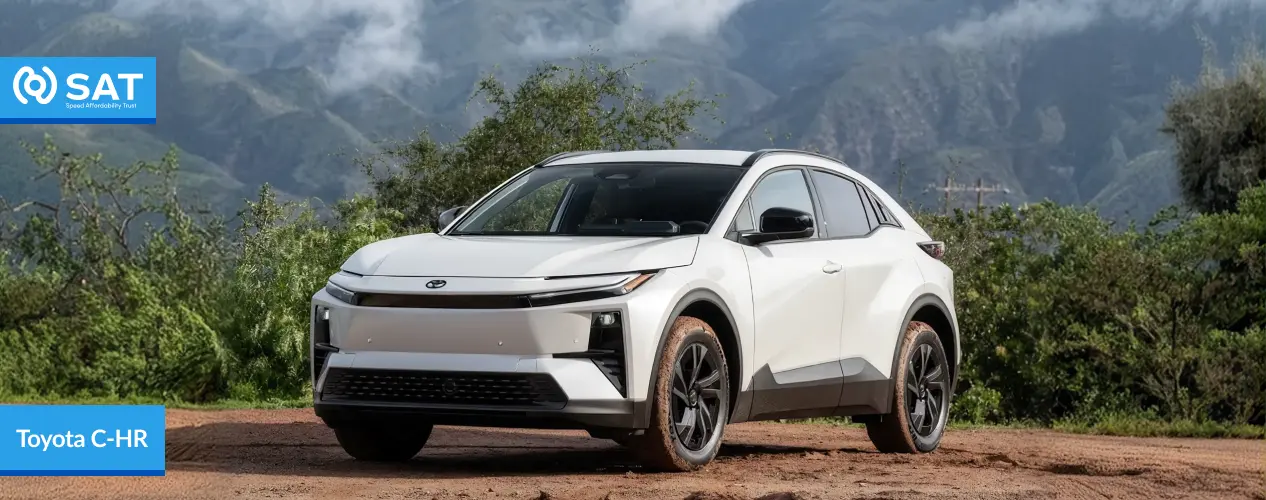
The Toyota C-HR's appeal lies in its SUV design, offered at a more affordable price point than its more traditional SUV counterparts.
Its size makes it easy to travel through UK cities, and its hybrid system helps to maintain low fuel costs.
The Toyota C-HR isn't the largest family car, but it is an excellent choice for those interested in efficiency, comfort, and contemporary styling.
The greatest plus is its balance. It makes users think it's an SUV but still maintains the reliability that Toyota hybrids have earned.
Import advantage: C-HR is well-established in the UK market, with good availability and support.
The C-HR is ideal for urban commuters, families, and buyers looking to move away from traditional hatchbacks.
Verdict: One of the best Japanese hybrid crossovers for general use on UK roads.
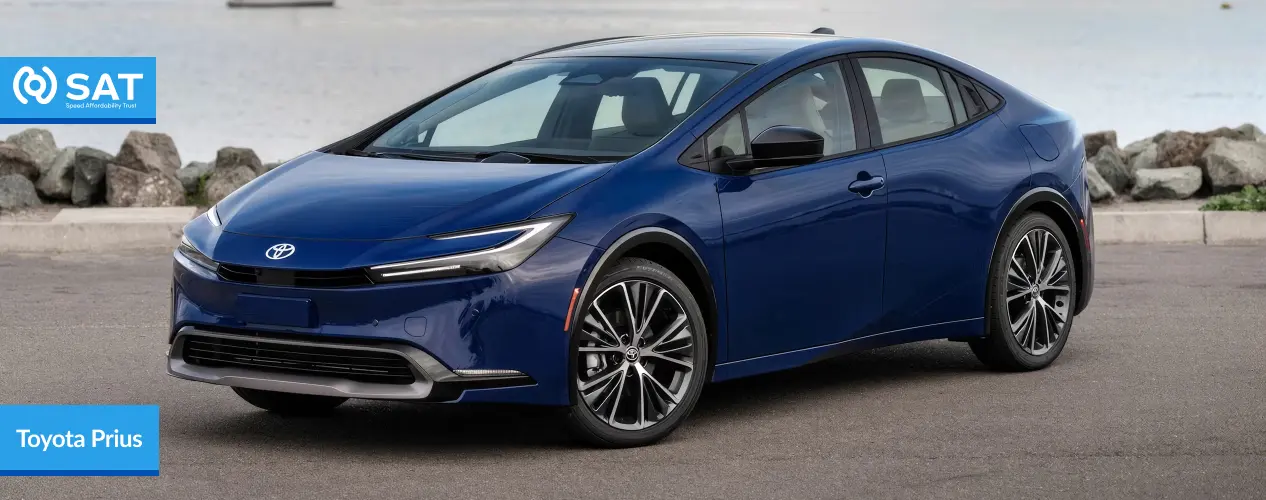
Toyota's Prius is undoubtedly one of the most significant hybrid cars ever made. It's known for its efficiency, durability, and low operating expenses. It is a smart choice for drivers who cover high annual mileage, since its design is geared toward reducing routine costs.
The Toyota Prius isn't a vehicle that's designed to be exciting. The combination of reliable ownership and hybrid technology is what buyers are looking for, making it a popular choice.
There is one important buying tip to keep in mind: Do not base your purchase on mileage. A high-mileage Prius, if properly maintained, can be better than a low-mileage car with a poor history.
Import advantage: Medium. Different specifications are offered with Japanese imports, but UK models already have good support. The Prius is perfect for business drivers, commuters, and those seeking the greatest efficiency.
Verdict: It's a good option for someone who cares more about value for the money than appearance.
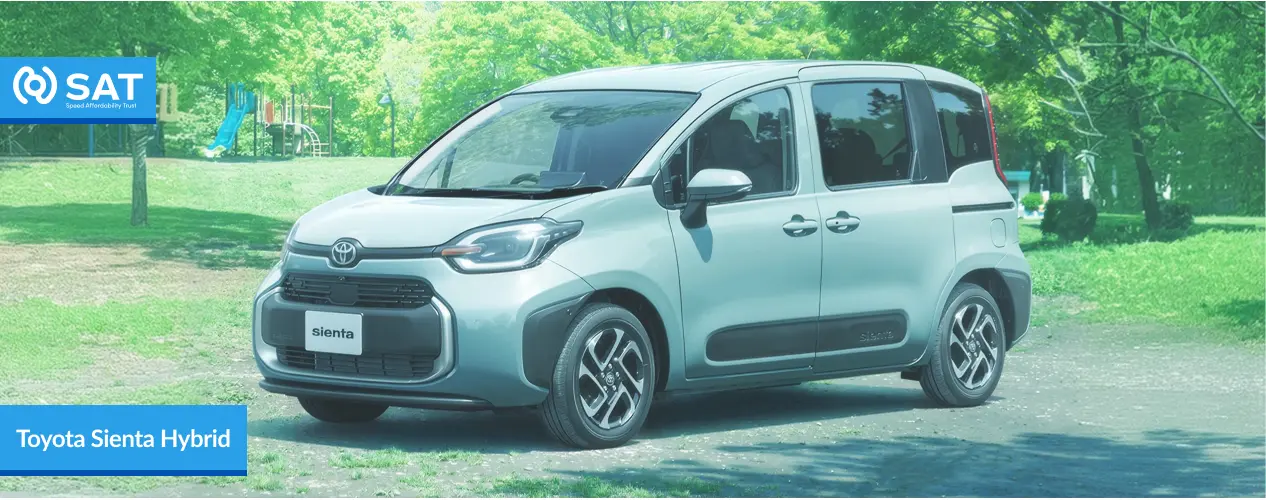
The Toyota Sienta Hybrid is a clear example of where Japanese imports can be beneficial. It is not just about being from Japan; it's about addressing many buyers' problems in the UK.
There is a choice between a small economy car at a low price or a larger car, an SUV, with a higher running cost, for the family. The Sienta is an alternative. It is a 7-seater, spacious and efficient, suitable for family use, yet not large enough to be a hassle. The sliding doors and ingenious interior layout make it especially suitable for families in towns and cities with limited space.
Import advantage: The Toyota Sienta is a car type that Japan developed much more strongly than the UK market. The real advantage is not so much the cost savings on the purchase price as the availability of something hard to find locally.
Verdict: One of the smartest Japanese imports to UK life in practice.
The Suzuki Jimny Sierra is built around a simple idea: stay compact, stay capable and keep genuine off-road ability.
Unlike many modern SUVs designed mainly for city roads, the Jimny Sierra retains a proper four-wheel-drive system and a lightweight, compact body. That makes it particularly useful on narrow rural roads, rough tracks and challenging terrain.
Its small footprint is another UK advantage. It is easier to park and maneuver than many larger 4x4s, while still offering the character buyers expect from a Jimny. The Sierra also has strong appeal to enthusiasts. Buyers are not choosing it simply for practicality; they want a distinctive Japanese 4x4 that feels different from the typical UK SUV.
Import advantage: Japanese imports can give UK buyers access to different specifications and a wider choice of Jimny Sierra examples.
Verdict: The Jimny Sierra is a compact Japanese 4x4 with genuine capability, strong character and lasting enthusiast appeal.
The advantage of the Toyota Vellfire is that it isn't competing with a traditional used car. Its greatest virtue is that it isn't fast; it's not about a badge or price. It is about the experience that it gives to a passenger. The UK SUV market is full of high-spec cars, but not so many focus on passenger comfort. This is what makes the Vellfire's opportunity.
For those who frequently transport family members, clients, or multiple passengers, the second row is a more significant part of the cabin than the driver's seat. Here is where the Vellfire adds value. The common error is to compare it only with MPVs. It's more like a comparison to high-priced SUVs and luxury vans. The Vellfire is a compromise; it's more comfortable than many SUVs, but more personal than commercial versions.
It has the best import edge in category access. Japan carved out a niche in luxury MPVs, which Britain failed to catch up with.
Ideal for: Passengers who appreciate comfort, executive travel, or high-class family transportation.
Think twice if: You are primarily a solo driver who prefers simplicity and affordability.
Verdict: The Vellfire is more than just a luxury Japanese car. It is a segment of the car market that the UK market was missing.
The Toyota Alphard is successful because it shows that all large family cars don't need to be SUVs. While many UK buyers prefer SUVs for space, they sometimes focus on luggage space and driving position rather than passenger comfort.
The Toyota Alphard goes the other way. It is structured to facilitate easy transportation of people. Its real strength seems to be during its actual use – when it's used as it was designed – for several passengers on longer trips.
The most common error among buyers is basing their purchase solely on exterior size or fuel efficiency. The question is, is the passenger experience worth the ownership requirements? For families, passengers at the airport, or businesses that transport passengers, the answer is often yes.
Ideal for: People who want a top-of-the-range passenger room, not just a bigger boot.
Verdict: The Alphard is one of the best examples of the Japanese import bringing something new.

The Nissan Serena is a strong choice for UK families who need more passenger flexibility without moving to a large SUV. Its value comes from using interior space efficiently rather than simply making the vehicle bigger.
For families, the Serena solves a practical problem: carrying several passengers while keeping access and everyday usability manageable. Its MPV layout makes it more focused on people and flexibility than most modern SUVs. The Serena is particularly interesting as a Japanese import because the UK market has moved heavily towards SUVs, leaving fewer choices for buyers who still prefer a true family MPV.
Import advantage: High. Japanese-market Serena models can offer UK buyers access to specifications and configurations less common locally.
Ideal for: Larger families, regular passenger use and buyers who value flexible seating.
Verdict: The Nissan Serena is a practical Japanese import for buyers who need genuine passenger flexibility rather than simply a bigger vehicle.
The Toyota Vitz is unique because of its roots in the Japanese car ownership philosophy, which is marked by efficiency, simplicity, and reliability. It's not about its performance or luxury. It is about reducing the cost and complexity of everyday transport.
While price is important to many buyers, the price to own is determined by consistent maintenance requirements, effective engine performance, and mechanical reputation. The Vitz suits those who don't need many frills or high running costs and want reliable transport.
It is important to note that its import advantage will vary by example. Unlike the rare Japanese-only vehicles, the UK already has similar Toyota small cars – the advantage lies in condition, specification and availability rather than difference in category.
Ideal for: First-time buyers, city drivers and budget-conscious owners.
Verdict: The Vitz is not a deal-breaker import, but it's the logical explanation why Japanese cars are trusted worldwide.
The Toyota Aqua is an excellent option for UK owners looking for cheap city driving without stepping up into a bigger hybrid. Its real import appeal is its size. Easy to park on narrow streets, offers convenient parking, and is suitable for frequent starts and stops. The Toyota Aqua was not a car sold in Europe; hence, UK models are Japanese imports and not a normal UK market car.
This makes a significant trade-off. Mechanical support may be simpler thanks to the shared hybrid technology, though body, trim and electronic components could prove more complex to source in Britain for each model. Before buying, also call for insurance, as grey-import status may influence the insurance policy available.
Best suited for: city commuters, first-time urban hybrids, and those who want convenient parking and/or efficient driving.
Verdict: A good buy for those in the UK market who are most concerned with space-saving and hybrid energy efficiency over extra room and convenience.

For those who are looking for a small car but don't want to sacrifice the usability of the vehicle in the interior, the Nissan Note is an overlooked choice. Balance is its main advantage. It's still small enough to drive through the city, and it's larger than many small hatchbacks in the interior. The Nissan Note is also an interesting import option for those seeking something other than the Aqua and Fit, as Japanese auction supply is available.
The Note e-POWER is a standout feature. While the petrol engine works primarily as a generator, an electric motor powers the wheels, making it more of an electric car than a conventional hybrid.
Best for: City drivers, small families, and drivers seeking a compact car for daily driving.
Verdict: It's a worthwhile inclusion because it offers something different from that small Japanese import, at least when it comes to the cabin and the e-POWER system.
It's not just about getting a better deal when buying Japanese second-hand cars. The first question smart buyers ask is whether the car is really a better buy in the UK.
The first step is to select the suitable vehicle for the purpose and not for the price. Buyers should take into account efficiency, special specifications, family usability, and whether a model is sold in Britain.
A professional importer reviews auction records, condition reports, mileage history, and export documents before purchase. It is then shipped to the UK, where it goes through customs, necessary checks, registration, and insurance, and then hits the road.
The worst choice is to select a vehicle because it is inexpensive in Japan. The ideal imports are those where Japan can really offer something the UK can't, as with the Toyota Sienta Hybrid, which offers compact 7-seat practicality.
The successful import is not a case of purchasing the cheapest vehicle. It's a matter of selecting the right car for extended ownership in the UK.
It's simple to find Japanese vehicles for sale in UK. The challenge is finding the right Japanese car that's verified, priced fairly, and has import confidence.
Typically, UK buyers have two choices: buying from a local dealer or from a trusted exporter from Japan. Having a local dealer can make life easier. Still, direct sourcing can give you access to a much broader selection of Japanese vehicles, original auction information, and clearer cost details.
If you are looking for second-hand cars, SAT Japan offers direct access to Japanese auction stock. Every listing on the vehicle listing page may include auction and condition information to help a prospective purchaser make an informed decision before buying.
The key question is not 'Where is the cheapest car? It is the place where you can check what you buy.
The following is a list of items that UK buyers should verify before selecting a seller:
Will the seller provide you with the auction records?
Are they able to describe the actual condition of the vehicle?
Do import costs become transparent before buying?
Do they assist with the shipping process?
A trustworthy Japanese vehicle importer isn't just about selling vehicles. They guide buyers in selecting cars that are appropriate for UK roads, budgets, and lifespans.
These days, the best way to find Japanese cars for sale is to go to a dealer with the experience and knowledge needed to provide transparency and a strong selection, rather than just a low advertised price. SAT Japan supports UK customers in accessing Japanese vehicles directly, from vehicle selection to import.
The first number is the auction price. The true expense is the money you invest before you can drive the car legally, on the road and within your budget. If it is a Japanese import, then divide the cost into three parts: purchase, roading and ownership. Import VAT and customs duty may apply depending on the vehicle and the circumstances. Where VAT is due, HMRC calculates it on the vehicle's taxable import value, which can include delivery charges, accessories and customs duty.
There's another choice that most buyers overlook: a unique Japanese model might offer something the UK market lacks, but parts, special servicing, insurance, and resale value can also affect its value. That's why we have a simple Import Value Test:
Compare the price of the equivalent UK vehicle with the fully landed import cost, then consider whether the Japanese specification offers additional value.
Unless the result is strong, importing might not be worth the investment. But if the car is filling a real need in the UK car market, the additional import effort may be worth it. A Toyota Sienta Hybrid, for instance, can make its case for import owing to its small size and seven seats. A Corolla won't be able to do it because UK buyers already have a good supply and support. It is not the Japanese used car with the lowest auction price that is the smartest. It's the one that still makes sense when it arrives at your driveway.
There is no single best Japanese used car in the UK. The right choice depends on how you drive and whether buying from Japan gives you a real advantage. For straightforward ownership, the Toyota C-HR is our top all-round choice. For high mileage, choose the Toyota Prius. For families, the Toyota Sienta Hybrid is a strong option due to its compact seven-seat layout.
For buyers seeking genuine 4x4 ability, the Suzuki Jimny Sierra is the specialist choice. For premium passenger comfort, the Toyota Vellfire and Toyota Alphard offer something most UK cars do not. The Nissan Serena is a strong choice for families who value flexible seating and passenger space. At the same time, the Toyota Vitz is a practical budget option for city drivers and first-time buyers.
For buyers considering Japan second-hand vehicles, SAT Japan can provide access to Japanese stock and support through the import process. You can visit the SAT Japan UK office to get the best of the deals in front of your eyes. The key is to compare the fully landed cost, vehicle condition, UK support, and future resale value, not just the Japanese asking price.
Our rule is simple: buy UK-spec when Britain already offers the right car. Consider a Japanese import when Japan offers a clear advantage that remains valuable once it reaches the UK.
The Jaecoo 8 arrives with numbers that are hard to ignore. At £45,500, this large plug-in hybrid SUV offers all-wheel drive, up to 428PS, an official electric range of up to 83 miles, and either six or seven seats. A Hyundai Santa Fe PHEV starts at £53,200.
The question is whether all that value translates into a genuinely good family SUV. The Jaecoo still needs to be comfortable, practical, easy to live with, and efficient once the battery runs low. Explore this Jaecoo 8 Review 2026 to see if this SUV is worth your money.
The Jaecoo 8 is a good large SUV with one major condition attached. The Jaecoo 8 isn't the strongest choice for regular seven-seat use, but as a spacious family PHEV with exceptional range and value, it is difficult to dismiss. If you genuinely need seven usable seats every day, the Hyundai Santa Fe or Kia Sorento is easier to recommend.
Its biggest strength is the PHEV system. A 34.46kWh battery gives it an official electric range of 83 miles, while 428 PS makes it unusually quick for a two-tonne family SUV. The weak point isn't the power or even the ride. It's packaging.
Here’s my take: I'd choose the Luxury. It costs £2,000 less than the Executive and keeps the more useful second-row bench.
The unusually long electric range makes daily EV driving realistic rather than theoretical.
Performance is far stronger than most large family SUVs need, yet the hybrid system stays quiet and smooth.
Standard equipment is unusually generous at £45,500.
The cabin looks convincing enough to make several more expensive SUVs feel poor value.
The third row needs easier access and more adult space.
Too many basic functions rely on the touchscreen.
The steering could give more confidence on faster roads.
Some cabin fittings don't feel as solid as those in a Hyundai Santa Fe or Volkswagen Tayron.
Jaecoo 8 key specifications | Figure |
UK price | £45,500–£47,500 |
Powertrain | 1.5-litre plug-in hybrid, AWD |
Combined power | 428PS |
Torque | 580Nm |
Battery | 34.46kWh |
Official electric range | 83 miles |
0–62mph | 5.8 seconds |
Seating | Six or seven seats |
Boot space with third row folded | 738 litres |
Vehicle warranty | Seven years / 100,000 miles |
This is Jaecoo's flagship UK SUV, sitting above the Jaecoo 7 and 5. The UK version comes only with the SHS-P plug-in hybrid system and all-wheel drive. Luxury models use a 5+2 layout, while Executive versions use a 4+2 arrangement with two individual second-row captain’s chairs.
Its obvious rivals include:
Hyundai Santa Fe
Kia Sorento
Skoda Kodiaq
Volkswagen Tayron
MG S9
The Jaecoo 8 isn't reinventing the family SUV. Its trick is simpler. It gives you enough power, range, and equipment to make established alternatives suddenly look expensive.
If the Jaecoo 8 feels larger or more expensive than you need, our Jaecoo J7 2026 Review: Price, Hybrid Specs & Worth It? looks at the smaller model's price, hybrid system, practicality, and value in more detail.
The Jaecoo 8 Luxury costs £45,500, while the Executive costs £47,500. Both include all-wheel drive, adaptive suspension, 20-inch wheels, a panoramic roof, dual 12.3-inch displays, a head-up display, wireless Apple CarPlay and Android Auto, a 14-speaker Sony system and a 540-degree camera.
That price is more impressive once the rivals are matched in terms of powertrain. The Hyundai Santa Fe PHEV starts at £53,200, while current data puts the Kia Sorento PHEV around £48,425. The Skoda Kodiaq and Volkswagen Tayron can cost less, but their plug-in versions are five-seaters, so they aren't direct substitutes if you need a third row.
The Luxury is the sensible family version. Its second-row bench gives you seven seats in total and better flexibility when carrying children, friends or luggage.
The Executive changes the car's character. The middle bench disappears, and two heated, ventilated and massaging captain's chairs take its place. Real leather, suede trim and several smaller luxury touches also arrive. It feels more special from row two, but you're paying £2,000 to lose a seat.
Expert Tip: For most people, buy the Luxury. The Executive makes sense if four people travel most of the time and the second-row experience matters more than maximum flexibility.
If the Jaecoo 8 stretches your budget, there are less expensive SUVs within the wider Chery family to consider. Our Jaecoo 7 vs Chery Tiggo 7: Which SUV Is the Better Buy? comparison looks at how the two smaller SUVs differ in price, features, practicality and overall value.
UK buyers can currently choose from eight exterior colour options for the Jaecoo 8. These include Basalt Black, Granite White, Amazonite Blue, Pearl Silver and Iced Slate Grey, along with two-tone Amazonite Blue, Granite White and Pearl Silver finishes with a contrasting black roof.
UK customer deliveries began in 2026, with Jaecoo confirming the first deliveries by late May. The car is now on sale through the brand's UK dealer network, so it is no longer a future model awaiting launch.
A 1.5-litre turbo petrol engine works with the electrical side of Jaecoo's Super Hybrid System, a 34.46kWh battery, all-wheel drive and a three-mode dedicated hybrid transmission. Combined output is up to 428PS and 580Nm, with 0–62mph taking 5.8 seconds.
A 5.8-second 0- 62 mph time is unusually quick for a large, three-row family SUV. The strange part is that outright speed isn't what makes the system impressive. The smooth way it delivers that performance matters more.
The Jaecoo 8 performs well at low speeds because it behaves much like an EV when battery charge allows. Steering is light, visibility ahead is good, and the turning circle is tighter than the size suggests. The surround-view camera also makes parking much less stressful, although Hyundai's camera system produces a clearer image.
Its 20-inch wheels and considerable weight can still make sharp potholes noticeable. The car is comfortable rather than floaty, but badly broken streets reveal that you're moving more than two tonnes of SUV.
This is where the Jaecoo 8 makes its strongest case. The petrol engine stays unusually quiet, overtaking power remains strong at motorway speeds and wind noise is well controlled. Some road tests have picked up noticeable tyre noise and a slightly busy ride over rough motorway surfaces, but it remains a relaxed long-distance car.
The seats help, too. The driver's seat includes ventilation as standard, while the Executive adds massage-equipped captain's chairs and a more luxurious seating package.
Don't mistake 428PS for sporting ability. The Jaecoo 8 carries more than two tonnes, and the weight becomes obvious when corners start arriving quickly. There is body roll, and the steering loses the precision that something like a Kodiaq or Tayron gives you.
Grip is strong, and the adaptive dampers control the body reasonably well at normal speeds. Push harder, and it starts to feel busy rather than entertaining.
The Jaecoo 8 can be very fast without being particularly sporty. That's fine. A family SUV doesn't need to entertain you on Sunday morning. It needs to stay calm on Monday morning.
The Jaecoo J8 interior makes a better first impression than its price suggests. Twin screens sit across the dashboard, the centre console feels substantial, and most of the surfaces you touch are soft enough to support the luxury pitch.
Look more closely, and the cost savings become easier to find. Some panels feel hollow, and UK testers have noted a few questionable fit-and-finish issues. A Santa Fe or Tayron still feels more solid when you start pressing around the cabin.
The cabin doesn't feel cheap, but its premium impression is stronger visually than physically.
The 12.3-inch driver display, central touchscreen, and head-up display give you plenty of information. Wireless Apple CarPlay and Android Auto are standard, as is 50W wireless charging and the 14-speaker Sony audio system.
The problem is control placement. Climate settings and several common functions are built into the touchscreen. The software responds quickly enough, but changing temperature while driving shouldn't need carefully aimed taps and swipes. Physical climate switches would make this cabin better overnight.
There is plenty of driver assistance, including lane support, speed assistance, driver monitoring, blind-spot detection and adaptive cruise functions. The problem is how aggressively some of those systems intervene.
Some UK tests have found the lane and speed systems intrusive, while driver monitoring can become irritating. Useful shortcuts let you quickly switch several functions off, but some settings revert when the car is restarted due to safety regulations.
That sums up the Jaecoo's technology problem. It isn't short of clever features. It needs more of them to quietly help rather than constantly remind you they're there.
This is the section that changes the recommendation.
The Jaecoo 8 is spacious in rows one and two. The third row is different. Jaecoo itself describes the layouts as 5+2 and 4+2 rather than simply seven- and six-seat, and that "+" is doing important work.
Legroom and foot room are generous, with good headroom for most adults. ISOFIX points are fitted in the second row, and the Luxury's three-seat bench is the layout to choose if you're carrying children. Executive buyers get a much nicer two-seat experience.
Adults can get into the third row. But the access is awkward in both versions. The seven-seat Luxury requires passengers to climb past the folded middle row, while the Executive leaves a narrow passage between the captain's chairs. Once seated, legroom and headroom are tight.
Children should manage short journeys. Smaller teenagers may cope. Adults belong there only when all other seats have already been claimed.
So is this a genuine seven-seat SUV? No, not in the same sense as a Hyundai Santa Fe or Kia Sorento. It's a very good five-seater with two occasional seats.
With the third row folded, luggage space is a strong 738 litres, rising to 2,021 litres with the middle seats down. UK published figures differ for the boot with every seat raised, with some sites listing 110 litres and others listing 200 litres, but both point to the same real-world problem: there isn't much room left for luggage when all seats are occupied.
Fold the third row and the story changes completely. A pushchair, weekly shopping or several suitcases become easy to carry. In five-seat use, the Jaecoo is genuinely practical.
It can, but only if you plug it in. That sounds obvious, yet it is the difference between a very efficient PHEV and a 2.2-tonne petrol SUV carrying an expensive battery around for no reason.
The 34.46kWh battery gives an official 83-mile electric range.UK road tests suggest around 65–70 miles is achievable in mixed real-world driving, depending on temperature, speed and driving conditions.
That makes the Jaecoo much more useful as an electric commuter than the Santa Fe or Sorento PHEVs, both of which officially offer roughly 34 miles.
Current UK vehicle data lists 6.6kW AC charging and up to 70kW DC rapid charging. A 30–80% rapid charge takes around 20 minutes. A 30-80% rapid charge takes about 20 minutes, while a home charge takes roughly five hours depending on starting percentage and supply.
Rapid charging isn't essential for most PHEV owners, but it makes sense here because the battery is unusually large. On a long trip, A quick top-up can add enough electric range to make the stop worthwhile.
This is where the four-digit official MPG figure needs context.
Charge-sustaining WLTP data lists 50.5mpg, while UK road testing has reported roughly 43.5mpg over mixed driving, and other tests place depleted-battery economy around 45-50mpg. That's respectable for something this large and powerful. Still, don't buy the Jaecoo because it says 543mpg on a specification sheet. That figure assumes regular charging.
A brilliant official MPG figure means very little if the owner rarely plugs the car in.
With 14g/km of CO2, the Jaecoo 8 sits in the 1-50g/km VED band. For 2026/27, that means £115 first-year VED. From year two, the £200 standard rate applies, plus the £440 Expensive Car Supplement because both versions cost more than £40,000. That brings years two to six to £640 annually under current rates.
Company-car drivers get a much better deal. Its 83-mile electric range places it in the 7% BiK band for 2026/27. Current vehicle data lists a Luxury P11D value around £45,330, which works out to roughly £635 a year for a 20% taxpayer before options.
Insurance is less friendly. Current data places the Jaecoo 8 around group 42, so get a real quote before assuming the low purchase price also means low fixed costs.
The warranty is reassuring. Proven long-term reliability is something different.
As of August 2026, the Jaecoo 8 has not yet been tested by Euro NCAP. It does offer a long list of active safety systems, including autonomous emergency braking, blind-spot monitoring, lane assistance, adaptive cruise control, driver monitoring, and rear cross-traffic assistance. Multiple airbags and second-row ISOFIX mounts are standard.
Jaecoo offers a seven-year/100,000-mile vehicle warranty and an eight-year/100,000-mile high-voltage battery warranty. RAC Home Start is also included for the warranty period, subject to the required servicing conditions. That is one of the strongest reasons to take a new brand seriously.
There simply isn't enough UK history to call the Jaecoo 8 proven. Jaecoo entered the British market in January 2025, so long-term reliability data doesn't yet exist.
The wider Chery operation is far more established, and the UK network is growing quickly. According to Omoda & Jaecoo UK, the two brands had passed 100,000 combined UK sales by August 2026 and grown their retail network to more than 144 locations. That's useful reassurance for servicing and parts access. It still isn't the same thing as ten years of owner reliability data.
Hyundai, Kia, Skoda and Volkswagen have established used markets. The Jaecoo 8 doesn't. Nobody can yet say with confidence how a £45,500 Jaecoo will depreciate after four or five years.
A PCP or lease can reduce your exposure to uncertain resale values compared with buying outright, depending on the agreement. Cash buyers should factor in depreciation risk when comparing Jaecoo's attractive purchase price with that of an established rival.
At current prices, the Jaecoo wins the value argument. The Luxury costs £45,500, compared with £53,200 for the entry-level Santa Fe PHEV. It is also much quicker, has more than twice the official electric range and includes an extraordinary amount of standard equipment.
The Santa Fe fights back where families may care more. Its third row is easier to use, cabin controls are better sorted, and the interior feels more solidly assembled. Hyundai also brings a much longer UK ownership history and more predictable resale prospects.
The Jaecoo's much longer electric range versus the Hyundai's 34 miles is not a small difference. Someone commuting 40 miles per day could do that comfortably in the Jaecoo without petrol. The Santa Fe will need its engine much sooner.
On the road, neither is a driver's SUV. The Jaecoo has far more straight-line punch, while the Hyundai feels more mature in the way its steering, controls and chassis work together.
Jaecoo 8 Luxury | Hyundai Santa Fe PHEV | |
Starting price | £45,500 | £53,200 |
Official EV range | 83 miles | Around 34 miles |
Seating | Seven | Seven |
Main strength | Range, performance and value | Better seven-seat practicality |
Main weakness | Tight third row | Higher price |
Our Pick
Choose the Jaecoo 8 if you want the strongest PHEV system, lots of equipment and rarely need adults in the third row.
Choose the Hyundai Santa Fe if seven-seat practicality, proven ownership history and cabin usability matter more than electric range or acceleration.
At current UK list prices, the Jaecoo 8 Luxury gets our vote. The £7,700 saving is significant, and its much longer electric range makes the weaker third row easier to accept for buyers who rarely need all seven seats.
If you like Jaecoo but don't need the size, performance or extra seating of the J8, the smaller J5 is worth considering. Our 2026 Jaecoo J5 Hybrid Review: Specs, Range, Pros & Cons covers its hybrid system, range, practicality and main strengths and weaknesses.
The Sorento PHEV is the alternative for someone who genuinely needs seven seats and wants a long warranty from an established UK brand. Its 34-mile electric range now looks dated next to the Jaecoo, but its family packaging is easier to trust.
The Kodiaq is the better driver's family SUV. Steering and suspension feel more polished, and practicality is excellent. One catch matters: the current Kodiaq PHEV is five-seat-only, so choose a petrol or diesel version if you need seven seats.
The Tayron feels more conventional and better resolved from behind the wheel. Like the Kodiaq, its PHEV versions have five seats, while the seven-seat layout comes with combustion powertrains.
If value is the entire mission, drive the MG S9 before signing anything. At the time of writing, the MG S9 starts at around £34,210, has seven seats, and offers 62 miles of electric range. The Jaecoo feels quicker and more upmarket, but the MG undercuts it by more than £11,000.
The Omoda 9 uses similar thinking with a 93-mile electric range and lots of equipment. It has a roomy cabin but only five seats, so it suits buyers who like the Jaecoo's technology but don't need the extra row.
If the Jaecoo 8 does not quite fit your budget or you would rather consider a proven used alternative, SAT Japan gives UK buyers access to a wide range of Japanese used cars for sale. Buyers can compare SUVs, hybrids and other vehicles sourced from Japan, with support available throughout the import process. SAT Japan UK office provides its customers with local assistance when buying or importing a vehicle into the United Kingdom.
The Jaecoo 8 is more than a spec-sheet vehicle. The important numbers actually change the ownership experience. Its huge battery means useful electric commuting, 428PS gives effortless overtaking, and the £45,500 Luxury genuinely costs thousands less than an equivalent Santa Fe PHEV.
The areas where the saving becomes visible are less dramatic but still important. Interior fit isn't quite as solid as the best rivals, the touchscreen asks too much of the driver, and the third row simply isn't good enough to make this a first-choice seven-seater.
That last point decides who should buy it.
Buy it if you mainly need five seats, can charge at home, and want maximum equipment and PHEV range for the money.
Think twice if you are paying cash and worry about future resale values, or you dislike touchscreen-heavy interiors.
Skip it if six or seven people regularly travel together. A Santa Fe or Sorento does that job better.
The Luxury is the version to have. At £45,500, it gives away surprisingly little to more expensive rivals while beating many of them on electric range, performance and standard equipment. It isn't the strongest choice for regular seven-seat use, but for buyers who mainly need five seats and can charge at home, the Jaecoo 8 makes a compelling case.
Every SUV faces the same struggle of being dismissed as yet “another SUV”, but Kia Carnival tackles this problem with grace. In this Kia Carnival Review 2026, let’s take a look at how the Carnival outshines its competitors and makes the statement that it is not an average SUV.
Marketed as an "MPV" by Kia and fitted with the latest tech and a punchy V6 engine, it has a lot to offer. Carrying its predecessor’s legacy, it makes a few necessary changes here and there, making this Multi-Purpose Vehicle definitely worth checking out. By the end, we will help you decide whether this MPV is the smart or right choice for you.
Two powertrains, a 287-hp V6 or a 242-hp hybrid, both front-wheel drive.
The hybrid returns up to 33 mpg combined, versus 21 mpg for the V6.
Class-leading cargo, up to 145.1 cubic feet with the seats folded.
Seven or eight seats, with reclining second-row lounge chairs available.
Prices start at about $37,390 to over $54,000 across the lineup.
Very little has changed for 2026; however, last year’s model received a major facelift, with fresh styling, upgraded tech, and a new hybrid powertrain.
Fitted with three rows of seats, this MPV offers ample space for up to 7 or 8 people. Plus, the middle seat in the second row can be folded or removed, providing ample space. Additionally, if required, both second- and third-row seats can be folded, giving 145.1 cubic feet of space. With more to offer, let’s take a closer look at the Kia Carnival 2026.
The 2026 Kia Carnival specs make a strong case as to why it should be your next purchase, considering they do all the heavy lifting, whether it's when making the final decision or while you’re on the road.
The gas V6, of course, remains a great option if you’re looking for higher towing power; however, the hybrid also presents a strong case incase you want higher efficiency. Both use Front Wheel Drive and seat up to 8 passengers, providing ample seating and cargo space.
Specification | Gas V6 | Hybrid |
|---|---|---|
Engine | 3.5L V6 | 1.6L turbo four plus electric |
Horsepower | 287 hp | 242 hp (combined) |
Torque | 260 lb-ft | 271 lb-ft |
Transmission | 8-speed automatic | 6-speed automatic |
Drivetrain | Front-wheel drive | Front-wheel drive |
Seating | 7 or 8 | 7 or 8 |
Max towing | 3,500 lbs | 2,500 lbs |
Combined mpg | 21 | Up to 33 |
Length | 203 in | 203 in |
The 2026 Kia Carnival price starts at $37,390 for the base gas LX, plus a $1,545 destination charge. This is remarkable, considering the 2026 Kia Carnival undercuts all its rivals, which start at or above $40,000. The lineup climbs past $54,000, so there is the Carnival for most budgets.
Gas V6: from $37,390 (LX) to about $53,035 (SX Prestige)
Hybrid: from $42,400 (LXS) to about $54,525 (SX Prestige)
Destination Charge: $1,545 added to the base amount
The Hybrid costs $2,000 more than the gas trim, but it narrows the price gap by saving on fuel over the long run. Regardless of the option you pick, here is a quick rundown of both the Gas V6 and Hybrid options side by side for each of the trim options available.
Trim | Gas V6 | Hybrid |
|---|---|---|
LX | $37,390 | Not offered |
LXS | $40,990 | $42,990 |
EX | $43,190 | $45,190 |
SX | $46,090 | $48,090 |
SX Prestige | $51,090 | $53,090 |
Incase you’re looking for other options, make sure to check our endless inventory of MPVs, listed on our official website.
The 2026 Carnival trim levels consist of LX, LXS, EX, SX, and SX Prestige. The gas V6 covers all six, while the hybrid one skips the base LX and directly starts at the LXS. The models use the same engine choices, and higher trims prioritize comfort and convenience over power.
LX: Gas-only base trim, includes tri-zone climate, power sliding doors, and a full safety suite.
LXS: Improves convenience and comfort; starting point for the hybrid.
EX: Sweet spot; more comfort and technology for the money.
SX: Upgrades to the leather, better screens, and Highway Driving Assist 2
SX Prestige: Loaded top trim with lounge seating and every available driver aid.
Expert Tip: The EX is the sweet spot in value. It piles on features over the LXS for a small premium, so most buyers never need to pay up for the SX.
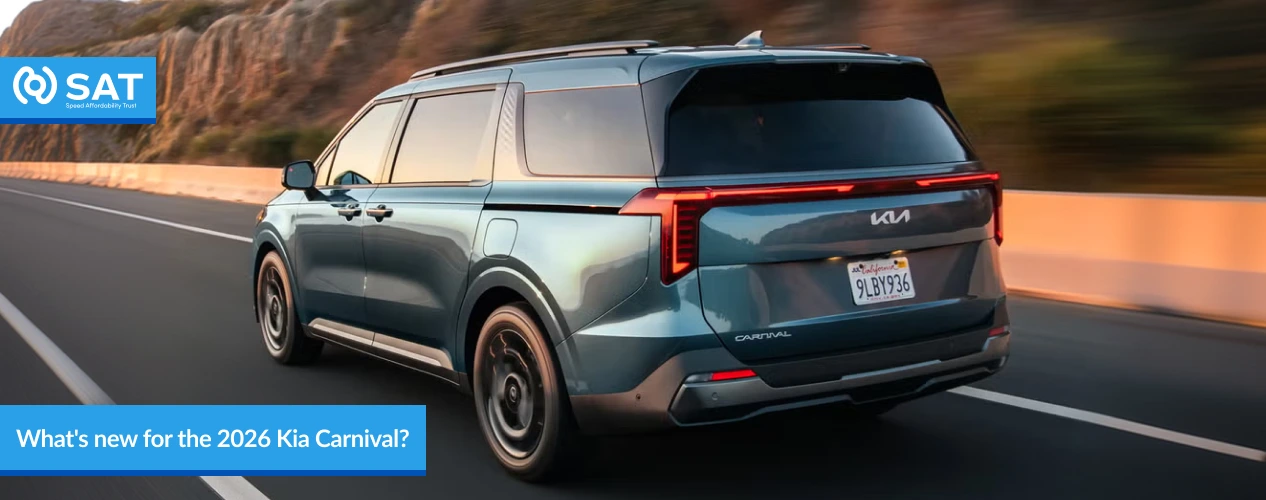
The Kia Carnival 2026 has proven to be quite the smooth ride, thanks to its 287-hp V6 delivering strong, usable power through a smooth eight-speed automatic. Though a 0 to 60 mph time of about 8.5 seconds is quite average. The hybrid is smooth, too, and can run on electric at low speeds.
On the road, the steering feels light, and parking is easy for such a big vehicle, with body roll kept in check through corners. Ride comfort is good, and cabin noise is well-isolated, though rivals like the Honda Odyssey ride a touch more smoothly. The one main drawback is that this SUV is Front Wheel Drive only, with no option for All Wheel Drive.
The gas V6 returns 21 mpg combined; however, the hybrid lifts that up to 33 mpg combined.
The V6 is standard for a van that can carry 7 to 8 people, and the hybrid is quite efficient. Additionally, the price gap eventually closes, with the hybrid practically paying for itself over time by reducing fuel costs.
Gas V6: 21 mpg combined (18 city / 26 highway).
Hybrid: up to 33 mpg combined (about 34 city / 31 highway).
Independent road tests showcased around 31 mpg overall in the hybrid.
Interestingly enough, independent testers have come quite close to these numbers in real-world test scenarios.
Expert Tip: The hybrid is the smart choice if you regularly travel around town; however, for longer rides involving heavy lifting, the V6 is the better option overall.
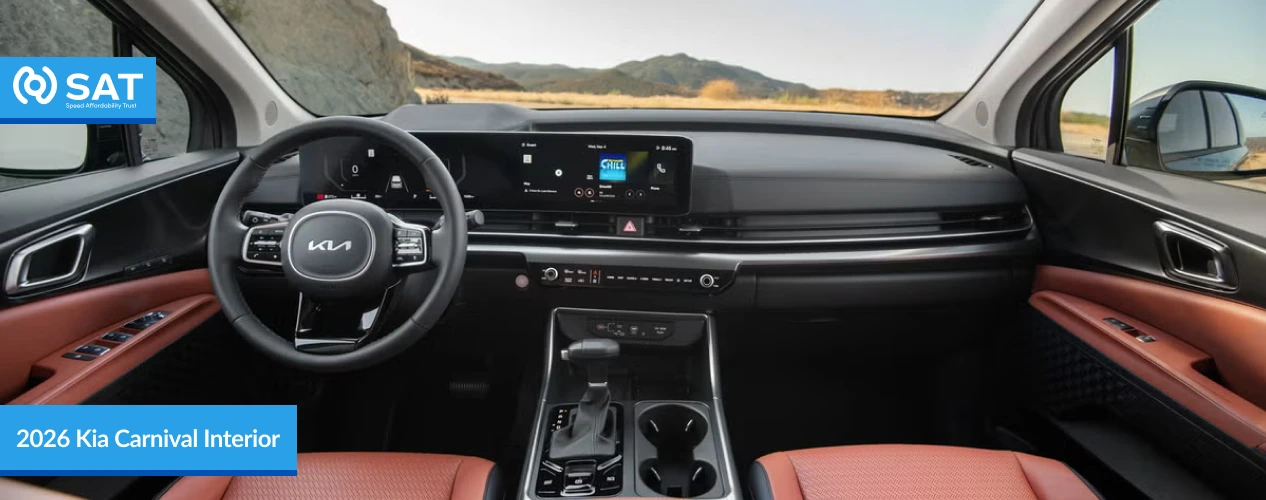
First Row: The dashboard and the front row area use a modern aesthetic, creating a sleek, accommodating design. A large center console provides ample storage space for small items. Additionally, the 12.3-inch panoramic display and digital gauge cluster provides easy tech access.
Second Row: The second row offers ample space for either 2 or 3 people, depending on the trim configuration. The LXS and EX are fitted with a three-person seating arrangement, where the middle seat can be folded down to create an armrest and cup holder; the other trims feature two VIP lounge-style chairs with pop-up footrests.
Third Row: The third row is genuinely comfortable, providing an ample 35.6 inches of legroom. All necessary features, such as USB charging ports, climate control, cupholders, and even sunshades. Additionally, across all trim configurations, these seats can be folded down to increase storage space when needed.
Expert Tip: Unless you truly want the luxury feel, skip the VIP lounge seats, as the three-piece removable bench maximizes space for both seating and cargo.
Technology is a genuine highlight, with sleek screens and standard wireless smartphone connection. The twin 12.3-inch displays are sharp and easy to navigate. Additionally. The Carnival also provides standard wireless Apple CarPlay and Android Auto, a 360-degree surround-view camera for tight parking, and an in-cabin intercom system.
A built-in voice assistant is also available for passengers to use to perform tasks such as opening their windows or adjusting the climate control. Also, seven USB ports are provided throughout the car, along with two additional power outlets. Lastly, a rear entertainment system provides two 14.6-inch screens that can be utilized for streaming, utilizing independent applications, or mirroring external devices.
If the Kia Carnival had a superpower, it would be infinite cargo space, and the reality comes quite close to it. The 2026 Kia Carnival cargo space is massive, with around 40.3 cubic feet behind the third row. Additionally, the second- and third-row seats can be folded to provide a whopping 145.1 cubic feet of space.
When it comes to towing, the powertrain you pick matters, as the 2026 Kia Carnival's towing capacity is up to 3,500 for the V6. In comparison, the hybrid is ranked lower, coming in at only 2,500 pounds. Considering the differences, the hybrid trades off muscle to acquire higher efficiency.
If towing is a part of your regular life, then the 3,500-pound limit V6 model is well suited even if you’re towing a small boat or a utility trailer. However, if this isn’t part of your regular activities, the Hybrid’s higher efficiency makes a strong case as a family car. Though, incase you’re looking for alternative SUVs with different towing capacities.
The 2026 Kia Carnival carries a 4-star overall NHTSA rating and mixed IIHS results, scoring Good in most crash tests but weaker in the updated front-overlap and side-impact tests, though Kia added structural reinforcements for 2025.
Standard driver aids include:
Automatic emergency braking with pedestrian and cyclist detection.
Blind-spot monitoring and rear cross-traffic alert.
Lane-keeping assist, lane-departure warning, and adaptive cruise control.
Kia's Highway Driving Assist and a driver attention monitor.
SX and SX Prestige add Highway Driving Assist 2 and a blind-spot view monitor.
The Carnival is pretty solid in terms of reliability, considering it is backed up by one of the best warranties in the business. A 5-year or 60,000-mile basic warranty and a 10-year or 100,000-mile powertrain warranty protect this car, which is unmatched when compared to competitors.
Do note that there are two open recalls for a leaking fuel pipe and an instrument panel software glitch, both of which will be fixed at no charge. Most owners on Reddit praise the comfort, space, and especially the tech and infotainment, which they say are top-notch in quality and control.
The 2026 Kia Carnival 2026 performs exceptionally well, despite having really strong competitors.
Feature | 2026 Kia Carnival | 2026 Toyota Sienna | 2026 Honda Odyssey | 2026 Chrysler Pacifica |
Powertrain Options | Gas V6 or Hybrid | Hybrid only | Gas V6 only | Gas V6 |
Fuel Economy | Up to 32 MPG (Hybrid) | Up to 36 MPG | Around 22 MPG combined | Around 20 MPG combined |
Seating Capacity | 7 or 8 passengers | 7 or 8 passengers | Up to 8 passengers | 7 or 8 passengers |
Cargo Space (Behind 3rd Row) | 40.2 cu ft | 33.5 cu ft | 32.8 cu ft | 32.3 cu ft |
Max Cargo Capacity | 145.1 cu ft | 101.0 cu ft | 155.8 cu ft | 140.5 cu ft |
AWD Availability | No | Yes | No | Yes |
Additionally, apart from these fast-moving competitors, here is a list of alternatives you can explore:
Nissan Qashqai
Lexus RX
Nissan Kicks
Ford Expedition
Infiniti QX80
In the end, it is all about your personal preferences that will help you make the final decision. Compared to its competitors, the Kia Carnival 2026 offers more space and comfort, making it a really good choice for new buyers.
For most family buyers, the 2026 Kia Carnival is definitely worth buying. It offers space, style, and tech in a three-row SUV that is hard to match. This SUV works hard to cover the weaknesses SUVs have, such as being fuel-hungry, by going hybrid.
Of course, like all great products, this SUV is not perfect either. The main drawback is that it’s strictly Front Wheel Drive, with no option to switch to All Wheel Drive. The hybrid has less towing capacity, and a few comfort options avaialble on the rivals are missing. But, if you want maximum comfort and low running costs, only a few options in the same category come close.
Here is a quick balance sheet; refer to it to judge whether or not you’re making the best decision possible. Clearly, you win some, you lose some, and depending on how you plan on using this minivan, this could make or break your decision.
Pros | Cons |
|---|---|
+ Rival-beating cargo space, up to 145.1 cubic feet. | – Front-wheel drive only, with no all-wheel-drive option. |
+ Upscale interior with a premium look and feel. | – Ride can feel rough over broken pavement. |
+ Lots of standard features for the price. | – Acceleration is merely average for the class. |
+ Low entry price that undercuts all rivals. | – Hybrid gives up towing capacity to the V6. |
+ Class-leading 10-year / 100,000-mile powertrain warranty. | – VIP lounge seats are gimmicky and cannot be removed. |
+ Standout tech, with twin 12.3-inch screens and wireless smartphone connection. | – Touch controls and piano-black trim can distract and smudge. |
Whether you choose the Carnival or another family minivan, where you make your purchase from matters just as much as what you buy. With SAT Japan, this process is straightforward, with the website displaying transparent condition reports and well-inspected vehicles. Take a look at our available stock and feel free to reach out whenever the time feels right.
This 2026 Kia Carnival review makes a strong case for family buyers. Its biggest strengths are space and value, backed by a huge, flexible cargo hold, sliding doors, and a premium cabin that feels well above its price point. Its biggest weakness is that it comes with front-wheel drive only, sacrifices some towing in hybrid form, and omits a few comfort features on the cheaper trims.
The hybrid is the strongest pick for buyers who want low running costs and do most of their miles around town, while the V6 offers more power and towing for those who need it. If you want an all-wheel-drive van for heavy snow, look elsewhere. But if you want maximum room and low fuel bills in one family vehicle, Carnival remains one of the most convincing choices in its class.
Getting right to the point, many car reviews won't mention it: there's no new 2026 Kia Soul. Kia ceased manufacturing the model with the 2025 model year. The move ended production of one of the brand's most iconic cars, which sold over 1.5 million vehicles in the United States and was in production for 16 years.
This changes what this 2026 Kia Soul review needs to address.
When looking for a new Soul, you're essentially considering used Souls, or newer competition. The question gets even more significant if you are in the market for an electric model. The Soul EV and e-Soul were based on an older EV formula, whereas newer electric cars offer faster charging, updated technology, and better overall value.
This review is not dependent on the old brochure numbers. We will discuss the 2026 Kia Soul EV review, price, range, specs, interior, charging, performance, and practical alternatives that might be worth your money at this time.
There is no new 2026 Kia Soul, so buyers should focus on remaining 2025 models or used Soul EVs.
The 64-kWh Soul EV is the best version to target for its stronger range and performance.
Home charging is where the Soul EV works best. Its slow DC charging makes frequent long trips less appealing.
A healthy, well-priced used Soul EV can still be worth buying if you value its roomy cabin, unique design, simple controls, and easy everyday driving.
The last Soul did not come in a brand-new look. Instead, Kia gave the 2025 model a few targeted upgrades, making it the most complete version of the outgoing Soul.
The most obvious difference was the Soulmate Special Edition. It was equipped with 18-inch wheels, lower body cladding, SynTex and cloth seats, an umber interior, and Harman Kardon audio. It built on the EX base and added $1,000.
If you're searching for the final Soul, that package is worth checking out. It offers several desirable features without requiring an upgrade to the more expensive GT-Line Technology Package. There is a downside, however: Soulmate comes without a sunroof.
Under the skin, Kia kept things simple. The same 147-hp 2.0-liter four-cylinder engine and smart-shifting automatic transmission were used across all 2025 Souls. A new engine, hybrid system, and all-wheel drive were not available.
Therefore, this 2026 Soul is not a new model to look at. This is the final chance to purchase the final, best-kept version of a very unusual small crossover. So it's not about waiting for that 2026 update; it's about choosing the right trims.
There is no new-car MSRP to use for a 2026 Kia Soul EV. The realistic way to judge its value is through the used market. Current used examples typically range from around $17,490 to $27,490, depending on battery size, mileage, trim, condition, and location.
It's just a half-price story.
The first thing you should check is the battery's health. Request a battery state of health before making a purchase. If there's any noticeable loss of capacity, it's not worth as much as the same car with a good battery. Vehicle specialists also recommend a diagnostic checkup before buying a used vehicle.
Warranty coverage can change the value, too. In the published documentation, Kia covers the battery capacity of the Soul EV, but the details of its battery coverage may vary by model year and market. Do not rely on coverage being transferred or continuing from the original registration date or local warranty; verify with the original registration date and local warranty document.
Another helpful price check is available. The 64-kWh version of the Soul EV wasn't cheap to begin with.
So, what makes a Soul EV good value?
Look for:
For longer trips, a 64-kWh battery is a better option.
Good battery health, not just low mileage.
If applicable, a battery's remaining warranty.
CCS support in markets where CCS is standard fast charging.
A price based on older charging technology.
The choice of battery is key to the Kia Soul EV range. The 39.2-kWh model is quoted to be 171 miles WLTP. If tested under real-world conditions, it is closer to 160 miles. It is best suited for city driving and short trips.
The 64 kW version can be expected to achieve around 280 miles according to WLTP. In real-world driving conditions, the range is approximately 230-250 miles in mild conditions.
Those can be lowered when the highway speed is high, when it's cold, when it's heating, and when there's a lot of air conditioning. That means the larger battery is better suited for a long highway trip.
The main benefit of the 64-kWh version is not necessarily extended range. Provides more buffer between charges. This helps make driving day-to-day more relaxed.
Driving conditions | 39.2-kWh Soul EV | 64-kWh Soul EV |
Official WLTP | 171 miles | 280 miles |
Mixed real-world driving | 160 miles | 230–250 miles |
Highway driving | Much lower | Expect a noticeable drop |
Cold weather | Range falls further | Range falls further |
The point is, select the smaller battery if you are driving in a familiar area. If you make frequent long trips, opt for the 64-kWh model.
The 2026 Kia Soul EV specifications will vary based on battery type. The 39.2-kWh model makes 134 hp. The 64-kWh model makes 201 hp. They both have 395 Nm of torque, and both are front-wheel drive.
The 64-kWh version is the top model. It can accelerate from 0 to 62 mph in approximately 7.9 seconds. The smaller one takes approximately 9.9 seconds.
Specification | 39.2-kWh | 64-kWh |
Battery | 39.2 kWh | 64 kWh |
Power | 134 hp | 201 hp |
Torque | 395 Nm | 395 Nm |
0–62 mph | 9.9 sec | 7.9 sec |
Top speed | 98 mph | 104 mph |
Drive | Front-wheel drive | Front-wheel drive |
Length | 165.2 in | 165.2 in |
Width | 70.9 in | 70.9 in |
Height | 63.2 in | 63.2 in |
Wheelbase | 102.4 in | 102.4 in |
Cargo space | 11.1 cu ft | 11.1 cu ft |
Max cargo space | 47.3 cu ft | 47.3 cu ft |
The numbers tell a story. The Soul is not bigger because of the battery size. The wheelbase of both versions remains the same at 102.4 inches, while the cargo area retains a helpful box shape.
There is a weight compromise. The 64 kWh version weighs approximately 3,874 lbs. The additional battery weight is significant; however, it's outweighed by the increased motor strength when putting on gas.
This translates to the 64-kWh Soul EV being the better all-round specification. The 39.2-kWh version only really makes sense if performance and range are less important, and the lower cost and shorter daily trips are more important.
The 2026 Kia Soul EV performance is stronger than its upright shape suggests. The 64-kWh model makes 201 hp and 395 Nm of torque. It can accelerate from 0 to 62 mph in approximately 7.6–7.9 seconds, depending on the test.
However, there's a catch. Not all that power can be put into the front tires. On wet roads, hard launches may cause wheel spin. The traction control then diverts power to regain traction.
This alters the Soul's feel. It is fast, but it will pay off for smoother acceleration. Generally, a gentle start will be quicker than a full-throttle start, as it will keep the front tires operating rather than leaving the traction system to get involved.
The 64-kWh variant is also 140 kg heavier than the 39-kWh version. The smaller is a little more responsive; the larger, a little more efficient in acceleration and highway driving.
This is where regenerative braking comes in handy. The steering-wheel paddles let you adjust the regen level while driving. A higher regen value can make the car slow down rapidly during deceleration. It can make city driving much easier by reducing the use of the brake pedal.
The Soul is not designed to be a competitive racer. It can be quick to steer in tight streets, but it is not particularly fun to drive on twisty streets due to its high body and hard suspension. It's also a heavy ride over rough surfaces.
The reality of the performance lesson is that the Soul EV is more than capable of passing other cars and merging into traffic, but its front-wheel-drive architecture makes the throttle the most important part of driving, rather than maximum acceleration.
That's a good exchange for everyday driving. It responds quickly without needing sports-car manners.
The 2026 Kia Soul EV charging setup is fine for home use but dated for road trips.
The 64-kWh version accepts up to 7.2 kW of AC power. A full home charge takes about 10 hours and 30 minutes on a 7.2-kW supply. That is easy to manage overnight. A 3.7-kW connection takes roughly twice as long.
DC charging uses CCS and peaks at 77 kW. The important number is the average, not the peak. From 10–80%, charging averages about 61 kW and takes roughly 46–50 minutes under favorable conditions.
There is a bigger catch. The Soul EV has no battery preconditioning. Cold weather can therefore hurt charging performance. You cannot rely on the navigation system to warm the battery before reaching a fast charger.
The charging curve also changes how you should use public chargers. EVKX estimates the strongest charging window at about 0–55%. After that, power begins to fall. It drops sharply in the upper part of the battery.
That makes a shorter, lower-state-of-charge stop more efficient than sitting at a charger while the car slowly climbs toward 100%.
There is another detail worth knowing. The Soul EV does not support Plug & Charge, although supported stations can use Autocharge.
The 2026 Kia Soul EV features an interior that is designed to be as spacious and simple as possible. The tall roof provides two adults with all the headroom they could desire, and the upright seating arrangement makes it easy for them to climb in and out.
The weak spot is the 315-liter boot. Its square shape is helpful, and the floor can be raised or lowered to store the charging cables in a dedicated space. Fold the rear seats, and it holds 1,339 liters.
Trim choice matters. The nicer cabin is found on the 64-kWh version, which features heated seats, leather trim, and the larger 10.25-inch screen in many markets. The smaller battery version is definitely more functional.
Another benefit is physical climate controls. You can easily adjust certain settings without navigating through the touch screen menus.
The takeaway: People fit better into the boxy form of the Soul EV than a suitcase. It is ideal for couples and small families, but can be a bit cramped in the boot for heavy holiday loads.
Much of the Kia Soul EV safety story is contingent on the model year. Newer versions include helpful driver-assistance features such as automatic emergency braking, lane-keeping, blind-spot monitoring, rear cross-traffic alert, and adaptive cruise control. Equipment depends on the market and trim.
The catch is, there is no crash-test rating for the second-generation Soul EV. This does not indicate that its safety equipment is equivalent to a proven crash score.
The reliability record is positive, but it is more important than the reliability check typically performed on a used car. Purchase the vehicle after testing the high-voltage battery, 12V battery, charging system, climate control, and warning lights.
Older Soul EVs require additional maintenance. A high-voltage battery issue is responsible for some 2015-2019 models being recalled. Some vehicles may have an internal battery short circuit, which can pose a fire hazard. This fix might include software updates, battery management efforts, or a battery replacement.
There were also recalls for the parking system. Parcour's parking mechanism may have been damaged, causing some 2015-2019 cars to move unexpectedly. Additional remedies were implemented to update electronic parking-brake logic.
Always check the VIN against the official recall list before purchase and request repair history. Avoid taking it on trust that revisions have been completed without documentation.
The Soul is no longer the obvious small EV pick. The best alternative is based on what you liked about it.
The Hyundai Kona is the closest gas-powered competitor. It is more recent and more powerful, thanks to modern technology. The Soul has a higher cabin, more basic controls, and a unique exterior style. The Kona Electric case is a bit unusual this year because Hyundai is selling off some of these models and decreasing its availability for 2026.
If you're looking for a more modern EV option, you should go with the Kona Electric. If you prefer to focus on used-car prices and interior design, choose the Soul EV. The lower price of the Soul is more important than its aging charging system.
The Soul is straighter and odd. The Niro is a bit more sophisticated. There is a twist here, though; this is the last model year of the Niro EV, so it too is a transitional Kia EV.
The Soul is straighter and odd. The Niro looks a bit more refined. However, there is an important twist: 2026 is the final model year for the Niro EV, making it another transitional Kia EV.
The revamped Nissan Leaf is the more desirable option for those who value more recent EV technology, charging, and long-distance driving. The Soul's biggest advantage is that an all-used Soul EV can be afforded, with unique styling and utility cabin space.
This is the most significant comparison. Overall, the EV3 is the updated version of the Soul EV. The U.S. version is expected to be priced as low as $31,385 in 2027 and to offer an EPA range of up to 321 miles. The larger battery can charge from 10-80% in about 31 minutes.
What you want | Best choice |
Soul-like character | Used Kia Soul EV |
Family practicality | Kia Niro EV |
New Kia EV technology | Kia EV3 |
Conventional small SUV | Hyundai Kona |
Newer EV for long trips | Nissan Leaf |
Lowest-cost Soul experience | Used Soul |
Thus, the Soul EV is a winner if the lower base price, its unconventional design, and its simple interior are more important to you than its charging capabilities and more advanced EV technology. The EV3 offers a better choice for someone looking to purchase a new car.
The Kia Soul EV is easy to fall in love with, but its virtues only really come through when the driver is behind the wheel. It remains effective with an efficient powertrain, easy controls, and a vertical design. The real challenge in 2026 is slow fast charging.
Efficient 64-kWh version: Long real-world range means charging less often.
Easy around town: Light steering, good visibility, and instant torque suit busy streets.
Simple controls: Common functions are quicker to use with physical buttons.
Comfortable for four: High cabin provides good headroom and rear space for adults.
Unique styling: It looks really special in a sea of almost indistinguishable crossovers.
Slow DC charging: The 64-kWh version also tops out at just 77 kW.
Lack of space for family trips: The 315-liter load capacity limits its usefulness for family trips.
No cable in front storage: Cable(s) must be stored in the rear storage area.
Front Wheel Drive: This can cause wheel spin on wet roads under hard acceleration.
Charging port placement can irritate: The nose-mounted port is ideal for head-in parking, but short cables can be an issue in the back.
The Soul EV is better suited for those who charge primarily at home and prioritize range over fast charging. Owning it will make road-trip drivers feel the age more quickly.
The 2026 Kia Soul review comes down to one question: does the Soul still make sense when newer EVs have moved the game forward?
For the right driver, yes.
The 64-kWh Soul EV remains a strong daily car. It has useful real-world range, quick acceleration, a roomy cabin, and simple controls. Its boxy shape also gives it a character that many modern EVs lack.
But the weaknesses are clear. Fast charging is slow by today's standards. The 315-liter boot limits family-trip practicality. Newer EVs also offer better software, more advanced safety technology, and improved charging performance.
For buyers searching the Japanese used-car market, SAT Japan is another place to look for EVs. We provide pre-export inspection checks for mechanical, electronic, cosmetic, interior, accident, and odometer-related details before shipment.
Buy it if you:
Can charge at home.
Drive around town or commute most of the time.
Desire the 64-kWh battery for additional range.
Appreciate the visibility and ease of controls.
Looking for a new twist on an ordinary crossover.
Look elsewhere if you:
Go on a lot of long journeys.
Depend on public fast chargers.
Seek a big family boot.
Desire the most up-to-date technology for EVs.
A helpful value test is also provided. The popularity of the Soul EV rises as the used price comes in line with its older charging equipment. It isn't the best use of near-new-EV funds. For instance, the newer EV3 model boasts an EPA range of up to 321 miles and 10-80% charge in approximately 31 minutes.
Another viable option is the Niro EV. It provides greater utilization of family space and a more refined overall product.
The Soul EV is no longer the pick of all-round EVs. It is something more specific. For those who wish to buy electric vehicles that offer low operating costs, convenience, and character, it's a wise choice. If charging speed is a priority over character, purchase the latest.
Some SUVs look ready for a trail but are much happier staying on pavement. The Bronco is not one of them. In this Ford Bronco review 2026, the big attraction is its ability to handle rough ground without becoming unbearable for everyday use. Ford starts the Bronco at $40,795 before destination, with two-door and four-door bodies, three turbo engines, standard 4x4, and up to 418 hp.
That ability comes with a price beyond the sticker. Once you spend more time on highways, wind noise and fuel use are hard to ignore. Buyers who can live with those drawbacks get one of the more capable off-road SUVs you can still use during the week. This review looks at the price, engines, trims, MPG, cabin, towing, off-road hardware, reliability, and the versions that make the most sense.
Starting price: The 2026 Bronco Base begins at $40,795 before destination, so getting into the range does not require top-trim money.
Engine range: The standard 2.3L EcoBoost makes 300 hp, while the Bronco Raptor takes output all the way to 418 hp with its 3.0L V6.
Towing: A regular Bronco tops out at 3,500 pounds, but the Raptor can pull as much as 4,500 pounds.
Fuel economy: Fuel economy varies considerably by engine, tires and configuration, with off-road-focused versions generally using more fuel.
Off-road strength: Locking differentials, available 35-inch tires, useful trail electronics and serious ground clearance make the Bronco far more than an SUV with rugged styling.
Buying verdict: Pick the Bronco if you will actually use its off-road ability or open-air design. If quiet road manners and low fuel bills matter more, there are better SUVs.
This review combines official Ford specifications with independent road-test results, owner feedback, safety and recall information, and used-car market data. Where performance or fuel-economy figures come from independent testing rather than Ford, we identify them as tested results. Used buyers should also compare mileage, condition, service history, and equipment on the individual Bronco they are considering.
The Bronco is manufactured for off-road use first, and that shapes almost everything about it. It has a separate body-and-frame layout, standard 4x4, and a choice of two or four doors on selected trims. The 2026 Ford Bronco specs also change quite a bit depending on which end of the range you choose.
Specification | 2026 Ford Bronco |
Starting MSRP | $40,795 before destination |
Body Styles | 2-Door / 4-Door |
Seating Capacity | 4 / 5 |
Engine Options | 2.3L turbo I-4 / 2.7L twin-turbo V6 / 3.0L twin-turbo V6 |
Horsepower Range | 300-418 hp |
Torque Range | 325-440 lb-ft |
Transmission | 7-speed manual / 10-speed automatic |
Drivetrain | 4x4 |
Maximum Towing Capacity | 4,500 lbs, Raptor |
EPA Fuel Economy | Varies by engine, trim, tires and configuration |
Maximum Cargo Space | Up to 83.0 cu ft, four-door soft top |
Ford has not completely redesigned the Bronco for 2026. Instead, most of the work has gone into packages, special editions, and changes within the existing range.
60th Anniversary Package: Available on Outer Banks, with Wimbledon White details, special graphics, leather seating and the Sasquatch Package.
Wildtrak returns: Wildtrak is back, though not as a separate trim. For 2026 it becomes a package for the four-door Badlands, bringing the 2.7L V6 together with Sasquatch hardware and HOSS 3.0 suspension with FOX internal-bypass dampers.
Stroppe Edition changes: The Stroppe Edition moves to a four-door body for 2026, a notable change for a version that was previously tied to the two-door Bronco.
Connectivity: Ford says 2026 Broncos include one year of the Ford Connectivity Package, with connected services varying by feature.
Core mechanical formula: The familiar 2.3L, 2.7L and Raptor 3.0L engine structure continues.
More appearance choices: Buyers can choose from several roof, wheel and appearance combinations depending on trim.
The Ford Bronco’s main rivals are the Jeep Wrangler and Toyota 4Runner. The Wrangler is its closest match for serious off-road ability and removable body panels, while the 4Runner offers a more conventional SUV layout and stronger everyday practicality. The Land Rover Defender is another alternative for buyers who want more refinement and are willing to spend more.
There is a Bronco for around $40,000, and another that costs roughly twice as much. The 2026 Ford Bronco price starts at $40,795 for the Base before destination, while the Raptor begins at $80,990 before you add options. The 2026 Ford Bronco trim levels range from the basic Base model to the high-performance Raptor.
Trim | Starting MSRP | Engine | Key Feature | Best For |
Base | $40,795 | 2.3L I-4 | Core Bronco hardware | Budget buyers |
Big Bend | $41,790 | 2.3L I-4 | More package choices | Everyday use |
Outer Banks | $48,685 | 2.3L I-4, 2.7L available | More comfort and style | Daily driving |
Badlands | $49,385 | 2.3L I-4, 2.7L available | HOSS 2.0, stronger trail hardware | Serious off-road use |
Heritage Edition | $52,120 | 2.3L I-4, 2.7L available | Retro styling, Sasquatch | Style plus capability |
Stroppe Edition | $69,995 | 2.7L V6 | Sasquatch and Baja-focused equipment | Fast off-road driving |
Raptor | $80,990 | 3.0L V6 | 418 hp, extreme suspension | Maximum performance |
Best value: Big Bend. It stays close to the Base in price while opening the door to useful option packages.
Best daily driver: Outer Banks. Its comfort-focused equipment makes more sense for buyers spending most of their time on pavement.
Best off-road: Badlands. It gives serious trail users the important hardware without forcing them into Raptor money.
Best performance: Raptor. Nothing else in the regular Bronco family combines 418 hp, 37-inch tires and suspension this extreme.
A new 2026 Ford Bronco makes sense if you want the latest packages, full warranty coverage, and the exact trim or options you prefer. However, used Broncos from earlier model years can offer most of the same off-road ability and character for less money.
The current generation has been on sale since 2021, so used buyers have several model years to choose from. Prices vary heavily by trim, mileage, condition, body style, and optional equipment such as the Sasquatch Package.
When comparing a used Bronco, pay particular attention to:
Model year and trim
2-door or 4-door body style
2.3L or 2.7L engine
Sasquatch Package and other factory options
Mileage and service history
Underbody and suspension condition
Aftermarket modifications
Outstanding recalls
A clean, well-maintained lower-trim Bronco can sometimes offer better value than a heavily modified or poorly maintained higher-trim example.
If you're considering buying a used Bronco, keep in mind that used car prices vary with age, mileage, trim, and condition, so compare the specific cars in front of you rather than deciding by model year alone. You can also check SAT Japan's Ford Bronco inventory when comparing used options.
The 2026 Bronco offers three EcoBoost engine choices across the range, although availability depends on trim.
Engine | Horsepower | Torque | Transmission | Available On |
2.3L EcoBoost I-4 | 300 hp | 325 lb-ft | 7-speed manual / 10-speed automatic | Base, Big Bend, Outer Banks, Badlands, Heritage |
2.7L EcoBoost V6 | 330 hp | 415 lb-ft | 10-speed automatic | Outer Banks, Badlands, Heritage; standard Stroppe |
3.0L EcoBoost V6 | 418 hp | 440 lb-ft | 10-speed automatic | Raptor |
Power and torque figures are Ford ratings using premium fuel where specified. Manual-transmission availability varies by trim, and the Outer Banks uses the 10-speed automatic.
Independent testing shows that Bronco acceleration varies significantly by engine, tires, and configuration.
0-60 mph: A 2.7L V6 Bronco can reach 60 mph in roughly the low-six-second range, while heavier off-road versions with larger tires are slower. Large Sasquatch tires improve off-road capability but add weight and rolling resistance, so acceleration, braking, and fuel economy can suffer compared with road-focused versions.
Low-end response: The turbo engines have useful torque for slow trail work and normal traffic without needing high revs.
7-Speed Manual | 10-Speed Automatic | |
Engine Availability | 2.3L only | 2.3L, 2.7L and 3.0L |
Best For | Driver involvement | Everyday convenience |
Off-Road Use | Excellent low-speed control | Easier technical driving |
Daily Driving | More work in traffic | Better for most buyers |
The seven-speed manual is more involving and gives drivers excellent low-speed control off-road, but it is only available with the 2.3L engine. The automatic is easier in traffic and during technical trail driving, where the driver can focus more on wheel placement.
There is a point where you expect an SUV this focused on off-roading to feel clumsy on pavement. The Bronco is better than that. It still drives like a tall, heavy 4x4, but on an ordinary road it is far less awkward than its shape suggests.
Ride: Regular models deal with broken roads reasonably well. Large off-road tires can add movement and make the ride feel busier.
Handling: Ford's independent front suspension pays off here. The steering feels more settled and accurate than you might expect from an SUV designed to crawl over rocks.
Body control: There is noticeable body movement because of the Bronco's height and suspension travel. It feels controlled rather than sporty, and quick direction changes remind you that this is still an off-road SUV.
Highway: At speed, the Bronco settles down well enough that long trips are realistic rather than something you have to endure. The 2.7L V6 also has plenty in reserve when you need to pass.
City: The upright driving position helps, but width, external spare tire and larger off-road configurations need attention in tight parking spaces.
Noise: This is the biggest road-going compromise. The removable roof, upright body and aggressive tires create noticeable wind and road noise.
Sasquatch tires: The larger 35-inch tires improve trail ability but add road noise and make the Bronco feel heavier on pavement.
Brakes: Brake feel is adequate for normal driving, but the Bronco's weight and large off-road tires mean it does not stop or change direction like a road-focused crossover.
Visibility: The high seating position and square body help drivers judge the Bronco's corners, although the spare tire affects the view directly behind.
How good is the 2026 Ford Bronco off-road review verdict? It is one of the Bronco's easiest questions to answer. Even before you get anywhere near a Raptor, there is proper 4x4 hardware underneath you, useful low-speed electronics and several ways to add more clearance, traction and suspension ability.
Feature | Specification/Availability |
4WD | Standard across range |
G.O.A.T. Modes | Up to 7 |
Ground Clearance | Up to 13.1 in, Raptor |
Water Fording | Up to 37 in, Raptor |
Approach Angle | Up to 47.2°, Raptor |
Breakover Angle | Up to 30.8°, Raptor |
Departure Angle | Up to 40.5°, Raptor |
Locking Differentials | Available front and rear |
Trail Technology | Trail Control, Trail Turn Assist, Trail 1-Pedal Drive depending on configuration |
Trail Control: Think of it as cruise control for the slow stuff. The Bronco manages the low speed while you concentrate on where to place the wheels.
Trail Turn Assist: Tight switchback? This system can brake the inside rear wheel at low speed, helping the Bronco pivot through a smaller arc.
Trail One-Pedal Drive: Allows accelerator lift-off to bring in braking during low-speed trail driving on equipped models.
Those 35-inch rugged-terrain tires are not there just for the look. They increase ground clearance and improve capability when the terrain gets rough.
Front and rear electronic lockers give the Sasquatch-equipped Bronco a much better chance of finding traction when the surface under each wheel is different.
Ground clearance rises as high as 11.6 inches on compatible two-door models.
It suits buyers who genuinely plan to tackle mud, rocks, sand, or difficult trails rather than simply wanting the look.
If you want Ford off-road capability with the added practicality of a pickup bed, read our 2025 Ford Ranger review.
Need more towing capacity and passenger space? Our Ford Expedition Review covers Ford’s larger SUV and its stronger towing and family-focused capability.
Engine/Configuration | Maximum Towing Capacity |
2.3L, 2-door | 3,500 lbs |
2.3L, 4-door | 3,500 lbs |
2.7L, 2-door | 3,500 lbs |
2.7L, 4-door | 3,500 lbs |
Raptor | 4,500 lbs |
If towing and payload matter more than having an SUV body, our Ford F-150 Review looks at Ford’s full-size pickup alternative.
Payload and towing are not the same thing. Payload covers weight carried by the Bronco itself, including people, luggage, accessories, and trailer tongue weight.
The exact payload limit varies by configuration, so the certification label on the individual vehicle is the figure that matters.
Nobody buys a tall, square 4x4 on big tires expecting tiny fuel bills, and the 2026 Ford Bronco mpg numbers reflect that. Some configurations are easier on fuel than others, but even the better ones sit a long way from an efficient midsize crossover.
Ford lists fuel-economy figures by individual Bronco configuration rather than one figure for each trim. Engine choice, transmission, tires and off-road equipment can all change the rating, so buyers should check the EPA estimate for the exact vehicle they are considering. Larger tires and more aggressive off-road equipment generally reduce fuel economy.
Real-world fuel economy can fall below the official numbers, especially on Broncos fitted with large off-road tires. Independent reviewers have reported noticeably lower economy from aggressive Sasquatch and Raptor configurations. Highway speed, tire choice, engine, roof type, and driving style all have a large effect on the final number.
2.3L Bronco: tested MPG
2.7L Bronco: tested MPG
Bronco Raptor: tested MPG
Buyers who want Ford utility with better everyday efficiency can also see our Ford Maverick vs Ranger comparison.
Body Style | Fuel Capacity |
2-door | 20.6 gal |
4-door | 20.8 gal |
Driving range varies substantially by engine, trim, tires, and driving conditions. Check the EPA rating of the exact configuration for a more useful range estimate.
No. Ford does not offer the U.S.-market 2026 Bronco with a hybrid powertrain. Your choices remain the 2.3L turbo four-cylinder, the 2.7L EcoBoost V6 and, in the Raptor, the 3.0L EcoBoost V6.
Ford does offer electrified options elsewhere in its lineup. Our Ford Maverick Hybrid guide covers one of the brand’s more fuel-efficient alternatives.
A Bronco cabin starts to make more sense once dirt, wet boots and removable doors enter the picture. The 2026 Ford Bronco interior is not trying to copy a luxury SUV.
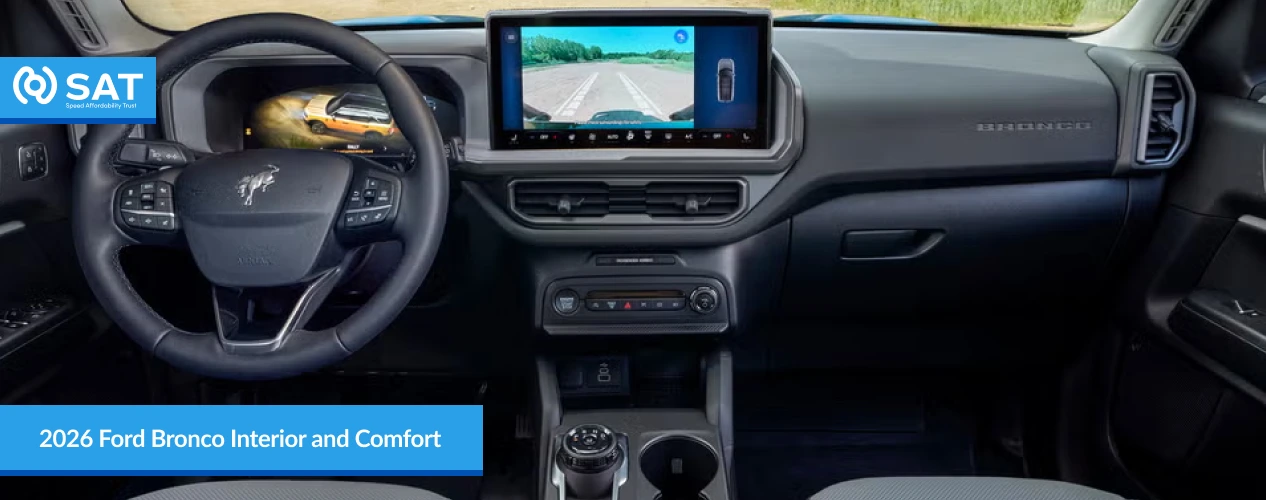
Materials: Durable plastics dominate much of the cabin, particularly on trail-focused versions.
Dashboard: The broad, upright dash suits the Bronco's square exterior and keeps important information easy to see.
Physical controls: Ford keeps useful physical switches for functions drivers may need with gloves or while bouncing along a trail.
Washable features: Available marine-grade vinyl and rubberized flooring make dirt and mud less stressful.
Ergonomics: The driving position is upright, and controls are generally easy to reach.
The downside is that some plastics feel inexpensive once the Bronco reaches higher trim prices. That is easier to accept in a trail-focused Base or Badlands than in a heavily optioned model costing far more.
2-Door Bronco | 4-Door Bronco | |
Seating | 4 | 5 |
Rear Access | Through front doors | Separate rear doors |
Rear Legroom | 35.7 in | 36.3 in |
Best For | Couples, enthusiasts | Families, daily use |
The difference in rear legroom looks small on paper. Access is the bigger issue. Climbing behind the front seats of a two-door gets old much faster than opening a normal rear door.
The removable roof and doors are a huge part of the Bronco experience. Few modern SUVs let you change the character of the vehicle so completely.
There is a price for that freedom. Roof panels need storage, removing parts takes time, and a body designed to open up will never isolate wind noise like a fixed-roof crossover.
The side mirrors are mounted to the body rather than the doors, so drivers still have mirrors when the doors are removed. The doors themselves can be removed with basic tools, although taking them off, storing them safely, and reinstalling them takes more effort than the marketing images suggest.
Roof choice also affects daily usability. The soft top is quicker to open but allows more wind and road noise into the cabin. Hardtop models feel more secure and refined, although they still cannot match the isolation of a conventional fixed-roof SUV.
Rear cargo access can also be less convenient with the soft top, especially when loading bulky items.
The four-door Bronco is considerably easier to live with than the two-door if luggage, children, or outdoor equipment regularly come along.
Cargo Measurement | 2-Door | 4-Door |
Behind Rear Seats | 20.6 cu ft | Up to 38.3 cu ft, soft top |
Maximum Cargo Space | 52.0 cu ft | Up to 83.0 cu ft, soft top |
Interior storage: Useful bins and storage areas suit smaller trail and daily-use items.
Cupholders: Everyday storage is adequate, though layouts differ with body and seating configuration.
Rear swing gate: The side-hinged rear gate carries the spare tire and needs space behind the vehicle to open.
Hardtop vs soft-top cargo access: The four-door soft top offers the largest quoted cargo volume, but roof design changes how easily large objects can be loaded.
Is the Bronco practical for a family?
Yes, especially as a four-door. The two-door can work for occasional rear passengers, but the four-door's easier access, fifth seat and much larger cargo area make it the sensible family choice.
Ford gives the Bronco enough technology without making basic vehicle functions feel buried inside a screen.
Feature | Availability/Details |
Touchscreen | 12-inch center display |
SYNC 4 | Standard infotainment system |
Apple CarPlay | Wireless support |
Android Auto | Wireless support |
Navigation | Available depending on package |
Audio System | Standard system; available 12-speaker B&O |
USB Ports | Available front/rear connectivity depending on configuration |
Digital Display | Digital driver information display |
Where It Stands
The Bronco's technology is modern without forgetting that muddy hands and rough roads make physical controls useful.
Few SUVs offer as many ways to change their appearance and capability.
Sasquatch Package: Adds 35-inch tires, front and rear locking axles, high-clearance flares and related off-road upgrades.
Roof options: Soft-top, hardtop and dual-top choices vary by body style and trim.
Wheels/tires: Ford offers several wheel designs plus all-terrain and rugged-terrain tire packages.
Roof racks: Available carriers make it easier to transport outdoor equipment.
Winch/off-road accessories: Ford's accessory catalog includes equipment aimed at trail and overlanding use.
Auxiliary switches: Factory switches make aftermarket lights and electrical accessories easier to integrate.
Check the equipment list of the individual vehicle before buying.
Automatic emergency braking: Pre-Collision Assist with Automatic Emergency Braking is standard. Other Ford Co-Pilot360 features vary by trim and equipment.
Blind-spot monitoring: Available on equipped models.
Lane assistance: Available depending on equipment package.
Adaptive cruise control: Available on higher equipment packages rather than universal across the range.
Parking assistance: Parking sensors and camera systems vary by trim.
Other systems: Automatic high beams, stability control, and available 360-degree camera technology add useful support.
Organization | 2026 Bronco Rating |
NHTSA | No complete 2026 overall rating verified at publication |
IIHS | No standalone full 2026 Bronco rating verified at publication |
Do not confuse the Bronco with the smaller Bronco Sport. They are different vehicles, and the Bronco Sport's IIHS results cannot be used as a 2026 Bronco rating.
It is too early to give the 2026 Bronco a firm long-term reliability verdict. The current generation has now been on sale for several years, which gives buyers useful history, but that history also includes recalls and owner-reported issues. A 2026 buyer should judge the exact VIN and service campaign status rather than trusting a generic reliability score.
Current recall information matters here because several 2026 Broncos are included in safety campaigns announced during 2026. Recall information can change as new safety campaigns are announced. Ford recommends checking an individual vehicle by VIN to confirm whether any open recalls apply. Buyers should complete this check before purchasing a new or used Bronco.
Coverage | Term |
Basic Warranty | 3 years / 36,000 miles |
Powertrain | 5 years / 60,000 miles |
Corrosion Perforation | 5 years / unlimited miles |
Roadside Assistance | 5 years / 60,000 miles |
Used Bronco buyers should inspect the individual vehicle carefully, especially if it has been used off-road or modified.
Common areas worth checking include:
Roof seals, rattles, and signs of water leaks
Frameless window alignment and sealing
Infotainment and other electrical functions
Uneven or excessive tire wear
Suspension and underbody damage from off-road use
Windshield chips or cracks
Outstanding recall work
Aftermarket suspension, wheels, lighting, or electrical modifications
Off-road use does not automatically make a Bronco a bad buy. However, underbody damage, poorly installed modifications, or missing maintenance records should be checked carefully before purchasing.
Owner feedback tends to follow the same pattern as professional reviews. Many owners love the Bronco because of its styling, open-air experience, customization, and off-road ability, while accepting compromises that would be frustrating in a normal crossover.
Strong off-road capability
Fun open-air driving with the roof and doors removed
Upright visibility
Easy-to-use SYNC infotainment
Huge customization potential
Better road manners than its rugged design suggests
Wind and road noise
Fuel economy
Interior plastics
Roof or window rattles on some vehicles
Tire cost on Sasquatch models
Windshield chips and cracks
Occasional electrical or infotainment complaints
Owner reports vary widely by model year, trim, modifications, and use, so these should be treated as recurring themes rather than problems affecting every Bronco.
Pros | Cons |
Excellent off-road capability | Poor fuel economy |
Two-door and four-door choices | Noticeable highway wind noise |
Manual transmission still available | Interior plastics can feel cheap at higher prices |
Huge range of packages and accessories | Options can push the price up quickly |
Strong 2.7L V6 and 418-hp Raptor | Large off-road tires increase running costs |
Removable doors and roof | Towing is limited to 3,500 lbs on most versions |
The Bronco, Wrangler, and 4Runner overlap, but they are not identical answers to the same question. Bronco and Wrangler lean hardest into open-air off-road fun. The 4Runner is the more conventional fixed-roof SUV and offers stronger towing.
2026 Ford Bronco | Jeep Wrangler | Toyota 4Runner | |
Starting Price | $40,795 before destination | Varies by trim | $42,070 base MSRP |
Engine Options | 2.3L I-4, 2.7L V6, 3.0L V6 | Multiple gas and electrified choices depending on trim | Turbo 2.4L and available i-FORCE MAX hybrid |
Maximum Power | 418 hp | Higher-output performance versions available | Up to 326 hp with i-FORCE MAX |
Transmission | 7MT / 10AT | Manual/automatic depending on engine | Automatic |
Towing Capacity | Up to 4,500 lbs | Configuration dependent | Up to 6,000 lbs |
MPG | About 15-20 combined | Configuration dependent | Up to 20/26 city/highway on listed 2026 models |
Off-Road Strength | Trail technology and broad factory packages | Huge aftermarket and proven rock-crawling formula | Strong durability focus and available trail hardware |
Best For | Best all-round off-road/play balance | Buyers wanting the classic Jeep experience | Practical adventure and heavier towing |
Choose Bronco if: You want serious off-road ability, removable body panels and better road manners than a traditional hardcore 4x4 normally provides.
Choose Wrangler if: The Jeep identity, huge modification scene and classic solid-axle off-road formula matter most.
Choose 4Runner if: You want a more conventional SUV layout, up to 6,000 pounds of towing, and do not care about removable doors.
The Land Rover Defender is another strong alternative if you want more cabin refinement and are willing to spend more. If you are also considering a pickup instead of an SUV, our Ford Ranger vs F-150 comparison explains the key differences between Ford’s midsize and full-size trucks.
A used Bronco from Japan can make sense for buyers in markets where the right vehicle is difficult or expensive to find locally. The important part is checking the individual vehicle rather than assuming every Bronco of the same year and trim is equal.
Model year: Confirm the first registration and production year.
Trim: Base, Big Bend, Badlands, and Raptor can differ enormously in equipment and value.
Engine: Verify the 2.3L, 2.7L or 3.0L engine rather than relying on photos.
Mileage: Check documented mileage and its consistency with the vehicle's condition.
Condition: Inspect body, chassis, interior, and underbody condition.
Service/inspection information: Review available maintenance and inspection records.
Accident/repair information: Check available history for structural or major repair work.
2-door vs 4-door: Make sure the body style suits how you will actually use it.
Steering configuration: Confirm whether the vehicle is left-hand drive and whether that configuration meets your destination country's import and registration rules.
Import eligibility: Confirm the vehicle can legally be imported before paying for it.
Modifications: Check whether suspension, tires, lighting, bumpers, winches, or other aftermarket parts have been installed correctly.
Possibly, but import rules depend on the destination. Check steering-side requirements, maximum vehicle age, inspection standards, emissions rules, and applicable duties or taxes before purchasing.
A Bronco that is legal to export from Japan is not automatically legal to register in every destination country.
Buyers looking for a used Ford Bronco or other Ford models can check SAT Japan’s Ford inventory to see available stock, with pricing and specifications.
Check the exact listing details and destination-country import requirements before making a final decision.
This 2026 Ford Bronco review leaves the Bronco with a strong recommendation, but only for buyers who understand what they are getting. Its biggest strength is real off-road ability backed by excellent factory hardware and huge customization potential. Its biggest weakness is the everyday cost of that design, mainly wind noise, fuel use, and an interior that can feel basic at higher prices.
Badlands is the strongest choice for buyers who will use the Bronco off-road, while Big Bend offers better value for lighter-duty owners. If you want a quiet, efficient family SUV, look elsewhere. If you want an SUV that can handle the commute on Monday and a difficult trail on Saturday, the Bronco remains one of the most convincing choices in its class.
For most buyers, Big Bend offers the best entry point, while Badlands is the better choice for people who will genuinely use the Bronco off-road. Outer Banks makes more sense for road-focused buyers. Raptor is impressive, but its price, fuel use, width, and running costs make it difficult to justify unless maximum performance is the goal.
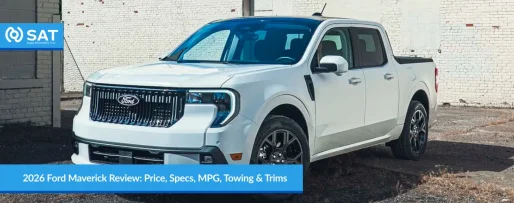
Small trucks are meant to be simple. The 2026 Ford Maverick, on the other hand, is no exception. Its value lies in the fact that it can be customized for a range of different owners to become a fuel-efficient everyday vehicle, a capable work truck, or a sporty pickup. The flexibility comes at a cost, however; when it comes time to purchase, one configuration might be ideal for a commuter while another is not. Here's an in-depth 2026 Ford Maverick review, examining its strengths, weaknesses, and best overall value.
Power and efficiency: The 2026 Maverick is available with a 2.5L Hybrid, combining 184 hp, and a 2026 EcoBoost gives it 250 hp and 280 lb-ft of torque. The Hybrid's estimated fuel economy is 42 mpg in city driving and 35 mpg on the highway.
Truck capabilities: Mavericks can tow 4,000 pounds and carry 1,500 pounds. The 4.5-foot bed offers 33.3 cubic feet of cargo space and is fitted with the FLEXBED system.
Trim-specific trade-offs: The Tremor has a 1,140-lb payload and 2,000-lb towing limit, and the Lobo is rated at 1,045 pounds of payload and 2,000 pounds of towing. These trims focus more on the off-road or street performance than the highest possible utility.
The 2026 Ford Maverick receives incremental updates following the more substantial 2025 refresh. Instead, Ford fine-tuned the formula that made the Maverick popular. The most significant is the revival of the EcoBoost FWD on some trims. That provides an alternative way to get the 2.0-liter turbo engine without the added AWD cost.
Ford also made some smaller changes that go unnoticed. New Marsh Gray and Orange Fury Metallic paint colors are added. The blue Ford oval is back instead of the black badges found on the previous model. Other versions also have a power-sliding rear window.
The Ford Connectivity Package is available for all 2026 Mavericks and gives you one year of complimentary subscription. A regular spare will be easier to add, too. These are not major changes, but the changes enhance daily use and customize the truck for your needs.
What's important is that the vast majority of the big changes took place for the 2025 Ford Mavericks. The new dashboard and 13.2-inch touchscreen, Hybrid AWD, Tremor changes, and the new Lobo performance model appeared that year. Ford is tweaking that package for 2026 and not replacing it. So the 2026 Maverick is not a new generation. It carries forward the major updates introduced for 2025 with additional model-year changes for 2026.
The 2026 Ford Maverick sticker price begins at $27,145 on Ford's build and price page. But that number has to be put into perspective. The lowest consumer-ordered Maverick with the $1,695 destination charge is the XL EcoBoost FWD at $28,840. The XL Hybrid FWD starts at $29,840.
Trim Level | EcoBoost (Gas) | Hybrid |
XL | $27,145 | $28,145 |
XLT | $29,645 | $30,645 |
Lobo | $35,930 | Not Available |
Lariat | $35,870 | $38,090 |
Tremor | $41,140 | Not Available |
(Note: This price does not include the required destination charges.)
The configurations make the pricing interesting. The Hybrid FWD is a $1,000 more expensive option than the EcoBoost FWD on the XL and XLT. Plus, Hybrid AWD costs $2,220 more than Hybrid FWD on applicable lower trims. Lariat comes with AWD, with the Hybrid and EcoBoost versions carrying different MSRPs.
The 2026 Ford Maverick specs reveal why the truck is different from a traditional pickup. It's a unibody design and comes in at 199.8 inches with most trims. That makes it more convenient for city tight spaces. But it still has a 4.5-foot bed and seats for five.
Spec | 2026 Ford Maverick |
Body style | 4-door compact pickup |
Seating | 5 |
Length | 199.8–200.9 inches |
Wheelbase | 121.1 inches |
Bed length | 54.4 inches |
Hybrid engine | 2.5L I-4 |
Hybrid output | 184 hp combined |
EcoBoost engine | 2.0L turbo |
EcoBoost output | 250 hp / 280 lb-ft |
Max towing | 4,000 lbs with 4K Tow Package |
Max payload | Up to 1,500 lbs |
Fuel tank | 13.8 gal Hybrid / 16.5 gal EcoBoos |
The numbers provide insight into the Maverick's versatility, too. A fuel-prioritized Hybrid and more potent EcoBoost are available. There's even more to consider when choosing between front- and all-wheel-drive versions. The truck's unibody design is also a factor in its smaller, more car-like feel.
One more important point is that the headline capability numbers are maximum ratings, not universal ratings. Towing and payload capacities are dependent on the engine, drivetrain, trim, and equipment of the truck. This is why you must check the exact setup before purchasing a Maverick for towing or work.
Choosing between the 2026 Ford Maverick Hybrid and 2026 Ford EcoBoost isn't as simple as it sounds. The 2.5-liter Hybrid makes 184 hp, while the 2.0-liter EcoBoost produces 250 hp and 277 lb-ft of torque. The EcoBoost is more powerful, and the Hybrid is more efficient for normal driving.
For commuters that spend the majority of their driving time in and out of the city, the Hybrid is an intelligent option. The FWD gets a rating of up to 42 mpg city / 35 mpg highway. Hybrid AWD achieves up to 40 mpg city and 34 mpg highway on applicable XL/XLT configurations; Lariat Hybrid AWD is rated lower at 39 city/32 highway.
This is something that many buyers overlook: The Hybrid is not a commuter configuration. With the right equipment, it can tow up to 4,000 pounds. That makes the efficient Maverick a whole lot more capable than it lets on when it comes to saving fuel.
When you're looking for a quick punch, the 2026 Ford Maverick EcoBoost is the more appropriate choice. It has a turbocharged 2.0-liter engine that produces 250 hp and 280 lb-ft of torque. This helps when merging, going up a hill, or towing a trailer.
There is a definite price, though. EcoBoost FWD gets better fuel economy, with 23 mpg in city driving and 32 mpg on the highway. AWD decreases to 22 city and 30 highway. So you are sacrificing a lot for this additional performance.
It's not just Hybrid vs EcoBoost. It's efficiency vs. power. A daily driver that tows only occasionally has no choice but to consider the Hybrid. If you tow often, accelerate more, or drive hard, the EcoBoost is a more expensive driving experience.
The Hybrid is the highlight of the 2026 Ford Maverick fuel economy. The Hybrid FWD gets 42 mpg in city driving, 35 mpg on the highway, and 38 mpg in combined city/highway driving. Hybrid AWD is rated up to 40/34/37 mpg city/highway/combined on applicable configurations, while Lariat Hybrid AWD is rated 39/32/36.
The greatest benefit is in urban conditions. The Hybrid can use the electric motor and recover energy through regenerative braking in stop-and-go traffic. This is why its City Rating is so high.
The EcoBoost FWD gets 23 city, 32 highway, and 26 combined mpg. AWD falls to 22/30/25 mpg. That's a huge deal from the Hybrid, particularly for those who drive long distances weekly.
A 38-mpg Maverick would burn 395 gallons of fuel at 15,000 miles per year. The 26-mpg version would require approximately 577 gallons. That's about 182 gallons more a year, before gasoline price differences.
There will still be a variety of factors affecting real-world MPG, including speed, weather, traffic, payload, tires and towing. Use the EPA ratings as a guideline, not as a guarantee.
The 2026 Ford Maverick's towing capacity is capped at 4,000 pounds. However, this number will require the available 4K Tow Package. Otherwise, it is 2,000 pounds. The available 4K Tow Package raises the Maverick's maximum trailer rating from 2,000 to 4,000 pounds on eligible configurations.
Many small campers, utility trailers, boats and recreational loads are possible on a well-equipped Maverick. For such a compact pickup, the 4,000-pound capacity is impressive. Nevertheless, towing near the limit is more of a challenge than light-duty towing.
The package includes a Class III 2-inch hitch receiver, 4-pin and 7-pin connectors, a trailer brake controller, and an enhanced cooling fan. Additionally, hybrid models get a transmission oil cooler, while EcoBoost models are equipped with a larger radiator.
The 2026 Ford Maverick has a payload capacity of 1500 lbs, but not all models are the same. The Hybrid FWD and EcoBoost FWD/AWD versions have a capacity of 1,500 lbs. The hybrid AWD system's rating is 1,400 pounds.
Payload not only includes materials in the bed, but people and cargo as well. The weight of passengers, tools, luggage, accessories, and more all counts. This reduces the real-life payload after the truck is full with people on board.
If four 180-pound adults were on the payload, the amount would be 720 pounds. That means about 680 pounds for the other things on a 1,400-pound Maverick. That's the reason why the maximum rating should not be considered the maximum number of beds in use.
The specialty models give up some payload for their unique hardware. The Tremor weighs 1,140 pounds, while the all-action Lobo weighs in at 1,045 pounds.
It's easy to overlook that tradeoff between trims. The Lobo and Tremor are designed to accomplish different tasks, so if you're driving heavy loads often, you might want to consider a standard Maverick setup.
You can use the Maverick's payload for daily activities like tools, landscaping equipment, building materials, luggage, and recreational equipment. Ford's 4.5-foot bed gives a 33.3 cubic foot cargo capacity with 42.6 inches between the wheel wells.
The FLEXBED system is a useful feature. Smaller loads can be prevented from slipping around with its built-in slots that help to divide the bed. The Maverick's small bed is more functional than its dimensions would imply.
Before carrying a heavy load, check the payload label on the driver's door of the exact truck. Payload depends on configuration, accessories, cargo, and passengers.
It's the number that counts when loading up the Maverick. The advertised 1,500-pound maximum is a helpful guideline, but not for every truck.
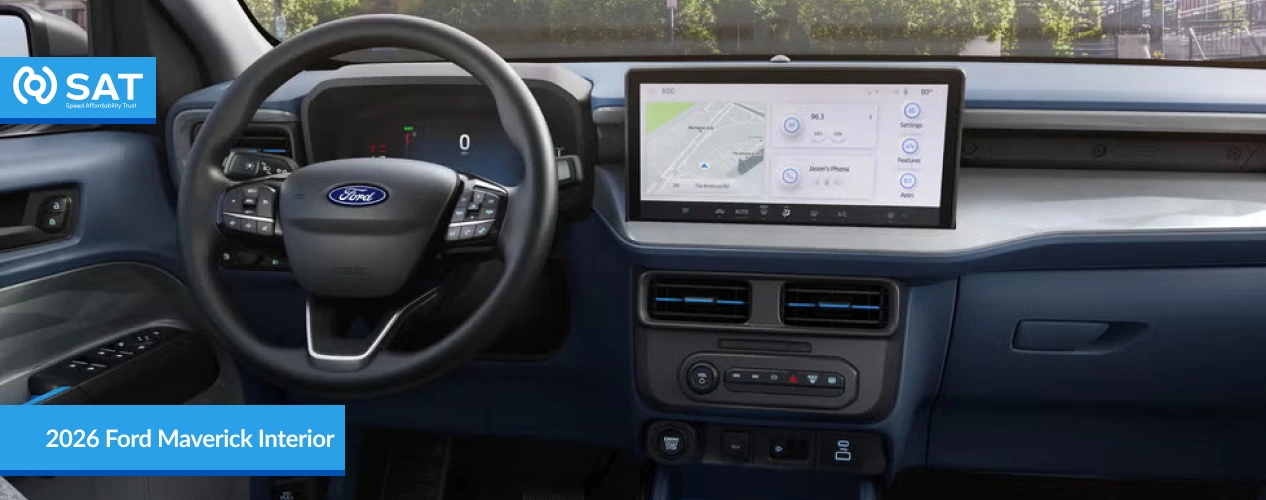
The 2026 Ford Maverick's interior is designed with functionality in mind. Smart storage and helpful gadgets make it easy to live in, without it being a luxury cabin. All Mavericks are standard with an 8-inch digital driver display, 13.2-inch touchscreen, and wireless Apple CarPlay/Android Auto.
Useful front seat adjustments are found, plus heated seats, power adjustments, and dual-zone climate control in higher trims. The rear seat accommodates adults, but taller passengers may prefer more legroom. Back cushions can also be flipped up for out-of-the-way storage.
The Maverick has more storage for daily gear with large door pockets, cabin cubbies, and under-seat storage. The 13.2-inch standard screen is a big plus, as even the base XL ends up with smartphone connectivity.
Hard plastics are common, especially on lower trims. The Lariat includes heated seats, dual-zone climate control, ambient lighting and a heated steering wheel to make it a more sophisticated experience.
The 2026 Ford Maverick bed is small, but it is one of the truck's smartest features.
The FLEXBED is designed to optimize the Maverick's space. Owners can use 2x4 or 2x6 boards in built-in slots to build dividers, shelves, and two-level storage. The multi-position tailgate can also support longer items.
That design can be useful in regular work-related situations. You can also divide tools from food or prevent items like camping gear from falling into one pile. It transforms a small bed into a more functional workspace.
The bed has pre-wired 12-volt connections for accessories. Available Pro Power Onboard adds a 110-volt outlet, giving you a convenient way to run tools or charge equipment at a job site or campsite. A bed extender is also available.
Loading height depends on the configuration. Ford lists measurements from about 28.2 to 30.5 inches, with the Lobo sitting lowest. The lower loading height can make bulky items easier to lift into the bed.
The 4.5-foot bed works well for tools, groceries, camping equipment, landscaping gear, and other everyday cargo. But its short length becomes a limitation with long lumber or large flat materials.
For longer items, the tailgate, FLEXBED system, and extender are helpful. However, if buyers habitually carry long pieces of construction, they may want to know if larger pickups are better suited.
For its size, yes. The Maverick's secret to winning is not the largest bed. It wins because it makes a small space easy to set up, run, and change. This is the true benefit of FLEXBED.
The engine determines the 2026 Ford Maverick performance. The 2.0-liter EcoBoost produces 250 hp and 280 lb-ft of torque and is paired with an 8-speed automatic transmission. The 2.5-liter Hybrid uses an electronic continuously variable transmission (eCVT).
The Hybrid isn't a slow car. In a Hybrid AWD test, it measured 6.7 seconds from 0–60mph. It also provides a smooth response at low speeds due to its electric motor.
The EcoBoost features a new 8-speed automatic transmission and optional all-wheel drive. The performance-focused Lobo is based on the same engine, but has sportier hardware. A 2025 Lobo test demonstrated 5.8 seconds to 60 mph.
Maverick is easy to handle, but may be very stiff on uneven surfaces. Both the Lobo and Tremor are road-ready cars, yet the Lobo is the more road-oriented, whereas the Tremor is meant for off-road driving. When power is more important than efficiency, the more powerful EcoBoost is the more appropriate choice for most buyers; otherwise, the Hybrid is more than adequate for everyday driving.
The 2026 Ford Maverick Tremor is the off-road-focused version of the Maverick. It is equipped with Advanced 4WD, a twin-clutch rear drive unit, off-road suspension, extra ground clearance, and a lockable rear differential. Trail Control with Trail 1-Pedal Drive also comes standard.
The Tremor is equipped with all-terrain tires, off-road suspension tuning, and underbody protection. The improvements make it a more confident version of a standard Maverick on dirt, rocks, and rough trails.
The dual-clutch rear drive system is particularly handy in slippery conditions. It can also assist in power transmission to the front wheels as well as power to the rear wheels.
The Tremor's off-road parts have their pros and cons. It has a payload capacity of 1,140 pounds, which is lower than the 1,500-pound capacity of some other Mavericks.
There's also a severe towing restriction. The Tremor is rated to pull 2,000 lbs, as the 4K Tow Package is not offered. This makes the Tremor ideal for off-road driving, as opposed to owners who demand the maximum towing alongside very regular driving.
The Tremor is most appropriate when you plan to use its additional ground clearance, traction devices, and off-road suspension. If you're mostly driving on pavement, you can get more payload and towing power with a standard Maverick.
The 2026 Ford Maverick Lobo is a bold change for the small pickup. It does not have a design for use on trails. The 250 hp EcoBoost, Advanced 4WD, lowered suspension, seven-speed quickshift, and Lobo Mode give it a definite street-performance tune.
The Lobo is loaded with paddle shifters, new brakes, and a torque-vectoring rear drive unit. These features make the truck more responsive on paved roads. Lobo Mode also alters the way the truck drives, making it more spirited.
The Lobo's suspension has been lowered, and the 19-inch wheels also contribute to the ride's overall feel, which differs greatly from the Tremor. The Tremor is built for off-road driving, and the Lobo targets drivers who prefer a more sport-driven Maverick on the road.
The largest compromise is in use. The Lobo can carry 2,000 pounds of towing and 1,045 pounds of payload. That's much lower than the maximum ratings of other Maverick setups.
The Lobo is an unusual Maverick. You sacrifice some hauling capacity for a more on-the-road-capable truck. That's a sacrifice that could be accepted by buyers who do not frequently carry heavy items.
The four trucks are positioned in really different segments of the pickup market. The smallest and the most efficient is the Maverick. The Santa Cruz is more of a crossover model. The Frontier is a traditional midsize truck. The Honda Ridgeline is targeted at a more streamlined and elegant truck ride.
Category | 2026 Ford Maverick | 2026 Hyundai Santa Cruz | 2026 Nissan Frontier | 2026 Honda Ridgeline |
Truck type | Compact unibody | Compact unibody | Midsize body-on-frame | Midsize unibody |
Best strength | Efficiency & flexibility | Crossover comfort | Towing & rugged use | Ride & practicality |
Bed approach | FLEXBED | Compact utility bed | Traditional pickup bed | In-bed trunk |
Character | Small and nimble | SUV-like | Traditional truck | Refined truck |
Best buyer | Daily driver who needs a bed | SUV buyer wanting a bed | Frequent hauler/tower | Family-focused truck buyer |
The size and mission are the biggest differences. The Frontier is the straight road to truck functionality, and the Ridgeline adds more space and a less truck-like feel. The Santa Cruz falls somewhere in the middle. The Maverick remains dedicated to providing consumers with the features they need on their trucks without the midsize pickup size. Nissan, for instance, has a 310-hp V6 in the standard configuration, with towing capacities of up to 7,150 lbs.
The 2026 Ford Maverick has the essentials right, but its strong points are in the hands of the driver. The greatest benefit is flexibility. The downside is some versions will require you to sacrifice useful truck capabilities for specialty features.
High efficiency: The Hybrid makes trucks more fuel efficient.
Smart cargo design: FLEXBED makes the short bed easier to organize and use.
Easy to drive around with: Compact size suits urban areas & narrow parking.
True truck utility: The right equipment in the right model is a serious capability in a compact pickup.
Power train optioning: Customers can choose performance or efficiency.
Good standard tech: The base XL is loaded with a big 13.2-inch touchscreen and 8-inch digital cluster.
Rear seat space is limited: The back seat space is smaller, which can restrict taller passengers.
Basic cabin materials: Lower trims feel more focused on durability than luxury.
The more expensive trims lose some value: The Maverick is difficult to compare to larger trucks in the higher ranges of the $30,000s.
Specialty trims compromise payload or towing: Tremor/Lobo models compromise payload or towing for their specialty missions.
A short bed: FLEXBED makes the 4.5-foot bed smarter, but it will not replace the longer pickup bed.
If you need a bigger car, the 2026 Ford Maverick is definitely worth it. It provides the rugged durability of a pickup bed without the weight of a midsize or full-size pickup. The Hybrid also makes it a wise choice for daily driving when consumers want the utility of a truck and not the fuel consumption.
The sweet spot is the lower and middle trims. The XLT is a nice addition of useful gear but not as expensive as the Lariat, Lobo, or Tremor. Recent data also indicates that Maverick buyers may be able to secure trucks for less than the sticker price, depending on the market and truck.
The higher the price, the more difficult it is to justify the value. There's a point where a well-equipped Maverick can start to compete with more powerful trucks. That's where it's best to ask one simple question: Do you need more features, or do you need a larger truck?
The Maverick is an excellent choice for a commuter, small family, weekend do-it-yourselfer, or light-duty truck owner. Its small size is its downfall for frequent heavy towing, large loads, or maximum cabin space.
If you're looking for the most affordable option, the 2026 Ford Maverick XL is the best vehicle. It provides the Maverick's core formula without any additional features you might not want.
For most buyers, the ideal size is the XLT. It offers several helpful and convenient amenities that take the Maverick into the considerably more expensive upper trims of the lineup.
Pick the Lariat if attention to cabin comfort and technology is more important than low cost. It's best suited for those who will be spending a significant amount of time sitting in a car.
The Tremor is a real off-roader. Its optional equipment is nice on trails, but it lacks the payload and 2,000-pound towing capacity of a full-size truck, so it doesn't appeal to all buyers seeking maximum utility.
The wildcard is the Lobo. It sacrifices some hauling capacity for a sportier, street-inclined package. If you're looking for a Maverick that's going to be a little bit different than all the other small pickup trucks, then this is it.
The best strategy is to select the use first and then the trim. If you will never use Tremor or Lobo hardware, don't pay for them. The XLT is the sweet spot between cost, comfort, and utility for most users who need a truck for regular use.
2026 Ford Maverick is best suited for those who seek a truck that is a part of their daily routine. However, selecting the appropriate vehicle is just half the task. Knowing who to buy from, the condition of the car, and the total purchase price are just as important.
If you're also interested in used Ford trucks or other imported trucks, you might want to check out SAT Japan. We have a large used vehicle marketplace, offer Ford in our inventory, and provide international vehicle export services.
This means that Japanese shoppers who are evaluating a new Maverick against a used Ford or are considering a foreign option will be interested in SAT Japan. Always review the vehicle's history, condition, mileage, import laws, taxes, shipping fees, and final landed price before purchasing.
A good car isn't just a good name and a good price. The better buy is the one that suits your needs and is still financially viable when all costs have been considered.
The Toyota Camry Review 2026 is no longer just about deciding if it's a good midsize sedan. It's about figuring out which version gives you the best value. As all of the 2026 Camry models now have a hybrid powertrain, the distinctions lie in the trims, technology, comfort, and optional AWD system. That's where most buyers overspend. This expert review goes beyond the spec sheet to explain the price, actual performance, interior, fuel efficiency, and trims of the 2026 Toyota Camry, helping you choose the right trim based on your budget and driving requirements.
The Toyota Camry Review 2026 provides insights that make the purchasing decision easier than ever. The choice of engine is not a major factor when it comes to the right Camry trim; all 2026 Camrys are equipped with the same hybrid powertrain. Buyers must consider comfort, technology, and value, rather than horsepower.
The LE is perfect for most drivers as it offers the same fuel-saving hybrid system found in higher trims at a cheaper cost. The XLE is the better choice for buyers who require a quieter cabin, premium materials, and extra comfort, while the SE and XSE would be best suited for those wishing for a sportier design and not performance.
The greatest assets of the Camry are its fuel efficiency, comfortable driving experience, safety features, and Toyota's reputation for reliability. It's not the most sporting midsize sedan, but it's definitely one of the strongest choices for buyers prioritizing efficiency, comfort, and low running costs. Overall, the 2026 Camry is one of the most cost-effective sedans available, offering excellent resale value and low running costs.
Category | Rating |
Performance | 8.6/10 |
Fuel Economy | 8.9/10 |
Interior | 8.0/10 |
Comfort | 8.0/10 |
Technology | 9.1/10 |
Safety | 10/10 |
Reliability | 8.5/10 |
Overall Score | 9.4/10 |
Excellent fuel economy with the standard hybrid.
Most buyers will choose the LE trim.
Comfortable ride, quiet cabin, and easy-to-use technology.
Excellent safety, reliability, and resale value.
No engine performance option.
Higher trims are considerably more expensive.
The Sportier trims focus primarily on styling rather than driving.
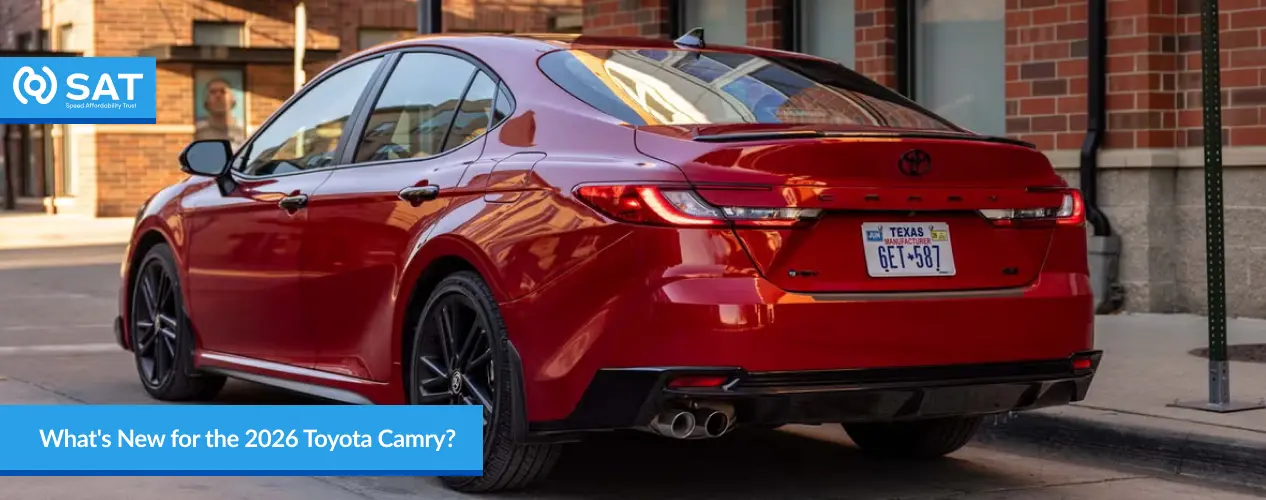
The biggest news for the 2026 Toyota Camry is what hasn't changed. Last year, Toyota underwent a complete overhaul of its hybrid-only model lineup, and the company is sticking with the tried-and-tested formula, with buyers deciding on features and value rather than engines. This also translates into fewer first-year redesign issues and a smoother ownership experience.
The Nightshade is a styling-focused trim that adds distinctive black exterior accents and special wheels for buyers who want a sportier appearance.
The Nightshade offers the same hybrid powertrain as the other Camry trims while adding unique black exterior accents and wheels. It is a good choice for buyers who want a more distinctive, sporty appearance without paying for the higher-end XLE or XSE trims.
All Camry trims use Toyota's hybrid powertrain, although output varies by drivetrain: FWD models produce 225 hp, while AWD models produce 232 hp. For 2025 Camry owners, the 2026 model may not offer enough changes to justify an immediate upgrade. For new buyers, however, the 2026 Camry remains a strong choice for its fuel efficiency, features, and available AWD.
Prices for the 2026 Toyota Camry range from $29,000 for the LE trim up to $35,200 for the XSE, both before destination charges and optional packages. All the trims have the same hybrid powertrain, so the price difference is not necessarily a performance difference. It's a luxury, comfort, technology, and style difference.
Trim | 2026 Starting MSRP (FWD) |
LE | $29,000 |
SE | $31,300 |
Nightshade | $32,300 |
XLE | $34,000 |
XSE | $35,200 |
Prices exclude destination fees and optional equipment.
The LE is the most affordable way to get the Camry's hybrid powertrain and standard safety technology. The XLE is the better upgrade if you desire a quieter cabin and more high-quality features. The XSE is the best option for buyers looking for sporty styling over additional performance. The best approach is to compare the features, not the horsepower, since all of the trims have the same hybrid system.
Toyota's 2026 Camry trim comparison is easier than ever, as all trims share the same hybrid powertrain. It's not a matter of engine power; it's a matter of matching price, comfort, technology, and style. Some consumers spend more than necessary by choosing the highest trim instead of the one they drive every day.
The LE is the smartest choice for most buyers. It features Toyota Safety Sense, a standard hybrid system, and the same reliability that is common to all models. This is the trim to beat if you're looking for low ownership costs and excellent fuel economy.
Ideal for: People who commute daily or have a family, or are looking for a budget-friendly purchase.
The SE gets a sportier look, bigger wheels, and stiffer suspension for a more assertive driving experience. If you're looking for a more sophisticated appearance without the high-end price tag, it's a perfect choice.
Ideal for: Drivers seeking additional style without compromising efficiency.
Improved styling and black wheels and exterior accents make the Nightshade an improvement over the SE. Providing the same hybrid performance, it's a bigger design and not more speed.
Ideal for: Purchasers seeking remarkable styling on a budget.
The XLE is a luxury-focused as opposed to sport-focused vehicle. It refits the cabin with high-quality materials, with added convenience, and with a quieter driving experience, so it is the better choice for a long commute or road trip.
Ideal for: drivers looking for refinement
The XSE combines the premium comfort of the XLE with the sportier styling of the SE, making it the most complete Camry in the lineup. It adds unique exterior styling, larger wheels, premium interior materials, and more advanced convenience features. However, don't expect quicker acceleration—every 2026 Camry uses the same hybrid powertrain. You're paying for a more upscale driving experience, not extra horsepower. If you want the best-looking and best-equipped Camry without stepping into a luxury brand, the XSE is the right choice.
Ideal for: Drivers seeking additional style without compromising efficiency.
For most buyers, the LE provides the most value, with all the other hybrid and basic safety features. The trims share the same basic hybrid powertrain, while output and fuel economy vary by drivetrain. The XLE is best suited to buyers who regularly appreciate the extra comfort, whereas the XSE is best suited to buyers who value the premium features and distinctive styling.
The 2026 Toyota Camry review indicates that Toyota was more concerned with enhancing the driving experience for everyday use. No matter the trim, the 2.5-liter hybrid powertrain is the same, so there is no performance increase between the different models. Rather, you are paying for the extra comfort, technology, and style – something that many buyers overlook!
The electric torque is instant in this hybrid system, giving the Camry newfound responsiveness in city driving, while the eCVT delivers smooth acceleration and great fuel economy. Toyota fine-tuned the suspension for comfort, making it easier to run on rough roads and for long-haul trips on the highway as opposed to being aggressive on corners. Available AWD gives drivers an added sense of confidence in rainy weather and light snow, but people in hot weather might not require the extra expense.
The Camry is among the best options in the midsize sedan category if you value reliability, hassle-free driving, and low ownership expenses.
For 2026, the horsepower of the Toyota Camry is 225 hp for front-wheel-drive models and 232 hp for all-wheel-drive models. While these numbers may not seem class-leading, they don't tell the full story. The hybrid system's electric motor provides instant torque, giving the Camry a quick start-off from traffic lights and making it more responsive in town than its power ratings imply.
Specification | FWD | AWD |
Horsepower | 225 hp | 232 hp |
Engine | 2.5L Hybrid | 2.5L Hybrid |
Toyota built the Camry to be efficient and provide a strong performance, rather than maximizing horsepower. More expense doesn't mean higher speed; it means more comfort, technology, and premium features, as all trims are equipped with the same hybrid powertrain. That usually means choosing a trim for what it will do, not what it will look like. It is a sensible choice that helps keep fuel expenses low, while offering solid acceleration for commuting, highway merging, and family excursions.
One of the most noteworthy features of the 2026 Toyota Camry is its fuel efficiency, making it an excellent option for anyone seeking a reliable yet fuel-efficient vehicle. Fuel economy varies by trim and drivetrain. The most efficient version is the front-wheel-drive LE, which has an EPA-estimated rating of 52 mpg city / 49 mpg highway / 51 mpg combined. The SE, XLE, and XSE with front-wheel drive are rated at 47 mpg city / 45 mpg highway / 46 mpg combined.
With all-wheel drive, the LE is rated at 50 mpg city / 49 mpg highway / 50 mpg combined, while the SE and XLE achieve 46 mpg city / 46 mpg highway / 46 mpg combined. The XSE AWD is rated at 43 mpg city / 43 mpg highway / 43 mpg combined. Despite these differences, the Camry remains one of the most fuel-efficient non-plug-in sedans on the market.
The front-wheel-drive option is more attractive for most people who are considering buying a car, as it provides the most efficient and cost-effective option for owners. The increased traction of AWD is only a benefit for those who frequently travel in wet, snowy, and other slippery conditions.
Many reviews fail to mention one benefit when driving the hybrid: The electric motor does a lot more of the work when it's in city driving conditions. That means many owners can match or even exceed the EPA ratings on a typical daily commute, making the Camry a great investment for those who spend most of their time in urban areas.
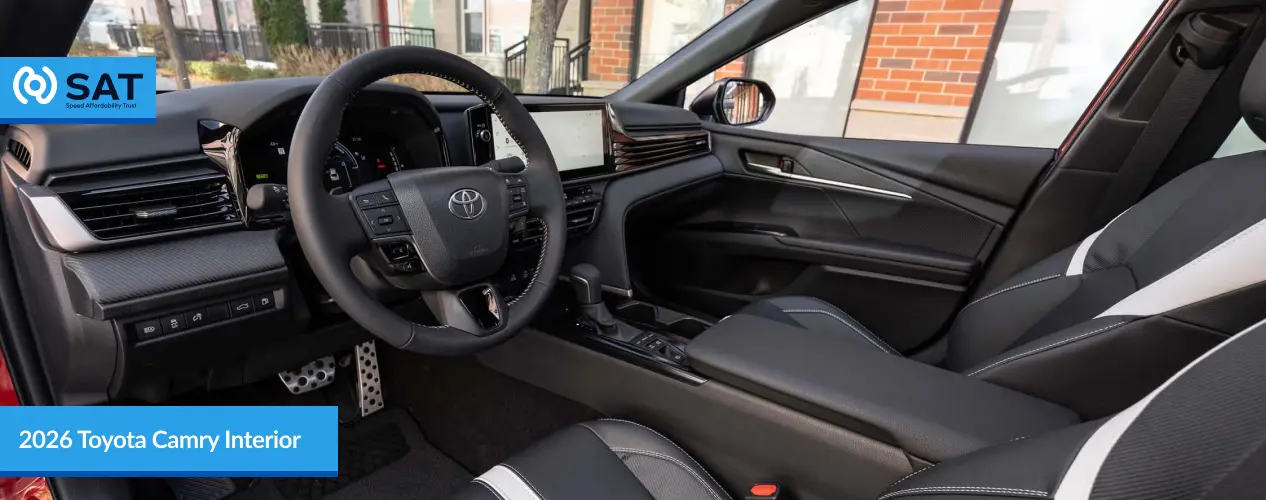
The 2026 Toyota Camry interior is designed for practicality. Toyota has selected long-lasting materials, comfortable seating, and an uncluttered design that remains functional over the years. Lower trims feature more hard plastics, but the cabin retains a solid fit and finish, while higher levels introduce more soft plastics and an increased level of quality without much alteration to the basic design.
Long drives in the front seats are comfortable, and the back seat is spacious for adults or an expanding family. Many reviews will not mention this, but a wide-opening rear door makes loading passengers and installing child seats both easy. Toyota also kept the interior uncluttered, with the driver having fewer distractions to help them navigate the road.
The Camry is not a flashy vehicle like some of its competitors, but one that looks good for everyday use. The main difference between trims is cabin refinement, not space, and if you want it, you'll have to pay for the upgrade to appreciate the additional comfort and luxury materials.
Good technology isn't about having the biggest screen; it's about making every drive easier. The 2026 Toyota Camry delivers a user-friendly infotainment experience across the lineup. The base LE comes with an 8-inch Toyota Audio Multimedia touchscreen, while higher trims offer a larger 12.3-inch touchscreen. Wireless Apple CarPlay® and Android Auto™ are standard features, making it easy to connect compatible smartphones.
Toyota's infotainment system features clear menus, easy-to-read icons, and responsive controls. Convenience features available on higher trims include a 12.3-inch digital instrument cluster, JBL® premium audio, wireless smartphone charging, and over-the-air software updates.
The main benefit is the value. The Camry offers even low-priced buyers a modern infotainment system experience, while some competitors only offer this technology in high-end trims. The only upgrade is a bigger screen size or better sound quality.
Additional driver-assist upgrades, such as Front and Rear Parking Assist with Automatic Braking and a Panoramic View Monitor, are available on select higher trims or premium packages. However, all buyers can rest easy knowing that essential protections like the Blind Spot Monitor and Rear Cross-Traffic Alert come standard on every single model.
Additional safety and convenience features, including Front and Rear Parking Assist with Automatic Braking and the Panoramic View Monitor, are available on select higher trims or configurations. Blind Spot Monitor and Rear Cross-Traffic Alert are standard across the 2026 Camry lineup, providing essential driver assistance regardless of which trim you choose.
The premier plus is Toyota's safety strategy. Advanced driver aids are available from the outset with the Camry, but many competitors only offer them in higher-specification versions. This means buyers can choose the model that suits their price range without compromising on the level of security it offers. The Camry is one of the strongest long-term choices in the midsize sedan market for families, first-time buyers, and commuters.
The 2026 Toyota Camry dimensions are perfect for a balance of comfort and functionality. It is 193.5 inches long, 72.4 inches wide, and 56.9 inches high, and has a wheelbase of 111.2 inches. The Camry also packs 15.1 cubic feet of trunk space and 5.4 inches of ground clearance. It is easy to park and has a cabin with plenty of room for five passengers.
The significance of these dimensions lies in the impact they have on the driver's everyday driving experience. With its long wheelbase, the vehicle offers a smoother ride and more legroom in the rear seats, and the moderate width makes parking the Camry in city streets easy.
While the Honda Accord has a slightly larger trunk, the Camry offers an excellent combination of trunk space, comfort, and handling. Rather than trying to get more data, Toyota concentrated on aspects of the car that make driving to work, taking vacations with the family, and long highway trips more pleasant on a daily basis.
Whether you're commuting to work, driving to the grocery store with the kids, or just piling in the driver's seat for a long drive, the 2026 Toyota Camry is built for the moments that matter. It has comfortable seats, an optimized suspension system, and a quiet cabin. All this helps eliminate driver fatigue, making longer routes more manageable. To keep passengers comfortable on both rough roads and highways, Toyota concentrated on its ride quality rather than a sporty ride.
The Camry really shines in the realm of practicality. The rear seat is large enough for adults to sit in, and the doors are generously sized, allowing child seats to be mounted easily and for older passengers to enter and exit. The spacious trunk is adequate for groceries, suitcases, or sporting equipment, and it's clearly a car that's perfect for long and short journeys.
Some of the biggest benefits that many buyers ignore are consistency. There is the same amount of space and convenience in each trim, so the upgrades are mostly for comfort rather than space. So you can choose the trim you want without sacrificing functionality.
The Toyota Camry's reliability has been a hallmark since its inception, and the 2026 iteration upholds that tradition. Toyota's hybrid system has been tested in the real world for many years and provides more confidence to the buyer than many newer hybrid designs. This reliability over an extended period of time can be as important as fuel economy for the driver who will keep the vehicle for 8 to 10 years.
It is also very easy to maintain. The hybrid system incorporates regenerative braking, which not only minimises brake wear but can also lead to reduced maintenance expenses in the long run. Services such as oil changes, tire rotation, and fluid checks are routine and are readily available at Toyota dealerships and independent repair centers, so owning a Toyota car is easier almost anywhere.
Another aspect that many purchasers overlook is that reliability is not only about avoiding repairs; it's about predictable ownership expenses. The Camry's reliability, the availability of replacement parts, and its proven hybrid technology all contribute to lower TCO. For this reason, the Camry remains one of the most intelligent long-term purchases in the midsize sedan market.
The 2026 Toyota Camry's warranty provides peace of mind after the dealership. It has a 3-year/36,000-mile basic warranty and a 5-year/60,000-mile powertrain warranty. As all Camry models are hybrids, Toyota additionally provides an 8-year/100,000-mile hybrid component guarantee and a 10-year/150,000-mile hybrid battery guarantee, providing peace of mind for one of the Camry's most important systems.
Toyota also comes with ToyotaCare, which covers factory-scheduled maintenance for 2 years or 25,000 miles, as well as 24-hour roadside assistance during the same period. This will help lower the total cost of ownership in the first few years and facilitate regular maintenance.
The length of the warranty is not the most important part; it's the experience of Toyota hybrids. Many people are concerned with hybrid ownership, and the extended battery warranty helps alleviate that concern. When added to the Camry's reputation for reliability and good resale value, the warranty package makes it a great option for those looking to drive their vehicle for many years.
The decision of which midsize sedan to purchase is not solely based on price, but also on what will suit your driving habits and long-term requirements. While the 2026 Toyota Camry is a standard hybrid with good reliability and low ownership costs, each competitor has some advantages.
The driving character of the Honda Accord is sportier, and it provides more responsive handling. For those who prioritize fuel efficiency and long-term savings, the Camry's standard hybrid model offers superior fuel economy throughout the range.
The design of the Hyundai Sonata is bold and loaded with features. The Camry is known for its reliability, high resale value, and trusted hybrid system.
The Kia K5 attracts buyers with its sporty design and available turbocharged engine. The Camry's emphasis on comfort, fuel efficiency, and reduced running costs makes it the wiser choice for daily driving.
When it comes to the Toyota Camry and Nissan Altima comparison, both are available as an AWD vehicle and have a comfortable ride. But the Camry has better hybrid fuel economy, has a more refined cabin, and has better long-term value.
Feature | Toyota Camry | Honda Accord | Hyundai Sonata | Kia K5 | Nissan Altima |
Best For | Long-term ownership | Sporty driving | Technology | Bold styling | AWD value |
Hybrid Available | Yes | Yes | No | No | No |
Fuel Economy | Excellent | Excellent | Good | Good | Good |
Reliability | Excellent | Excellent | Very Good | Very Good | Very Good |
Resale Value | Excellent | Very Good | Good | Good | Good |
The best part of the Camry is that it isn't the best in every category; it's the best in almost all categories. When it comes to efficiency, reliability, and low ownership costs, the Camry is the most well-rounded choice in this crowded category.
When looking for a Toyota Camry 2026 for sale, don't just consider the price tag. With all trims sharing the same hybrid powertrain, it's more crucial to compare features, condition, and total ownership costs than it is to opt for the most expensive model. That's the number of smart buyers who avoid paying for things that they don't need.
If you are interested in importing a Camry, you can trust SAT Japan to offer access to Japanese vehicles, provide access to the stock, and arrange international shipping. Always check the vehicle's history, mileage, inspection records, and import requirements for your country before buying; there are always hidden costs.
Buying a 2026 Toyota Camry is a smart decision, but choosing the wrong trim or features can cost you more than necessary. Avoid these common mistakes before signing the paperwork:
Don't assume the highest trim is the best value. Every Camry uses the same hybrid powertrain, so higher trims add comfort and technology—not better performance.
Don't pay extra for AWD unless you need it. If you drive mostly in warm or dry climates, the FWD model offers better fuel economy and lower ownership costs.
Don't judge the car by horsepower alone. The hybrid system's instant electric torque makes the Camry feel more responsive in everyday city driving than the numbers suggest.
Don't ignore the total ownership cost. Compare fuel savings, insurance, maintenance, and resale value—not just the purchase price.
Don't skip comparing dealer offers. Factory incentives, financing rates, trade-in values, and dealer-installed accessories can change the final price by thousands of dollars.
Making the right buying decisions from the start can save money and help you enjoy the Camry's strengths for many years.
The 2026 Toyota Camry is designed for those who prefer long-term satisfaction over short-term excitement. The hybrid system, low maintenance, and great resale value make the Camry a good choice for those who drive primarily in city traffic, have a long commute, or drive their car for 8-10 years. The spacious interior, safety equipment, and trustworthiness will also be advantageous for families, first-time car buyers, and ride-share drivers.
The 2026 Toyota Camry might not be for everyone. Acceleration, cornering, and high-performance sports sedan lovers may find rivals such as the Honda Accord or performance-oriented special versions more desirable. If you're looking for more cargo space or a higher ground clearance, you will want to consider other vehicles as well, because the SUVs don't offer those options. The Camry is designed for comfort, efficiency, and reliability, not excitement. If you're looking for long-term value, it is a great option. If driving fun is the top priority, you'll likely be better off with another car.
The most important thing to take from this Toyota Camry Review 2026 is that it is better to pick the right trim than to go for the best price. Toyota has stripped away the layers of engine choice and let customers focus on the features they'll use rather than engine options. This is refreshing in a sea of sedans these days. You'll enjoy years of reliable ownership, reduced operating expenses, and a car that will provide value long after you've driven it.
This 2026 Hyundai Elantra Review looks at its price, performance, fuel economy, reliability, and available trims. The Elantra suits buyers who want an affordable sedan with good fuel economy and a smooth-running hybrid option.
Its main strength is the wide choice of models, ranging from a 40-mpg petrol sedan to a 54-mpg hybrid and a 276-hp Elantra N. The basic engine feels slow, and some cabin materials look cheaper than those in a Honda Civic or Kia K4. It makes the most sense for commuters, first-time buyers, and small families who want a lot of car without moving into SUV pricing. Read this complete Hyundai Elantra review to see whether the new Elantra is worth buying.
Starting price: The 2026 Hyundai Elantra SE starts at $22,825 before freight. The Hybrid Blue starts at $25,650, while the Elantra N starts at $35,300.
Engine choices: Buyers can choose a 147-hp 2.0-liter petrol engine, 201-hp 1.6-liter turbo, 139-hp hybrid system, or 276-hp 2.0-liter turbo in the Elantra N.
Fuel economy: The standard SE reaches 40 mpg highway, while the Hybrid Blue is rated at up to 54 mpg combined.
Best trim: The SEL Sport Premium offers a strong mix of price, safety technology, and everyday features.
Main strengths: Good fuel economy, roomy rear seats, long warranty coverage, and a wide choice of engines and trims.
Main weaknesses: The standard engine is slow, road noise is noticeable, and some cabin plastics feel cheaper than those in the Honda Civic.
This review combines official Hyundai specifications and EPA figures with independent road-test results, safety information, owner feedback, reliability data, and long-term ownership considerations. Tested performance and real-world fuel economy figures are identified separately from Hyundai's official ratings.
The basic body design and engines carry over from 2025.
The SEL Sport Premium replaces the earlier SEL Convenience position in the range.
The SEL Sport receives dark-finish 17-inch alloy wheels.
A limited-production Elantra N TCR Edition joins the performance range.
The biggest regular-model change is the SEL Sport Premium. It sits between the SEL Sport Plus and Limited and focuses on driver-assistance features rather than luxury equipment.
There is no full redesign or major body change for 2026. The sharp front end, low roofline, wide grille, and deeply cut body panels remain from the facelift introduced earlier in this generation.
If you want to see how the current model evolved, read our 2025 Hyundai Elantra Redesign, Specs, Range & Speed guide.
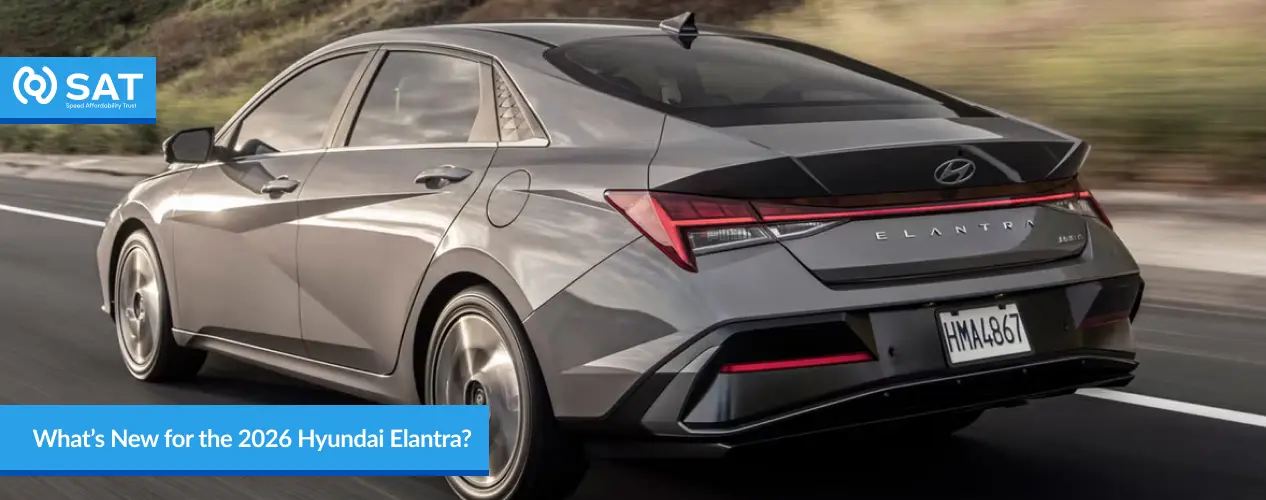
The Elantra does not look like a plain economy car. Its front is low and wide, the side panels have strong diagonal lines, and the roof flows toward the short trunk lid.
That design gives the car more character than a Nissan Sentra or Toyota Corolla. It also makes the Elantra easy to recognize in a busy parking lot. The shape will not suit everyone, though. Buyers who prefer simple and clean styling may find the body lines too busy.
The N Line adds a more aggressive front bumper, twin exhaust outlets, a rear spoiler, and larger wheels. The Elantra N adds red trim along with a front bumper, side skirts, rear bumper and wide air openings.
Specification | Measurement | What It Means |
Length | 185.1 inches | Almost as long as the Kia K4 and longer than some older midsize sedans. It may need more parking space than its low shape suggests. |
Wheelbase | 107.1 inches | Helps provide useful rear legroom. |
Width | 71.9 inches | Suitable for normal garages and city streets. |
Ground clearance | 5.3 inches on regular trims and 5.5 inches on the N Line and Elantra N. | Fine for paved roads, but steep driveways, deep snow, and broken road edges should be approached slowly. |
The SE uses 15-inch alloy wheels. They do not look exciting, but their taller tire sidewalls help ride comfort and reduce replacement cost. SEL models move to 17-inch wheels. The N Line uses 18-inch wheels, while the Elantra N comes with 19-inch wheels and Michelin Pilot Sport 4S summer tires. The TCR Edition adds lightweight 19-inch forged wheels.
Regular Elantra colors include:
Abyss Black
Amazon Gray
Fluid Metal
Ecotronic Gray
Ultimate Red
Serenity White
Intense Blue
Some colors and combinations are limited by trim.
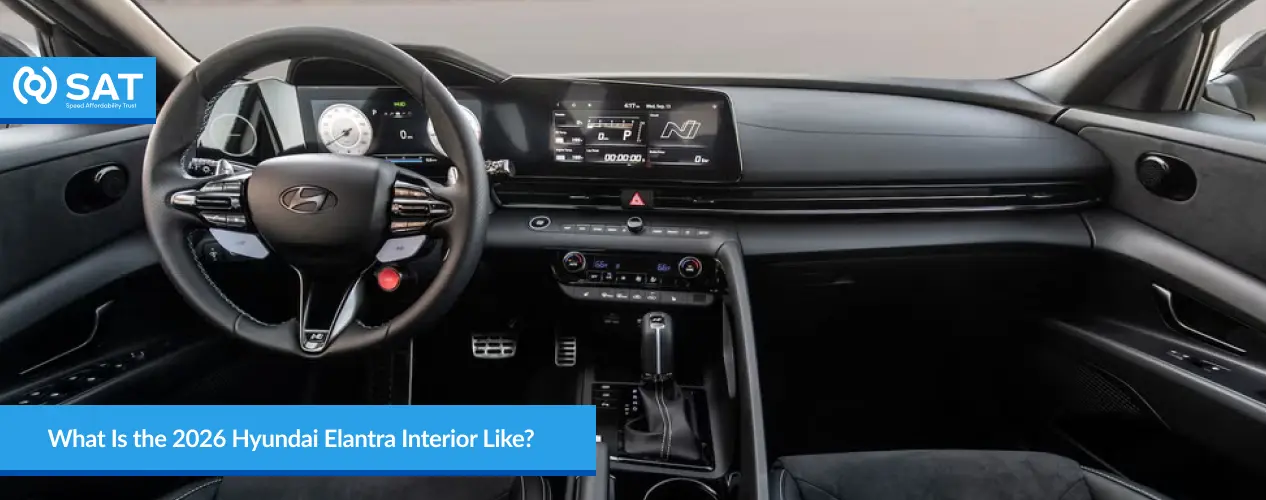
Passenger volume: 99.4 cubic feet.
Front legroom: 42.3 inches.
Rear legroom: 38 inches.
Trunk capacity: 14.2 cubic feet.
The dashboard has a wide, driver-focused shape. On higher trims, the screen area and digital instrument panel sit inside one long unit, which makes the cabin look more expensive at first glance.
Look closer, and the cost-saving becomes clear. Hard plastic covers large parts of the doors, center console, and lower dashboard. The pieces are fitted neatly, but they do not feel as rich as the materials in a Honda Civic. Physical climate controls are a good decision.
The driving position offers a wide adjustment range, so short and tall drivers should be able to find a sensible position. Visibility through the windshield is good, and the main controls sit within easy reach.
Rear legroom is one of the Elantra’s best features. The official 38-inch figure gives adults enough knee room for normal trips, even when a taller person can sit comfortably in the front.
The nearly flat floor helps the middle passenger place their feet, although the center seat is still best kept for shorter trips.
Black and light gray interiors are offered on regular models, although availability changes by trim and exterior color.
Lower trims use an 8-inch touchscreen.
Limited and N Line models receive a 10.25-inch navigation screen.
Wireless Apple CarPlay and Android Auto work with the smaller screen.
The larger factory navigation screen requires a cable for phone projection.
The SE and most mid-range petrol trims use a 4.2-inch screen between traditional gauges. It shows fuel use, range, safety alerts, and trip information. The full 10.25-inch digital cluster is reserved for higher trims.
Front and rear USB-C ports make it easier to keep several devices charged. Wireless phone charging is available above the base trim, and higher models offer Hyundai Digital Key functions.
Expert Tip: Choose the screen based on how you use your phone. The smaller 8-inch unit is less impressive to look at, but its wireless smartphone connection may be more useful every day.
Standard engine: 2.0-liter four-cylinder with 147 hp and 132 lb-ft.
N Line engine: 1.6-liter turbo with 201 hp and 195 lb-ft.
Hybrid system: 1.6-liter petrol-electric setup with 139 combined hp and 195 lb-ft.
Elantra N engine: 2.0-liter turbo with 276 hp and 289 lb-ft.
The normal Elantra uses a naturally aspirated 2.0-liter four-cylinder engine. It sends 147 hp and 132 lb-ft to the front wheels through Hyundai’s Intelligent Variable Transmission. Daily driving feels smooth around town, but it needs time and engine speed when joining a fast highway or passing another car.
The lack of a turbocharger can also be viewed as a long-term benefit. There is less heat and pressure than in a high-output turbo engine, although that does not guarantee better reliability by itself.
Version | Engine | Output | Transmission | Key Difference |
Standard | 2.0L petrol | 147 hp | IVT | Basic everyday option |
Hybrid | 1.6L petrol + electric motor | 139 hp, 195 lb-ft | 6-speed DCT | Better low-speed response and fuel economy |
N Line | 1.6L turbo | 201 hp, 195 lb-ft | 7-speed DCT | Stronger performance and multi-link rear suspension |
Elantra N | 2.0L turbo | 276 hp, 289 lb-ft | 6-speed manual or 8-speed DCT | Performance suspension, brakes, differential and exhaust |
As far as the horsepower concern, Hyundai Elantra horsepower ranges from 139 hp in the Hybrid to 276 hp in the Elantra N, depending on the trim. Hyundai Elantra transmission options include an Intelligent Variable Transmission (IVT), a 6-speed manual, a 7-speed dual-clutch automatic, and an 8-speed dual-clutch automatic, depending on the model.
The Elantra offers more engine choice than most rivals. The Hybrid focuses on efficiency, the N Line adds everyday performance, and the Elantra N is the serious sports model.
Independent testing shows that acceleration can vary even between versions using the standard engine. Car and Driver recorded about 8.1 seconds to 60 mph in a non-hybrid Elantra, while Edmunds recorded about 9.4 seconds in its tested car.
The Hybrid has reached 60 mph in about 8.4 seconds in testing.
The N Line takes about 6.5 seconds.
The Elantra N with the dual-clutch transmission has reached 60 mph in about 4.8 seconds.
Regular Elantra models handle broken pavement without losing control, but the ride can feel firm over sharp edges. The smaller wheels give the SE the softest response. Road and wind noise are more noticeable than in the best compact sedans.
The Elantra N has adaptive dampers. Its softest setting remains firm, though it is usable for daily driving by performance-car standards.
Version | 0–60 mph | Ride | Handling | Brakes |
Standard | 8–9.4 sec | Firm over sharp bumps; SE is softer | Light and predictable | Easy to control |
Hybrid | Similar to standard | Better control on uneven roads | More alert at low speeds | Regenerative braking can feel different |
N Line | Around 6.5 sec | Firmer but more settled | Sharper steering and better grip | Strong enough for daily use |
Elantra N | Around 4.8 sec | Firm, even in Comfort mode | Fast responses with an electronic differential | 14.2-inch ventilated front rotors |
The base Elantra is calm rather than quick. The N Line is the better road car for drivers who want extra pace, while the Elantra N is one of the strongest performance bargains in the class.
SE: 31 city, 40 highway, and 35 combined mpg.
Other 147-hp petrol trims: 30 city, 40 highway, and 34 combined mpg.
N Line: 28 city, 35 highway, and 31 combined mpg.
Hybrid Blue: 51 city, 58 highway, and 54 combined mpg.
The Elantra SE is the most efficient non-hybrid model, with an EPA estimate of 35 mpg combined. The other 147-hp trims lose only 1 mpg combined despite their larger wheels and added equipment.
The Hybrid Blue is the fuel-economy leader at 51 mpg city, 58 highway, and 54 combined. The Hybrid SEL Sport and Limited are rated at 49 city, 52 highway, and 50 combined.
Real-world results depend heavily on weather, traffic, speed, tires, and driving style. Some independent testing has returned about 38 mpg from a petrol Limited at a steady 75 mph and around 48 mpg from the Hybrid under the same highway conditions.
Petrol Elantra
12.4-gallon tank
SE: about 434 miles
Other 147-hp models: about 422 miles
N Line: about 384 miles
Elantra Hybrid
11-gallon tank
Blue: about 594 miles
Other hybrid trims: about 550 miles
For a closer look at real-world driving range and tank capacity, read our Discover the Hyundai Elantra Fuel Capacity and Range article.
Expert Tip: Do not buy the hybrid based only on its headline MPG. Compare the extra purchase price with your annual mileage and the type of driving you do. A petrol SE can already return excellent highway economy.
Trunk capacity: 14.2 cubic feet.
Passenger capacity: Five people.
Rear legroom: 38 inches.
Rear child-seat anchors are easy to reach.
The 14.2-cubic-foot trunk is competitive for a compact sedan. It is large enough for weekly shopping, several soft travel bags, or a folded stroller, although a large stroller will use much of the floor.
The Honda Civic has a slightly larger 14.8-cubic-foot trunk, while the Kia K4 offers 14.6 cubic feet. The Elantra still provides more luggage room than the Toyota Corolla sedan’s 13.1 cubic feet.
Forward visibility is good because the dashboard sits low. The side mirrors are a useful size, and every trim has a rearview camera.
The sloping roof and high rear deck reduce the view directly behind the car. Blind-spot warning and rear cross-traffic collision avoidance help, and both are standard across the normal range.
The 2026 Elantra has a five-star NHTSA overall rating, excluding the Elantra N and Hybrid.
The 2026 Hyundai Elantra is an IIHS Top Safety Pick.
Blind-spot warning and rear cross-traffic collision avoidance are standard.
Highway Driving Assist is standard on the Limited.
The regular 2026 Elantra earned five stars overall from NHTSA. That result includes five stars for the side crash and rollover categories, although individual frontal results are lower. The NHTSA rating does not cover the Elantra N or Elantra Hybrid.
Standard equipment includes:
Forward Collision-Avoidance Assist with pedestrian detection
Blind-Spot Collision Warning
Lane Keeping Assist
Lane Following Assist
Driver Attention Warning
High Beam Assist
Rear Cross-Traffic Collision-Avoidance Assist
Safe Exit Warning is a strong list for the base price. Some rivals make buyers move up a trim level before adding blind-spot monitoring.
Hyundai new-vehicle warranty: Five years or 60,000 miles.
Powertrain warranty: Ten years or 100,000 miles for the original owner.
Certain 2026 vehicles are covered by active safety recalls.
The 2026 Elantra is still too new for a firm long-term reliability verdict. The current generation has been on sale for several years, which provides some useful ownership history, but reliability can vary by engine, maintenance, model year, and individual vehicle.
J.D. Power currently gives the 2026 Hyundai Elantra an overall consumer rating of 83 out of 100. This is an overall owner-based score and should not be treated as a guaranteed measure of long-term mechanical reliability.
It is too early to identify a proven list of common mechanical faults specific to the 2026 model year. The cars have not been on the road long enough to build meaningful long-term failure data.
Current owner feedback and road tests more commonly mention road noise, hard interior plastics, weak base-engine acceleration, and occasional complaints about electronics or driver-assistance systems. These are recurring ownership concerns rather than faults that affect every Elantra.
One 2026 Elantra recall covers certain cars built from September 2 to October 15, 2025. A side-impact sensor may have been assembled incorrectly, which could delay airbag deployment. Dealers inspect and replace affected sensors free of charge.
Owner-complaint totals change as more vehicles enter service. Current reports are too early to prove a broad 2026 pattern.
Hyundai does not publish a fixed Elantra lifespan. Long life will depend on oil changes, fluid servicing, cooling-system care, accident history, climate, driving style, and how quickly recalls are completed.
A carefully maintained Elantra may remain usable well beyond the warranty period. A neglected one can become costly much sooner.
Hyundai provides:
Five years or 60,000 miles of new-vehicle coverage
Ten years or 100,000 miles of powertrain coverage for the original owner
Seven years with unlimited mileage against body-panel perforation
Five years with unlimited mileage of roadside assistance
Ten years or 100,000 miles of hybrid-battery coverage
The Elantra has a good early reliability score and one of the longest warranties in its class. Active recalls mean buyers should still complete a VIN check rather than relying on the warranty alone.
Owner feedback generally supports many of the strengths and weaknesses found in professional reviews. The Elantra is often praised for efficiency, passenger space, technology, and value, while complaints tend to focus on refinement rather than one major mechanical weakness.
Strong fuel economy
Roomy rear seats
Easy-to-use controls
Good standard technology
Comfortable everyday driving
Long warranty coverage
Noticeable road and wind noise
Slow acceleration from the standard engine
Hard plastics in parts of the cabin
Occasional infotainment or electronics complaints
Some complaints about driver-assistance behavior
Owner experiences vary by model year, trim, mileage, and maintenance history, so these should be treated as common themes rather than problems affecting every Elantra.
The SEL Sport Plus sits between the SEL Sport and SEL Sport Premium. It gives buyers another mid-range option without requiring the price jump to the Limited.
Cost: $24,450 before freight.
Elantra SEL Sport Premium: The SEL Sport Premium adds more driver-assistance equipment and sits below the Limited in the range.
Cost: $25,275 before freight.
Elantra Limited: The Limited adds the larger 10.25-inch touchscreen, a 10.25-inch digital cluster, built-in navigation, Bose audio, adaptive cruise control, and Highway Driving Assist.
Cost: $27,375 before freight.
Elantra N Line: The N Line is the choice for someone who wants useful performance without moving to the full Elantra N. Its 201-hp turbo engine, seven-speed dual-clutch transmission, multi-link rear suspension, 18-inch wheels, and sport seats make it much quicker than the 147-hp models.
Cost: $29,600 before freight.
Elantra Hybrid Blue: The Hybrid Blue is the mileage leader. It is the best version for drivers covering many city miles.
Cost: $25,650 before freight.
Elantra Hybrid SEL Sport: The Hybrid SEL Sport adds more technology and visual appeal. Its 50-mpg combined rating remains excellent.
Cost: $27,625 before freight.
Elantra Hybrid Limited: The Hybrid Limited adds the richest interior and technology package. It is comfortable and efficient.
Cost: $30,000 before freight.
Elantra N: The Elantra N is a separate performance model. It has 276 hp, an electronic limited-slip differential, adaptive suspension, stronger brakes, performance tires, and a choice of manual or dual-clutch transmissions.
Cost: From $35,300 before freight. The eight-speed dual-clutch transmission is optional.
Elantra N TCR Edition: The limited-production TCR Edition adds more track-focused styling and equipment.
Cost: Hyundai USA has not listed a separate starting price for the TCR Edition on its public model page.
Current window-sticker pricing can be higher once freight is added.
The SEL Sport Premium is the best all-round trim. It keeps the efficient 147-hp engine, stays well below Limited pricing, and adds adaptive cruise and stronger driver-assistance equipment. The Hybrid Blue is the smarter choice for a high-mileage city driver.
The N Line only makes sense when performance matters enough to accept higher fuel, tire, and purchase costs.
A new 2026 Elantra makes sense if you want the latest trim choices, full new-car warranty coverage, and the exact specification you prefer. However, buyers focused on value should also consider a recent used Elantra.
The current generation has been on sale since 2021, while the major exterior refresh arrived for 2024. That means a well-kept 2024 or 2025 Elantra can offer much of the same design, technology, and everyday driving experience for less money.
When comparing a used Elantra, check:
Model year and trim
Mileage
Service history
Accident and repair history
Remaining warranty coverage
Outstanding recalls
Tire and brake condition
Hybrid battery coverage on hybrid models
A clean recent Elantra with documented maintenance can make more financial sense than paying extra for a new car simply to get the latest model year.
There is no verified 2026-specific annual maintenance average yet. The car is too new. Some sites estimate $363 per year in repair costs for the Elantra, but that calculation uses data from older model years.
Hyundai includes complimentary scheduled maintenance for three years or 36,000 miles under current U.S. coverage terms. That lowers early service spending for the original owner. After that period, normal costs include oil and filters, cabin and engine air filters, brake fluid, tires, brake pads, wiper blades, and alignment work.
Insurance cannot be estimated accurately without the driver’s age, ZIP code, history, coverage level, deductible, credit factors where allowed, and annual mileage.
Some sources estimate that an SE may lose about $9,831 over five years, while its SEL Sport estimate is $9,815. The Limited estimate is higher at $12,162, and the N Line reaches $13,582.
Hyundai resale has improved, but Toyota Corolla and Honda Civic models still have stronger long-term reputations in many used-car markets.
Pros
| Cons
|
The Elantra has one of the lowest base prices in this comparison.
Honda Civic has the strongest available mainstream hybrid powertrain.
Kia K4 has a larger trunk and similar warranty coverage.
Nissan Sentra has the highest current J.D. Power reliability score among the directly rated rivals.
The figures below compare entry-level petrol sedans unless stated otherwise. Reliability information uses current J.D. Power results where available, so it should not be treated as a guarantee of future repairs.
Category | Hyundai Elantra | Toyota Corolla | Honda Civic | Kia K4 | Nissan Sentra |
Starting MSRP before freight | $22,825 | $23,125 | $24,695 | $22,290 | $22,600 |
Base horsepower | 147 hp | 169 hp | 150 hp | 147 hp | 149 hp |
Best petrol fuel economy | 31/40/35 mpg | 32/41/35 mpg | 32/41/36 mpg | 29/39/33 mpg | 30/38/33 mpg |
Passenger space | 99.4 cu ft | 101.7 cu ft EPA interior volume | Up to 99 cu ft | 98.7 cu ft | 96.1 cu ft |
Trunk capacity | 14.2 cu ft | 13.1 cu ft | 14.8 cu ft | 14.6 cu ft | 14.3 cu ft |
Basic warranty | 5 years/60,000 miles | 3 years/36,000 miles | 3 years/36,000 miles | 5 years/60,000 miles | 3 years/36,000 miles |
Powertrain warranty | 10 years/100,000 miles | 5 years/60,000 miles | 5 years/60,000 miles | 10 years/100,000 miles | 5 years/60,000 miles |
The Honda Civic is the most polished rival, while the Toyota Corolla remains the conservative ownership choice. The Elantra wins on range choice, warranty, equipment, and entry price.
Buyers comparing Hyundai with Kia can also read our Kia Forte vs Hyundai Elantra comparison for a closer look at how the two sedans differ.
Daily commuters: The petrol Elantra is efficient on highways, and the Hybrid Blue is even better in stop-and-go traffic.
First-time buyers: The SE provides good safety equipment, easy controls, low fuel use, and a long warranty without a high starting price.
Small families: Rear legroom, easy child-seat anchors, and a useful trunk make it practical for one or two children.
Budget-conscious buyers: The strongest value sits in the SE, SEL Sport, and SEL Sport Premium range. Current market prices may also leave room for negotiation.
Technology-focused buyers: The Elantra offers wireless phone integration, available digital gauges, navigation, Bose audio, wireless charging, and connected services.
Buyers who need all-wheel drive should consider a Toyota Corolla Hybrid AWD, Mazda3 AWD, Subaru Impreza, or an all-wheel-drive crossover.
Drivers who carry more cargo should look at the Kia K4 hatchback, Honda Civic hatchback, or a compact SUV.
Anyone needing higher ground clearance should consider a Hyundai Kona, Kia K4 hatchback only if clearance is sufficient for their use, Nissan Kicks, or another small crossover.
Buyers who expect premium cabin materials should test a Honda Civic or Mazda3. Both place more attention on touch points and cabin finish.
If the 2026 Hyundai Elantra is not available, SAT Japan offers a wide selection of compact sedans with similar comfort, fuel economy, and value. Buyers can explore models such as the Toyota Corolla, Honda Civic, Mazda3, Nissan Sentra, and other Japanese alternatives available for export. Comparing several options side by side can help you find the right balance of price, equipment, and running costs.
Yes, the 2026 Hyundai Elantra is worth buying if value, fuel economy, cabin space, technology, and warranty coverage matter more than strong base-engine performance or rich interior materials.
The SEL Sport Premium is the best all-round trim. It keeps the purchase price under control and adds adaptive cruise and stronger safety technology. The Hybrid Blue is the right choice for high-mileage city driving.
Its main advantage is choice. A buyer can have an affordable 35-mpg commuter, a 54-mpg hybrid, a 201-hp N Line, or a 276-hp Elantra N. No close rival covers the same range this well.
The main disadvantage is refinement. The base engine lacks urgency, road noise is noticeable, and too many cabin surfaces feel cheap. A Honda Civic feels more mature, and a Toyota Corolla remains the safer choice for buyers who place resale history above equipment.
For commuters, first-time buyers, and small families, those faults are unlikely to outweigh the low running costs, rear space, safety equipment, and warranty.
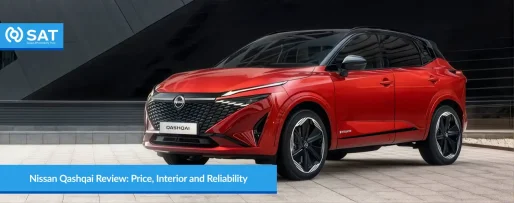
This Nissan Qashqai review finds an easy family car that is comfortable and straightforward, although keen drivers may find more enjoyment elsewhere. The Qashqai is quiet, simple to place on the road and sensibly sized for British streets. The latest e-Power version is the one that gives the car a real advantage, with quicker response and much better official fuel economy than the mild hybrid.
Still, the trade-offs are easy to spot. A Sportage or Tiguan carries more luggage, and the mild-hybrid automatic can pause when you ask it to move. Used cars also need a careful once-over. It works well every day, even though some rivals do particular jobs better.
Verdict: It feels relaxed, quiet and uncomplicated. It is better at daily life than it is at entertaining the driver.
Price: New UK prices start at £30,635 for Acenta Premium. Move up the range or choose e-Power and the figure can reach about £43,225.
Boot: There is room for up to 504 litres with the rear seats in use and 1,447 litres after folding them. The Sportage and Tiguan both carry more.
Reliability headline: Of 683,919 Qashqai MOT records reviewed, 20.0% were failures. Similar-age cars averaged 17.5%. Those numbers help, but they cannot expose every engine, transmission or software fault.
Fuel economy: Nissan rates the latest e-Power at 62.8 to 65.7 mpg, but Auto Express recorded 52.5 mpg in independent testing. The mild hybrid returns 44.1 to 45.6 mpg officially.
Fault warning: An older Qashqai deserves a close look at its suspension, steering, brakes and lights. With an early 1.2 DIG-T petrol, also look for excess oil use and a noisy timing chain.
This review combines official Nissan UK specifications with independent road tests, real-world fuel economy results, Euro NCAP safety data, owner feedback, MOT records and used-car reliability information. Official figures and independent test results are kept separate so buyers can compare what Nissan claims with how the Qashqai performs in normal use.
Comfortable and easy to drive
Best on 17-inch or 18-inch wheels
e-Power is the strongest engine choice
Built for comfort, not sporty driving
Within Nissan’s range, the five-seat Qashqai sits between the Juke and X-Trail. It measures 4,425 mm long, 1,835 mm wide and 1,625 mm tall, with a 2,665 mm wheelbase. It remains manageable on town roads, while four adults can travel comfortably.
That character appears as soon as the road turns. The steering puts the car where you point it, but gives little feedback. Body movement is controlled, yet the Qashqai never asks to be driven hard. A Ford Kuga or Mazda CX-5 feels more energetic. The Nissan is quieter, easier and more settled on the motorway.
Off-road travel shows why the wheel choice matters. The Qashqai is calmer on 17-inch or 18-inch wheels than on the largest rims. Tekna+ has a more advanced rear suspension, but its 20-inch wheels still let extra tyre noise and low-speed fidget reach the cabin. A mid-range version suits the car better.
The current Qashqai is available with a 1.3-litre mild-hybrid petrol engine or Nissan's e-Power system. The mild hybrid is the more conventional choice, while e-Power uses its petrol engine to generate electricity and drives the wheels with an electric motor.
Version | Power | Transmission | 0–62 mph |
1.3 Mild Hybrid | 140 PS | 6-speed manual | Around 10 seconds |
1.3 Mild Hybrid | 158 PS | Manual or Xtronic automatic | Around 9–10 seconds |
e-Power | 190 PS, up to 205 PS in Sport | Automatic electric drive | 7.6 seconds in Sport |
The mild hybrid provides enough performance for normal family use, but it does not feel particularly quick. The e-Power is noticeably more responsive because an electric motor drives the wheels and delivers its torque immediately.
The 158 PS mild hybrid is available with Nissan's Xtronic automatic. It is convenient in traffic, but it can hesitate when moving away quickly and allows the engine to become more noticeable under hard acceleration.
The e-Power is the smoother automatic choice. There are no conventional gear changes, so acceleration feels more immediate and more like an electric car.
Nissan e-Power works differently from a normal hybrid. Its petrol engine generates electricity, but it does not directly drive the wheels. Instead, an electric motor powers the front wheels.
This gives the Qashqai quicker and smoother response than the mild hybrid, especially around town. There is no need to plug it in because the petrol engine keeps the small battery charged while driving.
The latest e-Power produces 190 PS in normal driving and up to 205 PS in Sport mode. Nissan quotes 0–62 mph in 7.6 seconds in Sport mode.
The main advantages are:
Quicker response than the mild hybrid
Smooth electric-motor acceleration
No charging cable required
Strong fuel economy
Quiet low-speed driving
The disadvantage is the higher purchase price. Buyers covering low annual mileage may take a long time to recover that extra cost through fuel savings.
Suitable for families and daily driving
e-Power N-Connecta offers the best overall value
Mild hybrid suits lower-mileage buyers
Limited boot space and shorter warranty than some rivals
Yes. For a family, commuter or first-time SUV owner, the Qashqai feels easy to drive from the start, and it does not take long to get comfortable with it. It does not demand a change in driving habits. The mild hybrid uses petrol in the normal way, while e-Power fills up at a fuel station and charges its own small drive battery.
The e-Power N-Connecta is where the range comes together. It loses the entry car’s plainness, adds parking aids and cabin features you will actually use, and stops short of top-trim money. Sport mode raises output to 205 PS and gives a 7.6-second 0 to 62 mph run. In Standard or Eco, 190 PS is enough for motorway slip roads and ordinary overtakes.
The mild hybrid remains the cheaper choice. Buy it if your yearly mileage is low or the extra cost of e-Power would take too long to recover through fuel savings. Pick the manual if you are comfortable changing gear. The automatic is convenient, though its pause at a busy roundabout can test your patience.
Buy something else if you need class-leading boot space, a plug-in hybrid or unusually long warranty cover. Kia gives the Sportage seven years or 100,000 miles. Nissan’s standard warranty is three years or 60,000 miles, while the e-Power motor, lithium-ion battery and other electrified parts receive five years or 60,000 miles.
Starts at £30,635 in the UK
e-Power starts at £34,875
N-Connecta offers the best value
Tekna+ is expensive for what it offers
The current Nissan Qashqai price starts at £30,635 in the UK. That is the Acenta Premium mild hybrid with a manual gearbox, before paint and options begin adding to the bill. An e-Power starts at £34,875, while the range climbs to roughly £43,225.
The figures below are each trim’s starting point, using Nissan’s lowest-priced mild-hybrid version. Change the engine, gearbox, colour or options and the total changes too.
Trim | Starting UK price | What it adds |
Acenta Premium | £30,635 | 17-inch alloy wheels, 12.3-inch display, rear camera and keyless entry |
N-Connecta | About £33,105 | Better cabin tech, around-view camera availability and a stronger equipment balance |
N-Design | £35,025 | 20-inch wheels, two-tone paint and body-colour exterior trim |
Tekna | £35,025 | 19-inch wheels, panoramic roof, assisted driving tech and powered tailgate |
Tekna+ | £39,175 | 20-inch wheels, quilted seat trim, massage function and driver memory features |
Check the latest prices, trims and specifications on the official Nissan Qashqai page, as available models and pricing may change.
Nissan’s current consumer pages and online stock listings support these starting figures, though available engines and stock can change.
Acenta Premium is not badly equipped, but N-Connecta is the more complete family car. N-Design spends much of its extra cost on appearance. Tekna is a better use of similar money if the glass roof, powered tailgate and driver-assistance features matter to you.
Tekna+ is difficult to recommend at full list price. Some versions exceed the £40,000 expensive-car supplement threshold. Depending on trim, BIK sits at around 26% for e-Power and 34% to 37% for mild hybrids. The Qashqai is also expected to retain around 47% to 50% of its value after three years or 36,000 miles.
Expert Tip: Judge the full list price, not only the monthly payment. Choose paint, packs or a higher grade carelessly, and the car can slip into a dearer tax band.
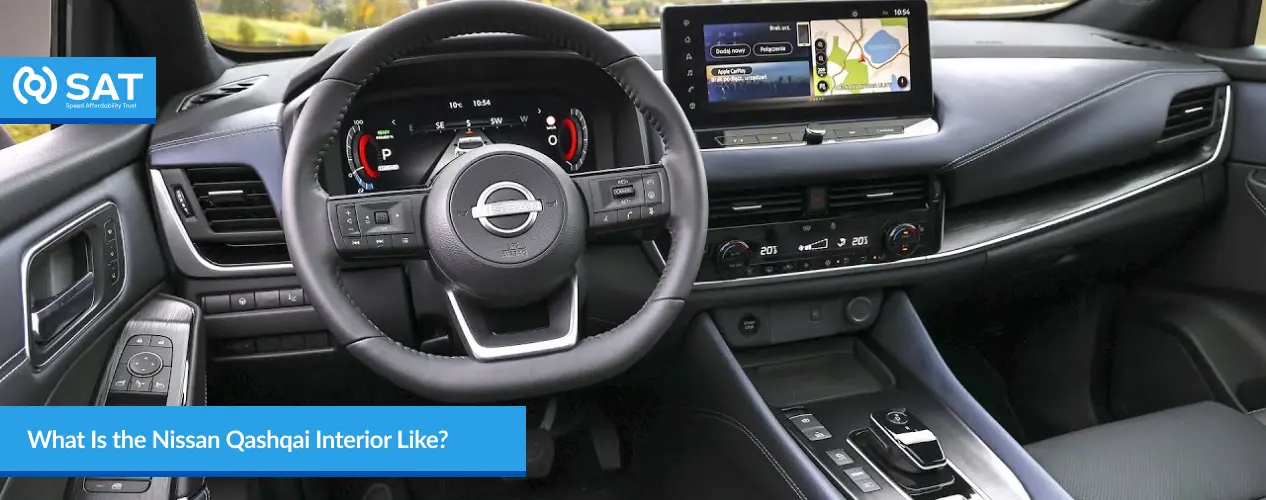
Practical, well-built and easy-to-use cabin
Comfortable seats with good visibility
12.3-inch touchscreen comes as standard
Physical climate controls are simple to use
The Nissan Qashqai interior feels sturdier and easier to understand than the old cabin. The controls fall naturally to hand, the seat and wheel offer useful adjustment, and proper buttons remain for the heater and ventilation.
A 12.3-inch central display is standard on current UK cars. Higher trims add Google built-in, including Google Maps and access to supported apps. The system is quick to use within Google’s own services, though some Nissan menus take longer to learn. The digital instrument display can also look busy until you remove the information you do not use.
Material quality is good in the places you touch often. The upper dashboard and door tops feel soft, and facelifted cars use richer trim across the dashboard. Lower areas still use hard plastic, but most panels feel made to handle family use. That matters more than a shiny surface that scratches after six months.
Up front, the wide cushions and upright driving position make long spells easier, and the view out is good. Very tall drivers may wish the wheel came a little closer, so sit in the car properly before ordering. Tekna+ brings quilted trim and a massage function, but the standard seats already do the important job well.
The simple climate controls deserve praise. A driver can change the temperature or fan speed without hunting through a screen. That sounds like a small point until rain starts, the windscreen fogs and you need the right button at once.
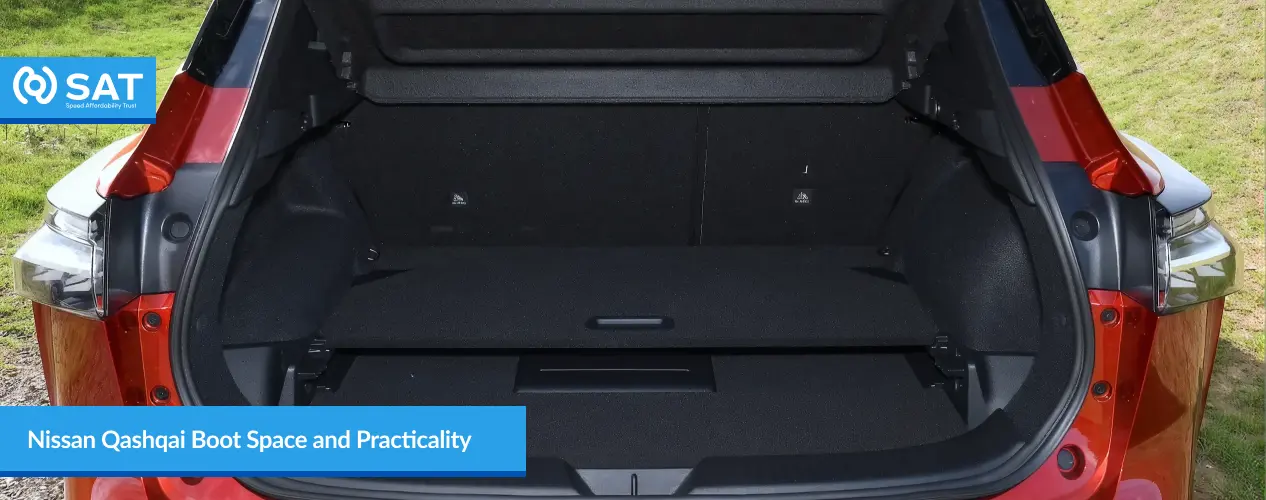
Enough space for a four-person family
504-litre boot capacity
Rivals offer more passenger and luggage space
Compact size makes town driving and parking easier
There is enough room for a four-person family, although the Qashqai is not among the class’s largest cabins. Adults are comfortable in the two outer rear seats. The narrow middle place is better for a child or a brief trip, and doors opening to about 85 degrees make child-seat fitting easier.
Nissan Qashqai boot space reaches 504 litres without the luggage boards and 1,447 litres after folding the rear seats. Versions fitted with the flexible boot-floor system have less space, and a high-end audio system can reduce it further. The floor is wide, and the load capacity is manageable, but there are no handy boot levers for dropping the rear seats.
The rivals are plainly roomier. A Kia Sportage offers roughly 587 litres, depending on the powertrain. Move the petrol or diesel Tiguan’s sliding rear bench forward, and it can take up to 652 litres. Its plug-in hybrid manages about 490 litres, a useful reminder that boot figures only mean something when the engine and measuring method match.
The Nissan feels comfortable with shopping, school bags and a folded pushchair. Pack a large stroller, travel cot and several hard suitcases, though, and the missing capacity becomes obvious. Braked towing capacity ranges from 770kg for e-Power to around 1,800kg for selected petrol versions, so caravan buyers should check the exact model.
The Qashqai’s smaller body pays you back in town. It is shorter than the Tiguan, easy to judge from the driver’s seat and available with excellent camera coverage on middle and high trims. That trade makes sense for buyers who park on the street more often than they carry a boot full of holiday luggage.
Expert Tip: Take your own pushchair or largest suitcase to the viewing. A litre figure cannot show whether the shape of the boot works for your gear.
The mild-hybrid Nissan Qashqai officially returns around 44.1 to 45.6 mpg, depending on the engine, gearbox, wheels, and trim.
The latest e-Power is much more efficient, with official combined figures of around 62.8 to 64.2 mpg depending on specification.
Real-world economy is normally lower than official figures. Independent testing has returned figures in the low-50s from the e-Power, while driving style, motorway speed, temperature, and wheel size can all affect the result.
The mild hybrid costs less to buy, while the e-Power can save more fuel for drivers covering higher annual mileage. Larger wheels also increase tyre replacement costs, so N-Connecta and other mid-range versions can make more financial sense than top trims with 20-inch wheels.
Reliability is average overall
Newer models perform better
Suspension and steering are common problem areas
Full service and MOT history matter most
The honest answer is that Nissan Qashqai reliability is mixed, and the model year matters. Newer examples generally perform better in reliability data, particularly cars registered from 2021 onwards. Their lower mileage and younger age explain some of the difference.
DVSA’s anonymized MOT data records the make, model, mileage, result and reason for failure. One independent study covered 683,919 Qashqai tests from 2023. It found a 20.0% failure rate, against 17.5% for cars of a similar age. Suspension and steering produced the clearest group of recorded issues, followed by corrosion or structure faults and lighting or electrical defects.
Another DVSA-based study found first-test pass rates of 91.6% for 2021 cars, 91.7% for 2020 models and 89.9% for those from 2019. Predictably, the figures fall as age and mileage build. Among 2011 cars tested in 2025, average mileage had passed 107,000, and only 47.2% cleared the MOT first time. That reflects years of wear and heavy use, not a fault shared by every 2011 Qashqai.
An MOT is good at finding worn tyres, tired brakes, loose suspension parts, dead lamps, emissions faults and structural damage. It may miss a screen that fails now and then, a hesitant gearbox, increasing oil use or a warning lamp cleared before inspection.
The current model has Nissan’s three-year or 60,000-mile warranty. The 2026 Driver Power survey placed the Qashqai 29th out of 50 cars, while Nissan ranked 12th out of 30 brands. I would still rather buy a modest version with annual servicing, matching tyres and clean records than a high-spec car with gaps in its history.
The Nissan Qashqai received a four-star Euro NCAP rating in its 2025 reassessment.
Its scores were:
Adult occupant protection: 78%
Child occupant protection: 85%
Vulnerable road users: 65%
Safety assist: 62%
The Qashqai also offers automatic emergency braking, lane assistance, traffic-sign recognition, and other driver-assistance features. Higher trims can add systems such as adaptive cruise control and ProPILOT assistance.
Safety equipment can vary by model year and trim, so used buyers should check the exact specification of the vehicle they are considering.
Start by checking the generation. That search phrase spans nearly 20 years of Qashqais, so the weak points change from one generation to the next.
Suspension and steering wear: DVSA-based MOT records show this as the model’s clearest trouble spot. On an older car, drive over rough tarmac with the radio off, look for uneven tyre wear and check previous advisories for bushes, springs, ball joints or play in the steering.
Brakes, lights and age-related corrosion: Older cars commonly pick up advisories for worn discs, failed bulbs, a rusty exhaust or corrosion underneath. None is unusual on an aging family car, but several repeated advisories suggest delayed maintenance.
1.2 DIG-T oil use and timing-chain noise: This is the major engine warning on second-generation cars from the earlier part of the 2014 to 2021 run. Reports cover high oil consumption and rattling timing chains. Check the oil level before starting the engine, listen for cold, and avoid any car with poor service records or an unexplained engine warning light.
CVT automatic behaviour: Give an older CVT car a proper, lengthy drive. It should move off cleanly, without shuddering, flaring revs or a long delay when selecting drive or reverse. Proof of correct servicing matters.
Diesel DPF trouble: A diesel used mainly for short trips may struggle to complete diesel particulate filter regeneration. Warning lights, repeated forced regenerations and a rising oil level need investigation. Petrol or e-Power is usually the better fit for mostly urban use.
Battery and electrical faults: Earlier second-generation cars have a history of battery complaints. Parking sensors, stop-start, cameras, mirror indicators and air conditioning should all be tested rather than assumed to work.
The latest third-generation car has fewer age-related MOT results, so any claim that it is proven for very high mileage would be premature. Owner reports mention software and electrical annoyances, but there is no single failure pattern strong enough to condemn the full generation. Check the VIN through Nissan’s recall system and insist that every warning light goes out after startup.
Expert Tip: Start a used 1.2 DIG-T from cold. If the seller has already warmed it up, arrange another cold start because that is when the troublesome rattle is easiest to catch.
Called Rogue Sport in the US
Known as Dualis in Japan and early Australian models
Australia and Canada later used the Qashqai name
The badge depends on the country and the age of the car.
The second-generation Qashqai was sold in the US as the Nissan Rogue Sport, which was discontinued after the 2022 model year. The current-generation Qashqai is not sold there. It sat below the regular Rogue in size, and Nissan dropped it after the 2022 model year. The current UK Qashqai is not sold in the US under that former name.
In Japan, Nissan used the Dualis name for the first generation. In Japan, the first-generation J10 was sold as the Nissan Dualis from 2007 to 2013. The present Qashqai is not part of Nissan’s normal new-car line-up there.
Australia received the first-generation model as the Dualis in 2007, while later generations used the Qashqai name, which the current Australian car still uses.
In Canada, the same second-generation model was sold as the Qashqai rather than the Rogue Sport. It has since been discontinued. Remember that difference when looking for parts, service information, or records for an imported car.
Of the three, the Qashqai is the easiest to live with. The Sportage gives you more room and longer warranty cover, while the Tiguan has the largest boot and the richer-looking cabin.
Category | Nissan Qashqai | Kia Sportage | Volkswagen Tiguan |
UK starting price | £30,635 | £31,395 | £38,920 |
Maximum quoted boot space, seats up | Up to 504 litres | About 587 litres, depending on powertrain | Up to 652 litres for petrol or diesel |
Main powertrains | Mild hybrid and e-Power | Petrol, hybrid and plug-in hybrid | Petrol, diesel and plug-in hybrid |
Standard warranty | 3 years or 60,000 miles | 7 years or 100,000 miles | 3 years or 60,000 miles |
Driving character | Quiet, light and comfort-led | Spacious, well-equipped and secure | Refined, roomy and more costly |
Best reason to buy | e-Power response and ease of use | Cabin space and long warranty | Boot size and cabin quality |
Main weakness | Smaller boot and average warranty | Bulkier feel and busy dashboard design | Higher entry price |
The current prices, boot figures, powertrain choices and warranty terms come from the manufacturers’ UK information.
The Qashqai wins for drivers who want a manageable body and a convincing non-plug-in hybrid. The new e-Power is smoother and quicker to respond than the Nissan mild hybrid, and its official 62.8 to 65.7 mpg figure is excellent for this class. It also avoids charging cables.
The Sportage is the stronger family-value choice. Its boot is larger, its rear cabin feels more open, and Kia’s seven-year warranty is difficult to ignore. It also offers a plug-in hybrid and four-wheel-drive choices on selected versions. The Nissan is easier to place in town, and its e-Power system feels more like an electric car when pulling away.
The Tiguan is the space winner. It has a sliding rear bench, a larger standard boot and a broad range of petrol, diesel and plug-in hybrid engines. It also feels more expensive inside. The price gap is large, though, and the plug-in hybrid loses much of the boot advantage because its battery reduces cargo space.
Clear Winner: Nissan Qashqai e-Power for a typical mixed-use buyer. The Sportage is better for maximum family value, and the Tiguan is better for cargo room, but the Qashqai gives the best balance of size, comfort, response and fuel use.
The Nissan Qashqai is a strong family SUV, but some rivals may suit different buyers better.
Choose the Kia Sportage for value and warranty, the Volkswagen Tiguan for a more premium cabin, or the Hyundai Tucson for family space. The Ford Kuga offers flexible seating and hybrid options, while the five-seat Chery TIGGO 7 is a value-focused alternative with generous equipment. The Skoda Karoq and Dacia Bigster are also worth considering for practicality and value.
Overall, the Qashqai remains one of the most balanced options for UK buyers.
The Nissan Qashqai suits buyers who want an SUV to make daily travel easier rather than more exciting. It is especially strong for school runs, commuting, town parking and regular motorway travel. The cabin is simple to operate, the ride is calm on sensible wheels, and e-Power removes the slow response that weakens the mild-hybrid automatic.
First-time SUV buyers who do not want a large vehicle
Families with one or two children
Drivers who value quiet cruising and an upright seating position
Urban buyers who want hybrid efficiency without charging
Older drivers who prefer physical climate controls
Used buyers who can find a well-serviced 1.3 DIG-T or newer e-Power
You need the largest possible boot, in which case the Tiguan is better
You want a seven-year warranty, which points to the Sportage
You need a plug-in hybrid or full electric SUV
You want sharp steering and more fun on a winding road
You regularly tow a heavy caravan, especially if considering e-Power
You are looking at an early 1.2 DIG-T without complete service records
The final verdict in this Nissan Qashqai review is positive. Buy the e-Power N-Connecta for the best mix of equipment, comfort and economy. Choose the mild hybrid only when its lower purchase price matters more than performance and fuel use. The Qashqai is not the biggest, sportiest or most luxurious SUV here. It succeeds because it asks very little from its driver and handles ordinary family life well.
SAT Japan offers a wide selection of used Nissan vehicles and practical crossovers sourced from Japan. While the exact Qashqai model may not always be available, buyers can compare similar SUVs by year, mileage, specification, and condition. You can also read our how to buy guide to understand the purchasing and import process in the UK before choosing a vehicle.
What if the UK's favourite little SUV is not necessarily the best one for you? This Ford Puma review UK seeks to answer that question. The innovative MegaBox boot, fun to drive, and a stylish look have won over thousands of drivers for the Puma. Having a car as a constant companion is more than just pretty design and a quick test drive. The latest Puma has also had a cabin overhaul, new technology and more driver assistance features, making it even more competitive than ever.
In this Ford Puma review, we'll go beyond the usual road test. You will learn which engine offers the best value, how it drives on the UK roads, what owners have to say about reliability, and whether it's still the best compact SUV to purchase. When you're paying your hard-earned pounds, you should get actual facts of ownership, use and analysis, not marketing claims or headline numbers.
The Ford Puma is one of the simplest small SUVs to recommend because it does what it needs to do in a way that is easy to understand. It is also more fun to drive than some of its competitors, has excellent fuel economy with its EcoBoost Hybrid engines, and has a neat boot and a unique MegaBox that make it more useful for daily driving. The new version also improves one of the most common criticisms of the previous version: the introduction of a modern cabin with a larger touchscreen and improved SYNC 4 infotainment.
Nonetheless, it's far from flawless. There is less space for rear passengers than with some competitors, and a few interior materials don't match the quality of the top-of-the-class car. For those who appreciate driving fun, running cost, and smart design more than those who are looking for the biggest car for a family of five, this Ford Puma review UK finds the car to be one of the best all-round options available in the compact SUV segment.
Specification | Ford Puma |
Body Type | 5-door Compact SUV |
Seats | 5 |
Engine Options | 1.0-litre EcoBoost Mild Hybrid (125 PS & 155 PS) |
Fuel Type | Petrol Mild Hybrid |
Transmission | 6-speed Manual / 7-speed Automatic (DCT) |
Power Output | 125–155 PS |
Drive Type | Front-Wheel Drive (FWD) |
Boot Capacity | 456 litres (plus MegaBox underfloor storage) |
Fuel Economy | Up to 52.3 mpg (combined, depending on model) |
Safety Rating | 5-Star Euro NCAP |
Price (UK) | From around £27,000 (varies by trim) |
The new Ford Puma offers the biggest change in the model since its launch in 2019, and the majority of the modifications are in the car's interior. The new Ford dashboard is a more streamlined, driver-focused design featuring a 12-inch touchscreen, a 12.8-inch digital instrument cluster, and the quicker SYNC 4 infotainment system. Smoother everyday driving with the addition of wireless Apple CarPlay, Android Auto, Alexa Built-in and 5G connectivity.
Ford has also enhanced the Puma's smarter driver-assistance systems such as the new adaptive cruise control, 360-degree camera, Matrix LED headlights and new parking aids. The tried and tested 1.0-litre EcoBoost mild hybrid engines are still in place, and are being developed to improve fuel efficiency instead of achieving more power. Ford didn't change what worked; it enhanced the things that owners wanted the most: technology, convenience and comfort. That's what makes the new Puma appear more contemporary but without sacrificing the fun driving attitude that's helped it become one of the UK's top-selling SUVs.
A practical family SUV doesn't have to look like a bore, as the Ford Puma has demonstrated. The coupe-inspired roofline, the aggressive front grille and the lifted attitude impart a sporty flair that is timeless. The new version features even slimmer LED headlights, a new grille, new alloy wheels and new paint colours, resulting in an even sharper appearance on UK roads.
The Puma's well-balanced design is a fusion of hatchback agility and SUV utility. Muscular wheel arches and sloping roof give a dynamic profile that doesn't compromise on boot space. Titanium trims come with a clean and elegant appearance, whereas ST-Line comes with sportier bumpers, larger alloy wheels and exterior black accents.
LED headlights with Dynamic Matrix (optional) enhance night vision when it matters most by steering the light beam around other road users. The Puma's appearance, aesthetic flair and modernism, backed by its high build quality, is one of the most appealing and distinctive compact SUVs.
The Ford Puma interior has improved more than any other part of the car. The redesigned dashboard features a 12-inch SYNC 4 touchscreen and a 12.8-inch digital driver display, giving the cabin a modern, driver-focused feel. Wireless Apple CarPlay, Android Auto, Alexa Built-in, and over-the-air updates come as standard, making everyday use simple and convenient.
Comfort is another strong point. The front seats offer plenty of adjustment and good support for long journeys, while the cabin includes useful storage, multiple USB ports, and wireless phone charging on higher trims. Material quality has improved, although some hard plastics remain, and moving the climate controls into the touchscreen may not suit everyone. Rear-seat space is good for two adults but tighter than some rivals, making the Puma a better choice for small families than larger households.
The newest Ford Puma is one-of-a-kind with one of the finest infotainment systems in its category. All models are now equipped with a 12-inch touchscreen that features Ford's faster SYNC 4 software and a 12.8-inch digital driver display. The system reacts promptly, adjusts gradually to your preferred settings, and can be updated with wireless Apple CarPlay, Android Auto, voice activation, and over-the-air software updates to continuously enhance the car without ever having to visit the dealer.
Technology goes beyond the screens. The built-in Alexa makes it easy to check your calendar, play music, or control smart home devices with voice commands. The extra trims also come with wireless phone charging, a higher-spec B&O audio system, 5G, and a 360-degree camera, which is really useful for parking. The only negative is that climate controls have been added to the touchscreen and may require more attention than physical climate controls. Overall, the Puma offers a seamless and intuitive user experience, making it modern and convenient for everyday use.
The Ford Puma proves that it is possible to make a small SUV look big. There is a lot of headroom and legroom up front, and the high seating position makes it easy to get in and out of the vehicle. Rear seats are suitable for two adults and/or three children, and provide ample knee room for normal travel. But if you are a frequent three-adult-user (or have a panoramic roof), backspace may be more cramped than with other models such as the Volkswagen T-Roc. The rear doors open wide, making it easier to fit child seats, which also use ISOFIX anchor points located between the cushions of the rear seat.
The Puma is really practical. The 456-litre boot is one of the largest in its class, though the standout feature is the MegaBox located under the boot. A deep washable compartment with a drain plug so you can keep muddy boots, wet sports gear or even items held upright and up to about 115cm in height. The Puma is truly functional in family life, shopping, or weekend adventures thanks to the 60:40 split-folding seats, low loading area, 12V socket and clever cabin storage. It's the little things, such as the boot size, that make the big difference for the Puma when compared to many of its small SUV competitors.
The new Ford Puma engines are made for drivers who desire low running expenses without sacrificing enjoyable driving. Ford does not provide many choices in terms of fuel, but it does have two versions of its 1.0-litre EcoBoost mild hybrid engine to choose from. They are both based on a 48-volt system which recycles energy when the vehicle is braking, and uses energy for acceleration when the petrol engine is not. The Puma cannot be driven on electric power alone, but the added power makes the engine smoother, more economical and cleaner in real-world driving.
The 125 PS engine is the best all-round choice for most drivers. It delivers enough power for city driving, country roads, and motorway trips while keeping running costs low. Expect real-world Ford Puma fuel economy of around 45–52 mpg, depending on your driving style. If you mainly commute, run family errands, or want the best value, this is the engine to choose.
If you regularly drive on motorways or carry passengers, the 155 PS version is worth considering. The extra power and torque make overtaking easier and improve acceleration without a major drop in fuel economy. It feels more relaxed at higher speeds and is the better option for drivers who enjoy a more responsive drive.
Engine | Best For | Real-World MPG | Our Verdict |
1.0 EcoBoost Hybrid 125 PS | Daily commuting, families, city driving | 45–52 mpg | Best overall value |
1.0 EcoBoost Hybrid 155 PS | Motorway driving, frequent overtaking, long trips | 44–50 mpg | Best performanc |
The 1.0 EcoBoost Hybrid 125 PS is the most intelligent option for most buyers, combining the best of modern technology, fuel efficiency, and practicality. If you frequently use the motorway, have a full load of passengers, or prefer faster acceleration, select the 155 PS engine. Either engine paired with the automatic transmission leads to stress-free commuting, while either with the manual transmission is more involved. For those who don't need specific performance, the 125 PS EcoBoost Hybrid offers the most balanced ownership experience and better value for money.
The Ford Puma EcoBoost Hybrid is among the simplest electrified SUVs to live with, since it requires no different driving. It is equipped with a 48-volt mild-hybrid system that recovers energy during braking and helps the 1.0-litre EcoBoost engine during acceleration. It cannot operate on electric power alone but has a beneficial impact on the pull-away performance, minimises turbo lag, and can improve the efficacy of engine use in stop-start traffic.
The hybrid system runs in the background on the road, and you can enjoy driving it like you would a high-quality petrol car. The 155 PS model provides increased power for motorway driving and overtaking, and is better suited for family driving or commuting, whereas the 125 PS model is well suited for everyday driving. In real-world driving, most owners will get about 44-50 mpg, depending on the traffic and driving style, and up to 52.3 mpg according to official ratings. Full hybrids such as the Toyota Yaris Cross offer improved city fuel efficiency, but they're also expensive and different to drive.
The main advantage of the Puma is its simplicity. No charging cable, no battery range to take care of and no special driving modes to master. It is just refuelled with petrol and driven as usual – with only the slight but noticeable reduction in fuel consumption and emissions. When you're looking for a compact SUV that doesn't require a major lifestyle change to get the fuel efficiency you want, the Ford Puma EcoBoost Hybrid is one of the best options around.
One of the standout features of the Ford Puma is its performance capabilities. Many competitors pay attention to comfort; however, the Puma remains enjoyable behind the wheel each time. The 125 PS version of the EcoBoost Hybrid is adequate for everyday driving, and the 155 PS model provides more power when catching up on motorways or joining high-speed traffic. What's more important is that the Puma is light, quick and assertive around corners, and the driving nature of the vehicle is more that of a hatchback than a typical SUV. Few compact SUVs add as much fun to driving as do the ones that are this practical.
The Ford Puma continues to be the driver's top option in the small SUV segment as it drives better than a tall crossover, even though it looks more like a tall SUV than a Fiesta. Light, tight and fast steering response gives confidence on twisting roads, whilst superb body control ensures the car remains stable around corners. It offers a rare combination of fun handling and everyday comfort which many competitors have yet to deliver.
Most bumps are taken in stride around town - even the 18- or 19-inch wheels on ST-Line models are quite firm on rough roads. For a more comfortable experience, opt for 17-inch wheels for a smoother ride, while still keeping the Puma's agile handling and responsiveness. The quiet cruise of the motorway is where the EcoBoost engine shines; it provides sufficient torque for relaxed overtaking and stable high-speed driving.
If you're a driver, the 6-speed manual is the superior option as it offers more accurate gear changes and direct gear input. The seven-speed automatic transmission is quieter in heavy traffic but may have slower gear changes when driving aggressively. Driver assistance is well calibrated and tends to be discreet, reducing journey fatigue without being intrusive.
The choice between manual and automatic Ford Puma depends on day-to-day driving. The 125 PS engine is mated to a six-speed manual transmission, which is a more economical option for those who prefer to drive. It has a light clutch, accurate gear changes, and is more controllable on country roads, reducing purchase and running costs.
The 125 PS engine comes with a seven-speed dual-clutch automatic (DCT), and the 155 PS engine comes with only a seven-speed DCT. It drives easily through urban traffic and is more relaxing on long motorway trips but may slightly hesitate under hard acceleration. When you spend most of your time commuting, go for the automatic. The manual remains the top choice for those who prioritize a good time and value out of their vehicles.
The Ford Puma reliability reviews are largely positive, especially for the latest EcoBoost Hybrid models. Owners commend the car's low running costs, reliability and good build. The issues noted are minor, such as infotainment glitches, low 12-volt battery indications, or occasional electrical issues, and not serious engine or gearbox failures. There have also been recalls for some early models, so it's important to verify that all recall work has been done prior to purchasing a used Puma.
The wet timing belt was one of the largest issues with older Ford 1.0 EcoBoost engines. The Puma, however, has a timing chain, eliminating that well-known area of weakness. But there is a small wet belt for the oil pump, so it's still a critical part of the engine that requires regular servicing with the proper Ford-recommended oil. When purchasing a used vehicle, look for one with a complete service record and annual oil changes noted. On a general level, the 125 PS EcoBoost Hybrid is the safest and most reliable option for the majority of buyers, providing excellent reliability, efficiency and overall performance.
The Ford Puma price in the UK begins at approximately £27,000 for a new Puma, and goes up based on the type of trim and engine you select. But it can be deceptive to look at just the price of the car. The Puma's resale value, the effective EcoBoost Hybrid engine, and the cost of servicing contribute to lower total ownership costs. The 125 PS ST-Line is the most economical model for buyers seeking the best combination of performance, equipment and fuel economy. With a well-preserved Puma, you can get many of the same advantages for thousands less than new.
Ford Puma is one of the more budget-friendly compact SUVs to buy as it keeps regular running costs manageable. The EcoBoost Hybrid engine offers solid on-the-road power and efficiency, allowing you to save at the pump without sacrificing driving time. Insurance costs are competitive for the class, and regular servicing is usually straightforward if done on a regular basis. The 125 PS variant is also more cost-effective to buy and operate, which is a bonus.
Another strong attribute is depreciation – the Puma remains popular in the UK, and this helps it to retain its value better than some of its competitors. To maintain low ownership expenses, follow Ford service recommendations, use recommended engine oil, and regularly inspect tyre pressures. A Puma that has been well maintained should be a reliable performer, have reasonable maintenance costs and provide good value long-term.
One of the Ford Puma's best-selling features is its safety. The Euro NCAP has rated it with five stars for safety, due to its excellent crash protection and sophisticated driver assistance. To help prevent common accidents, every model is equipped with key features, including Autonomous Emergency Braking, Lane-Keeping Assist, Traffic Sign Recognition, Intelligent Speed Assist, and Driver Alert.
The beauty of the Puma is its natural operation of this system. Lane-Keeping Assist offers subtle steering corrections, and Adaptive Cruise Control and Blind Spot Information System (on higher trims) make motorway driving easier. Families will also be impressed by the rear ISOFIX mounting points and wide-opening rear doors for easier seat fitting. The combination of safety and value is best with the optional driver assistance pack, so it's definitely worth the investment.
Trim | Best For | Key Features |
Titanium | Comfort & value | 17-inch alloys, SYNC 4, digital display, LED lights, front & rear parking sensors |
ST-Line: Best Value | Sporty styling | ST body kit, sports seats, unique alloy wheels, red interior stitching |
ST-Line X | Premium buyers | B&O sound system, wireless charging, powered tailgate, keyless entry, premium upholstery |
ST | Performance lovers | Ford Performance styling, Matrix LED headlights, sports suspension, performance seats, advanced driver aids |
We'd suggest the ST-Line if you're looking for the maximum amount of sport for your money without the price increase. ST-Line X offers the best compromise for those who have a bit more in their budget, as it offers the best features in terms of audio system, powered tailgate and added comfort.
Model | Best For | Biggest Strength | Biggest Drawback | Our Verdict |
Ford Puma | Drivers who want the best all-round package | Excellent Handling, Megabox Boot, low running costs. | Rear seats are tighter than some of its rivals | Best overall |
Peugeot 2008 | Looking for a high-specification cabin | Stylish interior and high-specification materials | Handling is not as sharp as Puma | Best for interior quality |
Nissan Juke | Those looking for bold style | Unique styling and comfortable driving | Small boot and less functional | Suitable for those who like style |
Toyota Yaris Cross | Drivers who care about fuel economy | Excellent full hybrid performance | Less fun to drive and small boot space | Best for fuel economy |
The Ford Puma faces some terrific small SUV competition, but it's the only one to deliver the combination of fun driving and everyday usability. The Nissan Juke is the winner for its bold styling, the Renault Captur has more room for rear seats, the Peugeot 2008 has a more premium interior, and the Toyota Yaris Cross takes the lead in terms of fuel efficiency, due to its full hybrid technology. Both competitors have lots of strengths but none as good as the Puma.
In terms of style, the Renault Captur is the more spacious of the two options if you need extra space in the rear. However, if you're looking for the most fun-to-drive SUV and also have great practicality and low running costs, the Ford Puma is our pick.
The Ford Puma is an easy car to live in, with the important things done correctly. Its low overall height makes parking easy, and the high driving position does not make you feel like you're driving a large SUV. The interior provides ample space for daily use and the innovative MegaBox boot will fit all your shopping, sports or family pushchairs. Owners also remark on the Puma's practicality and fun to handle, which many competitors lack.
Long-term ownership reveals that the Puma is comfortable on the motorway, economical to run and great fun on country roads. The 125 PS EcoBoost Hybrid is best suited for most drivers, delivering a balance between performance and fuel economy. The only compromises are a slightly firmer ride on bigger alloy wheels, and a slightly smaller rear seat for two adults than three. But overall, it is the kind of car you'll love to drive long after you've bought it.
If you are looking for a used Ford Puma for sale, you will find it to be an excellent purchase when you make the right decision. Due to strong demand in the UK, there is no shortage of well-maintained examples available, and many of them have modern technology, good fuel economy, and are fun to drive. For most buyers, the 125 PS EcoBoost Hybrid model is the best combination of performance, efficiency and cost of ownership.
When shopping, look for a full service record, ensure all Ford recalls have been addressed, a smooth gear shift, any infotainment problems, battery warning lights, and damage to alloy wheels. Also, there should be no suspension knocks and engine noises during the test drive. Purchase a clean and well-serviced one and the Puma will give you many years of reliable service and good value.
The Ford Puma could be an excellent option for those who want a car that can do almost everything well. It's perfect for commuters, couples, small families and anyone making the switch from a hatchback to their first SUV. If you love driving with all the benefits of a hybrid engine, but don't want to spend much, the 125 PS EcoBoost Hybrid is perfect. It delivers high fuel economy while retaining the fun, agile handling of the Puma that sets it apart from most competition.
The Puma is particularly attractive if you predominantly drive in urban areas and make regular journeys on motorways at the weekend. It is compact for easy parking, and the MegaBox and large boot can easily fit large items such as shopping, luggage, or sports equipment. If space in the back seats is a top priority for you, you might prefer a bigger SUV. The Puma is otherwise one of the smartest all-rounders in the compact SUV class.
The Ford Puma is not necessarily the best option for all. You will probably prefer a larger SUV like the Skoda Kamiq or VW T-Roc if you regularly carry 3 adults, need good legroom in the rear seats, or want the softest ride available. The Puma's dual-clutch transmission isn't quite as responsive as a conventional automatic, either, meaning it may feel a bit slow to react when you're driving with style.
Another reason to look elsewhere is if you also frequently drive on rough roads and are more about luxury than driving enjoyment. Alloy wheels on ST-Line models provide a more solid ride than alloy wheels on Titanium models, and the thick rear pillars diminish rear visibility. But if ease of handling and the need for day-to-day utility outweigh the need for maximum comfort or room in the back, then these trade-offs are unlikely to be a big problem.
The Ford Puma proves that you do not need a large SUV to enjoy everyday practicality, low running costs, and fun driving. Its clever MegaBox, efficient EcoBoost Hybrid engine, and enjoyable handling make it one of the strongest choices in the compact SUV class. If you choose a well-maintained model with a full service history, it can be a dependable car for many years. Independent experts also rate it highly for its balance of value and driving enjoyment.
If you're buying a used Ford Puma, SAT Japan is worth considering. We offer direct access to Japanese auction vehicles, detailed inspection reports, transparent pricing, and support throughout the import process, helping buyers make informed decisions with confidence. You can locate SAT Japan in the UK office at Purfleet-on-Thames, Grays RM20 3NL, United Kingdom
This 2026 Mercedes-AMG C63 Review finds a very fast and technically impressive sedan held back by its weight and limited steering feel. This car is a genuinely stunning piece of engineering, and no, it still isn't the best driver's car in its class. That's a strange thing to say about something with a 671-hp hybrid system that hits like a train, with savage speed, instant passing power, and strong grip in bad weather. But all of that comes at a cost, and the cost is weight.
You feel it on broken roads. You feel it in quick changes in direction. You feel it in the exact moments when the steering should be telling you something and just isn't.
The V8 is gone. A turbocharged 2.0-liter four-cylinder and a rear electric motor now do the job eight cylinders used to.
This version is nearing the end of its run. Mercedes-AMG has confirmed that the four-cylinder hybrid C63 will be replaced by a non-hybrid inline-six C53.
Power was never the issue. 671 hp and 752 lb-ft give it a startling launch and overtaking punch.
It isn't cheap. US pricing starts at $88,000, and published UK figures put the saloon at £97,530 and the estate at £99,280.
Weight shapes everything about this car. The grip is immense, but a curb weight close to 4,800 pounds makes it feel busier and less natural than its closest rival.
That rival is still the safer buy for most people. Get this one for the tech and the force. Get the rival for the steering, the balance, and an engine that's simply more convincing.
Category | Details |
Starting price | $88,000 in the US |
Engine | 2.0-liter turbo four-cylinder hybrid |
Power | 671 hp and 752 lb-ft |
0-60 mph | 3.3 seconds |
Top speed | 168 mph in testing |
Drivetrain | All-wheel drive |
Electric range | 7 miles officially |
Best for | Drivers who want strong acceleration, AWD grip, and cabin technology |
Main drawback | Its 4,817-pound weight affects steering feel and balance |
Overall rating | 6.5/10 |
Quick Answer: The 2026 Mercedes-AMG C63 is extremely fast and technically impressive, but its weight and limited steering feedback stop it from being the best driver’s car in its class. Mercedes-AMG is also phasing out this four-cylinder hybrid version and replacing it with an inline-six C53.
Older C63s were never subtle. You pressed the starter, heard the V8 clear its throat, and you knew exactly what the car was about before you'd rolled an inch. This one takes a bit more explaining.
Its full name is the Mercedes-AMG C 63 S E Performance 4MATIC+. Behind that badge is a hand-built four-cylinder engine, an electric turbocharger, a rear-mounted motor, a small high-performance battery, a nine-speed automatic transmission, all-wheel drive, rear-wheel steering, and adaptive suspension. It's a lot.
Mercedes has essentially turned a compact sedan into a rolling power station, and the result is 671 hp, 752 lb-ft, a claimed 3.3-second run from 0 to 60 mph, and 4,817 pounds of curb weight. All four figures are real, and together they explain almost everything good and frustrating about this car.
Where It Stands: Put your foot down, and the engineering feels worth every dollar. Find a twisting, uneven road, though, and you start wondering whether AMG solved a problem of its own making.
Powertrain changes: None
New standard feature: Digital Vehicle Key
Pinnacle trim update: MBUX Entertainment Plus
Other updates: Revised trim, wheel, and appearance choices
Recall: Check NHTSA campaign 26V281 by VIN
The 2026 C63 keeps the same four-cylinder hybrid powertrain, output, transmission, AWD system, battery, adaptive suspension, and rear-wheel steering.
The main equipment update is the Digital Vehicle Key, which is now standard and allows a compatible smartphone to lock, unlock, and start the vehicle. The Pinnacle trim also gains MBUX Entertainment Plus, while revised center-console trim and wheel choices provide smaller visual updates.
Several no-cost 19-inch wheel choices remain available, with larger 20-inch wheels offered as an option. However, none of these updates address the car’s biggest weakness: its 4,817-pound curb weight.
There's also a recall worth knowing about. NHTSA campaign 26V281 covers certain 2024 to 2026 Mercedes-Benz models, including the C-Class. Software in the infotainment control unit can trigger repeated system resets while the car is moving, and during that reset, the instrument display can briefly go blank for driving information. Dealers are supposed to fix it with a free software update, though you'll want to check the VIN through the NHTSA recall lookup first, since the recall only applies to specific production ranges, not every car wearing the badge.
Final Verdict: The 2026 model doesn't fix the weight problem, and it doesn't bring the V8 back. What it gives you is one more year to decide if the new personality works for you.
Expert Tip: Ask for a printed recall-status report before you take delivery. "It should be updated" isn't proof the work actually got done.
Yes. Mercedes-AMG has confirmed that the current four-cylinder plug-in-hybrid C63 will be phased out.
The model will be replaced by a new C53 using a non-hybrid 3.0-liter turbocharged inline-six. The engine will be related to the unit used in the Mercedes-AMG CLE 53, although Mercedes-AMG has not yet confirmed the final horsepower, price, weight, or complete specifications.
This does not mean the V8 is returning. AMG is instead moving away from the four-cylinder plug-in-hybrid setup and returning to a more traditional six-cylinder performance engine.
Buy the 2026 C63 if you specifically want its 671-hp hybrid system, instant electric response, AWD traction, and unusual performance technology.
Consider waiting if you prefer a six-cylinder engine and a non-plug-in powertrain. The final specifications of the upcoming C53 have not yet been announced.
Where It Stands: Buying the 2026 C63 means buying the final version of AMG’s four-cylinder hybrid experiment. That makes it unusual, but it does not guarantee stronger resale value.
US starting price: $88,000
Earlier UK saloon price: £97,530
Earlier UK estate price: £99,280
AWD six-cylinder rival: $88,600
US pricing starts at $88,000 before destination charges, taxes, and options. That's Mercedes' own listed number for the C 63 S E Performance sedan.
Published UK pricing has the saloon at £97,530 and the estate at £99,280, though those figures reflect an earlier UK specification. Current Mercedes UK pages show Night Edition Premium Plus models instead, so your actual order price may land somewhere else once trim and current offers are factored in.
Model | US Starting Price | Drivetrain |
2026 Mercedes-AMG C63 S E Performance | $88,000 | AWD |
Six-Cylinder Rival (RWD) | $83,500 | RWD |
Six-Cylinder Rival (AWD) | $88,600 | AWD |
Manual-Gearbox Rival | $64,195 | RWD |
Buyers considering a lower-priced option can also check this used Mercedes-Benz C-Class listing available through SAT Japan. The all-wheel-drive version of the six-cylinder rival costs just $600 more than the Mercedes, which makes for a fair fight: four doors, automatic transmissions, AWD traction, and roughly matching claimed acceleration on both sides.
Then there's the manual-gearbox rival, which changes the whole conversation. It starts about $23,800 below the C63 and still gives you 472 hp, rear-wheel drive, magnetic dampers, and a standard six-speed manual. It feels less expensive inside because it is less expensive. What catches you off guard is how little that ends up mattering once the road turns interesting.
The C63 does pack in a lot of pricey hardware as standard: rear-wheel steering, adaptive suspension, the hybrid drive unit, an electric turbocharger, and a cabin full of screens. Even so, it doesn't take ticking many boxes to push it past $100,000, and none of those boxes make it a better driver's car.
Where It Stands: Against the six-cylinder rival, the Mercedes is priced fairly. Against the manual-gearbox rival, it needs its badge and its tech to do a lot of talking.
Engine: Hand-built 2.0-liter turbo four-cylinder
Electric motor: Rear-mounted 150kW unit
Mercedes C63 horsepower and torque: 671 hp and 752 lb-ft
Transmission: Nine-speed AMG SPEEDSHIFT MCT
Battery: 6.1kWh
Calling it "a four-cylinder hybrid" undersells the whole setup. The petrol engine drives through a nine-speed AMG SPEEDSHIFT MCT transmission, and its turbocharger carries its own small electric motor that spins the compressor before exhaust pressure has even built up. That's exactly what kills the lazy pause you'd normally get from a big turbo engine.
A separate 150kW electric motor lives near the rear axle, with its own two-speed transmission, pulling from a 6.1kWh battery. From there, the AWD system shuffles power between the axles based on grip, driving mode, and how hard you're leaning on the throttle.
The battery is deliberately small; AMG never built this for electric-only commuting. Its job is to dump energy fast, soak up strong regenerative charging, and repeat that cycle without overheating, and direct liquid cooling keeps the individual cells in a workable range.
So what happens once the displayed charge hits zero? The good news is the car doesn't just lose its electric motor and turn into a heavy four-cylinder C-Class. The petrol engine and regenerative braking keep the battery topped up, and in the faster drive modes the system actively holds back charge for another hard burst.
You notice this most during an overtake. Bury the pedal at 40 mph and the electric motor answers before the engine's even finished building boost. There's no gentle ramp-up. The car just lunges, then keeps pulling.
The four-cylinder itself has real muscle too. It revs cleanly, responds fast, and makes a slightly absurd amount of power for its size. What it doesn't do is give you that warm, heavy sound that used to separate the old C63 from everything else in this class.
Where It Stands Out: AMG traded a simple pleasure for a brilliant technical answer. Whether that's progress depends entirely on what you loved about this car in the first place.
Claimed 0-60 mph: 3.3 seconds
Fastest tested 0-60 mph: 3.1 seconds
European 0-62 mph claim: 3.4 seconds
Mercedes-AMG C63 top speed: 168 mph in testing
It is properly fast, not just fast for a sedan. Mercedes claims 3.3 seconds to 60 mph, with the European 0-to-62 figure sitting at 3.4 seconds.
Source | Acceleration Result |
Mercedes-Benz USA | 0-60 mph in 3.3 seconds |
European manufacturer claim | 0-62 mph in 3.4 seconds |
Independent road test | 0-62 mph in 3.4 seconds |
Independent road test | 0-60 mph in 3.1 seconds |
The launch is almost too clean. AWD barely gives the tires a chance to waste anything, and the electric motor fills the gap before the petrol engine is even at full force. It's a hard shove, quick gear changes, and suddenly you're doing a speed that's hard to explain to whoever's checking your license.
But the standing start isn't even this car's best trick. It really comes alive once it's already moving. At 50 or 70 mph, electric torque shows up instantly, and the turbo engine just keeps pulling as the speed climbs. Testing has found unusually strong in-gear pace here, including low-rev acceleration that could trouble cars twice its size.
There's one small annoyance hiding in all that ability. In automatic mode, pushing past the kickdown point can drop a gear even when there's already enough torque to pull cleanly from where you are. Manual mode tends to feel better, since it lets the powertrain lean on its low-rev strength.
Top speed came in at 168 mph on the tested car, though the exact limiter can shift depending on market and package. It's worth checking your specific build sheet rather than assuming.
Final Verdict: Nobody's arguing with the speed. What's missing is theatre. A slower car with a better soundtrack can still feel more memorable.
Comfort mode makes it easy and stable for daily driving.
The seats are supportive, the cabin is quiet, and rear space is usable.
The gearbox can hesitate during sudden acceleration.
Electric range is only 7 miles officially and 8.6 miles in testing.
Too many drive settings make the best setup harder to find.
Expert Tip: Save an Individual mode with the engine in Sport, the suspension in Comfort, and the steering set light. Quick response, without making a rough road feel any worse than it already is.
Curb weight: 4,817 lb
Main strength: Huge AWD grip
Main weakness: Limited steering feel
Main rivals: BMW M3 Competition xDrive and Cadillac CT4-V Blackwing
Tremendous grip, but the BMW M3 Competition xDrive and Cadillac CT4-V Blackwing feel more natural once the road starts twisting. Weight is the reason. The US sedan comes in at 4,817 pounds, which is not just heavy next to the old C63, but also heavy next to plenty of larger luxury cars.
AMG throws everything at keeping those pounds in check. Rear-wheel steering helps it turn at lower speeds. The AWD system sends torque wherever the tires can actually use it. Adaptive dampers manage body movement, and wide tires generate enough grip to make the first few corners feel almost effortless.
Handling Area | Mercedes-AMG C63 | BMW M3 Competition xDrive | Cadillac CT4-V Blackwing |
Smooth roads | The car turns in quickly and puts its power down without waiting for the rear tires to settle. | Feels lighter and settles sooner through quick corners. | Feels more responsive and gives the driver more involvement. |
Rough roads | The body takes longer to settle after a crest, while mid-corner bumps make the suspension work overtime. | Settles sooner and changes direction more smoothly. | Its lighter chassis and magnetic dampers cope better with uneven roads. |
Steering | Fast and accurate, but there is not much feedback about what the front tires are doing. | Clearer and more natural. | More direct and communicative. |
Direction changes | The weight of the battery, cooling gear, and hybrid hardware becomes more noticeable. | Feels lighter and more controlled. | Feels more agile and easier to place. |
Driver involvement | Relies heavily on AWD, rear-wheel steering, and adaptive suspension. | Feels more natural despite using AWD. | The manual gearbox and rear-wheel-drive chassis make the driver feel more involved. |
Final Verdict: The C63 has stronger grip, but the BMW M3 Competition xDrive and Cadillac CT4-V Blackwing feel lighter, more natural, and more enjoyable to drive.
US rating: 36 MPGe city and 38 MPGe highway
Battery-depleted economy: About 21 mpg combined
Real-world petrol economy: 26 mpg
Official electric range: 7 miles
Fine for the power on tap. Disappointing for something wearing a plug-in-hybrid badge.
Mercedes lists 36 MPGe city and 38 MPGe highway for the US car, with roughly 21 mpg combined once the usable battery charge runs out.
Real-world testing told a better story: 8.6 miles on electricity, then 26 mpg averaged for the petrol-powered stretch. For a 671-hp car pushing close to 4,800 pounds, 26 mpg is respectable. Eight miles of electric range is not.
The battery tops up in roughly 1.2 hours on a 240-volt supply, which is convenient, though that's partly just a side effect of the battery being small to begin with.
UK Figure | Earlier Published Test Data | Current Mercedes UK Listing |
Combined economy | 38.7 mpg | 31.4 mpg |
Weighted CO2 output | 167 g/km | 205 g/km |
Electric range | About 7 miles | 7 miles |
Benefit-in-kind band | 36% in earlier data | Check current tax-year rate |
If you're a company-car buyer, check the exact version and current tax year rather than leaning on an older road-test figure.
Plugging in helps if your regular trips are genuinely short. It won't turn this into a long-distance economy car; the hybrid system exists mainly to make power, sharpen response, and recover energy for the next hard burst.
Final Verdict: That makes the fuel numbers easier to understand, but not easier to admire.
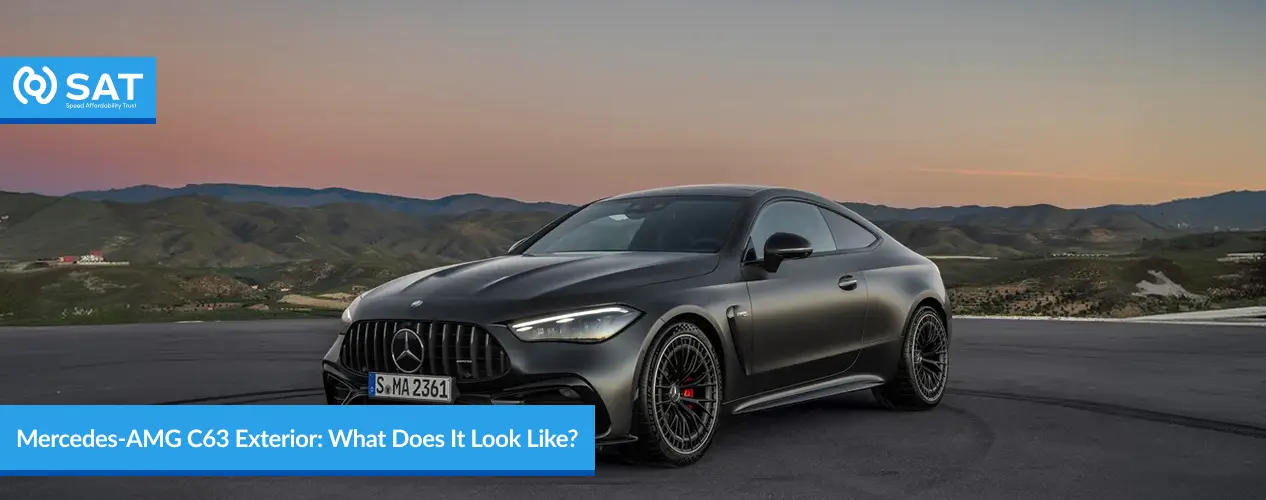
Standard wheels: 19 inches
Optional wheels: 20 inches
US body style: Saloon only
Other markets: Saloon and estate
Muscular, without trying too hard. Up front: the vertical-bar AMG grille, a deep lower bumper, and wider air openings than a standard C-Class. The bonnet has stronger creases, the front arches sit further apart, and small Turbo E Performance badges hint at the complicated machinery hiding underneath.
Side-on, it stays clean, with no huge wing and no random slabs of carbon bolted on for effect. The body's longer and wider than a standard C-Class, but the changes look like they belong.
The bigger wheels fill the arches nicely and photograph well; the 19s leave more sidewall between an expensive rim and an ugly pothole, which matters more after week one of ownership than it does in the showroom.
Round back: four squared exhaust outlets sit inside a dark diffuser, and a small spoiler finishes the boot lid without making the car look like it's headed to a track day every single morning.
The saloon is the only body offered in the US. Other markets also get the estate, which adds a longer roof and a more usable opening, though the hybrid hardware eats into a good chunk of the space you'd expect back there.
Where It Stands Out: The design is one of the safer calls here. Aggressive enough to look special, calm enough to still work outside an office, a hotel, or a family home.
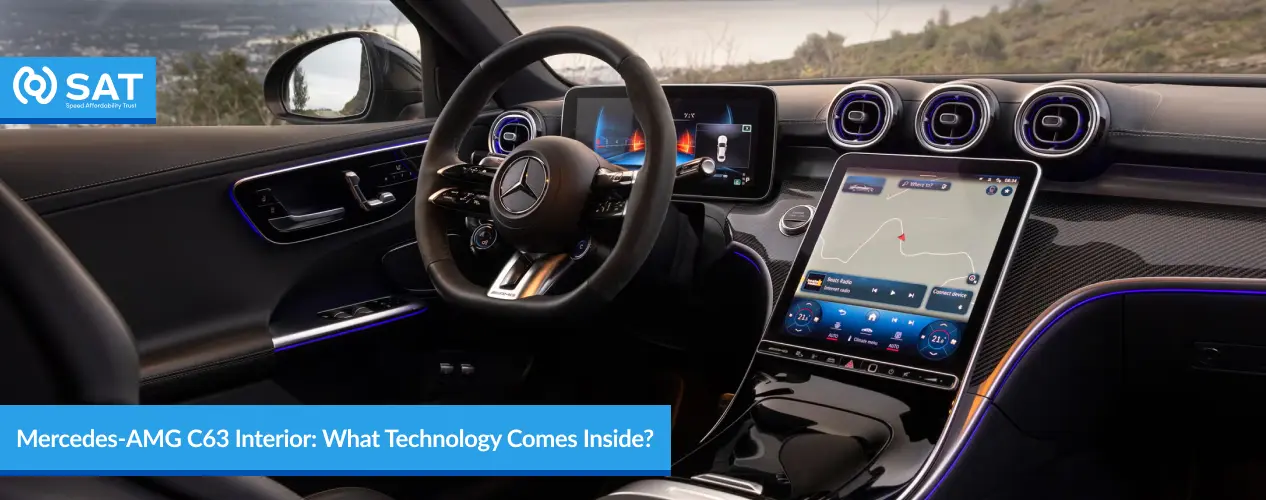
Mercedes C63 technology includes a portrait touchscreen running Mercedes' MBUX system.
It runs navigation, media, phone functions, climate settings, charging data, drive modes, and AMG performance displays.
The screen is bright, fast, and easy to read.
Wireless smartphone mirroring comes standard, and the available surround-view cameras take a lot of the stress out of tight car parks.
The head-up display shows speed, navigation prompts, and selected driving data without asking you to look away from the road.
Glossy touch-sensitive pads stand in for a lot of proper buttons and can change the display by accident.
Climate controls live on the touchscreen, though the temperature strip stays visible instead of getting buried in a submenu.
Final Verdict: The cabin proves good software can't paper over every bad control decision. MBUX earns its keep. The touch-sensitive wheel stays annoying long after you've learned to work around it.
IIHS award: Top Safety Pick
Standard pedestrian system: Acceptable
Upgraded pedestrian system: Good
Recall check: Instrument-display software
It has a strong safety foundation, though it is worth noting that the crash testing covered the wider C-Class family rather than the C63 on its own.
The 2026 Mercedes-Benz C-Class earned an IIHS Top Safety Pick award, with Good ratings across the small-overlap front, updated moderate-overlap front, and updated side tests. Those results apply to relevant 2022 to 2026 C-Class models, depending on the specific test.
Mercedes includes or offers a wide range of assistance features:
Automatic emergency braking
Blind-spot monitoring
Rear automatic braking
Parking sensors
Surround-view cameras
Lane-departure assistance
Adaptive cruise control
Cross-traffic assistance
The standard pedestrian crash-prevention system earned an Acceptable rating, while the upgraded version bundled into the Driver Assistance Package scored Good and performed better across several day and night tests. That package is worth having, though it raises an obvious question. Why does the stronger safety system cost extra on an $88,000 sedan?
The instrument-display recall from earlier belongs in this conversation too. A blank screen can briefly wipe out speed and other driving information, so affected cars need that update whether or not the issue's ever actually shown up on a test drive.
Final Verdict: The structure holds up well, and the available safety systems are genuinely strong. Mercedes just keeps some of the best of them locked behind an option box.
US sedan cargo space: 11.6 cu ft
C63 estate: 320 liters
C300e estate: 360 liters
Non-hybrid C-Class estate: 490 liters
11.6 cubic feet in the US sedan, enough for daily shopping, a few soft bags, or a weekend away for two. The opening's useful, though the hybrid gear does eat into the space behind the rear seats.
C-Class Version | Cargo Capacity |
US C63 sedan | 11.6 cu ft |
C63 estate | 320 liters |
C300e estate | 360 liters |
Non-hybrid C-Class estate | 490 liters |
Only 320 liters with the rear seats up: 40 liters behind the plug-in hybrid estate, and 170 behind a non-hybrid C-Class estate. The rear drive unit raises a section of the floor, and there's no proper underfloor spot for the charging cable either. This isn't a minor issue. People buy an estate because they need the room, and this one gives away a big chunk of that advantage before you've loaded a single bag.
Rear seating fares better. Adults fit comfortably in the second row, the doors open wide, and there's enough legroom for normal family use, though the bulky front seats keep the back from feeling as open as the wheelbase suggests.
For a broader look at cabin space, practicality, and ownership costs, read our Mercedes A-Class vs C-Class comparison.
Final Verdict: The sedan has enough room for ordinary life. The estate wears the right shape but doesn't deliver the capacity that shape promises.
Model-specific rating: Not available
Basic warranty: 4 years/50,000 miles
Hybrid coverage: 6 years/62,000 miles
Best approach: Buy new or nearly new with warranty
Mercedes-AMG C63 maintenance cost: No model-specific average is available yet
Honestly, there isn't enough long-term evidence yet to give the current hybrid version a real score. That "4 out of 5, ranked 20th of 68" figure floating around online doesn't apply here. Some sites do list the luxury midsize class average at 3.5 out of 5, but that's class-wide, not specific to this car.
Measure | Luxury Midsize Class Average |
Annual repair cost | $739 |
Unscheduled workshop visits | 0.59 per year |
Chance of a severe repair | 12% |
None of that predicts what's coming for this specific car. It can't tell you what an electric turbocharger, a rear electric motor, a high-voltage battery, an active rear-steering system, or a two-speed electric transmission will cost to keep healthy years down the line. More complexity doesn't automatically mean less reliability. It does mean more expensive systems that all need to keep working at once.
US warranty coverage is more useful than guesswork here. Mercedes covers four years or 50,000 miles on the basics and drivetrain, with hybrid-component protection running six years or 62,000 miles. Some states offer longer emissions-related coverage on top, so check the warranty booklet and your registration state before buying.
Final Verdict: The sensible move is buying new or nearly new and holding onto strong warranty coverage. This car might turn out reliable; it's just too new and too complicated to promise that with any real confidence yet.
Expert Tip: A used C63 needs a Mercedes diagnostic scan, proof of software updates, a recall check, full service records, and a careful tire inspection. A clean body and low mileage tell you nothing about whether every hybrid system underneath is actually healthy.
Early used listings provide some indication of depreciation, but they do not prove long-term reliability.
Used 2024 hybrid C63 examples have appeared with asking prices ranging approximately from the low-$70,000s to the low-$80,000s, depending on mileage, options, warranty coverage, and vehicle history.
These are advertised prices rather than confirmed sale prices. Buyers should compare each car’s asking price with its original window sticker because heavily optioned examples may have cost considerably more than the $88,000 base price when new.
Older C63 owner reviews should also be treated separately. Positive experiences with previous V8 generations do not prove that the battery, rear motor, electric turbocharger, and electric transmission in the current model will have the same reliability record.
Power advantage: Mercedes-AMG C63
Weight and steering advantage: BMW M3
AWD price difference: $600
Clear winner: BMW M3 Competition xDrive
The BMW M3 Competition xDrive is the better all-round performance sedan. The C63 hits harder on paper, but the BMW feels lighter, clearer, and easier to enjoy.
Specification | Mercedes-AMG C63 | BMW M3 Competition | BMW M3 Competition xDrive |
Engine | 2.0L turbo I4 hybrid | 3.0L twin-turbo I6 | 3.0L twin-turbo I6 |
Power | 671 hp | 503 hp | 523 hp |
Torque | 752 lb-ft | 479 lb-ft | 479 lb-ft |
Drivetrain | AWD | RWD | AWD |
Claimed 0–60 mph | 3.3 sec | 3.8 sec | 3.4 sec |
Starting US price | $88,000 | $83,500 | $88,600 |
Approximate curb weight | 4,817 lb | About 3,890 lb | About 3,990 lb |
Mercedes wins the power argument with 148 hp and 273 lb-ft more than the BMW M3 Competition xDrive. The electric motor also gives it a harder first punch from medium speeds.
The BMW settles faster after bumps, gives clearer steering feedback, and feels lighter through corners. Its six-cylinder engine also sounds richer as the revs climb.
Go for the C63 if you want the stronger powertrain, instant low-rev shove, and hybrid hardware. Go for the BMW M3 Competition xDrive if you want similar all-weather pace with better balance and clearer steering.
Clear Winner: BMW M3 Competition xDrive. It costs almost the same, remains extremely quick, and is more rewarding to drive.
For a wider brand-level comparison, read our BMW vs Mercedes comparison.
C63 power: 671 hp
CT4-V Blackwing power: 472 hp
C63 advantage: AWD, faster launch, cabin tech
CT4-V advantage: Manual gearbox, lower weight, sharper steering
Price difference: $23,805
Weight difference: Nearly 1,000 lb
C63 starting price: $88,000
CT4-V starting price: $64,195
Clear Winner: Cadillac CT4-V Blackwing. It is lighter, cheaper, more engaging, and offers better performance per dollar.
The Alfa Romeo Giulia Quadrifoglio is worth considering as a used alternative rather than a direct new-car rival. Its 2.9-liter twin-turbo V6 produces 505 hp and sends power to the rear wheels.
The Alfa has less power and no AWD, but it is roughly 1,000 pounds lighter than the C63. That lower weight gives it sharper steering, more natural balance, and stronger driver involvement.
Choose the C63 for acceleration, AWD traction, cabin technology, and daily usability. Choose the Giulia Quadrifoglio if lower weight, steering feel, and V6 character matter more.
Important: US buyers will generally be comparing the new C63 with a used Giulia Quadrifoglio because the Alfa is no longer a direct new 2026 rival.
Pros | Cons |
671 hp and 752 lb-ft give it savage acceleration | Its 4,817-pound curb weight hurts agility |
Electric torque makes overtaking almost effortless | The four-cylinder sound lacks old C63 drama |
AWD gives it excellent traction in poor weather | Steering feedback is limited |
MBUX and the head-up display work well | Touch controls make easy tasks harder |
Comfort mode makes long trips manageable | Electric range and estate boot space are weak |
Best for: Tech-focused daily-performance buyers
Works well for: Wet or cold climates
Avoid if: Steering feel and engine character matter most
Wrong fit for: Buyers chasing the old V8 personality
Someone who finds the engineering just as interesting as the driving. It suits a buyer who wants huge acceleration but still needs four doors, a genuinely usable back seat, and a calm motorway cruiser. AWD makes sense if you're somewhere wet or cold, and the hybrid system gives instant response instead of making you wait around for a big engine to find its sweet spot.
It doesn't sound like an old AMG. It doesn't feel light. The electric range won't transform your commute, and the estate isn't as roomy as its shape suggests.
Pick a rival if steering, balance, and engine character top your list. Pick the value-focused rival if you want a manual gearbox, a lower price, and a car that feels alive without needing 671 hp to get there.
Final Verdict: This car is built for a tech-forward daily-performance buyer. Anyone hunting for a modern version of the old V8 car is looking in the wrong showroom.
Availability: Confirm through live inventory
Support: Search, documents, and shipping
Final cost: Depends on destination and vehicle
Before payment: Get a confirmed landed-cost quote
SAT Japan can help international customers search Japanese used-car listings, walk through the purchase process, sort out export documents, and arrange shipping to supported destinations. The exact services, inspection rules, taxes, port charges, and delivery costs all depend on the destination and the specific vehicle.
An exact 2026 Mercedes-AMG C63 S E Performance should only be treated as available once it actually shows up in live inventory or SAT Japan confirms the listing directly, since rare AMG models can come and go from Japanese stock fast.
Final Verdict: Check SAT Japan's new Mercedes-Benz listings and get a confirmed landed-cost quote for the exact 2026 Mercedes-AMG C63 before you pay for anything.
Final rating: 6.5/10
Best qualities: Speed, technology, and AWD confidence
Biggest problems: Weight, steering feel, and engine character
Best alternative: BMW M3 Competition xDrive
Yes, for a specific kind of driver. Just not the strongest all-round choice in this class.
The achievements are real. It delivers supercar acceleration from a practical four-door body, finds grip in filthy weather, covers long distances without beating up its occupants, and packs one of the most interesting hybrid systems fitted to any modern sports sedan. That should be enough. Somehow, it isn't quite.
All that extra machinery pushes the weight close to 4,800 pounds. The steering tells you less than it should, the suspension has to work overtime on rough roads, and the engine note never quite matches the aggression the body promises. The tiny electric range doesn't do much to justify itself as an economy feature either.
Independent reviewers scored it in the low-to-mid 6-out-of-10 range, which makes a lot more sense once you separate straight-line performance from driver involvement.
For most people, the all-wheel-drive six-cylinder rival is the smarter buy. It's nearly as quick, meaningfully lighter, and more satisfying through a corner. The manual-gearbox rival is the emotional pick, especially with that gearbox and the much lower price tag.
Here's the whole point of this review: buy this car for its force, its technology, its AWD confidence, and its slightly mad engineering. Don't buy it expecting the old C63 with a battery bolted on. AMG built something new, clever, and shockingly fast here. It just didn't build the best C63.
The Ford F-150 has been America's best-selling truck for 47 straight years. That's not a marketing line; that's a track record no other vehicle in history has matched. But sales numbers alone don't tell you whether this truck is actually worth your money in 2026.
This Ford F-150 review 2026 does. Five engines, six trims, two dedicated off-road builds. The hybrid that genuinely changes the fuel economy conversation. Whether you're towing a trailer, running a job site, or importing one through SAT Japan to Uganda, Ghana, or the UK, this is everything you need to decide if the F-150 still deserves the crown.
This is reviewed and updated in June 2026 by our AUTOYOLOGIST test team, based on one week of real-world testing, including towing, job-site hauling, and daily driving of the 2026 F-150 PowerBoost Hybrid.
Key Takeaways
America's best-selling truck for the 47th straight year, with six engines and eight trims.
Prices start at $39,330 for the XL and reach $109,145 for the Raptor R.
Maximum towing is 13,500 lbs with the 3.5L EcoBoost V6.
The PowerBoost Full Hybrid delivers 23 mpg combined, the best in the lineup.
SAT Japan sources XLT and Lariat SuperCrew builds for buyers in the UK, Uganda, and Ghana.
You should seriously consider buying the 2026 F-150. If you need a truck that can tow things or haul stuff and still be comfortable to drive home in, then this is the truck for you. The F-150 is the best truck you can buy for the money, period.
Contractors will like how much weight the 2026 F-150 can carry. Families will like the SuperCrew cabin. People who enjoy off-roading on the weekends have two options, each designed for a different kind of terrain.
The great thing about the 2026 F-150 is that it does not make you choose between what you want and what you need.
There are three things to know about the 2026 F-150. The maximum towing capacity is 13,500 pounds with the 3.5L EcoBoost engine. The PowerBoost hybrid engine really does save you money on fuel without making the truck less powerful. The 2026 F-150 also has two off-road models, the Tremor and the Raptor, so you do not have to pick just one truck to do two different jobs.
Scorecard:
Category | Score (/10) |
Performance | 8.5 |
Comfort | 8 |
Tech | 8.5 |
Towing/Capability | 9.5 |
Value | 7.5 |
Looking to import a 2026 F-150 through SAT Japan? Browse our available F-150 stock.
Rear-wheel drive is now the standard setup on Lariat, King Ranch, and Platinum, which actually lowered their starting prices compared to 2025. 4WD adds $3,800 back on.
King Ranch and Platinum both dropped the V8 option; they're EcoBoost- or PowerBoost-only now.
New Active X leather-like seating material shows up across most trims, replacing some of last year's cloth-standard setups.
The new STX Lobo package adds a 2-inch lowered rear suspension, gloss-black 22-inch wheels, and the 5.0L V8.
BlueCruise hands-free highway driving can now be bought once, instead of by subscription.
New appearance options include the XLT Chrome package and the Satin Platinum package.
Reports indicate the next-generation F-150 has been delayed until 2028, meaning a 2026 purchase isn't a "buy right before a redesign" risk.
Here's the thing: after a week of towing, hauling mulch, and driving the PowerBoost hybrid through an entire tank of fuel, we can tell you this truck earns most of its reputation. It doesn't earn all of it.
The hybrid pulling a 6,000-lb trailer without the fuel gauge cratering is genuinely impressive. That's not marketing copy. That's what actually happened over two mountain passes. Pro Power Onboard is the kind of feature you don't think you need until you're running a table saw off the tailgate with zero extension cords in sight.
Now the wince part. Climb into a loaded Platinum, and you're suddenly looking at luxury-SUV money for a truck bed you might use twice a month. Some features that should be standard, like adaptive cruise control and the 360-degree camera, are hidden behind option packages that add up fast.
Who should skip this truck? If your driving is 90% city parking lots and errands, the F-150's full-size footprint is more truck than you need, and something smaller will save you money and headaches. See how the two stack up in our Ford Ranger vs F-150 comparison.
Likes | Dislikes |
Broad engine lineup covers every use case | Fuel economy swings hard by engine choice |
Best-in-class towing when properly equipped | Loaded trims push past $70K fast |
Pro Power Onboard is genuinely useful on job sites | Full-size footprint is a lot for daily city driving |
BlueCruise hands-free capability on select trims | Some tech features are gated behind expensive packages |
This 2026 Ford F-150 review specs section is your cheat sheet. Skim it now, then jump to whichever deep dive matters most to you below.
Spec | Detail |
Engine options | 2.7L EcoBoost V6 / 3.5L EcoBoost V6 / 5.0L V8 / 3.5L PowerBoost Hybrid / Raptor High-Output 3.5L EcoBoost / Raptor R 5.2L Supercharged V8 |
Horsepower range | 325–720 hp |
Torque range | 400–640 lb-ft |
Drivetrain | RWD / 4WD |
Transmission | 10-speed automatic |
Max towing | Up to 13,500 lbs |
Max payload | Up to 2,440 lbs |
Bed lengths | 5.5 ft / 6.5 ft / 8 ft |
Cab configs | Regular / SuperCab / SuperCrew |
Fuel economy range | 16–22 mpg city / 15–25 mpg highway |
Starting price | $39,330 (XL, before destination) |
This Ford F-150 review 2026 price breakdown starts with the floor: the base XL comes in at $39,330 before the $2,595 destination fee. Here’s how fast this climbs from there.
Choosing the Lariat means you're looking at around $66,000–$70,000 with 4WD, which most families want. If we move forward to the Platinum ones, they cost around $75,395. That's the starting pricing without adding any B&O and display package pricing.
One package worth flagging: the XLT Equipment Group 302A, which bundles the 360-degree camera and adaptive cruise, adds roughly $5,330 on its own. That single package pushes a $48,490 XLT past $53,000 before you've touched anything else.
Trim | Starting Price | Best For |
XL | $39,330 | Fleet/work |
| STX | $46,310 | Style on a budget |
XLT | $48,490 | Everyday value |
Lariat | $62,355 | Comfort-focused buyers |
King Ranch | $65,825 | Luxury-leaning |
Platinum | $68,800 | Top-tier luxury |
Raptor | $79,005 | Performance/off-road |
Raptor R | $109,145 | Extreme performance |
Best Value Trim: Our pick is the XLT with the 2.7L EcoBoost and the 302A package. You get real driver-assist tech, decent towing, and you're still comfortably under $54,000. Everything above that is paying for comfort, not capability.
The XL is the honest workhorse. Cloth seats, a 12-inch screen, and a 325-hp 2.7L V6 come standard, and it's still the only trim you can get in Regular Cab. Fleet buyers stick with it because there's nothing on it that isn't earning its keep.
The XLT is where the daily-use stuff shows up: 18-inch wheels on 4WD models, better paint options, enough tech to feel current without tipping into luxury pricing. Most contractors end up here once they've run the numbers.
Lariat is the tipping point. Leather seats, dual-zone climate, an optional B&O sound system, and the cabin starts feeling nice enough that you'd want to drive it even with no trailer hitched up.
King Ranch and Platinum are lifestyle picks, plain and simple. You're paying for Western-themed leather, a twin-panel moonroof, and massaging seats. None of it tows more or hauls more than a cheaper trim. You're paying for how it feels, not what it does. If three-row seating matters more than bed space, our 2026 Ford Expedition review covers Ford's SUV alternative in the same lineup.
This isn't a dressed-up XLT. It sits on a genuinely different chassis: five-link coil rear suspension, FOX Racing Shox Live Valve dampers, and a track six inches wider than the standard truck. Built to cover rough terrain at high speed, not just to clear it.
Which Trim Fits Your Life:
Your Priority | Recommended Trim |
Hauling/work | XL or XLT |
Family comfort | Lariat |
Luxury daily driver | King Ranch or Platinum |
Off-road performance | Raptor |
Best all-around value | XLT with 302A package |
Numbers on a spec sheet don't tell you if the truck fits your garage. One detail most sites skip: standard American garages run about 240 inches deep, and an 8-foot-bed SuperCrew will not leave you much room to spare.
Config | Length | Width | Height | Wheelbase | Bed Length | Cargo Volume |
Regular Cab | 209.3–227.9 in | 79.9 in | ~75–77 in | 122.5 in | 6.5 ft / 8 ft | 62.3 / 77.4 cu ft |
SuperCab | 232.0–243.9 in | 79.9 in | ~75–78 in | 145.0 in | 6.5 ft / 8 ft | 62.3 / 77.4 cu ft |
SuperCrew | 231.7–243.8 in | 79.9 in | ~75–80 in | 157.0 in | 5.5 ft / 6.5 ft | 52.8 / 62.3 cu ft |
One practical detail worth knowing: tow mirrors add real width beyond that 79.9-inch body figure, and if you're regularly backing a trailer past neighborhood mailboxes, it's worth test-fitting your driveway before you commit to a long-wheelbase build.
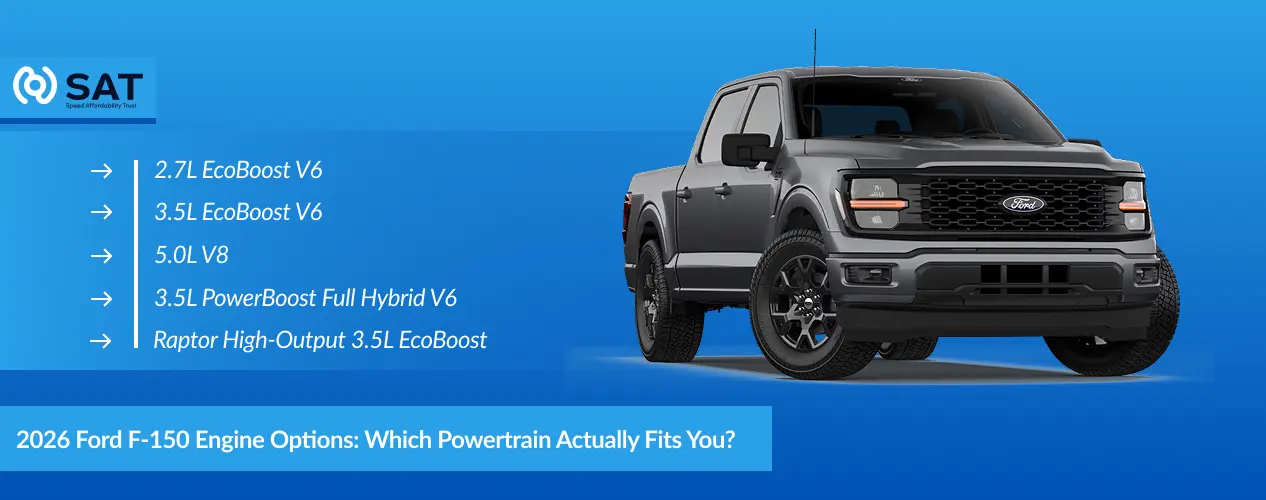
This is the truck for buyers who don't need to max out every number. It's efficient, it's cheap to operate, and it tows plenty for the average boat or small camper. The trade-off? It's not built for repeated heavy towing near its ceiling.
Here's the one contractors actually want. It carries the full 13,500-lb tow rating and the best-in-class 2,440-lb payload. The catch is you'll want the Tow/Haul package and Max Tow axle to actually unlock those numbers; it's not automatic.
You might be wondering why anyone still picks a naturally aspirated V8 in a turbo-everything world. Because it sounds right, it pulls smoothly under load, and there's no turbo lag to manage on a boat ramp. It's the traditionalist's engine, and it's a good one.
This is the most interesting engine Ford builds for this truck. It leads the lineup in torque, delivers better fuel economy than the gas V6s, and throws in Pro Power Onboard as a bonus. The trade-off is a slightly lower max towing rate than the gas 3.5L.
Built for speed over rough ground, not top-line towing. What makes this engine special is how it behaves at wide-open throttle across sand, smooth, controlled, and never running out of breath.
Engine | HP | Torque | 0–60 mph (approx.) | Best For |
2.7L EcoBoost V6 | 325 | 400 lb-ft | ~6.7 sec | Everyday/value |
3.5L EcoBoost V6 | 400 | 500 lb-ft | ~5.7 sec | Towing-focused |
5.0L V8 | 400 | 410 lb-ft | ~6.3 sec | Traditionalists/sound |
PowerBoost Hybrid | 430 | 570 lb-ft | ~5.8 sec | Efficiency + power |
Raptor High-Output EcoBoost | 450 | 510 lb-ft | ~5.1 sec | Performance/off-road |
0–60 figures reflect independent testing of comparable configurations, since Ford doesn't publish factory acceleration numbers.
The most fuel-efficient 2026 F-150 engine is the PowerBoost Full Hybrid, rated at 23 mpg combined. That's a real gap over the gas engines, not a rounding error.
Here's what the EPA numbers don't tell you: in mixed city driving with the hybrid, the electric assist does more of the heavy lifting at low speeds than the sticker suggests. You feel it most in stop-and-go traffic, where the gas engine actually gets to rest more than you'd expect.
EPA fuel economy by engine:
Engine | Drivetrain | City | Highway | Combined | Combined (L/100km) |
2.7L EcoBoost V6 | 4x2 | 19 | 25 | 21 | 11.2 |
3.5L EcoBoost V6 | 4x2 | 17 | 25 | 20 | 11.8 |
5.0L V8 | 4x2 | 16 | 24 | 19 | 12.4 |
PowerBoost Hybrid | 4x4 | 22 | 24 | 23 | 10.2 |
The 2026 Ford F-150 towing capacity reaches up to 13,500 pounds when properly equipped. To get that, you need the 3.5L EcoBoost V6 engine. You also need the Tow/Haul package and the Max Tow locking rear axle upgrade. If you skip any one of those, you will not be able to tow 13,500 pounds.
Most people get confused about this. A base 3.5L EcoBoost engine without the Max Tow package can only tow 12,400 pounds. That is still a lot, but not 13,500 pounds. If you want to tow 13,500 pounds, make sure you get the build.
Ford has technology to help with towing. The Pro Trailer Backup Assist helps you back up a trailer by steering it for you. The truck is also available with an integrated trailer brake controller. It comes standard on trucks equipped with the tow package. You can also equip the truck with extended tow mirrors. These provide much better rear visibility when towing wide trailers.
Towing & payload by engine:
Engine | Max Towing | Max Payload | Package Required |
2.7L EcoBoost V6 | 8,400 lbs | 1,775 lbs | Standard tow prep |
3.5L EcoBoost V6 | 13,500 lbs | 2,440 lbs | Tow/Haul + Max Tow axle |
5.0L V8 | 12,800 lbs | 2,235 lbs | Tow/Haul package |
PowerBoost Hybrid | 11,600 lbs | 2,045 lbs | Tow/Haul package |
What you're actually paying extra for with these three features, and whether it's worth it.
Pro Power Onboard turns the bed into a generator. The base 2.0kW setup runs phones and small tools without a second thought. Step up to 2.4 kW, and you're covering real job-site tools. Go all the way to 7.2kW on the hybrid, and you can genuinely back up a portion of your house during an outage.
The Pro Access Tailgate opens to the side in addition to the standard drop-down, which may seem minor until you're trying to reach cargo with a trailer hitched and no room to walk around the back. That's the part most people miss when they're comparing spec sheets instead of actually loading a truck.
BlueCruise deserves an honest explanation, not brochure language. It's hands-free, but only on pre-mapped divided highways. Ford calls these "Blue Zones," and they cover a huge chunk of North American interstate. A driver-facing camera watches you the whole time, and if your attention drifts, the system immediately hands control back. It doesn't work on surface streets, and it won't work at all if you're not on a mapped route.
Pro Power Onboard output:
Output | Typical Use |
2.0kW | Small tools, phones, basic camp gear |
2.4kW | Job-site tools, small appliances |
7.2kW | Home backup power, heavy equipmen |
Yes, but the 2026 Ford F-150 off-road performance depends heavily on which trim you buy. Standard 4WD models handle dirt roads and light trails fine. They aren't built for serious off-road obstacles, and Ford doesn't pretend otherwise.
The Tremor changes that equation. It has 10.9 inches of ground clearance, a 27.6-degree approach angle, and a 24.3-degree departure angle, all riding on 33-inch all-terrain tires. Skid plates and a locking rear differential come standard. This is the truck for ranch roads, rutted trails, and the occasional mud bog, not high-speed desert running.
The Raptor is a different animal entirely. Ground clearance jumps to 12 inches, approach angle to 31 degrees, and the FOX Live Valve suspension reads the terrain and adjusts damping in real time. That's the part most people miss. This isn't a lifted F-150; it's a different chassis wearing the same badge.
Spec | Tremor | Raptor |
Ground clearance | 10.9 in | 12.0 in |
Approach angle | 27.6° | 31.0° |
Departure angle | 24.3° | 23.9° |
Suspension | Monotube front, twin-tube rear, leaf-spring rear axle | FOX Live Valve, 5-link coil rear |
Best for | Moderate trail use | Serious off-road/desert running |
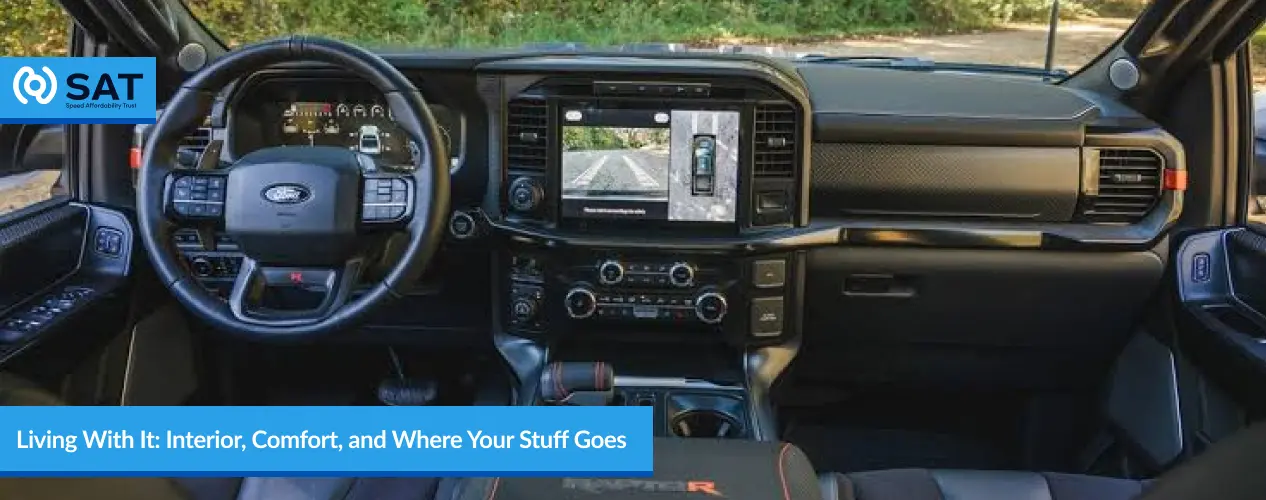
The SuperCrew is where this truck really shines as a daily driver. Rear legroom stretches to roughly 43.6 inches, which is genuinely comfortable for adults on a long haul, not just "technically fits" comfortable.
Storage is smarter than it looks. The front console can fold flat into a work surface on higher trims, and under-seat storage in the rear gives you a place to lock up tools or gear out of sight. In the bed, the tie-down cleats and available spray-in liner keep cargo from sliding around on a rough road.
One thing buyers rarely get a straight answer on: highway noise. At 70 mph, the cabin stays quiet enough for normal conversation without raising your voice, noticeably better than older-generation trucks, and a real point in the F-150's favor for anyone doing long commutes.
The 2026 F-150 earned the maximum 5-star overall rating from NHTSA's official safety ratings, with 5-star scores in both frontal and side crash tests. That's a strong result, and it's not the whole story.
One thing most reviews gloss over: The IIHS updated moderate-overlap front test flags a "Poor" result due to rear-seat shoulder belt migration and lap belt submarining in a frontal crash. That's not unique to Ford; it's an unresolved issue across nearly every half-ton truck on sale right now, but it's still worth knowing if you regularly carry rear passengers.
Ford Co-Pilot360 comes standard across every trim, which means automatic emergency braking, lane-keeping assist, and blind-spot monitoring with trailer coverage aren't locked behind an options list. That's the right call, and not every competitor does it.
Test | Rating |
NHTSA Overall | 5-star |
NHTSA Frontal | 5-star |
NHTSA Side | 5-star |
NHTSA Rollover | 4-star |
IIHS Award | Top Safety Pick (crew cabs built after Sept. 2024 |
Reliability sits in solid-but-not-perfect territory. J.D. Power's predicted reliability score lands at 86 out of 100, which falls in the "Great" band, respectable, though it isn't class-leading against every full-size rival.
Ford's warranty coverage is fairly standard for the segment. Basic coverage runs 3 years or 36,000 miles, and the powertrain gets 5 years or 60,000 miles. If you go PowerBoost, the hybrid-specific components get an extended 8-year or 100,000-mile umbrella, worth factoring in if long-term ownership costs matter to you.
Maintenance costs track close to the class average for routine service, though towing-heavy use will noticeably shorten oil-change intervals. If you're regularly pulling near the truck's max rating, budget for more frequent service, not less.
Coverage | Terms |
Basic | 3 years / 36,000 miles |
Powertrain | 5 years / 60,000 miles |
Hybrid components | 8 years / 100,000 miles |
Corrosion | 5 years / unlimited miles |
Roadside assistance | 3 years / 36,000 miles |
The Ram rides better. Its coil-sprung rear suspension smooths out rough pavement in a way the F-150's more traditional setup doesn't quite match. But the F-150 wins on payload and edges it out on outright towing, and that's the category most working buyers actually care about.
The Tundra counters with a reputation for long-term durability and its own hybrid option. Still, the F-150's hybrid produces more torque, and Ford's towing tech, especially Pro Trailer Backup Assist, remains the more complete package for anyone who tows regularly.
Import-relevant quick notes:
Factor | SAT Japan's Note |
RHD availability | Not factory RHD; UK buyers typically need conversion or LHD acceptance |
Typical buyer profile | Contractors and fleet operators in Uganda and Ghana; private UK buyers accepting LHD |
Most-requested trim/engine | XLT or Lariat SuperCrew with 5.0L V8 or 3.5L EcoBoost |
Value-for-money verdict | Strong, proven parts network and steady resale across all three markets |
Import restrictions | Check destination-country vehicle age limits and emissions rules before purchase |
At SAT Japan, we sell F-150s to buyers in the UK, Uganda, and Ghana, and the demand never really stops. That tells you something. This truck has a reputation that travels well beyond America.
RHD conversion is the honest sticking point. The F-150 isn't factory right-hand drive, so UK-bound buyers are almost always looking at an aftermarket conversion or accepting LHD for private use off public roads in certain markets. Uganda and Ghana buyers are far more relaxed about this, since LHD trucks see everyday use across both markets without the same friction.
Our typical F-150 buyer in these regions isn't chasing the Raptor. They want the XLT or Lariat SuperCrew with the 5.0L V8 or 3.5L EcoBoost. They're proven, easy to service, and have widely available parts even outside major cities. That preference for simplicity over flash comes up in almost every conversation we have with East African and West African buyers.
The value for money remains strong for import buyers specifically because of parts availability and resale. A well-kept F-150 SuperCrew moves fast in our export inventory, and buyers in all three regions treat it as a safer long-term bet than some rarer trims that look impressive but complicate maintenance down the line.
Engine choice should track local conditions as much as trim. Markets with variable fuel quality do best with the 5.0L V8, since it avoids turbo heat stress and runs on simpler architecture. Markets with high fuel prices and stable grid power get the most value from the PowerBoost hybrid. Buyers running heavy commercial towing should stick with the 3.5L EcoBoost, budgeting for stricter oil-change intervals.
Landed cost isn't just the vehicle price. Buyers should budget for vehicle price plus freight, insurance, import duty, local taxes, and registration before comparing an import against a locally available truck.
Many of the F-150s we source come through Japan's domestic auction network, where trucks are inspected to Japan's strict standards before export, giving import buyers a level of pre-purchase certainty that's hard to get from other used-import channels.
Import-relevant quick notes:
Factor | SAT Japan's Note |
RHD availability | Not factory RHD; UK buyers typically need conversion or LHD acceptance |
Typical buyer profile | Contractors and fleet operators in Uganda and Ghana; private UK buyers accepting LHD |
Most-requested trim/engine | XLT or Lariat SuperCrew with 5.0L V8 or 3.5L EcoBoost |
Value-for-money verdict | Strong, proven parts network and steady resale across all three markets |
Import restrictions | Check destination-country vehicle age limits and emissions rules before purchase |
The scorecard tells the real story: strong towing, strong tech, solid comfort, and a value proposition that gets shakier the higher you climb the trim ladder. Where it loses points is trim strategy; Ford could make adaptive cruise and the 360 camera standard on XLT instead of gating them behind a $5,330 package, and the value proposition wouldn't feel like it craters the moment you leave XL.
The ideal buyer here is someone who tows or hauls regularly, wants a cabin that doesn't feel like a compromise, and is willing to shop the trim ladder carefully instead of defaulting to the top.
Our direct recommendation: buy the XLT or Lariat with the 3.5L EcoBoost or PowerBoost hybrid, skip the luxury-trim price creep, and you'll own the most complete truck in the segment without overpaying for badges.
For this 2026 Hyundai Sonata review, I picked up the SEL Sport on a Tuesday with a half-empty tank and no plan other than to drive it the way an owner would: errands, a highway stretch past the edge of town, a rainy commute where I was grateful for lane-keep assist more than once. Two weeks and two more trims later, a Hybrid Limited and an N Line, I had a clear picture of where this car earns its money and where it doesn't. Pricing starts at $28,545, the hybrid will do up to 51 mpg combined, and the base engine is the one weak spot everything else has to work around.
Five trims run on gas or hybrid power, prices range from $28,545 to about $38,100, and the car is built for commuters and small families who got tired of SUV pricing for space they weren't using. Ask me which trim to buy, and I won't hesitate: SEL Hybrid. Price and fuel savings line up there better than anywhere else in the lineup.
Best for: Commuters, hybrid shoppers, and midsize-sedan buyers who don't need an SUV. Skip if: You want class-leading resale value or a genuinely sporty base model.
If you're reading this Hyundai Sonata car review to decide whether it's the right midsize sedan for you, the sections below break down every major area, from performance and comfort to long-term ownership costs.
Starting price | $28,545 |
Top trim price | $38,100 (Limited Hybrid) |
Best trim for most buyers | SEL Hybrid |
Engine options | 2.5L gas, 2.5L turbo, 2.0L hybrid |
Horsepower range | 191–290 hp |
Best fuel economy | 51 mpg combined (Blue Hybrid) |
Safety award | 2026 IIHS Top Safety Pick+ |
Warranty | 10-year/100,000-mile powertrain |
Reliability score | 4.0/5 |
Length | 193.3 in |
Wheelbase | 111.8 in |
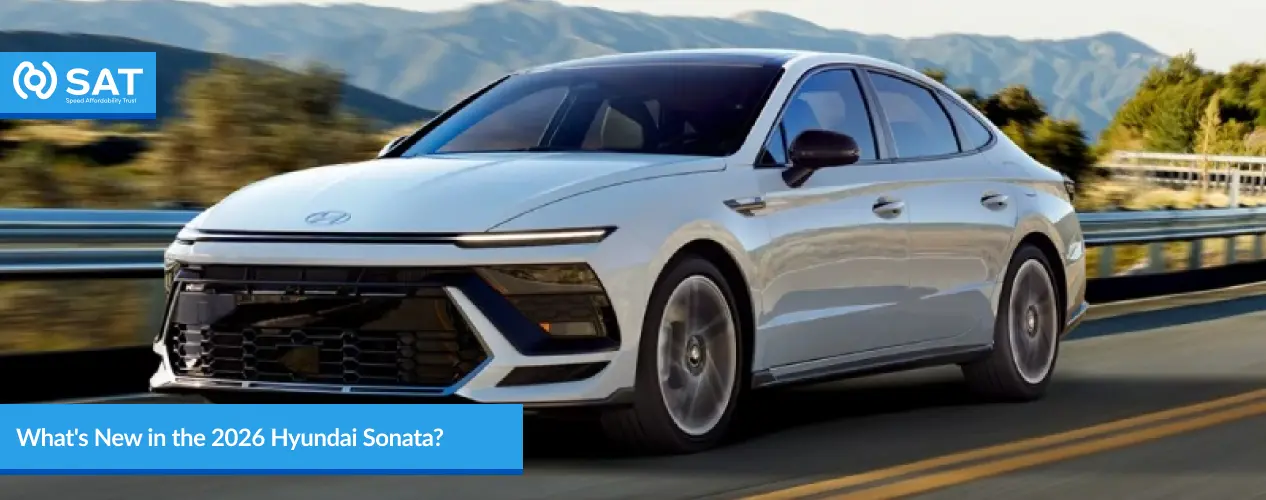
Hyundai tightened bolts this year instead of reinventing anything. The old SEL and SEL Convenience trims were merged into a single SEL Sport, which sounds minor until you've stood on a dealer lot trying to tell two nearly identical trim names apart.
The hybrid lineup changed more:
A new Blue Hybrid trim starts at $30,295, undercutting last year's hybrid floor
Wireless phone charging is now available earlier in the trim lineup
The leather-wrapped steering wheel is now standard sooner
These are small refinements rather than major changes, the kind of updates manufacturers make once they've already found a formula that works.
If you're shopping for a factory-fresh sedan, it's worth comparing other Japanese new cars alongside the Sonata. Looking at similarly priced models can give you a better idea of which one best matches your budget, driving style, and feature priorities.
Trim | Starting MSRP | Engine |
SE | $28,545 | 2.5L I-4, 191 hp |
SEL Sport | $30,245 | 2.5L I-4, 191 hp |
N Line | $35,900 | 2.5L Turbo I-4, 290 hp |
Blue Hybrid | $30,295 | 2.0L Hybrid, ~192 hp combined |
SEL Hybrid | $32,300 | 2.0L Hybrid, ~192 hp combined |
Limited Hybrid | $38,100 | 2.0L Hybrid, ~192 hp combined |
Overall, Hyundai Sonata pricing remains competitive for the midsize sedan segment, especially when you consider the amount of standard technology and safety equipment included across the lineup. I expected the base SE to feel cheap, the way base trims used to feel a decade ago. It doesn't. Standard gear includes a 12.3-inch touchscreen, wireless Apple CarPlay and Android Auto, and the full driver-assist safety suite. That's a lot of equipment for a car starting under $29,000.
Best trim for most buyers: SEL Hybrid. Heated front seats, a sunroof, a leather-wrapped wheel, a power driver's seat, and fuel savings that help pay for the upgrade within three or four years for a typical commuter.
Best trim for performance: N Line. Best trim for max mpg: Blue Hybrid.
AWD is available only on the SEL Sport gas trim, as a $1,500 option; N Line and hybrid trims stay FWD only. One line item catches buyers off guard: the $1,095 destination fee applies on top of every MSRP in the table above.
Base 2.5L: smooth, does exactly what it needs to, not quick
Hybrid: instant torque off the line, the smartest all-rounder, slightly firmer ride
N Line: legitimately quick, sharper steering, still trails the class's best sport sedans
Ride comfort: composed and quiet on the highway
Handling: secure rather than sporty on non-N Line trims
Three powertrains: a 191-hp naturally aspirated 2.5-liter four on the SE and SEL Sport, a turbocharged version of that same engine making 290 hp on the N Line, and a 192-hp combined hybrid setup across the Blue, SEL, and Limited Hybrid trims. Torque tells a similar story: 181 lb-ft on the base 2.5L, 139 lb-ft on the hybrid, and 311 lb-ft on the N Line turbo.
Driving the SEL Sport through city streets and a highway stretch, the base engine did exactly what it needed to and nothing more. It's built to disappear into the background of a commute, and for most buyers, that's the point rather than a flaw.
The N Line's just built different. Throttle response sharpens noticeably, steering firms up, and the whole car takes on a different attitude despite sharing a platform with the base trims. A drive mode selector lets you toggle between Normal, Sport, and Eco on SEL Sport and higher trims, and the difference in throttle mapping is noticeable even on the base 2.5L engine.
Performance numbers:
Base 2.5L Sonata: 0-60 in roughly 8.2 seconds
N Line: 0-60 in roughly 5.8 seconds, ahead of the Accord and close to the Kia K5 GT
Towing capacity: not rated. Skip this car if towing is part of your plans.
Nissan doesn't build a hybrid Altima. Kia doesn't build a hybrid K5. The Sonata Hybrid sits in a category most of its direct rivals can't touch.
Blue Hybrid rates 47 city / 56 highway / 51 combined. SEL and Limited Hybrid land a touch lower at 44/51/47. I averaged close to 46 mpg in the SEL Hybrid over a week of mixed suburban and highway driving in mild spring weather (50–65°F), tire pressure at the manufacturer spec , worth noting since cold weather cuts into hybrid battery recharging and can drop real-world numbers well below the sticker figure.
Power delivery feels smoother off the line than the gasoline engine because the electric motor provides instant torque. The one tradeoff: a slightly firmer ride on rough pavement, since the battery pack sits low and adds weight.
Toyota took a different route entirely. Every 2026 Toyota Camry is a hybrid, no exceptions, and the LE Hybrid rates 51 mpg combined standard. Hyundai kept the choice intact instead: gas, hybrid, or a 290-hp turbo, all in one showroom.
Unlike most hybrid rivals, the Sonata Hybrid pairs its electric motor with a conventional 6-speed automatic instead of a CVT. It's a deliberate trade-off: you give up a little efficiency, but the car feels more mechanically conventional and predictable to drive. The one downside I noticed was a slight hesitation at low speeds, particularly pulling away from a dead stop, which lines up with what other reviewers have flagged as the setup's main weakness.
More than the badge suggests. The N Line pairs its 290-hp turbo engine with an eight-speed dual-clutch, paddle shifters, sport-tuned suspension, and 19-inch wheels.
I ran it through some on-ramps and a curvy stretch of road I usually save for sportier cars, and the chassis held up better than expected from a front-wheel-drive family sedan. Body roll stays controlled. Steering feels sharper than the standard Sonata's, though it still trails the Accord a bit.
Visual differences: quad exhaust tips, a rear lip spoiler, distinct 19-inch wheels. The standard tires aren't the stickiest, so outright grip isn't its strongest suit, but as a daily driver that occasionally wants some excitement, it delivers.
Quick comparison: Accord, still more polished to drive. Camry Hybrid, better efficiency and smoother hybrid integration. K5 GT, more dramatic than the Sonata N Line, but not necessarily more rounded.
For more details, read our comprehensive guide on the 2026 Hyundai Sonata N Line Review.
Trim | Combined MPG |
SE | 32 |
SEL Sport | 29 |
N Line | 27 |
Blue Hybrid | 51 |
SEL / Limited Hybrid | 47 |
AWD comes with a small efficiency cost: SEL Sport rates 25/36/29 mpg (city/highway/combined) with FWD versus 24/33/27 mpg with the AWD option. For 12,000 miles a year, the gap between the base engine and Blue Hybrid works out to filling up once a week versus once every ten days.
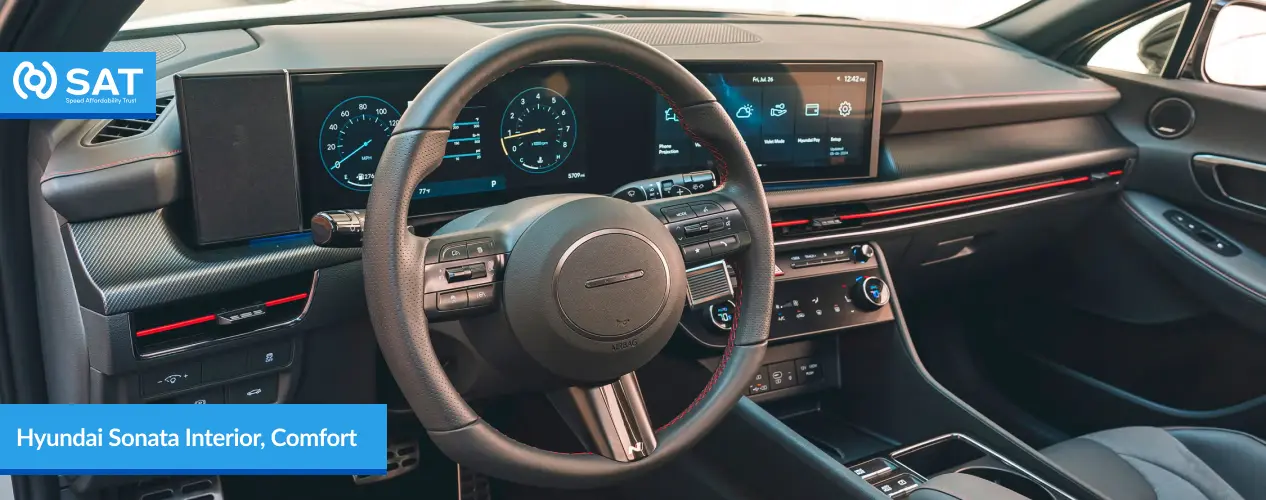
Four adults ride comfortably without anyone having to negotiate for legroom. That's the short version of why this car works for small families.
Trunk space by the numbers:
Model | Trunk Space |
Hyundai Sonata | 15.6 cu ft |
Honda Accord | 16.7 cu ft |
Toyota Camry | 15.1 cu ft |
The Accord wins on paper. But I loaded two carry-on suitcases and a stroller into the Sonata's trunk with room left over, and the opening itself is wider and sits lower than the Accord's. Loading anything bulky, like a golf bag, felt easier here than the cargo figures suggest.
The Hyundai Sonata premium interior feels more substantial than you'd expect, unlike the hollow feel you get in cheaper cars. The 12.3-inch touchscreen paired with a matching digital gauge cluster on upper trims keeps the dash looking current. I set the driver's seat to my own position, then climbed in the back to check legroom. A few inches to spare, enough to matter if you're regularly driving teenagers or installing car seats. Headroom holds up even with the panoramic sunroof on higher trims.
Trim-level interior notes:
SE / SEL Sport: Cloth or leatherette (depending on configuration), black or gray
N Line: Sport seats with unique bolstering and stitching
SEL Hybrid / Limited Hybrid: Full leather, leather-wrapped wheel, softer touch points on the dash and doors
Road noise stays well controlled at highway speeds. This is a quiet place to sit through a long commute.
Every 2026 Sonata gets a 12.3-inch touchscreen with wireless Apple CarPlay and Android Auto, no trim exceptions. That beats the Camry, which reserves its larger screen for pricier trims. Bluelink+ adds remote start, vehicle status checks, and over-the-air updates on supported trims. Digital Key lets you lock, unlock, and start the car from your phone on SEL Hybrid and higher trims, no fob required. The optional 12-speaker Bose system impressed me more than expected, with clean bass without drowning out vocals.
This Hyundai Sonata safety review starts with a strong headline: a 2026 IIHS Top Safety Pick+ award highlighting the car's crash-test performance. Good scores across small-overlap front, updated moderate-overlap front, updated side, and headlights are the categories the IIHS weighs most heavily. TSP+ status also required a Good score in pedestrian front crash prevention and at least Acceptable in the updated vehicle-to-vehicle front crash prevention test. The Sonata earned the required IIHS scores to qualify for Top Safety Pick+. Every trim also carries a 5-star NHTSA overall rating, with five stars in side crash and rollover and four stars in the frontal crash test.
Standard on every trim:
Limited Hybrid adds a blind-spot view monitor and parking distance sensors on top of the standard suite. Hyundai bundles all of this under its SmartSense name, and every 2026 Sonata carries seven airbags as standard. Plenty of rivals reserve this package for mid-tier or higher trims. Hyundai includes it from the SE up.
RepairPal rates the Sonata 4.0 out of 5.0, ranking it fifth out of 24 midsize cars, and Hyundai Sonata maintenance costs average $458 a year in repairs, compared with a $526 class average. Owners bring their cars in for unscheduled repairs about 0.3 times a year, in line with the class, and only 11 percent of those repairs are severe, compared with a 12 percent class average. Roughly $458 a year covers combined scheduled and unscheduled maintenance, or somewhere between $2,300 and $2,600 over five years and 60,000 miles.
One change to flag for 2026: Hyundai discontinued its complimentary scheduled-maintenance program. Through 2025 it covered three years or 36,000 miles of free dealer visits; that perk is gone, though Bluelink+ connected services remain free to the original owner for as long as they own the car.
Common Hyundai Sonata problems are concentrated in the pre-2020 models. Hyundai overhauled its engines starting with the 2020 redesign, introducing Smartstream engines, and complaint volume dropped noticeably after that. Stick to 2020 or newer used, and you avoid most of the well-known Theta II engine concerns that affected 2011-2015 models.
Two recalls to know about: 2020-2023 models had a damaged check valve tied to a fuel tank fire risk, with notification letters mailing starting January 2026; 2021-2022 models had a transmission oil pump issue tied to possible loss of drive power. Both were repaired under warranty at no cost. Check the NHTSA recall database for the latest information before purchasing.
A 5-year/60,000-mile basic warranty and a 10-year/100,000-mile powertrain warranty on every trim, both longer than what Toyota or Honda offers. Hybrid models add a 10-year/100,000-mile battery warranty. This directly changes the ownership math: a longer powertrain warranty means lower long-term repair risk, which helps offset the weaker resale value for anyone keeping the car past the typical five-year window.
Resale value is one area where the Sonata still trails some of its biggest rivals, largely because Toyota and Honda have built stronger resale reputations over decades. Part of this is the broader market, too: midsize sedans depreciate faster right now as buyer demand shifts toward crossovers.
Rival | Starting Price | Where It Beats the Sonata | Where the Sonata Wins |
Honda Accord | $29,590 | More engaging drive, bigger trunk (16.7 cu ft) | Lower starting price, longer warranty, cheaper hybrid entry |
Toyota Camry | $28,900 | Hybrid standard on every trim, 51 mpg combined | Choice of gas, hybrid, or turbo powertrains |
Kia K5 | $28,735 | Bolder styling, sharper driving character | Quieter cabin, more composed highway ride |
Nissan Altima | $27,580 | Lower starting price | Far stronger IIHS scores, hybrid option Nissan doesn't offer |
Hyundai Elantra | $23,870 | Lower price, similar tech in a smaller body | More rear-seat room and trunk space |
2025 U.S. sales tell the segment story: Camry moved about 316,000 units, Accord 150,000, Altima 93,000, K5 73,000, and Sonata roughly 60,000. Every one of these sedans is still priced around 30% below a comparably equipped crossover, the real reason this segment survives despite the SUV shift.
Sonata vs Accord: the Accord drives with more polish and edges the Sonata on trunk space, but the Sonata starts lower, carries a longer warranty, and undercuts the Accord Hybrid on price.
Sonata vs Camry: the Camry makes hybrid standard on every trim and edges out the Sonata on combined mpg. The Sonata answers with powertrain variety- gas, hybrid, or turbo- a lower starting price, and a longer warranty.
Sonata vs K5: the K5 GT is the sharper, more dramatic driver's car, but the Sonata rides quieter and more composed at highway speed.
Sonata vs Altima: the comparison isn't close once safety enters the picture. The Altima posted a Marginal rating on the updated moderate overlap test and a Poor rating on the updated side-impact test, a real gap next to the Sonata's Top Safety Pick+ award. Nissan also doesn't offer a hybrid Altima. The Altima's edge is a lower starting price, nothing more.
If you're deciding between the SE, SEL Sport, Blue Hybrid, SEL Hybrid, Limited Hybrid, and N Line, this Hyundai Sonata trim comparison makes one thing clear: the SEL Hybrid delivers the strongest balance of equipment, efficiency, and overall value for most buyers.
Buy it if:
You want a midsize sedan with strong value and a long warranty
You want a hybrid without giving up rear-seat space
You care more about comfort, safety, and equipment than badge prestige
Skip it if:
Resale value is your top priority
You want the sharpest-driving sedan in the class
You want AWD with the hybrid or N Line
Class-leading standard safety tech, 2026 IIHS Top Safety Pick+ award
A real hybrid option most rivals at this price don't offer
Roomy rear seat, trunk more usable than its number suggests
Solid reliability on 2020-and-newer models
Best-in-class 10-year/100,000-mile powertrain warranty
Weaker resale value than the Camry or the Accord
Base engine is underpowered next to hybrid rivals
N Line is FWD only, no AWD performance variant
Options and higher trims push pricing close to $40,000 fast
Commuters chasing fuel savings: look at the Blue Hybrid or SEL Hybrid. Families needing rear-seat space and strong safety scores: this delivers. Enthusiasts wanting a fun daily driver without a dedicated sports car: test the N Line before ruling out sedans.
Strong safety credentials, an unmatched warranty, and a hybrid option most competitors can't match. That's the case for the Sonata in one sentence.
Pick it over the Accord if you want more standard tech and a longer warranty for the money.
Pick it over the Camry if you want more powertrain variety and a more distinctive cabin.
Pick the Camry instead if fuel economy and resale are your top priorities.
Pick the Accord instead if you care most about driving polish and trunk space.
For most buyers weighing this segment on price, safety, and long-term ownership costs, the Sonata puts more car on the table than nearly anything else at this price.
Shopping pre-owned or importing? See our used Hyundai Sonata buying guide and our import guide for country-specific duty and tax rules.
Once you've decided the Hyundai Sonata is the right fit, the next step is finding one in good condition from a seller you can trust. That's where SAT Japan makes the process much easier.
Whether you're looking for a nearly new 2026 Sonata, a well-maintained used model, or even a higher-spec trim that's difficult to find locally, SAT Japan gives you access to thousands of Japanese vehicles through one platform. Every listing includes detailed specifications, photos, and condition information so you know exactly what you're considering before making a decision.
SAT Japan also assists buyers throughout the import process, from vehicle selection and inspection to shipping and documentation. If you're planning to import a Hyundai Sonata directly from Japan, having experienced support can make the entire process much smoother and more transparent.
If you're importing into the UK, Uganda, or Ghana specifically, duty and tax rules vary by market. Check our full import breakdown for each country before you commit to a shipping date.
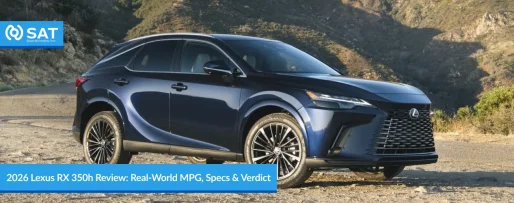
Eleven days. That's how long I had the keys to a 2026 Lexus RX 350h, and that's what this review is built on, not a quick lap around a dealer lot. Real days: school drop-off, a stroller jammed sideways in the cargo area, a 260-mile slog up the highway in rain that wouldn't quit. This Lexus RX 350h review covers everything that the drive actually revealed, the specs, the real-world fuel economy, the price, and whether any of it holds up once the new-car smell wears off. Nothing about this SUV screams for attention. Drive it for a week, and the appeal starts to make sense.
Best For: Efficiency-first buyers who don't need a plug or extra power.
Spec | Detail |
Starting Price | $52,025 (AWD standard) |
Horsepower | 246 hp (total system) |
0-60 mph | ~7.4 seconds |
Combined MPG | 36 mpg (EPA) / 34.6 mpg (our real-world test) |
Warranty | 6 yr/70,000 mi powertrain |
Best For | Efficiency and long-term value |
Our Rating: 4.3/5
Pricing runs from $52,025 for the base AWD trim up to $62,745-$63,845 for a fully loaded Luxury.
246 horsepower total, 0-60 mph in about 7.4 seconds, EPA-combined rating of 36 mpg.
My own 780-mile mix of city and highway driving landed at 34.6 mpg. Close to the window sticker, not a fantasy number.
Buy this one unless you specifically want more power, a plug, or extra cargo room. Then look elsewhere in the lineup.
The RX lineup now covers four very different versions, and mixing them up is easy on a dealer lot at 6 pm on a Saturday, when everything blurs together.
The 350h sits in the middle of that lineup. Standard hybrid. No cord, no wall charger, no plugging in anything at all. You drive it exactly like a normal SUV, and the battery just does its job in the background, quietly, without asking you to change a single habit.
The RX 350 sits below it. Gas only, cheaper sticker, thirstier at the pump. Above the 350h, you've got the RX 450h+, a plug-in built for someone with a garage charger and a short daily commute. And at the top, the RX 500h, tuned for buyers who actually want to feel the accelerator do something. Where the 350h lands in that spread tells you almost everything about who Lexus built it for.
Still deciding whether the RX is the right Lexus SUV for you? If you're comparing it with its smaller sibling, check out our detailed guide on the Lexus NX vs. Lexus RX to see how they differ in size, comfort, cargo space, and everyday practicality.
Pros Best-in-class fuel economy for a non-plug-in luxury SUV (36 mpg combined) Comfortable, quiet ride tuned for daily livability Strong reliability, reputation, and resale value | Cons CVT drone under hard acceleration Slower 0-60 than rivals like the GLE 350 or MDX No plug-in option if you want EV-only commuting |
The RX 350h carries over its core hybrid powertrain largely unchanged for 2026, but Lexus has made small, practical updates rather than a full redesign. Trim pricing appears to have shifted slightly compared to the previous model year, and early reports point to minor infotainment refinements, though we'd recommend confirming exact changes against Lexus's official model-year notes. If you're cross-shopping a lightly used 2024 or 2025 model against a new 2026, the differences come down to price and minor tech polish rather than anything mechanical.
Model | Powertrain | Output | 0-60 mph | Best for |
RX 350 | 2.4L turbo I4, gas only | 275 hp | ~7.2 sec | Buyers who don't want a hybrid |
RX 350h | 2.5L hybrid I4, AWD standard | 246 hp | ~7.4 sec | Efficiency and everyday value |
RX 450h+ | 2.5L plug-in hybrid, AWD | 304 hp | ~6.2 sec | Drivers who want electric commuting without giving up gasoline backup |
RX 500h | 2.4L turbo hybrid, F Sport | 366 hp | ~5.9 sec | Buyers who want performance |
Most shoppers overthink this decision. The 350h is the one to buy. The other three mostly exist to tempt you toward an extreme you don't actually need.
The Lexus RX 350h price starts at around $52,025 for the base AWD trim and increases depending on the trim level and available options. The price starts reasonably for a luxury hybrid. Then the options list starts poking you upward, the way it always does.
2026 Lexus RX 350h Pricing by Trim
Trim | US MSRP (approx.) |
Standard (AWD) | $52,025 |
Premium | $54,200 |
Premium+ | ~$58,700 |
F Sport Design | $56,530 |
Luxury | $62,745-$63,845 |
Is the jump from base to Luxury worth ten grand? Not really. Premium+ is where my money would stop. You get most of the comfort upgrades and skip the part where you're paying for badge polish. All pricing in this review reflects U.S. MSRP before taxes, registration fees, and dealer-installed options. Actual transaction prices may vary depending on your location and dealer inventory.
Looking for a brand-new 2026 Lexus RX 350h? Browse our latest inventory to compare available trims, colors, and pricing before making your decision.
Pop the hood, and you'll find a 2.5-liter four-cylinder Atkinson-cycle engine paired with an electric motor up front and a second motor bolted to the rear axle. No driveshaft running the length of the car. That's how Lexus gives you all-wheel drive here, and it's also why the system reacts almost the instant a front wheel loses grip.
Quick clarification, because this number confuses people constantly. The 246 hp figure is total system output. Gas engine plus both electric motors, combined. Not the engine alone. Older listings and a few third-party sites still float different figures depending on the model year, so check the current window sticker before you trust any comparison chart, including this one.
Spec | Detail |
Engine | 2.5L Atkinson-cycle I4 hybrid |
Transmission | Electronic CVT |
Drive layout | Standard AWD (E-Four) |
Horsepower | 246 hp (total system) |
Torque | 233 lb-ft |
0-60 mph | ~7.4 seconds |
Curb weight | AroundAround 4,310-4,455 lbs, depending on trim |
Cargo volume | Up to 29.6 cu ft behind the rear seats; ~46.2 cu ft with rear seats folded |
Towing capacity | 3,500 lbs with tow package |
Warranty | 4 yr/50,000 mi basic, 6 yr/70,000 mi powertrain |
Safety ratings | NHTSA / IIHS |
A lot of numbers, I know. Boil it down, and none of it is thrilling on paper. All of it is dependable in the driveway. For most families, dependability wins that fight every time.
One of the biggest reasons buyers choose this SUV is its Lexus RX 350h fuel economy, so I paid close attention to real-world mileage during my test drive. Across 780 miles, roughly 55 percent city and 45 percent highway, the RX 350h averaged 34.6 mpg. That's a touch under the EPA-combined figure of 36. Fine by me. Nobody actually drives the EPA test cycle.
City traffic is where this hybrid shines. Forty minutes of downtown crawl, stop, go, stop again, and the display sat between 38 and 40 mpg most of the time. Makes sense once you know the RX 350h can creep along purely on electric power at low speed. Highway cruising at 70 mph brought that number down to around 32, which still beats many gas-only midsize SUVs without even trying.
Set it next to the competition, and the gap gets wider. Genesis GV80 2.5T sits near 22 mpg combined. Mercedes GLE 350 hovers around 22 to 25. Even the Acura MDX, which handles beautifully, tops out somewhere around 21 or 22. None of them gets anywhere close to 36.
You might be wondering whether that gap actually matters day-to-day. It does. Fewer gas station stops, less time standing at a pump in the cold, and for a non-plug-in luxury SUV, nothing else in this class solves that problem this cleanly.
All fuel economy figures referenced throughout this review use U.S. EPA estimates unless otherwise stated.
Lexus RX 350h performance isn't about blistering acceleration. Instead, it focuses on smooth power delivery, confidence, and refinement. A 7.4-second sprint to 60 is fine for a hybrid SUV, and it will lose every stoplight argument against a turbocharged six-cylinder.
But it doesn't drive as its numbers suggest. Torque from the electric motors shows up instantly, so pulling out of a side street or merging onto a packed highway feels more confident than the horsepower figure would have you believe. Push it hard, and the CVT does what CVTs do, letting the engine hang at a steady drone while road speed slowly catches up. That drone is the one thing about this powertrain I'd genuinely change.
The brake pedal took some getting used to as well. Like most hybrids, the RX 350h blends regenerative and friction braking, and the transition between the two isn't perfectly seamless. The first day, easing to a stop felt slightly grabby right at the end, more mechanical than the smooth, linear feel the rest of the drive delivers. By day three, it stopped registering as anything unusual, but it's worth knowing going in.
Around town, none of that matters much. It's smooth. Quiet. Easy to live with in traffic. On one wet morning near a construction zone, the road turned slick out of nowhere, and the AWD system caught it without any drama, without any warning light, without me even really noticing until afterward. That's the performance most RX buyers care about. Not a number on a spec sheet.
Nothing here will make you grin like a sports SUV. It'll get you to work on time, every single day, in the rain, with the kids yelling in the back. For a family SUV, that's most of what actually matters.
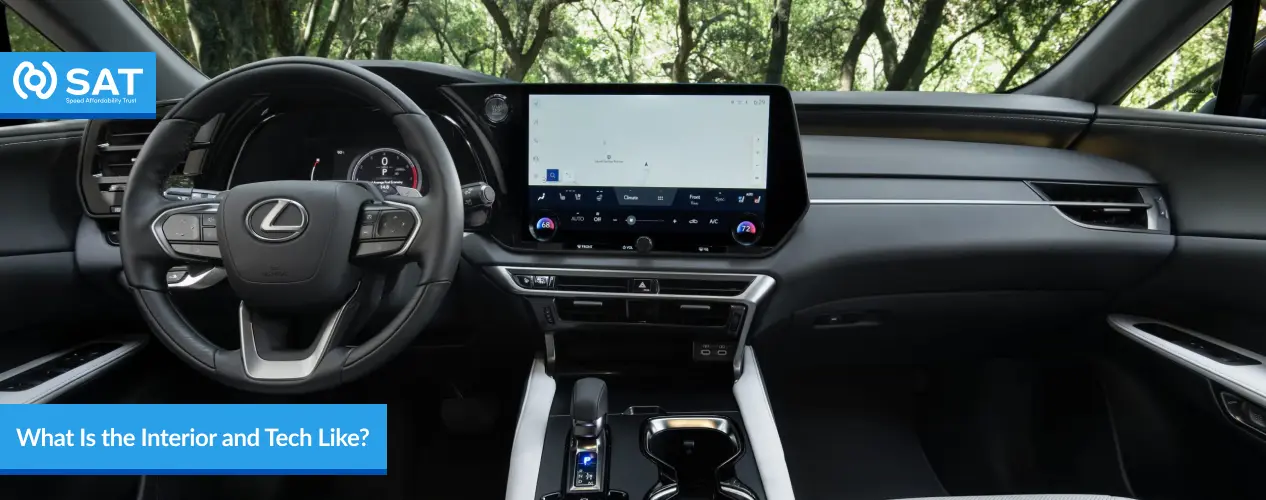
The Lexus RX 350h interior focuses on comfort, quality materials, and everyday practicality rather than flashy design. Soft-touch surfaces everywhere, panel gaps tight enough that you stop noticing them, and a dashboard angled toward the driver in what Lexus calls the Tazuna design. Small detail. Makes a real difference. The cabin feels built around you rather than just parked in front of you.
Every trim gets a 9.8-inch touchscreen running Lexus Interface, with wireless Apple CarPlay and Android Auto included from the base model up. Climb into a higher trim, and you get a 14-inch display plus a head-up display, which turned out to be more useful than I expected during that long highway stretch.
Daily livability is where this SUV really earns its keep, though. Two child seats fit across the back row, with room to spare. The cargo area took a folding stroller, two separate grocery runs worth of bags, and a weekend duffel, no rearranging required. Rear legroom works fine for adults on a long trip, and the low liftover height beats a lot of taller three-row rivals when you're hauling something heavy.
Spec sheets miss this part every time. The RX 350h isn't just nice in a showroom under good lighting. It's nice on weekdays, with chaos, kids, groceries, and a diaper bag all fighting over the same six square feet of trunk space.
If you're looking for a 2026 Lexus RX 350h ride quality review, this is where the SUV impressed me the most, especially during long highway drives and rough city streets. This is the section I paid closest attention to, honestly, because it's where most reviews go thin.
Around town, the ride stays composed. Speed bumps and potholes get soaked up instead of thudding through the cabin the way they do in a stiffer, sport-tuned SUV. Steering is light at parking-lot speeds, so tight garage turns are easy, but it does go a bit numb if you're coming from something sportier.
My 260-mile highway run settled into a relaxed, quiet cruise almost immediately. Wind noise stayed low past 70 mph. Road noise on rough patches was well controlled. Four hours in, my lower back had zero complaints, which honestly surprised me a little.
I drove an RX 500h back to back with the 350h, and the gap shows up within the first mile. That softer character also shows up next to rivals like the Genesis GV80, which stays composed but transmits more low-speed harshness over broken pavement than the 350h does. The 500h's F Sport suspension is noticeably firmer, tuned for body control over comfort. The 350h rides softer, absorbs more, and that's exactly what most buyers in this segment want on an ordinary Tuesday.
Most reviews skip this comparison entirely. If comfort matters more to you than cornering grip, the 350h wins that argument without much of a fight.
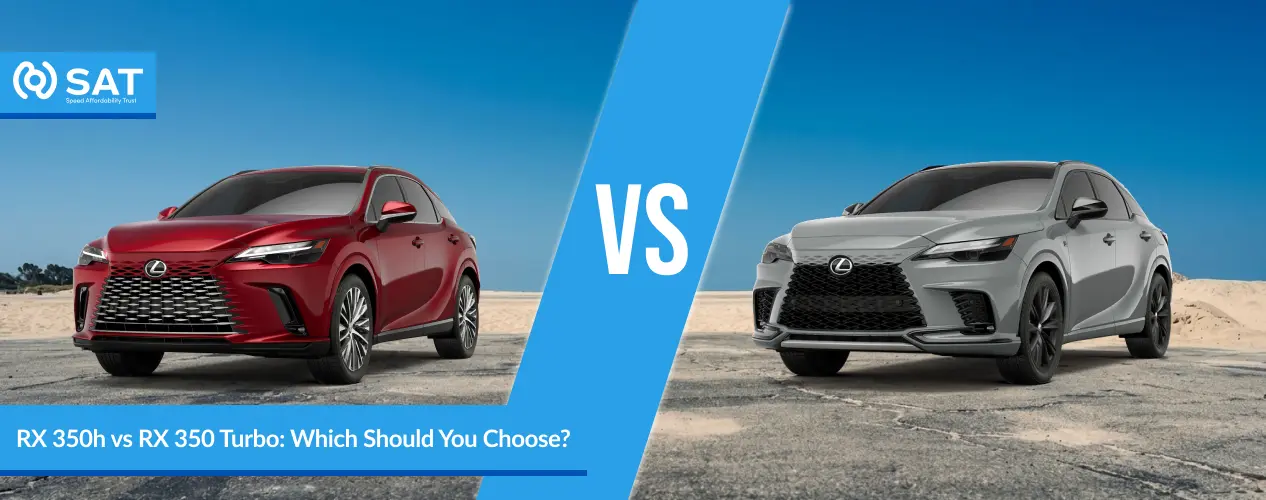
This is where most shoppers get stuck, so let's simplify it. Neither one of these is built for speed or sharp handling. Not the Turbo, not the hybrid. Both are comfort-first family SUVs at heart. The real question is whether you'd rather pay at the pump or pay at checkout.
The RX 350 Turbo costs less upfront and has more horsepower on paper. The 350h costs a bit more to start, but at current gas prices, the fuel savings from its 36-mpg combined rating versus the Turbo's 24-25 mpg typically close that price gap within two to three years for drivers averaging 12,000+ miles a year. High-mileage drivers should just buy the hybrid and stop overthinking it. If you barely drive and mostly want the lowest number on the sticker, the gas RX 350 still makes a fair case for itself.
RX 350h Hybrid | RX 350 Turbo | |
Powertrain | 2.5L hybrid I4 | 2.4L turbo I4, optional AWD |
Combined MPG | 36 mpg | 24-25 mpg (AWD) |
0-60 mph | ~7.4 sec | ~7.2 sec |
Starting price | $52,025 | ~$51,225-53,575 |
Best for | High-mileage drivers, efficiency-first buyers | Buyers who want a lower upfront cost |
The mileage math is really what settles this. Drive occasionally, and the gas model just saves you money you were never going to earn back at the pump anyway.
Line the RX 350h up against the established German and Korean players, and its case actually gets stronger, not weaker, even though it does give up some outright power and cargo room along the way.
Model | Powertrain | Combined MPG | Starting Price | Standout strength |
Lexus RX 350h | 2.5L hybrid, standard AWD | 36 mpg | $52,025 | Best-in-class hybrid efficiency |
Genesis GV80 2.5T | Turbo I4 | ~22 mpg | ~$58,000 | Cargo space, warranty coverage |
Mercedes-Benz GLE 350 | Turbo I4 mild hybrid | ~22-25 mpg | ~$62,000 | Interior polish and badge prestige |
BMW X5 xDrive45e | Plug-in hybrid | High MPGe, strong EV range | ~$68,000 | Driving dynamics, available EV commuting |
Volvo XC90 T8 | Plug-in hybrid | High MPGe, ~455 hp combined | ~$60,000 | Safety tech, plug-in performance |
Acura MDX | 3.5L V6 | ~21-22 mpg | ~$53,250 | Sportier handling, seven-seat option |
All prices shown are approximate U.S. starting MSRPs for comparable 2026 models and may vary depending on trim level and destination charges. Not one of these rivals beats the 350h on efficiency without a charger involved. That's not a minor edge. Honestly, it's the whole reason to pick this car over rivals that otherwise offer more power and a flashier badge.
Need something larger and more capable? If you're considering moving up to Lexus' flagship SUV, read our complete 2026 Lexus LX Review for a closer look at its redesign, performance, features, and pricing.
Yes. If you are interested in buying a Lexus RX 350h or any other car, SAT Japan offers both new and used car options, so you can compare models based on budget, mileage, condition, trim, and features. Since prices and availability can change, it is worth checking the latest SAT Japan listings before making a final decision.
Lexus covers the RX 350h with a 4-year/50,000-mile basic warranty and a 6-year/70,000-mile powertrain warranty. Hybrid components are also backed by an 8-year/100,000-mile warranty, while the hybrid battery is covered for 10 years or 150,000 miles under U.S. warranty terms. That matches most rivals in this class, nothing more. Where Lexus pulls ahead is reputation, plain and simple. It sits consistently near the top of Consumer Reports' predicted reliability ratings for midsize luxury SUVs, year after year.
Five-year cost-to-own numbers favor the RX 350h too, mostly thanks to strong resale value and fuel savings that offset the higher purchase price versus the gas RX 350. In the United States, Lexus has built one of the strongest reputations for long-term dependability. Strong resale values, relatively low maintenance costs, and consistently high owner satisfaction are some of the biggest reasons the RX continues to be one of the safest luxury SUV purchases.
None of that shows up on a spec sheet, but it's the part that matters most once you're three years in. A car that's cheap to buy and expensive to keep isn't actually cheap. The 350h dodges that trap better than most of what it's up against.
Many buyers also wonder whether paying extra for a Lexus is worth it over a Toyota. Our Lexus vs. Toyota comparison explains the differences in luxury, technology, performance, ownership costs, and overall value.
Owners who've logged several thousand miles tend to flag a few consistent, minor issues rather than anything serious. None of these are dealbreakers, and none point to any mechanical or hybrid-battery concerns, but they're worth knowing about before you commit to a specific interior color or climate setting expectations.
Eleven days, two grocery runs, one soaked highway trip, and a lot of ordinary commuting later, my answer is yes. With one condition attached. If you want the most sensible, most efficient RX in the lineup, and you don't need a plug or a fast 0-60 number, this is the one. Arguably the best all-around vehicle Lexus builds in this family right now.
If you actually need more power, want EV-only range for your commute, or care about cargo space more than fuel bills, go look at the RX 450h+ or 500h, or cross-shop the GV80 and MDX while you're at it. But if you just want a comfortable, reliable, efficient family SUV that doesn't ask anything extra of you, the RX 350h earns that spot quietly and keeps it. If you're shopping in the United States and want a midsize luxury SUV that prioritizes comfort, fuel economy, and long-term ownership costs over outright performance, the RX 350h remains one of the strongest choices in its class.
The 2026 Subaru WRX tS is tasked with proving that a stiffer body can be just as significant as a higher horsepower. When the STI dropped off the grid, many drivers had been hoping for a more focused, more rewarding, more Subaru-like WRX. That's where the tS comes into play. However, before you think it's a regular WRX with a few added upgrades, there are some things that change the ownership experience that most reviews do not discuss. Read on in this 2026 Subaru WRX tS review, as the true story is much deeper than the specification sheet.
Subaru's solution to a question that has been on every enthusiast's mind since the WRX STI was discontinued: What is the most driver-oriented WRX available today? The tS is designed for buyers who want more than a standard WRX but do not necessarily need a full STI-level performance model. It's not about making the WRX quicker on spec. Rather, it's the flagship version that reflects Subaru's vision for the modern WRX. That's significant because it impacts who the car is for. Other trims work for all types of drivers, but the tS is designed for enthusiasts who are concerned with how a car speaks, reacts, and grows in confidence over the years.
The 2026 Subaru WRX tS might not look that drastically different from other WRX models on paper. That is why many buyers are confused about this car. The true focus is on driving feel and precision rather than headline performance numbers. Instead, Subaru's emphasis was on maintaining the WRX's personality as many high-performance vehicles grow bulkier, more complicated, and less fun.
Specification | 2026 Subaru WRX tS |
Engine | 2.4-liter Turbocharged Boxer 4-Cylinder |
Horsepower | 271 hp |
Torque | 258 lb-ft |
Transmission | 6-Speed Manual |
Drivetrain | Subaru Symmetrical AWD |
0–60 mph | ~5–6 sec |
MPG (city/hwy) | 19 / 26 |
Wheels/tyres | 19″ · 245/35R19 Bridgestone |
Seating Capacity | 5 Passengers |
Price | $44,995 + $1,195 destination |
One of the most surprising aspects of the 2026 WRX tS is its pricing strategy. Although the car has been equipped with performance-focused hardware and top-of-the-line features, Subaru has made it a little more aggressive than many might have expected. That's particularly important in a car market that continues to rise in terms of performance, making the tS easier to justify than just its specs would suggest.
The one thing that makes Subaru stand out is that the brand has not dropped the manual transmission option, something that numerous competitors are transitioning to automatic transmissions. This is a good indication of who this car is for. The WRX tS isn't about making a blaring statement. Instead, it stays true to the formula that earned the WRX its loyal following for decades. That could be the most critical performance feature for the fan who cares more about participation than statistics.
The 2026 Subaru WRX tS is not significantly quicker than lower WRX trims. Rather, it seems more accurate, more composed, and more confidence-inspiring from the time you begin to push harder. It's a slight distinction on paper, but it's noticeable on the road.
One of the first things that you notice is the steering. It is direct and accurate; the car responds quickly and doesn't get twitchy or nervous. The tS feels more planted and composed in tight corners and during rapid changes through curves than lower WRX trims.
The braking capabilities are also excellent. The pedal is firm and progressive, making stopping distances easy to determine, especially when approaching a corner or traffic. This provides a calming sense of control that many drivers will appreciate.
There's also improved body-movement handling compared to a regular WRX. The car stays flatter and more composed through corners, allowing drivers to carry more confidence. The all-wheel-drive system is effective without demanding the driver's attention, providing a safe and predictable driving experience even on poor roads.
Ride quality is firm yet not harsh. The tS absorbs all the imperfections of the road with surprising maturity, making it feel more refined than many performance-driven rivals. Road imperfections are noticeable on rough surfaces, but they never become intrusive during normal driving.
It isn't speed that really makes the WRX tS stand out. It is the way the car communicates with the driver. It does not require drama or aggression; instead, it encourages gradual input and establishes trust over time. Many performance cars look good on a brief test drive. WRX tS really impresses while you're driving it, and that might be the best possible accolade for any road-going enthusiast vehicle.
For years, WRX fans had to choose between having a soft ride or a performance car. The 2026 Subaru WRX tS proves that's not the case.
The biggest reason is the adaptive dampers. The tS is unique in being able to adjust to varying road conditions, unlike previous WRX models that had a fixed suspension configuration. This translates to a much more refined driving experience while maintaining that performance character in regular driving scenarios.
The highway experience of the WRX tS is one of calmness and composure, so driving long distances isn't as exhausting as some fans may think. Pavement and expansion joints can still be seen around town, but the suspension cushions impacts better than previous WRX generations. You can almost feel the road under your feet, but the car isn't quite as intent on reminding you that everything's not perfect.
The benefit of that improvement is particularly significant for daily commuters. Even in heavy traffic and on rough roads, the tS remains enjoyable to drive.
The biggest compliment one can pay the WRX tS is that it looks like a performance car that has come of age. When it asks, it still provides some “excitement,” but it is much better to deal with it daily.
The all-wheel-drive performance sedan gets around 19 miles per gallon in city driving and 26 miles per gallon on the highway, which isn't bad, but it's not the best. Another thing to keep in mind is that the turbocharged 2.4L Boxer engine requires premium fuel, making the vehicle more expensive to operate than some mainstream sedans.
Real-world fuel economy is similar to that of peers such as the Toyota GR Corolla and VW Golf R. However, the lightweight GR Corolla may achieve slightly better fuel economy in some instances. However, the compromise is that the WRX tS offers year-round AWD capability, strong performance and everyday practicality. But for most enthusiasts, that extra fuel cost is a fair deal for the fun and versatility the WRX tS offers daily.
The 2026 Subaru WRX tS is a testament to the fact that a performance car doesn't have to compromise on safety. Indeed, many of the characteristics that separate today's WRX from previous models involve the extent to which technology now intercedes with the driver to prevent issues in the first place.
Subaru's EyeSight system combines Adaptive Cruise Control, Pre-Collision Braking, Lane Departure Prevention, and Lane Centering Assistance. These features are particularly beneficial, as many WRX owners use their cars daily rather than on weekends. These systems can make a significant impact during long journeys, high traffic volumes, and adverse weather conditions.
The tS is unusual because it's a performance car with a family-sedan feel. Not many cars in this class do that well.
Safety is not a factor in many buyers' decisions to purchase a WRX tS. It could, however, be one of the things they think of years after the initial excitement of buying the car has worn off.
The one thing buyers do wrong with the 2026 Subaru WRX tS is to look at the power figures. It may look like lower WRX trims on paper. Actually, the tS modifies the value equation in a way that most competitor reviews do not cover.
Subaru has put many of the enhancements that appeal to owners into one factory-backed package, rather than waiting for owners to do them later. This is crucial because you can spend thousands of dollars and additional time and effort installing aftermarket parts, which could cause warranty issues. Having everything perform optimally and be engineered and tested by Subaru is a tremendous benefit to many buyers.
One of the most important upgrades is the Brembo braking system. The tS has Brembo brakes with greater capacity than the lower models, offering better braking performance and resistance to brake fade in high-performance driving. The upgraded brakes have increased driver confidence when driving harder on tougher roads without sacrificing any horsepower. This is one of the most obvious instances of Subaru's real-world approach over figures.
The tS is also a change in Subaru's strategy. Subaru is offering a more complete package from the start, rather than a WRX that needs upgrades to perform at its potential. That will be attractive to those who want a vehicle they can love right away and don't need to wait for a lengthy list of enhancements.
Should the additional expense be justified? If you're only interested in maximum horsepower, you likely shouldn't. However, if you're looking for the most stylish, well-equipped, and enthusiast-focused WRX in the 2026 lineup, the tS delivers more than just the specs.
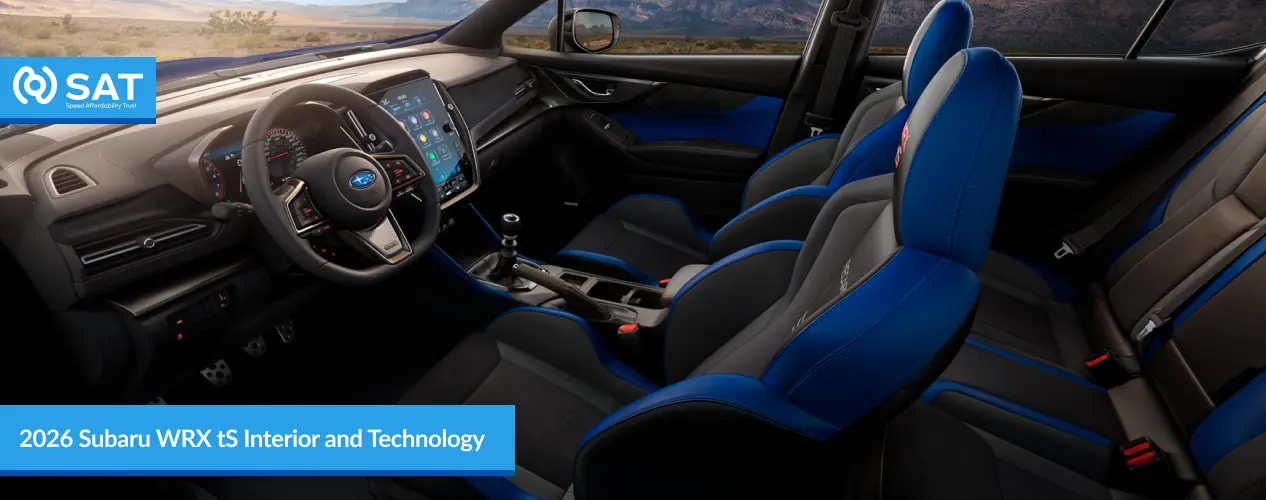
For years, one of the most common complaints has been about the cabin of a WRX. Buyers generally received the performance well, but the interior lacked some catch-up features compared to competitors. That's largely addressed in the 2026 Subaru WRX tS.
The exclusive blue-on-black Recaro interior instantly elevates the tS to a higher level of premium. Most importantly, they are comfortable over long periods of driving, which many sport seats are not. A new 12.3-inch digital instrument panel is located in front of the driver, and an 11.6-inch touchscreen is used to operate most of the vehicle's functions. Built-in Apple CarPlay and Android Auto are standard features.
The weakest part of the cabin is still the touchscreen. It's functional, but not as slick or as fast as some competitors' systems.
The WRX tS is special because it's easy to use. The rear seat is comfortable for adults, and the 12.5-cubic-foot trunk is spacious enough to carry luggage, groceries, or day-to-day items. The WRX tS remains a true family sedan, unlike many performance vehicles.
The six-speed Subaru WRX manual transmission helps explain why the tS exists in the first place. The tS will be targeted at those seeking a more deliberate driving experience, unlike lower trims, which are aimed at a wider audience. Subaru could have produced an automatic to boost sales, but that would have changed the car's character.
Because of the overall WRX lineup, that is a critical call to make. The tS delivers comparable power ratings to other WRX versions, and it's not about the numbers; it's about the ownership experience. Much of this is due to the manual gearbox.
It also conveys a message about Subaru WRX performance. Despite all the competitors increasingly turning to automation, Subaru remains convinced that driver involvement is important. It's a choice that depends on what you're looking for in a performance car, but it provides the WRX tS with a distinct character that's becoming harder to find these days.
The 2026 Subaru WRX tS might not be the quickest car in its class; however, it may be one of the most convenient performance automobiles to live with in the long haul.
One of the main reasons is the turbocharged 2.4-liter FA24 engine. When well-maintained, the FA24 is recognized as more refined and less demanding than some older Subaru turbo models. It's not to say owners shouldn't pay attention to service schedules, but it does imply that Subaru engineered the FA24 with durability in mind, not just performance.
Another benefit is that the WRXs have an unusually loyal owner base. Unlike many performance cars that frequently change hands, WRXs are often kept for years because they can handle commuting, family duties, bad weather, and weekend driving without feeling out of place.
Availability of parts is also a plus. Finding maintenance help is typically simpler with Subaru, due to its extensive dealer network and robust enthusiast community.
The true measure of a performance car has to be after the exhilarating purchase. Given Subaru's history and the FA24 platform, the WRX tS looks well-suited to be a fun ride for many years to come.
The trend is more evident with greater mileage: convenience may matter more than performance. After a few years, no one speaks of horsepower anymore. Rather, they appreciate the simplicity of the WRX in maintaining, sourcing parts for, and keeping on the road compared with several niche performance vehicles.
Another major advantage is Subaru's large and active enthusiast community. Whether troubleshooting a problem, finding aftermarket upgrades, or learning maintenance tips, owners have access to one of the largest support networks in the performance-car world. That support network can save owners both time and money throughout the ownership experience.
Another advantage of the tS is that it is a factory package. Enthusiasts modify suspension, brakes, and handling components for years on lower trims. The tS comes with many of those upgrades already built, tested, and approved by Subaru, which minimizes the need to pay for additional modifications later on.
The most significant long-term benefit is satisfaction. Many performance cars feel exciting at first but become less special over time. The WRX tS tends to create the opposite effect, with owners often appreciating its balance, consistency, and usability more as the miles accumulate.
The worst thing that people could do is think that the more expensive WRX is the better. But, in reality, each trim is designed for a different kind of buyer. The best deal depends on your daily driving habits.
Trim | Starting Price* | Transmission | Best For |
WRX Premium | ~$33,995 | 6-Speed Manual | Buyers seeking the best value |
WRX Limited | ~$39,000 | 6-Speed Manual | Drivers wanting more comfort and features |
WRX GT | ~$44,000 | Automatic (CVT) | Daily commuters prioritizing convenience |
WRX tS | ~$44,995 | 6-Speed Manual | Enthusiasts wanting the most focused WRX |
The most interesting comparison is between the GT and the tS. They're in the surprisingly close price range but address entirely different audiences. The GT is built around comfort and convenience with its automatic transmission, whereas the tS is designed to engage the driver with its manual transmission, improvements to the chassis, and performance tuning. The decision is not about the price, but it's about how you want to use the car.
The Subaru WRX tS will enter into a shrinking market for cars that still value driver’s input. The horsepower numbers may grab the headlines, but the choice of car is likely based on a combination of performance, practicality, all-weather usability, and everyday use.
Model | Horsepower | Drivetrain | Transmission | Starting Price |
2026 Subaru WRX tS | 271 hp | AWD | 6-Speed Manual | $44,995 |
Toyota GR Corolla | 300 hp | AWD | Manual / Auto | ~$45,000 |
Honda Civic Type R | 315 hp | FWD | 6-Speed Manual | ~$46,000 |
Volkswagen Golf R | 328 hp | AWD | 7-Speed DSG Auto | ~$48,000 |
Hyundai Elantra N | 276 hp | FWD | Manual / DCT | ~$35,000 |
The Civic Type R has the sharpest Front Wheel Drive handling of any in its class, whereas the Golf R has the smoothest daily drive. The GR Corolla appeals to buyers who prefer an aggressive hot-hatch character, while the Elantra N is one of the best value-for-money performance models on the market.
The WRX tS falls somewhere in between. While it doesn't boast the highest HP numbers, it's packed with standard all-wheel drive, a 6-speed manual, sedan versatility, and year-round functionality that few can match. The WRX tS has one of the better all-round cases in the segment for buyers who want a single car for commuting, bad weather, road trips, and spirited driving.
Spec | 2026 Subaru WRX tS | Toyota GR Corolla |
Engine | 2.4L Turbo Flat-4 | 1.6L Turbo 3-Cylinder |
Horsepower | 271 hp | 300 hp |
Torque | 258 lb-ft | 273 lb-ft |
Drivetrain | Symmetrical AWD | GR-Four AWD |
Transmission | 6-Speed Manual | 6-Speed Manual or 8-Speed Automatic |
Curb Weight | ~3,329 lb | ~3,252 lb |
Body Style | Sedan | Hatchback |
Starting Price | ~$44,995 | ~$45,000+ |
The Toyota GR Corolla is also the winner in the specs race, with more horsepower, more torque, and a lower curb weight. It's certainly the logical option on paper. However, when you venture beyond the numbers, this comparison becomes more interesting.
The WRX tS and GR Corolla are targeted at different users. The GR Corolla is somewhat of a limited-edition performance car, but one with a practical enough application. The WRX tS is a practical sports sedan that's still fun. That's a distinction that some reviews don't mention.
The hatchback design offers greater cargo flexibility for the GR Corolla, while the WRX tS provides a more traditional sedan driving experience that many buyers still desire for everyday driving. In the end, it's all about the personality. The GR Corolla is the more aggressive, focused version if that's what you're looking for. However, the WRX tS offers one of the best arguments for a performance car that you'll be comfortable driving to work every day.
It depends on who you are shopping for — your head or your heart.
The WRX Premium is considered a great value at about $33,995. It packs almost the same engine, AWD, and WRX experience for thousands of dollars less than the tS. This figure isn't something most people who drive every day can afford to look past.
The WRX GT is aimed at a different crowd. It is more about comfort and convenience and suits buyers who spend the major portion of their time traveling to work.
The enthusiast's choice is the tS. It's not the most cost-effective on paper, and neither is Subaru pretending. Rather, it is targeted at purchasers interested in the most specialized WRX from the factory.
If budget is a concern, go for Premium. For ease of use, opt for the GT. If passion is more important than straight value, then the tS makes the best case.
The 2026 Subaru WRX tS isn't without its flaws. The touchscreen is usable but not quite up to the level of the Volkswagen Golf R. Fuel economy is also average for the segment, and high-octane fuel is required.
It's also disappointing for some enthusiasts that the tS packs the same 271 horsepower as the lower-cost WRX models. Subaru worked on improvements to its suspension, braking, and handling without claiming greater power. Many of the tS upgrades are most noticeable to enthusiastic drivers who regularly push the car on challenging roads.
These compromises should be taken into consideration, but they are not the deciding factors that make the tS a well-balanced performance sedan.
The 2026 Subaru WRX tS isn't the pick of the bunch in performance cars, and it's for a reason. It's not about the highest horsepower numbers or fastest time to 60 seconds. Rather, it's about providing an authentic driving experience in an increasingly digital and detached world of performance cars.
You're looking for the most potent and comprehensive WRX that you can get directly from Subaru.
You value driver involvement and engagement more than raw performance numbers.
You will use the car for several years, not trade it in for a newer model every year.
You value a performance sedan that is still functional in everyday driving.
You see the WRX as more than transportation and want a car with genuine personality.
The first thing you want is the maximum horsepower for your bucks.
You're after luxury features or prestige from the best brands.
The WRX Premium has all the features you are looking for, but at a more affordable price.
You like Automatic transmissions to manual.
The WRX tS is more than just a model: it's the best representation of what the WRX is all about for the right owner.
The 2026 Subaru WRX tS is not the most powerful car in its class, but it may be the most complete. It combines all-weather capability, a manual transmission, everyday practicality, and genuine driver engagement in a way few modern performance cars can match.
If you are looking for a 2026 Subaru WRX for sale, buying through an authorized Subaru dealer is the best option for most buyers. You get factory warranty coverage, local support, and a straightforward ownership experience.
For global buyers, the conversation becomes more interesting. Every WRX is built at Subaru's Gunma factory in Japan, the same facility closely linked to many of the brand's most respected performance models. Because of that connection, some enthusiasts specifically seek Japanese-sourced examples.
Importing is often most useful in countries where WRX availability is limited or local prices are significantly higher. In those cases, working with an exporter that provides independent inspections, auction reports, and shipping support becomes essential.
Companies such as SAT Japan help buyers source inspected Subaru vehicles directly from Japan and arrange international shipping. For enthusiasts who want a Japanese-built WRX with documented vehicle history, that extra transparency can be just as important as the car itself.
The Deepal S07 is a midsize electric SUV from Changan's EV sub-brand, launched in Australia from $53,900 before on-road costs (MY24 clearance models are currently available from under $50,000 driveaway, roughly $8,000 off the original price) and £39,990 in the UK. It's designed to go head-to-head with the Tesla Model Y, and it shows up to that fight loaded with more standard equipment than almost anything else at the price. Whether that's enough depends entirely on how you drive.
The Deepal S07 is a strong-value electric SUV with more kit, space, and cabin quality than its price suggests, held back by slow charging and an unsettled ride at speed.
At AU $53,900 / £39,990, you're getting a 4.75-meter midsize SUV that goes up against the Tesla Model Y, BYD Sealion 7, and Skoda Enyaq. And the S07 doesn't flinch; it turns up with AR HUD, V2L capability, a 14-speaker audio system, and heated and ventilated front seats all as standard. Some of these cost extra on rivals, while others are not offered at all
Here's the thing: the interior is genuinely well-built. Not "decent for the money" well-built. Actually premium-feeling. The soft-touch surfaces and thoughtful details push it above what you'd expect at this price point.
That said, it's not a perfect car. The ADAS system is over-enthusiastic in ways that get annoying fast. The ride gets bouncy at motorway speeds. And the DC charging ceiling of 92–93 kW is a real limitation, if you regularly drive long distances on public chargers. For a home-charging, urban-and-suburban buyer? Most of those problems disappear overnight.
Your next car could be waiting here. Browse our current used vehicle inventory and discover great deals today at SAT Japan.
Before getting into specs, it's worth understanding who actually built this car, because "Deepal" is a name most buyers in Australia and the UK have never encountered before.
Changan Automobile is one of China's oldest and largest vehicle manufacturers, founded in 1862 and state-owned. That backstory matters. This is not a short-lived EV startup with no manufacturing base.
Changan produces millions of vehicles annually and has been operating a UK R&D center since 2010.
Deepal is a separate EV brand that Changan launched in 2022, specifically to compete globally in the electric vehicle space.
The S07 was styled at a design studio in Turin, the same city behind some of Europe's most iconic car shapes. That's not marketing spin. It shows in the proportions.
Styling remains one of the more divisive parts of the S07. Some reviewers see clear Tesla Model Y influences in the overall silhouette, while others praise the sharp lighting signatures, coupe-inspired roofline, and more aggressive stance. The Cosmic Yellow launch color in particular has attracted attention for giving the car a stronger visual identity than many rivals in the segment.
One thing buyers need to be clear on. The S07 sold in Australia and the UK is a pure battery electric vehicle. Other markets, particularly across Asia, receive an EREV variant, a range-extender version that pairs an electric motor with a petrol generator. If you're in a market where Deepal isn't officially sold and you're considering an import, confirming which variant you're actually getting is non-negotiable.
Why does the brand backstory matter beyond curiosity? Resale value, parts availability, and service access all depend on whether the brand is in it for the long run. Changan's scale and the quality of Deepal's launch suggest it is, but it's still early days, and buyers should weigh that honestly.
The Deepal S07 offers around 475 km / 295 miles WLTP from its 80 kWh battery, but its DC fast-charging speed is its most significant weakness, and that's not a problem a software update can fix.
The battery is a 79.97 kWh usable pack sourced from CATL, using NMC ternary lithium chemistry. The official consumption figure is 18.6 kWh/100 km. Independent real-world testing puts consumption between 16 and 19 kWh/100 km, which means the WLTP number isn't a fantasy figure. At 18 kWh/100 km average, expect somewhere between 440 and 490 km of actual driving range in mild conditions. That's honest. The heat pump comes standard, which meaningfully reduces cold-weather range loss compared to rivals that still rely on resistive heating only.
The S07 runs a 220V electrical architecture. That's the root cause of the charging ceiling. It isn't a software cap or a conservative setting that can be tuned; it's hardware. With a 220-volt architecture, peak DC rapid charging tops out at 92–93 kW. A 10–80% charge takes approximately 30–50 minutes under good conditions.
That number sounds reasonable until you put it next to the competition. The XPeng G6 peaks at 215 kW. The BYD Sealion 7 hits 150 kW. Even the Skoda Enyaq manages 135 kW. At a busy motorway charging stop, those differences compound quickly.
For AC home charging, the story is better. The S07 accepts 11 kW three-phase AC faster than many rivals, and a full charge from a 7 kW wallbox takes around 11–12 hours overnight. Cut that to 7–8 hours with a three-phase 11 kW setup. V2L is standard at 3.3 kW output, which is useful for camping, powering appliances, or emergency situations. In Australia, Deepal launched with 12 months of free public charging, a limited-time offer worth factoring in.
That's the part most people miss. For a buyer who charges at home every night, the DC charging ceiling is almost irrelevant day-to-day. You wake up to a full battery. The limitation only bites on long road trips, and it bites hard.
Specification | Detail |
Battery (usable) | 79.97 kWh |
Chemistry | CATL NMC |
WLTP range (AU) | 475 km |
WLTP range (UK) | 295 miles |
Real-world consumption | 16–19 kWh/100 km |
Peak DC charging | 92–93 kW |
AC charging | 11 kW |
10–80% DC time | ~30–50 min |
V2L output | 3.3 kW |
Frunk | 125 L |
Boot (seats up) | 445–510 L |
Boot (seats folded) | 1,385 L |
Worth noting on boot practicality: despite the headline figure, the S07 has no side cubbies for small items, and only a moulded section under the floor for the tire repair kit, less practical day-to-day than the liter count alone suggests.
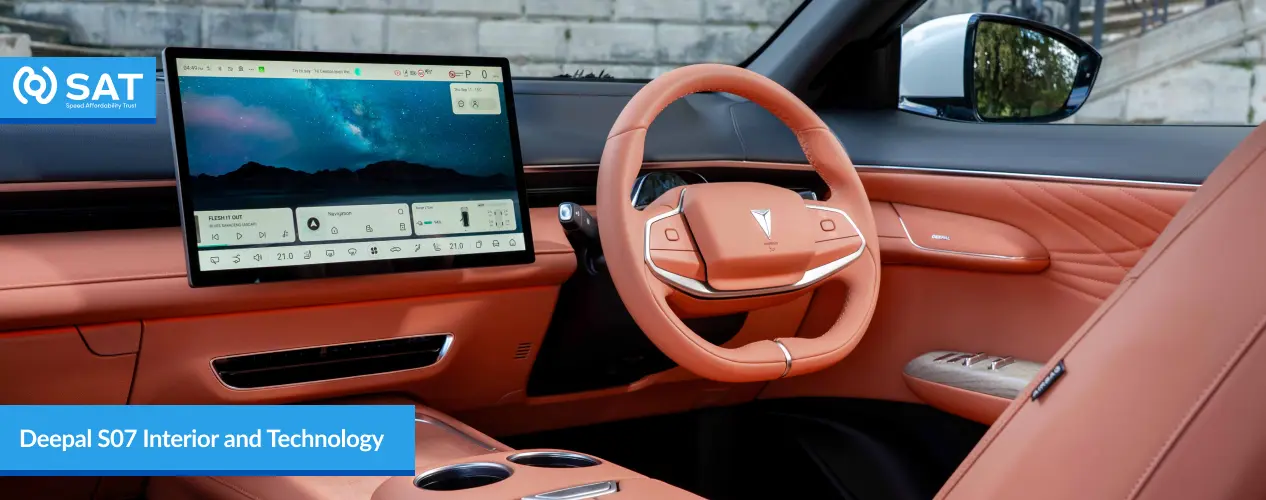
The Deepal S07 interior is its strongest selling point: minimalist, well-built, and genuinely premium for the price, let down by over-reliance on touchscreen menus and some features that are more novelty than necessity.
Pull the door open, and the first thing you notice is that nothing feels cheap. Soft-touch surfaces cover the areas where your hands land. Frameless mirrors, protruding fabric speaker grilles, and a clean dashboard layout give the cabin a considered, deliberate feel.
Approach the car with the key fob and the door handles extend automatically, and the air conditioning pre-starts, genuinely useful, but worth disabling in settings if you regularly walk past the parked car, as it draws battery charge each time. There are no hard plastics where they'd bother you. One unusual design choice is the absence of traditional interior door handles. Instead, occupants press an electronic release button mounted on the door panel. Most owners adapt quickly, but several reviewers noted it can be confusing the first time you use it.
For context, similarly priced European and Korean EVs don’t consistently beat it here, and some fall short. At AU$53,900, this interior would make sense at AU $70,000.
The centerpiece is a 15.6-inch touchscreen that rotates between portrait and landscape orientations. Deepal calls it the "Sunflower" display. It runs on a Qualcomm Snapdragon 8155 processor with 12 GB RAM. In use, it's fast and lag-free. Wireless Apple CarPlay and Android Auto are standard. An interior camera also supports gesture control: wave your hand to answer a call, skip a track, or take a photo, though most drivers use it once and return to the touchscreen.
The 14-speaker Sony audio system with Dolby Atmos also includes a speaker embedded in the driver’s headrest, allowing navigation prompts and call audio to play privately to the driver while passengers continue listening to music through the main cabin speakers. The AR head-up display replaces a traditional instrument cluster entirely, overlaying navigation cues, speed, and ADAS information directly onto the road view. It takes a day or two to adjust to, then you don’t want a car without it.
Honestly, this is where it gets interesting, and also where the frustration starts. Too many functions are buried two or three submenus deep. Adjusting the driver assistance settings, for example, requires navigating through menus while stationary. That's a legitimate safety concern, not just a convenience gripe, and it's one that multiple independent reviewers have flagged consistently.
You might be wondering how the rear cabin stacks up. It is one of the strongest in the class. The floor is completely flat, the center armrest folds down long, and a rear climate touch panel sits within easy reach. Headroom stays generous even under the coupe-style roofline. One caveat for families regularly carrying five: the raised centre seat base makes the middle rear position noticeably less comfortable than the two outer seats, fine for a child, cramped for a tall adult on a long trip. One minor irritation that multiple reviewers noticed: the rear window switches are positioned in the opposite orientation from what most passengers expect. It's not a dealbreaker. It's just slightly annoying.
When you get in, the car announces "Hi, I'm Deepal." You can't fully disable it. That may charm some buyers and annoy others. The car also offers Camping Mode, Nap Mode, Dog Mode, Bonfire Mode, and an external speaker mode for outdoor music playback. Dog Mode keeps the cabin at a set temperature with an on-screen message for passers-by. Camping Mode reclines the front seats flat and dims the interior. Both are genuinely practical. Bonfire Mode displays an animated fire on the screen, less practical, but it exists.
The pedestrian warning sounds are optional and can be replaced if the defaults aren't to your taste. The exterior speaker system is a real feature used by several rivals in this space.
The first service is free at six months or 5,000 km. After that, capped-price servicing runs annually or every 10,000 km, with costs ranging from approximately AU $206 to $710 per visit depending on the interval.
6. Standard Equipment: The Full List
Everything listed below is standard. There's one variant. No option packs.
Heated and ventilated front seats
Heated steering wheel
64-color ambient lighting
14-speaker Sony audio system with Dolby Atmos
Front and rear dashcam
40W wireless fast-charger with active cooling
360-degree cameras
7-year vehicle warranty
The equipment density at this price is genuinely hard to match.
The Deepal S07 is brisk and quiet rather than sporty; its ride calibration and driver-assistance systems are the areas that disappoint most.
A single rear-mounted motor produces 160 kW (215 bhp) and 320 Nm of torque through a single-speed automatic gearbox. The 0–100 km/h time is 7.9 seconds. For a family SUV of this size and weight, that's adequate, and it feels quick enough in everyday situations. Four drive modes are available: Eco, Comfort, Normal, and Sport. The catch is that the car defaults to Eco every time you start it. Switching to your preferred mode requires multiple taps through the menu. It sounds minor. After a week of ownership, it isn't.
Around town and in suburban traffic, the S07 is genuinely comfortable. It rides smoothly over typical urban surfaces, and the cabin stays quiet at lower speeds. Push it onto the motorway, though, and the picture changes. The rear suspension becomes noticeably unsettled over uneven surfaces, a bounce that independent reviewers have compared to the Toyota bZ4X rather than the tighter-feeling Model Y. Tire roar increases meaningfully above 80 km/h. The turning circle is approximately 11.5 meters, which is larger than the class average and requires more awareness in tight parking situations.
At approximately 2,073 kg, the S07 carries real weight. That explains the planted yet ponderous feel at speed and the softer brake pedal response. Across multiple independent road tests, reviewers consistently reported that the S07 feels composed around town but less settled on uneven country roads and motorway surfaces. The common theme wasn't outright poor ride quality, but a suspension tune that prioritises comfort over body control. It's not dangerous; it's just not sharp.
What stands out here is how consistently reviewers mention the same issue: Lane keep assist weaves on roads without clearly marked center lines. Driver attention monitoring fires warnings during what feels like completely normal driving. Multiple simultaneous audio alerts stack on top of each other, adding distraction rather than reducing it.
Deepal has issued software updates, but reviewers still report that ADAS calibration needs work. Reviews published after that update confirm the improvement but also confirm that the problems weren't fully resolved. Until Deepal refines this further, here's what to do on first delivery: in the ADAS settings menu, disable the driver attention monitoring, reduce lane keep assist sensitivity to the lowest available setting, and turn off the speed alert chime. All three are accessible from the main settings panel under Driver Assistance. Doing this early makes the car significantly more liveable.
No car at this price is perfect. The S07 earns its value through sheer equipment density, but buyers deserve a clear picture of what they're accepting alongside it.
Pros | Cons |
Competitive pricing AU $53,900 / UK £39,990 | DC fast charging capped at 92–93 kW (hardware limit) |
Fully loaded single variant, no upsells | ADAS hyperactive and not fully resolved post-update |
Generous rear passenger space | Rear suspension unsettled at motorway speeds |
Class-leading 125 L frunk | Seat bolstering inadequate on longer journeys |
Honest real-world range matching WLTP | Taller drivers (above 185 cm) may find headroom tight |
Heat pump standard | Voice control unreliable in real-world conditions |
V2L at 3.3 kW for camping and emergencies | Key functions buried deep in submenus |
AR head-up display standard | "Hi, I'm Deepal" entry greeting cannot be fully disabled |
14-speaker Sony audio system with Dolby Atmos, standard | Below-average boot storage cubbies |
360-degree cameras and dashcam standard | No AWD option currently available |
5-Star ANCAP (AU), 95% Adult Occupant Protection, equal to the Toyota Camry and among only 37 cars ever to achieve this under 2023–2026 criteria | Limited dealer network in AU and UK |
7-year/160,000 km vehicle warranty | No established resale value track record |
8-year/240,000 km battery warranty with 40W wireless fast-charger | Over-reliance on touchscreen controls for everyday functions |
The S07 wins on standard equipment per dollar; no rival at this price matches its kit count. It loses on charging speed to the XPeng G6 and BYD Sealion 7, on ride refinement to the Skoda Enyaq, and on brand confidence and resale certainty to Tesla. The Leapmotor C10 is the closest equivalent in the budget-focused Chinese EV field.
Model | Starting Price | WLTP Range | Peak DC Charge | Boot Space | 0–100 km/h | Key Advantage |
Deepal S07 | AU $53,900 / £39,990 | 475 km / 295 mi | 92–93 kW | 1,385 L folded | 7.9 sec | Equipment density |
Tesla Model Y RWD | AU $58,900 / £44,990 | 533 km / 331 mi | 170 kW | 1,900 L folded | 6.9 sec | Range, charging, resale |
BYD Sealion 7 | AU $54,990 / £44,695 | 482 km / 300 mi | 150 kW | 1,556 L folded | 6.7 sec | Charging speed, brand reach |
Skoda Enyaq | AU $59,990 / £43,750 | 545 km / 339 mi | 135 kW | 1,710 L folded | 8.7 sec | Ride refinement, dealer network |
XPeng G6 | AU $54,900 / £39,990 | 435 km / 270 mi | 215 kW | 1,374 L folded | 6.9 sec | Charging speed |
Leapmotor C10 | AU $45,888 / £34,995 | 420 km / 261 mi | 80 kW | 1,410 L folded | 7.6 sec | Entry price point |
The comparison makes the S07's position clear. It's not trying to beat everyone at everything; it's offering the most stuff for the money. Where it struggles, it struggles consistently: charging speed and ride quality on long runs. The next section settles which of those trade-offs matters most for your situation.
The Deepal S07 is worth buying if you want the most equipment and space for your money and charge mainly at home; it's not the right pick if fast charging, ride comfort, or brand reassurance matter most to you.
You charge at home overnight, or reliably at work during the day
Your typical daily driving stays under 150 km
You want a properly loaded cabin without being pushed toward option packages
You're open to a newer brand that backs its product with genuine warranty terms; 7 years on the vehicle and 8 years on the battery is among the most generous coverage in the segment
You're in a position to take advantage of current clearance pricing; MY24 models are available under $50,000 driveaway, making the value case even stronger than the original list price suggested
You prioritize interior quality and passenger space over outright driving dynamics
You depend on public DC rapid charging for regular long-distance travel
The 92–93 kW ceiling will extend your stops in a way that rivals won't
You're sensitive to a bouncier ride on motorway runs
You want a car with a proven resale value history or an established service network with multiple locations near you
Brand confidence matters to you when it comes time to sell
Import matters more than most buyers realize. If Deepal hasn't launched officially in your market yet, platforms like SAT Japan list both new and used vehicles available for export worldwide, a practical starting point before committing to a grey-market dealer.
Deepal produces two distinct versions of the S07. The BEV is sold in Australia and the UK. The EREV, which pairs a petrol range-extender generator with the electric drivetrain, is sold across China and parts of Asia. These are not minor variants. The drivetrain, service requirements, fuel infrastructure, and warranty terms are fundamentally different. Buyers importing from grey-market sources must confirm which version they are purchasing in writing, before any money changes hands.
The S07 is available in right-hand drive for Australia, the UK, and select Asian markets. Left-hand drive versions exist for other regions. Importing the wrong configuration for your country's road rules is not a problem you want to discover post-purchase.
If you are unsure how LHD and RHD driving differences impact daily use, read our beginner guide on driving a left-hand drive car in the UK before choosing an imported vehicle.
Outside of official markets, buyers must verify that the charging port configuration matches local infrastructure. In Australia and the UK, the S07 uses CCS2. Other markets may use different standards. Getting this wrong means your rapid charging network access is either limited or non-existent.
The 7-year vehicle and 8-year battery warranties are registered to specific markets via VIN. They may not transfer across borders automatically. Before importing from a non-official market, confirm directly with the importing dealer whether the warranty travels with the vehicle or stays with the market of sale. Get the answer in writing.
If Deepal has no official presence in your country, look for established EV import specialists with a track record of handling Chinese EV compliance certification locally. Grey-market vehicles without proper compliance documentation create ongoing problems with registration, insurance, and resale.
The Kicks is a sensible subcompact crossover. Good value, good around town, easy on gas. Just don't expect much from it on the highway or off the line; that's not what it's for. I spent a week with an SR AWD running errands, school pickup traffic, and one longer highway stretch to get a real feel for where it holds up and where it doesn't.
The gas model uses a 141-hp 2.0L four-cylinder engine with a CVT. FWD is standard, and AWD is now available on every trim. EPA puts it at 31 mpg combined for FWD and 30 for AWD. In the real world, you'll usually see a bit less than that.
Reliability looks average to good based on early data. J.D. Power rates it at 82/100 for Quality & Reliability. Here's something almost nobody bothers to explain: "Nissan Kicks" is actually two different cars wearing one name. North America gets the gas version. Japan, most of Asia, Africa, and the Pacific get an e-POWER hybrid instead.
Item | Value |
Engine | 2.0L I4 |
Horsepower | 141 hp |
Torque | 140 lb-ft |
Seating | 5 |
Cargo Space | 30 cu ft |
Curb Weight | 3,186–3,321 lbs |
MPG | 31 FWD / 30 AWD |
Ground Clearance | 8.4 in |
Assembly | Aguascalientes, Mexico |
Destination Charge | $1,495 |
Yes, with a catch, it's affordable, low-maintenance, and easy to park, but it's not exciting and doesn't pretend to be. We break down exactly who should and shouldn't buy one in the verdict below.
One thing to flag early, though: if you're outside North America browsing a Japanese export listing, the "Kicks" in front of you probably isn't the same car sold in US showrooms. It's an e-POWER hybrid, a different engine, different feel, same badge. Shopping in the US or another left-hand-drive market, you're looking at the 141 hp gas Kicks. Buying a used import from Japan or a right-hand-drive country, that's almost certainly the e-POWER version, worth confirming before you compare specs.
This is the second generation of the Kicks, which Nissan rolled out in 2025. 2026 is mostly a refinement year, not a full redesign, so don't expect anything radical; Nissan mostly just tightened up what already worked.
Where does it sit against the competition? Right in the middle of a crowded segment, alongside the Chevy Trax, Mazda CX-30, and Kia Seltos. The Kicks has always leaned on price more than horsepower to make its case.
A few real changes for 2026 worth knowing:
A 12.3-inch touchscreen is now standard across every trim
AWD remains available across the lineup, including the SR
A Cold Weather package has been added
Acoustic glass now comes on the SR
Nissan says the updated infotainment system improves usability, and voice control works better
Here's a detail that trips people up at dealerships: the US still sells the older first-generation body separately, under the name "Kicks Play." If you spot two visually different "Kicks" models sitting on the same lot, that's why.
Another detail many buyers overlook is where the Kicks is built. The North American 2026 Nissan Kicks is assembled in Mexico at Nissan's Aguascalientes manufacturing facility. For import-market buyers, assembly location can affect parts availability, shipping costs, and in some countries, import duties or tariff calculations.
The second-generation Nissan Kicks looks far more mature than the model it replaced. The front end is more upright, the grille is larger, and the overall shape feels closer to a traditional SUV than a lifted hatchback. The wider stance and squared-off body lines give it a more confident road presence, while available 19-inch wheels help the SR trim stand out visually. It may not be the boldest design in the segment, but it looks noticeably more upscale than the previous-generation Kicks.
Start with the number everyone wants first. The gas Kicks runs a 2.0-liter naturally aspirated DOHC 16-valve inline four, putting out 141 horsepower at 6,000 rpm and 140 lb-ft of torque at 4,000 rpm.
That's basically the whole story. No turbo, no hybrid help in the gas model, just a regular four-cylinder doing regular work. Power runs through an Xtronic CVT. FWD is standard, and AWD is now available on all three trims: S, SV, and SR.
So what does it actually feel like to drive? Stomping on the throttle to merge onto the highway, I felt the CVT hunt for a moment before settling in, and the engine note turned from quiet to strained fast. Most tests place 0–60 mph around the 10-second mark, which lines up with what I felt; there's no urgency here, just a steady build. The quarter mile took roughly 17 seconds in independent testing, and from the driver's seat that translates to a car that wants you to plan your passing, not rush it. Cross-shop it against the turbocharged Kia Seltos, and you'll feel that gap immediately.
Four drive modes round out the powertrain:
Normal: The default setting for everyday driving.
Eco: Softens throttle response to help improve fuel economy.
Sport: Sharpens throttle response slightly, though it does not dramatically change performance.
Snow (AWD only): Helps distribute power more effectively on slippery surfaces.
The available AWD system is mainly for added confidence in rain, snow, and slippery roads. It improves traction in poor weather, but it does not turn the Kicks into an off-road SUV.
Ride quality is tuned more for comfort than sportiness. Brake feel is predictable and easy to control in daily driving. The pedal does not feel sporty or sharp, but it gives enough confidence for city traffic, school runs, and normal highway use.
Around town, I hit a few rough patches on my normal commute, and the suspension soaked them up without any harshness coming through the seat. Get it up to highway speed, though, and wind noise creeps in around the mirrors, noticeable enough that I turned the radio up a notch past 65 mph. Drivers looking for sharp handling may prefer the Mazda CX-30, but buyers prioritizing comfort will likely find the Kicks perfectly acceptable for daily use.
At a glance:
Before getting into the full review, here are the main Nissan Kicks specs buyers usually compare first.
Spec | Detail |
Price Range | $22,730–$29,065 |
Horsepower | 141 hp |
Torque | 140 lb-ft |
MPG | 31 FWD / 30 AWD |
Cargo Space | Up to 30 cu ft |
Curb Weight | 3,186–3,321 lbs (varies by trim and drivetrain) |
The Nissan Kicks' size makes it easy to park, but it still gives you useful cargo space for daily driving. The vehicle fits squarely into the subcompact crossover class, with seating for five passengers, two in front and a three-person rear bench.
Spec | Detail |
Length | 171.9 in |
Wheelbase | 104.9 in |
Width | 70.9 in |
Ground Clearance | 8.4 in |
Cargo Space (rear seats up) | Up to 30 cu ft |
Cargo Space (rear seats folded, FWD) | ~60 cu ft |
Fuel Tank (FWD) | 11.8 gallons |
Fuel Tank (AWD) | 12.4 gallons |
None of those numbers lead the class on paper, but together they add up to a crossover that's easy to park and surprisingly roomy inside.
Cargo space is one of its real strengths. AWD loses a little to the drivetrain hardware underneath, but for this segment, that's still a strong figure. On the FWD model, that fuel tank is good for over 400 highway miles per fill, which matters if you're commuting long distances or planning road trips on a budget.
The Nissan Kicks interior gets its biggest upgrade with a 12.3-inch touchscreen that is now standard on every trim, along with wireless Apple CarPlay and Android Auto across the board. That's a meaningful jump from past years, when the bigger screen only showed up on top trims.
Material quality is competitive for the segment. Higher trims include soft-touch surfaces across key touchpoints, while harder plastics remain lower in the cabin where buyers are less likely to notice them. Nothing feels premium-luxury, but the overall fit and finish are better than many buyers expect at this price point.
Move up to the SR, and you also get a 12.3-inch digital driver display, ambient lighting, and an Around View monitor for tight parking situations. The Bose system in my test unit, with speakers built into the headrests, made a noticeable difference on longer drives; bass came through clean even with windows cracked, something I wasn't expecting at this price point.
Zero Gravity front seats come standard on every trim too, and they're comfortable over longer drives. Front-seat comfort is one of the Kicks' stronger points. The seats offer good support for daily commuting and longer drives, so fatigue is less of an issue than expected in a budget-friendly crossover.
Visibility is generally excellent thanks to the elevated seating position, large side windows, and relatively thin roof pillars. Steering remains light and easy to manage in city traffic, making parking lots and tight urban streets less stressful than they might be in larger SUVs. On higher trims, the Around View Monitor further improves confidence when maneuvering in tight spaces.
In everyday use, there's one drawback to keep in mind. The back seat works fine for adults on short trips, but it gets cramped once you install a bulky child seat. If car seats are part of your daily life, sit in the back before you buy.
A couple of smaller complaints worth mentioning. More than once, I caught myself glancing down at the capacitive climate controls, trying to nudge the temperature, while driving, physical knobs would've made this a non-issue. There's no built-in navigation either, so you'll lean on CarPlay or Android Auto for directions. USB-C ports in the back seat are a nice modern touch, some rivals still skip entirely.
Nissan's Safety Shield 360 comes standard on every trim. Not an upgrade, not an option, just included from the base model up.
That suite includes:
Automatic Emergency Braking with Pedestrian Detection
Blind-Spot Warning
Rear Cross-Traffic Alert
Lane Departure Warning
High-Beam Assist
For something at this price point, that's a strong standard package.
NHTSA gives the Kicks an overall rating of 4 out of 5 stars. Worth being upfront about the breakdown, though. Frontal crash protection scored 3 out of 5, the weak spot in an otherwise solid result. Side crash protection earned a full 5 out of 5, and rollover risk is 19.8 percent, low and reassuring for a taller crossover.
ProPilot Assist 1.0 is exclusive to the SR trim. It pairs stop-and-go adaptive cruise control with lane centering, which makes highway stretches noticeably less tiring. It's not hands-free driving, though. You still need to keep your hands on the wheel and stay engaged. Think helpful assistant, not autopilot.
New for 2026, the SR also adds driver attention monitoring, watching for signs of fatigue or distraction behind the wheel.
The Kicks scores 82 out of 100 for Quality and Reliability across both the 2025 and 2026 model years. Solid, not class-leading, but well clear of anything concerning.
Independent reliability data backs this up, rating the latest Kicks as more reliable than average for its model year. For a budget-focused crossover, that's a genuine vote of confidence.
Shopping used? Model year matters more than most buyers assume. 2021 and 2022 are widely seen as the most dependable years: fewer reported issues, fewer surprises. 2019 is the one to approach carefully. That year saw electrical faults, catalytic converter problems, and AEB systems that triggered false alerts more than they should have.
The current generation has had several recalls worth knowing, including a 2026 software defect that can cause the instrument display to go blank on startup, a front-seat weld issue, and a door-striker fault on certain units. All get fixed free of charge. Check your VIN on NHTSA.gov before buying used.
CVT longevity deserves an honest word too. Nissan's CVT history across its subcompact lineup hasn't always been spotless, but the Kicks specifically hasn't shown the widespread failures that hit some other Nissan models in past years. Regular fluid service remains the best thing you can do to protect it.
Key takeaway: Buying used? Aim for 2021 or 2022. Steer clear of 2019 if possible. And on any redesign-year unit, confirm recall completion before signing anything.
No car is flawless; here's what shows up most often in owner reports. None of these affects every vehicle, but they're worth knowing before you buy. On one gusty highway stretch during testing, I felt the Kicks get pushed a bit more than I expected for its size. Its tall, lightweight build means crosswinds are more noticeable here than in some competitors. Most of these issues are preventable with routine maintenance.
Area | Symptom | Fix | Severity |
CVT issues | Hesitation, whining, or delayed response | Scheduled CVT fluid service and inspection | Moderate |
Infotainment glitches | Screen freezes, Bluetooth drops, or slow system response | Software update or system reset | Low |
Driver assist false alarms | False AEB warnings or unnecessary safety alerts | Clean front sensors/camera; recalibration if the issue continues | Low |
Dashboard warning lights | Intermittent warning lights or sensor-related alerts | Scan for fault codes; check battery, sensors, and software updates | Low to Moderate |
Brake wear | Premature brake pad or rotor wear | Regular brake inspection and timely pad/rotor replacement | Low to Moderate |
Crosswind sensitivity | Feels pushed around by wind at highway speed | No direct fix; check tire pressure and alignment, but mostly inherent to tall, light design | Low |
If you're looking for available Nissan Kicks e-POWER models from Japan, browse our current Nissan Kicks inventory.
This is the part most reviews skip entirely, and it's genuinely the most important section here if you're shopping outside North America. The Nissan Kicks isn't one car. It's two mechanically different vehicles wearing the same name, and your region decides which one ends up in your driveway.
In North America and parts of Latin America, you get the gas Kicks covered throughout this article: the 141 hp four-cylinder paired with a CVT. In Japan, China, Southeast Asia, much of Africa, the Caribbean, and across the Pacific, the Kicks sold is an e-POWER hybrid. Same badge, completely different machine underneath.
So what's e-POWER, exactly? It's a series hybrid setup, simpler to explain than it sounds. The petrol engine never actually drives the wheels. It works purely as a generator, producing electricity. Electric motors handle all the actual propulsion. You're always driving on electric power, but you never plug it in, since the gas engine keeps the battery topped up as you go.
The first-generation e-POWER system, the one found in most used Japanese export stock right now, pairs a 1.2-liter three-cylinder engine that works purely as a generator with an electric drive motor that actually powers the wheels. The gas engine makes around 81 hp on its own, just enough to keep the battery charged, while the electric motor delivers the real output: 134 horsepower and about 206 lb-ft of torque. That torque number matters quite a bit. It gives the car an EV-like response off the line, something the North American gas model simply can't match.
A second-generation e-POWER system launched in Japan in June 2026. It steps up to a third-generation e-POWER design built around a 1.4-liter generator engine packed into a 5-in-1 unit, and paired for the first time with Nissan's e-4ORCE electric all-wheel-drive system. Pricing in Japan starts at around 3.0 million yen, roughly $18,900 USD, which is genuinely affordable for what it offers.
Thinking about importing a used e-POWER Kicks? Check these things first:
Required steering side for your country
e-POWER battery condition
Service history
Local import duties
Inspection and registration rules before shipping
Spec | Gas (North America) | e-POWER (1st-gen, export) |
Engine | 2.0L 4-cyl | 1.2L 3-cyl generator (81 hp) |
Drive Output | 141 hp | 134 hp (electric motor) |
Torque | 140 lb-ft | ~206 lb-ft (electric motor) |
Efficiency | 31 mpg combined | ~30 km/L (JP cycle) |
AWD | Available (mechanical) | e-4ORCE (2nd-gen only) |
Market | NA, parts of Latin America | Japan, Asia, Africa, Pacific |
Approx. price | $22,730–$29,065 | ~$18,900 (new, JP) |
Buyers interested in importing a used Nissan Kicks e-POWER can browse available stock through SAT Japan, a JUMVEA-registered Japanese exporter that supplies inspected vehicles to international markets.
Maintenance of the 2026 Nissan Kicks is not complicated, which is why it's one of the more affordable subcompact crossover SUVs to own. The turbo-free, naturally aspirated 2.0-liter engine helps minimize early ownership costs, while Nissan provides 2 years or 24,000 miles of free scheduled maintenance.
The costs of the day-to-day items are known. Most of your maintenance costs will be routine oil changes, tire rotations, brake inspections, air filter replacements, and other services recommended by the CVT service schedule. These are normal ownership expenses, not expensive repairs, which makes it easier to plan for long-term ownership.
The number-one money-saving tip is simple: Do not neglect preventive maintenance. Failure to follow the recommended service schedule or software updates can end up costing a lot more in the long run. Failing to do so is typically the least expensive way to own any vehicle, and the Kicks is no exception.
Overall ownership cost remains competitive in this class, as maintenance, fuel, and insurance are all quite reasonable. The 2026 Nissan Kicks is designed for those who prefer a practical, low-cost SUV over one that's high on impressiveness.
The 2026 Nissan Kicks comes with a 3-year/36,000-mile Basic Limited Warranty and a 5-year/60,000-mile Powertrain Limited Warranty. The basic warranty only covers defects in materials or workmanship, while the powertrain warranty covers the major components of the engine, transmission, and drivetrain.
One thing many first-time buyers don't realize is that a factory warranty won't cover items that are worn or used. Things such as brake pads, tires, wiper blades, and normal maintenance are the owner's responsibility. This can help you avoid any surprises when it comes to the bill and better understand what is and is not covered.
One of the easiest ways to maximize the value of your warranties is to address minor issues as they arise. If you see a warning light, hear an odd noise, or detect a fault in the electrical system during the warranty period, get it checked out immediately; don't wait! It saves money and frustration in the long run to correct problems before the warranty period ends.
The 2026 Nissan Kicks isn't aiming to outcompete every competitor in every category; it's just doing its best to offer the best value to those looking for an easy-to-own, affordable subcompact crossover. You shouldn't ask which is the "best" SUV, but rather which one is the most suitable for you.
Model | Best For | Where It Wins | Where the Kicks Win |
Nissan Kicks | Everyday commuters | Standard features and low ownership costs | , |
Kia Seltos | If buyers are looking for more power | More powerful engine options | Quality and competitiveness of value and initial cost |
Mazda CX-30 | Sporty handling drivers will love this | Improved interior and enhanced driving dynamics thanks to premium materials | Increased cargo capacity and improved day-to-day convenience |
Hyundai Kona | Customers who desire a greater selection of power trains | Hybrid and turbo options | Fewer lines and more of a budget-oriented option |
Chevrolet Trax | Value-focused shoppers | Lower entry price | Available AWD and more standard safety features |
The biggest difference is not the horsepower or the size of the touchscreen; it's the personality. The Kicks is designed for someone who drives for nearly the entire day, goes shopping, travels on city streets, and more. It's one of the most practical options for those who value convenient parking, excellent fuel economy, and reduced ownership expenses.
Opt for the Mazda CX-30 if you are looking for a vehicle that offers a great deal of fun. Opt for the Kia Seltos for more power. However, for those seeking reliable daily commutes without paying for unnecessary extras you won't use, the 2026 Nissan Kicks is a smart choice this year.
If you drive mostly in urban areas, residential streets and congested parking lots, the 2026 Nissan Kicks is the vehicle for you. This compact crossover is built for commuters who are usually rushing to and from work, dropping off kids at school, running errands at the grocery store, or doing so on weekends.
If your main concerns are Nissan Kicks reliability, decent fuel economy, and low cost of ownership, you'll be pleased with the Kicks. The Kicks is ideal for drivers who do not tow often, do not carry passengers frequently, and simply seek reliable transportation.
If you spend a lot of time on the highway, pass each other a lot, or haul around a lot of stuff, you'll find that a bigger or more powerful SUV will make you happier. The Kicks is easier to drive, cheaper than other vehicles, and less stressful to drive for the rest of us, rather than being something it's not.
If you drive long distances on the highway, regularly pass other vehicles, or constantly carry heavy loads, the 2026 Nissan Kicks might not be the ideal vehicle. Anyone who drives more than 70-100 miles per day, drives in fast-moving traffic, or drives on steep hills may benefit from a more powerful SUV.
If you're typically packing for 5 adults, big suitcases, or towing equipment on your weekend trips, you need to find another place to go. The Kicks isn't built to carry as many passengers or as much weight as the higher-powered version, but rather for day-to-day use. Those buyers will eventually become frustrated with its limitations.
The most obvious indicator that the Kicks is not for you is that you think every drive will be fast, sporty, and easy at highway speeds, and you're probably going to want to go with something that has more power. However, if these are merely occasional exceptions, it's more about its capabilities than its weaknesses that will count in normal driving conditions.
Avoid purchasing the first 2026 Nissan Kicks you come across. Try out at least two of the trims, drive them on the roads you normally use, and spend a few extra minutes on the highway rather than near the dealership. You can't know how the Kicks will handle when you’re in the middle of a city test drive.
For those new to the car, the SV level offers the most well-rounded mix of features and affordability for most drivers. If purchasing used cars, request a service history, confirm all recalls have been addressed, and verify that the infotainment system and digital displays are functioning properly before signing the sales contract.
The last word of advice is to purchase the Kicks for its fit rather than for price: it's yours to own, not to cheap out on! If you drive it every day, you're going to be more satisfied with a car that's on the same level as you are than with one that has more features or a little more horsepower. It's the difference between making a good buy and making the right buy!
The key to buying the right SUV is not necessarily the most powerful, the most expensive, or the one with the longest list of features. It's a matter of selecting the one that suits your life. Use this handy ownership matrix to determine whether the 2026 Nissan Kicks aligns with your priorities before you decide.
If This Matters Most | How the 2026 Nissan Kicks Performs | Ownership Verdict |
Easy city driving | Good visibility, light steering and compact size make everyday driving stress-free. | Excellent Choice |
Low running costs | Predictable ownership costs are maintained by excellent fuel economy, solid reliability in the Nissan Kicks, and low maintenance costs. | Excellent Choice |
Long highway commuting | Easy to cruise in, but not much power, so overtaking slower traffic should be planned. | Good Choice |
Winter driving | Available AWD offers confidence in rain and snow without the added size of an SUV. | Good Choice |
Family practicality | Space is generous for small families, shopping and weekend packs, but may feel cramped for trips with 5 adults. | Good Choice |
Sporty performance | Smooth and predictable rather than quick or engaging. | Consider Another SUV |
Towing or heavy-duty use | Not designed for regular towing or carrying heavy loads. | Consider Another SUV |
The most important lesson is that the Kicks earns the highest marks from most owners, who spend the bulk of their time commuting, shopping, and driving the car day to day. It's one of the shrewdest subcompact crossover SUVs in its class if you do those types of things. If you're all about speed, towing, or spirited driving, another SUV will be more in line with your lifestyle in the long run.
Fits naturally into busy daily routines without feeling difficult to drive or own.
Keeps ownership predictable with practical running costs and encouraging Nissan Kicks reliability.
Makes city driving less stressful thanks to its compact footprint and confidence-inspiring design.
Offers everyday value by focusing on the features most owners actually use.
Delivers an honest driving experience instead of promising more than it can provide.
Drivers who spend most of their time on fast highways may want stronger passing performance.
Frequent road trips with five adults can make the cabin feel less accommodating than larger SUVs.
Buyers looking for sporty handling or premium refinement may find rivals that better match their expectations.
Families needing regular towing or heavy-duty capability should consider moving up to a larger SUV.
The 2026 Nissan Kicks isn't built to win drag races or impress with flashy features. It's built for people who want dependable, affordable transportation that quietly fits into everyday life. If your priorities match that purpose, its strengths will matter far more than its compromises.
The 2026 Nissan Kicks proves that a good SUV doesn't have to be the fastest or the most expensive to be the right choice. If your daily routine revolves around commuting, errands, and city driving, it delivers where it matters most with encouraging reliability, practical gas mileage, and stress-free ownership from the Nissan Kicks.
For buyers in North America, the SV trim offers the best overall value. If you're importing a Japanese-market e-POWER model, working with a trusted exporter like SAT Japan helps ensure you receive an inspected vehicle with the documentation needed for international shipping.
The Kicks won't suit every driver, but it doesn't try to. It succeeds by making everyday driving simple, affordable, and dependable, and for many buyers, that's exactly what makes it one of the smartest subcompact crossover SUVs you can buy.


