Menu

 Find Your
Car
Find New
Car
Local
Pages
Find Your
Car
Find New
Car
Local
Pages
 Pakistan
 Antigua
 Anguilla
 Armenia
 Australia
 Azerbaijan
 Bahamas
 Bangladesh
 Botswana
 Burundi
 Canada
 Chile
Chile
 Costa Rica
 Cyprus
 Dominican Republic
 Fiji
Fiji
 Georgia
 Ghana
Ghana
 Guatemala
 Guyana
 Ireland
 Jamaica
 Kenya
Kenya
 Kyrgyzstan
 Lesotho
 Malawi
 Micronesia
 Mongolia
 Mozambique
 Namibia
 New Zealand
 Nigeria
 Papua New Guinea
 Paraguay
 DR Congo
 Russia
 Rwanda
 Samoa
Samoa
 Solomon Islands
 Somalia
 South Africa
 South Sudan
 Sri Lanka
 Tanzania
 Tonga
Tonga
 Uganda
 Ukraine
 USA
USA
 Zambia
 Zimbabwe
Car
Services
Company
Overview
Reviews
Blogs Categories
Help
Explore Stock
Explore Stock
Explore By Price
Explore By Price
Explore By Make
Explore by
Type
Explore by Year
Explore by
Discount
Inventory
Location
Inventory
Location
Other Categories
Other Categories
Zimbabwe
Car
Services
Company
Overview
Reviews
Blogs Categories
Help
Explore Stock
Explore Stock
Explore By Price
Explore By Price
Explore By Make
Explore by
Type
Explore by Year
Explore by
Discount
Inventory
Location
Inventory
Location
Other Categories
Other Categories
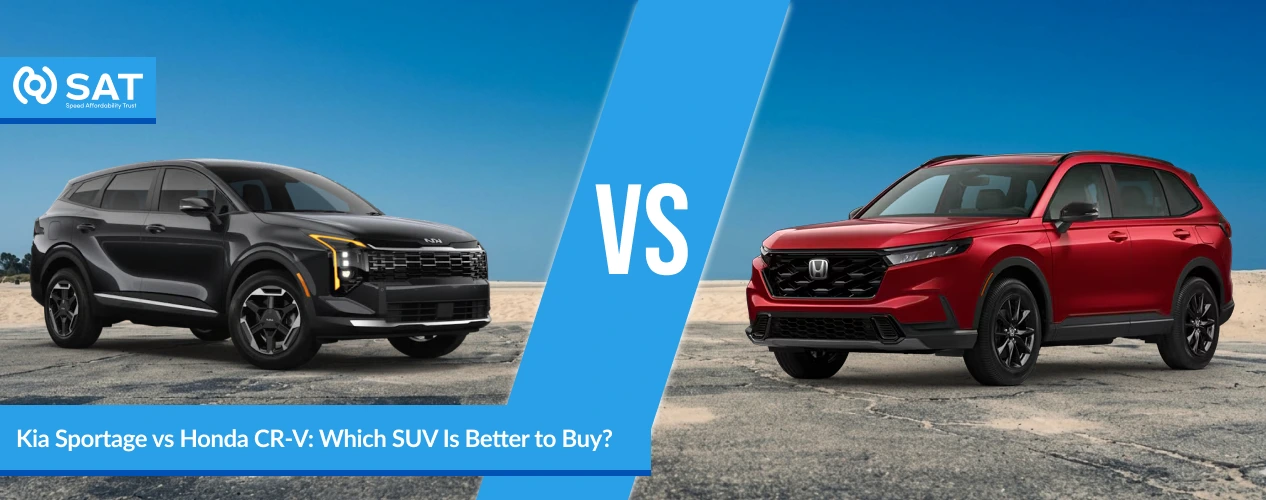
I spent back-to-back weeks in a 2026 Kia Sportage and a Honda CR-V, running the same errands, the same highway stretch, and the same gravel driveway in both, and the gap between them showed up faster than I expected. The Sportage felt like the smarter buy the moment I sat in it: bigger screen, longer warranty on paper, and a price tag that let me option it up without flinching. The CR-V took longer to win me over, but it did, mostly on the road. Every pothole I hit in the Sportage, I felt a little more of; every one I hit in the CR-V, the suspension just absorbed it and moved on. That’s really the whole comparison in miniature. The Sportage wins on what you get for your money. The CRV wins on how it feels to actually live with. Neither one left me disappointed, but which one you’d pick depends on whether you are chasing value or refinement.
Choose the Kia Sportage :If you want a lower starting price, a longer warranty, a larger standard touchscreen, stronger hybrid output, and an available plug-in hybrid option.
Choose the Honda CR-V :If you want stronger resale value, a smoother ride, better cabin refinement, and slightly more maximum cargo space with the rear seats folded
Category | Better Choice | Why |
Lower starting price | Kia Sportage | It starts lower than the CR-V |
Standard technology | Kia Sportage | Larger standard touchscreen |
Warranty coverage | Kia Sportage | Longer powertrain warranty |
Hybrid value | Kia Sportage | Lower hybrid entry price and stronger output |
Plug-in hybrid option | Kia Sportage | CR-V PHEV is not offered |
Fuel economy, gas models | Honda CR-V | Better combined MPG on gas trims |
Resale value | Honda CR-V | Honda usually holds value better |
Ride comfort | Honda CR-V | Smoother and quieter daily drive |
Maximum cargo space | Honda CR-V | More room with seats folded |
Best overall: The Kia Sportage is the better value choice for most buyers because it costs less, offers a longer warranty, has stronger hybrid output, and includes more standard technology. The Honda CR-V is the better choice for buyers who care more about resale value, ride comfort, and long-term brand trust.
If you are comparing these SUVs as used imports, SAT Japan can help you browse available used Kia Sportage stock and other reliable used SUVs before you decide.
This Kia Sportage vs Honda CR-V comparison breaks down the main differences in price, specs, fuel economy, size, reliability, safety, and daily ownership value. Price is one of the clearest differences between the 2026 Kia Sportage and the 2026 Honda CR-V. The Sportage starts lower than the CR-V, and that gap continues across several trims. In the hybrid lineup, the difference becomes even more important because the Sportage Hybrid starts much lower than the CR-V Hybrid.
Trim Level | Sportage MSRP | CR-V MSRP | Drivetrain |
Base gas trim | $28,790 | $30,920 | FWD, gas |
Mid gas trim | ~$31,500 | $33,150 | FWD/AWD, gas |
Upper gas trim | ~$34,000 | $35,400 | FWD/AWD, gas |
Top gas trim | ~$37,500 | Not directly comparable | AWD, gas |
Hybrid entry trim | $30,490 | $35,630 | FWD/AWD, hybrid |
Hybrid upper trim | ~$35,000–$38,000 | $38,725 | FWD/AWD, hybrid |
Hybrid top trim | $41,835 | $42,550 | AWD, hybrid |
Plug-in hybrid entry trim | $40,490 | Not offered | AWD, PHEV |
Plug-in hybrid top trim | $47,190 | Not offered | AWD, PHEV |
That $2,130 base-trim gap is not pocket change. Depending on the driver and location, it can cover a meaningful part of annual insurance or maintenance costs. The important part is that the Sportage does not feel stripped down despite the lower starting price. You're getting a 12.3-inch touchscreen standard, where the CR-V LX starts you off with a 9-inch screen.
Short answer: The Kia Sportage is cheaper than the Honda CR-V in base, hybrid, and plug-in hybrid comparison points, while the CR-V costs more but may return stronger resale value later.
Short answer: The Kia Sportage is cheaper than the Honda CR-V in base, hybrid, and plug-in hybrid comparison points, while the CR-V costs more but may return stronger resale value later.
You can also compare available hybrid and fuel-efficient SUV stock through SAT Japan if you are shopping beyond new 2026 pricing.
Before choosing either SUV, look closely at the spec sheet.
Spec | Sportage | CR-V |
Gas engine | 2.5L naturally aspirated I4 | 1.5L turbocharged I4 |
Gas horsepower | 187 hp | 190 hp |
Gas torque | 178 lb-ft | 179 lb-ft |
Gas transmission | 8-speed automatic | CVT |
Hybrid system output | 232 hp | 204 hp |
Plug-in hybrid | Available, 268 hp | Not offered |
Drivetrain | FWD standard, AWD available | FWD standard, AWD available |
Gas towing capacity | Up to 2,500 lbs with trailer brakes | Up to 1,500 lbs |
Hybrid towing capacity | Up to 2,000 lbs | Up to 1,000 lbs |
Brakes | 4-wheel disc brakes with ABS | 4-wheel disc brakes with ABS |
Wheels | 17 to 19-inch, trim dependent | 17 to 19-inch, trim dependent |
Spec sheets do not tell the whole story. The gas Sportage uses a naturally aspirated 2.5-liter engine paired with an 8-speed automatic transmission, so it feels more traditional and predictable. The gas CR-V uses a smaller 1.5-liter turbocharged engine with a CVT, which helps fuel economy but gives the SUV a different driving feel.
If you want to look deeper into the Sportage lineup and older performance-focused variants, our Kia Sportage R specs guide covers its redesign, range, and speed details separately.
Towing is one place where the Sportage has a clearer advantage. The gas Sportage can tow up to 2,500 pounds when properly equipped, while the gas CR-V is rated up to 1,500 pounds. Hybrid towing is lower, but Kia still has the edge there too: the Sportage Hybrid and PHEV are rated up to 2,000 pounds, while the CR-V Hybrid is rated up to 1,000 pounds.
Short answer: The gas CR-V has slightly more horsepower, but the Sportage offers a traditional 8-speed automatic, stronger hybrid output, higher towing capacity, and an available plug-in hybrid.
This is where the Sportage makes its strongest case.
Start with the powertrain. The Sportage Hybrid uses a 1.6-liter turbocharged engine paired with an electric motor, producing 232 combined horsepower. The CR-V Hybrid uses a 2.0-liter engine with a two-motor hybrid system and produces 204 total system horsepower. That means the Kia is not only cheaper to enter as a hybrid, but also stronger on paper.
The biggest difference is plug-in hybrid availability. Kia offers a plug-in hybrid version of the Sportage, and Honda doesn't build one for the CR-V. The Sportage PHEV pairs a 1.6-liter turbocharged engine with a plug-in hybrid system and produces 268 horsepower. It also offers 34 miles of all-electric range, giving it a daily-commute advantage the CR-V cannot match. You get real electric-only range for short trips, and gas-engine backup for everything else. That gives the Sportage a flexibility advantage the CR-V does not currently offer.
You might be wondering about the price. The Sportage Hybrid LX starts at $30,490, barely more than the gas LX. The CR-V Hybrid starts notably higher, with the 2026 CR-V Sport Hybrid starting at $35,630. So you're paying a real premium to get into a Honda hybrid, while Kia makes the jump nearly painless.
EPA-estimated combined fuel economy favors the Sportage Hybrid in its lighter trims, with the Sportage Hybrid LX rated at 42 mpg combined. The CR-V Hybrid lands closer to 40 mpg combined. It's not a massive gap on paper, but stack it over a few years of ownership, and it adds up.
Short answer: The Kia Sportage Hybrid is stronger and cheaper to enter, while the Honda CR-V Hybrid focuses more on smoothness, efficiency, and long-term Honda resale value.
If you are leaning toward the Honda hybrid for long-term ownership, it is also worth checking our 2024 Honda CR-V Hybrid Battery Life guide.
Trim/Drivetrain | City | Highway | Combined |
Sportage Gas FWD | 25 | 33 | 28 |
Sportage Gas AWD | 24 | 30 | 26 |
Sportage Hybrid FWD | 41 | 44 | 42 |
Sportage Hybrid AWD | 35 | 36 | 35 |
CR-V Gas FWD | 28 | 33 | 30 |
CR-V Gas AWD | 27 | 31 | 29 |
CR-V Hybrid 2WD | 43 | 36 | 40 |
CR-V Hybrid AWD | 40 | 34 | 37 |
Sportage PHEV Rating | Figure |
Engine-only combined MPG | 36 mpg |
Combined MPGe | 83 MPGe |
All-electric range | 34 miles |
Here’s where the comparison flips. On gas trims, the CR-V wins on fuel economy. Its turbocharged engine and CVT setup are genuinely efficient, and Honda’s reputation for fuel economy is not just marketing. Once you move into hybrid territory, the Sportage takes the lead back, especially when you compare price, horsepower, and the availability of a plug-in hybrid model.
What does that mean in dollars? If you're driving 12,000 miles a year at $3.50 a gallon, the difference between a 42-mpg Sportage Hybrid and a 40-mpg CR-V Hybrid works out to roughly $50 a year. That is not a huge yearly saving. But over a five-year ownership window, paired with the lower starting price, it stacks the deck further in Kia's favor for hybrid shoppers specifically.
Measurement | Sportage | CR-V |
Length | 184.4 in | 184.8 in |
Width | 73.4 in | 73.5 in |
Height | 65.6–66.9 in, depending on trim/roof rails/AWD | 66.2–66.5 in, depending on drivetrain |
Wheelbase | 108.5 in | 106.3 in |
Their overall footprints are almost identical, but the wheelbase difference is worth a second look. The Sportage's longer wheelbase puts more distance between the front and rear axles, which generally translates to a steadier ride and a bit more cabin room for the same overall length. The CR-V plays it conservatively, with the same general size and slightly more front and rear overhang.
If you are still deciding where the CR-V fits in Honda’s SUV lineup, this Honda HR-V vs Honda CR-V comparison explains the size, space, and practicality differences between the two.
Styling is subjective, but the two SUVs clearly take different design paths. The Sportage leans into a bolder, more angular design with its signature "star map" lighting signature up front; it doesn't try to blend in. The CR-V goes the other direction, sticking with a clean, understated shape that's barely changed in silhouette for two generations. If you want your SUV to make a statement in a parking lot, the Sportage does that. If you prefer a cleaner, more conservative design that does not draw much attention, the CR-V fits that brief better.
Measurement | Sportage | CR-V |
Cargo behind 2nd row | 39.6 cu ft | 39.3 cu ft |
Max cargo, seats folded | 74.1 cu ft | 76.5 cu ft |
Rear legroom | 41.3 in | 41.0 in |
Front legroom | 41.4 in | 41.3 in |
Behind the second row, these two are basically tied; the Sportage actually edges ahead by a hair. Fold the seats flat, though, and the CR-V opens up more total space, by about two and a half cubic feet. That's roughly one more medium suitcase worth of room.
Where the Sportage pulls slightly ahead is rear legroom, but the gap is only about 0.3 inch. That means it is a small advantage, not a major deciding factor. Both SUVs are roomy enough for adult passengers in the second row.
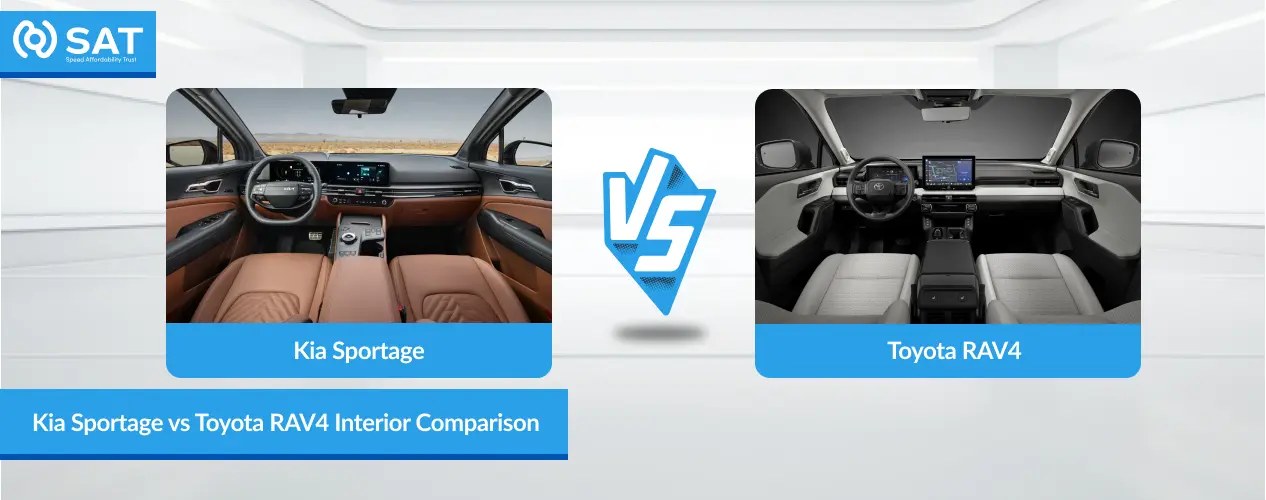
On paper, the technology difference is one of the first things buyers will notice.
The Sportage has a standard 12.3-inch touchscreen, while the CR-V uses a 9-inch touchscreen. The difference is easy to notice, especially if you care about maps, menus, and display size. The Sportage also offers a more modern dashboard layout, while the CR-V keeps a simpler and more conservative interior display setup. Honda’s layout is clean, but Kia’s looks more tech-forward.
The Sportage gives buyers strong charging convenience, with front and rear USB-C access depending on trim. The CR-V also includes a front USB-C smartphone/audio interface, while higher trims add more charging options. That matters if your family regularly charges phones, tablets, or other devices on road trips.
The Honda CR-V feels stronger in cabin refinement. Its interior has a more solid feel, the materials seem more mature, and the cabin is quieter on the highway. The difference is not dramatic, but it is noticeable. The Sportage feels stronger on standard technology and driver-assist value, while the CR-V feels stronger on material quality and highway comfort.
The gas Kia Sportage uses a 2.5-liter engine paired with an 8-speed automatic transmission. That gives it a more traditional driving feel, especially when accelerating or shifting through traffic.
The Honda CR-V uses a CVT instead of a traditional automatic transmission. This setup helps fuel economy and keeps the drive smooth, but it can feel less direct when you accelerate hard. Some drivers will like that smoothness. Others may prefer the Sportage’s more familiar automatic transmission feel.
The CR-V has the edge in ride comfort. Its suspension feels calmer over rough roads and potholes, which matters if you spend a lot of time on city streets or long highway drives.
The simple verdict is this: the Sportage feels more traditional and value-focused, while the CR-V feels smoother, quieter, and more comfort-focused.
This is one of the most important ownership differences between the two SUVs.
Category | Sportage | CR-V |
Predicted reliability | Competitive, but source-dependent | Competitive, often favored historically |
Basic warranty | 5-year/60,000-mile | 3-year/36,000-mile |
Powertrain warranty | 10-year/100,000-mile | 5-year/60,000-mile |
Hybrid/electrified coverage | 10-year/100,000-mile battery/electrified coverage | 8-year/100,000-mile hybrid battery coverage |
Estimated maintenance | Moderate | Moderate, historically strong |
Resale value | Usually depreciates faster than Honda | Usually stronger resale value |
Best ownership case | Long-term ownership, warranty value | Shorter ownership, resale strength |
The reliability discussion is close, but the warranty difference is not. Kia gives the Sportage a much longer powertrain warranty, while Honda relies more on its long-term reputation and resale value.
Kia’s powertrain warranty is twice as long as Honda’s in both years and mileage: 10 years/100,000 miles for Kia versus 5 years/60,000 miles for Honda. This means the Kia owner may still have powertrain coverage in year seven, as long as warranty terms and ownership conditions apply. The Honda owner may be out of warranty by that point, depending on mileage and ownership terms. Major powertrain repairs can cost thousands of dollars, depending on the issue, vehicle, and repair shop. That is not just a spec-sheet advantage. It can become real money if a major repair happens later in ownership.
Honda usually does better when it comes to resale value. The Honda CR-V has a long-standing resale reputation, which can help it hold value better when you trade it in. If you sell your car every three to four years, the CR-V’s stronger resale value can offset some of the money you save by buying the cheaper Sportage. If you keep your SUV for a long time, Kia’s longer warranty becomes more useful because you are more likely to benefit from the extra years of coverage.
Both SUVs come with important driver-assist features as standard, so buyers do not need to jump straight to the top trim for basic safety technology.
Feature | Sportage | CR-V |
Forward collision warning + auto braking | Standard | Standard |
Lane keeping assistance | Standard | Standard |
Adaptive cruise control | Standard | Standard |
Blind-Spot View Monitoring | Available on upper trims | Not offered |
Highway Driving Assist | Available on upper trims | Not offered |
Front and rear parking sensors | Available by trim | Available by trim |
Low-Speed Braking Control | Not offered | Available on higher trims |
IIHS safety result | 2026 Top Safety Pick+ for models built after May 2025 | Check the current IIHS rating by trim/test |
On base trims, the two systems are closely matched feature for feature. The split shows up higher in the lineup, where Kia leans into Blind-Spot View Monitoring and Highway Driving Assist, while Honda adds parking sensors and Low-Speed Braking Control. Neither one leaves you exposed; they've just made different bets on what upper-trim buyers want. The 2026 Kia Sportage earned IIHS Top Safety Pick+ status for models built after May 2025. The 2026 CR-V has also been tested by IIHS, so safety should be compared using current 2026 ratings rather than assumptions from older model years.
Sportage owners and reviewers often praise its value: the large screen, long warranty, strong feature list, and wide powertrain choice all help it feel generous for the money. Some owners get frustrated with all the touch controls.
They say the climate and audio controls are not as easy to use as buttons. Most get used to it in a few weeks. CR-V owners often praise the smooth ride and quiet cabin, especially on long highway trips.
Some drivers may not like the CVT feel during hard acceleration, and the 9-inch screen can look modest next to the Sportage’s larger display.
The bigger difference is not that one SUV feels risky and the other feels safe. The bigger difference is personality. The Sportage feels more value-focused and tech-heavy, while the CR-V feels calmer, more mature, and more comfort-focused.
Here's the breakdown by buyer type.
Choose the Sportage if you want the lower starting price, longer warranty, larger standard screen, stronger hybrid output, and an available plug-in hybrid option.
Choose the CR-V if you prioritize resale value, ride refinement, cabin quality, and maximum cargo space with the rear seats folded. If you trade in every few years and care more about a quiet, composed ride than outright tech specs, Honda's decades of resale strength and suspension tuning win out.
For plug-in hybrid flexibility, the Sportage is the clear choice because Honda does not currently offer a CR-V PHEV in the U.S. If you want electric-only commuting with gas-engine backup for road trips, Kia is your only option in this match-up.
For buyers who want maximum cargo space with the seats folded, the CR-V has the advantage. The gap is only a couple of cubic feet with seats folded, but if you regularly haul large, bulky items, that extra room is real.
Here's the breakdown by buyer type.
Buyer Type | Better Pick |
Budget-focused buyer | Kia Sportage |
Hybrid value shopper | Kia Sportage |
Plug-in hybrid shopper | Kia Sportage |
Long warranty buyer | Kia Sportage |
Resale-focused buyer | Honda CR-V |
Comfort-focused buyer | Honda CR-V |
Cargo-space buyer | Honda CR-V |
Traditional Honda loyalist | Honda CR-V |
Neither SUV is a bad purchase. The Sportage makes the stronger value case because it costs less, offers more warranty coverage, and gives buyers more hybrid flexibility. The CR-V still makes sense for shoppers who value resale strength, comfort, cargo space, and a more refined daily-driving feel.

Comparison Between the Advantages of Electric vs. Gas-Powered Cars
Hybrid vs Plug-In Hybrid Cars: Cost, Range & Performance
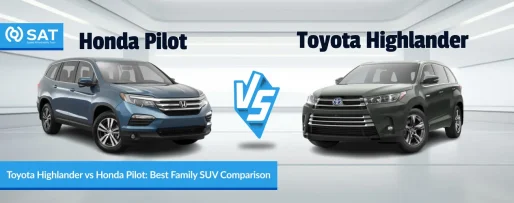
Toyota Highlander vs Honda Pilot: Best Family SUV Comparison

Noah Mitchell
I am Noah Mitchell, an experienced automotive journalist with over 9 years covering the dynamic world of cars and transportation. My in-depth analysis and passion for sustainable mobility drive my stories. I regularly contribute to leading publications an
No major size difference. The Honda CR-V is slightly longer at about 184.8 inches, while the Kia Sportage is about 184.4 inches long. The Sportage has the longer wheelbase, which helps it feel roomy in the second row.
For gas-only models, the CR-V edges ahead at 30 mpg combined FWD versus the Sportage’s 28 mpg combined FWD. For hybrids, the Sportage Hybrid LX FWD is rated at 42 mpg combined, while the CR-V Sport Hybrid 2WD is rated at 40 mpg combined.
The Kia Sportage has the longer warranty. Kia covers the powertrain for 10 years or 100,000 miles, while Honda’s powertrain warranty runs for 5 years or 60,000 miles.
Reliability depends on the source and the exact model year. Honda usually has the stronger long-term resale reputation, while Kia gives buyers the stronger warranty coverage. For most buyers, the CR-V is the safer resale choice, while the Sportage is the better warranty-value choice.
The Kia Sportage is the better value for most budget-conscious buyers. It costs less, includes more standard technology, offers stronger warranty coverage, and has a lower hybrid entry price. The Honda CR-V is better for resale value and long-term brand trust.
Yes, but the answer depends on the powertrain. The gas Sportage can tow up to 2,500 pounds when properly equipped, while the gas CR-V is rated up to 1,500 pounds. The Sportage Hybrid and PHEV are rated up to 2,000 pounds, while the CR-V Hybrid is rated up to 1,000 pounds.
_1733297922.webp)
Trucks have carved their distinct niche in the automotive industry. Originally built for durability, utility, and off-road duties, these vehicles have evolved over the decades to incorporate some of the finest luxury features that were once exclusive to sedans and SUVs. Two highly sought-after trucks in this category are the Ford Ranger and the Toyota Tacoma. These trucks have a global cult and offer some of the best features and amenities that have skyrocketed their popularity making them a great choice for both urban and off-roading purposes. The Ford Ranger and Toyota Tacoma are midsize trucks with their unique strengths and capabilities. This blog will dive deep into the comparison of these two trucks based on performance, specs, features, and overall value.
Ford Ranger
The Ford Ranger made a comeback in 2019 after eight years and soon became a formidable competitor in the mid-size truck segment acquiring a reputation for balance between off-road capability, towing capacity, and modern technology. It runs on a turbocharged engine and is available in various trims and configurations to suit different needs. Whether you need it for rugged off-roading or daily commutes, the Ranger serves well for multiple purposes.
Toyota Tacoma
The Toyota has, for years, redefined the standard of durability and reliability setting the benchmark in the mid-size truck category. With a robust build quality, this truck is an absolute beast both on and off the road. The Tacoma serves as a perfect workhorse that needs to tackle even the toughest terrains and daily driving challenges.
Ford Ranger
Ford mounts the Ranger with a 2.3L turbocharged four-cylinder engine that produces 270 horsepower and 310 lb-ft of torque. With a 10-speed automatic transmission, the Ranger has a smooth ride in both highway cruising and off-road adventures. The turbocharged engine is great for acceleration, and the 10-speed transmission promises gentle shifting and improves fuel economy.
The Ranger can tow up to 7,500 pounds and has a payload capacity of 1860 pounds which is quite an impressive feat. Whether you’re hauling a boat, trailer, or heavy equipment, you can count on the Ranger to get the job done.
Toyota Tacoma
The Toyota Tacoma comes with a 2.7L inline-four-cylinder engine and a more powerful 3.5L V6 engine. The 2.7L engine makes only 159 horsepower and 180 lb-ft of torque, which should be sufficient to perform light-duty tasks but may feel somewhat inadequate when towing heavier loads. On the other hand, the 3.5L V6 delivers much better performance and capacity for towing.
The driving experience of the Tacoma is averagely impressive, mainly due to its 6-speed automatic or manual transmission. It feels very archaic in terms of driving when compared to its rival, the Ranger's 10-speed automatic. The V6 Tacoma's towing capacity is around 6,800 pounds and a payload capacity of 1685 pounds which isn’t bad at all.
Ford Ranger: Ranger models equipped with the FX4 Off-Road Package come fitted with skid plates, off-road tires, a terrain management system, and a trail control feature that's basically like off-road cruise control. Such a package combined with higher torque and lighter weight makes the Ranger highly agile off-road.
Toyota Tacoma: The Tacoma doesn’t lag in offroad prowess. The TRD Off-Road and TRD Pro variants are equipped with such features as crawl control, multi-terrain select, and advanced suspension, to take on extreme terrains seamlessly. For years now, it has been one of its biggest selling points.
Ford Ranger
The Ford Ranger's convenience is underscored by its quiet, modern interior and technology. This infotainment interface called SYNC 3 is very easy to use with an 8-inch touchscreen, Apple CarPlay, Android Auto, and FordPass Connect that allows you to use your smartphone to control some of the vehicle's functions. The cabin materials are not the best; however, the front seats provide a good amount of support for long trips.
The Ranger offers ample storage space and a center console for accommodating large items. The rear seats are a bit tighter and might not be very comfortable for three passengers on longer journeys.
Toyota Tacoma
The Toyota Tacoma has a more rugged, utilitarian interior, so it may not be the most comfortable in comparison to the more modern-looking Ranger. There is a 7-inch screen infotainment system that comes as standard in the Tacoma, and the 8-inch in higher trim, and supports Apple CarPlay and Android Auto, though the interface seems a bit less modern in comparison to the Ranger’s. The cabin interior is decent but not very premium.
The Tacoma offers adequate seating comfort but it's high floor height and less legroom compromise a bit on comfort.
Ford Ranger
The Ranger provides the best modern style with a hint of ruggedness. Its sleek design and improved aerodynamics lead to better performance and efficiency. With the angular and slim hexagonal grille together with slimmer headlights, it exhibits a futuristic look. Its clean lines together with its wider stance give it a refined yet muscularly designed appearance at the same time. The exterior design of the Ranger is intended to appeal to those seeking a modern, sporty truck with a dash of tough capability.
Toyota Tacoma
The Toyota Tacoma offers a more muscular, utilitarian look with a wide grille, square headlights, and an aggressive posture. The Tacoma portrays strength and toughness, making it the most appropriate vehicle for adventure lovers.
Ford Ranger
The Ranger offers advanced technology like the Ford Co-Pilot360 which is a standard feature on most trim levels. It includes automatic emergency braking with pedestrian preemption, adaptive cruise control, and lane-keeping assist, along with blind-spot monitoring. The SYNC 3 infotainment system provides easy operation with voice controls and smoother smartphone connectivity.
Toyota Tacoma
Toyota Tacoma is also equipped with advanced safety features like Toyota Safety Sense which includes pre-collision braking, lane departure alert, automatic high beams, and adaptive cruise control. But as for tech, the Tacoma can't quite catch up with the Ranger's offerings, especially when the responsiveness and graphics of its infotainment system are concerned.
Ford Ranger
The Ford Ranger offers a great combination of power and fuel efficiency. It has an impressive fuel economy of 21 mpg in the city, 25 mpg on the highway, and a combined average of 22 mpg.
Toyota Tacoma
The V6 engine Toyota Tacoma gives 20 mpg in the city and 26 mpg on the highway making an average of 23 mpg. The Tacoma also boasts impressive figures that are not much different from the Rangers. Conversely, the 2.7L is more fuel-efficient, but that engine does not give power to drive and haul heavy loads or tow.
Ford Ranger
The base XL variant of the Ford Ranger starts at around $27,400 and goes around $41,000 for higher trims such as the Lariat. Considering its tow rating, high-tech features, and turbocharged powerplant, the Ranger represents great value for money.
Toyota Tacoma
The Toyota Tacoma starts at around $28,400, with the TRD Pro and top variants going up to $47,000. Yes, the base model of the Tacoma is more expensive only because of the good name for reliability attached to the brand; some may find higher trims too steep when compared to similarly equipped peers from the Ranger.
These trucks have their strengths and drawbacks, however, both are quite capable. For a more modern-looking versatile truck with the latest state-of-the-art technology, the Ford Ranger is the winner. A turbocharged engine and even greater towing capability combined with better fuel efficiency make this truck a balanced selection for any driver who needs an able driver for regular daily use but sometimes wants the option to venture into off-road conditions.
However, if your main priority is ruggedness, reliability, and off-roading the Tacoma has an edge ove the Ranger. TRD trims of the model proudly boast some of the best off-road features within this segment making the Tacoma an ideal choice for adventure-seekers. Ultimately, your choice will depend on what you want in a truck.
_1733297746.webp)
Ever wonder why the Kia Sportage and Hyundai Tucson are the top two searched compact SUVs? It's not just their badges. Together, these SUVs have sold millions of units worldwide and are still popular among first-time buyers, families, used-car buyers, and long-term value-seeking vehicle importers.
At first, both cars are from the same car company and share several engineering aspects. But, in the real world, buying decisions are not quite as easy. Depending on where you live and what you plan to do with it, one may be a better option than the other.
In this 2026 Hyundai Tucson vs Kia Sportage comparison, we will explain key differences to help you make an informed, confident decision before you invest your money.
Category | Kia Sportage | Hyundai Tucson |
Vehicle Class | Compact SUV | Compact SUV |
Starting MSRP (2026)* | Around $28,000 | Around $29,000 |
Available Powertrains | Petrol, Hybrid, Plug-In Hybrid | Petrol, Hybrid, Plug-In Hybrid |
Maximum Horsepower | Up to 268 hp (PHEV) | Up to 268 hp (PHEV) |
Cargo Space Behind Rear Seats | Up to 39.6 cu-ft | Up to 38.7 cu-ft |
Maximum Cargo Capacity | Up to 74.1 cu-ft | Up to 74.8 cu-ft |
Available Drivetrain | FWD / AWD | FWD / AWD |
Maximum Towing Capacity | Up to 2,500 lbs | Up to 2,000 lbs |
Warranty Coverage | 5-Year/60,000-Mile Basic Warranty | 5-Year/60,000-Mile Basic Warranty |
Powertrain Warranty | 10-Year/100,000-Mile | 10-Year/100,000-Mile |
The 2026 Kia Sportage and Hyundai Tucson have their priorities set. Kia is making key changes to the Sportage; they're more obvious in the exterior styling, better technology, more hybrid options, and improved driver assistance. While Hyundai builds on the recent redesign of the Tucson, the focus is on polishing existing elements rather than making significant changes.
That difference is significant not just for looks. If there is strong demand for a newly refitted model, it can increase the resale value. A model with not so many modifications between years, though, has a more established manufacturing system, and software updates and manufacturing enhancements have been released over the years.
The Sportage is an advantage for those who love the newest design and technology. The Tucson is a more stable option for those who prefer a model that is already established in production.
Not exactly. The Kia Sportage and Hyundai Tucson share engineering, including chassis, engine family, transmissions, and safety structure, as they are built on the Hyundai Motor Group's N3 platform. Although sharing resources can lower development expenses, manufacturers still fine-tune each vehicle to offer a different driving experience.
The more tech-focused cabin and bolder styling and trims make the Kia Sportage the more expressive SUV. The Hyundai Tucson promises a more relaxed, comfort-oriented driving experience, featuring a cleaner dashboard and more straightforward controls.
Many people don't realize that the specifications of the market can differ. Depending on the country of origin, two Sportage or Tucson versions with the same trim level can differ in terms of safety, lighting, infotainment, or engine. It's not really about the platform for used and import buyers; it's about market-specific equipment.
Both the Kia Sportage and Hyundai Tucson offer front-wheel drive or all-wheel drive and are powered by the same engines (the 187-hp 2.5-liter petrol, 231-hp hybrid, and 268-hp plug-in hybrid). Their performance on paper seems to be almost the same. In the cockpit, it's a different story.
The distinction is due to the tuning of the vehicles. The Sportage has a more connected steering and throttle response in most trims, making it a more responsive experience when merging onto the highway and navigating corners. The Tucson takes its focus on ride comfort seriously, and with it also comes lighter steering and suspension tuning that eases out more road imperfections, making long journeys a more comfortable experience.
The hybrid options are also said to be “faster to ride” in normal driving conditions as their electric motors produce maximum torque at very low speeds. While the official horsepower ratings are comparable, that instant reaction enables the SUVs to get away from the traffic lights smoothly.
At first look, Kia Sportage and Hyundai Tucson look just about the same, with a considerable amount of common original equipment components and architecture. The hybrid models, however, show a more significant difference.
Powertrain | Kia Sportage | Hyundai Tucson |
2.5L Petrol (FWD) | Up to 28 mpg combined | Up to 28 mpg combined |
Hybrid | Up to 43 mpg combined | Up to 38 mpg combined |
Plug-In Hybrid | Up to 35 miles EV range | Up to 33 miles EV range |
The Sportage Hybrid's fuel economy advantage may seem small on paper, but on the 15,000-plus miles range that most people drive annually, this can translate to dozens of gallons annually in fuel savings versus the Tucson Hybrid. It is more apparent for those who drive much in stop-and-go traffic.
The single most important choice is not Sportage vs. Tucson but petrol vs. hybrid. Moving from a 28 mpg petrol model to a 43 mpg hybrid can improve efficiency by more than 50%, which has a much greater impact on fuel use than the difference between the two brands.
The Kia Sportage is the winner of this category, owing to the improved hybrid efficiency and marginally greater electric-only driving range. But if fuel economy is a priority, consumers should think carefully about their powertrain options, just as much as they should think about the Sportage vs Tucson.
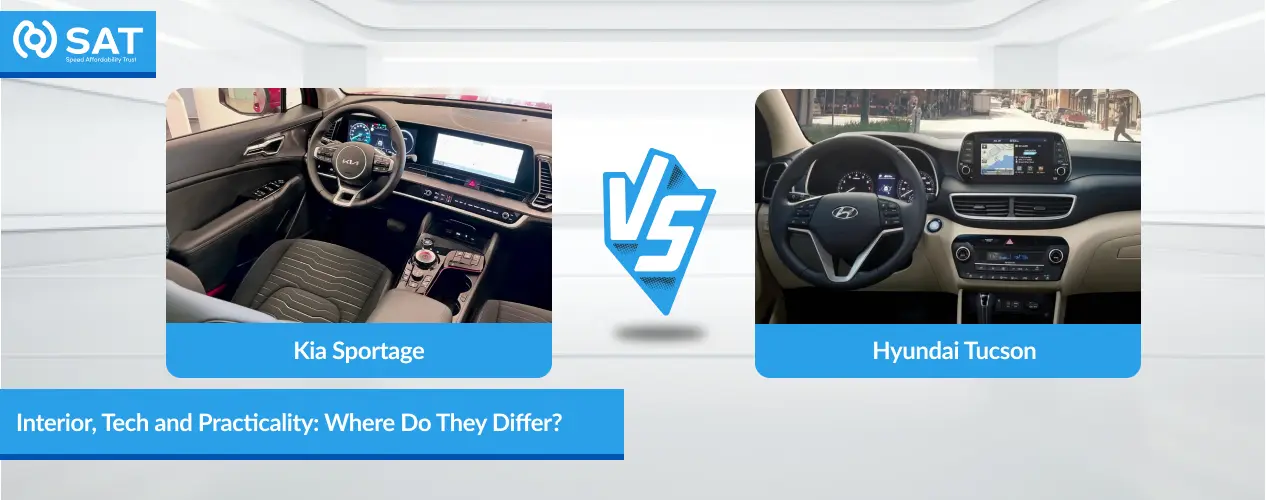
While the Kia Sportage and Hyundai Tucson have more in common in their engineering, the approach taken to the cabin is quite different. This is one of the most obvious feature differences between the two SUVs, and it can make a significant difference in ownership experience.
The Sportage is designed to make a lasting impression. The higher trims offer a curved panoramic display layout that makes several displays appear as a single, modern cockpit-like display. Opting for a simpler, less flashy dashboard design, the Tucson offers a more subdued look that emphasizes functionality and usability.
It's not a matter of which has the most technology in the SUV. It's about the way that technology is provided. Kia prioritizes digital interaction and customization, whereas Hyundai prioritizes simplifying things and making the cabin feel like home from the start.
One of the often-neglected factors is cognitive load. The Sportage's technology-oriented design might attract those who like to delve into features and settings. A simpler presentation, such as the Tucson, may be more convenient for those drivers who do not want to be distracted in their daily driving experience.
Aesthetically, the Sportage is a car that will catch the eye as soon as you enter, whereas the Tucson is an intuitive car that will be a pleasure to own for years to come. That's what makes two cars with the same underpinnings appeal to different audiences.
The Kia Sportage (39.6 cu-ft) and Hyundai Tucson (38.7 cu-ft) are just under 1 cubic foot apart on paper. In practice, that small difference doesn't make a lot of difference. It isn't the size that matters; it's the shape of the space. The side cargo opening and the square cargo floor are designed to accommodate strollers, large suitcases, and bulky shopping bags. The Tucson just slips slightly ahead with the rear seats folded, and is better for carrying longer objects. Most reviews fail to mention this one aspect: most families use the area behind the second row more than the maximum cargo capacity. For everyday use, the Sportage will be a bit better, but the Tucson will be great for flexible long load storage.
The Kia Sportage and Hyundai Tucson are two of the safest compact SUVs, with the NHTSA giving them a good safety rating and the IIHS giving them excellent crash-test ratings in recent model years. Both have advanced driver-assistance technologies such as Forward Collision-Avoidance Assist, Lane Keeping Assist, Blind-Spot Collision Warning, and Smart Cruise Control to help prevent accidents. Many buyers forget that the trim is as important as the model when it comes to safety. The features may change from year to year, market to market, and trim to trim, particularly on used and imported vehicles. Always inspect safety equipment that has been installed before purchase. The safest is not necessarily the one with the best crash test score, but rather the one with the most comprehensive driver-assistance system.
The Kia Sportage and Hyundai Tucson are engineered on the same DNA, and as such, their long-term reliability is quite similar and not as far apart as many think. They both have the same engines, transmissions, and most mechanical parts, so neither has an edge unless both are well-maintained. Most of the reported problems are related to the infotainment system and driver-assistance sensors, with a few instances of transmission hesitation on certain model years, but nothing serious with the engine. Regular oil changes, software updates, and sticking to the service schedule do more for reliability than the choice of badges.
The running costs are also comparable, as many parts are shared among both types of SUVs and parts are readily available in most markets, making repairs easier and quicker. Both models are also covered under an excellent basic 5-year/60,000-mile warranty and a 10-year/100,000-mile powertrain warranty in the U.S. (Warranty coverage for used or imported models varies by country and local policies.)
The most common mistake a buyer makes is assuming the greatest reliability risk comes from the previous owner, not the model. A clean Sportage or service record will nearly always outlast a dirty Tucson and vice versa. When purchasing, look for maintenance history, accident records, recall completion, tire condition, and regular maintenance. The info there will give you much more insight into the future ownership than the front badge.
There are many buyers who just have an eye on the buying price and neglect it at the time of selling later. That's why depreciation is important. Leading the value is that the Kia Sportage and Hyundai Tucson both have modern technology, high safety ratings, and fuel-efficient hybrid options. Here's something most comparison articles don't mention: buyers aren't paying more for a badge; they're paying more for confidence. Whether it's Hyundai or Toyota, a model with a full service record, no accident history, and desirable features such as AWD or a hybrid powertrain will often sell faster than a neglected model. If you're looking for long-term value, you'll want to purchase the vehicle in the best condition, but no one said it had to be the one with the better resale reputation.
The price that you pay for a vehicle is important, but the true cost of a vehicle is what happens after you drive it off the lot. In fact, over the years, maintenance, repair, insurance, and depreciation can be more significant than the sticker price.
Due to the common engineering parts and components shared by the Kia Sportage and Hyundai Tucson, the maintenance costs are quite similar. Service contract costs like oil services, brake pads, air filters, tires, and fluid changes typically hover around the same price for both SUVs.
But one of the major ownership misconceptions is that the biggest expense is maintenance. But often depreciation and neglect by the previous owner have a bigger financial impact. A poorly maintained SUV can quickly erase any savings gained from a lower purchase price.
The other one is the shared parts ecosystem. Both cars are available worldwide and share a lot of parts, making it easier to get replacement parts for them than for less common cars. This can help to minimize repair delays and to keep repair costs in check in the long term.
The decision on whether to opt for the Kia Sportage or the Hyundai Tucson is not always the most important, but rather the choice of trim is. Frequently, buyers pay thousands more for top trims but only use a few of the additional features. The best trim for most is one that offers comfort, technology, safety, and value.
Buyer Priority | Kia Sportage | Hyundai Tucson |
Best Budget Choice | LX | SE |
Best Value for Money | EX | SEL |
Best Hybrid | Sportage Hybrid EX | Tucson Hybrid SEL |
Adventure Style | X-Line / X-Pro | XRT |
Premium Experience | SX Prestige | Limited |
The Sportage EX is the most versatile model to suit most consumers. It delivers some of the things that people with daily driving require, such as increased size, extra comfort, and high-tech driving assistance, but at a more affordable price than the most expensive trims. The Sportage Hybrid EX offers excellent value for buyers who are seeking hybrid efficiency.
The Tucson SEL is based on the same concept. It provides a perfect balance of technology, comfort, and value with a simple and easy-to-understand trim range. The Tucson's trim structure simplifies the purchase process if you're looking for a straightforward buying experience with fewer options.
One thing many comparison articles neglect to mention is that the best trim is often the one that's easiest to resell. These vehicles appeal to the used car market by combining the desired features with a price point that is more in line with what customers are willing to pay for a vehicle.
Recommendation: If value, features, and resale value are the priorities, the Kia Sportage EX is the best choice. If you're looking for a simple, comfortable, and very practical Hyundai Tucson with a reasonable price tag, the SEL will be your choice. These middle-of-the-range options offer the best value for the money for most purchasers.
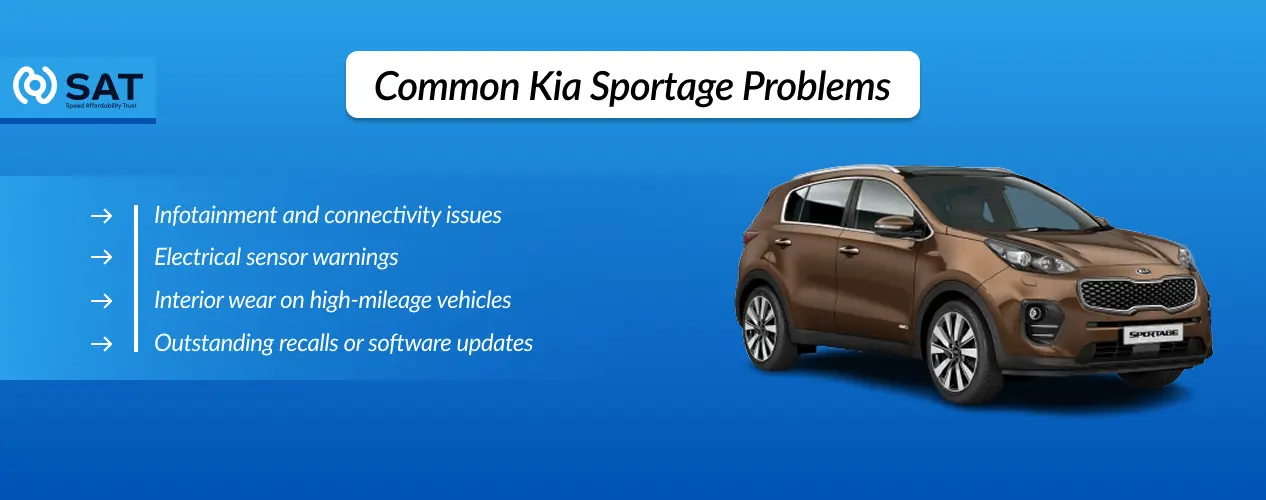
Considering a used Kia Sportage? The bright side is that there aren't many of the most typical complaints about major mechanical issues. Rather, most problems are typically electronic, software, or limited to specific model years.
Infotainment and connectivity issues: A few Sportage owners have complained that their touchscreen is delayed, the system freezes at times, or their phone cannot connect to the system. Typically, these are not disabling to the vehicle.
Electrical sensor warnings: Some model years have had intermittent warning lights for driver-assistance or monitoring systems. In many instances, the problem has been solved by software fixes or by a recalibration of the sensor.
Low-speed transmission hesitation: Some drivers have reported a lack of response when operating at low speeds. A test drive will be of great benefit when purchasing gearbox equipment, as the buyer must be alert to any unusual gearbox performance.
Interior wear on high-mileage vehicles: With older vehicles, seat bolsters, steering wheels, and often common-use controls may be more worn than mechanical parts.
Outstanding recalls or software updates: Check that all recalls have been done and software is up to date before buying.
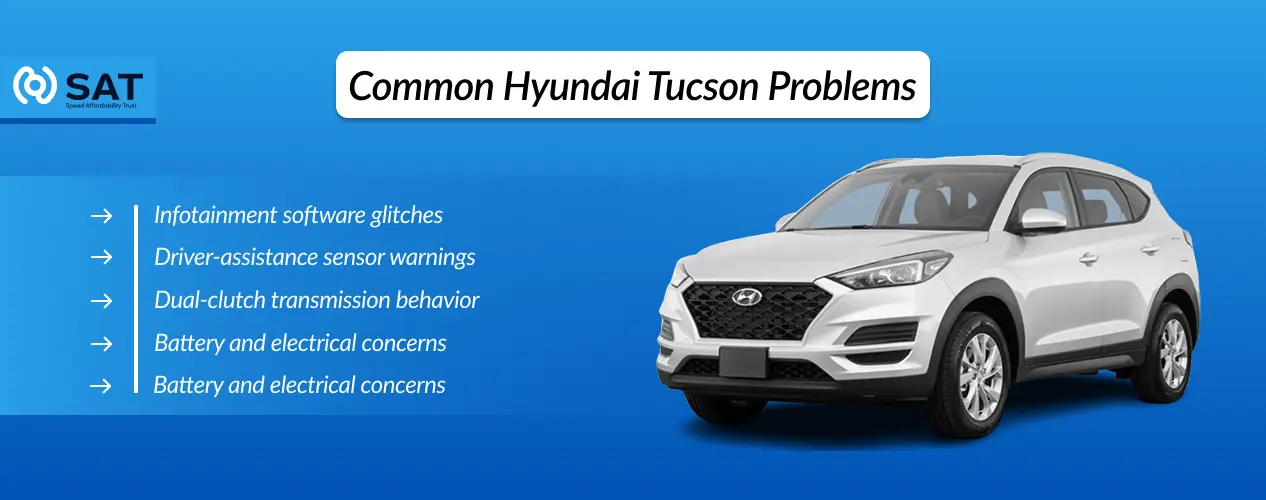
Purchasing a used Hyundai Tucson? While most models have been reliable in Tucson, there are some common problems that you should look for before making a final purchase.
Infotainment software glitches: A few have mentioned that the touchscreen freezes, responds slowly, or occasionally has a problem connecting with their smartphone. They're typically software and not serious hardware issues.
Driver-assistance sensor warnings: Some Tucson models have given erratic warnings from driver assistance systems, sometimes necessitating sensor calibration or software updates.
Dual-clutch transmission behavior: Few reported delays or lag in transmission response at low speeds, especially when driving in stop-and-go situations on some turbocharged variants.
Battery and electrical concerns: A few battery or electrical system problems have been reported, particularly in models with a lot of electronics.
Recall and update history: If recalls and manufacturer software updates have been done, make sure they have been recalled and updated before purchasing.
Kia Sportage Pros | Kia Sportage Cons |
Combined up to 43 mpg in hybrid mode | Conservative buyers may not like bold styling |
Slightly larger 39.6 cu-ft cargo area behind rear seats | It may be confusing if there are more complex trim levels |
When equipped, up to 2500 lbs of towing capacity is available | There are some features that are available in higher trims |
Wide variety of trim and package combinations, such as X-Line and X-Pro | For some, the technology-rich cabin might not be the ideal choice |
Great value-to-feature ratio throughout the line | Higher trims are expensive |
Hyundai Tucson Pros | Hyundai Tucson Cons |
Clean and simple design is timeless | The Tucson Hybrid is slightly less efficient than the Sportage Hybrid |
Easier to navigate, simpler trim structure | Reduced max tow capacity in many scenarios |
Convenient and easy-to-use cabin design | Less specialized trims options |
High levels of safety and driver-assistance equipment | Cargo advantage only comes with folded rear seats |
Competitive ownership and maintenance costs | Premium trims can approach the price of larger SUVs |
The most common error people make when comparing the Kia Sportage and Hyundai Tucson is thinking there is one clear winner. There isn't. These SUVs share the same DNA but serve different kinds of owners. The best option is not the one that boasts the most features on its SUV list. It's the one that seamlessly integrates into your standard driving routine without requiring you to alter your driving habits.
A question that will help you make your decision much easier:
At the end of a long day, what do you want your SUV to do for you?
If you're looking for a solution, the Sportage is for you: "make every drive a little more exciting. If your answer is "help me get home feeling relaxed," then the Tucson might be a better fit.
You enjoy a more confident and responsive driving feel.
The ideal driving experience includes the best hybrid fuel economy, up to 43 mpg in hybrid mode.
You enjoy a bold, contemporary aesthetic that will stand the test of time.
You frequently have camping gear, sports equipment, or luggage and need a little more cargo space behind the seats.
With a higher available towing capacity, you can tow a small trailer or recreational equipment.
More options for trim, such as adventure gear like the X-Line and X-Pro.
What you want is a cabin that feels modern, digital, and filled with technology.
The Sportage is designed for the buyer who likes choices. It is designed to reward drivers who have a preference for a different trim, powertrain, and feature as opposed to a one-size-fits-all.
You prefer a comfy ride over sporty handling.
You want a clean, easy-to-understand dashboard.
You drive for hours to get to work, and you need a relaxing cabin.
You enjoy a light and easy steering in town traffic.
You want an SUV that you feel comfortable in after just a few minutes of driving.
You like to have a shorter range of trims that you don't have to compare with numerous packages.
You want a design that will not quickly become outdated.
The Tucson is designed for those who do not often consider the car when in transit. Everything runs on its own accord, and you're able to concentrate on driving rather than the technology.
The most surprising result of this comparison is how little separates these two SUVs. Years ago, buyers often chose between Kia and Hyundai based on price or styling alone. Today, both vehicles have matured into highly refined compact SUVs that compete on much more than value.
What ultimately sets them apart is not capability but character. The Sportage feels aimed at buyers who enjoy having more choice and a stronger sense of individuality, while the Tucson focuses on delivering a straightforward experience with fewer decisions to make. Neither approach is objectively better—they simply appeal to different types of owners.
For import buyers, the real challenge is no longer finding a good vehicle but finding the right example. A well-maintained vehicle with a documented history will almost always be a smarter purchase than a poorly maintained alternative.
If you're sourcing a Sportage or Tucson from Japan, SAT Japan can help by providing access to inspected vehicles and export support, making it easier to find a quality example that matches your requirements.
Final Winner: Kia Sportage, but only by the narrowest of margins.

When it comes to leading car companies, Lexus is one of the first names that comes to mind. Lexus is known for producing premium SUVs, sedans, and other performance vehicles that are known for their reliability and class. In this blog, we will compare two of Lexus’ famous brands – Lexus RX vs Lexus NX.
Both these models provide a similar level of class and comfort and are great options individually. Let us break down the RX vs NX battle.
This luxury SUV was originally produced in 1997 in Japan and its export sales began in 1998. The vehicle is currently in its 5th generation, with many modifications occurring over the years, and has been a best-selling SUV globally due to its exceptional features.
The Lexus NX is a luxury SUV that came out in 2014. This vehicle instantly gained recognition after its launch and is now one of the top-selling Lexus models in Europe, currently still flourishing in its 2nd generation.
The Lexus RX offers a heated leather seating capacity of five people. In the latest 2024 version of the vehicle, the Lexus RX offers a boot space of 621 L with the rear seats up and up to 1678 L if the rear seats are folded.
Similar to the Lexus RX, the Lexus NX also features heated leather seats for five people. The latest version offers a boot capacity of 475 liters, expanding to 1520 liters with the rear seats down.
The vehicle provides several safety features in the latest generation, such as the ten airbags for passengers’ safety in case of any accidents, and a child lock feature and ISOFIX child seat anchors, so children cannot open their door from inside. Other latest safety features include:
Anti-lock braking system
Traction control
Vehicle stability control
Hill start assist control
Immobilizer
Moving onto the NX, the vehicle has a total of six airbags and five seatbelts. Just like the Lexus RX, this vehicle is also equipped with a child lock feature and ISOFIX child seat anchors for the safety of your children. More safety features may be:
Anti-lock braking system
Vehicle stability control
Hill start assist control
Traction control
Immobilizer
Now, let’s have a look at the comfort and luxury features that come with this vehicle. The latest versions of the Lexus RX are equipped with:
Air conditioner, Heater, Defogger, Climate Control:
This gives the passengers an option of customizing the temperature inside the car and enjoying their journey, regardless of the weather outside.
Power Windows, Power Steering, Power Mirrors, Power Locks, Power Boot:
This allows the driver to gain complete control of the car with just a push of buttons. The RK takes a win in the Lexus NX vs RK debate here with its power boot that the NX lacks.
Front and Back Cameras:
These make it easy for the driver to drive in congested places, safely.
Smart Keyless Entry
Front and Rear Power Outlets
Cupholder
Armrest
Interior Lighting
Sunroof and Moonroof
This vehicle also has several comfort and luxury features that increase its worth and induce temptations for its customers. The Lexus NX comes with:
Air conditioner, Heater, Defogger, Climate Control
Power Windows, Power Steering, Power Mirrors, Power Locks
Rear Wiper: Here, the NX takes the Lexus RX vs. Lexus NX lead as it boasts of the rear wiper not present in the RK.
Smart Keyless Entry
Front and Rear Power Outlets
Cupholder
Armrest
In this section, we will look at the exterior of the Lexus RX. This SUV carries exterior dimensions of 4.89m x 1.90m x 1.69m, with a kerb weight of 2085 kilograms. It features 20-inch alloy wheels and 235/55/R20 tires, plus a 19-inch spare tire.
As for the Lexus NX, its dimensions are 4.64m x 2.13m x 1.87m, with a kerb weight of 1896 kilograms. Similar to the RK, it also features 17-inch alloy wheels and 225/65/R17 tires, including a 17-inch spare tire.
The Lexus RX is an automatic car with a 72-liter petrol tank. Its engine has six cylinders and delivers a top speed of 240 km/h. The 3456 cc engine produces 296 horsepower at 6300 RPM. The city mileage is 7 km/l, and the highway mileage is 8 km/l.
The Lexus NX , on the other hand, is an automatic car with a 56-liter petrol tank. Its engine has four cylinders and delivers 194 horsepower at 5700 RPM. The city mileage is 13 km/l, and the highway mileage is 14 km/l, making it more fuel-efficient than the RX.
Read more: Click here to learn about high-mileage oil for old engines.
Both cars share many similarities in terms of size, comfort, and class. However, the Lexus RX has slightly more comfort and luxury features than the Lexus NX. But when it comes to petrol consumption, the Lexus NX provides a better average for petrol consumption than the Lexus RX. Hence, the consideration of your personal needs is required before making a decision between these two top-sellers. SAT Japan is the leading used cars for sale marketplace where you can check all used cars and also read the info about the cars’ tricks and tips.