Menu

 Find Your
Car
Find New
Car
Local
Pages
Find Your
Car
Find New
Car
Local
Pages
 Pakistan
 Antigua
 Anguilla
 Armenia
 Australia
 Azerbaijan
 Bahamas
 Bangladesh
 Botswana
 Burundi
 Canada
 Chile
Chile
 Costa Rica
 Cyprus
 Dominican Republic
 Fiji
Fiji
 Georgia
 Ghana
Ghana
 Guatemala
 Guyana
 Ireland
 Jamaica
 Kenya
Kenya
 Kyrgyzstan
 Lesotho
 Malawi
 Micronesia
 Mongolia
 Mozambique
 Namibia
 New Zealand
 Nigeria
 Papua New Guinea
 Paraguay
 DR Congo
 Russia
 Rwanda
 Samoa
Samoa
 Solomon Islands
 Somalia
 South Africa
 South Sudan
 Sri Lanka
 Tanzania
 Tonga
Tonga
 Uganda
 Ukraine
 USA
USA
 Zambia
 Zimbabwe
Car
Services
Company
Overview
Reviews
Blogs Categories
Help
Explore Stock
Explore Stock
Explore By Price
Explore By Price
Explore By Make
Explore by
Type
Explore by Year
Explore by
Discount
Inventory
Location
Inventory
Location
Other Categories
Other Categories
Zimbabwe
Car
Services
Company
Overview
Reviews
Blogs Categories
Help
Explore Stock
Explore Stock
Explore By Price
Explore By Price
Explore By Make
Explore by
Type
Explore by Year
Explore by
Discount
Inventory
Location
Inventory
Location
Other Categories
Other Categories
_1785759576.webp)
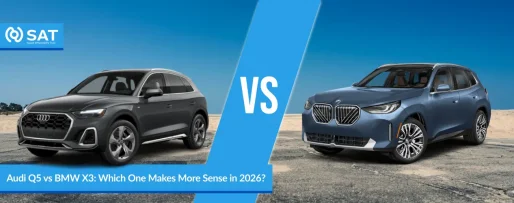
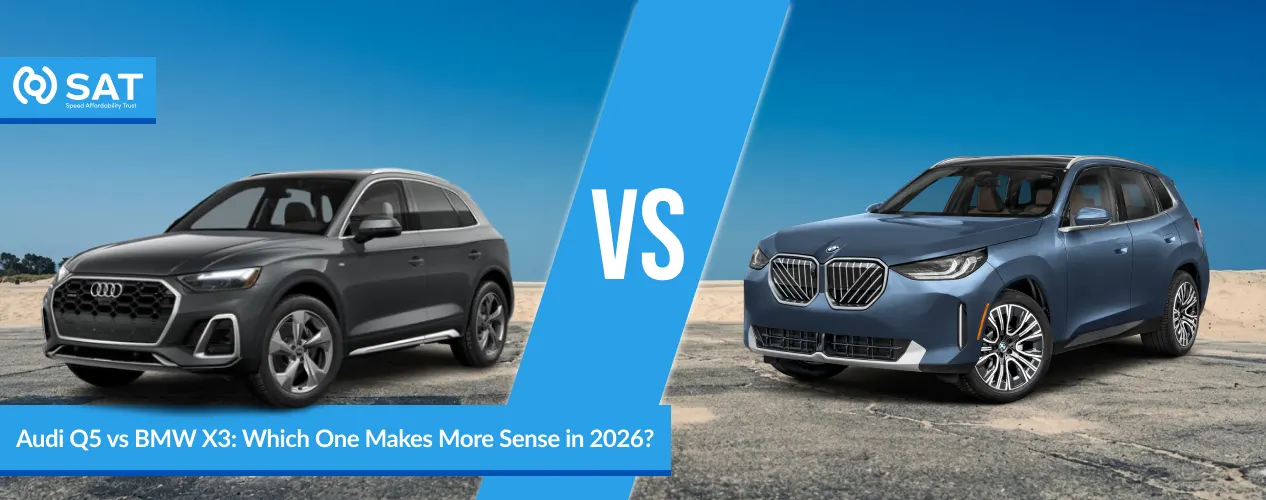
The BMW X3 makes more sense for most buyers in 2026, but the Audi Q5 has a few strong reasons to choose it instead. The Audi is slightly quicker in standard form, offers a sliding second-row bench, and puts more emphasis on comfort and cabin refinement. The BMW fights back with a lower starting price, much better fuel economy, more cargo space, and a better driving experience. This Audi Q5 vs BMW X3 comparison is close, but the differences become much clearer once you look past the badges.
Better all-round choice: BMW X3. It costs less to start, uses less fuel, carries more cargo, and still drives very well.
Better value at base price: BMW X3. The X3 30 xDrive starts at $51,300, while the Audi Q5 starts at $52,800 before destination charges.
Better standard performance: Audi Q5. Its 268-hp engine is stronger on paper, and Audi claims a quicker 5.8-second 0-60 mph time.
Better fuel economy: BMW X3. The X3 30 xDrive is rated at 27 mpg city and 33 mpg highway, well ahead of the Q5.
Better for comfort: Audi Q5. Its softer road manners, quiet highway behavior, and adjustable rear bench make it easier to relax in.
Better for luggage and family gear: BMW X3. It has 31.5 cu. ft. behind the rear seats compared with 27.6 cu. ft. in the Q5.
The Audi Q5 vs BMW X3 specs show two SUVs that look similar in size and power, but they are for two different buyers.
Specification | 2026 Audi Q5 | 2026 BMW X3 30 xDrive | Edge |
Starting MSRP | $52,800 | $51,300 | BMW |
Engine | 2.0L turbo 4-cylinder | 2.0L turbo 4-cylinder with 48V mild hybrid | BMW |
Horsepower | 268 hp | 255 hp | Audi |
Torque | 295 lb-ft | 295 lb-ft | Tie |
Transmission | 7-speed S tronic dual-clutch | 8-speed automatic | Depends on preference |
Drivetrain | quattro AWD | xDrive AWD | Tie |
0-60 mph | 5.8 sec, manufacturer claim | 6.0 sec, manufacturer claim | Audi |
City fuel economy | 21 mpg | 27 mpg | BMW |
Highway fuel economy | 29 mpg | 33 mpg | BMW |
Length | 185.7 in | 187.2 in | BMW is larger |
Width | 74.8 in | 75.6 in | BMW is wider |
Wheelbase | 110.9 in | 112.8 in | BMW |
Cargo behind rear seats | 27.6 cu. ft. | 31.5 cu. ft. | BMW |
Maximum cargo space | 56.9 cu. ft. | 67.1 cu. ft. | BMW |
Turning circle | 38.7 ft | 40.0 ft | Audi |
New vehicle warranty | 4 yr/50,000 mi | 4 yr/50,000 mi | Tie |
Included scheduled maintenance | 3 yr/30,000 mi | 3 yr/36,000 mi | BMW |
The table gives BMW more wins, but that doesn't make the Q5 the wrong choice. Audi's advantages are more evident in how the SUV feels day-to-day.
If you're still deciding between the two brands, our broader Audi vs BMW comparison looks at how they compare across performance, comfort, technology, and ownership.
The Audi Q5 vs BMW X3 price difference is minor. The BMW X3 30 xDrive begins at $51,300, while the 2026 Audi Q5 starts at $52,800. That puts the BMW ahead by $1,500 before destination charges and options.
Neither is cheap, of course. These are compact luxury SUVs, and the final price can rise quickly once larger wheels, driver-assistance packages, premium sound systems, or appearance packages are added to your receipt.
Both can become expensive, but Audi's trim and package ladder can push the Q5 well into the $60,000 range.
Audi's own U.S. site shows a 2026 Q5 Prestige with the S line black optic package at $63,495 before destination. BMW lists the much more powerful X3 M50 xDrive at $66,500, though that is a different performance model rather than simply an optioned X3 30. The smarter move with either SUV is to choose the one that meets your needs.
Expert Tip: Don't spend thousands on a larger wheel package just for the look. Bigger wheels can cost more to replace and may also make the ride firmer.
For most drivers, the BMW X3 is the more interesting SUV to drive. The Audi Q5 is the easier one to relax in. That is the main Audi Q5 vs BMW X3 performance split.
The Q5 gets a 268-hp 2.0-liter turbo four-cylinder with 295 lb-ft of torque. Audi quotes 5.8 seconds from 0-60 mph.
On the other hand, the X3 30 xDrive uses a 255-hp 2.0-liter turbo four-cylinder with 48-volt mild-hybrid technology. Torque is also 295 lb-ft, and BMW quotes 6.0 seconds to 60 mph.
Clear Winner: Audi wins the numbers.
The gap is only two-tenths of a second, though. That is not enough to make the X3 feel slow. Independent testing of the current-generation models recorded 5.8 seconds for the Q5 and 6.2 seconds for the X3 30 xDrive.
This is where the personalities separate. The X3 has stronger steering weight and responds more eagerly when the road starts to bend. Some buyers praised its balance between ride and handling, although the X3 can still feel firm over rough surfaces.
The Q5 is less interested in pretending to be a sports car. Its steering has been criticized for lacking feel, but the ride is comfortable, and the cabin stays calm at speed.
Here’s our take: BMW is for the driver. Audi is for the passenger. That is the simple version.
For a deeper look at the BMW on its own, read our full 2026 BMW X3 review, including its specs, features, pricing, and performance.
The BMW wins the Audi Q5 vs BMW X3 fuel economy comparison by a clear margin. The X3 30 xDrive is rated at 27 mpg city and 33 mpg highway.
Audi lists the 2026 Q5 at 21 mpg city and 29 mpg highway in its current U.S. technical information.
The BMW X3 should use less fuel, especially for drivers covering a lot of miles. Its advantage is greatest around town, where the mild-hybrid system and efficient four-cylinder powertrain help the X3 stretch a gallon further.
A driver doing only a few thousand miles per year may not care. A 15,000-mile-a-year commuter probably will. Fuel prices change. The MPG difference does not.
The Audi wins here, although neither cabin is perfect. The Audi Q5 vs BMW X3 interior battle has also changed because both brands now rely heavily on screens.
Both SUVs provide supportive front seats and plenty of adjustment.
The X3 comes with power-sport seats, while the Q5 offers a comfortable driving position with good adjustability. Neither has a clear space problem for front passengers. For a long trip, the Q5's calmer ride gives it a small advantage.
This one is more interesting than the exterior size suggests. The Q5 offers about 38.0 inches of rear legroom, while published specifications for the X3 list 36.3 inches.
Audi also fits a rear bench that can slide by about four inches and change its backrest angle. Push it back when people need more room. Move it forward when luggage matters more. That flexibility is genuinely useful.
Audi's cabin has a cleaner, more luxurious feel, but the latest Q5 is also much more screen-heavy than older versions.
The X3 is more controversial. Some buyers liked the quality of its screens but criticized the dashboard materials and illuminated plastic trim for feeling cheaper than expected for this price. Audi has not escaped criticism either. Independent reviewers have said the latest Q5's materials are less special than buyers may expect from the badge.
Neither car has a perfect cabin. Audi gets the edge, but only just.
To see BMW's approach higher up its luxury range, take a look at our BMW 7 Series guide.
The BMW X3 is the more useful cargo carrier. The Audi Q5 is cleverer with passenger space.
Almost, but the BMW is slightly bigger.
The X3 measures 187.2 inches long and 75.6 inches wide. The Q5 is 185.7 inches long and 74.8 inches wide. The BMW's wheelbase is also longer at 112.8 inches compared with 110.9 inches for the Audi.
These are small differences on a driveway. They matter more once you start driving them.
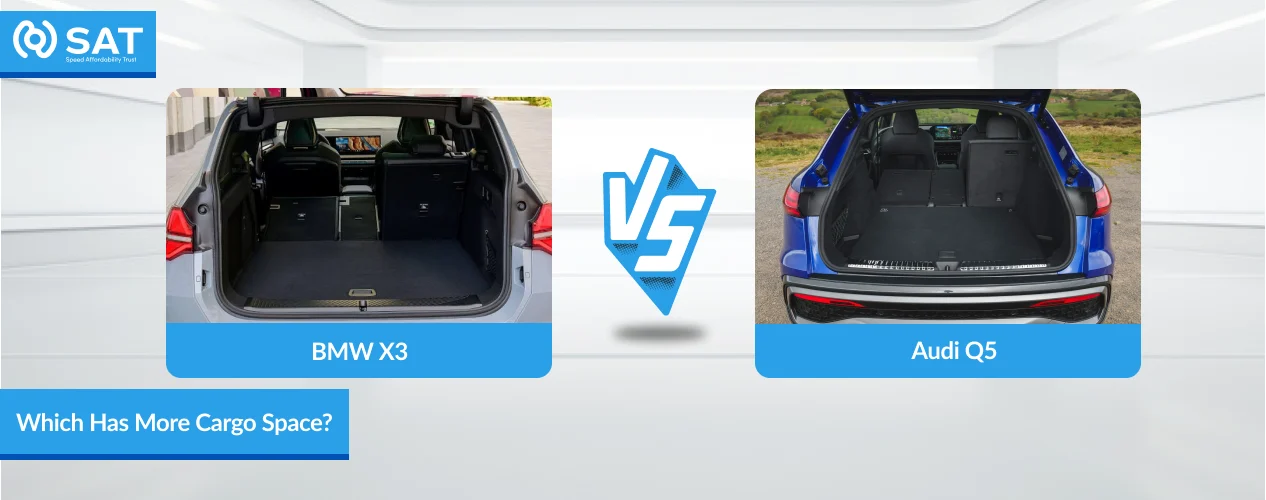
The BMW X3 wins easily.
It provides 31.5 cu. ft. behind the rear seats and 67.1 cu. ft. with them folded. The Audi Q5 provides 27.6 cu. ft. behind the rear seats and 56.9 cu. ft. with them folded.
That is nearly 10 extra cubic feet for the BMW with the seats down. For suitcases, sports equipment, moving boxes, or a big stroller, that extra room can be more useful than another luxury feature.
The Audi Q5 has the advantage if you plan to tow. The Audi Q5 has the advantage if you plan to tow. It can tow up to 4,400 pounds when properly equipped, compared with up to 4,001 pounds for the BMW X3 30 xDrive with the factory-installed trailer hitch.
The BMW X3 is the better family SUV if cargo space is the priority.
The Audi fights back with its sliding rear seat. A family carrying older children or adults in the second row may prefer that flexibility.
For everyday usability, the Audi gets our vote in this round. Mainly because Audi listened to criticism and brought back a proper steering-wheel scroll control for 2026.
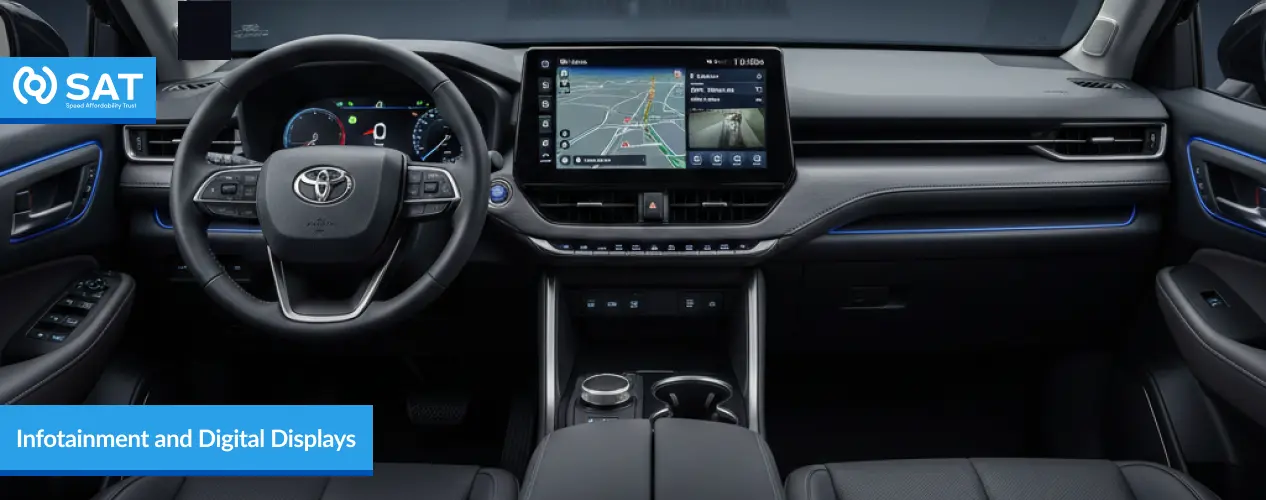
The Q5 uses an 11.9-inch digital instrument display and a 14.5-inch central MMI touchscreen. A 10.9-inch passenger screen is available.
The X3's curved display combines a 12.3-inch instrument screen with a 14.9-inch touchscreen running BMW Operating System 9.
BMW gives you slightly more central-screen area. That does not automatically make it easier to use.
Both support Apple CarPlay and Android Auto.
Audi provides wireless smartphone integration and has expanded how phone navigation, media, and calls appear across its displays for 2026. BMW also supports smartphone apps via Apple CarPlay and Android Auto, as well as voice control and remote software updates.
Nobody needs to choose between these SUVs because of CarPlay.
We give the Audi system a small edge for everyday use in 2026. Audi redesigned the MMI interface and returned the steering-wheel scroll wheel after criticism of touch-sensitive controls. That sounds small until you use the same control every day.
BMW's system looks sharp, but too many basic controls still live inside the touchscreen. Independent testing has also criticized some menu structures as needlessly complicated.
Both SUVs offer a strong range of driver-assistance technology. The BMW X3 comes standard with features including Active Blind Spot Detection, Lane Departure Warning, Frontal Collision Warning with City Collision Mitigation, Active Protection, and Active Driving Assistant.
The Audi Q5 also offers advanced assistance systems, including available adaptive cruise assist with lane guidance and a top-view camera system.
Both provide useful safety technology, so crash-test results are the better place to look if you want to separate them further.
There is not enough long-term 2026 data to honestly declare either SUV more reliable. That matters because the current X3 generation only arrived for the 2025 model year, and the current U.S. Q5 generation is also still new.
Any firm 2026 Audi Q5 vs BMW X3 reliability winner would be guesswork.
Audi gives the Q5 a 4-year/50,000-mile New Vehicle Limited Warranty. Roadside assistance is also included for four years.
For 2026, Audi now includes Signature Care scheduled maintenance for the first 3 years or 30,000 miles. That removes some routine service costs early in ownership.
BMW provides the X3 with a 4-year or 50,000-mile new-vehicle warranty. BMW Ultimate Care covers scheduled maintenance for 3 years or 36,000 miles.
That gives the BMW 6,000 more miles of included scheduled-maintenance coverage than the Audi.
Again, warranty and free maintenance are not the same thing as long-term reliability.
Warranty coverage is basically a tie. BMW wins the included-maintenance comparison because its mileage limit is higher.
Once both SUVs are outside warranty, service history becomes far more important. These are complex, turbocharged luxury SUVs with all-wheel drive and extensive electronics.
Expert Tip: If you're buying used, a complete service record is worth more than a slightly lower asking price. Check recall work, software updates, fluid leaks, warning lights, tires, brakes, and the condition of every electronic feature before buying.
If you're shopping pre-owned, you can compare current used BMW cars for sale and used Audi cars for sale before deciding which brand offers better value.
Numbers decide plenty in this comparison. They do not decide everything.
The Audi Q5 should be slightly easier to place in tight spaces. It is shorter and narrower than the X3 and has a tighter 38.7-foot turning circle, compared with 40.0 feet for the BMW. The difference is not huge, but city drivers may notice it in narrow garages and tight parking lots.
Both SUVs are well isolated at highway speeds. Independent testing measured the Q5 at 67 dBA during a 70-mph cruise, while separate testing of the X3 recorded 64.9 dB at the same speed.
Because those results came from different tests, they should not be treated as a direct head-to-head comparison. The bigger difference is character. The Q5 feels more focused on relaxed cruising, while the X3 combines good refinement with a more driver-focused feel.
Audi Q5 | |
Pros | Quicker standard acceleration, comfortable ride, quiet cabin, flexible sliding rear seat, smaller turning circle |
Cons | Higher base price, much weaker fuel economy, less cargo space, steering gives less feedback |
BMW X3 | |
Pros | Lower starting price, excellent fuel economy, larger cargo area, better steering, longer included maintenance mileage |
Cons | Firmer ride, less quoted rear legroom, screen-heavy controls, some cabin materials feel cheaper than expected |
Buy the Audi Q5 if comfort matters more to you than maximum practicality.
It suits buyers who want a quiet daily SUV, regularly carry adults in the back, drive in tight urban areas, and prefer a calmer feel behind the wheel. The sliding rear bench is a small feature with a real benefit. So is the tighter turning circle. There is also more standard horsepower than in the X3 30 xDrive.
If you don't need SUV space, our 2026 Audi A5 review covers another Audi option worth considering.
Skip the Q5 if fuel economy and cargo space sit near the top of your list. The BMW beats it clearly in both.
Buy the BMW X3 if you want the stronger all-rounder. It starts for less, uses less fuel, gives you more luggage space, and feels more interested in what the driver is doing. That combination is difficult for the Audi to beat.
The X3 makes particular sense for families carrying lots of gear, commuters covering high mileage, and buyers who still want some driving enjoyment from a compact luxury SUV.
Skip it if your roads are rough and ride softness matters more than steering feel.
If you're exploring more of the BMW range before deciding, you can also read our BMW 6 Series guide.
If you are ready to compare available options, SAT Japan makes it easy to browse both models in one place. Check the latest Audi Q5 cars for sale or explore available BMW X3 cars for sale to compare prices, model years, mileage, and specifications before making your choice.
The BMW X3 wins the Audi Q5 vs BMW X3 comparison for 2026. Not because it dominates every category. It doesn't.
The Audi Q5 is quicker, quieter, slightly easier to park, and more comfortable. Its sliding rear seat also makes the cabin unusually flexible.
If neither gives you enough room, our Audi Q7 vs Q8 comparison looks at Audi's larger SUV options.
But the X3 wins more of the differences that cost owners money or affect everyday use. It starts $1,500 lower, gets far better fuel economy, carries more luggage, and still has the better chassis.
For most buyers, the BMW X3 30 xDrive is the smarter choice.
Choose the Audi Q5 instead if comfort, rear-seat flexibility, and a calmer driving character matter more to you than fuel economy and cargo volume.
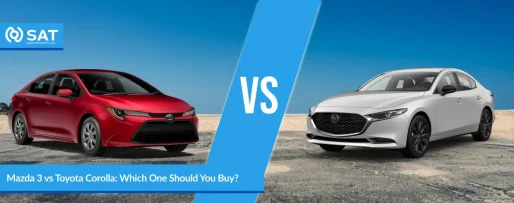
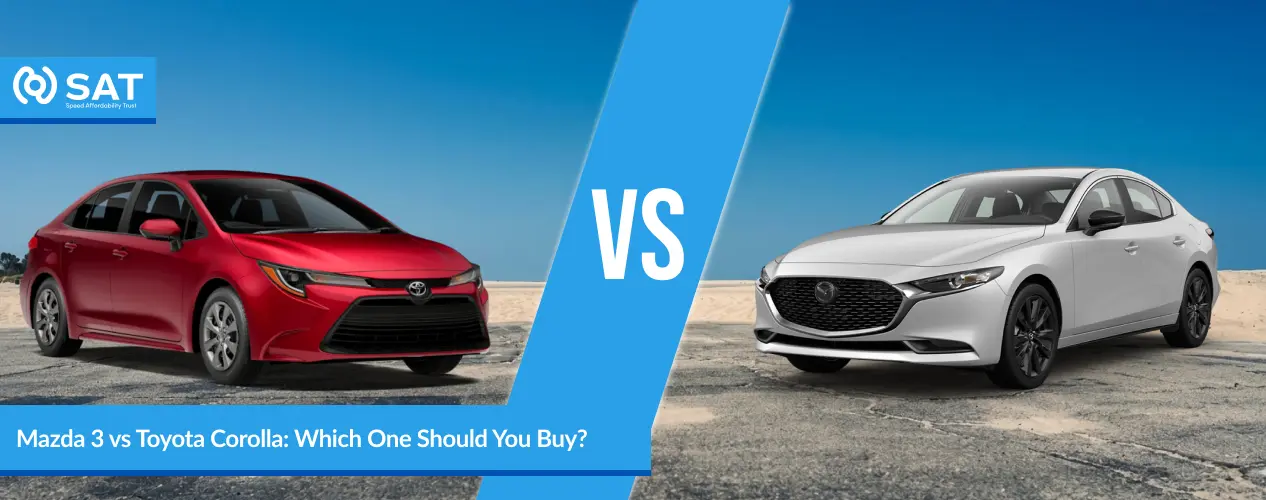
The most common comparison people make is between the Mazda 3 and Toyota Corolla based on horsepower, mpg, or cost. That's a mistake. Those are just a few of the numbers in the story. It really becomes apparent over months or years of ownership, when comfort, reliability, maintenance, and general driving experience are far more important than a spec sheet. In this Mazda 3 vs Toyota Corolla comparison, we'll delve deeper than the simple numbers to explore true fuel efficiency, durability, costs of ownership, cabin quality, driving, and resale value. If you're looking for a car that's fun to drive each day or a reliable commuter, this guide will help you select the compact car that's right for you.
Performance: The Mazda 3's 2.5L engine makes 191 hp, with an available turbo producing up to 250 hp and 320 lb-ft. The Corolla's 2.0L engine makes 169 hp and 151 lb-ft.
Fuel economy and size: The Corolla reaches 35 mpg combined, while the Corolla Hybrid reaches 50 mpg. The Mazda 3 reaches 31 mpg. The Mazda 3 sedan is also 183.5 inches long, compared with 182.5 inches for the Corolla.
Best fit: Choose the Mazda 3 for stronger performance and a more driver-focused experience; choose the Corolla for better fuel economy, practical passenger space, and lower long-term ownership costs.
At first glance, the 2026 Mazda3 and Toyota Corolla appear to be direct competitors, but when you compare the base versions of each model, you might get the wrong impression. The available trims, body styles, powertrains, and equipment can affect what you pay. That's why it's more than a spec sheet fight. We'll compare the 2026 model at the trim level, explore what you get as you'll spend more, and separate the gas Corolla from the hybrid versions. We will also explore comfort, usability, driving experience, safety, ownership costs, and value. At the end, you'll know which car will fit you and which version you need to purchase.
Factor | Mazda 3 | Toyota Corolla |
Starting MSRP | Around $25,000 | Around $23,500 |
Available Body Styles | Sedan & Hatchback | Sedan & Hatchback |
Most Powerful Engine | 2.5L Turbo (up to 250 hp with premium fuel) | 2.0L 4-cylinder (169 hp) |
Hybrid Option | Not Available | Available (up to 50 MPG combined) |
Fuel Economy | Better performance than efficiency | Better efficiency than performance |
Transmission | 6-speed Automatic | CVT (Gas & Hybrid) |
All-Wheel Drive (AWD) | Available on selected trims | On Hybrid models |
Driving Experience | Sporty steering, composed handling, quieter cabin | Smooth, comfortable, and easy to drive |
Interior Quality | Soft-touch materials, high-quality design and luxury feel | Efficient use of space and strong materials |
Rear Seat Space | Slightly tighter for taller adults | More rear legroom for passengers |
Cargo Space | Hatchback provides great versatility | Sedan has a larger trunk, while the hatchback is practical |
Safety Technology | Mazda i-Activsense® suite | Toyota Safety Sense™ 3.0 |
Reliability | Very few major problems, a good reliability record | Strong reliability and ownership satisfaction |
Maintenance Costs | A little more expensive because of high-quality parts used | Reduced average maintenance and repair expenses |
Resale Value | Strong | Excellent, one of the best in the compact car segment |
It's just a high-level comparison. Let's take a closer look at the Mazda 3 and Toyota Corolla, from fuel efficiency to hatchback convenience, hybrid options to interior room, reliability to maintenance costs and more, so you can make an informed decision when choosing the right compact car for you.
Neither car enters 2026 with a full redesign. Instead, both manufacturers made targeted updates to keep these long-running compact cars competitive. That matters because a 2026 badge does not automatically mean a completely different car.
For the 2026 Mazda3, the most useful change is equipment. Mazda made its eight-speaker Harmonic Acoustics audio system standard, while Bose remains available on higher trims. Mazda also made small packaging changes across the lineup rather than changing the Mazda3's basic formula.
The 2026 Corolla receives a more noticeable technology update. Toyota added a digital gauge cluster to the lineup, with a 7-inch unit on lower trims and a larger 12.3-inch display on selected higher trims. The Corolla also continues with both hybrid and gasoline versions, giving buyers more ways to configure the car.
2026 is an equipment-and-packaging year, not a new-generation year. That makes trim selection especially important—and we will compare those trims next.
The low prices of the Corolla and Mazda3 are not all that matters. After the first or two trims, the value equation changes rapidly. Toyota has six variants of the Corolla, including gas and hybrid, while the Mazda3 targets a number of gasoline models, with sedan and hatchback options.
2026 model | Starting MSRP* | What you are paying for |
Corolla LE | $23,125 | Lowest-cost Corolla sedan |
Mazda3 2.5 S | $24,550 | More performance-focused base model |
Corolla Hybrid LE | $24,975 | Hybrid powertrain without a large price jump |
Corolla SE | $25,565 | Sportier styling and equipment |
Mazda3 2.5 S Select Sport | $25,540 | More equipment while keeping the 2.5L engine |
Mazda3 2.5 S Preferred | $27,290 | More comfort and convenience features |
Base MSRP; destination, taxes, registration, and dealer charges are additional. Mazda pricing may vary by trim and body style.
The fascinating aspect is the overlap. Place the Corolla SE side by side with the Mazda3 Select Sport, and it's a far more level playing field than if you were to make a comparison between the lowest-priced Corolla and the lowest-priced Mazda3. Meanwhile, the Corolla Hybrid LE comes in at $425 above the Mazda3 2.5 S and offers a very different value proposition for those seeking fuel savings.
So, don't base your decision solely on the starting MSRP. The real question is: which trim offers all the features and driving experience you want at real value?
The 2026 Mazda3 is on top in performance, but it's more than just the 17 hp edge it has over the standard Corolla. The 2.5-liter engine is capable of generating 186 hp along with 186 lb-ft of torque, while the Corolla's 2.0-liter engine generates 169 hp and 151 lb-ft of torque. The added power results in a more aggressive acceleration and overtaking experience in the Mazda3.
With real testing, the difference becomes more apparent. The Mazda3 hatchback took 7.0 seconds to reach 60 mph, while the Corolla FX hatchback took 8.2 seconds.
The difference is stark when it's the Mazda3 Turbo. Up to 250 hp and 320 lb-ft of torque are available from its 2.5-liter turbo engine on high-quality fuel.
The Corolla Hybrid is the opposite. It has 138 net combined hp and is designed to save fuel, not accelerate.
When it comes to performance, the Mazda3 is the winner.
While the 2026 Toyota Corolla certainly looks like the fuel-economy winner, the difference in fuel economy goes beyond MPG. The Corolla LE is rated at 32 city, 41 highway, and 35 combined MPG, compared with 27/36/30 MPG for the 2026 Mazda3 2.5 S.
Using EPA estimates, that 5-mpg differential translates to about 71 fewer gallons of gas per year for the Corolla when driven 15,000 miles annually. This amounts to $3.50 per gallon, totaling $249 in annual fuel savings.
With the Corolla Hybrid, the disparity is significantly bigger. The Toyota Corolla FWD version gets 53 city and 46 highway MPG, which is particularly appealing to those who drive thousands of miles on city roads annually.
2026 model | City | Highway | Combined |
Mazda3 2.5 S | 27 MPG | 36 MPG | 30 MPG |
Corolla LE | 32 MPG | 41 MPG | 35 MPG |
Corolla Hybrid FWD | 53 MPG | 46 MPG | — |
You get a more aggressive driving experience with the Mazda3, but at the expense of higher fuel consumption. If low fuel consumption is a top concern, the Corolla may be the better option.
The Mazda 3 and Toyota Corolla take completely different approaches to exterior design. The smooth body panels and minimal ‘hard edges' design of Kodo Design by Mazda make for a clean yet modern appearance. More attention is being drawn to the Corolla's larger front grille, angular lighting, and more angular body lines, particularly the SE and XSE.
The most noticeable distinction is with the hatchbacks. Compared with the Toyota Corolla hatch, the Mazda 3 hatch focuses on styling, with a coupe-like rear profile. Toyota maintains a taller rear hatch to enhance rear visibility and facilitate loading bulky items.
The exterior design is not just about looks. The timeless styling of the Mazda 3 is less likely to feel dated over a few years. On the other hand, the Corolla's sporty front end is more attractive to buyers seeking a more aggressive initial impression. It is all about your preference for long-lasting style or an impactful first impression.
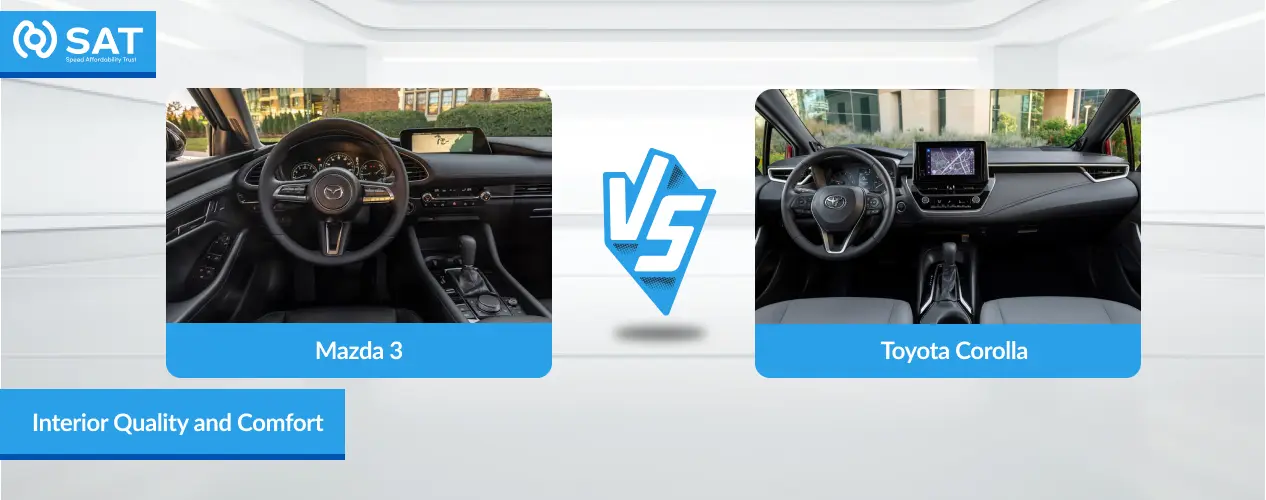
The 2026 Mazda3's biggest selling point is its driver-centric design. It features high-quality cabin materials, supportive front seats, physical climate controls, and a driver-friendly layout. Additionally, the Mazda3 is well insulated from engine and road noise, making it feel more expensive on longer trips.
That is not the approach of the Corolla. The back seat of the sedan offers more usable space than the Mazda3, and its controls are easy to understand and simple to use. If you frequently transport adults or children in the rear seat, the Corolla is the simpler option.
There is, however, a very important trade-off. The driver's seat in the Mazda3 is its best, and the Corolla's greatest strength is its practicality for everyday use. The rear cabin in the Mazda can be tight and cramped, whereas the rear cabin in the Corolla sedan is easier to live with.
Therefore, if you spend the majority of your time in the driver's seat, the Mazda3 is a special vehicle. If you transport passengers regularly, it's better to consider the Corolla.
The 2026 Mazda3 and Toyota Corolla are quite similar in size, but they're not as practical. The Mazda3 sedan is 183.5 inches long and 70.7 inches wide; the Corolla is 182.5 inches long and 70.1 inches wide. That tiny bit of change also brings an extra inch of front shoulder room and an inch of front headroom to the Mazda3.
Dimension | 2026 Mazda3 Sedan | 2026 Toyota Corolla Sedan |
Length | 183.5 in | 182.5 in |
Width | 70.7 in | 70.1 in |
Wheelbase | 107.3 in | 106.3 in |
Front legroom | 42.3 in | 42.0 in |
Rear legroom | 34.4 in | 34.8 in |
Cargo space | 13.2 cu. ft. | 13.1 cu. ft. |
Turning circle | 34.8 ft. | 35.6 ft. |
Here's the odd thing: the Corolla offers a bit more rear-seat room; the Mazda3 offers more driving room and a tighter turning radius. The difference in the sedan cargo bed is virtually inconsequential.
That makes the Mazda3 a more likely choice for the driver who uses it for everyday driving, whereas the Corolla seems a little more practical when there are passengers in the back seats. But if you pick a hatchback, the comparison is completely different.
The 2026 Mazda3 Hatchback and Toyota Corolla Hatchback look like close rivals, but their numbers tell an interesting story. The Mazda3 is much longer, with a 107.3-inch wheelbase, while the Corolla uses a shorter 103.9-inch wheelbase. That matters inside: the Mazda3 gives rear passengers 34.4 inches of legroom, compared with only 29.9 inches in the Corolla Hatchback.
Cargo space also favors Mazda. The Mazda3 offers 20.1 cubic feet behind the rear seats, compared with 17.8 cubic feet in the Corolla. But Toyota fights back with better fuel economy: the Corolla Hatchback SE reaches 35 mpg combined, while the Mazda3 2.5 S returns 29 mpg.
2026 Hatchback | Mazda3 | Corolla |
Starting MSRP | $25,550 | $24,580 |
Horsepower | 186 hp | 169 hp |
Cargo space | 20.1 cu. ft. | 17.8 cu. ft. |
Combined MPG | 29 | 35 |
Rear legroom | 34.4 in. | 29.9 in. |
For cargo, rear-seat comfort, and driving performance, choose the Mazda3. For fuel savings and a lower starting price, the Corolla makes more sense.
The biggest advantage of the 2026 Corolla Hybrid is not simply its fuel economy. It gives buyers another way to configure the Corolla. Toyota offers the Hybrid in several grades, including LE, LE AWD, SE, SE AWD, and XLE, so buyers can choose among lower-cost models, sportier equipment, or all-wheel drive. Mazda does not offer a hybrid version of the 2026 Mazda3.
Price also makes the hybrid interesting. The Mazda3 sedan starts at $24,650, while the Corolla Hybrid LE is priced close to that figure. That means the decision is not simply about paying a large premium for hybrid technology.
There is also a useful ownership advantage. Toyota provides separate coverage for hybrid components, including long-term protection for the hybrid battery, while ToyotaCare covers scheduled maintenance for the first two years or 25,000 miles.
For shoppers who want choice, hybrid technology, or AWD without leaving the Corolla lineup, the Hybrid gives Toyota a major advantage that the Mazda3 cannot match.
The driving experience of a Mazda 3 is quite different from that of the Toyota Corolla. Mazda is geared toward drivers who like to be in control of their car. Toyota's design is aimed at those wanting comfort and convenience for daily driving.
The Mazda 3's steering is sharper, and the suspension is firmer, which provides enhanced body control through corners and added confidence on the highway. It also quiets the wind, making long trips more comfortable and quieter. The compromise is that people feel the bumps and potholes more in the Camry than in the Corolla.
The Corolla features lighter steering and a softer suspension, which help absorb bumps better, particularly on rough city roads. It also has a CVT that delivers smooth acceleration, but it's not as responsive when overtaking quickly.
The most significant difference is in driving character, not the performance. The Mazda 3 is more rewarding if you like to be connected to the road and spend a lot of time on highways. The Corolla will be the more comfortable option if you drive in the city, ride over rough pavement, or travel long distances regularly.
The 2026 Mazda3 and Corolla seem to be making an undeniably different decision regarding driver-technology interaction. Instead, Mazda provides a multifunction Commander control so the driver can access the menus without reaching for the screen, along with an 8.8-inch display. Rather complex, but it provides the main controls within easy reach of the driver.
The Corolla's touchscreen is its focal point. It normally runs on an 8-inch display; there is also a 10.5-inch screen available. The system is more familiar to most smartphone users; therefore, there is less of a learning curve.
That means there's an easy-to-solve problem: Mazda focuses on interaction that is controlled and driver-centric, while Toyota focuses on the familiar touchscreen interface. Neither of these is a superior one in and of itself. Mazda's physical controller might be more natural if you frequently adjust the navigation or audio while driving. Corolla might be the more accessible option if you need to tap, swipe, and learn the system in a short period of time.
Both the 2026 Mazda3 and 2026 Toyota Corolla offer a solid package in terms of safety, but the difference lies in the trims each model offers. The Mazda3 comes standard with a number of key driver-assistance features, including Mazda3 Smart Brake Support, Blind Spot Monitoring, Rear Cross Traffic Alert, Lane-Keep Assist, Radar Cruise Control, Driver Attention Alert, and Lane Departure Warning. Mazda's 2026 Mazda3 sedan and hatchback have also earned an IIHS Top Safety Pick+ rating.
There's a significant adjustment for 2026. Blind Spot Monitor with Rear Cross-Traffic Alert is a new standard feature on all Corolla models, including the $23,125 LE. Other features of Toyota Safety Sense 3.0 are automatic emergency braking with pedestrian detection, Lane Tracing Assist, Full-Speed Range Dynamic Radar Cruise Control, Road Sign Assist, and Automatic High Beams.
Safety consideration | 2026 Mazda3 | 2026 Toyota Corolla |
Blind-spot monitoring | Standard | Standard |
Rear Cross-Traffic Alert | Standard | Standard |
Automatic emergency braking | Standard | Standard |
Lane assistance | Standard | Standard |
Adaptive cruise control | Standard | Standard |
IIHS 2026 Top Safety Pick+ | Yes | No current award listed |
Advanced parking/rear braking equipment | Trim dependent | Trim dependent |
The simple truth is that Toyota has filled a vital equipment gap and now offers blind-spot protection as standard across all Corolla variants. Mazda's 2026 sedan and hatchback Mazda3 are still a big advantage for independent safety award recognition, earning the Top Safety Pick+ award from the IIHS.
There's also a good tip to buyers: a safety award doesn't necessarily correspond to the same crash-test rating for all versions of a vehicle. Every IIHS test is of a specific body style and configuration, and buyers should consider the specific Mazda3 or Corolla they are interested in purchasing, not just the name.
The Corolla has now become very impressive at the base with the standard safety equipment. If safety ratings are a priority for a buyer, the Mazda3 has a more solid independent safety record for 2026.
The 2026 Toyota Corolla's reliability claim is more robust, but you can't make any guarantees about what either vehicle will do after 10 or 15 years. For now, there is evidence that Toyota is ahead: J.D. Power rated the Corolla 81/100 for Quality & Reliability, while the Mazda3 received 77/100.
Both cars have a 3-year/36,000-mile basic warranty and a 5-year/60,000-mile powertrain warranty. ToyotaCare provides scheduled maintenance for 25,000 miles or 2 years, adding value to Toyota.
While the turbo version will be a powerful option in its own right, the naturally aspirated 2.5-liter will appeal to Mazda buyers who prefer to avoid the hassle of long-term ownership. Also, separate hybrid-component coverage is included for Corolla Hybrid vehicles, including coverage of the battery for 10 years/150,000 miles.
Of the two, Corolla has the more solid reliability backing, while Mazda3 is a solid alternative, particularly as a non-turbo model.
The sticker price is not always a good indicator of the car's ownership cost. Higher costs for the 2026 Mazda 3 and Toyota Corolla include fuel, maintenance, insurance, and depreciation. 5-year costs give the Mazda3 2.5 S sedan an estimated $37,733 in ownership costs, while the Corolla LE has an estimated $36,948. However, the cause of that disparity is more interesting.
5-year cost | Mazda3 2.5 S | Corolla LE |
Fuel | $8,919 | $7,652 |
Maintenance | $3,924 | $3,266 |
Repairs | $602 | $543 |
Depreciation | $7,912 | $8,368 |
Total ownership | $37,733 | $36,948 |
The Corolla is more fuel- and maintenance-efficient, but the Mazda3's estimated depreciation is lower. That's a huge piece of information that's frequently overlooked when the Corolla is just referred to as the “cheaper car.”
It's unlikely that anyone would consider a single ownership cost figure universal, but Mazda3 buyers should be mindful of its current 5-year depreciation estimate of $12,952. In contrast, Corolla buyers should be aware that depreciation is estimated at $8,673.
Another benefit offered by Toyota is ToyotaCare, which includes scheduled maintenance for 2 years or 25,000 miles.
While the Corolla might offer an ownership cost advantage, it doesn't have to be significant. The actual winner may vary depending on your mileage, insurance rate, selected trim, and length of time you own the car.
Premium cabin with an entry-level luxury-car feel.
You can count on sharp steering and confident driving, which makes every trip more interesting.
Both the all-wheel drive and the rare 250-hp turbo engine are available.
The cabin is quiet at highway speeds, which decreases driver fatigue on long trips.
Tight reliability track record, notably on the naturally aspirated 2.5L engine.
Higher price than the Toyota Corolla at launch.
Fuel and maintenance expenses are higher for turbo models.
The rear seat is cramped, particularly in the hatchback.
Thick rear pillars reduce rear visibility.
No hybrid option for buyers who want to save as much fuel as possible.
Superb reliability and long-term performance, having been proven for decades.
Improved operating expenses due to superb fuel economy and low maintenance.
The hybrid model is extremely efficient with no need to charge.
Larger rear seat and improved views to the outside of the Mazda 3.
High resale value is one way to lower long-term ownership costs.
Less powerful engine and slower acceleration than the Mazda 3.
The CVT is more about efficiency than fun to drive.
Cabin materials are more functional than luxury ones.
No all-wheel drive for U.S. gas-powered models.
The top trims are close to the better-equipped Mazda 3, but don't deliver the same driving experience.
The Mazda 3 is the car for someone who wants a car for more than just a means to get from point A to point B. If you drive an hour or more a day, you'll want a car that's fun to drive long after you purchase it.
It's also ideal for those looking for a longer-term vehicle and who want to invest a bit extra initially for an even better driving experience. These buyers don't care about the lowest running cost, but the feeling of driving the car.
If your lifestyle is to carry adults in the back seat, save fuel, or keep costs as low as possible, the Mazda 3 is not the vehicle for you. In such cases, the Toyota Corolla is typically the better option.
You drive long distances or spend a lot of time behind the wheel.
You like to drive rather than just commute.
You plan to keep your car for 7–10 years.
You appreciate satisfaction from ownership more than purchase price.
You typically share your trips with a partner, or one child, and not a bunch of kids in the car.
For reliable transportation and predictable running expenses, the Corolla is among the safest potential long-term investments in the compact car market.
It's particularly good for first-time car buyers, students, expanding families, and commuters who drive long distances weekly. For those who don't need the most thrilling ride but rather keep fuel, maintenance, and repair costs manageable, the Corolla is an ideal choice!
For customers who plan to resell or trade their car after a few years, the Corolla is a good option too. It has a great reputation, has demand in the used car market, and can recover more of the original investment than many competing compact cars.
You want the lowest possible long-term ownership costs.
You drive high annual mileage and want to spend less on fuel.
You regularly carry rear-seat passengers or need a practical daily commuter.
You value proven reliability over performance.
You want a car that's easy to maintain almost anywhere because parts and service are widely available.
Purchasing a used Mazda 3 or Toyota Corolla from Japan is not the same as buying it at local dealerships. The most difficult part isn't picking the model; it's finding a car with a proven record. When considering the car, not only are the year and mileage important, but also the vehicle's condition, so always look at the car itself, not the badge.
If importing through SAT Japan, be sure to note the Auction Sheet, Auction Grade, inspection photos, and the condition of the underbody. These documents provide information that cannot be seen just by looking at the pictures, such as details from previous repairs, rust, scratches, or replaced body panels. The pre-purchase review can help avoid unpleasant surprises that may arise after the car is on the road.
International buyers must verify import restrictions, taxes, emission standards, and availability of spares in their country prior to ordering. An easy-to-import, low-maintenance car will typically offer a better car ownership experience than a cheaper car.
The Mazda 3 and the Toyota Corolla are two great options, but which one is best depends on your driving style and preferences, not on who has the most wins in the comparison categories. When purchasing a used Japanese vehicle, it may be more important to pick a well-maintained car than to select between these two models. That's why many international buyers choose to purchase from SAT Japan. We review auction sheets, provide inspection reports, and vehicle history before purchase. A good Mazda 3 or Corolla with a proven track record will almost always be a better investment than a poor car with an unknown history.
_1785759576.webp)
The Jeep Wagoneer vs Grand Wagoneer comparison changed completely for 2026. Jeep discontinued the standalone Wagoneer after the 2025 model year and moved its role under the Grand Wagoneer name, creating a wider lineup that now covers both mainstream and luxury buyers.
I tested a 2025 Wagoneer and a 2026 Grand Wagoneer back-to-back. They share the same full-size SUV roots, but the differences in price, trims, technology, and overall value become clear once you spend time with both.
Here's my honest take on both.
Our rating: 8.2/10
This score is based on performance, interior and technology, value, safety, and import practicality. Each category is scored out of 10.
Performance: 8.5
Interior & Tech: 8.7
Value: 7.5
Safety: 8.0
Import Friendliness: 6.5
Overall: 8.2/10
So this Jeep Wagoneer vs Grand Wagoneer comparison isn't just about trim levels anymore; it's about knowing what you're actually buying. If you're importing from outside the US, this name change matters for you, so stick with us to the end.
Jeep ended production of the standalone full-size Wagoneer after the 2025 model year.
The 2026 Grand Wagoneer now starts at $63,995 at the time of writing.
Its standard 3.0-liter Hurricane twin-turbo engine produces 420 horsepower and 468 lb-ft of torque.
Lower Grand Wagoneer trims now cover the role previously filled by the regular Wagoneer.
A new full-size SUV carrying only the “Wagoneer” badge is no longer available, although the separate electric Wagoneer S remains in Jeep’s lineup.
Buyers outside the United States should calculate freight, taxes, duties, registration, and compliance costs for their specific destination.
A new Wagoneer doesn't exist in 2026. Jeep pulled the plug and merged everything under Grand Wagoneer. That one fact untangles almost every confusing thing floating around about this comparison right now. Price-wise, the 2026 Grand Wagoneer starts about $20,000 below where it used to, close enough to the old base Wagoneer that the gap barely registers. Mechanically, nothing much moved: same 3.0L Hurricane six, same 8-speed automatic, roughly the same 10,000-pound towing capacity. And if you're buying from outside the US, none of it matters much anyway. Both nameplates are left-hand drive only, so your import math stays identical no matter which name you were chasing.
The Jeep Grand Wagoneer vs Jeep Wagoneer specs table below is labeled by year because these models are now a model year apart rather than direct competitors.
Spec | 2025 Wagoneer (discontinued) | 2026 Grand Wagoneer (current) |
Starting MSRP | $59,945 (2WD) | $63,995 (standard, w/ destination) - $66,995 (Grand Wagoneer L) |
Top trim MSRP | $83,440 (Wagoneer L Series III Super) | $100,000+ (Summit Reserve) |
Engine | 3.0L Hurricane twin-turbo I6 | 3.0L Hurricane twin-turbo I6 |
Output | 420 hp / 468 lb-ft | 420 hp / 468 lb-ft |
Transmission | 8-speed automatic | 8-speed automatic |
Drivetrain | RWD or 4WD | RWD standard, 4WD available/included by trim |
EPA-estimated MPG, city/highway | 17/24 RWD; 16/23 4WD | Up to 17/24 RWD |
Max towing | 10,000 lbs | 10,000 lbs |
Wheelbase (std / L) | 123 in / 130 in | 123 in / 130 in |
Length (std) | 214.7 in | 216.1 in |
Cargo behind third row, L models | 42.1 cu ft | 42.1 cu ft |
Seating | 7 or 8 passengers | 7 or 8 passengers |
Air suspension | Available on upper trims | Available on upper trims |
Infotainment | Uconnect 5 | Uconnect 5 |
Safety features | 100+ standard/available | 170+ standard/available |
Powertrain warranty | 5 years / 60,000 miles | 5 years / 60,000 miles |
A base 2026 Grand Wagoneer matches or beats an old Wagoneer on nearly every line in that table. The one thing you're actually giving up is the plain-sounding name. That's the real loss.
Expert Tip: The 2026 Grand Wagoneer carries a four-star overall NHTSA rating, with five stars in front and side impact but only three stars for rollover, worth knowing given the vehicle's height and weight. Check current scores at NHTSA's ratings page before you buy.
Status: Wagoneer discontinued after the 2025 model year
Replacement: Grand Wagoneer covers every trim for 2026
Official reason: Jeep has not published a detailed single reason on its discontinued-vehicle page.
Jeep officially confirms that the standalone Wagoneer is no longer in production and directs buyers to the 2026 Grand Wagoneer. The practical result is that the Grand Wagoneer now covers a wider range of prices and equipment levels. Lower trims serve buyers who may previously have considered the regular Wagoneer, while the upper trims continue to compete in the luxury full-size SUV segment.
The main change is the new entry price. The 2026 Grand Wagoneer starts at $63,995, while the outgoing 2025 Wagoneer started at $59,945. That creates a base-price difference of about $4,050 before options and market-specific charges. In practical terms, the entry-level Grand Wagoneer now sits much closer to the old Wagoneer’s price range than earlier Grand Wagoneer models did.
So if you're mid-research and you come across a 2026 comparison treating these as two live, separate products? You're either reading stale content or a leftover-versus-new comparison in disguise. There's no "which new one" decision anymore. What you're actually deciding between is an outgoing 2025 Wagoneer (used or leftover only), a current Grand Wagoneer, or something that isn't a Jeep at all.
Clear Winner: Not applicable, this is a status change, not a competition. There's no "new Wagoneer" left to compare against.
Cabin quality: Grand Wagoneer got the plusher materials and bigger badge
Engine (pre-2024): Grand Wagoneer ran the bigger V8
Price: Wagoneer carried the lower sticker
Before the merger, this was still a fair thing to ask. It's still relevant if you're eyeing leftover 2025 stock or a used Wagoneer today. Both SUVs sat on the same platform, and for most of their run together, the gap between them was thinner than the two separate names suggested.
The Grand Wagoneer got the plusher cabin, the bigger badge, and, until the engine swap, a bigger V8 up front. Wagoneer got a lower price tag and a slightly plainer interior. That's really the whole story.
Clear Winner: Depends on priority; Wagoneer wins on price, Grand Wagoneer wins on materials and badge prestige.
Wheelbase: 123 in standard, 130 in L, identical on both
Length: 214.7 in (Wagoneer) vs 216.1 in (Grand Wagoneer)
Interior space: legroom, headroom, and cargo room nearly identical
Basically, yes. Standard wheelbase ran 123 inches on both; the extended L body stretched that to 130 inches on both. Overall length came in at 214.7 inches for Wagoneer and 216.1 for Grand Wagoneer, a difference you'd need a tape measure to even notice. The L versions grew further still, landing somewhere around 226 to 228 inches depending on trim. Sit in either one and nothing feels different. Legroom, headroom, cargo space, all of it lined up nearly identically across both names.
Clear Winner: Tie
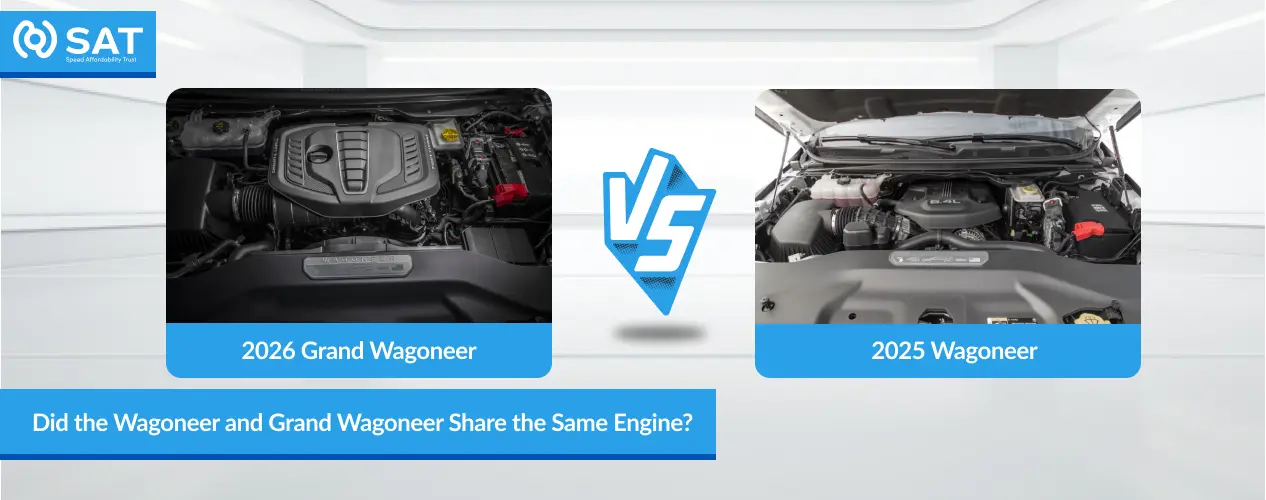
Engine family: 3.0L Hurricane twin-turbo inline-six
2025 Wagoneer output: 420 hp and 468 lb-ft
2025 Grand Wagoneer output: 540 hp and 521 lb-ft
2026 Grand Wagoneer output: 420 hp and 468 lb-ft
Transmission: Eight-speed automatic
They used the same 3.0-liter Hurricane twin-turbo engine family, but they did not always use the same version or output. The 2025 Wagoneer produced 420 horsepower and 468 lb-ft of torque. By comparison, the 2024 Grand Wagoneer used a 510-hp version, while the 2025 Grand Wagoneer increased output to 540 horsepower and 521 lb-ft. For 2026, the Grand Wagoneer moves to the standard-output Hurricane engine with 420 horsepower and 468 lb-ft. All these versions use an eight-speed automatic transmission.
By the time Jeep actually merged the badges, there was barely a powertrain argument left to make. The mechanical gap had already closed two full years earlier.
Clear Winner: The 2025 Grand Wagoneer was considerably more powerful. However, the 2026 Grand Wagoneer now uses the same 420-hp output as the outgoing 2025 Wagoneer.
2025 Wagoneer starting price: $59,945 (2WD)
2026 Grand Wagoneer starting price: $63,995
Price gap: approximately $4,050 higher
Here's the number people are actually typing into Google. The 2026 Grand Wagoneer opens at $63,995 with destination included for the standard-wheelbase model; the longer Grand Wagoneer L starts at $66,995. Dealer listings tend to run a touch higher once regional fees stack on top. Whatever number you land on, it's roughly $20,000 under where the outgoing 2025 Grand Wagoneer used to start.
Now put that next to the last 2025 Wagoneer, which opened around $59,945 in base two-wheel-drive form and $62,945 with four-wheel drive. The new Grand Wagoneer's floor sits within a few thousand dollars of that old, cheaper Wagoneer price. Not identical, no, but close enough that arguing over "which one's actually cheaper" isn't really worth your time anymore.
Trim-wise, 2026 runs Grand Wagoneer (base), Limited Altitude, Upland, 85th Anniversary Edition, Limited Reserve, Summit Obsidian, and Summit Reserve, rolling out in waves: base, Limited Altitude, and Summit Obsidian launched first, with Upland and Summit Reserve following later in the model year. Top trim still clears six figures and lines up against the Cadillac Escalade, Lincoln Navigator, and Lexus LX 600.
Shopping from outside the US? This price reset doesn't touch your math one bit. You're still tacking on roughly $8,000 to $20,000-plus in landed cost over whatever the US window sticker says.
The dollar gap didn't shrink because Jeep decided to make Grand Wagoneer affordable out of the goodness of its heart. It shrank because Jeep deleted the cheaper badge and rebuilt the bottom rung of Grand Wagoneer to fill the hole.
Clear Winner: Old Wagoneer, by a slim margin on price, but it's no longer available new.
Successor trims: Base Grand Wagoneer and Upland
Base-price gap vs old Wagoneer: Approximately $4,050 higher
What you gain: 170+ safety features, refreshed front end, RWD option
This is the part almost no one else writing about this topic bothers to answer, and if you actually liked the old Wagoneer, it's probably the most useful thing in this whole guide. The base Grand Wagoneer and Upland are the practical successors, offering the closest prices and standard feature sets to the old Wagoneer trims.
What do you gain stepping from an old Wagoneer into a new base Grand Wagoneer? A refreshed front end. Rear-wheel drive is the more fuel-efficient setup, while four-wheel drive trades some fuel economy for additional traction. The current Uconnect 5 stack. What do you lose? The plain “Wagoneer” name and a starting price approximately $4,050 higher.
If you specifically wanted the cheapest possible way into a Wagoneer-badged SUV, I'll be straight with you: that exact vehicle doesn't exist new anymore. A certified pre-owned 2025 Wagoneer is the closest thing you'll find; same feel, same badge, used pricing.
Bottom line, though: if the old Wagoneer's appeal to you was the price point, the base 2026 Grand Wagoneer covers that role. It's not a downgrade. It's the same job at a slightly higher entry fee.
Clear Winner: Base/Upland Grand Wagoneer, same job as the old Wagoneer, slightly higher entry fee.
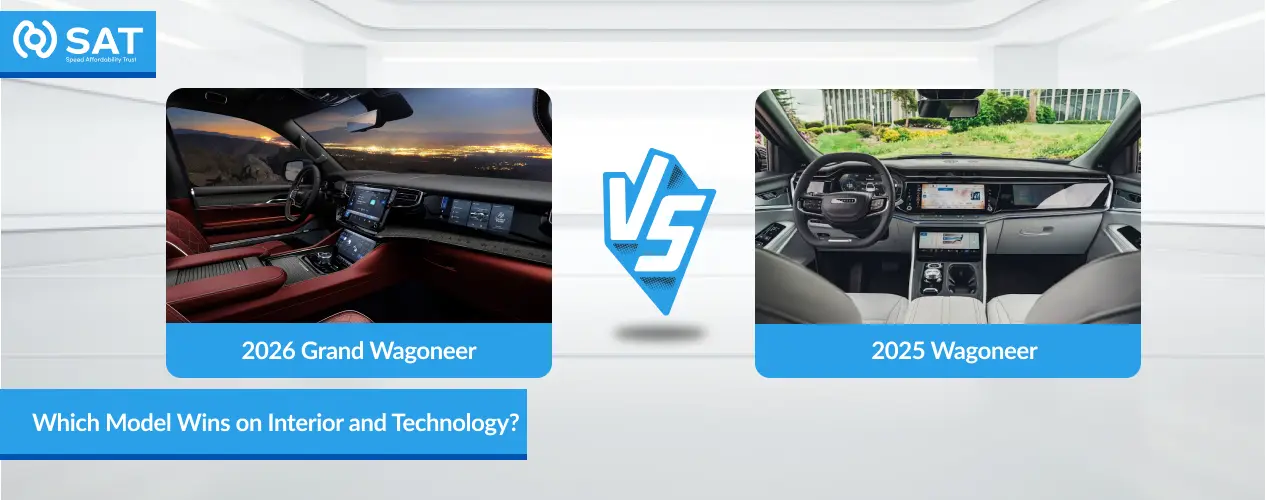
This question hasn't really changed shape. It's just organized by trim now instead of by name badge. Step into a Summit or Summit Reserve and you get Nappa leather, open-pore wood, massaging front seats, and a 23-speaker McIntosh sound system. I’ll admit it: this is one of the nicer cabins I’ve sat in from an American brand. It is quiet, tightly put together, and not remotely shy about showing off.
Drop down to base or Upland, and you still get leather standard, a 12.3-inch center display, wireless Apple CarPlay and Android Auto, and a 9-speaker Alpine system, while a 19-speaker McIntosh system is available on higher trims. Across the whole lineup you'll find Uconnect 5, a Fire TV-powered rear entertainment system, wireless charging, and a hands-free power liftgate as shared kit.
One quirk survived the merger completely intact. Base and Upland trims still default to an 8-passenger bench layout, exactly what the old plain Wagoneer favored, while the upper trims default to 7-passenger captain's chairs, just like Grand Wagoneer always did. That old feature split never actually disappeared. It just moved inside a single nameplate.
Clear Winner: Summit Reserve for outright luxury; base/Upland for best value.
Expert Tip: The 2023–24 Wagoneer earned an IIHS Top Safety Pick, one of the few large SUVs to clear that bar outright. See how the current lineup scores at IIHS's ratings page, before comparing it against the Land Cruiser or LX 600.
Almost nobody covering this topic mentions resale, which feels like a strange gap for a purchase in this price range. Discontinued nameplates can push values in either direction in the short term. Some buyers avoid an "orphaned" badge out of caution. Others chase remaining new inventory precisely because they expect it to dry up.
Reality check: 2025 Wagoneer inventory only gets smaller from here. Dealer lots aren't getting restocked, period. If you're buying used, and that describes most people reading this from outside the US, a discontinued nameplate usually means a supply pool that ages and shrinks over time. Want the old Wagoneer badge specifically? Buy sooner rather than later.
One honest caution while we're on the subject: full-size Jeep flagships have historically lost value faster than comparable Toyota or Lexus full-size SUVs in the same price bracket. Worth keeping in mind before you drop six figures on either Jeep nameplate over a Japanese import alternative.
Discontinuation doesn't automatically translate into stronger resale. For the old Wagoneer specifically, it more likely means a used pool that keeps getting harder to find.
Clear Winner: Toyota/Lexus alternatives; they hold value better long-term than either Jeep nameplate.
This is where the two nameplates stop mattering, and geography takes the wheel. Neither Wagoneer nor Grand Wagoneer has ever come in factory right-hand drive. Not one unit, ever. That single fact rules both out for the UK, Australia, New Zealand, Japan, Kenya, Tanzania, Trinidad, Jamaica, and most of the right-hand drive world, no matter which badge is bolted to the tailgate.
Jeep does officially export both nameplates to a short list: Canada, Mexico, and select Gulf markets including the UAE, Saudi Arabia, and Kuwait. Outside of that list, Europe, South America, and most of Africa get zero factory Jeep distribution for either SUV.
Importing anyway? Here's roughly what stacks on top:
Ocean freight from a US East Coast port: $2,500 to $4,500
Import duty and VAT: as low as 5% in the UAE, north of 90% in places like Pakistan and parts of Africa
Port handling, clearance, and compliance work: $1,500 to $4,000
Total landed premium over US MSRP: $8,000 to $20,000-plus
If I were shopping from outside the US, here's the honest comparison I'd want in front of me. The Toyota Land Cruiser 300 comes in genuine factory right-hand drive, sells across nearly every major import market, and holds resale value better than either Jeep nameplate ever managed. The Lexus LX 600 covers the luxury tier the same way. The Toyota Sequoia is left-hand drive just like the Jeep, but it's backed by a global parts and service network that's tough to beat. SAT Japan sources these Japanese alternatives straight off the domestic used market; if landed-cost numbers on a Land Cruiser 300 or LX 600 would help you decide, please reach out to our sales team at +81345784224. For right-hand-drive buyers, a Japanese alternative remains the more practical choice.
Clear Winner: Toyota Land Cruiser 300 or Lexus LX 600, for RHD or non-factory markets, no contest.
US or Canadian buyer, buying new: Base or Upland 2026 Grand Wagoneer. It's the functional Wagoneer replacement, with better tech and a rear-wheel-drive option that helps at the pump.
GCC or Middle East factory-market buyer: Look higher up the Grand Wagoneer trim ladder. Air suspension, better thermal management for the climate, and a trim ceiling that actually competes with the luxury segment.
RHD or non-factory-market import buyer: Skip both Jeep nameplates entirely. A Land Cruiser 300 or LX 600 out of Japan wins on cost, support, and resale.
Family buyer chasing the old 8-passenger Wagoneer layout: Base and Upland Grand Wagoneer trims replicate that setup closely. A used 2025 Wagoneer is your only route to the actual old badge.
Fleet, dealer, or bargain-focused buyer: Chase remaining certified pre-owned 2025 Wagoneer stock while it still exists. Once it's gone, base 2026 Grand Wagoneer is your fallback.
No more "which new one" decision here, really. It comes down to picking a Grand Wagoneer trim level, hunting a used Wagoneer while one's still findable, or walking away from Jeep entirely for an import. Pick whichever lane matches your market and your budget.
If none of this Jeep math works for your market and for most RHD buyers, it won't. SAT Japan sells factory right-hand-drive alternatives like the Land Cruiser 300 and LX 600 straight from Japan's domestic used market, plus new vehicles and auction inventory across most major brands. We handle sourcing, landed-cost breakdowns, and export paperwork for buyers in the UK, Uganda, Ghana, and beyond, so you're not guessing at duty and freight the way you would when importing a Jeep.
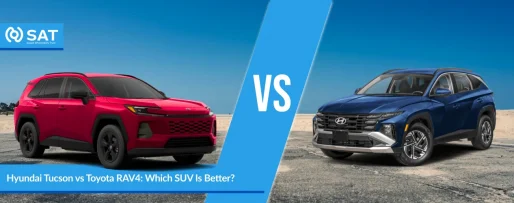
Purchasing a compact SUV isn't just about getting the most horsepower or the longest range of features. What really matters is after thousands of miles, when fuel economy, maintenance, cabin space, and resale can make for a significant distinction. That's where the Hyundai Tucson vs Toyota RAV4 comparison gets interesting, rather than just a spec sheet. Both SUVs are in the same segment, but they have different engineering and ownership philosophies. This comparison isn't about the marketing copy; it's about actual performance, long-term value, and real-world factors that truly matter when making a smart purchase.
The Hyundai Tucson and Toyota RAV4 comparison isn't one-size-fits-all, as each model is designed to excel in a different phase of ownership. The Tucson is the most useful the day you drive it home, as it has one of the most feature-packed, lowest starting-price, and most modern interiors in the class. However, the RAV4 appears to build its credibility as it gains years on the road, due to its reputation for reliability, maintenance predictability, and rising resale value.
It all depends on how long you'll be owning it. It's worth considering that buyers who buy every 5-7 years are better off appreciating the Tucson's equipment value, while those with a long-term view of ownership may be more interested in the RAV4's reputation for long-term value. That distinction is more important than comparing the specs.
Specification | Hyundai Tucson (Gas) | Toyota RAV4 (Gas) |
Engine | 2.5L Inline 4-cylinder | 2.5L Inline 4-cylinder |
Horsepower | 187 hp | 203 hp |
Torque | 178 lb-ft | 184 lb-ft |
Transmission | 8-speed Automatic | 8-speed Automatic |
Drivetrain | FWD / AWD | FWD / AWD |
EPA Fuel Economy (Combined)* | 28 mpg (FWD) / 26 mpg (AWD) | 30 mpg (FWD) / 29 mpg (AWD) |
Fuel Tank Capacity | 14.3 gal (54.1 L) | 14.5 gal (54.9 L) |
Maximum Towing Capacity | 2,000 lbs | 1,500 lbs (3,500 lbs on Adventure/TRD Off-Road) |
Cargo Space (Behind 2nd Row) | 38.7 cu ft | 37.5 cu ft |
Maximum Cargo Capacity | 74.8 cu ft | 69.8 cu ft |
Wheelbase | 108.5 in | 105.9 in |
Standard Safety Suite | Hyundai SmartSense | Toyota Safety Sense 3.0 |
When we look at the specifications, the Tucson offers better value with its longer wheelbase, larger cargo area, and industry-leading warranty coverage. The RAV4 counters with slightly more powerful output, higher towing capacity, and incremental improvements over the years. These specs don't call out one SUV as the obvious winner; instead, they make it clear that the best one for you may vary depending on whether you prioritize daily convenience and warranty coverage or long-term durability and functionality.
The Hyundai Tucson and Toyota RAV4 give their confidence in entirely different ways, and it's not because of the similarities in design – it's a matter of different philosophies. The Tucson's sharp body lines, integrated daytime running lights, and flush surfaces limit visual distractions and lend a contemporary touch to the vehicle design that keeps it feeling fresh years after its debut.
The RAV4 goes the other way, with squared wheel arches, stiffened-up body cladding, and more strength than style. One overlooked difference is how each of these SUVs tells you what it's doing before it even begins to move.
The Tucson's sleek design makes it feel at home in any city, whereas the RAV4's lofted SUV body and tough exterior styling immediately signal a drive in the outdoors. A buyer should not only select the design that reflects current taste, but also the one that suits their driving environment.
How an SUV will be used inside the vehicle is more important than its size. With a longer wheelbase, the Hyundai Tucson will offer a more open cabin experience, which means that the rear seats will be able to be stretched out for extended trips. The rear floor is also flat, offering a more comfortable seating experience for the second row, especially for families traveling with three passengers and/or child seats, which is enhanced by a wide feeling seating area.
The Toyota RAV4 does not. It's shorter in the outside so it's easier to maneuver in heavy traffic and for parking without compromising on daily comfort for the front passengers. The upright sitting position also encourages drivers to be more confident of their outward view of traffic and parking distances.
People looking to buy an SUV shouldn't compare the size of each cabin, but rather how they plan to utilize the vehicle. The Tucson is ideal for families that often transport rear passengers, whereas the RAV4 is more of a vehicle designed for drivers who spend more time driving in cities.
The cargo capacity only indicates how much cargo will fit, not how the space can be utilized. The Tucson's extended load floor makes loading things like flat-pack furniture, golf bags or folded strollers easier, without loading diagonally. It has a larger interior, too, for larger items when the back seats are folded up.
The RAV4, which has just marginally less max cargo capacity, boasts a more squared cargo compartment with a broad opening that makes it easier to arrange rigid goods like storage containers, camping gear and travel bags. The upright cargo shape also helps to minimize space wasted when stacking rectangular loads.
This is really dependent on what you're carrying the most time. If you are moving your family belongings or other big items, the Tucson's extra long load floor might be ideal for you or if you are constantly packing luggage, outdoor gear, or storage containers, the boxier load floor of the RAV4 could be a better fit.
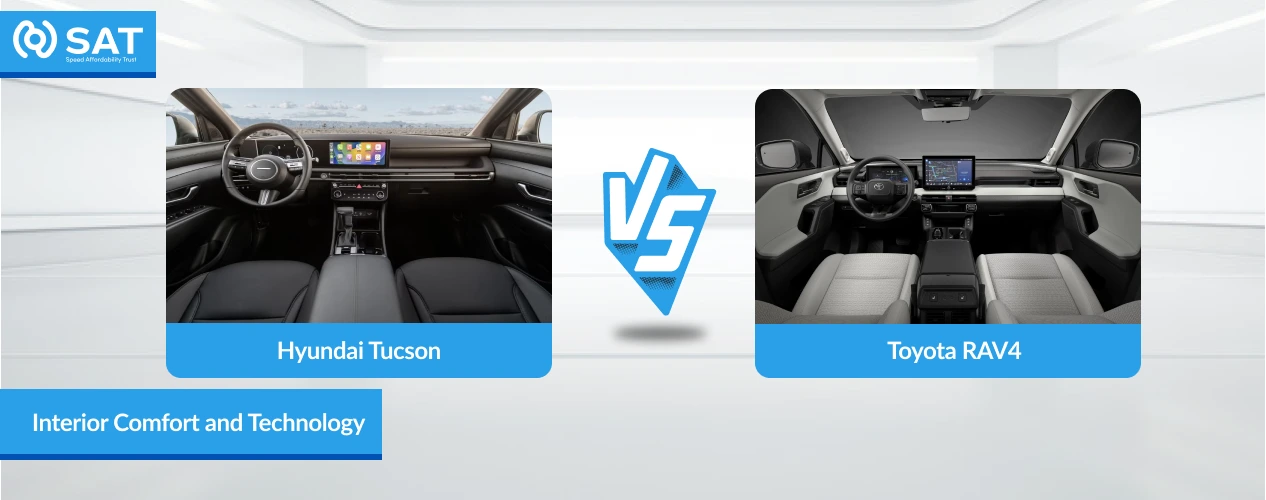
The Tucson and RAV4 are two completely different design philosophies. The infotainment display is 12.3 inches, and the optional digital instrument cluster is 12.3 inches, creating a connected digital environment that can be developed in the future with software updates without changing the dashboard layout. Toyota's 10,500-pixel 8.0-inch touchscreen and driver display are 7.0-inch, with an optional 12,300-pixel 10.5-inch screen, in an effort to keep driving information and entertainment apart and help prevent visual overload.
This difference not only affects the size of the screen, but also its usability in everyday life. Hyundai's interface caters better to owners who frequently adjust settings and leverage connected features, whereas Toyota's layout ensures an easier learning curve for multi-driver families. Neither manufacturer prioritizes screen size; it's about how they maximize the usability of a vehicle for a specific type of extended use.
Trim comparisons provide a better value story than base model comparisons. It's basically a price choice for the buyer, as the Hyundai SE has more standard convenience features at a lower cost point than the Toyota LE. The better comparison is SEL vs XLE, as the former gets more premium tech and cabin touches earlier in the range, while the latter holds on to some nice options for higher trims, with a more logical package progression.
On the high end, Limited vs Limited are considered not as a budget difference, but as a set of priorities. While Hyundai Limited puts more focus on comfort-oriented features and high-quality equipment, Toyota Limited puts more effort into refinement and the long-term appeal of the Limited. The best approach to buying is not the cheapest trim; it's the trim that offers extra features you'll actually use, not those that you won't.
The Hyundai Tucson and Toyota RAV4 both come equipped with a comprehensive suite of advanced driver-assistance features designed to help prevent accidents before they happen. Automatic Emergency Braking, Adaptive Cruise Control, Lane Keeping Assist, Lane Departure Warning, Blind-Spot Monitoring, Rear Cross-Traffic Alert, and Driver Attention Monitoring are some of the common features of standard systems.
It's not about the number of features, but how each manufacturer develops their safety package. Toyota is adding progressively more technology to the vehicles in the lineup, while Hyundai is adding more convenience features to lower trims. Carefully compare the trim levels since certain driver-assistance features may be offered exclusively on higher trim levels.
Both SUVs offer a very good amount of active safety for most drivers. Whether the SUV of your choice has the features you are using daily is more important than the one that has the longest list of features.
Crash-test ratings are as vital as accident-prevention technology, judging the extent to which a vehicle will keep its occupants safe in a crash. In new moderate overlap front, side-impact and crash-avoidance tests, the Hyundai Tucson has scored well and was awarded the IIHS Top Safety Pick+. It also had good ratings in pedestrian front crash prevention and headlight tests on qualifying models.
Toyota RAV4 has consistently scored well in IIHS and NHTSA crash testing with good ratings in frontal, side-impact and rollover tests. It has long used a proven, safe crash-test record to help earn its reputation as one of the safest compact SUVs in the segment.
People should not look at an overall safety rating, but rather should pay attention to individual categories of the crash tests that reflect the items they care about. Driving to work regularly during nighttime hours might want to consider headlight ratings, and urban commuters looking for improved pedestrian crash-prevention performance should look at this one. The overall score doesn't tell the whole story, so other details can help to illustrate the SUV's response when it matters most.
While the Hyundai Tucson and Toyota RAV4 are built to minimize driver fatigue in different ways, the difference is more apparent over the course of a mileage than in a dealership test drive. The 108.5-inch wheelbase and comfort-focused suspension system minimize the vertical body motion after hitting a bump, which means the car settles faster and makes a lot fewer small steering corrections when driving on uneven surfaces.
The 105.9-inch wheelbase and stiffer chassis deliberately convey more road feedback, so that the driver can more easily assess how much grip is available on slippery surfaces. This is not a tuning preference, but rather a deliberate engineering compromise. Hyundai reduces driver workload during long highway trips, while Toyota has made every effort to ensure drivers feel predictable, whether the SUV is empty or hauling a full load. That's important to consider beyond the acceleration numbers.
Acceleration is only half of the story. For many people who purchase a compact SUV, confidence on the highway, passing slower drivers and changing lanes in emergencies are more important to them in everyday driving than outright 0-60 times. The straight-line performance of the two gasoline variants is close, reaching 60 mph in about eight seconds in independent tests.
The difference comes into play when the road is no longer predictable. The RAV4's naturally aspirated engine offers improved throttle response in the early stages of acceleration when passing other vehicles on the highway, with the focus on power delivery at cruising speeds. The Tucson, on the other hand, has a more progressive power delivery that makes it easier to accelerate and keep a tighter grip in stop and go traffic.
The braking performance is also quite comparable, however repeated braking performance is more useful than the quickest stopping distance in a single instrumented test. Their stability control systems are well calibrated, keeping both SUVs steady during emergency lane change manoeuvres and boosting driver confidence in their ability to avoid unexpected obstacles.
Also, if you tow often, you should be aware that performance varies under towing. To owners who often tow small trailers or recreational gear, Toyota offers a superior towing capacity, with some of the RAV4 Adventure and TRD Off-Road variants topping out at 3,500 pounds, while properly equipped Tucson variants can pull 2,000 pounds.
All-wheel drive is the same on both SUVs, but they handle the issues differently. Hyundai's HTRAC system constantly monitors steering angle, throttle position, wheel speed and road conditions and then redistributes torque between the front axle and rear axle. When cruising, most of the power is delivered to the front wheels to optimize efficiency, but extra torque is also applied to the rear wheels when it is sensed that they are slipping. Drivers may also switch to AWD Lock at low speeds, thereby providing a more even torque distribution on loose gravel, snow or muddy roads, before the system reverts back to normal operation at higher speeds.
On the other hand, Toyota's DTC AWD is based on a different concept. It also runs the front wheels first under normal conditions, but quickly shifts the torque to the rear wheels when extra grip is needed. Outdoor-focused higher trims bring an extra set of features for maintaining traction and controlled speed on uneven trails and steep descents: Multi-Terrain Select, Downhill Assist Control. Both manufacturers disengage the rear axle when more traction is not needed to save on driveline drag and save fuel.
Official EPA fuel economy ratings offer a consistent method of comparing fuel economy based on standardized testing conditions. The front-wheel-drive Hyundai Tucson gets 25 city and 33 highway miles per gallon, while the front-wheel-drive Toyota RAV4 gets 27 city and 35 highway miles per gallon. The RAV4 retains a minor efficiency edge in most models, but it does lose a bit of efficiency with all-wheel-drive.
The numbers indicate that while Toyota is more focussed on fuel efficiency, Hyundai is concerned with fuel economy and everyday driving. While the savings are small on the surface, the RAV4 might save drivers more money in the long run.
While it can be useful to compare official EPA ratings, real-world results will vary based on the vehicles, the driver, the road conditions, driving conditions, weather, and load. Toyota RAV4 follows its EPA calculations closer at long-distance drives, supporting the efficiency of its naturally aspirated engine at cruising speed.
The Hyundai Tucson, on the other hand, can be competitive in mixed urban driving conditions, with frequent stops, slower speeds, and better throttle control, which helps maintain fuel economy performance. People who commute to and from work mainly by driving in city traffic might see the differences between the EPA ratings and real-world use be less significant.
But buyers should not only pay attention to published mileage but to where they're driving the most. The RAV4's efficiency advantage will be more apparent for highway commuters, but will be quite comparable for mixed-use drivers.
The Hyundai Tucson Hybrid vs Toyota RAV4 Hybrid comparison points out two well-developed hybrid systems with differing long-term objectives. The Tucson Hybrid has a 1.6-liter turbocharged engine and an electric motor that deliver a total of 231 hp, while the Toyota RAV4 Hybrid gets a 2.5-liter naturally aspirated engine and Toyota's hybrid system for a combined 219 hp. The difference isn't output; it's power-delivery strategy.
Hyundai's 6-speed automatic transmission also shifts between high and low gear in a familiar manner that feels more like a traditional gasoline SUV. Toyota's eCVT (electronic continuously variable transmission) system ensures that the engine stays within a range that's optimal for its efficiency, rather than for shifting feel.
It's a testament to two philosophies: Hyundai's dedication to maintaining a traditional driving style, and Toyota's drive to get the most out of hybrid technology by controlling power distribution via software, not mechanical gear changes.
Reliability should be judged by more than warranty length. It reflects how consistently a vehicle performs over years of ownership, how predictable maintenance remains, and how easily replacement parts and servicing can be obtained.
Hyundai supports the Tucson with one of the industry's strongest factory warranties—5 years/60,000 miles of basic coverage and 10 years/100,000 miles on the powertrain—reducing financial risk during the early years of ownership. Toyota's warranty is shorter at 3 years/36,000 miles basic coverage and 5 years/60,000 miles for the powertrain, but the RAV4 has built a long record of dependable long-term ownership across multiple generations.
Maintenance requirements for both SUVs are straightforward and include routine oil changes, brake inspections, fluid replacements, and tire rotations at manufacturer-recommended intervals. Toyota's naturally aspirated 2.5-litre engine has remained fundamentally unchanged across several model years, giving technicians extensive familiarity with the powertrain and contributing to broad parts availability in many markets. Hyundai's current Smartstream engine family is newer but has matured considerably through continuous refinement and benefits from extensive dealer support in major markets.
The purchase price is only one part of what you'll spend over the life of an SUV. Buyers should also consider financing costs, insurance premiums, depreciation, warranty coverage, and routine maintenance before deciding which model offers the better value.
The 2026 Hyundai Tucson starts at around $29,450, making it the more affordable option for buyers looking to reduce their upfront investment or monthly finance payments. Toyota's RAV4 starts at approximately $31,900, requiring a higher initial budget but offering strong resale performance that can offset part of that cost when it's comes time to sell or trade in the vehicle.
Instead of focusing only on the window sticker, buyers should calculate the total cost of ownership by considering purchase price, financing, insurance, fuel, scheduled maintenance, warranty protection, and expected resale value. Looking at these factors together provides a much clearer picture of which SUV delivers the better financial value for your individual ownership plan.
Professional reviews consistently praise the Hyundai Tucson for its modern interior, generous standard features, comfortable ride, and strong value. Long-term owners also appreciate its quiet cabin, spacious interior, and user-friendly technology, although some mention that the base engine feels less responsive during highway overtaking.
The Toyota RAV4 earns recognition for different strengths. Professional reviewers and long-term owners regularly highlight its dependable reliability, predictable maintenance costs, strong fuel economy, and excellent resale value. Rather than focusing on luxury features, most owners value the RAV4 for its long-term durability and low ownership stress.
The overall pattern is clear. Tucson owners tend to appreciate comfort, technology, and everyday convenience, while RAV4 owners value long-term dependability and ownership confidence. The better choice depends on which qualities matter most throughout your ownership experience.
Looking for a cheaper option that offers more standard specifications?
Choose a 12.3″ touchscreen and a more modern cabin configuration.
Desire an extra 41.3" of rear legroom and additional cargo space when traveling with family.
Enjoy a 10-year/100,000-mile powertrain warranty.
Focus on ride quality and a quieter highway ride.
Seek longer-lasting reliability and durability.
Plan on keeping the SUV for 10 years or more.
Choose for improved fuel efficiency, particularly in a hybrid.
Look for a good resale value and lower depreciation.
Like a more responsive driving experience, and an interior that's more functional.
The Hyundai Tucson vs Toyota RAV4 is a personal choice of opinion and not a performance comparison. On paper, there may be slight variations between these SUVs, but when you're out on the road, it's quite evident. The one that suits your driving habits, expected use life, and what's important to you once you have the car is the ideal choice.
Whether you're importing either model, the vehicle's condition is just as crucial as your choice of model. With SAT Japan, buyers can get auction services for the vehicle, view inspection reports and detailed history records, and then process their purchase. For long-term ownership satisfaction, it will be a much bigger deal in the case of either a documented history vehicle versus a spec-only one than models from a Tucson and RAV4.
Nissan Elgrand was a vehicle that was long forgotten in the luxury MPV market for a long time. The Toyota Alphard continued its upward trend, while the Elgrand remained largely unchanged, with only minor modifications. That is all changing now. Nissan has officially announced the all-new fourth-generation Elgrand, which features a new design, an upscale interior and the latest e-POWER hybrid powertrain. The new model is expected to debut in Japan in summer 2026 and is among the most significant vehicle releases in Nissan's recent history.
In this 2027 Nissan Elgrand review, we'll separate facts from expectations so you can get a clear picture of what this luxury MPV offers.
Best For
Large families
Executive transportation
Luxury MPV buyers
Long-distance travelers
Not Ideal For
Buyers looking for a sporty driving experience
Those needing an affordable family van
What really comes as a surprise is the bold styling. It's Nissan's choice to focus on the parts the parts owner uses daily – ride comfort, cabin quietness, passenger space, and hybrid efficiency. That's a sign that Nissan is focused on the car's value to owners rather than its showroom looks.
The 2027 Nissan Elgrand is a fresh 4th-generation Elgrand (E53). This redesign is not simply a front bumper redesign or new lights. The Elgrand is a new model built with increased emphasis on high-quality ride quality and electric driving.
The exterior is inspired by the Nissan Hyper Tourer Concept, but the production model appears to be cleaner and more functional. A large grille, patterned after the Japanese Kumiko craft, dominates the front, and the slim LED lights give the MPV a modern feel. A full-width light bar and roof spoiler round the back add to the revamped look.
Within, Nissan claims the interior is intended as a private lounge. Premium TailorFit leather, woodgrain trim, ambient lighting, and Zero Gravity captain's chairs with extendable leg rests help create a relaxing environment for passengers. Advanced digital displays and a Bose premium sound system are likely to be found in higher trims as well.
Nissan has yet to confirm official pricing, but compared with the outgoing model and the Toyota Alphard, the new Elgrand is likely to start at around ¥5.2 million (almost $42,600 USD), with the top-tier VIP variants exceeding the ¥6.5 million (nearly $46,900 USD) mark. Final prices will vary by trim level and market.
Specification | Expected Details |
Powertrain | Third-generation e-POWER Hybrid |
Engine | New 1.5L turbo generator engine |
Drive System | Electric motor drive |
Drivetrain | FWD and e-4ORCE AWD expected |
Seating | 7 or 8 passengers |
Launch | Summer 2026 (Japan) |
The standout feature is Nissan's third-generation e-POWER system. Unlike a normal hybrid, the gasoline engine doesn't directly power the wheels. Rather, it produces power as the electric motor is used to drive the vehicle. The new 5-in-1 powertrain design, according to Nissan, is lighter, quieter, and more efficient than the 2026 Nissan Elgrand and other previous models, resulting in a smoother and more EV-like experience.
The 2027 Nissan Elgrand is no louder-looking luxury MPV on the street. Rather, it's about clean lines and a harmonious design that will appear modern years from now. Its premium appearance is made by the bold front light bar, the LED headlights, and the full-width rear light bar, without being overpowering.
An interesting detail to note is the shape of the body. The large windows and tall roof are no less than for their aesthetic appeal. They are meant to provide the driver with more visibility and to open the cabin up for passengers. This should be convenient for families with children and older passengers.
Inside, Nissan has definitely made comfort the priority over flashy technology. The Elgrand's premium materials, roomy captain's chairs, and enhanced sound insulation indicate it's built for long voyages, not quick test drives.
The Elgrand is expected to have a large infotainment screen, a fully digital instrument cluster, wireless Apple CarPlay and Android Auto, USB-C charging ports, wireless charging, and OTA software updates.
The safety side is best with the buyers' latest ProPILOT driver support suite, which includes adaptive cruise control, lane-keeping assist, automatic emergency braking, blind-spot monitoring, rear cross-traffic alert, and a 360-degree camera system.
These are more than just marketing points for families. They can help drivers in the case of long journeys and parking a large MPV in a congested urban area.
The Toyota Alphard has been the benchmark for premium MPVs for years. The new Elgrand enters the market with the difficult task of winning back buyers who have already switched brands.
Category | 2027 Nissan Elgrand | Toyota Alphard |
Exterior Design | Modern and elegant | Bold and luxurious |
Hybrid System | Third-generation e-POWER | Toyota Hybrid System |
Passenger Comfort | Premium lounge-style cabin | Class-leading comfort |
Technology | Latest Nissan digital features | Advanced technology |
Driving Feel | EV-like smoothness expected | Smooth and refined |
What Nissan is doing seems different from what Alphard is doing. The Alphard seems to be about prestige, while the Elgrand is more about a slow, relaxed ride. Those who prefer refinement and style over a brand name could be interested in the Nissan.
Everything officially announced until now indicates that it is yes.
The most significant aspect of the new Elgrand isn't the fact that it's a totally new design or that it's much more powerful. As Nissan strives to enhance the car's comfort, noise levels, and hybrid efficiency, it is up to them to determine the impact of those changes.
The answers to some questions remain unknown. The official fuel economy, full trims, and pricing information are not yet available. Independent road tests will also be a key factor in ensuring the third-generation e-POWER system works as intended in real driving situations.
Nevertheless, Nissan has made one thing clear. The company is very serious about reentering the luxury MPV market with a new product, not just a facelift.
If international buyers wish to import one after launch, they can count on trusted exporters like SAT Japan to help source the vehicles from Japan, arrange inspections, and manage the import process once the new Elgrand is available in the Japanese market.
The 2027 Nissan Elgrand will be one of the most significant models for the company in years. Instead of sacrificing flash and performance, Nissan has focused on the attributes that luxury MPV buyers most look for – comfort, refinement, space and efficiency.
The Elgrand may prove to be one of the best options for the Toyota Alphard if the production model can live up to Nissan's promises of a quiet drive and quality cabins.
Nevertheless, the best redesign isn't necessarily a complete overhaul. It is the one that enhances the particular owners' observations every single day. Today, it looks like the 2027 Nissan Elgrand follows precisely that line.
After comparing both SUVs through published road tests, specifications, and owner feedback, here is the short version. This 2026 CR-V–CX-5 comparison looks beyond the usual sporty-versus-practical argument. The CX-5 feels like the driver's choice. The CR-V feels like the family's choice. Neither one is wrong. But one may be wrong for your specific needs, and that's what this Mazda CX-5 vs Honda CR-V comparison is going to sort out.
The Honda CR-V is the better all-round SUV for most buyers because it offers more passenger space, greater cargo capacity, better fuel economy, and stronger resale value. The Mazda CX-5 is the better choice for drivers who value handling, standard AWD, cabin quality, and a lower starting price.
Overall winner: Honda CR-V
Best for driving enjoyment: Mazda CX-5
Best for families: Honda CR-V
Best for fuel economy: Honda CR-V Hybrid
Best standard-equipment value: Mazda CX-5
The simple answer is this: buy the CX-5 if you want to enjoy driving your SUV. Buy the CR-V if you need your SUV to make everyday life easier.
Category | Mazda CX-5 (2026) | Honda CR-V (2026) |
Starting price (MSRP + destination) | $29,990 + $1,495 destination | $30,920 + destination (gas); $35,630 + destination (hybrid) |
Fuel economy (combined) | 26 mpg | Up to 30 mpg (gas AWD 29 mpg); up to 40 mpg (hybrid FWD) |
Cargo space (seats up) | 33.7 cu ft | 39.3 cu ft (gas); 36.3 cu ft (hybrid) |
Safety rating | IIHS Top Safety Pick+ (2026) | NHTSA 5-Star overall |
Basic warranty | 3 yrs / 36,000 mi | 3 yrs / 36,000 mi |
Powertrain warranty | 5 yrs / 60,000 mi | 5 yrs / 60,000 mi |
One-line verdict: The CX-5 wins the drive, the CR-V wins the daily grind.
The Mazda CX-5 is a car that people like to drive. It is a sport utility vehicle. For 2026, the Mazda CX-5 is all-new. The body is larger, and the wheelbase is longer. The inside of the car has a lot of technology. The Mazda CX-5 is similar to the RAV4 and the Tucson. Mazda wants the CX-5 to be a car that people enjoy driving on curvy roads.
The Honda CR-V is a sport utility vehicle made by Honda. It is a popular car in America. People like it because it is useful and easy to own. For 2026, Honda made some changes to the CR-V. The lineup includes both gas and hybrid models. Honda also added a TrailSport Hybrid trim for light off-road use. Every CR-V trim now includes a 9-inch touchscreen. The Honda CR-V is not a car that will get your heart racing. It is a car that you can depend on.
These two cars are similar but with very different personalities. That is what this comparison is about.
Honda CR-V vs Mazda CX-5 reviews reveal divided opinions, especially regarding driving comfort, cabin quality, and technology. Most people agree that the additional size is a major advantage, offering more space in the back seat, a larger cargo area, and updated technology. However, they disagree about the touchscreen. Mazda replaced the rotary control dial with a full touchscreen interface, and many testers have criticized the lack of basic physical controls, such as a volume knob. Owners who liked the dial are also not happy.
On the road, though, almost everyone agrees that the CX-5 is still fun to drive. It handles well and corners smoothly. That's what people expect from the CX-5.
The CR-V has a story to tell. It's a comfortable car, and that's kind of the point. Many car owners have rated it highly. It remained one of America’s best-selling SUVs during the first half of 2026. Reviewers praise its interior and easygoing feel. Some people have mentioned drawbacks, such as some road noise, a plain cabin, and a camera system on certain trims that isn't as good as real blind-spot monitoring.
Numbers are close; character is not.
Engine: 2.5L SKYACTIV-G four-cylinder
Output: 187 hp / 186 lb-ft
Transmission: 6-speed automatic
Drivetrain: standard AWD, all trims
0-60 mph: 9.0 sec (independently tested)
The CX-5 feels livelier than its modest output suggests. Mazda has never needed big horsepower numbers to make a car feel alive, and the CX-5 proves it again. The steering has real weight to it. The chassis stays flat and composed through corners where many compact SUVs start to lean and complain. You can hustle it down a back road, and it doesn't fall apart; it just asks for more.
The CR-V takes a completely different approach.
Gas engine: 1.5L turbocharged four-cylinder
Gas output: 190 hp / 179 lb-ft
Gas transmission/drivetrain: CVT, FWD or optional Real Time AWD
Hybrid engine: 2.0L gas-electric
Hybrid output: 204 hp combined
0-60 mph (Sport Touring Hybrid AWD): 8.0 sec, genuinely quicker than the CX-5, on paper and in the real world
The gas version of the CR-V runs on a 1.5-liter turbocharged four-cylinder engine that makes 190 horsepower and 179 lb-ft of torque, and is paired with a CVT. You can get it in front-wheel drive or with the Real Time AWD. If you choose a hybrid trim, you get a 2.0-liter gas-electric setup that produces a combined 204 horsepower. We tested the Sport Touring Hybrid trim. It went from 0 to 60 in 8.0 seconds, which is genuinely quicker than the CX-5 both on paper and in the real world.
What most CR-V buyers will remember is how smooth it feels. The CVT produces far less noise than many older systems, while the ride remains comfortable over rough roads. It is not designed to be exciting. Instead, it stays quiet and unobtrusive, allowing you to focus on the journey rather than the vehicle itself.
Although the CR-V is not a serious off-roader, the TrailSport Hybrid deserves attention. It comes with all-terrain tires, hill descent control, and standard AWD. U.S. News testers drove it on trails and steep hills. They were impressed. They liked that it had tires but did not make too much noise on the road. The CX-5 has an off-road mode but no dedicated trail-focused trim.
The CR-V can tow up to 1,500 pounds with the gas engine and 1,000 pounds with the hybrid engine, if set up correctly. Mazda has not announced the CX-5’s tow rating, which suggests towing was not a priority for them.
Spec | Mazda CX-5 | Honda CR-V (Gas) | Honda CR-V (Hybrid) |
Horsepower | 187 hp | 190 hp | 204 hp (combined) |
Torque | 186 lb-ft | 179 lb-ft | 247 lb-ft |
0-60 mph | 9.0–9.6 sec | Not independently tested | 8.0 sec (Sport Touring AWD) |
Transmission | 6-speed automatic | CVT | CVT-based hybrid EVT |
AWD system | i-Activ AWD (standard, all trims) | Real Time AWD (optional; standard on TrailSport & Sport Touring) | Real Time AWD (optional; standard on TrailSport & Sport Touring) |
Towing capacity | Not yet published for 2026 | Up to 1,500 lbs | Up to 1,000 lbs |
Verdict: The CX-5 is the more entertaining drive, but the hybrid CR-V is genuinely quicker off the line.
The CX-5 does not offer a hybrid powertrain for 2026. Mazda has confirmed a hybrid CX-5 is coming, but not until the 2027 model year. If fuel economy is your top priority, the CX-5 simply isn't fighting in that category right now.
What you get instead is the same naturally aspirated 2.5-liter engine across every trim, rated at 24 mpg city, 30 mpg highway, and 26 mpg combined. That's respectable for a standard-AWD compact SUV, but it hasn't actually improved from the outgoing generation despite the redesign.
The CR-V splits its lineup cleanly. Choose an LX, EX, or EX-L gas trim, and you're looking at 28 mpg city / 33 highway / 30 combined with front-wheel drive, dropping to 27/31/29 with AWD. Not a huge gap either way.
That's the part most people miss, though: the CR-V Hybrid is where this comparison stops being close.
CR-V Hybrid FWD: 43 city / 36 highway / 40 combined
CR-V Hybrid AWD: 40 city / 34 highway / 37 combined
CR-V TrailSport Hybrid: 38 city / 33 highway / 35 combined
In real-world testing, I saw a slightly lower 33.3 mpg with an AWD hybrid on a highway-heavy route, and U.S. News logged 35.1 mpg with a TrailSport in normal mixed driving. Either way, that's 7-13 mpg better than anything the CX-5 currently offers.
Here’s what the CX-5 offers:
A CX-5 running its roughly 15-gallon tank at 26 mpg combined lands you around 390 miles between fill-ups.
A gas CR-V with a similarly sized tank at 30 mpg combined pushes closer to 420 miles.
The hybrid CR-V, at 40 mpg combined, can stretch past 550 miles on the same size tank
If you drive a lot of highway miles for work, that's fewer stops, less time wasted, and real money staying in your pocket.
Metric | Mazda CX-5 | Honda CR-V (Gas) | Honda CR-V (Hybrid, FWD) |
City mpg | 24 | 28 | 43 |
Highway mpg | 30 | 33 | 36 |
Combined mpg | 26 | 30 | 40 |
Estimated range (combined) | ~390 miles | ~420 miles | ~550+ miles |
Verdict: If fuel economy is the deciding factor, this isn't even a debate. The CR-V Hybrid wins by a mile, literally hundreds of them, over a year of driving.
In size, they are much closer. Their exterior dimensions are close, but the CX-5 has the longer wheelbase.
Dimension | Mazda CX-5 | Honda CR-V |
Length | 184.6 in | 184.8 in |
Width (excl. mirrors) | 73.2 in | 73.5 in |
Height | 66.7 in | 66.2–66.5 in |
Wheelbase | 110.8 in | 106.3 in |
Ground clearance | 8.0–8.2 in | 7.8 in (2WD) / 8.2 in (AWD) |
Verdict: Nearly identical footprints outside, but the CX-5's longer wheelbase gives it a small edge in ride stability.
Front-seat comfort in the CX-5 is genuinely good. Some reviewers praised the seats, the fit and finish, and the overall material quality, which feel more upscale than the class average. Rear legroom grew to 39.9 inches for 2026, a real improvement, and wider rear door openings make it noticeably easier to secure a child in a car seat.
The CR-V, though, is close to limousine territory for a compact SUV. Front legroom comes in at 41.3 inches and rear legroom at 41.0 inches, genuinely enormous numbers for this class. U.S. News testers noted that a 6-foot-4 passenger could sit comfortably in the second row behind a driver who'd already adjusted the front seat to their own height. That's not a small thing if you regularly carry adult passengers or teenagers who've hit their growth spurt.
The CX-5 offers 33.7 cubic feet behind the rear seats and 66.5 cubic feet with them folded.
The gas CR-V offers 39.3 cubic feet seats-up and a massive 76.5 cubic feet folded, genuinely one of the best cargo numbers in the entire segment.
Choose the CR-V Hybrid instead, and that battery pack eats into some of that room: 36.3 cubic feet seats-up (34.7 on the Sport Touring trim only) and 71.8 cubic feet folded. Even with that hybrid penalty, it's still bigger than the CX-5 in every configuration.
The CX-5 looks and feels more upscale, but it cannot carry as much cargo.
Row | CX-5 Legroom | CX-5 Headroom | CR-V Legroom | CR-V Headroom |
Front | Not officially published for 2026 | Not officially published for 2026 | 41.3 in | ~41.3 in |
Rear | 39.9 in | Not officially published for 2026 | 41.0 in | ~40.1 in |
Cargo Configuration | Mazda CX-5 | Honda CR-V (Gas) | Honda CR-V (Hybrid) |
Seats up | 33.7 cu ft | 39.3 cu ft | 34.7–36.3 cu ft |
Seats folded | 66.5 cu ft | 76.5 cu ft | 71.8 cu ft |
Verdict: The CX-5's cabin feels nicer to sit in, but the CR-V simply gives you and your stuff more room to breathe.
The CX-5's biggest change might be its infotainment system.
Touchscreen: 12.9" standard, 15.6" on Premium Plus (the largest screen Mazda's put in a production car)
Infotainment: Google built-in, native Google Maps, and voice assistant
Wireless Apple CarPlay/Android Auto: standard, all trims
Wireless phone charging: standard, all trims
Audio: 12-speaker Bose on upper trims (up from standard 8-speaker)
Roof: panoramic glass roof, Premium trim and above
Honda made a similar leap.
Touchscreen: 9" standard, all trims (gas and hybrid)
Apple CarPlay/Android Auto: wired on the base trim; wireless from Select upward
Wireless phone charging: standard from the Select trim upward
Digital instrument cluster: 10.2" on EX-L trim
Google built-in: available, with real-time traffic and navigation
Remote start: standard, all Hybrid trims
The CX-5's larger screen and premium-feeling cabin materials edge out the CR-V on first impression, but Mazda's decision to remove the physical volume knob has drawn real criticism from testers who found themselves fumbling for touch controls at highway speed. The CR-V keeps more physical buttons in the mix, which some drivers will actually prefer.
Feature | Mazda CX-5 | Honda CR-V |
|---|---|---|
Standard touchscreen size | 12.9 in (15.6 in on top trim) | 9 in (all trims) |
Wireless Apple CarPlay/Android Auto | Standard, all trims | Standard, all trims |
Wireless phone charging | Standard, all trims | Standard, all trims |
Premium audio | 12-speaker Bose (upper trims) | Standard system (no Bose branding confirmed) |
Sunroof/moonroof | Panoramic glass roof (Premium and above) | Moonroof available on select trims |
Remote start | Not confirmed standard on all trims | Standard, all Hybrid trims |
Physical climate/volume controls | Largely removed in favor of touchscreen | Retained on most trims |
Verdict: The CX-5's screen is bigger, and its cabin feels a little more special, but the CR-V hasn't sacrificed the physical controls people rely on.
The CX-5 earned a 2026 IIHS Top Safety Pick+ award, the institute’s highest honor, while its official NHTSA rating was still pending at the time of writing. Every CX-5 trim comes standard with Mazda's i-Activsense suite, and for 2026, that suite grew substantially:
Mazda i-Activsense:
Forward turn-across-traffic braking: new for 2026, standard on all trims
Features Mazda says are now standard across every single trim for the first time.
The CR-V earned a full 5-star overall rating from NHTSA, which puts it in the top tier of crash protection by federal standards. But its IIHS results for 2026 are more complicated than most owners realize. The CR-V scored Good in the small overlap front test and Good in the side-impact test. In the moderate-overlap front test, though, which now includes a rear-seat crash dummy under IIHS's updated 2022 protocol, the CR-V scored Poor, driven by the front-seat bracket deforming and the seat belt shifting on the dummy in a way that raises the risk of chest and abdominal injury. Because of that result, the CR-V did not earn a 2026 Top Safety Pick or Top Safety Pick+ award, even with its strong NHTSA score.
A 5-star NHTSA rating and an IIHS Top Safety Pick aren't the same test, and right now they're telling two different stories about the same vehicle.
Honda Sensing:
Standard driver assistance is strong on both.
Road-departure mitigation: standard, all trims
Lane-departure warning: standard, all trims
EX and higher trims add a Blind Spot Information System and Cross Traffic Monitor, which shows a live feed of the right-side blind spot when signaling, a feature Consumer Reports has specifically criticized as a poor substitute for true two-sided blind-spot detection.
Safety Rating | Mazda CX-5 | Honda CR-V |
NHTSA overall | Not yet rated | 5-star (confirmed) |
IIHS small overlap front | Good | Good |
IIHS moderate overlap front | Good | Good |
IIHS side impact | Good | Good |
IIHS 2026 award | Top Safety Pick+ | No award |
ADAS Feature | Mazda i-Activsense | Honda Sensing |
Forward collision warning + AEB | Standard, all trims | Standard, all trims |
Blind-spot monitoring | Standard, all trims (2026) | Standard on all but base LX |
Rear cross-traffic alert | Standard, all trims (2026) | Standard on all but base LX |
Rear automatic emergency braking | Standard, all trims (new for 2026) | Not confirmed standard |
Adaptive cruise control | Standard, all trims | Standard, all trims |
Lane-change assist | Available on top trim | Not offered |
Final Verdict: Don't assume the CR-V wins safety just because it's the bigger name. For 2026, the CX-5 carries the stronger independent safety credentials.
Both use conventional, proven hardware. Wheels run 17 to 19 inches by trim; the CR-V TrailSport Hybrid stands apart with 18-inch wheels on Continental all-terrain tires. Braking is ventilated front discs and solid rear discs on both. The TrailSport Hybrid averaged 111 feet from 60 mph in testing, solid for an all-terrain tire. Mazda's brake pedal feel is tuned firmer, matching its sportier positioning.
Final Takeaway: Close to a wash; both stick with sensible, class-standard hardware.
Honda and Mazda are very even on paper. This isn't a coincidence. Both brands give their SUVs a 3-year/36,000-mile basic warranty and a 5-year/60,000-mile powertrain warranty. This is the coverage for mainstream brands. Hyundai and Kia offer more with their plans.
The CR-V takes the lead when it comes to hybrids. Honda gives the CR-V Hybrid an 8-year/100,000-mile warranty on its battery and electric parts. This gives buyers peace of mind about the part that worries them the most. Mazda does not list hybrid battery coverage because it does not offer a hybrid CX-5 for 2026.
Both brands also offer standard corrosion/perforation coverage of 5 years with unlimited mileage, and both include roadside assistance for the length of the basic warranty period.
Coverage | Mazda CX-5 | Honda CR-V (Gas) | Honda CR-V (Hybrid) |
Basic warranty | 3 yrs / 36,000 mi | 3 yrs / 36,000 mi | 3 yrs / 36,000 mi |
Powertrain warranty | 5 yrs / 60,000 mi | 5 yrs / 60,000 mi | 5 yrs / 60,000 mi |
Corrosion warranty | 5 yrs / unlimited mi | 5 yrs / unlimited mi | 5 yrs / unlimited mi |
Hybrid battery/electric drive | N/A | N/A | 8 yrs / 100,000 mi |
Verdict: A wash for gas models, but the CR-V Hybrid's extra battery coverage is a real, tangible advantage.
The CR-V has decades of goodwill behind it, and the data backs it up. It has earned a reputation as the ‘golden retriever of compact SUVs’: dependable, low-drama, and easy to own. Built to be owned for a long time without surprises.
Estimated ownership costs land close together. One independent cost analysis puts the non-payment monthly ownership costs for the CR-V- insurance, maintenance, depreciation, and fees, at roughly $857, plus around $125 in fuel, for a combined $982 a month, excluding the car payment itself.
The CX-5's ownership costs track similarly low for the segment, driven mostly by depreciation rather than maintenance surprises, according to MotiveGrid's cost breakdown.
Reliability Metric | Mazda CX-5 | Honda CR-V |
Owner-reported score | 4.5 / 5 (KBB) | 4.5 / 5 (RepairPal) |
Independent complaint-based score | 88 / 100 (MotiveGrid) | 83 / 100 predicted (Hybrid, U.S. News) |
Predicted reliability tier | Not yet published (new generation) | "Great" (Hybrid) |
Verdict: Both brands have earned genuine trust here, but the CR-V has the longer track record to prove it.
The CX-5 should cost less upfront because its starting price is lower and AWD comes standard. The gas CR-V offers a useful middle ground. It costs slightly more to buy but delivers better fuel economy and more interior space. The CR-V Hybrid has the highest purchase price, but it makes the most financial sense for commuters and high-mileage drivers who can benefit from its lower fuel use.
Ownership factor | Better choice |
Lower purchase price | Mazda CX-5 |
Standard AWD value | Mazda CX-5 |
Lowest fuel costs | Honda CR-V Hybrid |
Proven resale strength | Honda CR-V |
Hybrid warranty coverage | Honda CR-V Hybrid |
Low-mileage ownership value | Mazda CX-5 |
High-mileage ownership value | Honda CR-V Hybrid |
Ownership verdict: The CX-5 is easier on the initial budget, while the CR-V Hybrid is more likely to save money for buyers who drive frequently and keep their vehicle for several years.
The S Preferred is the sweet spot in the CX-5 range. At $34,250, it adds desirable comfort and convenience equipment without moving too close to the price of the top trim. It is the best choice for buyers who want the Mazda’s premium feel without paying for every available feature.
The EX-L AWD at $36,900 is the most balanced gas CR-V. It combines all-weather capability, leather seating, improved technology, and useful family features without crossing into the price range of the fully loaded hybrid.
The Sport Hybrid FWD at $35,630 is the better recommendation for commuters. Its 40 mpg combined rating gives buyers the CR-V Hybrid’s biggest advantage without requiring the more expensive Sport Touring trim.
Trim verdict: Choose the CX-5 S Preferred for standard-equipment value, the CR-V EX-L AWD for family use, or the CR-V Sport Hybrid FWD for lower fuel costs.
The CX-5's cheapest trim, the 2.5 S, starts at $29,990 before the $1,495 destination fee. From there, pricing climbs through the S Select, S Preferred, and S Premium before topping out at $38,990 for the S Premium Plus. Even fully loaded, the CX-5 stays under $41,000, well below the average new-vehicle transaction price in the U.S. right now.
The CR-V's lineup is wider, and prices vary depending on whether you go with gas or hybrid. The base LX starts at $30,920 with front-wheel drive and climbs to $32,420 with AWD. Gas trims top out at the EX-L AWD at $36,900. Hybrid trims start at $35,630 for the Sport Hybrid and climb to $42,550 for the fully loaded Sport Touring Hybrid.
Here’s my take:
The CX-5 is the better deal if you want a lot of standard equipment for less money, since AWD and a 12.9-inch touchscreen come standard, while wireless charging begins on the Select trim without an upcharge.
The CR-V is the better deal if efficiency and interior space matter more to you than sticker price, because the hybrid premium buys you real, measurable savings at the pump over years of ownership.
Available resale data generally favors the CR-V, although the gap varies by trim, age, and mileage. Honda's compact SUV has one of the strongest resale reputations in the entire industry, built over multiple generations of consistent demand.
The CX-5's resale story is still being written for this all-new generation, though the outgoing model held its value respectably by segment standards.
Trim | Mazda CX-5 Price | Honda CR-V Price |
Base | $29,990 (S) | $30,920 (LX FWD) |
Mid | $34,250 (S Preferred) | $34,650 (EX AWD) |
Upper-mid | $36,900 (S Premium) | $36,900 (EX-L AWD) |
Hybrid entry | N/A | $35,630 (Sport Hybrid FWD) |
Top trim | $38,990 (S Premium Plus) | $42,550 (Sport Touring Hybrid) |
Verdict: The CX-5 wins on standard-equipment value, but the CR-V wins on long-term resale and efficiency payback.
Adding it all up, here's how these two SUVs actually stack up across the categories that matter most, based on everything covered above.
Category | Mazda CX-5 | Honda CR-V |
Performance & driving feel | Winner | - |
Fuel efficiency | - | Winner |
Interior space & cargo | - | Winner |
Safety (2026 IIHS award) | Winner | - |
Reliability track record | - | Winner |
Value (standard equipment) | Winner | - |
Resale value | - | Winner |
Verdict: It's genuinely close, but the CR-V takes more categories overall, mostly because practicality carries more weight for most buyers than driving fun.
Standard AWD on every trim
More responsive steering and handling
Upscale cabin materials
Large standard touchscreen
Stronger 2026 IIHS safety recognition
No hybrid option for 2026
Less cargo and rear-seat space
Lower fuel economy than the CR-V
Touchscreen controls may distract some drivers
Slower than the CR-V Hybrid in acceleration tests
Excellent passenger and cargo space
Up to 40 mpg combined with the hybrid
Comfortable ride and smooth power delivery
Strong resale value
Proven long-term reliability record
Less engaging to drive than the CX-5
Some noticeable road noise
Hybrid and upper trims cost considerably more
Base trims offer fewer convenience features
The cabin feels more functional than premium
The CX-5 and CR-V appeal to different buyers, even though their prices and exterior dimensions are similar. Your normal passengers, annual mileage, cargo needs, and driving preferences should decide the winner.
Buyer type | Recommended SUV | Why |
Families with young children | Honda CR-V | Larger rear seat, wider usable space, and more room for strollers and groceries |
Driving enthusiasts | Mazda CX-5 | More responsive steering, better body control, and a more connected feel |
Daily commuters | Honda CR-V Hybrid | Better fuel economy and smoother low-speed driving |
Buyers on a lower initial budget | Mazda CX-5 | Lower starting price with AWD and major technology included |
Tall passengers | Honda CR-V | More generous front and rear legroom |
Dog owners and active families | Honda CR-V | Larger cargo area with the rear seats raised or folded |
Buyers wanting a premium cabin | Mazda CX-5 | More upscale materials and a more driver-focused design |
Long-distance road-trippers | Honda CR-V Hybrid | Longer estimated range and fewer fuel stops |
Buyers living in wet or snowy areas | Mazda CX-5 | AWD is included on every trim |
Buyers focused on resale value | Honda CR-V | Longer history of strong demand in the used market |
Safety-focused buyers | Mazda CX-5 | Stronger 2026 IIHS award based on the results covered above |
Buyers keeping the SUV long-term | Honda CR-V | Proven reliability, resale strength, and hybrid battery coverage |
Choose the CX-5 if you want an SUV that feels more enjoyable and premium than the average compact crossover. It suits individuals, couples, smaller families, and buyers who want standard AWD without moving into a more expensive trim.
Its main compromises are the smaller cargo area and lack of a hybrid. Those drawbacks matter less if you drive fewer miles and do not regularly carry several passengers or bulky equipment.
Choose the CR-V if space, fuel economy, comfort, and long-term ownership matter more than sporty handling. It is particularly well suited to growing families, frequent commuters, road-trippers, and anyone who regularly uses the rear seats.
The CR-V Hybrid is the strongest choice for high-mileage drivers, while the gas EX-L AWD provides a good balance of comfort, equipment, and all-weather ability.
Buyer verdict: The CX-5 is the emotional choice for drivers. The CR-V is the practical choice for households.
Everything above covers buying new in the US market. But if you're shopping from the UK, Uganda, Ghana, or another right-hand-drive or import-friendly market, there's a third option worth knowing about: a used, Japanese-market CX-5 or CR-V, sourced and shipped directly through an exporter like SAT Japan.
Japan's used car market turns over vehicles fast, often with low mileage and full maintenance records, well before they'd be considered "used" by US standards. That means a well-kept previous-generation CX-5 or CR-V can offer most of the daily-driving strengths covered in this comparison, reliability, cargo space, comfort, potentially for less than a new model after shipping, duties, taxes, and clearance costs are included.
Browse available SUV stock, or get a landed-cost quote for your country through SAT Japan's inventory search.
I spent back-to-back weeks in a 2026 Kia Sportage and a Honda CR-V, running the same errands, the same highway stretch, and the same gravel driveway in both, and the gap between them showed up faster than I expected. The Sportage felt like the smarter buy the moment I sat in it: bigger screen, longer warranty on paper, and a price tag that let me option it up without flinching. The CR-V took longer to win me over, but it did, mostly on the road. Every pothole I hit in the Sportage, I felt a little more of; every one I hit in the CR-V, the suspension just absorbed it and moved on. That’s really the whole comparison in miniature. The Sportage wins on what you get for your money. The CRV wins on how it feels to actually live with. Neither one left me disappointed, but which one you’d pick depends on whether you are chasing value or refinement.
Choose the Kia Sportage :If you want a lower starting price, a longer warranty, a larger standard touchscreen, stronger hybrid output, and an available plug-in hybrid option.
Choose the Honda CR-V :If you want stronger resale value, a smoother ride, better cabin refinement, and slightly more maximum cargo space with the rear seats folded
Category | Better Choice | Why |
Lower starting price | Kia Sportage | It starts lower than the CR-V |
Standard technology | Kia Sportage | Larger standard touchscreen |
Warranty coverage | Kia Sportage | Longer powertrain warranty |
Hybrid value | Kia Sportage | Lower hybrid entry price and stronger output |
Plug-in hybrid option | Kia Sportage | CR-V PHEV is not offered |
Fuel economy, gas models | Honda CR-V | Better combined MPG on gas trims |
Resale value | Honda CR-V | Honda usually holds value better |
Ride comfort | Honda CR-V | Smoother and quieter daily drive |
Maximum cargo space | Honda CR-V | More room with seats folded |
Best overall: The Kia Sportage is the better value choice for most buyers because it costs less, offers a longer warranty, has stronger hybrid output, and includes more standard technology. The Honda CR-V is the better choice for buyers who care more about resale value, ride comfort, and long-term brand trust.
If you are comparing these SUVs as used imports, SAT Japan can help you browse available used Kia Sportage stock and other reliable used SUVs before you decide.
This Kia Sportage vs Honda CR-V comparison breaks down the main differences in price, specs, fuel economy, size, reliability, safety, and daily ownership value. Price is one of the clearest differences between the 2026 Kia Sportage and the 2026 Honda CR-V. The Sportage starts lower than the CR-V, and that gap continues across several trims. In the hybrid lineup, the difference becomes even more important because the Sportage Hybrid starts much lower than the CR-V Hybrid.
Trim Level | Sportage MSRP | CR-V MSRP | Drivetrain |
Base gas trim | $28,790 | $30,920 | FWD, gas |
Mid gas trim | ~$31,500 | $33,150 | FWD/AWD, gas |
Upper gas trim | ~$34,000 | $35,400 | FWD/AWD, gas |
Top gas trim | ~$37,500 | Not directly comparable | AWD, gas |
Hybrid entry trim | $30,490 | $35,630 | FWD/AWD, hybrid |
Hybrid upper trim | ~$35,000–$38,000 | $38,725 | FWD/AWD, hybrid |
Hybrid top trim | $41,835 | $42,550 | AWD, hybrid |
Plug-in hybrid entry trim | $40,490 | Not offered | AWD, PHEV |
Plug-in hybrid top trim | $47,190 | Not offered | AWD, PHEV |
That $2,130 base-trim gap is not pocket change. Depending on the driver and location, it can cover a meaningful part of annual insurance or maintenance costs. The important part is that the Sportage does not feel stripped down despite the lower starting price. You're getting a 12.3-inch touchscreen standard, where the CR-V LX starts you off with a 9-inch screen.
Short answer: The Kia Sportage is cheaper than the Honda CR-V in base, hybrid, and plug-in hybrid comparison points, while the CR-V costs more but may return stronger resale value later.
Short answer: The Kia Sportage is cheaper than the Honda CR-V in base, hybrid, and plug-in hybrid comparison points, while the CR-V costs more but may return stronger resale value later.
You can also compare available hybrid and fuel-efficient SUV stock through SAT Japan if you are shopping beyond new 2026 pricing.
Before choosing either SUV, look closely at the spec sheet.
Spec | Sportage | CR-V |
Gas engine | 2.5L naturally aspirated I4 | 1.5L turbocharged I4 |
Gas horsepower | 187 hp | 190 hp |
Gas torque | 178 lb-ft | 179 lb-ft |
Gas transmission | 8-speed automatic | CVT |
Hybrid system output | 232 hp | 204 hp |
Plug-in hybrid | Available, 268 hp | Not offered |
Drivetrain | FWD standard, AWD available | FWD standard, AWD available |
Gas towing capacity | Up to 2,500 lbs with trailer brakes | Up to 1,500 lbs |
Hybrid towing capacity | Up to 2,000 lbs | Up to 1,000 lbs |
Brakes | 4-wheel disc brakes with ABS | 4-wheel disc brakes with ABS |
Wheels | 17 to 19-inch, trim dependent | 17 to 19-inch, trim dependent |
Spec sheets do not tell the whole story. The gas Sportage uses a naturally aspirated 2.5-liter engine paired with an 8-speed automatic transmission, so it feels more traditional and predictable. The gas CR-V uses a smaller 1.5-liter turbocharged engine with a CVT, which helps fuel economy but gives the SUV a different driving feel.
If you want to look deeper into the Sportage lineup and older performance-focused variants, our Kia Sportage R specs guide covers its redesign, range, and speed details separately.
Towing is one place where the Sportage has a clearer advantage. The gas Sportage can tow up to 2,500 pounds when properly equipped, while the gas CR-V is rated up to 1,500 pounds. Hybrid towing is lower, but Kia still has the edge there too: the Sportage Hybrid and PHEV are rated up to 2,000 pounds, while the CR-V Hybrid is rated up to 1,000 pounds.
Short answer: The gas CR-V has slightly more horsepower, but the Sportage offers a traditional 8-speed automatic, stronger hybrid output, higher towing capacity, and an available plug-in hybrid.
This is where the Sportage makes its strongest case.
Start with the powertrain. The Sportage Hybrid uses a 1.6-liter turbocharged engine paired with an electric motor, producing 232 combined horsepower. The CR-V Hybrid uses a 2.0-liter engine with a two-motor hybrid system and produces 204 total system horsepower. That means the Kia is not only cheaper to enter as a hybrid, but also stronger on paper.
The biggest difference is plug-in hybrid availability. Kia offers a plug-in hybrid version of the Sportage, and Honda doesn't build one for the CR-V. The Sportage PHEV pairs a 1.6-liter turbocharged engine with a plug-in hybrid system and produces 268 horsepower. It also offers 34 miles of all-electric range, giving it a daily-commute advantage the CR-V cannot match. You get real electric-only range for short trips, and gas-engine backup for everything else. That gives the Sportage a flexibility advantage the CR-V does not currently offer.
You might be wondering about the price. The Sportage Hybrid LX starts at $30,490, barely more than the gas LX. The CR-V Hybrid starts notably higher, with the 2026 CR-V Sport Hybrid starting at $35,630. So you're paying a real premium to get into a Honda hybrid, while Kia makes the jump nearly painless.
EPA-estimated combined fuel economy favors the Sportage Hybrid in its lighter trims, with the Sportage Hybrid LX rated at 42 mpg combined. The CR-V Hybrid lands closer to 40 mpg combined. It's not a massive gap on paper, but stack it over a few years of ownership, and it adds up.
Short answer: The Kia Sportage Hybrid is stronger and cheaper to enter, while the Honda CR-V Hybrid focuses more on smoothness, efficiency, and long-term Honda resale value.
If you are leaning toward the Honda hybrid for long-term ownership, it is also worth checking our 2024 Honda CR-V Hybrid Battery Life guide.
Trim/Drivetrain | City | Highway | Combined |
Sportage Gas FWD | 25 | 33 | 28 |
Sportage Gas AWD | 24 | 30 | 26 |
Sportage Hybrid FWD | 41 | 44 | 42 |
Sportage Hybrid AWD | 35 | 36 | 35 |
CR-V Gas FWD | 28 | 33 | 30 |
CR-V Gas AWD | 27 | 31 | 29 |
CR-V Hybrid 2WD | 43 | 36 | 40 |
CR-V Hybrid AWD | 40 | 34 | 37 |
Sportage PHEV Rating | Figure |
Engine-only combined MPG | 36 mpg |
Combined MPGe | 83 MPGe |
All-electric range | 34 miles |
Here’s where the comparison flips. On gas trims, the CR-V wins on fuel economy. Its turbocharged engine and CVT setup are genuinely efficient, and Honda’s reputation for fuel economy is not just marketing. Once you move into hybrid territory, the Sportage takes the lead back, especially when you compare price, horsepower, and the availability of a plug-in hybrid model.
What does that mean in dollars? If you're driving 12,000 miles a year at $3.50 a gallon, the difference between a 42-mpg Sportage Hybrid and a 40-mpg CR-V Hybrid works out to roughly $50 a year. That is not a huge yearly saving. But over a five-year ownership window, paired with the lower starting price, it stacks the deck further in Kia's favor for hybrid shoppers specifically.
Measurement | Sportage | CR-V |
Length | 184.4 in | 184.8 in |
Width | 73.4 in | 73.5 in |
Height | 65.6–66.9 in, depending on trim/roof rails/AWD | 66.2–66.5 in, depending on drivetrain |
Wheelbase | 108.5 in | 106.3 in |
Their overall footprints are almost identical, but the wheelbase difference is worth a second look. The Sportage's longer wheelbase puts more distance between the front and rear axles, which generally translates to a steadier ride and a bit more cabin room for the same overall length. The CR-V plays it conservatively, with the same general size and slightly more front and rear overhang.
If you are still deciding where the CR-V fits in Honda’s SUV lineup, this Honda HR-V vs Honda CR-V comparison explains the size, space, and practicality differences between the two.
Styling is subjective, but the two SUVs clearly take different design paths. The Sportage leans into a bolder, more angular design with its signature "star map" lighting signature up front; it doesn't try to blend in. The CR-V goes the other direction, sticking with a clean, understated shape that's barely changed in silhouette for two generations. If you want your SUV to make a statement in a parking lot, the Sportage does that. If you prefer a cleaner, more conservative design that does not draw much attention, the CR-V fits that brief better.
Measurement | Sportage | CR-V |
Cargo behind 2nd row | 39.6 cu ft | 39.3 cu ft |
Max cargo, seats folded | 74.1 cu ft | 76.5 cu ft |
Rear legroom | 41.3 in | 41.0 in |
Front legroom | 41.4 in | 41.3 in |
Behind the second row, these two are basically tied; the Sportage actually edges ahead by a hair. Fold the seats flat, though, and the CR-V opens up more total space, by about two and a half cubic feet. That's roughly one more medium suitcase worth of room.
Where the Sportage pulls slightly ahead is rear legroom, but the gap is only about 0.3 inch. That means it is a small advantage, not a major deciding factor. Both SUVs are roomy enough for adult passengers in the second row.
On paper, the technology difference is one of the first things buyers will notice.
The Sportage has a standard 12.3-inch touchscreen, while the CR-V uses a 9-inch touchscreen. The difference is easy to notice, especially if you care about maps, menus, and display size. The Sportage also offers a more modern dashboard layout, while the CR-V keeps a simpler and more conservative interior display setup. Honda’s layout is clean, but Kia’s looks more tech-forward.
The Sportage gives buyers strong charging convenience, with front and rear USB-C access depending on trim. The CR-V also includes a front USB-C smartphone/audio interface, while higher trims add more charging options. That matters if your family regularly charges phones, tablets, or other devices on road trips.
The Honda CR-V feels stronger in cabin refinement. Its interior has a more solid feel, the materials seem more mature, and the cabin is quieter on the highway. The difference is not dramatic, but it is noticeable. The Sportage feels stronger on standard technology and driver-assist value, while the CR-V feels stronger on material quality and highway comfort.
The gas Kia Sportage uses a 2.5-liter engine paired with an 8-speed automatic transmission. That gives it a more traditional driving feel, especially when accelerating or shifting through traffic.
The Honda CR-V uses a CVT instead of a traditional automatic transmission. This setup helps fuel economy and keeps the drive smooth, but it can feel less direct when you accelerate hard. Some drivers will like that smoothness. Others may prefer the Sportage’s more familiar automatic transmission feel.
The CR-V has the edge in ride comfort. Its suspension feels calmer over rough roads and potholes, which matters if you spend a lot of time on city streets or long highway drives.
The simple verdict is this: the Sportage feels more traditional and value-focused, while the CR-V feels smoother, quieter, and more comfort-focused.
This is one of the most important ownership differences between the two SUVs.
Category | Sportage | CR-V |
Predicted reliability | Competitive, but source-dependent | Competitive, often favored historically |
Basic warranty | 5-year/60,000-mile | 3-year/36,000-mile |
Powertrain warranty | 10-year/100,000-mile | 5-year/60,000-mile |
Hybrid/electrified coverage | 10-year/100,000-mile battery/electrified coverage | 8-year/100,000-mile hybrid battery coverage |
Estimated maintenance | Moderate | Moderate, historically strong |
Resale value | Usually depreciates faster than Honda | Usually stronger resale value |
Best ownership case | Long-term ownership, warranty value | Shorter ownership, resale strength |
The reliability discussion is close, but the warranty difference is not. Kia gives the Sportage a much longer powertrain warranty, while Honda relies more on its long-term reputation and resale value.
Kia’s powertrain warranty is twice as long as Honda’s in both years and mileage: 10 years/100,000 miles for Kia versus 5 years/60,000 miles for Honda. This means the Kia owner may still have powertrain coverage in year seven, as long as warranty terms and ownership conditions apply. The Honda owner may be out of warranty by that point, depending on mileage and ownership terms. Major powertrain repairs can cost thousands of dollars, depending on the issue, vehicle, and repair shop. That is not just a spec-sheet advantage. It can become real money if a major repair happens later in ownership.
Honda usually does better when it comes to resale value. The Honda CR-V has a long-standing resale reputation, which can help it hold value better when you trade it in. If you sell your car every three to four years, the CR-V’s stronger resale value can offset some of the money you save by buying the cheaper Sportage. If you keep your SUV for a long time, Kia’s longer warranty becomes more useful because you are more likely to benefit from the extra years of coverage.
Both SUVs come with important driver-assist features as standard, so buyers do not need to jump straight to the top trim for basic safety technology.
Feature | Sportage | CR-V |
Forward collision warning + auto braking | Standard | Standard |
Lane keeping assistance | Standard | Standard |
Adaptive cruise control | Standard | Standard |
Blind-Spot View Monitoring | Available on upper trims | Not offered |
Highway Driving Assist | Available on upper trims | Not offered |
Front and rear parking sensors | Available by trim | Available by trim |
Low-Speed Braking Control | Not offered | Available on higher trims |
IIHS safety result | 2026 Top Safety Pick+ for models built after May 2025 | Check the current IIHS rating by trim/test |
On base trims, the two systems are closely matched feature for feature. The split shows up higher in the lineup, where Kia leans into Blind-Spot View Monitoring and Highway Driving Assist, while Honda adds parking sensors and Low-Speed Braking Control. Neither one leaves you exposed; they've just made different bets on what upper-trim buyers want. The 2026 Kia Sportage earned IIHS Top Safety Pick+ status for models built after May 2025. The 2026 CR-V has also been tested by IIHS, so safety should be compared using current 2026 ratings rather than assumptions from older model years.
Sportage owners and reviewers often praise its value: the large screen, long warranty, strong feature list, and wide powertrain choice all help it feel generous for the money. Some owners get frustrated with all the touch controls.
They say the climate and audio controls are not as easy to use as buttons. Most get used to it in a few weeks. CR-V owners often praise the smooth ride and quiet cabin, especially on long highway trips.
Some drivers may not like the CVT feel during hard acceleration, and the 9-inch screen can look modest next to the Sportage’s larger display.
The bigger difference is not that one SUV feels risky and the other feels safe. The bigger difference is personality. The Sportage feels more value-focused and tech-heavy, while the CR-V feels calmer, more mature, and more comfort-focused.
Here's the breakdown by buyer type.
Choose the Sportage if you want the lower starting price, longer warranty, larger standard screen, stronger hybrid output, and an available plug-in hybrid option.
Choose the CR-V if you prioritize resale value, ride refinement, cabin quality, and maximum cargo space with the rear seats folded. If you trade in every few years and care more about a quiet, composed ride than outright tech specs, Honda's decades of resale strength and suspension tuning win out.
For plug-in hybrid flexibility, the Sportage is the clear choice because Honda does not currently offer a CR-V PHEV in the U.S. If you want electric-only commuting with gas-engine backup for road trips, Kia is your only option in this match-up.
For buyers who want maximum cargo space with the seats folded, the CR-V has the advantage. The gap is only a couple of cubic feet with seats folded, but if you regularly haul large, bulky items, that extra room is real.
Here's the breakdown by buyer type.
Buyer Type | Better Pick |
Budget-focused buyer | Kia Sportage |
Hybrid value shopper | Kia Sportage |
Plug-in hybrid shopper | Kia Sportage |
Long warranty buyer | Kia Sportage |
Resale-focused buyer | Honda CR-V |
Comfort-focused buyer | Honda CR-V |
Cargo-space buyer | Honda CR-V |
Traditional Honda loyalist | Honda CR-V |
Neither SUV is a bad purchase. The Sportage makes the stronger value case because it costs less, offers more warranty coverage, and gives buyers more hybrid flexibility. The CR-V still makes sense for shoppers who value resale strength, comfort, cargo space, and a more refined daily-driving feel.
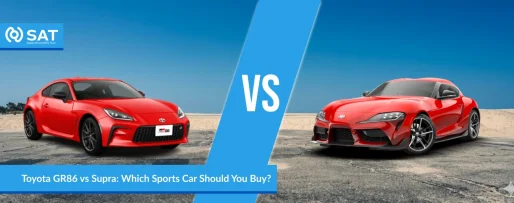
Most people assume the answer is simple: buy the Supra if you can afford it and the GR86 if you cannot. In reality, that thinking has led many enthusiasts to buy the wrong sports car.
With roots in Toyota performance, the Toyota GR86 and Supra offer two very different driving experiences. The difference in price between them can be more than $25,000, but the GR86 remains a popular choice among driving enthusiasts despite the significant price gap. But an important question remains – what are they seeing that isn't listed in the spec sheets?
The Toyota GR86 vs Toyota Supra comparison is not about chasing the biggest numbers. It's all about knowing which model fits you as a driver. The biggest difference between these two sports cars is not found on a specification sheet. It becomes clear the moment you get behind the wheel.
The Toyota GR86 and Supra may appear to be similar at first glance. They're both sports cars, and both feature rear-wheel drive, but they're targeting completely different buyers, and of course they're sporting Toyota performance badges. The GR86 is built to be light to handle, involve the driver, and be reasonably priced, while the Supra aims to deliver better acceleration, refinement, and premium sports-car performance. It's important for buyers to be aware of these differences early so that they don't end up purchasing a car that seems perfect on paper but will not feel perfect when they drive it.
Category | Toyota GR86 | Toyota Supra |
Starting MSRP* | Around $31,000 | Around $57,000 |
Engine | 2.4L Naturally Aspirated Flat-Four | 3.0L Turbocharged Inline-Six |
Horsepower | 228 hp | 382 hp |
Torque | 184 lb-ft | 368 lb-ft |
Transmission Options | 6-Speed Manual or Automatic | 6-Speed Manual or 8-Speed Automatic transmission |
Drivetrain | Rear-Wheel Drive | Rear-Wheel Drive |
0–60 mph | About 5.4–6.1 seconds | About 3.9 seconds |
Seating Capacity | 4 Seats | 2 Seats |
Cargo Space | 6.3 ft³ | 10.2 ft³ |
Prices are subject to change by model year, trim level, destination charges, and market.
Many buyers think that the Supra is just a stronger version of the GR86. The truth is, Toyota never intended to make these cars compete head-to-head.
In a growing segment that's dominated by heavier and more complex performance cars, the Toyota GR86 was developed to maintain the lightweight sports-car tradition. It has been created in collaboration with Subaru and emphasizes driver involvement, balance and feedback. Its goal is to make drivers feel connected to the car rather than relying heavily on technology.
The Supra was developed with a different mission in mind. It was built in collaboration with BMW and has the same platform as the BMW Z4, and is Toyota's top performance coupe. It is designed by Toyota to bring together the modern engineering, refinement, and high performance that the GR86 was not built to achieve.
The most fascinating thing about this Toyota GR86 vs Toyota Supra comparison is that many enthusiasts cross-shop these cars despite the large price difference. That means that buyers don't just want the fastest car. They're looking for a certain kind of driving experience. The GR86 is for drivers who like to get involved in the driving experience, and the Supra is for those who appreciate performance potential. In many instances, the final decision is not as much about the vehicle as the driver.
Many buyers compare horsepower and acceleration numbers, but some of the most important differences between the GR86 and Supra are found in their dimensions and chassis design.
Specification | Toyota GR86 | Toyota Supra |
Curb Weight | Around 2,850 lbs | Around 3,400 lbs |
Wheelbase | 101.4 in | 97.2 in |
Overall Length | 167.9 in | 172.5 in |
Width | 69.9 in | 73.0 in |
Height | 51.6 in | 51.0 in |
Weight Distribution | Near 53:47 | Near 50:50 |
GR86 and Supra are two of the most expensive models in Toyota's high-performance segment. A 2026 Toyota GR86 starts at around $31,000, while a 2026 Toyota Supra starts at roughly $57,000. That's over a $25,000 difference before options, taxes, and destination charges are factored in.
Model | Starting MSRP |
Toyota GR86 | Around $31,000 |
Toyota Supra 3.0 | Around $57,000 |
Difference | More than $25,000 |
A common misconception among buyers is to consider the extra cost the price of an upgrade. Actually, it's the price of moving to another sports car category.
The reason this is important is that it's becoming harder to find a sports car that's affordable and has rear-wheel drive. Over the last few years, models such as the Chevrolet Camaro and Dodge Challenger have ceased production, and so now there are fewer models available than there were before. This means the GR86 is one of the last of the new sports cars with RWD to be available at a relatively affordable price.
Another thing that is often overlooked is ownership value. The cost gap between the GR86 and Supra is significant enough to pay for years of fuel, insurance, maintenance, performance tires, and multiple track-day events for many owners. This is why some fans who can afford a Supra opt for the GR86 instead.
Perhaps the most surprising part of the Toyota GR86 vs Toyota Supra comparison is that many buyers cross-shop these cars despite the significant price gap. That suggests the decision is often driven less by budget and more by driving philosophy. The real question is not whether the Supra costs more—it clearly does. The key question is not whether the Supra is expensive or not, because it is. The question is whether moving into a premium sports-car category aligns with what you want from ownership.
It's not as simple as it sounds when it comes to the GR86 vs Supra performance debate. The Supra is certainly the faster of the two vehicles, but fun is about what you can actually extract from a vehicle's performance.
Category | Toyota GR86 | Toyota Supra 3.0 |
0–60 mph | About 5.4–6.1 sec | About 3.9 sec |
Weight | Around 2,850 lbs | Around 3,400 lbs |
Wheelbase | 101.4 in | 97.2 in |
Driving Focus | Engagement and balance | High-performance capability |
The acceleration capabilities of the Supra are indisputable. But one of the less-talked-about points of comparison between these two Toyota vehicles is how accessible their performance is. The GR86 gives drivers a more realistic feel of what's possible with a percentage of the car's ability in daily driving conditions. The driving dynamics, balance, steering response, and chassis response of many owners can be explored in an environment other than a public road with speeds that feel too high.
The Supra is a different game. Much of this capability is easily understood on a track or in controlled driving situations, but its performance ceiling is much higher. There's a fun contradiction here as well: the Supra offers a higher performance ceiling, while the GR86 allows drivers to access more of its potential more often.
The driver's confidence also plays a significant part. For many people, driving a car can be more fun when it pushes them to do more than they would normally do. That confidence is enhanced by the GR86's consistent handling, while the Supra offers those looking for more performance reserves at any time.
What's most surprising is that owners typically like these cars for different reasons. Supra owners like having more performance than they really need, and GR86 owners like being able to use more of their car more often. Hence, which is more fun isn't so much about capability, but how you enjoy capability.
It is a common misconception that the fastest car is the best track car. It is a different perspective for experienced enthusiasts. Lap time can be just as significant as a car's ability to teach the driver.
Category | Toyota GR86 | Toyota Supra |
Curb Weight | Around 2,850 lbs | Around 3,400 lbs |
Best For | Driver development | Maximum performance |
Learning Curve | More forgiving | More demanding |
Track-Day Costs | Generally lower | Generally higher |
One of the most common errors that new track drivers make is thinking that they need the fastest car. In fact, many experienced track-day instructors recommend learning performance-driving fundamentals in lighter, more predictable cars before moving to higher-powered vehicles. The GR86's balanced chassis helps drivers understand braking, cornering, and weight transfer without relying on horsepower to mask mistakes.
The Supra is different. It offers much more performance that suits those with a higher level of skill who aren't afraid of a bit of extra performance.
Surprisingly, it's not always the case that the fastest car produces the fastest driver. A slower lap in a GR86 can actually teach them more than a faster lap in a more powerful car, as the car gives them better feedback.
A common mistake made by most buyers is believing that the highest trim always represents the best value. Actually, the right trim depends on the features you'll utilize.
Model | Main Trims |
Toyota GR86 | GR86, GR86 Premium |
Toyota Supra | Supra 3.0, Supra 3.0 Premium, Special Editions |
The GR86 and GR86 Premium share the same 228-horsepower 2.4-liter engine. Likewise, the Supra 3.0 and Supra 3.0 Premium use the same 382-horsepower turbocharged inline-six engine. The 3.0 Premium is more about technology and interior features than performance.
The most surprising thing is that the lowest cost trim isn't always the lowest cost. The heart of the driving experience in each lineup remains largely the same, so many enthusiasts opt for a lower level and concentrate on the features that are most important to them.
Many enthusiasts opt for the Toyota GR86 over the more powerful Supra, and it's not just because of the numbers.
The GR86 is one of the lightest rear-wheel-drive sports cars on the market today, at about 2,850 lbs. For all its modern elements, technology, and power, the GR86 has remained a pure sports car, built around the driver.
There's one thing that isn't being recognized: Some enthusiasts are swapping out high-horsepower vehicles for lighter models that feel closer to the ground. The GR86 is designed to reward smooth inputs, proper technique, and driver awareness; hence, many owners perceive it as a vehicle that helps them develop driving skills.
One of the most interesting things is that some enthusiasts feel the GR86 can make a driver better, and many of the great sports cars just make a driver faster. That's how that philosophy leads to the reputation of the GR86 among the competitors with vastly larger numbers.
When it comes to the Toyota GR86 vs Toyota Supra comparison, many buyers think one of the two is the obvious improvement. Actually, that attitude usually results in disappointment.
There's a popular misconception that all GR86 owners will at some time wish to own a Supra. However, there are plenty of buyers who can afford a Supra who still opt for a GR86 due to their different taste for ownership experience. These cars appeal to similar buyers, but they are not the same objective.
The Supra is more than $25,000 more expensive than the GR86, but value for money is not always directly proportional. Other drivers find they use many of the GR86's features more frequently than they use a small part of the Supra's potential.
A lot of buyers see horsepower, torque, and acceleration numbers. But long-term satisfaction can also be affected by driving behavior, expectations, and the personality of the driver. That car that seems like a dream come true on paper can turn out to be completely different in reality after months of driving.
The most surprising is that a lot of buyers are able to afford either of the two models! Their selection is more on the basis of their preferences in sports cars, rather than just on the basis of financial constraints. The car with the biggest numbers is not always the best choice; it's the car that suits the driver who will drive it.
Many people often look at the performance metrics before buying a vehicle, but a host of smaller factors can make a bigger difference in how they feel using the vehicle day after day. Things that might be unimportant during a test drive may be more significant after months of driving.
Category | Toyota GR86 | Toyota Supra |
Seating Capacity | 4 seats | 2 seats |
Cargo Space | 6.3 cu-ft + fold-down rear seats | 10.2 cu-ft cargo area |
Visibility | Better all-around visibility | Larger blind spots |
Entry and Exit | Easier for most drivers | Lower seating position |
The flexibility is one of the main distinctions. The GR86's small rear seats offer additional space for carrying bags, groceries, and luggage, while the Supra goes all the way and is all about its two-seat configuration and cargo space.
It also affects what people are confident in seeing. The lower roofline of the Supra makes for more blind spots, while the GR86 has a clearer view of traffic around it.
Perhaps the most underutilized ownership rule is that it's not about the amount of space; it's about the kind of space. The most impressive car during a test drive may not be the one that best fits your daily routine. It is the car that fits your needs for months after your test drive.
Many buyers assume the GR86 is more reliable because it costs less or that the Supra is less reliable because of its BMW connection. Neither assumption tells the full story.
Reliability Factor | Toyota GR86 | Toyota Supra |
Engine | 2.4L Subaru Boxer | BMW-sourced 3.0L Turbo Inline-6 |
Turbocharged | No | Yes |
Complexity | Lower | Higher |
The GR86 has a more basic, naturally aspirated engine, potentially making it less complex in the long term. Meanwhile, BMW's B58 engine powers the Supra, which has a solid reputation among both experts and enthusiasts for its durability.
One common mistake is assuming simplicity and reliability are the same thing. A vehicle can be highly reliable while still being more complex to maintain. The main difference is there.
The biggest lesson to learn is that the GR86 is more suited to those looking for simple ownership, and the Supra proves that a modern high-performance sports car can also be highly reliable, with proven engineering backing it up.
While many buyers concentrate on the buy price, the ownership narrative plays out over time. It isn't always repairs that come as a surprise, but insurance, tires, brakes, and fuel are the highest costs.
Expense Category | Toyota GR86 | Toyota Supra |
Insurance Costs | Lower | Higher |
Tire Replacement | Lower Cost | Higher Cost |
Brake Components | Lower Cost | Higher Cost |
Performance Consumables | More Affordable | More Expensive |
A fact that is often forgotten by people who own sports cars is that high-performance tires wear much faster than the typical passenger-car tires, particularly when driven with excitement. It also goes for brake parts, which can be more costly in higher-performance cars.
Many owners plan for maintenance and forget about smaller recurring costs. The largest ownership expenses are typically the ones buyers don't foresee because they occur across multiple transactions throughout the year rather than as a single large bill.
One of the most surprising is that a sports car doesn't necessarily cost a lot more because of one big expense. It is expensive with the years of insurance renewals, tire changes, brake service, and more that add up to a substantial cost. It can be just as crucial to know where the money is going as it is to know how the car drives.
The difference between the Toyota GR86 vs Toyota Supra specs is more important than the difference in performance, reliability, cost to own, and resale value, and usually comes down to priorities rather than numbers.
Lightweight design of around 2,850 pounds.
One of the few reasonably priced rear-wheel drive sports cars on the market.
Very good enthusiast support and aftermarket.
Manual transmission available that features a driver-centric layout.
Easy sport car driving that advances skills.
Limited rear-seat space for passengers.
Not as aggressive as many of today's sports cars.
Cabin materials are less premium than the more expensive competitor.
Road and tire noise may be audible during longer journeys.
The turbocharged inline-six is a good performer with 382 horsepower.
More premium interior materials and technology.
A well-known and popular B58 engine with many enthusiasts.
Unique design and a recognizable brand.
Widely received factory-shipped high performance.
Higher purchase and ownership costs.
Two-seat configuration reduces versatility.
In certain driving conditions, it is difficult to be seen.
Fewer enthusiast buyers than lower-cost sports cars.
The Toyota GR86 is perfect for those seeking a sports-car feeling without the gimmicks. At 2,850 pounds, it's still one of the lightest rear-wheel-drive sports cars on the market.
Want your first dedicated sports car.
Enjoy manual-transmission driving.
Schedule autocrosses and/or track day sessions.
Prioritize driver involvement over luxury features.
Appreciate simplicity and an active fan base.
One of the most surprising features about the GR86 is that a lot of owners are not opting for the car just because they can't afford a quicker vehicle. They select it due to the fact that they favor an extra engaging driving experience. This is why the GR86 is popular among new customers and seasoned buyers.
The other unmentioned benefit is its community. The GR86 has one of the largest enthusiast followings in the affordable sports-car sector; therefore, owners can find aftermarket modifications, events, and knowledge sharing.
The GR86, however, is not for everyone. The Supra might be a more suitable choice for buyers looking for luxury, a sporty feel, or a desire to Grand-Tour.
The Toyota Supra is best suited for those who prefer a high-quality sports car that is engineered at the factory to deliver a strong performance. Its turbocharged inline-six engine delivers 382 horsepower, offering a balance of power, refinement, and exclusivity.
Want strong performance without major modifications.
Choose high-quality features and the latest technology.
Appreciate the heritage of the Supra name.
Want a sports car that feels special every time you drive it.
A few mistakes people make about the Supra are picking it because of its horsepower. In fact, it is the performance, comfort, and daily use that many love about it.
Not everyone would be suited to the Supra. The GR86 could be a better choice for those who want a more basic and active driving experience.
If you are an international buyer, you must consider more than just specifications when deciding between the GR86 and Supra. You shouldn't only think about the car; availability, vehicle history, and import requirements can be just as important.
Logbooks and vehicle history records.
The options available for different car trims and transmissions.
Import and registration requirements.
All Parts and Service Support in your country.
A frequent error is considering just the cost. When it comes to vehicle ownership, seasoned buyers understand that a well-documented car is a better bet than a less expensive vehicle with an uncertain past.
Another plus is that both models are in high demand globally, so the buyer doesn't have to choose from the limited selection of vehicles available in their region. Buying from SAT Japan allows you to source GR86 and Supra models directly from Japan, making it more likely to find the exact specification you are looking for.
The bottom line is: it's not always about the lowest price; it's about the right car.
Once all the specs, pricing, performance, ownership cost, and daily usage are compared, both cars come out on top of each other in various fields.
Category | Winner | Why It Wins |
Affordability | GR86 | Lower purchase and ownership costs |
Horsepower | Supra | 382 hp delivers significantly more power |
Straight-Line Speed | Supra | Faster acceleration and higher performance ceiling |
Driver Development | GR86 | Encourages skill-building and driver involvement |
Track-Day Learning | GR86 | Forgiving chassis and lower consumable costs |
Premium Feel | Supra | More upscale materials and technology |
Everyday Flexibility | GR86 | Rear seats add useful storage options |
Cargo Capacity | Supra | Larger cargo area |
Simplicity | GR86 | Less complex naturally aspirated setup |
Exclusivity | Supra | More premium positioning and lower sales volume |
Enthusiast Value | GR86 | Strong balance of performance and affordability |
Overall Performance | Supra | Higher capability straight from the factory |
Perhaps the most fascinating aspect of this comparison is that neither vehicle is superior in all areas. The GR86 is the winner where driver involvement, simplicity and value are concerned; the Supra is the winner where performance, refinement and capability are concerned.
That's why, when it comes to Supra vs. GR86, the choice isn't necessarily about the specs, but rather the ownership experience you're looking for.
One thing becomes apparent after years of studying sports cars: the Toyota GR86 vs Toyota Supra comparison isn't one that has a winner. It's about knowing what type of driving experience you desire.
The Supra would score many of the old-fashioned measures on paper. It features quicker acceleration, a higher performance ceiling, and its 382-horsepower turbocharged inline-six makes it the more capable machine. The Supra is the more refined and powerful if you favor speed, power, and refinement as the basis for a sports car.
However, the more intriguing finding of this comparison is that capacity and desirability are not synonymous. Although it sacrifices 154 hp, the GR86 is one of the most respected sports cars on the enthusiast road today thanks to such things as simplicity, balance, and driver engagement.
I have to admit, as an auto enthusiast, I think many prospective buyers ask the wrong question when comparing these two. Rather than asking “which car is better?” you should ask, “which car will I enjoy more 5 years from now?” Often the answer will come readily to you.
The GR86 is proof that a great sports car doesn't have to be big to be rewarding. The Supra is a testament to the fact that performance and everyday refinement can go hand-in-hand.
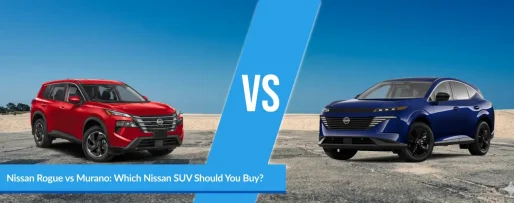
Two Nissan SUVs, same brand, very different missions. The Rogue starts at around $31,035 and delivers 32 MPG combined from its turbocharged three-cylinder engine, with a strong reliability score to back it up. The Murano starts at $41,670, more than $10,000 higher, with a redesigned 2.0L VC-Turbo four-cylinder making 241 horsepower, standard AWD across every trim, and a noticeably more premium cabin.
Both have five seats. Both have two rows. Both carry the Nissan badge. The Nissan Rogue vs Murano question is not only about size. It is about what kind of driver you are. These two SUVs are built for different buyers.
For global buyers, there is one more detail to know: the Rogue name is mainly used in North America, while the same SUV family is sold as the Nissan X-Trail in many international markets. So if you are comparing used imports, auction listings, or export stock, search both Rogue and X-Trail.
The biggest difference is class. The Nissan Murano is a midsize SUV, while the Nissan Rogue is a compact SUV. That size gap affects almost everything else: price, road presence, cabin feel, engine output, fuel economy, and daily driving comfort.
Both SUVs seat five people in two rows. Both use Nissan’s VC-Turbo engine technology. But they are built for different buyers. The Rogue is the easier, cheaper, and more efficient SUV to live with. The Murano is larger, stronger, quieter, and more premium.
That size gap starts under the hood.
Here's a quick side-by-side look at where these two vehicles stand on the numbers that matter most. This Nissan Murano vs Nissan Rogue specs table covers the main differences in engine, power, price, fuel economy, cargo room, drivetrain, and reliability.
Feature | 2026 Nissan Rogue | 2026 Nissan Murano |
Class | Compact SUV | Midsize SUV |
Starting MSRP | ~$31,035 | ~$41,670 |
MSRP Range | ~$31,035–$43,370 | ~$41,670–$49,800 |
Engine | 1.5L Turbo Inline-3 | 2.0L VC-Turbo Inline-4 |
Horsepower | 201 hp | 241 hp |
Torque | 225 lb-ft | 260 lb-ft |
Transmission | CVT | 9-Speed Automatic |
MPG Combined | 32 MPG | 23 MPG |
Cargo Seats Up | ~36.5 cu. ft. | ~36.2 cu. ft. |
Cargo Seats Folded | 74.1 cu. ft. | 63.5 cu. ft. |
Passenger Volume | 105.4 cu. ft. | 112 cu. ft. |
Length | ~180.6 in. | ~190.9 in. |
Standard Drivetrain | FWD | AWD |
Seating | 5 | 5 |
Towing Capacity | 1,500 lbs | 1,500 lbs |
Signature Trim | Rock Creek / Platinum | Platinum |
Global Name | Rogue / X-Trail in many markets | Murano |
JD Power Reliability | 84/100 “Great” | 77/100 “Average” |
RepairPal Annual Cost | ~$467 | ~$507 |
The price gap is hard to ignore. The 2026 Rogue starts at around $31,035 for the base S trim with FWD. The 2026 Murano kicks off at $41,670 for the SV AWD, and it's worth noting that Nissan dropped the FWD Murano SV entirely for 2026, so every Murano you buy now comes with AWD standard. That's the reason the base price jumped from last year.
The current-generation Murano arrived with a major redesign for 2025, introducing a new turbocharged engine, updated styling, and a nine-speed automatic transmission. For a detailed look at those changes, see our 2025 Nissan Murano: Redesign, Specs, Range, Speed guide.
Both vehicles run three shared trim levels: SV, SL, and Platinum. The Rogue adds a fifth option: the AWD-only Rock Creek, which targets adventure buyers with all-terrain tires and a roof rack. The Murano tops out at $49,800 for the Platinum. A loaded Rogue Platinum comes in somewhere around $43,370, which actually overlaps with entry-level Murano territory. That overlap is interesting. If you're already spending Murano money on a loaded Rogue, you might as well consider what the base Murano gets you for a similar investment.
Real-world prices can vary by dealer, market, incentives, and import costs. For export buyers, the landed cost may change again once freight, auction grade, inspection, duties, and local registration fees are added. That is why the Rogue usually remains the value pick, while the Murano makes more sense for buyers who want the bigger, more premium SUV.
The Rogue has the stronger cost-of-ownership case. Its reported 5-year total cost of ownership is $36,531, while the redesigned Murano’s long-term ownership data is still developing. The Murano may also cost more to insure because it has a higher starting price. If your main concern is long-term value, the Rogue is the safer pick on paper.
The two powertrains here are very different animals, and one of them comes with a story worth understanding before you buy.
Spec | 2026 Nissan Rogue | 2026 Nissan Murano |
Displacement | 1.5L | 2.0L |
Configuration | Inline-3, Turbo | VC-Turbo Inline-4 |
Horsepower | 201 hp @ 5,600 RPM | 241 hp |
Torque | 225 lb-ft | 260 lb-ft |
Transmission | CVT | 9-Speed Automatic |
Standard Drivetrain | FWD | AWD |
AWD Available | Yes | Standard on all trims |
The 2025 redesign replaced the old V6 and CVT with a 2.0L VC-Turbo four-cylinder and a nine-speed automatic. It improves efficiency and torque, but some reviewers note it feels less responsive than the old V6.
The Rogue runs a 1.5L turbocharged three-cylinder making 201 horsepower and 225 lb-ft of torque through a CVT. That CVT is the improved 2021+ generation, not the older unit that earned a mixed reputation in the 2014–2020 Rogue. It's refined, responsive, and well-matched to the engine.
The current-generation Rogue introduced significant updates to its design, technology, and powertrain. For a complete breakdown of those changes, read our 2025 Nissan Rogue: Redesign, Specs, Range, Speed guide.
In normal driving, the Murano is the stronger SUV. Its 2.0L VC-Turbo engine gives it more horsepower and more torque, so it feels more confident during highway merging, uphill driving, and passing slower traffic. The Rogue is quick enough for commuting, but the Murano feels calmer when the road opens up.
Both SUVs are rated at 1,500 lbs of towing capacity. That is enough for a small utility trailer or a light load, but neither the Rogue nor the Murano is built for serious towing. If towing is a major priority, look beyond these two Nissan SUVs.
The Rogue wins this category by a wide margin: 32 MPG combined (29 city / 36 highway) versus the Murano's 23 MPG combined. For daily commuters, that gap matters because the Rogue will usually cost less to fuel over a full year of city and highway driving. Official fuel economy ratings can be verified through the EPA's Fuel Economy database. Over a year of average driving, that gap works out to hundreds of dollars in fuel costs. Real-world range follows a similar pattern. The Rogue's 14.5-gallon tank gets you roughly 460 highway miles on a fill. The Murano carries a larger tank, but its thirst for fuel keeps real-world range in a similar ballpark despite the bigger reservoir.
The Rogue also gets a plug-in hybrid option for 2026, which gives it an advantage the Murano does not match. It offers 38 miles of electric range, 248 horsepower, standard AWD, and around 420 miles of total range. For buyers who want lower fuel use or a cleaner daily commute, the Rogue PHEV is the more flexible choice. The Murano does not offer a hybrid or plug-in hybrid version for 2026.
The Rogue usually comes with front-wheel drive. All-wheel drive is available. The Rock Creek trim of the Rogue only comes with all-wheel drive.
The Murano comes with all-wheel drive on all trims for 2026. That is good for people who live in areas with snow and want to be safe. For off-road use, the Rogue is better because of the Rock Creek trim. It has a package that's more focused on adventure. The Murano's all-wheel drive is more for driving on the road. It helps in rain, snow, and slippery conditions.
The Murano vs Rogue dimensions show the class gap clearly: the Murano is longer, wider, heavier, and more spacious overall, while the Rogue stays easier to park and still offers strong cargo flexibility. The Murano is categorized as a midsize SUV. The Rogue is compact. But dimensions alone don't tell the whole story, and the Rogue surprises in a few key areas.
Dimension | 2026 Nissan Rogue | 2026 Nissan Murano |
Length | ~180.6 in. | ~190.9 in. |
Width | ~72.4 in. | ~78.0 in. |
Height | ~67.6 in. | ~67.2 in. |
Wheelbase | ~106.5 in. | ~111.2 in. |
Ground Clearance | ~8.2 in. | ~7.2 in. |
Curb Weight | ~3,477–3,737 lbs | ~4,350 lbs |
Passenger Volume | 105.4 cu. ft. | 112 cu. ft. |
The Murano gives you more total interior volume: 112 cubic feet versus 105.4 cubic feet, which translates to a noticeably more airy, spacious cabin feel, especially up front.
Front passengers have more room in the Murano. It offers more front headroom and legroom, and taller drivers will notice the difference. Rear passengers, on the other hand, actually do better in the Rogue. The compact Nissan provides more rear legroom than the larger Murano one of those counterintuitive packaging wins that comes from a longer wheelbase-to-length ratio. Shoulder room is broadly similar in both vehicles.
Yes, the Murano is bigger overall, but the Rogue wins on maximum cargo room. With the rear seats up, the two are almost tied: about 36.5 cu. ft. in the Rogue versus 36.2 cu. ft. in the Murano. Fold the rear seats down, and the Rogue opens up to 74.1 cu. ft., while the Murano reaches 63.5 cu. ft. So for bulky luggage, boxes, or family gear, the Rogue is the more useful SUV.
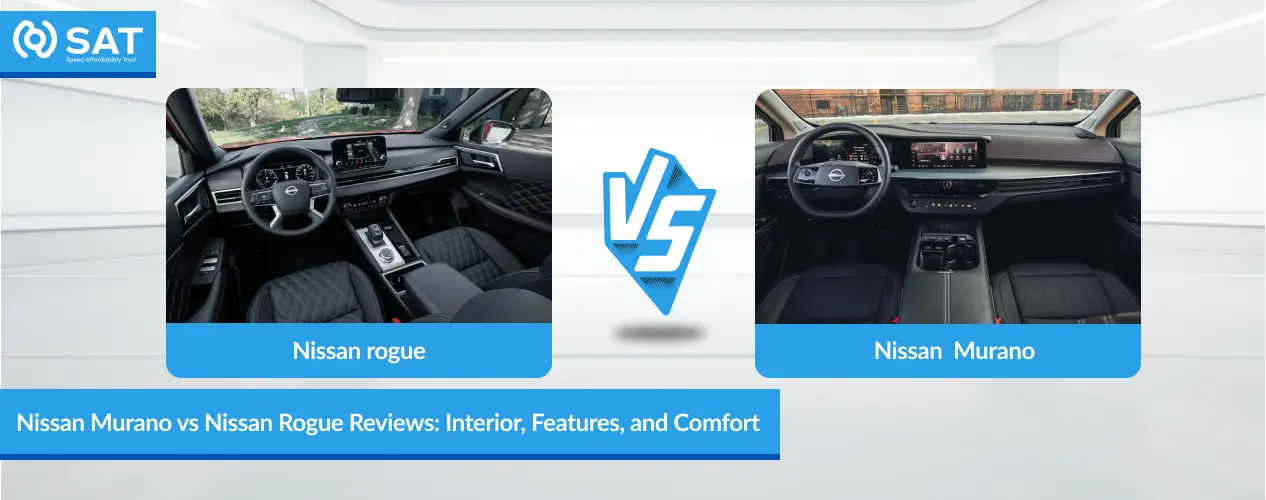
Most Nissan Murano vs Nissan Rogue reviews come to the same basic point: the Murano feels more premium, while the Rogue feels more practical and value-focused.
The Murano is more generous at the base level. Every 2026 Murano SV comes standard with a 12.3-inch NissanConnect touchscreen, a 12.3-inch digital instrument cluster, wireless Apple CarPlay, wireless Android Auto, a wireless charging pad, and Google Built-in. You get the full technology package from the entry trim.
The Rogue takes a more tiered approach. The base S starts with an 8.0-inch touchscreen and wired CarPlay. Wireless CarPlay and the larger display come as you move up the trim ladder. It is a workable setup, but the Murano spoils buyers at the base level in a way the Rogue does not match until the SL or higher.
Both vehicles offer cloth at the base trim and leatherette on mid-range trims. But their comfort philosophies are different. The Rogue offers tri-zone climate control on upper trims, something the Murano doesn't provide, which is genuinely useful for families with different temperature preferences front to back. The Murano counters with ventilated front seats available on upper trims, where the Rogue doesn't offer that feature at all. At the top of the Murano's lineup, you get quilted leather seating and a dual-panel moonroof that makes the cabin feel genuinely premium. The Rogue Platinum is well-appointed, but it doesn't quite match that level of ambiance.
Both vehicles come standard with Nissan Safety Shield 360 automatic emergency braking, blind spot warning, rear cross-traffic alert, lane departure warning, and rear automatic braking. That's a solid base across the board.
Where they separate is on the semi-autonomous driving side. The Murano offers ProPILOT Assist 2.1 on upper trims: Nissan's hands-free highway driving system. It handles steering, braking, and acceleration in single-lane highway scenarios without requiring hands on the wheel. The Rogue SL offers ProPILOT with Navi-link, which is hands-on and coordinates with the navigation system for speed adjustments. Both are capable systems. The Murano's hands-free setup is the more advanced of the two. On safety ratings, the 2026 Murano holds an IIHS TOP SAFETY PICK+ designation, one of the more meaningful endorsements in the industry.
This is where the comparison becomes more important. Because the reliability picture in 2026 looks very different from what buyers might expect based on older comparisons.
Start with RepairPal scores and annual maintenance costs. The Rogue earns a 4.0 out of 5.0 from RepairPal with average annual repair costs of $467. The Murano comes in at 3.5 out of 5.0 with an average of $507 per year. The Rogue wins on both counts.
Now look at JD Power predicted reliability for 2026 models. The Rogue scores 84 out of 100, rated "Great." The Murano scores 77 out of 100 and is rated "Average." That's a meaningful gap, and it represents a complete reversal of older-generation comparisons, where the Murano held its own in long-term dependability scores. The culprit is almost certainly the new powertrain. The VC-Turbo engine and nine-speed automatic are still being broken in by the ownership population. New powertrains carry uncertainty, and that uncertainty shows up in predicted reliability scores.
There's one more layer to this worth understanding. The 2014–2020 Rogue CVT had a spotty reputation. Transmission complaints were common enough to land Nissan in some class-action territory. The 2021-and-newer generation CVT is a different, significantly improved unit, and the current Rogue's scores reflect that improvement. If you're shopping used Rogues, the model year matters a lot. For 2026 specifically, the Rogue is in a better position for reliability than the Murano.
The iSeeCars quality data puts both vehicles roughly equal on overall quality scoring, though it gives the Rogue the edge on resale value and depreciation trajectory. IIHS safety ratings are strong for both; the Murano holds a TOP SAFETY PICK+, and the Rogue has historically performed well in crash testing.
For used buyers, service history matters more than badge loyalty. Both SUVs now rely on turbocharged VC-Turbo technology, so clean maintenance records, oil-change history, inspection sheets, and mileage verification should carry serious weight before purchase.
Buyer type | Better choice | Why |
Daily commuter | Rogue | Lower price, better MPG, easier to park |
Budget-focused buyer | Rogue | Lower starting price and running costs |
Premium comfort buyer | Murano | More upscale cabin and quieter ride |
Highway driver | Murano | More power, more torque, more relaxed cruising |
Small family | Rogue | Better cargo flexibility and strong fuel economy |
Light off-road buyer | Rogue Rock Creek | More adventure-focused trim |
Buyer wanting standard AWD | Murano | AWD comes standard on every 2026 trim |
Eco-conscious buyer | Rogue PHEV | Plug-in hybrid option; Murano has no hybrid |
If you're also considering one of the Rogue's biggest competitors, check out our Nissan Rogue vs Toyota RAV4 – Car Comparison to see how the Rogue stacks up against Toyota's best-selling compact SUV.
Neither vehicle is universally better. The right answer depends entirely on what you're asking the vehicle to do. Here's a clean framework.
Choose the Rogue if: fuel economy is a priority, you need maximum cargo space with seats folded, your budget is under $40,000, strong resale value matters, rear-seat legroom is important for your passengers, you want a proven reliability record, or you want a PHEV option with 38 miles of electric range.
Choose the Murano if: you want a premium cabin experience from the very first trim level, you want the stronger engine and more torque, you want AWD standard without having to pay extra for it, front-seat legroom and overall passenger volume matter more than rear legroom, or you value a quieter, more refined highway ride.
Interested in importing one? Browse current Nissan Murano inventory at SAT Japan to compare available model years, mileage, specifications, and pricing before making your decision. Nissan Murano listings at SAT Japan
Either works if: you need a dependable five-passenger Nissan SUV for daily driving and size or price flexibility isn't a hard constraint. Both vehicles are solid. Both will serve a typical family well. The question is which compromises you're willing to make.
For used-import buyers, the Rogue name can get confusing. In many global markets, especially outside North America, the Rogue is closely tied to the Nissan X-Trail nameplate. That means buyers should search both “Nissan Rogue” and “Nissan X-Trail” when comparing used stock, auction listings, export options, and spare-parts availability.
The Murano is easier to search by name, but availability depends on market, model year, mileage, trim, and drivetrain. For right-hand-drive import markets, Japanese listings are often worth checking because they usually include auction grades, mileage records, inspection notes, and detailed condition sheets.
Since most overseas buyers cannot inspect the SUV in person, compare verified inspection reports, auction grades, service history, and exporter credibility before paying. SAT Japan can be used as a practical starting point to browse used Nissan SUV stock, compare Rogue/X-Trail and Murano listings, and check mileage, specs, and condition details before shortlisting a vehicle.
For more help, see our Nissan Rogue/X-Trail buyer’s guide, our list of the best Nissan SUVs to import in 2026, or browse SAT Japan used Nissan stock.
If you are asking which is better, the Nissan Rogue or Murano for 2026, the answer depends on whether you care more about value or comfort. If you only remember one thing from this comparison, make it this: the 2026 Murano's reliability score dropped with its redesign. The Rogue, by contrast, scores 84 out of 100. That reversal matters, especially if you're planning to own the vehicle for five or more years.
Beyond reliability, the decision follows a clear pattern. The Rogue makes more sense for buyers who prioritize value, efficiency, cargo flexibility, and lower running costs. It's a smarter financial vehicle in almost every measurable category. The Rogue PHEV adds a compelling 2026 option for eco-conscious buyers that the Murano simply can't touch. The Murano makes more sense for buyers who want a genuinely premium two-row experience without stepping into luxury brand territory. Its cabin, from the SV up, delivers comfort and refinement at a price that still beats a comparably equipped Lexus or Acura. Standard AWD across the lineup is a real convenience, and the highway ride is notably quieter than what the Rogue offers.
The clean answer is simple: buy the Rogue if value, fuel economy, cargo flexibility, and reliability matter most. Buy the Murano if you want more power, standard AWD, a quieter ride, and a more premium cabin.
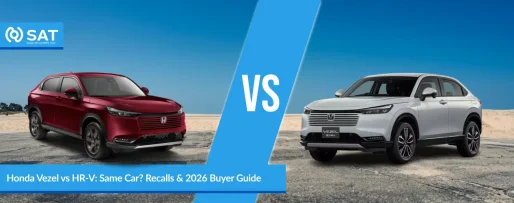
Honda Vezel vs Honda HR-V 2026 is one of the most common questions among used-car import buyers. For most markets, yes, the Vezel and HR-V are the same car. Same platform, same 1.5L engine, same body. Honda badges it differently depending on the market. But three things change that simple answer: the US HR-V from 2023 onwards is a completely different vehicle built on a different platform, the first-generation hybrid carries a recalled transmission that's caused owners serious grief, and some locally assembled HR-V models skip the hybrid system entirely. This guide maps the naming confusion, compares specs generation by generation, gives you the honest reliability picture, and ends with a verified checklist before you wire any deposit.
If you're browsing Japanese auction stock, platforms like SAT Japan list Vezel inventory with full auction sheet details, so you can verify exactly what you're getting before committing.
Before you get into the details, here's what actually matters:
Vezel is a Japan domestic market name; HR-V is an international export name. They refer to the same subcompact crossover in most markets
The US HR-V from 2023 onwards is NOT the same car. Honda moved it to the Civic/ZR-V platform, giving it different dimensions, different engines, and no meaningful comparison point with a Japanese Vezel
Early first-generation hybrids used Honda’s i-DCD dual-clutch system, and early production units were affected by repeated DCT recalls. All were documented issues, and many owners still report problems after recall completion.
The second generation (2021+) switched to the e:HEV system, a fundamentally different hybrid architecture with a much cleaner reliability record.
Safest used import: a confirmed clean e:HEV second-gen, or the petrol variant from either generation. Both carry significantly lower risk than any first-gen i-DCD hybrid.
If you've spent any time browsing Japanese used-car listings, you've probably seen both names used for what looks like the same car. A Japanese auction sheet says Vezel. A local dealer in Pakistan, Australia, or the UK lists the exact same vehicle as an HR-V. Buyers see two names, assume two cars, and start second-guessing perfectly good listings.
The confusion isn't a buyer error. It's a Honda naming strategy, and understanding the difference between Vezel and HR-V starts there. Honda sells its cars under different badges depending on the market. Japan gets the Vezel name for domestic sales. Every other major market gets the HR-V label for the same vehicle. Neither name signals a different car, at least not in most markets.
This guide uses generation-by-generation specs, auction sheet data, and Honda's own recall records to cut through the naming noise and give you a clear answer before you commit to any purchase.
Here's the thing: the confusion isn't the buyer's fault. Honda genuinely uses two names for what is, in most cases, the exact same vehicle. The Vezel is what Honda sells in Japan. The HR-V is what Honda calls it everywhere else. In most markets, they share the same platform, 1.5L engine family, and body structure.
For most buyers, the difference between Vezel and HR-V is largely a matter of branding and market naming rather than major mechanical changes.
Japan gets its own badge for domestic sales. The rest of the world gets the HR-V label. Neither name signals a different car, not for most markets, anyway.
The answer is simple: if it came out of a Japanese auction, it's a Vezel. If it's sitting on a local dealer's forecourt in most markets, it's the same car wearing a different badge.
The one place this breaks down completely is the United States from 2023 onwards. Honda's decision to rebuild the US HR-V on the Civic/ZR-V platform means American listings from that year onwards have nothing in common with a Japanese Vezel. Don't cross-reference them. Ever.
Market | Name Used |
Japan (JDM) | Honda Vezel |
UK, Australia, Middle East | Honda HR-V |
Pakistan (imported) | Honda Vezel |
Pakistan (local assembly) | Honda HR-V |
Europe | Honda HR-V |
US 2016–2022 | Honda HR-V (Vezel-based) |
US 2023+ | Honda HR-V (ZR-V/Civic platform — different car) |
Key Takeaway: If you're buying from a Japanese auction, you're buying a Vezel. If you're buying from a local dealer in most markets, you're buying the same car badged as HR-V.
For most markets, Vezel and HR-V mean the same car. The US is the one place that breaks this rule completely, and it's worth understanding before you look at any cross-market listing.
The 2016–2022 US HR-V was built on the same platform as the Japanese Vezel. Specs are broadly comparable and cross-referencing makes sense for that generation.
The 2023+ US HR-V is an entirely different vehicle. Honda moved it onto the Civic and ZR-V platform, giving it different dimensions, different engines, a different interior, and no meaningful overlap with a Japanese Vezel. The name stayed the same. The car did not.
The practical takeaway is simple: if a listing, spec sheet, or review is sourced from a 2023 or newer US HR-V, ignore it entirely when evaluating a Japanese Vezel. The dimensions won't match. The engine won't match. The comparison is meaningless and will only create confusion. Stick to JDM auction data and Japanese-market spec sheets when researching any Vezel purchase.
When comparing Honda Vezel vs Honda HR-V specs, the most important factor isn't the badge on the tailgate but the generation and drivetrain underneath. Generation matters more than model year when you're importing used. A 2020 and a 2022 Vezel look almost identical from the outside, but they carry completely different hybrid systems underneath. That difference alone changes the risk profile of your purchase.
Two generations. Meaningfully different specs. Here's how they break down:
1st Gen Vezel / HR-V | 2nd Gen Vezel / HR-V | |
Years | 2013–2021 | 2021–present |
Engine | 1.5L i-VTEC petrol | 1.5L i-VTEC petrol |
Hybrid system | i-DCD (dual-clutch) | e:HEV (series hybrid) |
Drive options | FWD / AWD | FWD / AWD |
Drive side | RHD (JDM) | RHD (JDM) |
Honda SENSING | Upper trims only | Standard on most trims |
Body style | Subcompact crossover | Subcompact crossover |
The petrol variant, available across both generations, runs a 1.5L i-VTEC producing around 130 hp through a CVT, with a real-world average of roughly 15–17 km/l. It's uncomplicated, easy to service almost anywhere, and carries none of the hybrid risk.
One thing to confirm before committing to any import: all Japanese domestic Vezel models are right-hand drive. Every single one coming out of a Japanese auction is RHD. If your market runs on the left, you cannot import a JDM Vezel; you'd need to source an LHD-market-specific HR-V.
US HR-V Warning: The 2016–2022 US HR-V was Vezel-based; specs are broadly comparable. The 2023+ US HR-V is a completely different car on a completely different platform. Never use a post-2023 US HR-V spec sheet to evaluate a Japanese Vezel listing. The dimensions don't match, the engines don't match, and the comparison is meaningless.
When it comes to Honda Vezel vs Honda HR-V reliability, the answer depends almost entirely on the generation and hybrid system you're looking at. Get this wrong, and you inherit a recalled transmission. Get it right, and you get one of Honda's most dependable small crossovers.
The i-DCD is a 7-speed dual-clutch automatic paired with an electric motor. On paper, it's cleverly designed to blend efficiency with performance. In practice, it gave owners a string of problems Honda had to acknowledge through three separate recall campaigns.
What went wrong, specifically:
Recall 1 targeted a software fault causing hesitation and stalling at low speeds, exactly the kind of thing you don't want in traffic.
Recall 2 fixed a slight hesitation and vibration some drivers noticed at lower speeds. Anyone who's driven a poorly calibrated dual-clutch knows how unnerving that sensation is. On a car at this price point, it wasn't acceptable.
Recall 3 was the most serious: transmission overheating leading to a complete loss of drive. That's not a minor inconvenience. That's a safety issue.
Most first-generation Vezel hybrids use the i-DCD system, so confirm the exact drivetrain by chassis code before buying. There's no trim-level workaround. If it's a first-gen hybrid, it has this transmission.
You might be wondering, if the recalls are closed, isn't the problem fixed? Not necessarily. That's the part most people miss. A closed recall means Honda performed the prescribed repair or software update. It does not mean the underlying mechanical characteristics of the dual-clutch were eliminated. Many owners with fully recalled, fully serviced units still report judder and hesitation years later. Before buying any first-gen hybrid, verify that the recall has been completed in the Japanese Ministry of Land, Infrastructure, Transport and Tourism (MLIT) recall database, and then test-drive it thoroughly regardless.
The e:HEV is not an evolution of the i-DCD. It's a completely different architecture. In a series hybrid setup, the petrol engine's primary job is generating electricity. It's the electric motor that actually drives the wheels. There's no dual-clutch. It avoids the dual-clutch setup, so the specific i-DCD clutch-judder concern is removed.
That structural difference shows up in real-world ownership. Second-gen e:HEV owners report significantly fewer drivetrain complaints compared to first-gen hybrid owners. It's not a close comparison. Honestly, this is where it gets interesting: Honda moved away from the i-DCD setup and adopted a different hybrid architecture.
The second generation also brings Honda SENSING as standard across most trims. Adaptive cruise control, collision mitigation braking, lane keeping assist, all included rather than reserved for top-spec configurations. For high-mileage drivers, that combination of fuel efficiency and active safety tech makes the e:HEV the most complete version of this car Honda has built.
Want a deeper look at the Vezel's features and ownership experience? Read our full Honda Vezel guide before you decide.
Real-world petrol economy is often quoted around 15–17 km/l, depending on traffic, tyres, and maintenance. That gap is real, and over a high-mileage ownership period it adds up. But the petrol drivetrain is significantly simpler, easier to service outside Japan, and carries none of the recall history that follows the i-DCD.
Who should choose petrol? Buyers in markets where Honda hybrid specialists are hard to find. Buyers who prioritize lowest long-term maintenance risk over fuel savings. Anyone on a tighter budget who wants reliability without the complexity.
Not the most exciting choice, but sometimes the boring option is the right one.
Key Takeaway: First-gen hybrid: verify all three recalls are closed and test drive extensively before committing. Second-gen e:HEV uses Honda’s two-motor hybrid setup, working mostly as a series hybrid at low to mid speeds and as a parallel hybrid at higher cruising speeds. Petrol: the simplest, most universally serviceable option regardless of generation.
After this Honda Vezel vs Honda HR-V comparison, the biggest factors affecting your decision are market, drivetrain choice, and generation. No single right answer here. It depends on where the car is going and what you're actually asking it to do.
Choose the petrol Vezel if:
Your budget is tight and you want the lowest long-term maintenance risk
Honda hybrid specialists are scarce or unavailable in your market
You're mostly doing short city trips where hybrid savings don't add up
You want a car that any competent mechanic can service without specialist equipment
Choose the e:HEV if:
You're covering 1,500 km or more per month and will recoup the hybrid premium over time
You have access to Honda hybrid servicing in your market
You want Honda SENSING as standard and the most refined version of this car
You're planning to keep the car for at least four to five years
Either works if:
You're in a RHD market and sourcing from a Japanese auction
You can confirm a second-generation build from the chassis number
You're not planning to sell within three years and want flexibility on drivetrain choice
One thing that doesn't come up enough in import discussions: servicing access. In many markets, hybrid-trained Honda technicians are genuinely scarce. If that's your situation, the petrol Vezel isn't a compromise. It's just the smarter call.
If you're already ready to import, browse our Auction Service and get started today.
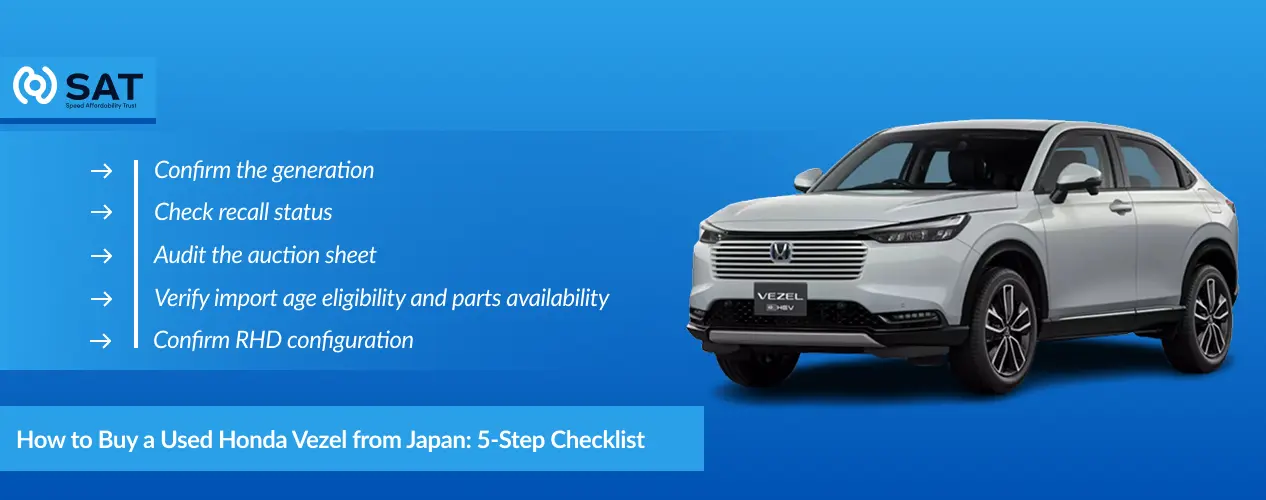
Before you wire a deposit, run through this checklist without exception.
Check the VIN or build plate against Honda's production records. 2013–2021 means first generation. 2021 onwards means second generation. Generation determines hybrid type and your entire recall exposure. Don't guess based on the year alone; confirm it against the chassis number.
Search the chassis number against the MLIT Recall Database to verify all recall campaigns are closed. If you're buying a first-gen hybrid, verify all three i-DCD recall campaigns show as closed. If any are open, either avoid the car or price in the risk only after expert inspection. A seller who can't confirm the recall status for a first-gen hybrid is one you should avoid.
Grade 4 or above is the safer target, but a clean Grade 3.5 can still be worth considering after inspection. Read the sheet carefully for electrical fault flags, any transmission notes, and accident repair markers on the diagram. A Grade 4 car with a clean sheet is worth more than a Grade 5 with query marks next to the drivetrain.
If reading Japanese auction sheets feels overwhelming, exporters like SAT Japan surface the key details: grade, electrical flags, accident markers on every listing.
Confirm the model year meets your country's import age rules. Then check that Honda dealer or independent specialist coverage actually exists in your market for the hybrid system. Finding out after purchase that no one local can service an e:HEV is an expensive lesson.
Every JDM Vezel is right-hand drive. If your market uses left-hand drive, you cannot import a Japanese auction Vezel. You need a market-specific HR-V built for an LHD country. Confirm before bidding, not after.
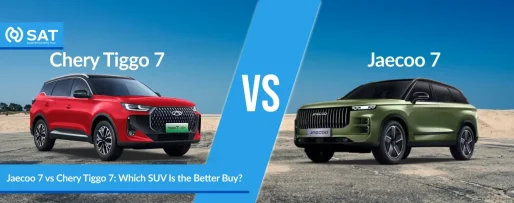
Spend time researching Jaecoo 7 vs Chery Tiggo 7, and you'll keep bumping into the same awkward reality: they come from the same parent company, and in some markets their engineering appears closely related, with largely the same running gear. The Jaecoo 7 looks sharper, costs more, and carries a newer badge that's trying to signal something premium. The Chery Tiggo 7 doesn't bother with any of that posturing; it just quietly offers almost everything the Jaecoo does while asking for less money.
Most people buying with their own cash end up in the Tiggo. Buyers who care more about road presence and design may lean toward the Jaecoo. Neither choice is wrong, but they're based on very different priorities, and it's worth understanding which camp you're actually in before you start negotiating with a dealer. This Jaecoo 7 vs Tiggo 7 comparison comes down to price, practicality, driving feel, resale confidence, and how much you value a more premium-looking cabin.
Yes, both are built by Chery, share the same T1X platform and use the same engines. Think of it like Volkswagen using Skoda and Audi to reach different buyers: same engineering, different badge and price.This Jaecoo 7 vs Tiggo 7 review focuses on real buying factors rather than brochure drama: price, space, running costs, safety, and long-term ownership.
Category | Jaecoo 7 | Chery Tiggo 7 | Winner |
Price | Higher | Lower | Tiggo 7 |
Platform | Shared | Shared | Tie |
Hybrid System | Similar | Similar | Tie |
EV Range | Similar | Similar | Tie |
Boot Space | Smaller | Larger | Tiggo 7 |
Interior Feel | More Premium | More Practical | Jaecoo 7 |
Safety | Strong | Strong | Tie |
Warranty | Similar | Similar | Tie |
Resale Confidence | Developing | More Established | Tiggo 7 |
The Jaecoo 7 vs Tiggo 7 price gap is the main reason this comparison matters. If both cars cost the same, you'd just pick the one you like the look of and move on. They don't, and the gap is consistent enough across markets that it can't be explained away as a regional anomaly or short-term promotion.
The Chery Tiggo 7 starts around £24,995 in the UK. The Jaecoo 7 starts near £30,000, a gap of roughly £5,000. For plug-in hybrid versions, the Tiggo 7 PHEV sits around £30,000 and the Jaecoo 7 PHEV around £35,170. For context, a plug-in hybrid Volkswagen Tiguan starts near £42,000.
Feature | Chery Tiggo 7 | Jaecoo 7 |
Starting price | ~£24,995 | ~£30,000 |
PHEV price | ~£30,000 | ~£35,170 |
Platform | Chery T1X | Chery T1X |
Warranty | 7 years | 7 years |
Euro NCAP | 5 stars | 5 stars |
In some markets, the gap is modest. In others, it can cover several months of insurance or a year of servicing. Here’s the part that makes the Jaecoo premium harder to justify: both vehicles show up with large infotainment displays, driver assistance systems, climate control, parking cameras, and long warranties across most trim levels. The Jaecoo isn't selling you a list of features the Tiggo doesn't have; it's selling you a different version of roughly the same list at a higher price, mostly on the strength of how it looks and feels rather than what it can actually do.
Avoid the base 1.6-liter petrol on both cars. It makes around 147hp but is noisy and returns little more than 30mpg in real-world driving. Both cars offer a plug-in hybrid pairing a 1.5-liter petrol with an electric motor for 204hp combined and up to 56 miles of electric-only range.
The Jaecoo 7 has one option the Tiggo 7 does not a self-charging hybrid making 224hp and returning around 50mpg with no plug needed. For buyers who cannot charge at home, this is the sweet spot. The PHEV only makes financial sense for company car drivers due to lower benefit-in-kind tax.
If you only look at the Jaecoo 7 vs Tiggo 7 specs, the two SUVs look more like siblings than rivals. The powertrains are closely related, the performance numbers land in very similar territory, and the dimensions are close enough that most buyers won't feel the difference in daily use.
Here is how the plug-in hybrid versions compare on paper. Exact figures can vary by market and trim, so always check the local brochure before buying. The Jaecoo 7 vs Tiggo 7 specifications are close enough that the winner is not decided by power figures alone.
Specification | Jaecoo 7 SHS / SHS-P PHEV | Chery Tiggo 7 CSH / Super Hybrid PHEV | What It Means |
Vehicle type | 5-seat compact/mid-size SUV | 5-seat compact/mid-size SUV | Both target the same family SUV buyer. |
Engine | 1.5L turbo petrol hybrid | 1.5L turbo petrol hybrid | Very similar hybrid setup. |
Transmission | Dedicated Hybrid Transmission / DHT | Dedicated Hybrid Transmission / DHT | Neither has a normal automatic gearbox feel. |
Battery capacity | 18.3 kWh / around 18.7 kWh depending on market | 18.3 kWh / 18.4 kWh depending on market | Battery size is almost the same. |
Electric-only range | Up to 56 miles WLTP / around 90 km WLTC | Up to 56 miles WLTP / around 90 km WLTC | Real-world EV range should be close if both are charged regularly. |
Combined power | Around 204 PS to 279 hp, market-dependent | Around 204 PS to 279 PS, market-dependent | Performance is close enough that price and practicality matter more. |
0–62 mph / 0–100 km/h | Around 8.5 seconds | Around 8.0–8.5 seconds | Neither has a clear performance advantage. |
DC fast charging | Around 30–80% in 20 minutes | Around 30–80% in 20 minutes | Both are unusually practical for plug-in hybrids. |
Boot space | Around 340L to 500L, market/variant-dependent | Around 484L to 565L, market/variant-dependent | Tiggo 7 is usually the more practical luggage carrier. |
Warranty | Often 7 years/100,000 miles or 7 years/150,000 km, market-dependent | Often 7 years/100,000 miles or similar, market-dependent | Both offer strong warranty cover for the segment. |
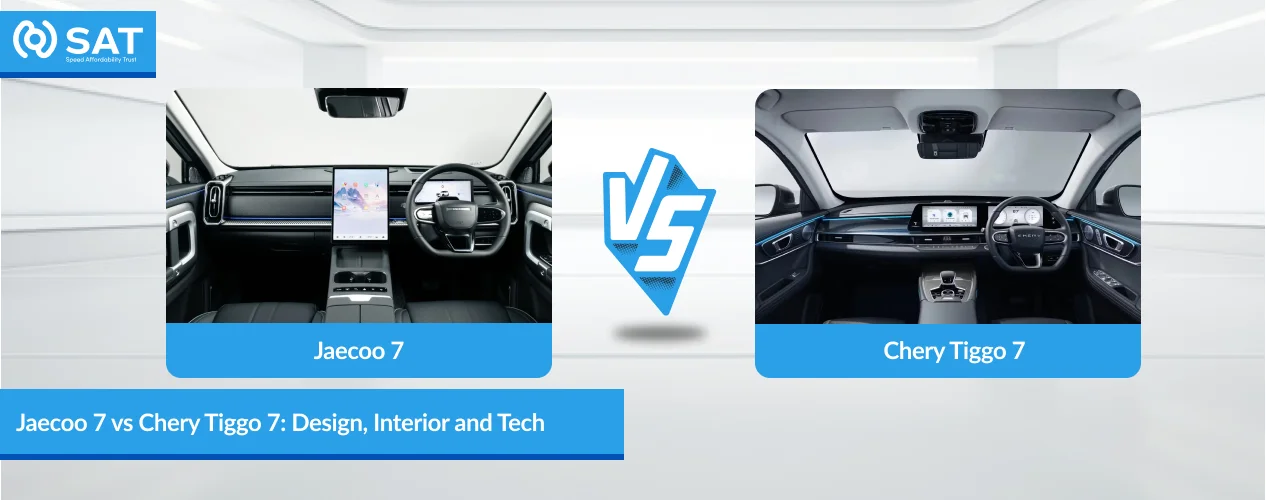
This is where the comparison stops being about numbers and starts being about the kind of thing that's difficult to quantify honestly.
Feature | Chery Tiggo 7 | Jaecoo 7 |
Styling | Understated | Premium, Evoque |
Top screen size | 12.3 inches | 14.8 inches |
Climate controls | Physical buttons | On-screen |
Cabin feel | Solid, practical | More premium |
Panoramic roof | Top trim only | Standard |
The Jaecoo 7 has a strong visual identity, and it's clearly intentional. The grille is large, the proportions are dramatic, and the overall impression is of something that's been designed to attract attention rather than blend into traffic. Some buyers find it genuinely striking. If the Jaecoo’s styling is what caught your attention, our Jaecoo J7 2026 Review breaks down its price, hybrid specs, cabin feel, and whether it is actually worth the premium.
Others think it overshoots the brief for a family SUV. There are not many neutral takes on it. Which is either a strength or a problem depending on your taste. The Tiggo's exterior is cleaner, more conventional, and less divisive. It is the kind of design that may not excite anyone in a showroom, but it also should not date badly or put off used buyers three years later.
Both cabins now feel modern enough that you do not need to apologize for the quality. The screens are large, the interfaces are reasonably intuitive, the driver assistance technology is comprehensive, and the overall sense of being in a modern, well-equipped car is present in both. In the Jaecoo 7 vs Tiggo 7 interior comparison, the Jaecoo feels more polished, while the Tiggo feels more practical and cost-conscious. The Jaecoo pulls ahead in a few specific areas: the materials feel softer in the places your hands actually rest, and some of the trim detailing looks more deliberate, but the gap is not as large as the price difference would suggest. You're paying partly for something real and partly for the idea of something premium; that balance matters more as the price gap grows.
At some point, the comparison has to move beyond brochure appeal and focus on daily life.
Rear seat comfort is fine in both cars. Adults fit without their knees in their chins; long motorway trips are manageable, and the space feels honest rather than barely acceptable on paper. The genuine difference is in the boot, where the Tiggo has more room in a way that starts to matter once you're loading a pushchair, a dog, and a week's shopping at the same time. It's easy to dismiss boot space as a minor spec point when you're comparing cars in the abstract. It becomes less minor the first time you're standing in a car park rearranging bags to make everything fit.
Both plug-in hybrids should perform similarly on paper, though real-world results will depend on driving style and charging habits. Official plug-in hybrid range figures are often optimistic in real-world use. The real-world numbers depend heavily on how you use the car, your typical journey profile, and most importantly whether you actually charge regularly. Buyers who build charging into their daily routine get meaningful fuel savings and rarely need to stop at a petrol station for typical commuting. Buyers who don't charge find the efficiency advantage narrows quickly, and the plug-in premium starts to feel harder to justify purely on running cost grounds.
There's a real difference here, even if it's not dramatic. The Jaecoo is tuned for comfort and rides with a softness that works well around town and on typical suburban roads. The problem shows up on faster roads, where the steering feels vague and a bit not-dangerous, but not especially confidence-inspiring when you want the car to respond to your steering inputs. The Tiggo feels more sorted across a wider range of conditions, which, for most buyers, is the scenario that matters most when covering long motorway stretches.
For most buyers asking which is better to drive, the Tiggo 7 is the more confidence-inspiring choice on faster roads, even if the gap largely disappears around town.
Both cars hold strong Euro NCAP ratings. On airbags, the Tiggo 7 has one more than the Jaecoo 7 as standard, though the practical safety difference between them is not large enough to drive a purchase decision on its own. But the safety difference is not large enough to drive a purchase decision on its own.
The old assumption that Chinese SUVs lag behind on safety is increasingly outdated, and it's certainly not the situation anymore. The Tiggo 7 holds a 5-star ASEAN NCAP result for the PHEV variant. Always check the rating for the exact trim sold in your market, as results vary by region and variant. For Jaecoo 7 vs Tiggo 7 safety, the smarter approach is to compare the exact trim and market-specific crash rating rather than assuming one is clearly safer. For a full breakdown of what the Tiggo's hybrid system delivers, see our Chery Tiggo 7 Hybrid Review 2026.
Modern crash structures, multi-stage airbag systems, advanced emergency braking, and lane support technology across both ranges put these vehicles in genuinely competitive safety territory, not just competitive for their price, but competitive full stop. Families should not assume these SUVs are weak on safety, but they should check the rating for the exact variant sold in their market.
Automatic emergency braking, adaptive cruise control, lane-keeping assistance, driver fatigue monitoring, and parking assistance technology are available broadly across both ranges at price points where some established European competitors still treat these as options worth charging for. The equipment landscape has shifted considerably in this segment over the past few years, and buyers with outdated expectations will be pleasantly surprised.
The purchase price gets most of the attention in car comparisons, but it's usually not the highest cost of owning a vehicle over a realistic ownership period. Depreciation usually matters more, followed by fuel, servicing, and insurance. Getting these right matters more than saving a few hundred on the sticker.
Plug-in hybrids make their financial case most convincingly to owners who charge consistently and have journeys that fit within the electric range. If you have a driveway or workplace charging and your daily commute is under 50km, the economics are genuinely good and the fuel savings compound over a year into something worth having.
If you don't charge regularly because your parking situation doesn't allow it, or because you travel long distances frequently, or because you just don't get around to it, the efficiency advantage over a well-equipped conventional petrol SUV shrinks to the point where the plug-in premium starts looking like a questionable investment.
Neither vehicle escapes this dynamic; it's just a fact of the plug-in hybrid model that's worth understanding clearly before it influences your budget.
Routine servicing is predictable and should not bring major surprises for either vehicle. Hybrid technology has become mainstream enough that service networks understand it without treating it as exotic, and the costs should stay competitive. The one thing worth being disciplined about is keeping a complete service record; it pays dividends at resale in ways that are disproportionate to the small effort involved, especially for brands that are still building their long-term reliability reputation in your market.
Extended warranty coverage is one of the strongest arguments for buying from either of these brands, and both deliver on it. For a buyer who's taking a chance on a nameplate without decades of local history, having that coverage in place reduces the anxiety considerably and represents real financial protection rather than just a number in a brochure.
For reliability, the Jaecoo 7 vs Tiggo 7 comparison leans slightly toward the Tiggo for now, not because the Jaecoo is known to be unreliable, but because Chery has a more established ownership base in many markets. A larger ownership base usually means more service data, better parts familiarity, and stronger used-buyer confidence. The Jaecoo 7 vs Tiggo 7 resale value question matters because the cheaper car is not always the cheaper car to own.
For buyers prioritizing long-term reliability, the Tiggo 7 is the lower-risk choice simply because more owners have lived with it longer.
The Chery Tiggo 7 is the lower-risk badge. Chery is the parent company with decades of manufacturing history. Jaecoo launched only in 2023 with no long-term track record in most markets. If Chery ever consolidates its brand lineup, a newer sub-brand like Jaecoo is more exposed than the parent nameplate. Buyers choosing the Jaecoo are partly betting the sub-brand survives and keeps its dealer and parts network over a five to seven year ownership period.
Chery itself looks more secure, its larger Tiggo 8 won carwow's Car of the Year 2026, giving the parent brand independent credibility in export markets.
Depreciation deserves more attention than it gets. Industry data suggests the Jaecoo 7 may shed around £14,500 over three years and 24,000 miles. A three-year lease can total around £13,000 — less than the depreciation hit of buying outright. On a lease, the monthly price gap between the two cars shrinks to roughly £10 per month. Most buyers calculate the cost of owning a car based on purchase price and running costs, then discover that, over several years, the difference between what they paid and what they could sell for was the largest single number in the whole equation.
Chery has been operating in international markets long enough to have a meaningful used market presence; buyers recognize the brand, dealers know how to price the product, and the parts network has had time to develop. That market familiarity creates a floor under used values that a newer nameplate simply hasn't had time to establish. Jaecoo is building that foundation, and it may build it quickly, but right now the uncertainty is real and used buyers price that uncertainty into what they're willing to pay.
Nobody can tell you precisely how either of these depreciates over the next decade, and anyone who claims otherwise is guessing with confidence. What holds consistently across the market is that established brands with deeper used-market presence tend to depreciate less aggressively than newer ones, and the Tiggo benefits from that dynamic in a way the Jaecoo currently can't match. The gap may close. It hasn't yet.
The Jaecoo 7 is the right answer if the way your car looks and feels matters enough to you to pay a meaningful premium. It's a genuinely attractive vehicle with a more considered interior, and for buyers who respond to that, and some absolutely do, the premium can feel justified. There's nothing irrational about valuing those things.
The Chery Tiggo 7 is harder to argue against. Same fundamental platform, same hybrid technology, similar safety credentials, lower price, more boot space, slightly better driving dynamics, and a more established resale outlook.
Final Buyer Recommendation
Buyer Type | Best Pick |
Budget Buyer | Chery Tiggo 7 |
Family Buyer | Chery Tiggo 7 |
First-Time Chinese SUV Buyer | Chery Tiggo 7 |
Style-Focused Buyer | Jaecoo 7 |
Premium Feel Seeker | Jaecoo 7 |
Long-Term Owner | Chery Tiggo 7 |
Overall Winner | Chery Tiggo 7 |
Both cars are increasingly available used and through import channels. Buying used lets the first owner absorb the steepest depreciation, which on these cars can be substantial in the first three years.
Before buying used or imported, check three things:
Confirm the warranty transfers
Verify the hybrid battery health
Make sure parts and servicing are supported in your country
Choosing between the Honda Pilot and Nissan Pathfinder sounds simple until you start looking at the details. Both are three-row SUVs with V6 power, available all-wheel drive, and room for up to eight passengers. On paper, they seem nearly identical.
In reality, they target different buyers. The Honda Pilot focuses on family comfort, passenger space, and everyday practicality. The Nissan Pathfinder leans more toward towing capability, rugged styling, and a slightly lower entry price. If you're trying to decide which one deserves a spot in your driveway, this comparison breaks down the differences that actually matter, from interior space and cargo capacity to towing, reliability, ownership costs, and long-term value.
Don’t tow much? The Pilot is the better buy. It has more room, a better third row, more cargo space, and a stronger resale history. For a family that mostly moves people and their stuff around, it's the most useful vehicle day-to-day.
Tow regularly? The Pathfinder pulls 6,000 lbs, while the Pilot tops out at 5,000 lbs. If you often tow a trailer, boat, or camper, the Pathfinder’s extra capacity matters.
Need | Better pick | Why |
Family space | Honda Pilot | Roomier cabin, better third row |
Towing | Nissan Pathfinder | 6,000-lb rating |
Cargo room | Honda Pilot | Much more with seats folded |
Interior feel | Nissan Pathfinder | Upper trims feel more premium |
Resale value | Honda Pilot | Stronger long-term |
Starting price | Nissan Pathfinder | Usually starts cheaper |
Fuel economy | Nissan Pathfinder | Small edge in some trims |
Daily family use | Honda Pilot | Easier to live with |
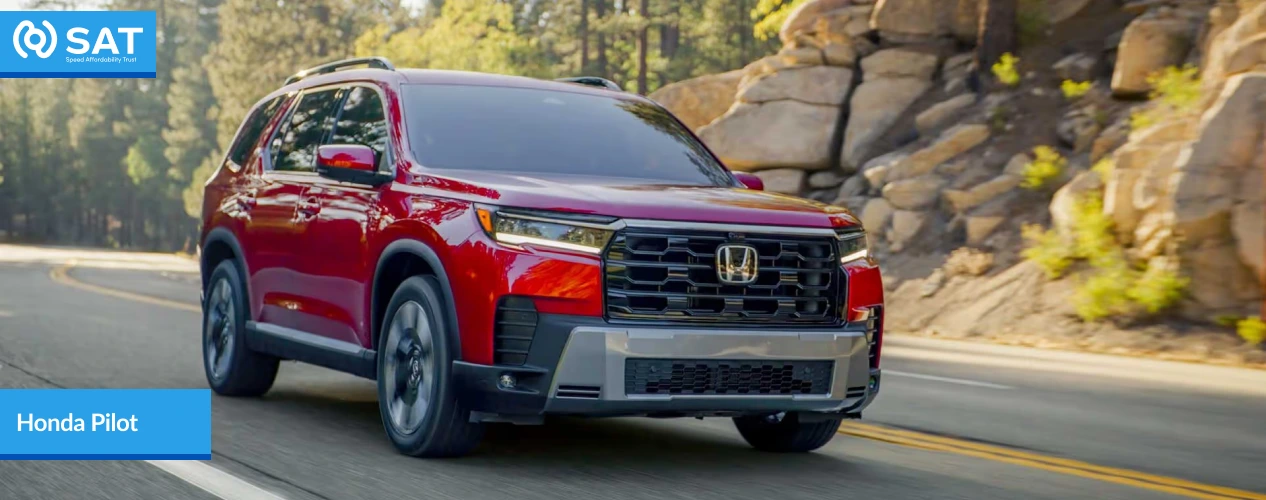
Honda didn’t build the Pilot to win a styling contest, and it shows. What they did build is something genuinely practical: a 3.5L V6, 285 horsepower, 10-speed automatic, available AWD, and a cargo hold that opens up to 113.7 cubic feet with the seats folded. That number matters, especially for families.
Towing is where it gives ground. With AWD, its 5,000-lb towing rating can handle a jet ski or small trailer without drama. For heavier regular towing, it's not the right tool.
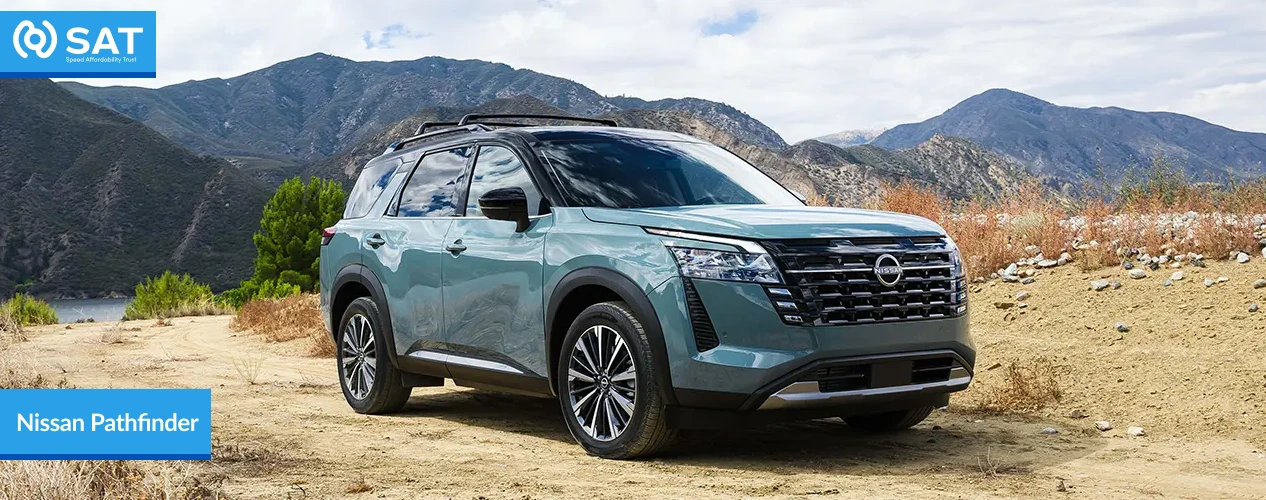
The Pathfinder has more personality. The Rock Creek trim looks the part, with a wider stance and rugged styling. It makes up to 295 hp on premium fuel, compared with 284 hp in other trims. It also gets a nine-speed automatic, available Intelligent 4x4, and a 6,000-lb tow rating. That tow rating is doing a lot of work in this comparison.
Space is where it loses ground. The third row is tighter than the Pilot's. Cargo space maxes out at 80.5 cubic feet. Fine for smaller families or lighter loads, but next to the Pilot, it's noticeably less flexible. These two vehicles have different priorities, and it shows.
Both SUVs use a 3.5-liter V6 and seat up to eight passengers, but they are not built around the same priority. The Honda figures below are based on Honda’s official 2025 Pilot specifications, while the Pathfinder towing, cargo, seating, and EZ FLEX details are taken from Nissan’s official Pathfinder specs and features pages. The Pilot gives families more usable space, while the Pathfinder gives buyers a higher towing rating and a slightly lower starting price.
Feature | Honda Pilot | Nissan Pathfinder |
Engine | 3.5L V6 | 3.5L V6 |
Horsepower | 285 hp | 284 hp |
Torque | 262 lb-ft | 259 lb-ft |
Transmission | 10-speed automatic | 9-speed automatic |
Seating | Up to 8 | Up to 8 |
Max towing | 5,000 lbs | 6,000 lbs |
Max cargo | 113.7 cu. ft. | 80.5 cu. ft. |
Front legroom | 41.0 in | 44.3 in |
Second-row legroom | 40.8 in | 35.5 in |
Third-row legroom | 32.5 in | 31.0 in |
Base MPG | 19 city / 27 hwy | 21 city / 26 hwy |
Starting MSRP | $42,395 | $41,900 |
Note: Pricing varies by model year, destination fee, and trim.
On paper, the Pathfinder looks stronger for towing and front-seat room. The Pilot makes its case in the rows families actually use most, especially the second and third rows.
Still undecided? You may also want to read our Toyota Highlander vs Honda Pilot comparison, especially if fuel economy and hybrid options are part of the decision
The Honda Pilot has more usable space than the Nissan Pathfinder, especially in the third row and cargo area. This matters if you regularly carry kids, adults, luggage, strollers, sports bags, or road-trip gear.
The legroom numbers explain why. The Pathfinder gives front passengers more space, but the Pilot has the advantage in the second and third rows. That matters more in a three-row SUV because the whole point is carrying people beyond the front seats.
The Pathfinder is still practical, but it feels tighter once all three rows are being used. If family space is the main reason you are buying a three-row SUV, the Pilot has the clearer advantage.
Key takeaway: The Pilot is the better space-first SUV because it gives families more usable room beyond the front seats.
If you are comparing more family-focused three-row SUVs, you can also read our Toyota Highlander vs Honda Pilot comparison for a closer look at space, comfort, fuel economy, and daily usability.
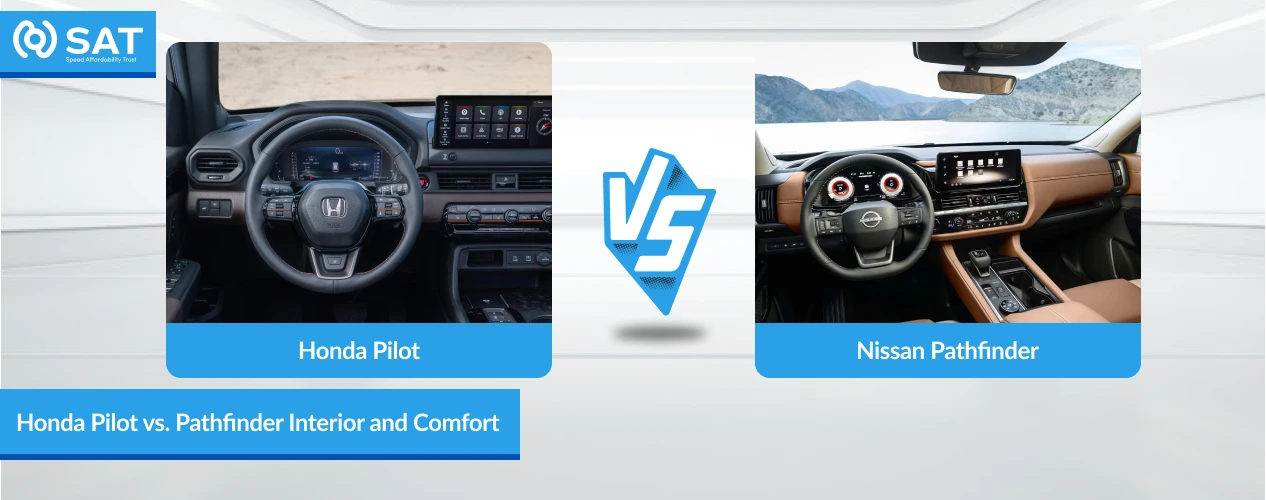
The Pilot wins here, though maybe not for the reason you'd expect.
The Pathfinder's SL and Platinum trims feel more upscale than many buyers expect at this price point. Walk through a dealership, and the Pathfinder might impress you more on looks alone. Then you start using it every day.
The real test comes on a weekday morning, not a weekend test drive: the third row has to fit real people, the trunk has to hold weekend gear, and everyone is loading in from different doors without much order. The Pilot handles that better.
Third row: Teenagers and adults can fit back there for short drives without feeling squeezed. The Pathfinder's third row is best suited to younger kids. Beyond that, it gets uncomfortable fast.
Cargo: The Pilot’s extra cargo space is not just a number on paper. You notice it loading luggage, a stroller, a cooler, and the bag that materializes every time you're about to leave.
Daily living: The Pilot has wide openings, clear visibility, and controls that do not need much figuring out. Nothing about it is exciting. After six months of daily use, that's no longer a complaint.
There are two family-specific seating details worth knowing. On select trims, the Pilot offers a removable second-row center seat, so families can switch between an eight-seat layout and easier third-row access. The Pathfinder counters with Nissan’s EZ FLEX seating system, which lets the second row tilt and slide forward for third-row access. If you use child seats, school bags, and third-row passengers in the same week, these small features matter more than brochure language suggests.
Key takeaway: The Pilot wins for passenger space and cargo flexibility, while the Pathfinder still deserves credit for smart second-row access.
Both run naturally aspirated V6s, which suits a heavy three-row SUV well. A turbocharged four-cylinder can feel less relaxed in this kind of vehicle.
The Pilot is smooth and unobtrusive. The 10-speed automatic suits its character: calm, consistent, and unremarkable in the best way. The Pathfinder, meanwhile, feels more planted when it is working. Loaded up and towing, it stays composed. The 9-speed automatic fits that personality well.
Towing is the Pathfinder’s strongest argument against the Pilot.
Max towing | Handles | |
Honda Pilot | 5,000 lbs | Jet skis, light trailers, small boats |
Nissan Pathfinder | 6,000 lbs | Campers, larger boats, loaded weekend gear |
Light or occasional towing? Either one works. Regular or heavier towing? The Pathfinder gives you room to work without bumping the ceiling.
Key takeaway: The Pathfinder is the better towing SUV, but the Pilot is enough for lighter family towing.
The truth is neither of them is built for off-roading. Both SUVs can handle snow, gravel roads, muddy campsites, and light trails. Rock crawling isn't on the menu.
Rock Creek earns its look more than TrailSport does because its towing rating, extra power, and rugged styling feel connected. The tow rating, the extra power on premium, and the styling hang together. TrailSport is a solid family SUV with some added capability for bad weather and unpaved roads.
The Pathfinder has a small edge. Some trims are rated around 21 mpg city and 26 mpg highway. The Pilot is rated at around 19 mpg city and 27 mpg highway in FWD form. Both will be relatively expensive to fuel compared with hybrid rivals. They're large V6 SUVs, and they behave accordingly. If fuel cost is the main concern, a Highlander Hybrid or Sorento Hybrid is a better conversation to have. The Pathfinder wins this category, but it won't make a meaningful difference in your monthly budget.
Both offer the main safety basics, though exact availability can vary by trim and model year. These include automatic emergency braking, lane-keeping assist, blind-spot monitoring, rear cross-traffic alert, and adaptive cruise control. Higher trims on both add 360-degree cameras and parking sensors.
Feature | Honda Pilot | Nissan Pathfinder |
Emergency braking | Standard | Standard |
Lane keeping | Standard | Standard |
Adaptive cruise | Available | Available |
Blind spot | Available | Available |
360 camera | Higher trims | Higher trims |
Safety verdict: Both SUVs cover the safety features most family buyers expect, but crash-test ratings can separate them depending on model year. The Pathfinder has earned stronger IIHS recognition in some recent years, including Top Safety Pick+ results, while the Pilot has also performed well but may not always match that highest rating. If you are buying used, check the IIHS and NHTSA rating for the exact year you are considering.
Key takeaway: Both are safe family SUVs, but exact crash-test ratings depend on the model year and trim.
Ratings shift between model years and trims, so check the exact vehicle before buying. Reliability is also not as simple as “Honda wins automatically.” Honda has the stronger long-term ownership and resale reputation, but third-party reliability scores can vary by source and model year. Some sources may favor Honda for long-term ownership confidence, while others may rate Nissan competitively in certain years.
The safest way to judge reliability is to look at the exact model year, service history, recall status, mileage, and ownership records. As a general used-SUV bet, the Pilot still feels safer for long-term resale. But the Pathfinder should not be dismissed as unreliable.
Key takeaway: Honda has the stronger long-term reputation, but reliability should be checked by model year, not brand name alone.
Category | Honda Pilot | Nissan Pathfinder |
Base trim | Sport | S |
Popular family trim | EX-L | SL |
Off-road-style trim | TrailSport | Rock Creek |
Top trim | Elite / Black Edition | Platinum |
Best value pick | EX-L | SL |
Best rugged pick | TrailSport | Rock Creek |
For most families, the sweet spot is not the cheapest trim or the most expensive one. The Pilot EX-L and Pathfinder SL are the trims most buyers should compare first because they usually bring the comfort, safety, and convenience features people actually use without jumping into full luxury pricing.
Honda Pilot | Nissan Pathfinder | |
Starting price | Slightly higher | Slightly lower |
Fuel | Slightly higher | Small edge |
Resale | Stronger | Weaker |
Depreciation | Slower | Faster |
Insurance | Similar | Similar |
The Pathfinder usually costs less up front. The Pilot usually gives more back at resale. More money is coming back out with the Pilot. It depends on which end of ownership matters more to you.
The Honda Pilot has a stronger long-term reliability and resale reputation, but the gap should not be treated as automatic for every model year. The Pathfinder is still a dependable family SUV, and some third-party scores may rate Nissan well depending on the year being compared.
If you plan to keep the SUV for several years, the Pilot is still the safer long-term bet because of Honda’s resale strength and ownership image. But before buying either one used, check the service records, recall history, mileage, and the exact model-year reliability data.
Pilot: EX-L covers what most families actually need. Comfortable, well-equipped, and doesn't require jumping to top-trim pricing to feel complete.
Pathfinder: SL for the balanced choice. Rock Creek, if towing or the rugged look is the point.
Used market: 2023 or newer Pilot, 2022 or newer Pathfinder. Both generations feel current enough for daily use without compromise.
For import buyers, the decision is not just Pilot vs. Pathfinder. It is finding the right year, mileage, condition, and export-ready paperwork. SAT Japan can help buyers compare available Japanese-market family SUVs, check real market availability, and source low-mileage options for international shipping. That matters if local listings are overpriced, limited, or missing the trim you actually want.
Pilot: Better third row, meaningfully more cargo space, easier cabin to use every day, stronger resale, and more flexible seating configurations. None of these advantages feels dramatic on its own. Together, they add up to an SUV that's less work to own.
Pathfinder: Higher tow rating, more visual personality, Rock Creek trim, better upper-trim interior quality, lower entry price, small fuel economy edge. Feels more like a vehicle with a point of view. If towing is part of your life, the argument for Nissan gets much stronger.
Buyer type | Better SUV |
Family with regular third-row use | Honda Pilot |
Buyer who tows often | Nissan Pathfinder |
Long-term ownership/resale | Honda Pilot |
Lower starting price | Nissan Pathfinder |
Weekend adventure/tougher styling | Nissan Pathfinder |
Maximum cargo space | Honda Pilot |
The Honda Pilot is better than the Nissan Pathfinder for most families. That is the clearest answer for most buyers.
It gives you more interior space, a better third row, more cargo room, stronger resale value, and a cabin that works better for daily family use. If you regularly carry kids, luggage, school bags, sports gear, or third-row passengers, the Pilot is the smarter SUV.
The Nissan Pathfinder is better only if towing is your main priority. Its 6,000-lb towing capacity beats the Pilot’s 5,000-lb rating, so it makes more sense if you often tow a camper, boat, or trailer.
So here’s the final verdict:
Choose Pilot if:
Third row gets used regularly
Cargo space matters
You're keeping it several years
Resale value is part of the decision
Choose Pathfinder if:
You tow trailers, boats, or campers regularly
Lower entry price is a priority
Rock Creek trim is the appeal
Third row size isn't a dealbreaker
For buyers outside North America, especially in the Middle East, Africa, and South Asia, importing a low-mileage Pilot or Pathfinder from Japan can be a more cost-effective option. Japanese-market vehicles typically come with full service histories, strict pre-export inspection standards, and lower mileage than comparable used inventory in other markets.
SAT Japan stocks both the Honda Pilot and Nissan Pathfinder models, handles the full export process, including documentation, inspection, and international shipping, and sells directly to buyers worldwide. Browse the current inventory of Japanese used cars on our website.

Most buyers make one costly mistake: they focus only on the purchase price. But that price is only the beginning. Fuel efficiency, maintenance, depreciation, insurance, parts availability, and resale value are the real costs of a vehicle. These costs quietly drain your money every month. However, a smart investment can save you. Keep this question in mind when comparing Japanese used cars vs new cars: “Which car will cost me less over the next 3 to 5 years?”, instead of “which car is cheaper today. Buying a car is not a short-term trend; it's a decision you live with for years. This guide will help you understand everything about Japanese used and new cars so that you can make an informed, logical decision.
Japanese new cars are more than just showroom products. These cars combine engineering discipline, cultural habits, government policy, and market behavior into something hard to replicate anywhere else. Brands like Toyota continuously refine their vehicles over time. Japanese cars are not built once and forgotten. These cars are
Constantly refined
Tested against real-world use
Improved in small, precise ways over time
Japan focuses on evolving its cars rather than just redesigning them. That’s why automotive companies like Honda sell millions of their units globally without reinventions every year.
The Japanese automotive market behaves differently from other big markets. In Japan, people replace their vehicles more often than in other countries. Also, they prefer local transport daily to reduce daily driving and fuel costs. Because of this, manufacturers like Nissan and Mazda build cars that prioritize efficiency, size control, and usability from day one.
Buying a new Japanese car doesn't mean it's only about the price. Ownership includes registration costs, mandatory inspection, and parking proof requirements. These factors can increase a vehicle's upfront cost each year. In general, Japanese new cars dominate their domestic market. However, Japanese used cars dominate the global market.
These cars have zero wear and tear and no prior ownership history.
They come with the latest technology, safety features, and updated design.
Backed by the manufacturer's warranty itself.
No risk of hidden damage.
Higher purchase price compared to used alternatives
Rapid depreciation in the first few years of ownership.
Higher total cost of ownership over time.
Higher insurance cost due to higher vehicle value
Looking to buy a used Japanese car, but concerned about whether they are worth the money? We’ve got you covered. It is no wonder that Japanese cars are the most reliable and offer the best return on investment. Japanese citizens usually rely on public transport on weekdays, as it is considered more practical.
Japanese cars are mostly used on weekends for grocery shopping or attending events. This contributes to their strong global reputation for reliability. This is also one of the biggest reasons why Japanese used cars dominate globally.
Japanese used cars are great for long-term investment. Japan has a strict inspection system called “Shaken”. Every new car in Japan undergoes a Shaken inspection after 3 years. Then, after every two years, Shaken will go through to highlight all the flaws in a vehicle.
Japan has a high vehicle production rate. Japanese people prefer the newest models, which keeps used Japanese cars widely available. These cars can easily last 100 to 200k kilometers. Besides, the Japanese cars being reliable, Japanese cars are also best known for low maintenance and long-term durability. Japanese cars like the Toyota Corolla, Nissan X-Trail, and Honda Fit are the best-selling used Japanese cars. Due to massive production, Japan exports ready-to-drive vehicles, which keeps its auction prices low.
In japanese cars, you will find a variety of models and specifications at a fraction of the cost. Buying these cars is a good investment, as it is better to buy a 5-year-old used Japanese car than a 2-year-old used car from another brand.
Low-mileage, high-maintenance vehicle at a fraction of the cost.
Lower depreciation compared to new cars.
Better value for money with higher specs at a lower price.
No manufacturer warranty in most cases for imported used cars.
Risk depends on the auction grade and inspection accuracy.
Importing often involves longer waiting times.
Most people think the full amount of the invoice is the full price. That’s where most people make mistakes. The actual costs start when you take your vehicle out of the showroom. That’s where real costs begin to add up. Taking out a new Japanese car means additional depreciation, which will be reduced if you buy a used Japanese car.
Let's understand what a fair deal is to buy a new Japanese car or a used one. Suppose “A” and “B” are two people buying a new and a used car. Let's see the stats.
“A” is buying a brand-new car at $20,000. After 3 years, the resale price will drop to $1200. Loss is $800. On the other hand, “B” is buying a 3-5-year-old used Japanese car for $ 1,200. After 3 years, the resale value will be $9,000 - $10,000. The loss will be between $2k and $3k.
New Japanese cars come with fresh ownership, zero previous history, and emotional satisfaction. But they are loaded with losses. Japanese used cars can give you proven performance, stable pricing, and a higher ROI.
Let's be honest for a second. When we hear the word “used car”, we instantly picture worn seats and plenty of hidden issues. But here come Japanese cars with fewer hidden issues and better condition. That’s because of the rigorous vehicle inspection system “Shaken”. Shaken leaves an owner with two choices.
Maintain their vehicle in good condition.
Sell out the car before the next inspection.
Why sell out before inspection? Because Shaken isn’t just a casual annual inspection, it's unforgiving, expensive, and detailed. Maintaining a car is the norm in Japan, not an expectation.
If we talk about mileage, Japanese used cars have lower annual mileage. This is because a car is not a daily survival tool in Japan. Most of them prefer to use local trains. These factors help keep vehicles in excellent condition and make used Japanese cars more reliable than other vehicles.
On the other hand, Japanese new cars come without any inspection pressure or wear and tear and are in factory-perfect condition.
So the difference becomes clear:
Japanese new cars are in perfect condition with no history.
Japanese used cars are well-maintained due to a strict system and are not neglected.
Most car buyers only see the price and model name, but the Japan import system changes the game here. Japan not only produces cars but also exports high-spec models that most markets never see. Japan builds vehicles for people who expect more features and tech and prefer comfort in everyday life. Importing a used Japanese car means you are importing a higher-spec model.
A Japanese used car often comes from the JDM, and this changes everything.
A new car in your local market is usually a simplified version:
Base trim to keep price attractive
Paid add-ons for features
Limited configurations
Meanwhile, a Japanese used car might be:
A higher trim level
Already equipped with premium features
Built for a market that expects more by default
In Japanese new cars, your choice is limited because of a few trim availability and limited stock in the local market. When choosing a used Japanese car, you have a wider market to choose from, with multiple trims of the same model, plenty of luxury hybrid and manual variants, special editions, and discounted specs.
New Japanese cars come with one big advantage: “Freshness”. But these cars are basic in terms of features unless you pay extra. Here’s the reality.
New car: Lower entry price, but features are locked behind upgrades.
Japanese used car: Features already included, depreciation already absorbed.
A Japanese new car comes with a manufacturer-backed warranty. So the risk is low, and the brand itself backs the vehicle. This usually includes:
Coverage for major components (engine, transmission)
Service support through authorised dealerships
Predictable maintenance schedules
No previous ownership history
Japanese used cars come with a transparent history but offer no safety. They don't come with manufacturers' warranties; they come with a documented history. Most of the used Japanese cars are sourced through auctions. So, here’s what you typically get.
Auction grade (overall condition rating)
Inspector notes (scratches, dents, repairs)
Mileage verification
Interior and exterior condition reports.
In buying a new Japanese car, you rely on the manufacturer's warranty. When buying a used Japanese car, you rely on the transparency of information.
This is where you save or lose your money. Fuel costs are recurring expenses. Japanese new cars are engineered for strong fuel efficiency. Brands like Toyota and Honda have advanced hybrid technology to the point where newer models deliver excellent mileage. With a new car, you get an updated engine and hybrid systems, improved fuel efficiency, and manufacturer-optimized performance.
Now look at used Japanese cars, especially the Toyota Aqua, Honda Fit Hybrid, and Daihatsu Mira. These cars were built for fuel efficiency from day one. Japan has built fuel-efficient vehicles as the default, as roads in Japan are typically narrower, fuel costs are already high, and there is strong demand for compact vehicles. Even a 3 to 5-year-old Japanese vehicle can have low mileage, better fuel efficiency, and stable running costs. So you get almost the same fuel-efficient vehicle while paying for either a new Japanese car or a used one.
Buying a car isn’t just about the price. It’s also about how easily you get your vehicle into your hands. Getting a new car is a straightforward process. You go to the dealer, choose the model and variant, go through some paperwork, and congratulations, you have your car.
But this way, you are limited to the models available locally, fixed trims and configurations, and dealer pricing and availability. In simple terms, the process is easier and faster than importing a car, but you have fewer choices.
Most people think importing a car is difficult, but actually, it’s not. It just needs your constant involvement. The process usually looks like this:
Select a car from auction platforms like USS Auctions
Work with an exporter to purchase and verify the vehicle
Choose shipping method (RoRo or container)
Wait for international delivery
Handle customs clearance and registration
This approach keeps your options open and leaves you with a wide range of choices. But you might have to compromise on the time.
This is the real struggle when you have your vehicle around you. The maintenance ecosystem for new cars is simple and predictable. You will get genuine parts through authorized dealers, a warranty, and a standardized service procedure. New car parts are readily available, easy to source, and backed by the manufacturers.
Japanese used cars rely on two ecosystems:
Local market support (mechanics, parts shops)
Import-based supply (used parts, aftermarket, online sourcing)
For common brands like Toyota and Honda, parts are available everywhere cheaply and quickly.
Feature | Japanese New Cars | Used Japanese Cars (3–5 Years Old) |
Purchase Price | High upfront cost | Significantly lower purchase price |
Depreciation | Rapid (30–50% in first few years) | Minimal (already depreciated) |
Condition | Brand new, factory condition | Well-maintained due to strict inspection systems |
Mileage | 0 km | Low to moderate mileage |
Fuel Efficiency | Latest engine & hybrid technology | Still highly fuel-efficient (built for efficiency) |
Features & Technology | Latest features but often basic trims | Higher trims with premium features included |
Variants & Options | Limited to local dealership stock | Wide range from auctions (JDM variants, special editions) |
Warranty | Full manufacturer warranty | Usually no warranty (depends on source) |
Maintenance Cost | Higher (authorized service, costly parts) | Lower (aftermarket and used parts available) |
Insurance Cost | Higher (based on car value) | Lower (reduced vehicle valuation) |
Resale Value | Drops quickly | More stable over time |
Availability | Immediate (if in stock) | Depends on import and shipping time |
Import Process | Not required | Requires auction, shipping, and clearance |
Risk Level | Very low | Depends on auction grade and inspection |
Overall Value | Lower (due to depreciation hit) | Higher (better specs at lower cost) |
The following are the common mistakes people usually make.
Ignoring depreciation: This is the biggest mistake. Buyers look only at today’s price. They don’t look at tomorrow’s loss. However, a vehicle loses its value as soon as it’s taken out of the showroom. On the other hand, the Japanese used cars have gone through this spike in cost loss.
Overvaluing “brand new” status: Brand-new car buying is a psychological pull. Buying a new car means you are buying everything fresh. Most of the time, you are paying for the premium feel. Once it loses the label “new”, it is just another car roaming on the roads.
Underestimating used car quality: Ignoring quality is another disastrous mistake. Don’t just look at the price, look for features and specs, so it will be a great investment in the long run.
Not calculating long-term costs: Upfront cost is not the only cost. Hidden costs will chase your wallet every month. Buying a used vehicle in better condition can save you thousands.
If your priority is maximum financial value, Japanese used cars are hard to beat. You skip the first-year depreciation and get a well-maintained vehicle, especially when sourcing through trusted exporters like SAT JAPAN. It’s the smarter move on paper, and for most people, it quietly wins. If you want zero hassle and complete peace of mind, new cars hold the ground. Full warranty, no unknown history, no surprises. It’s convenient, packaged, and priced accordingly.
If you’re chasing premium features without paying premium prices, used imports hit a sweet spot. This is where things get interesting. Higher trims, better specs, and features that never even made it to your local market, all at a fraction of the original cost.
And if you’re planning long-term ownership, the answer depends on how you play it. A carefully chosen used car can last years without draining your wallet. A new car, on the other hand, gives you predictability and a clean starting point. Neither is wrong, but one is clearly more efficient if managed well.
There’s no universal “best” choice, but there is a right choice for you. If you’re thinking long-term and logically, the used route usually comes out ahead. If you prefer certainty and don’t mind paying for it, new makes sense.
Have you ever wondered why some car owners prefer Japanese cars, while others prefer UK cars? When it comes to ‘JDM vs UK cars’, it’s not just about looks; it’s also about value, reliability, and everyday usability.
JDM cars are well-known for their engineering excellence, simplicity, and durability, which helps them consistently rank high in reliability ratings. UK cars, meanwhile, are designed for European roads, with better corrosion resistance.
But here’s the catch: JDM (Japanese Domestic Market) cars tend to be better kept, have lower mileage, and are sometimes even better equipped than UK models.
Sounds confusing, right? In this article, we’ll keep it simple so you can clearly see the real winner and which option suits you best.
For a clear choice, Japanese cars are better in terms of reliability, cost, and value for money, while UK cars offer comfort, refinement, and driving experience.
Here are the facts:
Japanese cars consistently rank highest in UK reliability surveys, with Toyota, Honda, and Lexus leading studies based on thousands of owners.
Lexus has a 5.79% warranty claim rate, compared with an industry average of 28.3% (meaning fewer breakdowns and repairs).
Japanese cars score over 94% in reliability, showing strong long-term durability.
On the other hand:
UK cars show variable reliability depending on maintenance.
They often have higher mileage and higher repair costs, especially luxury models.
Simple verdict:
Buy Japanese cars for low risk, lower costs, and fewer repairs.
Choose UK cars for performance, feel, and luxury.
Japanese cars are designed with longevity, reliability, and efficiency in mind. There is strong evidence to support this. In the UK, 7 out of 10 of the most reliable used cars are Japanese, highlighting their long-term durability. Toyota and Honda are among the most reliable brands, with some models scoring above 99% in owner surveys.
This is partly due to Japan’s vehicle inspection system. Cars go through strict inspections, and owners often sell them before major repairs are needed. This means used Japanese cars usually have low mileage (around 30,000 miles in Japan vs 150,000 miles in the UK). Globally, this is why Japanese car auctions are popular: they offer cleaner, better-maintained vehicles. If you want a broader comparison, you can also explore how Japanese vehicles stack up globally in our guide on Japanese vs American cars.
Put simply, Japanese cars are built to last, are cost-effective, and deliver consistent performance.
Japan is also home to some of the world’s most trusted car brands. Manufacturers like Toyota and Honda are known for reliability and fuel efficiency, while Nissan offers a balance of performance and affordability. Mazda focuses on driving dynamics and design, and Subaru is known for its all-wheel-drive systems. Premium brands like Lexus and Infiniti offer luxury with strong reliability. These brands highlight Japan’s strength in durability, innovation, and everyday usability.
UK-built cars are designed for local market needs, regulations, and real-world driving conditions. They are engineered to handle harsh weather, rough roads, and long motorway journeys.
The average UK car is driven around 7,400 miles per year, so most used cars have already seen significant use before resale. That’s why they tend to have higher mileage than imports. However, this also means they are tested in real driving conditions, including long motorway trips and stop-start traffic.
Another key advantage is compatibility. UK cars meet all local safety and emissions standards, so there are no extra modification costs. Insurance is also usually lower, as parts are easy to find and mechanics are familiar with UK models.
The UK car market is massive, worth over $88 billion in 2024, with strong supply and demand. Put simply, UK cars are more compatible, easier to maintain, and practical for everyday use.
The UK is also home to some of the world’s most iconic car brands. Manufacturers like Bentley and Rolls-Royce focus on ultra-luxury and craftsmanship, while Aston Martin and McLaren are known for high-performance sports cars. Brands like Land Rover and Jaguar offer a mix of luxury, off-road ability, and innovation, while Lotus focuses on lightweight design and precision handling. These brands show the UK’s strength in performance and premium vehicles.
The differences between Japanese and UK cars are significant because they affect reliability, affordability, and practicality.
Japanese cars are built to last and need fewer repairs. UK surveys show brands like Toyota, Honda, and Lexus consistently rank at the top. UK cars, however, show mixed reliability depending on maintenance history.
Real takeaway: Japanese cars are more reliable, and UK cars can be a mixed bag.
A 5–7-year-old Japanese import: 30,000–50,000 miles
A UK car: 70,000+ miles
Lower mileage means less engine wear and longer life.
The Japanese have rigorous inspection standards (Shaken), which encourage early disposal of cars that aren't well-maintained. So Japanese imports can come in better shape, with well-documented service history.
Drivers use UK cars more on motorways, and that’s why they wear out faster.
This is one of the reasons why Japanese cars feel "brand new" for so long.
There are practical UK spec vs JDM differences:
UK-spec cars have stronger rust protection to handle harsh weather conditions.
JDM cars have less rust protection, as Japan’s roads face less harsh winter conditions.
Result:
UK cars hold up to the weather.
JDM cars require rust-proofing on import.
JDM cars may have extra features and higher spec than their UK counterparts, such as:
Alternative engine tuning or higher rev limits.
More features and equipment.
Japan-exclusive trims and options.
In some cases, certain models even put out more power (+10hp in some models) because of different ECU settings.
Put simply, JDM cars offer better value for money.
JDM car: lower up-front cost, but more expensive repair parts and insurance.
UK cars: more expensive to buy, but cheaper to repair locally.
So, the price is lower, but the cost depends on total ownership.
The good condition and quality of Japanese imports often lead to higher resale value in many markets.
Imports are in greater demand because people want low-mileage, high-quality cars at lower prices.
Feature | Japanese Import Cars | UK Cars |
Reliability | Excellent - Toyota & Lexus are top with 90%+ reliability | Average - varies by brand and maintenance |
Average Mileage (Used Cars) | Low – typically 30,000–50,000 miles for 5–7 year old cars | Higher – usually 60,000–80,000+ miles |
Vehicle Condition | Cleaner interiors, less wear due to a strict inspection system | More wear due to frequent use and long-term use |
Maintenance Cost | Less frequent breakdowns, but parts are often costly or uncommon | Simpler maintenance, lower cost, and easy to find parts |
Fuel Efficiency | Excellent - good hybrid powertrain, 20-30% improved efficiency | Average, but lower due to the emphasis on power |
Features & Specs | More features, tech, higher-spec trims (Japan-only) | More standard features, fewer trims |
Rust Protection | Lower (requires maintenance on arrival) | Very good - can handle rain and snow |
Insurance Cost | Usually higher due to import duty | Often more affordable and stable |
Upfront Price | Cheaper for the features and condition | More expensive for similar condition vehicles |
Resale Value | Strong - retains value due to reliability and popularity | Moderate - often depreciates more rapidly |
Driving Experience | Smooth, practical, comfort-focused | More refined for motorway driving |
When comparing Japanese vs UK cars, the biggest differences are in condition, features, and cost of ownership. Japanese imports in the UK are more popular due to their better value for money, but there are some compromises in their practical use.
Japanese imports have much lower mileage and are in better condition. In Japan, cars are replaced early due to strict inspection requirements, ensuring that they remain in good condition. Research also reveals that Japanese brands are the most reliable in surveys and are the most reliable used cars in the UK.
Another key factor in Japanese vs UK car specs is superior specifications. JDM cars usually come with additional features, a higher-quality interior, and tech that is not standard in UK cars.
So you get more for your money.
Japanese cars are affordable, but there are some considerations. They often require modifications to comply with UK regulations, such as emissions and registrations.
Rust is a common problem. JDM cars tend to have less rust protection, so they can rust more quickly in harsh environments if not maintained.
Spare parts can also be available. Standard parts are readily available, but less common models may have restricted availability, adding time and money to repairs.
There are also minor tweaks. For instance, the speedometer may require conversion from km/h to mph, increasing the cost of importation.
Insurance is another factor. Imported vehicles are often categorized differently for insurance purposes, which may involve higher rates.
Japanese imports could be cheaper upfront, but they can require a little more work and money to get them up to speed.
When deciding between JDM vs UK cars, consider how you will use your car. There are real differences, so you can make an informed choice.
For reliability and durability, choose Japanese cars. A survey found that Japanese manufacturers, such as Toyota and Honda, are the most reliable used cars in the UK. And Japanese cars tend to have half the mileage of EU cars, so they last longer and have fewer engine problems.
But for hassle-free ownership, consider UK cars. They are designed for UK roads, and you won't have to deal with import-related issues, parts shortages, or compatibility.
Simple decision:
JDM cars for better condition, lower mileage, and good resale value
Choose UK vehicles if you want good service, support, and convenience
There are a lot of myths about JDM vs UK cars, and most are not supported by facts. Let's have a look at them.
Myth 1: ‘UK cars are more reliable.’
This is false. Major surveys in the UK show the most reliable cars are Japanese (Toyota, Honda, Lexus), and some UK/European ones are the least reliable.
Myth 2: ‘Japanese cars are boring and low quality.’
Not true. Data on the reliability index show that Japanese cars have a score of up to 96.8/100, indicating they are well built and well engineered.
Myth 3: ‘It's risky buying Japanese imports’
In reality, strict inspection rules in Japan keep cars well-maintained and low in mileage, which actually makes them safer to buy.
Myth 4: ‘UK cars are more affordable to maintain.’
Parts are easier to source, but research shows Japanese cars require less maintenance and repair.
Final truth: The JDM vs UK cars debate is not about myths—it’s about real data, and Japanese cars consistently prove their value.
When it comes to JDM vs UK cars, the final answer is very clear if you look at real data rather than just opinions. Japanese cars win in reliability, condition, and long-term value, while UK cars win in ease of ownership and local support.
Reliability reports show Japanese brands dominate the top positions, with very low claim rates, as low as 5.79% for Lexus, compared to much higher industry averages. This means fewer breakdowns and lower repair frequency over time. On top of that, Japanese imports are often in better condition and lower mileage, thanks to strict inspection systems and lighter road use. The SAT Japan UK office is making it easier for buyers to access high-quality, verified vehicles directly from Japan.
UK cars, however, are already built for local conditions. They offer easier servicing, faster parts availability, and no compliance issues, which reduces daily ownership stress.
So, choose JDM cars if you want maximum value, durability, and longevity; or UK cars if you want hassle-free day-to-day ownership. In short, JDM cars offer better long-term value, while UK cars provide easier day-to-day ownership.

Are you considering an MPV or SUV but confused about which one to choose? We’ve got you covered. An SUV is a versatile car built for mixed-use, city driving, and rough roads, while an MPV is a more practical car built for maximum space and family use. Explore this blog for a detailed MPV vs SUV comparison. Also, let’s break down the MPV vs SUV pros and cons to understand which suits your needs better.
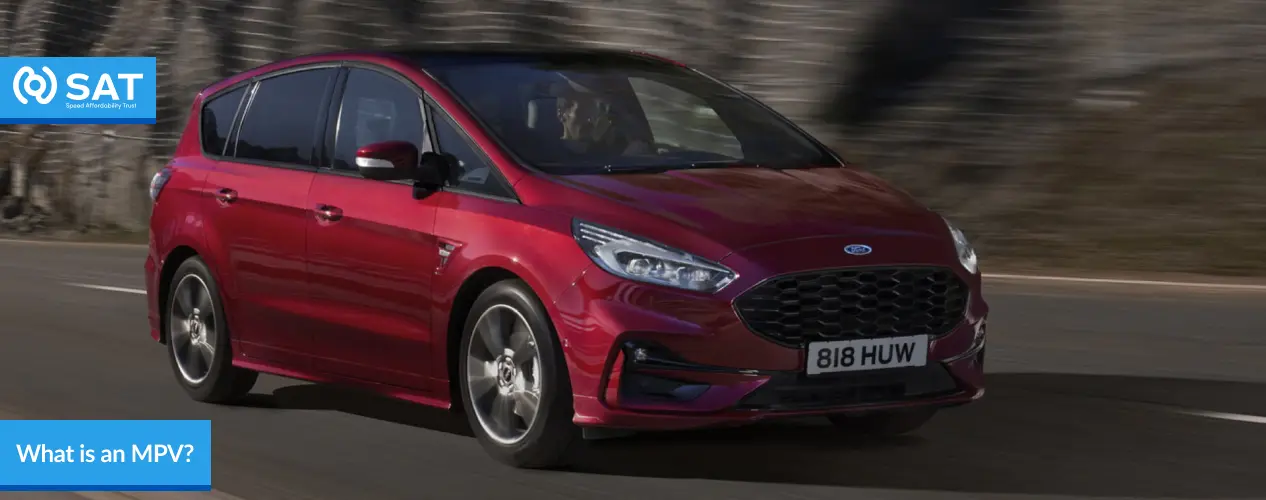
An MPV is often known as a minivan or people carrier, designed especially for maximum space and comfort. These vehicles are one-box or two-box in shape to maximize interior space, so even the tallest passenger can ride comfortably. When it comes to MPV vs SUV for family use, MPVs often stand out due to their space and practicality.
MPV stands for “Multi-purpose Vehicle”. These vehicles are designed to carry people, luggage, or both, with maximum space and flexibility. An MPV is often known as a minivan or people carrier due to its high capacity and practicality.
The following are common types of MPVs.
Compact MPVs: These MPVs are smaller and have lower fuel consumption than other MPVs. Compact MPVs come with decent space and are ideal for daily use.
Mini MPVs: These MPVs are affordable for smaller families as they are equipped with flexible seats. They focus more on practicality than on features and power.
Large MPVs: These are huge vehicles with maximum cabin space and are best for larger families. Large MPVs have 5 to 9 seats and are often known as “People Carriers”.
Premium MPVs: Offer top-notch luxury interiors, advanced technology, and superior comfort.
Whether you are choosing an MPV or an SUV, it is important to know the features first. This will help you invest in the right vehicle for your needs. The main features of an MPV are listed below.
3-Row Seating: Usually fits 6–8 passengers
Spacious Interior: Lots of head and legroom for comfort
Flexible Seats: Seats can be folded, slid, or removed for extra cargo space
Large Boot Space: Designed to carry luggage + people together
Easy Entry/Exit: Wide doors, often sliding doors (super practical)
Comfort-Focused: Smooth ride, ideal for families and long trips.
Below are the key benefits and drawbacks of an MPV.
Spacious: An MPV is a vehicle with a spacious interior having 5 to 9 seats.
Comfort: Most MPVs offer ample head and legroom, making comfort the top priority.
Safety: An MPV is usually the safest vehicle to drive on the road, as it passes most of the safety tests.
Flexible: Folding and sliding seats make a long journey comfortable and smooth.
Luggage Capacity: MPVs have more room for luggage besides people.
Style: Besides practicality, MPVs often miss style.
Driving Experience: The driving experience is slightly tame and may not suit thrill-seeking motorists.
Off-road Performance: MPVs are great for smooth roads but often struggle on rough terrain.
Bulky Size: The huge size of most MPVs makes parking difficult.
Higher Fuel Consumption: MPVs can consume more fuel due to their size, though this varies by model.
Toyota Innova / Innova Hycross: Especially known for strong reliability, durability, and comfort. This is an ideal choice for families and commercial purposes.
Kia Carnival: This is a premium MPV with high-end features, excellent comfort, and a spacious interior.
Hyundai Staria: It has a modern design with a very spacious cabin. Available in multiple seating configurations.
Suzuki Ertiga: This is an affordable, fuel-efficient, and practical vehicle for everyday family use.
Renault Triber: A compact but budget-friendly MPV suitable for small families.
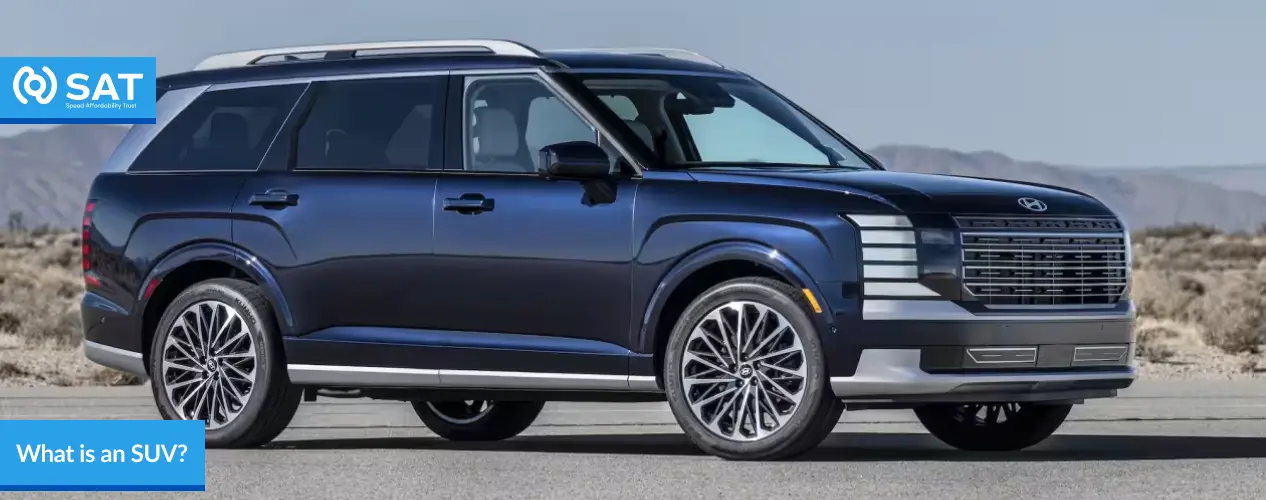
If you live in the UK, you have probably seen a wide range of SUVs on the roads. These vehicles are popular for their style and off-road capability. SUVs come in both compact and spacious options, and both are popular depending on individual preferences.
SUV stands for “Sports Utility Vehicle.” These vehicles are often known as 4x4s, which means all-wheel drive. The comfort and style of SUVs make them an ideal choice for a wide range of lifestyles, whether you are in your hometown or on highways.
The following are common types of SUVs.
Compact SUVs: These SUVs are very popular these days as they are easy to handle in urban areas. These SUVs provide decent space with SUV styling without the bulk.
Mid-sized SUVs: These offer more space than compact SUVs, stronger engines, and third-row seating.
Full-size SUVs: These are the largest and most powerful SUVs, maintaining maximum space and capacity, often accommodating 7 to 8 people comfortably.
Crossroad SUVs: These are car-based SUVs built on a unibody platform, offering a smoother ride and better fuel efficiency.
Off-road SUVs: These are the rugged ones, built on truck-like frames, making them ideal for tough terrain, heavy-duty use, and serious off-road adventures, though they are heavier and less fuel-efficient.
High Ground Clearance: These vehicles easily handle bumps, potholes, and rough roads.
Elevated Driving Position: SUVs offer better road visibility.
Spacious Cabin: More headroom and legroom, often with 5-7 seats
Large Cargo Space: It is ideal for luggage, travel, and family use.
Rugged Build: An SUV has a strong body designed for tougher conditions.
All-wheel drive / 4x4 (in many models): It has a better grip on mud, sand, and rain, as well as on uneven terrain.
Versatility: SUVs work well for city driving, highways, and light off-road use.
An SUV is a versatile vehicle, but it has both benefits and drawbacks.
Off-Road Capabilities: An SUV is an ideal choice for individuals seeking adventurous journeys.
Versatility: The SUV is suitable for city, highway, and light off-road driving.
Style: Unlike MPVs, SUVs entail comfort along with a modern, appealing appearance.
Interior Space: SUVs have enough space for passengers to enjoy a comfortable journey.
Better Visibility: Elevated seating in an SUV gives a clearer view of traffic.
Driving Experience: An SUV offers a more powerful and commanding driving experience, with a higher seating position and better road visibility than an MPV.
Many modern SUVs combine these capabilities with comfort, and you can explore online options to find the right fit. Explore Now
Expensive: Due to the use of modern technology in SUVs, these are more costly than other alternatives.
Fuel Consumption: In terms of MPV vs SUV fuel efficiency, MPVs are generally more economical due to their lighter build.
Not Ideal for Small Cities: SUVs can feel bulky on narrow roads and in heavy traffic.
Difficult to Park: Large size makes tight spaces and city driving harder.
Toyota Land Cruiser: This is well known for extreme durability and true off-road capability.
Honda CR-V: Comfortable, reliable, and great for everyday use.
Toyota RAV4: A globally popular, practical, and fuel-efficient vehicle.
If you want to explore more vehicle comparisons, read our detailed guide on Hatchback vs SUV: Pros, Cons, and Key Differences Explained.
Before deciding, it’s important to understand the key difference between MPV and SUV options.
Feature | MPV (Multi-Purpose Vehicle) | SUV (Sport Utility Vehicle) |
Primary Purpose | Carry people efficiently | Versatile driving (city + rough roads) |
Seating Capacity | 5–9 passengers | 5–7 passengers |
Interior Space | Very spacious, family-focused | Spacious but slightly less flexible |
Cargo Flexibility | High (fold/remove seats) | Moderate (foldable seats) |
Ground Clearance | Low to medium | High |
Driving Position | Lower, car-like | Higher, commanding view |
Off-road Capability | Not suitable | Suitable (especially AWD/4x4 models) |
Fuel Efficiency | Better | Lower (heavier body) |
Handling in City | Easier than SUVs | Harder due to size |
Comfort for Long Trips | Excellent (family comfort) | Very good (depends on model) |
Design Focus | Practical and functional | Bold and rugged |
Cost | Usually more affordable | Generally more expensive |
Both are the best value-for-money vehicles, but the right choice depends on your needs, lifestyle, family size, and budget.
Choose an MPV if you want a cost-effective and spacious vehicle with plenty of seats. Ideal choice for people with larger families, for comfortable long trips, and urban convenience. An MPV is perfect for those who prefer versatility more than style.
On the other hand, an SUV is a good choice for people who prefer style and want a vehicle with good off-road capability. Ideal choice for those seeking modern technology with style and a go-to option for motorists fond of adventurous trips.
Still unsure which one suits you best? No worries. At SAT Japan, our experts can guide you in choosing the right vehicle based on your exact requirements, ensuring you get the perfect balance of performance, comfort, and value.
If you’re new to SUVs and unsure which one to choose, this guide will help you compare the Grand Highlander and Highlander in great detail. Both the Toyota Highlander and the Toyota Grand Highlander are powerful competitors within the Toyota line, but they are designed to serve different purposes.
The Highlander is an efficient, comfortable, and practical car that is best suited to daily driving. The Grand Highlander, on the other hand, is more spacious, more comfortable in the third row, and has a higher cargo capacity, which is more suitable for use on long trips and big families.
In this guide, we will compare Grand Highlander to Highlander side by side to enable you to make the right decision on which SUV will fit your lifestyle.
Feature | Toyota Highlander | Toyota Grand Highlander |
Starting Price | ~$47,840 | ~$43,000 |
Engine | 2.4L Turbo | 2.4L Turbo + Hybrid MAX |
MPG (Hybrid) | ~36 MPG | ~37 MPG |
Cargo Space | 84.3 cu ft | 97.5 cu ft |
Third Row Comfort | Limited | Adult-friendly |
When comparing the Toyota Highlander to the Toyota Grand Highlander, the major differences boil down to the size, interior space, and powertrain choices.
Size is the most apparent difference. The Grand Highlander is bigger in size, has more cargo and passenger space, particularly in the third row. It is made to give real comfort to adults, whereas the third row of the Highlander is more appropriate for children or occasional use.
Performance is another significant difference. The Grand Highlander also has more advanced powertrain features, such as high-output turbocharged hybrid engines with up to 362 horsepower that provide the Grand Highlander with superior acceleration and towing capacity over the Highlander.
Mid-size SUV, ideal for daily use.
Best for city driving and easy to park.
Its third row is more suitable for children or occasional use.
Larger body with increased interior volume.
Spacious third-row seating that can comfortably accommodate adults.
Better suited for larger families and long-distance travel.
Toyota Highlander has a length of between 194.9 and 197.4 inches, depending on the trim. Being a medium-sized, three-row SUV, it has a moderate footprint, which allows it to have a spacious interior without difficulty in a smaller city setting.
The Toyota Grand Highlander is uniformly 201.4 inches long in all trims. This increased size translates to more interior volume and cargo capacity, providing enhanced comfort, particularly for third-row passengers.
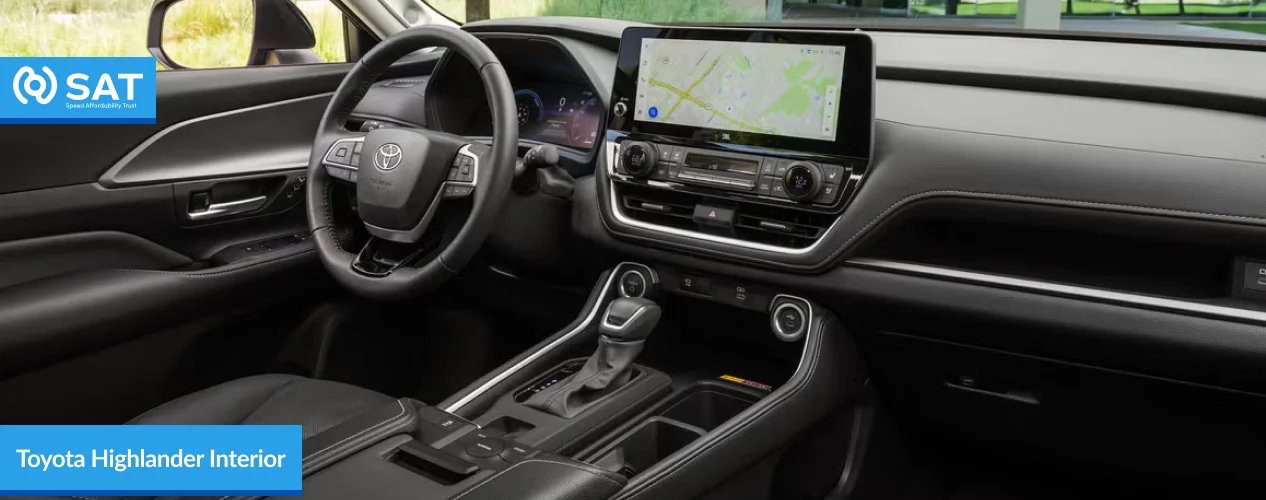
The Highlander has 42.4 inches of front legroom, 38.7 inches in the second row, and 28 inches in the third row. It has a maximum of 84.3 cubic feet of cargo space with the rear seats folded and 16 cubic feet behind the third row, which is good for daily life and light travel.
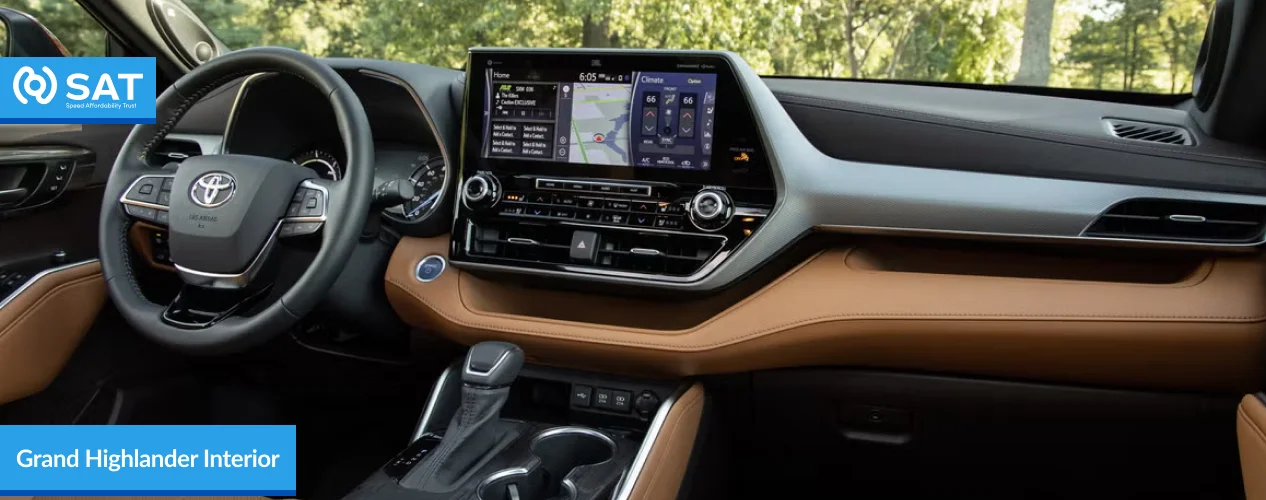
The Grand Highlander increases the rear-seat comfort by providing 41.7 inches of front legroom, 39.75 inches of second row, and 33.5 inches of third row. It also has a maximum of 97.5 cubic feet of total cargo capacity and 20.6 cubic feet behind the third row, which makes it more useful in a bigger family and for long-distance travel.
In the comparison of Toyota Highlander and Toyota Grand Highlander specs, the two SUVs have similar bases, yet the Grand Highlander has additional power choices available.
There are two Toyota Highlander powertrains. The typical model has a 2.4-liter, four-cylinder, turbocharged engine with a horsepower of 265 and a torque of 310 lb-ft. It even has a 2.5-liter hybrid system with 243 horsepower, focused more on fuel economy than performance.
The Toyota Grand Highlander has the same engines, with a more developed variant: the Hybrid MAX powertrain. It is a turbocharged engine with electric motors that gives it up to 362 horsepower and 400 lb-ft of torque.
The Toyota Highlander and Toyota Grand Highlander are practically the same in terms of fuel economy, but hybrids are where the payoff is.
Toyota Highlander gives 22 city / 29 highway MPG, with an average of about 22-25 MPG combined on gas, while on hybrid it gives 36 city / 35 highway MPG and 36 MPG. As both are powered by a similar turbocharged engine, there is no significant difference in the fuel cost per day.
On the other hand, the Toyota Grand Highlander provides 21 city / 28 highway MPG and 24 combined MPG on gas, while on hybrid, it offers 37 city / 34 highway and 36 combined MPG. The hybrid max provides 26 city / 27 highway and 27 combined MPG.
Comparing the Toyota Highlander vs Toyota Grand Highlander specs, the pricing shows a definite positioning approach, where the Grand Highlander initiates at a lower price, but has more options, whereas the Highlander concentrates on a more streamlined lineup.
Toyota Highlander has a base price of approximately $47,840, and it can go up to $56,000 in higher models. In 2026, Toyota has reduced its line to XLE, XSE, Limited, and Platinum trims, all of which include all-wheel drive as an option.
Comparatively, the Toyota Grand Highlander has a lower price entry point, which ranges between $41,000 to $43,000 (although) but also rises to $56,000 and above in the fully equipped models. It also provides a wider variety of trims, such as LE, XLE, Limited, and Platinum, as well as a variety of hybrid and Hybrid MAX.
Both the Toyota Highlander and Toyota Grand Highlander are designed with family safety in mind and have a full package of standard driver-assistance features. The Grand Highlander, however, enjoys a more sophisticated system.
The Highlander comes with Toyota Safety Sense 2.5+, and the Grand Highlander was fitted with the advanced Toyota Safety Sense 3.0. The two systems have the following key technologies: Pre-Collision System with pedestrian detection, adaptive cruise control, lane departure alert with steering assist, lane tracing assist, automatic high beams, and road sign recognition.
All these features come into play to increase driver awareness, alleviate fatigue, and assist in collision prevention in normal driving.
Both the Toyota Highlander and the Toyota Grand Highlander are tuned to be comfortable; however, their driving characteristics vary because of size and purpose.
Higher agility and manageability of the Highlander are especially observed in urban driving. It has a smaller footprint that makes it easier to park, pass through narrow streets, and make a daily commute, which is why it is practical to use in the city.
In contrast, the Grand Highlander prioritizes ride comfort and stability. Its longer wheelbase delivers a smoother and more composed ride, especially on highways. It is also better at absorbing road imperfections and can be stable at higher speeds.
The Grand Highlander further enhances the experience with improved refinement and technology. Its Toyota Safety Sense 3.0 system delivers more precise detection and smoother assistance, especially in lane-keeping and adaptive cruise control. Features like Traffic Jam Assist (on select trims) add extra convenience in stop-and-go traffic.
It is much easier to know the strengths and weaknesses of both SUVs and then make the choice. Both the Toyota Highlander and Toyota Grand Highlander are good options, but they fulfill different roles.
Pros | Cons |
Comfortable and quiet ride quality | The third row is compact and has limited legroom. |
Simple to drive and navigate in the city. | Less cargo capacity than competitors. |
Good fuel consumption, particularly hybrids. | Engine performance is not exhilarating, but decent. |
Properly outfitted with standard safety equipment. | Fewer trim and configuration options |
Dependable and useful in everyday life. | Aging design versus other newer competitors. |
Pros | Cons |
Much larger interior with adult-friendly third row | The base engine may not seem powerful enough. |
Spacious cargo capacity on family trips. | Noise level inside is a little higher than that of competitors. |
Comfortable and smooth ride quality. | The cost of higher trims is high. |
Additional engine choices, such as Hybrid MAX. | Not so easy to navigate through congested urban areas. |
Good fuel consumption for its size. | The third row is still a little bit tricky to access. |
City drivers: If you drive mostly in the city, the Highlander is a smart pick. It is smaller than the Grand Highlander, so it is easier to park and turn in tight streets. Its smooth handling makes daily driving stress-free.
Small families: This SUV works well for small families with 2–3 kids. The third row is better for children, not adults, but it is still useful when needed. You also get enough cargo space for groceries, school bags, and short trips (up to about 84 cubic feet max) .
Daily commuting: If you drive every day, the Highlander is very efficient. The hybrid version can reach around 35 MPG combined, which helps you save money on fuel over time. A great option here is the Toyota Highlander HEV Platinum, which gives you strong fuel economy, comfort, and advanced features in one package.
Large families: If you have a big family, this SUV is a better fit. The third row is made for adults, not just kids, and there is more room for everyone to sit comfortably.
Road trips: The Grand Highlander is perfect for long drives. It offers a smoother ride on highways and more space for luggage. It can also deliver up to 36 MPG in hybrid models, which is impressive for a large SUV.
Cargo-heavy use: If you carry a lot of stuff like luggage, gear, or shopping, this SUV stands out. It offers up to 97.5 cubic feet of cargo space, giving you much more room than the Highlander
The Toyota Grand Highlander is the more powerful SUV in general; however, it is only when you really need the additional space. It has more cargo capacity and a bigger third row, making it obviously a better choice with larger families and long trips.
Nevertheless, the Toyota Highlander is a wiser option in everyday driving. It is smaller and thus easier to handle, park, and move around in an urban setting, and at the same time provides good comfort and efficiency.
Use-case decision:
Select Grand Highlander when space, comfort, and family travel are needed.
Select the Highlander because it is convenient and practical in day-to-day life.
The two models are sold by SAT Japan, and this offers the buyers a wide variety of new and used cars depending on their requirements and costs.

If you get confused between the two similar terms, car warranty and car insurance, you are not alone. The distinction lies in the situation. If you get into an accident, or if your car is damaged by fire or stolen, standard car insurance will cover the repairs or replace your vehicle. Conversely, a car warranty covers wear and tear of certain parts of your car, any flaw on the manufacturer’s side, or any non-accidental issue. The typical duration of a car warranty is 1 to 3 years. In this article, we will provide a detailed car insurance vs car warranty comparison. We will examine the differences between them, what each covers, and how they work together to ensure your financial protection.
A car warranty is a contract that covers specific parts of the car in case of any mechanical issue, such as the transmission or electrical system. When you purchase a new car, the manufacturer assures you that the car is free of any issues and is in good working condition, and in case something goes wrong with the major components, they will do the repairs at no cost.
There are two main types of car warranties.
Manufacturer’s Warranty: This comes only with a new car and covers the major components of the car.
Extended Warranty: You buy an extended warranty when the manufacturer’s original warranty has expired.
People consider the manufacturer’s warranty and extended warranty the same, but they are different from each other.
Car insurance is a contract between you and an insurance company where you pay a premium to the insurance company to cover you in the event of an unforeseen accident. In some countries, drivers are required to insure their vehicles to compensate for damage they cause to other vehicles or property.
Feature | Car Warranty | Car Insurance |
Main Purpose | Mechanical or electrical breakdowns are covered. | Protects against financial loss caused by accidents, theft, or damage. |
Type of Protection | Internal issues (engine, transmission, electronics) | External events (collisions, fire, theft, natural disasters) |
Coverage Examples | Engine malfunction, gearbox problems, broken AC. | Car theft, accident damage, vandalism. |
What’s NOT Covered | Accidents, wear & tear, routine maintenance | Technical failures, service maintenance. |
Cost Structure | Usually included with a new car or paid upfront/monthly for extended plans | Monthly or annual premium payments |
Duration | Fixed period (e.g., 3-5 years or mileage limit) | Ongoing (renewed after every 6–12 months) |
Legal Requirement | Optional | Compulsory in most countries/regions. |
Provider | Car manufacturer or third-party warranty company | Insurance companies |
Claim Process | Repair done at approved service centers | Claim filed after an accident or damage event |
Best For | Protects against expensive repair bills | Protects against major financial losses |
New cars come only with the original factory warranty, which covers only some mechanical and electrical components if they are damaged, but insurance is a legally mandated protection that protects you from external risks.
You do not have a warranty after it expires. This is when you might require assistance from Mechanical Breakdown Insurance (MBI) or an extended warranty.
Insurance sometimes requires you to pay an additional fee known as a deductible, and insurance companies can increase it. The more claims you make, the higher your premium may become. On the contrary, warranties restrict which parts of your car can be repaired and require the provider’s approval. Sometimes, there are fixed authorized repair shops where a mechanic can repair your car.
Pros | Cons |
In case something happens to your car at any moment, you’d have the peace of mind knowing that your car is insured. | Warranties do not encompass all forms of repair, and therefore, it is important to know what is covered under warranty. |
You are not required to pay repair bills; you know the fixed warranty cost. | You’ll need to visit an authorized repair center. |
For the expensive repairs, a warranty can save you a lot of money. | Claiming the warranty is extremely challenging, and the dealer can dismiss the claim at any time he finds it plausible. |
Many warranties come with additional benefits like rental car coverage or roadside assistance, making the repairs easier to manage. | When you are purchasing an extended warranty, and your initial warranty is still active, it might overlap, and your money could be wasted. |
Pros | Cons |
A car insurance policy provides third-party liability, which protects you from any legal or financial burden. | Insurance premiums can be high. Car type, location, and driving record affect insurance costs. |
It covers your vehicle if it gets damaged by a natural disaster. | Many drivers never experience a situation in which they need insurance, which may feel like a waste of money. |
It protects you from financial loss if the car is stolen. | Even when you are covered by insurance, you still pay a set deductible amount, which can be a financial burden. |
Many insurance companies offer extensive personal accident coverage that provides you with financial protection if you get into a car accident and sustain a lifelong injury. | Understanding the complexities of car insurance, such as collision and liability, requires time and effort, which is not easy for a first-time buyer. |
Insurance | Warranty |
Insurance is highly variable and may cost you between $1,500 and $2,000. | It comes free with new vehicles, but if you buy an extended warranty, it will cost you around $1,000 to $4,200. |
Payments are made on a monthly, semi-annual, or annual basis. | You’ll have to pay the whole amount in a single payment. |
It is compulsory in most regions. | It is not mandatory to buy a warranty. |
It has a deductible of around $250 to $1000 per accident. | Deductibles usually cost around $0 to $400 per repair visit. |
It does not matter whether you have a new or used car; the warranty will eventually expire over time. You should buy an extended warranty right after your original warranty expires to avoid the risk of expensive repairs.
If you are new to warranties, it's not too late. Check if your car is eligible and get a warranty.
If your car is not covered by the manufacturer’s warranty, you should buy a warranty as soon as possible.
The first method is to look for the vehicle identification number (VIN). Each vehicle is given a 17-character code, which you can find either on the driver's side dashboard, on the driver's side door frame, or on the registration document of the vehicle.
Another way is to contact the dealer; you need to provide the VIN, and they can tell you the warranty status.
Most companies now provide the facility to check the warranty online so that people can verify if their warranty is active or not.
The owner’s manual provides information about warranty coverage, whether you're covered by the warranty, and how to compare the purchase date and current mileage of the car.
If none of the above works, you can contact the manufacturer directly, but make sure you have the car's VIN and other details, like the purchase date and mileage.
The easiest way to check the insurance status is by reviewing the digital policy or insurance ID. You should check the policy number, coverage, and vehicle details.
Some state systems allow insurance lookup by VIN, where you can check the insurance status and the provider.
Some insurance companies provide mobile apps or digital portals, where you can also check the status of your insurance.
If you have taken a loan or your car is on lease, it is recommended that you get full coverage as part of the financing agreement. On the other hand, if you have an older car and you think you can afford the repair costs if it gets damaged, you can go with the liability-only (enough) option. Many people with a good income choose the liability-only option just because it costs less than a car replacement. To avoid paying for expensive accident damages out of pocket, experts suggest purchasing liability coverage with limits higher than your region's minimum. Higher liability means a larger portion of the damage will be paid by the insurance company, which will reduce the out-of-pocket cost.
There are scammers in the market who claim to offer extended warranties but do not provide them, leading people to think that extended warranties are fake. You should check different options before buying and read reviews about them.
It is a common myth that new cars do not need extended warranties. Compare the manufacturer's warranty with other warranties to identify covered components that are otherwise excluded.
Another hoax claims that warranties cover everything, but in reality, they don't cover every component of the car. Always review once what is covered and what is excluded in the warranty.
People usually think that all varieties are the same, but that is not true. You should consider the car mileage, age, and the driving environment in which you will run the car.
There is another misunderstanding that you don't need warranties if you are covered by an insurance policy. Warranty coverage includes mechanical and electrical components of your vehicle. On the contrary, insurance will give you protection against any accident or damage.
People think that red cars are expensive to insure, but actually, this is related to the make and model that affects the cost of the insurance, not the color.
Another myth is that the higher the cost of the car, the higher the cost to insure. The reality is that if you have a used car, it may cost you more than a luxury vehicle due to a higher loss history. Make sure to get your car checked by a car insurance agent earlier, so that you don't have to pay later.
Your credit does not affect the cost of insurance. Actually, factors such as age, record of making claims, and driving record calculate the rate of insurance.
It is a good idea to get only the state minimum coverage. If you go with the minimum coverage, you have to pay more out of pocket in case of an accident.
Insurance and warranties both exclude normal wear and tear because warranties don’t include components like brakes or clutch discs, which are neither mechanical nor electrical parts, and insurance does not include them either.
Insurance and warranties may not cover damage if you don’t get your car repaired on time—for example, by not changing the car oil on time or by intentionally avoiding maintenance.
Scratching, dents, or fading paint are not mechanical defects, and therefore are not covered in either car insurance or warranties.
Cars damaged by natural disasters, such as floods, are not covered under the warranty. In comparison, some insurance companies may cover this.
Always check what is excluded from the warranty; some warranties do not cover maintenance, such as oil changes or brake pads.
You must know how to file a claim or use the warranty when required.
Before buying, check the repair cost and the cost of the warranty. Usually, third-party warranties are less expensive than the manufacturer's warranty, but they offer more flexibility and options.
If you are buying a used car, check if the warranty covers major components like the engine or transmission.
If you are purchasing insurance, remember that it is a financial commitment. So, check your needs and the things you want it to cover. Once chosen, contact the insurance company or agent to explain all the products they offer. It may help you determine your needs.
Every insurance company offers different products. Before buying, you must compare insurance policies from different companies. It’s very important if you wish to select the most appropriate option.
After careful consideration, determine how much it will cost you annually. You should select insurance that balances both your needs and budget.
Make sure you fully understand your insurance policy and are comfortable with it.
Ask the company to explain the policy in a way that helps you fully understand the terms.
Car warranties and car insurance both work differently; their aim remains the same: to provide you with financial protection. You are recommended to opt for both. By doing so, you will feel stress-free knowing that you are covered for almost every scenario, whether it is a mechanical issue or any sudden accident.
At SAT Japan, we provide extensive insurance policy coverage to protect you from any uncertain accident, theft, or damage. For a detailed understanding of what we cover, you can visit our insurance services page.
Electric cars have become very common these days. Most of the EVs are compact SUVs. As the number of EVs is constantly growing, it is becoming extremely hard to select the most appropriate one. The question here is, which one to choose among the unlimited EV possibilities?
Having thought it through, we have chosen two SUV models, namely, the Hyundai IONIQ 5 N and the Tesla Model Y. The Tesla Model Y is the most popular model, while the Hyundai IONIQ 5 model has been rated highly over the years.
In this article, we will have a detailed Hyundai IONIQ 5 N vs Tesla Model Y comparison so that you can decide which option is ideal for you.
When we compare the Hyundai IONIQ 5 N with the Tesla Model Y, each is amazing in its own way. The IONIQ 5 happens to be a more comfortable and smoother ride, whereas the Tesla Model Y is more efficient and has a longer range on a single charge. Therefore, when comparing them in a sentence, we observe that the Hyundai IONIQ 5 N is more futuristic and smoother, whereas the Tesla Model Y is more high-tech and is suited to long travel.
Here’s a simple and clear table to help you understand the key differences in Tesla Model Y vs. Hyundai IONIQ 5 specs:
Specification | Tesla Model Y | Hyundai Ioniq 5 |
Body Type | Electric SUV | Electric SUV |
Range (Max) | Up to 350–357 miles | Up to 300–318 miles |
Power Output | Up to 397 hp (AWD) | Up to 320 hp (AWD) |
0–60 mph | As fast as 3.3–4.8 sec | Around 4.5–7.4 sec |
Battery Capacity | 75–84 kWh (varies by trim) | 58–84 kWh (varies by trim) |
Charging Speed | Up to 225 kW | Up to 250–350 kW |
Drivetrain Options | RWD / AWD | RWD / AWD |
Efficiency | 134 MPGe (city) | 127 MPGe (city) |
Cargo Space | More cargo + front trunk | Less cargo, smaller frunk |
Both cars are stylish and convey a modern and energetic outlook. The Hyundai IONIQ 5 N looks more futuristic with pixel lights and a boxy body with sharp lines. By contrast, the Tesla Model Y is a more conventional model and looks simpler.
When we compare the Hyundai IONIQ 5 N and the Tesla Model Y dimensions, the Model Y beats the IONIQ 5 N here because the Model Y is longer with more cargo space. Regarding the size of the Hyundai IONIQ 5 N and Tesla Model Y, there isn’t much difference between the two. The Tesla is somewhat longer and is a compact or midsize electric crossover.
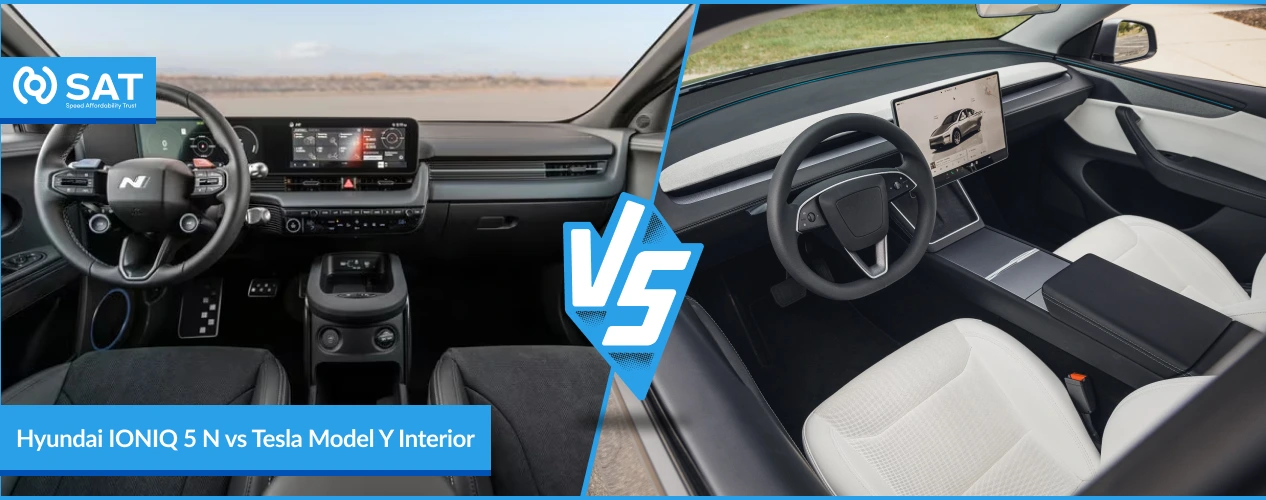
Both cars are stylish and modern from the inside, but the experiences they offer are entirely unique. The Hyundai IONIQ 5 N is very simple, featuring dual touch screens, an easy-to-use layout, and physical buttons. You do not feel lost in complicated menus in the car.
On the other hand, the Tesla Model offers a completely different approach by providing a single large touchscreen instead of too many confusing buttons.
When we compare the Hyundai Ionic 5 N and Tesla Model Y performance, both are fast, but there are multiple differences. Tesla Model Y is sportier and quicker. It only takes 3.3 seconds to reach 60 mph from 0, which is exceptional for an SUV.
The typical models of the Hyundai IONIQ 5 were more focused on comfort. It aimed at inducing comfort in everyday driving. But the Hyundai IONIQ 5 N changed the whole game by providing greater performance. It also has the same 0-60 mph acceleration time and has 600 horsepower.
The Tesla Model Y is certainly superior to the Hyundai IONIC 5 in range. Model Y will enable you to travel 350 miles on a single charge. On the other hand, IONIQ 5 will enable you to travel 300 miles on a single charge. The Model Y is more suitable for long trips. It also consumes less battery than the IONIQ over the same distance. This makes Model Y a cost-efficient option.
But the Hyundai IONIQ 5 with an 800 V system takes 18 to 20 minutes to charge its battery from 10% to 80%. Tesla Model Y uses a 400V system, allowing it to charge from 10% to 80% in 20 to 30 minutes.
Both SUVs have different technology experiences. With the Hyundai IONIQ 5 N, you get a 12.3-inch screen. The head-up shield shows most of the information on the windshield so that you can easily see it. Apple CarPlay and Android Auto are available so that you can connect your mobile to the apps.
By comparison, Tesla has a 15-inch touchscreen, which lets you navigate features like air conditioning and music. It comes with built-in software, such as Netflix and games, as well, to make driving more enjoyable. However, it will take some time to adapt to the absence of physical buttons, which can be challenging for someone who isn’t tech-savvy.
When we compare the prices of the Hyundai IONIQ 5 and the Tesla Model Y, the IONIQ 5 is the more affordable option. The Hyundai IONIQ 5 will have a starting price between $36,000 and $40,000, whereas the Model Y would cost you $46,000 or more, depending on the trim you prefer. They are both luxury electric SUVs, although the IONIQ 5 offers more interior space, a faster charging rate, and an easier-to-use interface.
Comparing the Tesla Model Y and the Hyundai IONIQ 5 specifications, it is evident that both cars are equipped with sophisticated safety measures. The Hyundai IONIQ 5 has been the best-rated electric vehicle for safety. The car offers Standard Downhill Brake Control, where you can creep slowly on the road; on the contrary, Model Y comes with regenerative brakes to give you better grip when on steeper roads.
The Hyundai IONIQ 5 N also has GPS and cellular connectivity, which offer better directional control, whereas the Model Y also has GPS, but you can only navigate on a central touchscreen, and it excludes the Apple CarPlay and Android Auto features. The Hyundai IONIQ 5 N also offers remote door unlocking to help if you forget your keys in the car. Moreover, if the vehicle is stolen, it can be easily tracked. The Tesla model provides a superior infotainment system.
Pros | Cons |
The vehicle features a new design and advanced technology, making it appear futuristic. | Its battery life is not as long as its competitor's. |
The interior of the car is spacious, leaving plenty of room to carry passengers and luggage without issue. | The fastest model of the car has a relatively short battery life. |
The vehicle feels super fast the moment you press the accelerator. | The steering sometimes feels vague. |
Compared to other SUVs, the car has the fastest charging time. | The storage space on the passenger side is very small. |
Pros | Cons |
The car combines exceptional handling and instant acceleration. | Fewer customization options. |
The car also maintains a minimal design and offers plenty of luggage space | The car does not come with fun features. |
The Y model has greatly improved its safety features. | It does not have any physical buttons. |
Choose the Hyundai IONIQ 5 N if:
You want a high-value car at a low price.
You are seeking a car that will not take a long time to charge the battery.
You are a non-tech person and like traditional physical buttons.
You would like to purchase a car that has a longer standard battery warranty.
Choose the Tesla Model Y if:
You need a car that offers a long driving range.
You want to experience autonomous car driving.
You prefer a vehicle with minimal interior.
This Hyundai IONIQ 5 N vs the Tesla Model Y review demonstrates the pace at which the EV market is changing. Both cars are based on different philosophies. The Hyundai IONIQ 5 N prioritizes the physical driving experience, while the Tesla Model Y prioritizes technology. Neither the battery nor your driving style will be sufficient to make the choice. You can find another comparison of the Tesla Model Y Juniper vs. the old Tesla Model Y in the blog section of SAT Japan.

It is not always easy to choose an appropriate car. Hatchbacks and SUVs are the two most popular models nowadays. Each of them has distinct advantages, and this is why their purchase is not easy for many buyers.
Hatchbacks are characterized by their small size, higher fuel economy, and easy handling on congested city roads. On the other hand, SUVs have better space, elevation, and presence that most families like.
So, which one is most suitable to live in and spend money on? Based on design, fuel efficiency, space, driving experience, and cost, we’ll compare hatchbacks vs. SUVs. At the end of it, you will have a clear picture of which kind of vehicles is best suited to your needs.
A hatchback is a small to medium-sized vehicle that has a back door opening upward, and therefore provides easy access to the trunk. Hatchbacks do not have a trunk separately as sedans do. Instead, the passenger and cargo areas are integrated, which makes the car convenient to use daily.
In case you are also comparing other types of cars, you might also want to read about our SUV vs sedan comparison in order to learn more about the way various car styles suit various driving purposes.
A hatchback can easily fit in any space, and this is one of the best things about this model. The rear seats are foldable in most models, and hence you can expand the space when you are required to carry luggage, groceries, or any other objects.
The hatchbacks are frequently small and light, and therefore easily fuel-efficient and easy to move in congested cities. This makes them very popular among commuters, small families, and drivers looking for a practical car that is easy to park and maintain.
SUVs or sports utility vehicles are larger models of the car that are intended to provide more space and a higher driving experience, and capability when it comes to other roads. These cars are designed to be comfortable, like a passenger vehicle, and strong and versatile to meet the demands of most drivers in their daily lives.
Another characteristic of an SUV is its higher ground clearance, which enables it to handle rough roads, speed bumps, and uneven surfaces with ease. The SUV also offers more room on the inside and is thus a favorite among families and long-distance journeys.
Due to size, robust physique, and spacious cabins, drivers tend to select SUVs, which provide comfort, practicality, and confidence on the road.
Comparing cars, there are a lot of buyers who are interested in knowing what the difference between a hatchback and an SUV is. The two types of vehicles have different uses. Hatchbacks are small and practical, whereas SUVs are concerned with space, height, and versatility.
In order to simplify the difference between hatchback and SUV, the following is a brief comparison.
Feature | Hatchback | SUV |
Size | Small and compact | Larger and taller |
Ground Clearance | Lower | Higher for rough roads |
Fuel Efficiency | Usually better | Lower due to a heavier body |
Cargo Space | Moderate | Larger cargo capacity |
Driving Experience | Easy for city driving | Better visibility and stability |
Passenger Capacity | Usually 4–5 people | Often 5–7 people |
Cost | Generally more affordable | Usually more expensive |
The design and the size of the vehicle are two of the greatest differences between the two vehicles. The construction of the car influences its appearance, how much space it has, and how easy it can be driven on a daily basis.
Hatchbacks are compact and practical. They are shorter in length and have an integrated cargo section in the rear, which has a hatch door on the front. Hatchbacks occupy less space, are simpler to park, easier to handle, and ideal for city driving.
SUVs are bigger, higher, and rougher. They are placed higher above the road, and most of them have wider bodies. This design provides a clearer view of the road, as well as giving the interior more passenger and luggage room.
Fuel efficiency is an important factor in car selection. A lot of drivers desire a car that consumes less fuel and costs less to run on a daily basis. Hatchbacks are normally at an advantage compared to SUVs.
Hatchbacks are usually more fuel-efficient. They are smaller, lightweight, and in most cases have smaller engines. Owing to this fact, the engine does not have to strain hard to move the car. This makes hatchbacks consume less fuel, particularly when driving around the city.
SUVs use more fuel. They are greater in weight and height, and most of the models carry bigger engines to sustain their sizes and power. This means that they consume a lot of fuel compared to compact cars.
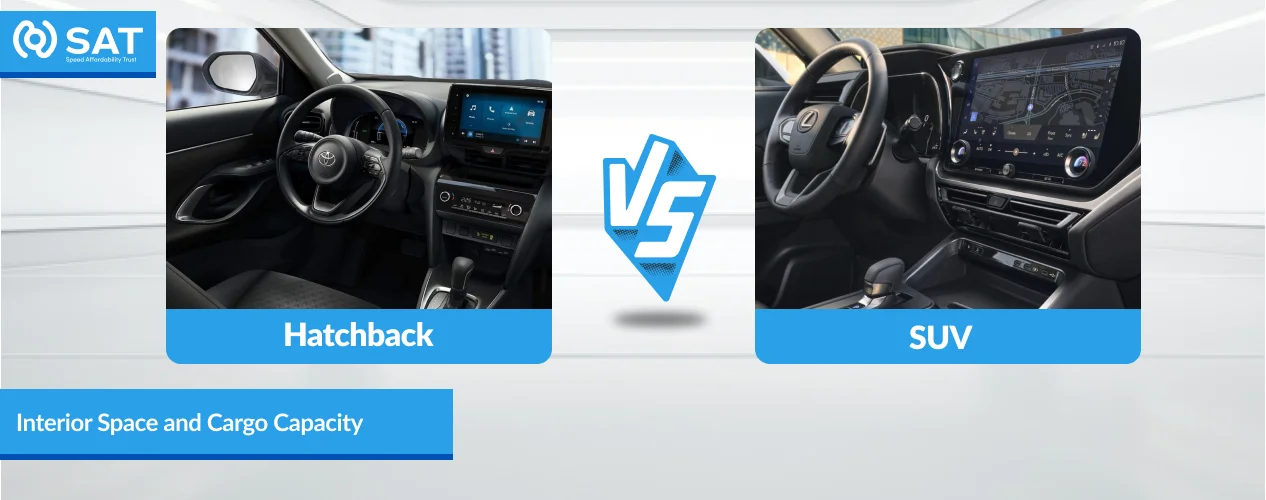
The amount of interior space and the amount of cargo space are also worth considering when making the choice between these two vehicles. When comparing the size of the hatchback and the SUV, you can see the difference in the amount of space available to passengers and luggage.
The majority of the Hatchbacks can fit four to five passengers and have flexible cargo space at the back of the seat. The biggest strength is that the back seats are often foldable, a feature that allows additional open space to store luggage, groceries, or sports equipment.
SUVs have been designed to offer more space to passengers and greater cargo capacity. Most SUVs also have the capacity to carry between five and seven passengers, and the rear seats can be folded to form a large cargo area in which luggage, travel gear, and bulky items can be transported.
Driving experience may be quite different depending on the kind of car you have. SUVs and hatchbacks have different driving requirements.
Hatchback Driving Experience
The hatchback is convenient and quite comfortable in urban traffic. They are smaller in size, hence they are easier to turn, park, and handle in narrow streets. They are also stable and smooth on daily driving because they are much closer to the ground.
SUVs give better elevation and dominance on the road. The car is higher, and this enables the driver to see the road clearly. SUVs are also able to deal with rough roads, making them a good choice when taking long trips.
One of the biggest considerations when selecting hatchbacks vs SUVs is safety. The positive thing is that a majority of modern cars have sophisticated safety technologies that help keep drivers and passengers safe.
A lot of features that contribute to hatchback safety are airbags, antilock braking system (ABS), electronic stability control (ESC), traction control, rear parking sensors, rearview cameras, lane departure warning, and automatic emergency braking. Such aspects prevent accidents and help maintain control on high-traffic roads.
SUVs are usually bigger and heavier, and hence offer greater protection in case of accidents. Similar to hatchbacks, modern SUVs are also equipped with airbags, ABS, ESC, traction control, blind spot monitoring, lane keep assist, adaptive cruise control, rearview cameras, parking sensors, and automatic emergency braking.
Ownership cost is a considerable aspect to consider when looking at the hatchback vs SUV comparison. It comprises a few elements, which include purchase price, maintenance, fuel cost, repairs, and depreciation over time.
Hatchbacks are relatively cheaper. They are usually cheaper to buy, more fuel efficient, and less costly to maintain. The insurance cost is also cheaper due to their smaller size. Moreover, hatchbacks usually depreciate more slowly in the entry-level market, making them a cost-effective choice for most drivers.
SUVs are generally more expensive to own. They usually cost more at the time of purchase, and their bigger engines burn more fuel. Maintenance, tire replacement, and insurance premiums may also cost more due to the fact that SUVs are larger and utilize bigger parts. There is also the possibility that certain models will attract higher depreciation.
Driving in the city is sometimes difficult due to congestion, small roads, and limited parking spaces. These are daily conditions that are influential when comparing hatchbacks vs. SUVs in determining which one is more effective.
Hatchbacks tend to be more appropriate for urban roads. They can be easily parked and moved around in the city. They are also more fuel-efficient, which is good for daily commuting and in congested traffic. Drivers tend to have an easy ride in the overcrowded urban environments.
In cities, SUVs can also be driven, but due to their bigger size, they are difficult to park and handle in narrow spaces. They are heavier and therefore might use more fuel in congested traffic. This may have a minor negative impact on running costs in heavy traffic that involves braking and accelerating.
The selection of a family car will be based on various simple needs, such as family size, daily activities, child safety, and long-term functionality.
Hatchbacks are good for small families. They can be used in day-to-day activities such as school runs, grocery shopping, and weekend outings. Lots of modern hatchbacks are compatible with child seats, ISOFIX anchors, and other safety systems, thus they are suitable for parents who have one or two children. They are also less complicated to handle for those families who mostly commute in the city.
Larger or growing families prefer SUVs. They are designed to accommodate a lifestyle involving longer drives, travelling holidays, sports equipment, or carrying additional items. Most SUVs also contain high levels of driver assistance systems, numerous airbags, kid locks, and high-impact crash protection, which many parents appreciate.
Many drivers love hatchbacks as they are convenient and easy to live with. However, they also have downsides like any other type of vehicle. The advantages and disadvantages of a hatchback can be used to determine whether this type of body style suits the lifestyle of a buyer.
Pros of Hatchbacks | Cons of Hatchbacks |
Affordable price: Hatchbacks typically cost less to purchase than most other types of cars, which makes them a reasonable choice for first-time buyers. | Limited passenger room: Since hatchbacks are small vehicles, the legroom in the rear seat may seem small if an adult takes a long trip. |
Flexible cargo area: Its rear hatch door and the ability to fold down the seats make it easier to carry groceries, luggage, or any other item. | Less cargo privacy: The cargo space is also attached to the cabin, meaning the items at the back may be seen without a covering. |
Easy loading and unloading: The broad back door allows one to easily fit large or oddly shaped items into the car. | More cabin noise: The rear part does not have its own trunk, thus the road noise can find its way into the cabin easily. |
Great fuel economy: Hatchbacks also have many lighter designs utilizing smaller engines, which helps in consuming less fuel. | Less powerful performance: There are hatchbacks that are concerned with efficiency, but not a strong engine. |
Practical everyday car: Hatchbacks are comfortable, efficient, and versatile, making them the choice of daily driving. | Smaller cargo space when seats are up: The storage space might be small when every seat is occupied |
The SUVs have gained a lot of popularity due to their combination of comfort, power, and versatility. Nonetheless, they also have certain disadvantages. Knowing what is good or bad about SUVs can enable buyers to determine whether such a car suits their lifestyle and driving requirements.
Pros of SUVs | Cons of SUVs |
Strong road capability: SUVs are constructed to go around rough roads and uneven surfaces more conveniently than many small cars. | Higher fuel consumption: Since SUVs are heavier and bigger in size, they tend to consume more fuel than small cars. |
Good towing ability: The SUVs with powerful engines and robust chassis are capable of towing trailers, boats, or heavy loads. | Higher purchase price: SUVs are relatively costlier to purchase than compact cars. |
Versatile for different lifestyles: SUVs are created to facilitate road trips, outdoor activities, and carrying equipment. | Maintenance costs can be higher: The cost of maintenance might be greater since parts such as tires, brakes, and suspension components are larger and more fragile. |
Comfort for long journeys: Most SUVs have a powerful suspension and modern technologies to enhance the comfort of a long ride. | Less eco-friendly: Increased fuel consumption might result in increased carbon emissions compared to smaller vehicles. |
Suitable for multiple driving conditions: SUVs are more confident with snow, mud, or other rough surfaces that have systems such as AWD or 4WD. | More challenging to handle in tight urban areas: Difficult to handle in dense urban places due to their huge size. |
The decision on whether to buy a hatchback or an SUV depends on your lifestyle, habits, and long-term demands. The vehicles will be used differently, and therefore, the most appropriate one is the one that will be applied to your actual use of the car in your day-to-day activities.
When you typically drive alone or with a small family and want a car that seems pretty straightforward and convenient, a hatchback may be a brilliant decision. Hatchbacks are also popular among many buyers as they are easier to handle in their daily tasks, such as getting to work and every other errand and short trip. It is also suitable for first-time buyers, students, and young professionals who need to have a reliable car without straining their budget.
The SUV can be a more appropriate choice in case of regular traveling, outdoor use, or transporting equipment like sporting gear or luggage. Another reason why many drivers prefer to purchase an SUV is that they have different needs depending on the type of road conditions they have to travel, the long distances they have to cover, or the changes in family needs.
The choice between a hatchback and an SUV depends on your needs and your lifestyle. The two types of vehicles target various types of drivers, and each of them has its strengths. In case you desire a car that is easy to handle, convenient, and affordable to use in daily commuting, a hatchback would be a nice option. It is appropriate for those who want a simple car to get them through their daily activities.
In case your lifestyle demands more demanding conditions and requirements, an SUV can be more appropriate for your needs. Finally, the most desirable car will be the one that suits your lifestyle, your budget, and your long-term goals. When you select a car that fits your real-life requirements, all your cars will drive better.
If you want to purchase a competent car, SAT Japan can simplify the process. They have a good selection of quality used cars, both hatchback and SUV models, with extensive checks and international shipping opportunities.
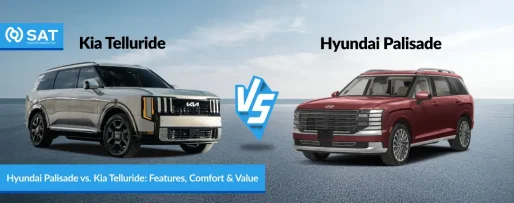
It might be thrilling and a bit confusing to shop for a large family SUV. The two prominent names are the Hyundai Palisade vs. Kia Telluride. They both are fashionable, have a large space, and are loaded with modern features. However, when you have a closer, then the minor differences begin to count. One may be luxurious, and the other may be capable of meeting your budget. So which one rightfully occupies your driveway? In this article, we’ll look deeper into the Hyundai Palisade vs. Kia Telluride comparison, including the features, comfort, performance, and value in general.
Feature | Hyundai Palisade | Kia Telluride |
Vehicle Type | Mid-size 3-row SUV | Mid-size 3-row SUV |
Engine (Gas Models) | 3.5-L V6 engine | 3.8-L V6 or newer 2.5-L turbo engine (depending on model year) |
Horsepower | Around 287 hp | Around 274–291 hp, depending on the engine |
Torque | About 260 lb-ft | Up to 311 lb-ft with turbo engine |
Transmission | 8-speed automatic | 8-speed automatic |
Drivetrain | FWD standard, AWD available | FWD standard, AWD available |
Fuel Economy (Approx.) | 19 mpg city / 25 mpg highway | 20 mpg city / 26 mpg highway |
Seating Capacity | 7–8 passengers | 7–8 passengers |
Infotainment Display | Up to 12.3-inch touchscreen | Dual 12.3-inch displays in newer models |
Cargo Space (Behind 3rd Row) | About 18–19 cu ft | About 21–22 cu ft |
Maximum Towing Capacity | Up to 5,000 lbs | Up to 5,000 lbs |
Starting Price (Approx.) | Around $36,645-$51,745 | Around $37,590–$53,590 |
Best Known For | Luxury-like interior and comfort | Rugged styling and slightly better cargo space |
The design is one of the things that people notice when comparing the Hyundai Palisade vs. the Kia Telluride. Both the SUVs appear bold and modern, yet their personalities share a significant difference on the road. One is more luxurious, whereas the other is inclined toward a rough SUV design.
The Hyundai Palisade has a sophisticated and classy appearance. It has a high-end feel with its huge grille, smooth LED lights, and flowing body lines. It is closer to a luxury SUV than a family car because of the chrome accents and stylish wheels. Generally, the Palisade is aimed at the drivers who desire a clean, elegant, and sophisticated SUV.
The Kia Telluride is more rugged. It is square-shaped, proudly grilled, and very solid in body line, which makes it look like a tough SUV. The presence of the upright position and the broad form makes it appear strong and bold. The Telluride suits drivers who like a strong and outdoor SUV style.
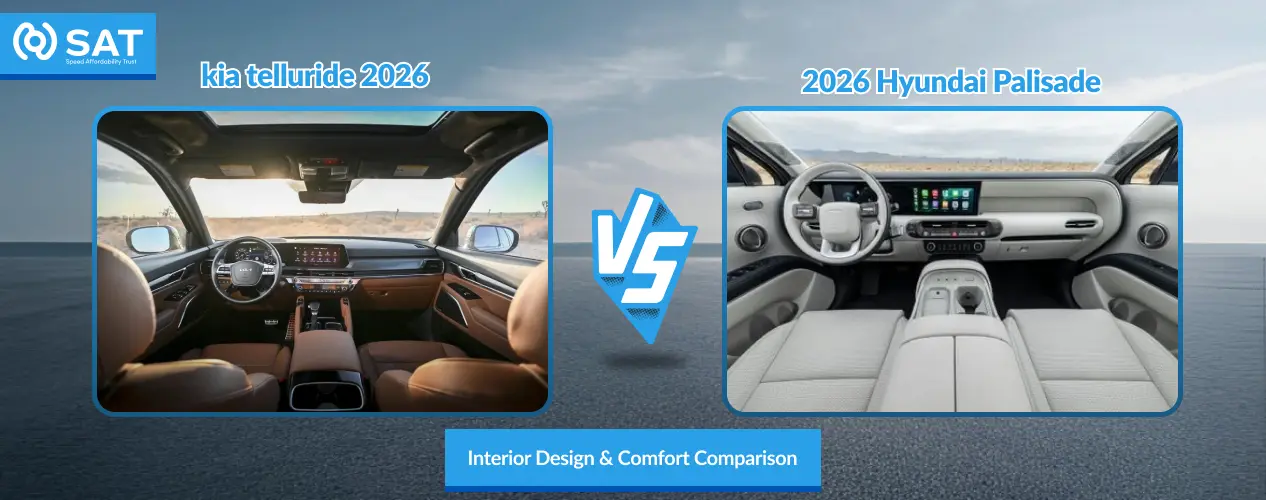
Comparing Kia Telluride vs Hyundai Palisade interior, the two SUVs have a roomy and comfortable interior that is ideal when travelling with the family. Enter any of the vehicles, and you will find soft materials, wide seating, and a modern dashboard that makes the interiors friendly.
The Hyundai Palisade is more concerned with a luxury-like interior. It provides high-quality material, high comfort leather seats, and a clean dashboard with a big touchscreen display. The cabin is very quiet and refined, which many drivers admire during long drives.
The Kia Telluride also has a stylish and practical interior. The seats are comfortable, the design is user-friendly, and the three rows are spacious enough to accommodate a passenger. The design is contemporary and family-friendly.
One of the areas where the SUVs have really excelled is the aspect of technology. In the comparison of the Hyundai Palisade and Kia Telluride, it can be seen that they are both equipped with the latest infotainment features that are aimed at making the driving experience easier and more fun.
The Hyundai Palisade also has a big 12.3-inch touchscreen that is compatible with Apple CarPlay and Android Auto. It is also equipped with wireless charging, various USB ports, and an optional Harman Kardon premium sound system. The cabin is modern and connected with the help of the digital driver display and user-friendly controls.
The Kia Telluride does not fall behind in terms of providing stunning technology. Most of the models come with two 12.3-inch displays, which form a smooth digital dashboard. It has smartphone connectivity, GPS, wireless charging, and a number of USB passenger ports.
When comparing Kia Telluride vs. Hyundai Palisade specs, one will soon observe an interesting fact. These two SUVs are quite similar in performance. They are both designed to provide smooth power, easy driving, and a sufficient amount of power to take the family on a trip or cover a long way on the highway.
The Hyundai Palisade is equipped with a 3.5-liter V6 engine, giving it approximately 287 horsepower and approximately 260 lb-ft of torque. It is available with an 8-speed auto transmission and a front-wheel drive or a 4-wheel drive.
The Palisade is also more comfortable than fast on the road. The ride is very comfortable and easy to ride, thus suitable for everyday commuting and extended family tours.
The Kia Telluride comes with a 3.8-liter V6 engine, which provides approximately 291 horsepower and 262 lb-ft of torque. Similar to the Palisade, it is powered by an 8-speed auto and has an optional all-wheel drive.
The Telluride will be powerful and confident on the road, particularly as long as the SUV is loaded with passengers or cargo. Its power is stable, and the acceleration is even, which makes it a dependable family car.
Safety is among the largest issues on the minds of SUV users, particularly families. In comparing Kia Telluride vs Hyundai Palisade specs, both cars are similar in terms of good safety technology and driver-assistance features. These are features that will enable drivers to remain alert, prevent accidents, and protect passengers in every trip.
The Hyundai Palisade is also fitted with the Hyundai SmartSense safety package that comprises some of the latest driver-assistance features. Such critical systems are Forward Collision-Avoidance Assist, which may notify the driver and brake in case a collision risk is identified, and Blind-Spot Collision Warning to ease the lane change.
It is also equipped with Lane Keeping Assist, Rear Cross-Traffic Collision Avoidance, and Smart Cruise Control with Stop and Go to ensure people keep a safe distance and stay in the middle of the highway.
The Kia Telluride also has Kia Drive Wise safety technology, which has an equivalent of protective features. To be more aware on the road, drivers receive Forward Collision-Avoidance Assist, Blind-Spot Collision-Avoidance Assist, and Lane Keeping Assist.
Rear Cross-Traffic Collision Avoidance and Smart Cruise Control are also provided in SUVs to relieve the stress of highway driving and traffic congestion.
Space is as important to most families as power or technology. In the comparison of the Hyundai Palisade and the Kia Telluride, both SUVs have flexible cargo space that makes your everyday life easier, whether you are transporting groceries, sports equipment, or suitcases on your long-haul trip.
When fitted with all three rows, the Hyundai Palisade has approximately 19 cubic feet of cargo room, and the Kia Telluride has approximately 21-22 cubic feet of cargo room behind the third row. That is to say that the Telluride would provide a bit more space for bags when all seats are occupied.
After folding the third row, both SUVs create a lot more space. The Telluride has an approximate of 46-49 cubic feet, whereas the Palisade has approximately 46 cubic feet. Both the second and third rows are folded, and you have a total cargo space of around 86-87 cubic feet in either SUV, which is sufficient to carry large furniture or camping gear.
Both SUVs are highly practical in their day-to-day use. Large tailgates, fold-up seats, and ingenious storage areas make loading and unloading easy. The Telluride has a minor advantage in the number of cargo, but this distinction is minimal in practice.
Having read numerous Kia Telluride vs. Hyundai Palisade reviews, it becomes obvious that the two SUVs are both great options. They have a lot of strengths, such as powerful engines, roomy interiors, and family-friendly features. Nevertheless, all vehicles possess their minor advantages and disadvantages, which must be familiar to a buyer to make a decision.
Pros
Luxury-style interior: The Palisade is more luxurious with quality materials and seats.
Very smooth ride: It has been known to have a quiet and relaxing drive, particularly on the highway.
Ease of use: The infotainment system and controls are easy and user-friendly.
Cons
A small bit of less cargo space than the Telluride.
The exterior design is more traditional, and this might not be bold enough for certain buyers.
Pros
Rough and bold design: The Telluride is conspicuous in its robust SUV appearance.
Greater cargo capacity: It has a slight increase in the capacity of luggage and gear.
Good value: It includes numerous features at a competitive price.
Cons
The ride may be a little tougher than the Palisade.
There are trims that might not be as luxurious as the best models of Palisade.
In a comparison of Hyundai Palisade vs Kia Telluride price, buyers often desire to get the most features, comfort, and value in the long term. The fact that both SUVs offer a lot of money is the good news, and this is one of the reasons why they are so popular in the midsize SUV market.
Kia Telluride has a tendency to be a bit cheaper in price, so it can appeal to customers who do not want to spend much money and still have a well-equipped SUV. Even the entry trims are fitted with tough safety, advanced technology, and a spacious interior. This renders the Telluride an obvious option to families that are concerned with efficiency and cost.
The Hyundai Palisade, however, is sometimes a little more luxurious. Although it tends to cost slightly more to start, it has more luxurious interior finishes and additional comfort options, and a more comfortable general driving experience. The Palisade can justify the added price to buyers who require the luxury feel but not that of luxury SUVs.
Having weighed all the pros and cons, the Hyundai Palisade vs Kia Telluride argument boils down to a single fact: both SUVs are excellent. They have good performance, advanced technology, high safety standards, and the space that families require in their daily lives. It is precisely the reason why these two models are leading the list of midsize SUVs.
Kia Telluride is characterised by a bold and rough style. It also has a little more cargo capacity and a solid set of features, as per the price, and this makes it a good choice for the buyer who will need an affordable and useful vehicle.
The Hyundai Palisade, on its part, excels in comfort and refinement. Its interior is of premium quality, and the ride is smoother and quieter, so long journeys are more relaxing.
Ultimately, it is not a question of which SUV is superior, but which one would best suit your life in the Hyundai Palisade vs Kia Telluride comparison. Whichever one you pick, you will have an efficient, comfortable, and family-friendly SUV that will be designed to ensure that all the trips are fun.

Choosing between the Honda Accord and Toyota Camry is not merely a question of choosing which car will be your midsize sedan, but rather the vehicle that you will live your life with on a daily basis. And in 2026, this competition seems to be more than ever.
The Accord still provides the flexibility to buyers with the option of a turbocharged gas engine and a hybrid. The Camry, in its turn, has been fully invested in hybrid power. Such a daring act alters everything. So which one shows better value, better performance, a smarter economy, and reliability in the long run?
Are you asking yourself, which between the 2026 Accord and the 2026 Camry would be the more intelligent choice? You have come to the right place. This is a deep dive into a comparison of real-world MPG, pricing, safety ratings, ownership costs, and driving experience. You will also know the type of sedan that fits your style and your pocket by the end of it. Let’s dive in.
In the case of 2026, Honda reinforces the Accord in the area where it counts the most value. Even entry-level models are now fitted with bigger standard screens and wireless phone connectivity, which makes them feel comfortable and luxurious. Honda retains its smart dual-powertrain theme, whereby it has the turbocharged gasoline engine as well as a sophisticated hybrid platform.
The result? Flexibility is also provided to buyers, which is no longer available in the Camry. Such modifications make the Accord look premium but not so expensive to the extent that it would enter the luxury segment, making the car very competitive in the midsize sedan segment.
The larger headline move was made by Toyota. Camry is fully hybrid in the U.S.; there is no gas-only version. Each trim has a 2.5-liter hybrid system and produces up to about 232 horsepower, and has the option of electronic on-demand all-wheel drive.
This change isae clear indication of Toyota paying attention to efficiency. However, it is not only about fuel economy, but the Camry offers good acceleration and even trims sporty enough to give it personality to drivers. Simply, Toyota reinvested in the hybrid performance without reducing the practicality of everyday use.
It is not only about the initial MSRP but what you really get with your money. Let’s take a look at the figures and put them into practical purchasing power.
Honda Accord LX (gas model) begins at $28,395 and is one of the cheaper options available in the midsize segment. The Accord Hybrid model starts at 33,795 dollars, with a top of around $40,000 being the maximum price of the fully-equipped Sport-L and Touring Hybrid models.
The most notable aspect is the extent of technology and refinement that Honda incorporates even in the bare-bones version. You are not paying more to have some modern necessities.
Toyota Camry 2026 begins with the price of $29,100; however, keep in mind that all Camrys are hybrid now. The majority of trims are priced in the range of low-to-mid $30,000, and XLE, XSE, and AWD models enter into the middle-to-high segment of $30,000s.
The entry price of the Camry is also a little more than the base Accord, since it is hybrid-only. Nonetheless, that premium will contain an effective hybrid system in Toyota from the beginning.
The Honda Accord and Toyota Camry get you on different performance platforms when you sink into the driver's seat and press the accelerator, and that makes this comparison exciting.
The Accord provides traditional gasoline enthusiast lovers one more reason to smile: a 1.5-litre turbo four cylinder that generates about 192 horsepower and offers quick throttle response in daily driving. It has an engine that works with a smooth CVT and makes the Accord spirited around town or on the highway. The hybrid system of Honda brings another touch of efficiency and smooth torque with about 204 horsepower when you upgrade the trim.
Toyota, however, has shifted the Camry completely to a hybrid line. The 2.5-liter Dynamic Force hybrid produces approximately 225 hp in Front Wheel Drive and up to 232 hp with available AWD, providing a slight increase in overall grunt off the line to the Camry. The hybrid emphasis not only increases the power marginally more than the hybrid of the Accord but also generates greater fuel economy.
This is where the Toyota Camry and Honda Accord begin to reveal themselves in terms of fuel economy, and why so many buyers tend to have about one or the other.
Efficiency is constructed in the 2026 lineup, all of which are hybrid. According to EPA estimates, the Camry LE hybrid has a maximum of 52-53 MPG combined (approximately 50 MPG on highway and 50+ MPG in the city, based on trim and drivetrain). That number is not good on paper only, but it is also a mid-size sedan class leader and translates to frequent visits to the gas pump over the years of ownership.
Honda has a totally different story of efficiency. With a 1.5-liter base turbo gas engine, you’ll get EPA rates of approximately 28-29 in the city and 36-37 on the highway, which is not very impressive but still alright not to be a hybrid. The Accord Hybrid, though, takes it up a notch, with scores reaching approximately 51 mpg combined in its most efficient models. Nevertheless, its best is not much higher compared with the top fuel economy of the Camry.
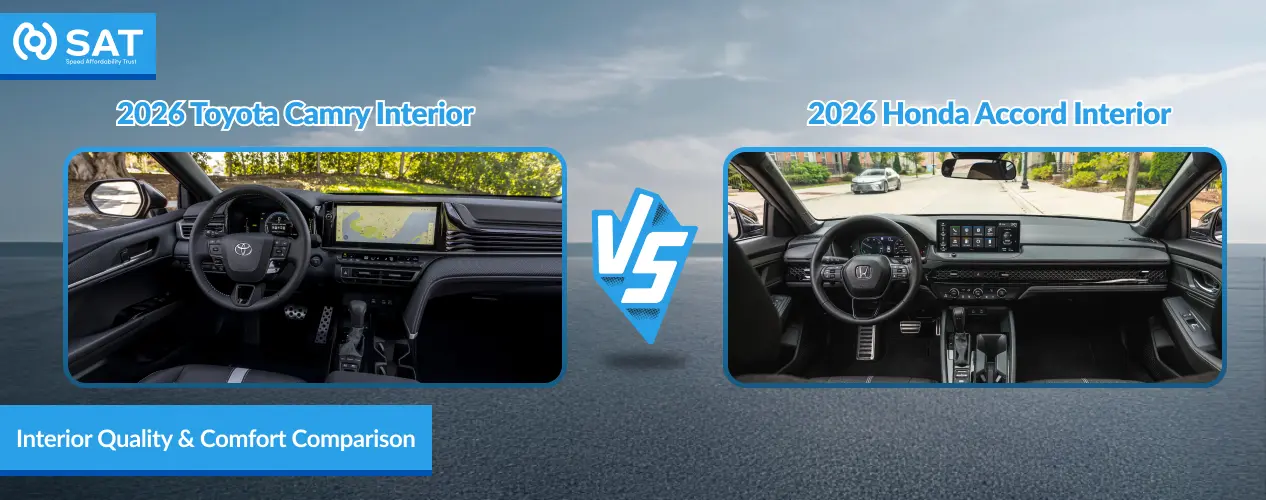
The first thing you see in the 2026 Accord is space. Honda boasts of a wide rear legroom and a big 16.7 cu ft trunk, and critics have praised the handsome materials and clever storage of the Accord. Technology has also increased in lower levels (larger touchscreens, wireless Apple CarPlay/Android Auto), giving the impression of a more expensive interior than the price will imply.
Already the 2026 Camry responds with a stylish, contemporary interior: comfortable redesigned seating arrangements, finer materials on upper models, and an optional 12.3-inch infotainment display, as well as SofTex/leather interior and optional panoramic roof on some models. The rear passengers have ample room as well - Toyota and testers describe the Camry as roomy and well-insulated in case of a lengthy drive.
Safety is a point when it comes to comparing the Honda Accord vs. the Toyota Camry. The Honda Accord and Toyota Camry are the champions of the midsize sedan category, yet they handle protection in slightly different ways, which is important to know.
Both sedans have achieved IIHS Top Safety Pick +, which means that they did very well in the intensive crash tests. These tests involve frontal impacts, side collisions, and moderate-overlap tests, which are very close to real-world accident conditions. In a nutshell, either you select one of the Accord or Camry, you are getting the best structural protection and crash avoidance engineering.
All 2026 Camry models are equipped with Toyota Safety Sense 3.0, which includes adaptive cruise control with lane centering, automatic emergency braking with pedestrian detection, lane departure alert, and road sign assist. Toyota equips the safety across the whole range.
The Accord responds with Honda Sensing, which has adaptive cruise control with low-speed follow, lane-keeping assist, forward collision warning, and automatic emergency braking. Blind-spot monitoring and rear cross-traffic alert are also available on many trims. Considering the specifics of the Honda Accord vs. Toyota Camry, you will be able to see that the two brands offer almost the same basic safety technology; the only difference in most cases is the trim packaging.
Assessing Honda Accord vs Toyota Camry specs, it is not only the horsepower and MPG, but reliability, depreciation, and long-term cost that make the difference between good cars and great investments.
According to independent reliability information, the 2026 Accord and Camry are both projected to do better than average, as opposed to other midsize sedans. Toyota still has a slight reputation advantage in long-term reliability. However, recently, Honda recalled some of its Accord Hybrid models because of a software glitch that might lead to a loss of drive power temporarily. Dealers are fixing it at no cost, but it is also a good idea to check the VIN history before buying.
The two models are similar in terms of basic warranty cover (3 years/36,000 miles). Where Toyota tends to be ahead is in resale value. Industry records will always reflect that Toyota cars have high long-term value, which means that the Camry might not depreciate as fast as the Accord. That can create a significant difference at the right time to trade or sell.
The Honda Accord 2026 remains the choice of the driver. It is a comfortable ride, bumps are easily absorbed, but the steering feedback is sharper than most midsize competitors. The 1.5 turbocharged with a smooth CVT provides low-end power that could be responsive in city traffic, and the chassis remains steady and confident on the highway. In Honda Accord vs Toyota Camry reviews, the Accord is being commended in many cases as the one that provides comfort and a slight touch of sportiness.
The 2026 Toyota Camry takes a slightly different approach. Its hybrid powertrain delivers smooth, quiet acceleration and effortless cruising. Steering is competent but less engaging than the Accord's, emphasizing comfort over a sharp cornering feel. For daily commutes and long-distance highway driving, that tradeoff pays off with exceptional smoothness and impressive fuel efficiency.
2026 Honda Accord (Pros / Cons) | 2026 Toyota Camry (Pros / Cons) |
Pros: Entry-level (cheaper than its competitors), high in terms of technology. Big trunk and generous rear legroom, good for families. Engaging, comfortable handling that makes driving daily entertaining. | Pros: Hybrid fuel economy that leads classes in the lineup (saves a lot of cash at the pump). Smooth, subtle cabin featuring polished materials in higher trims. Good resale value and extensive reliability reputation. |
Cons: Recently, a huge number of Accord hybrids were recalled because of software issues - check VIN/service history. A non-hybrid base engine is not as efficient as the Toyota Camry hybrid. | Cons: More expensive entry price as compared to the Accord base because the Camry is hybrid-oriented. The steering is not as sharp as the Accord - it is more comfortable than sporty. Certain owners complain of small infotainment/software quirks. |
The 2026 Honda Accord was designed to suit those who prefer a midsize car that is comfortable for daily use, fully equipped, and offers a bit of driving excitement. It suits commuters who appreciate a comfortable ride and high fuel efficiency in the hybrid trims, who require spacious rear seats and a large trunk, and shoppers who want more options, since Honda continues to supply both turbo-gas and fuel-efficient hybrid motors.
The Accord is also surprisingly premium at lower trims, and therefore, value-conscious customers will have higher tech at a reduced cost. The Accord strikes that balance between the practical, engaging,g and easy to live with every day sedan by drivers who desire it.
In case you prioritize the highest fuel efficiency without compromising the comfort of a daily car, the 2026 Toyota Camry is one of the best midsize sedans you could purchase at the moment. Considering that Toyota has transitioned to all-hybrid in 2026, all Camry models have extremely good EPA fuel economy, approximately 51 mpg combined in most trims, making it ideal for commuters and families, and those who just hate visiting the gas station.
The Camry also has a refined hybrid drive (225-232 hp depending on drive train) that will provide the confidence of acceleration, but remain smooth and quiet on both routine drives and long-haul highways. Its electronic on-demand AWD is also a wise option because it is available to drivers who have different weather conditions or have slippery roads.
No one can be called a winner; it is a matter of priorities. To the shoppers who are seeking value, a livelier drive, and a lower entry price, the Honda Accord 2026 is the wiser choice.
In case the primary motivation is the highest fuel economy, less noisy driving, and high resale value over time, then the 2026 Toyota Camry (all-hybrid model line) takes the lead.
Professionals give the Accord a slight overall driving range, overall value lead, but due to its hybrid power and resale potential, the Camry cannot be defeated by high-mileage consumers.
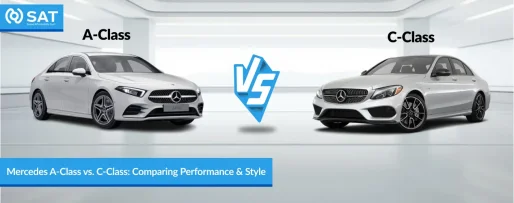
The decision between the Mercedes A-class vs C-class might be a bit confusing, as both car models appear fashionable and luxurious. At first, they appear to be similar. However, when you look deeper, there are great differences. One is considered the gateway to luxury. The other is more sophisticated and stronger. In case you are asking yourself which one suits your life, your budget, and your lifestyle, etc., you are at the right place. In this article, we’ll simply lay it all out so that you can make the right decision.
The following is a quick and friendly overview of the largest differences so that you can have a quick idea of the Mercedes A-Class vs. the C-Class without having to look through long specifications.
Category | Mercedes A-Class | Mercedes C-Class | What It Means for You |
Size | Compact Sedan | Midsize Sedan | C-Class has additional rear space. |
Horsepower | 188 hp | 255 hp | C-Class feels stronger |
Drive Type | FWD (AWD optional) | RWD (AWD optional) | C-Class feels sportier |
Trunk Space | Smaller | Larger | Better for travel & family |
Interior Feel | Modern & sleek | More premium & refined | C-Class feels more upscale |
Starting Price | Lower | Higher | A-Class is less expensive. |
Availability | Discontinued after 2022 | Current production | C-Class is easier to find new |
In consideration of a Mercedes A-class or Mercedes C-class, size and physical space are more important than fancy features. A class is a small sedan that is easy to park and comfortable inside with two adults and a child. The A class 2022 has approximately 33.9 inches of rear legroom and 8.6 cu trunk capacity, which is suitable when going in the city and on short journeys.
The C-Class is the bigger car. The 2022 C-Class offers approximately 36 inches of rear passenger legroom and approximately 12.6 cu ft of trunk capacity, making it more comfortable with passengers and luggage on extended journeys. The additional space can be felt during long journeys or those with strollers, golf clubs, or large suitcases.
In 2025, the C-class trunk changes slightly; it is listed to be around 11.6 cu, but the interior remains a similar volume to fit adults in the back. Thus, despite all the modifications, the C class remains the more practical option among families and travelers.
Mercedes stopped selling the A-class after 2022 in certain markets, which makes the newly produced A-class even more rare. They may come in deals or may come with fewer options when you want a brand-new car.
The A-Class is light and agile. Its 2.0-liter turbo four generates approximately 188 hp and is powered by 7-speed dual clutches, thus it feels fast in the city and is easy to park. With 4MATIC® added, it pulls more strongly off the line - many testers recorded a 0 to 60 mph of about 6.1 seconds in the A220 4MATIC.
The C-Class also rises with a slight-hybrid 2.0-liter, which increases power to approximately 255 hp and is combined with a smooth 9-speed automatic. The additional power, as well as the rear-wheel-drive structure (or optional AWD), gives the C-Class an impression of being stronger, more grounded, and confident on highways.
What it means to you: the A-Class is entertaining and easy in the city - light steering, quick turn-in, tighter handling. The C-Class is heavier and more controlled - more suitable on the highway with long highways, and it has a more stable steering and ride quality. Test runs indicate that the C-Class regularly accelerates to highway speeds under 6 seconds, indicating that it has an additional grunt.
In case you are a lover of speed, sound, and serious excitement, AMG transforms everything. The A35 AMG is the smallest fighter in this battle. It is sharp, quick, and eager with about 300-306 horsepower (turbocharged engine with mild-hybrid support). It is nimble, and it suits drivers who seek to have excitement in their daily lives without necessarily taking things to the extreme. It is lively and playful in the city.
The C43 AMG does not leave things at that. It combines real performance with comfort in its daily operations, with more than 400 horsepower, more robust mid-range pulling power, and a more planted feeling. It is quick, sure on the highways, and even comfortable enough to travel long distances. Power is attained without refinement being compromised.
Then the C63, where the icon of the V8 era is found. It brought thunder, drama, and pure muscle. But AMG is evolving. Mercedes is moving out of the conventional V8 in most markets and is transitioning to new electrified inline-six configurations, such as the C53. That implies that real V8 AMGs are becoming scarcer and sometimes costly to keep.
So is the upgrade worth it? The C43 will be a good choice when you want performance that is more balanced. The older C63 cannot be forgotten in case you desire pure emotion. And should you want a fun car every day and without the high running expenses, the A35 is a smart idea.
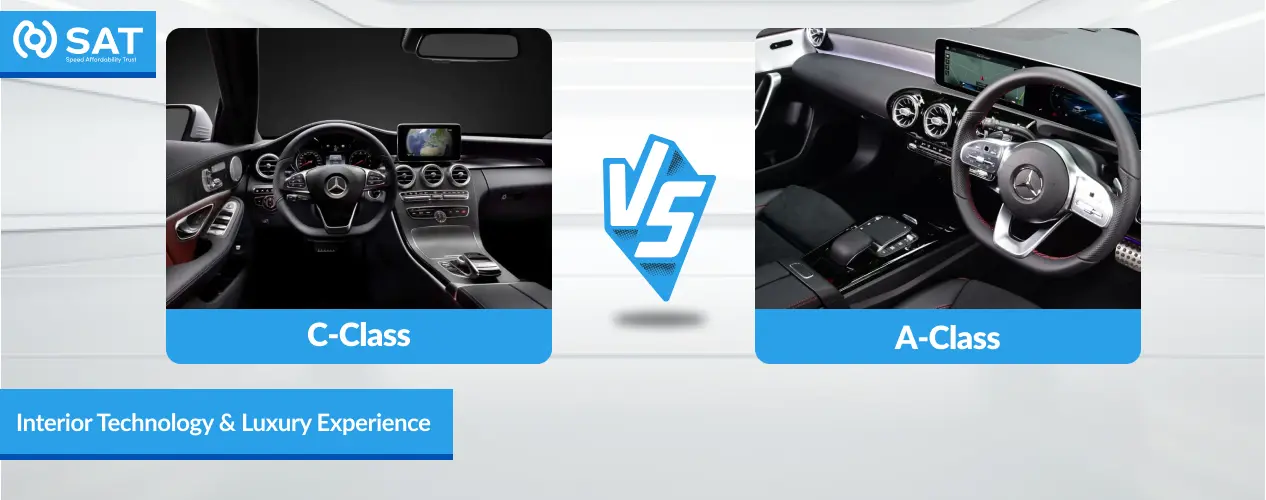
Get into a Mercedes and the interior immediately informs you that the brand takes luxury seriously. The C-Class has been transformed with an enormous 11.9-inch vertical touch display and a fine digital driver display. All is modern, clean, and easy to read. It is highly technological as soon as you sit down.
Base trims of the older A-Class models tend to have smaller 7-inch screens (large screens were available). It is still intelligent and stylish, yet does not carry the same presence as the C-Class.
The two vehicles are powered by the Mercedes MBUX system that responds to natural voice commands. You only need to speak to adjust navigation, climate, music, and so on. Even newer Mercedes systems are more intelligent, boasting better voice control and a less jerky interface update.
Music lovers will be provided with a Burmester premium sound system, which is optional in the C-Class, with deep and rich sound filling the cabin perfectly. Softer seat materials, bigger center consoles, and more ambient lighting options are also common in the C-Class and make driving long distances more comfortable and luxurious.
Both vehicles are loaded with intelligent safety features, but the C-Class generally provides more of them at the base. Mercedes equips the C-Class with features such as PRE-SAFE, Active Brake Assist (with pedestrian and cyclist support), blind-spot warning systems, and an emergency call center on base trims.
Strong safety equipment (Active Brake Assist, Blind-Spot Assist, Lane-Keeping Assist, and parking aids) is also found on the A-Class (currently mostly 20202022 models), though many driver aids are found at a higher level, depending on the trim and market. That would imply that you would require an additional package to have the same safety kit as the C-Class.
Mercedes Driver Assistance Package is a real assist to highway driving: DISTRONIC 2014 adaptive cruise, Active steering assist to keep you on track, and finally, Evasive steering assist to avoid an accident. These systems are compatible with cameras, radar, and sensors in order to respond quicker than a tired driver.
Discussing the Mercedes A-Class and C-Class outside, the first thing that comes to your mind is that both of them bear the stylish Mercedes appearance, though each of them has its own identity.
The lines of the A-Class are more sport-oriented, and the car looks smaller and nimbler. Its headlights and front grille are smooth and have a modern and younger touch. It is compact, so it doesn’t seem to be on its feet, almost like a high-end hatchback was turned into a sedan. This is ideal in urban living, narrow parking, and in places with narrow roads. Although recent model years (2020-2022) are predominant in A-Class sedan models, they continue to attract attention with their elegant proportions and sharp design elements.
The C-Class appears to be older and more sophisticated. It has a slightly longer hood, bigger stance, and it has more options of wheels, all of which make it appear more luxurious and solid on the road. The C-Class is usually characterized by LED headlights, a pronounced star emblem on the grille, and body lines that are sculpted as they run front to back. It is the type of vehicle that creates an impression of confidence and status as you arrive at a dinner or meeting.
When comparing the Mercedes A-Class vs C-Class price, one obvious fact appears: The A-Class is cheaper in the beginning. Newer A-Class models are projected to begin at about $38000 on the MSRP, whereas newer C-Class models are nearer to $48000, depending on the trim and market. These numbers can vary depending on the option and location, yet the C-Class will be more expensive due to its larger size, powerful engine, and additional features.
However, the cost of ownership does not include only the sticker price. The C-Class may be more expensive in terms of insurance, fuel, and servicing work, and its parts are more expensive as it is more complicated. According to analysts, the 5-year ownership cost of the C-Class may exceed $67000 or even higher when the depreciation, insurance, and fuel are factored in.
A-Class has a smaller engine, and its weight is lower, hence the maintenance expenses per year are lower, in the range of $500-650, which is usually cheaper than the C-class of similar years.
When considering Mercedes A-Class vs C-Class, money later will be as important as price today. The C-Class continues to lose an average of half its value within 5 years, approximately half or 50-53% depriciatiation depending on trims and options. This implies that a new C-Class will only be half valuable in the future.
The A-Class has conflicting performance. There are those A-Class models that appreciate and those that depreciate. The A-Class has a wide range of residuals, perhaps 60-70% of the original price after a couple of years of service with popular trims, but less with older or less popular models. It is also influencing the used-car environment as the A-Class itself is dropping in certain markets: with fewer new A-Class sedans, supply changes, and the used prices become firmer in some cases.
Choose the A-Class if you are:
A young professional seeking your first luxury car.
Residing in a densely populated city with too few parking areas.
Seeking a luxury everyday car that is entertaining
Choose the C-Class if you are:
A manager or executive seeking an elegant day-to-day car.
A small family that requires additional back-seat area and trunk.
A person who appreciates more modern safety technology and driver aid features as the norm.
Looking at the Mercedes A-Class vs. C-Class, there is no universal answer. The C-Class is the winner in case you need space, power, and the latest technology. It costs about 48,450 and offers a more powerful engine, a larger screen, and more standard safety equipment.
A-Class is a bright choice when you need an inexpensive and agile Mercedes to live in a city. It is a smaller and less expensive vehicle, it is easier to park, and may even be a smart used-car purchase as new A-Class sedans were discontinued in some markets after 2022.
When you need sport or AMG firepower, proceed with caution: the A35 AMG is unadulterated fun, the C43 is serious mid-range muscle, the old V8 C63 was pure drama, AMG is transforming rapidly with new inline-six AMG toys being introduced, and the C63 range is being redefined. That has implications for future value and availability.
In case of importing from Japan, there are firms such as SAT Japan that would assist you to buy an A-Class or a C-Class in good condition and at affordable rates, but ensure that you first examine the auction history, service history, and local import regulations.

Shipping terms might confuse you when you start trading globally. The most frequent query people ask is the difference between CIF and FOB, and what they are all about. When you have ever searched the FOB meaning you are most probably trying to figure out who bears the shipping cost, who does insurance, and when the risk transfers. Such minor details may go a long way in expenses and management. We will make it all simple so that you can make the right choice in the option that best suits your business.
As you begin to import and export goods, you come across the terms FOB and CIF again and again. These shipping terms will determine who is responsible for the transportation, who pays for the insurance, and when the risk is transferred to the buyer and seller.
In FOB, sellers' work is to transport goods to the port where they are loaded into the ship. After the cargo has been safely loaded, the next part is played by the buyer. Since then, the buyer pays sea freight, insurance, and all the expenses at the destination.
In CIF, a larger part is done by the seller. They organize and cover insurance and freight to the destination. New importers find it less stressful and easier since the logistics are managed by the seller.
In comparing FOB bs. CIF, the actual distinction is a question of control, cost, and responsibility. Both terminologies are applied in sea shipping; however, they vary when it comes to handling the journey as soon as the goods are loaded onto the ship.
Here is the side-by-side comparison
Feature | FOB (Free On Board) | CIF (Cost, Insurance, and Freight) |
Who pays sea freight? | Buyer | Seller |
Who arranges insurance? | Buyer | Seller |
When does risk transfer? | When goods are loaded on the ship | When goods are loaded on the ship |
Control over shipping | Buyer chooses carrier | The seller chooses the carrier |
Cost transparency | High | Moderate |
Best for | Experienced importers | New or small importers |
In FOB, after loading, the buyer acquires greater control. In CIF, the seller does more work, which may be more comfortable. The best option is based on experience, budget, and the level of comfort one wants to have on their shipment.
Risk transfer is one of the greatest misconceptions of shipping. It is believed that the seller bears all the risk until the goods are received. That’s not always true. In order to have the real knowledge of CIF shipping and FOB, you must know when the responsibility is changed.
We can simplify it into a few steps:
The seller transports the goods to the port.
The goods are loaded by the seller onto the ship.
Once the goods are safely packed into the plane, the risk shifts to the purchaser.
Thereafter, the buyer bears any kind of loss or damage incurred in the sea journey.
Under FOB, when the merchandise is loaded into the ship, it is up to the buyer. That is why customers tend to organize their own insurance.
Now let’s look at CIF shipping:
The seller transports and loads the products into the ship.
The risk is transferred to the buyer as soon as the goods are on board.
The freight and insurance charges are paid by the seller up to the destination port.
In case the damage occurs in the course of transportation, the buyer will have to make a claim against the insurance taken out by the seller.
Although CIF shipping feels more comfortable, the risk is still transferred at the loading port. This minor yet crucial fact can save you the unnecessary expenses and guide you to better shipping choices. This is why even experienced exporters such as SAT Japan lead the buyers through the risk and insurance issues in a clear way so that there are no misunderstandings when the cargo is on board.
Insurance is important when you are exporting goods from abroad. It assists in securing products in case something goes wrong on the way. There is a big difference in the manner in which insurance is done when comparing FOB and CIF.
In FOB, the buyer does the insurance and covers the cost. This allows you to select the company you trust, the extent of coverage that you desire, and the appropriate protection to cover your cargo. It was the case with many experienced importers since they have better control. In case of delivery failure to the shipment, your company will do its best to compensate for damage or loss.
Things are a bit easier with CIF shipping. The insurance is a part of the shipment that is set up and paid for by the seller. This is useful in case of new importers, as you do not need to find insurance immediately. Your goods are insured by the seller till the destination port.
However, here is one point to keep in mind: the insurance purchased by the seller may be only basic. It could then imply that it may not cover any type of damage or loss. The insurance terms should never be overlooked before you settle on CIF shipping.
In case you need powerful and personalized marine insurance assistance, in particular, with valuable shipments, you may seek valid alternatives such as the services by SAT Japan Insurance for marine cargo protection.
When comparing FOB and CIF, the first question would be simple: Which is more costly? The real truth is, it depends on you. However, learning about pricing will help you avoid unexpected expenses.
In the case of FOB, the seller can only cover the expenses up to loading the ship. Subsequently, the customer incurs the cost of sea transport, insurance, and destination expenses.
This may seem to be an extra burden, but it tends to provide you with greater control over the cost. You are able to compare freight rates, bargain with shipping companies, and buy insurance that suits your budget. It is saving lots of money for many experienced importers as they can see all the charges.
But without good freight contacts, the expenses can escalate. Port charges, freight costs, and delays may accumulate.
Under the CIF shipping method, the freight and insurance are added to the overall price of the seller. It is more convenient since you have a single cost. This simplifies budgeting, particularly among new buyers.
The only problem is, though, that here you might not be able to view a complete breakdown of freight charges. In some instances, sellers charge a shipping fee markup. That may increase the overall cost of CIF shipping.
On the FOB vs. CIF, a large number of buyers prefer FOB because it offers them more control. However, like any other thing, there are advantages and disadvantages. Let’s discuss them.
Negotiation power is one of the strengths of FOB. Direct control of freight provides you with the opportunity to develop long-term relations with carriers. In the long run, this may result in improved rates, priority areas in peak seasons, and quality service.
Shipment consolidation is also possible with FOB. When purchasing products of more than one supplier in the same country, you are allowed to put them in a single container. This saves on the per-unit cost of shipping and enhances efficiency.
The other advantage is quicker access to documents. As you take care of freight arrangements, you usually get shipping documents in your hands, and this can expedite clearance at customs.
FOB has the ability to generate pressure during the peak shipment seasons. When space on vessels is not available, you will compete to get bookings, which can raise freight costs.
It also has the ability to build gaps in coordination. Delays at the port can happen if your supplier and freight company are not aligned.
Lastly, FOB needs to be actively managed. Without paying attention to shipments closely, even the slightest delay may translate into storage costs or deadlines.
CIF may be more beneficial than FOB in terms of strategic advantages. However, there are also trade-offs to doing business with it that most buyers do not initially consider.
Price stability is a major strength of CIF. Freight is organized by a seller, and the unexpected fluctuation in the freight rate will not have any immediate impact on you.
CIF can strengthen the relationship with the supplier. When the seller takes control of transport, he/she usually have better coordination between the factory and the port, which involves less miscommunication in the origin.
The other advantage is less pressure on booking during the peak seasons. The seller has to deal with the vessel space arrangements that can be useful during peak times in the shipping lines.
CIF may restrict your transparency on the effectiveness of how freight is organized. In case the seller uses slower paths or less stable carriers, the time of delivery can be extended without your knowledge.
It can also lower your long-term bargaining power for freight. You are not negotiating directly with carriers, and therefore, you do not get a chance to develop your own shipping network.
CIF could provide you with comfort when operating your business, but in the CIF vs. FOB, CIF may slow down your business when you intend to increase imports over time.
The decision of CIF or FOB is not merely a matter of rules. It is concerned with actual business scenarios. Let us take some real-life examples.
CIF might be safe in case you are importing goods for the first time. The seller manages freight and insurance, so you have less to deal with. You do not need to go and find shipping companies or check insurance plans. This eases the process for beginners and reduces stress levels.
In case you already have reliable partners, FOB can be more appropriate. Better freight rates can be negotiated, and more powerful insurance is possible. In CIF vs. FOB fights, experienced buyers tend to use FOB to have better cost management.
CIF may be effective with bulk goods such as grains and raw materials. Sellers can have better access to vessels and can book freight in minimal time. This can be time-saving.
FOB can be a smarter choice in case you ship expensive goods. You’ll be able to select the high-quality insurance and reliable carriers. Control is very important when the price of cargo is high.
It is not only about shipping when you compare FOB and CIF. It is also concerned with the finances, future strategy, and planning of the business. The decision you’ll make will influence your profits, cash flow, and even your stress level.
In FOB, freight and insurance are charged separately. It is an indication that you might have to make payments at varying times. It provides you with a degree of control, but you need to watch your cash, though.
Under CIF, the seller includes freight and insurance in their prices. This may simplify the budgeting process, since you observe a single cost. For a small business, this is easy and predictable.
You have better control over costs in FOB. You are able to compare the cost of shipping and select the most convenient one. This may reduce total cost in the long run.
CIF provides more convenience but is less visible than FOB. The seller deals with the freight; you might not be aware of the precise charge breakdown.
FOB can be a better fit in your strategy if your company has logistics experience. CIF can be the smart option in case you desire fewer responsibilities and operations that are a lot easier.
Choose FOB when:
You are experienced in international shipping.
You would like to compare freight costs and save.
You like to select your own insurance cover.
You also import goods on a routine basis and in huge quantities.
You want complete openness of shipping fees.
Choose CIF when:
You are inexperienced in shipping.
You lack a logistics department.
You would like to have fewer responsibilities.
You would like to have one combined shipping price.
You are bringing in a small consignment.
CIF vs. FOB are not only terms of shipping. It's all about the cost, control, and confidence. FOB provides you with extra control of freight and insurance, whereas CIF provides convenience and simplicity. One is not necessarily better than the other. The correct option will be based on your experience, funds, budget, and the involvement that you want to purchase. Always make time to know what you are committing to before entering into any agreement. When you understand the FOB vs. CIF comparison, you save your money and experience. The smart choices today can help you avoid serious damage tomorrow, and support like SAT Japan insurance services can give extra peace of mind when protecting your cargo.
Fuel prices keep going up. Electric cars are the best idea, but they leave many drivers terrified. This is the reason why hybrid and plug-in hybrid vehicles are receiving so much attention nowadays.
They seem very similar to each other. Both use fuel and electricity. They both promise superior fuel efficiency. However, they are constructed to suit different classes of drivers.
You might end up spending more money than you save if you choose the wrong one. In this article, we’ll see the key differences between a hybrid and a plug-in hybrid in an easy way.
We will compare cost, performance, and driving range to help you know which is of importance in day-to-day life.
A hybrid vehicle refers to a car that moves using two sources of power. One is a petrol engine. The other one is an electric motor. They collaborate in the effort to conserve fuel and emissions.
The big thing to know? A full hybrid car does not require a plug-in. The battery is on a self-charging drive. It applies regenerative braking energy and additional engine power. The car has the ability to store its energy rather than dissipating it every time you decelerate.
The electric motor does most of the work in city traffic. The petrol engine replaces the diesel engine on highways. The change is automatic, and therefore, you do not experience the change.
This is the reason why hybrids are comfortable and easy to drive. They are like ordinary cars, only smarter with fuel. A hybrid is sometimes the easiest upgrade that a driver would rather make to get better mileage without making any changes in their habits.
A plug-in hybrid vehicle, commonly referred to as a PHEV, is a step further. It runs on a petrol engine and an electric motor, although with a far larger battery.
The battery is chargeable by using the car plug. A normal home socket or a wall charger can be used.
The best plug-in hybrid cars can cover only short distances on electric power due to the large size of the battery. There are numerous daily commutes that would not require the use of petrol.
The petrol engine also switches on automatically once the battery becomes depleted. This is why PHEVs remind us of the electric vs hybrid cars debate. Their use is ideal in the cases of drivers who want to drive electrically but require petrol when going on longer journeys.
Feature | Hybrid (HEV) | Plug-In Hybrid (PHEV) |
Plug-in charging | No | Yes |
Electric-only driving | Very limited | Yes |
Battery size | Small | Much larger |
Electric driving range | 1–2 miles (assist only) | 15–70 miles (model dependent) |
How the battery charges | Regenerative braking + engine | Plug-in + regenerative braking |
Petrol usage | Always used | Reduced if charged |
Best for city driving | Good | Excellent |
Best for long trips | Excellent | Good |
Upfront cost | Lower | Higher |
Running costs | Lower than petrol cars | Lowest if charged regularly |
Driving habit changes | None | Some (needs charging) |
The plug-in hybrids tend to cost more than the standard hybrids due to the larger battery and the additional electronics. You should also pay a few thousand dollars more to buy a PHEV than to buy the same model in a hybrid.
Assuming that you charge a PHEV each day, your fuel cost can significantly decrease. It is usually cheaper to charge a vehicle with electricity than it is with petrol. However, practical experience demonstrates that lots of PHEV owners do not charge enough, reducing such savings significantly. In some places, PHEV drivers have spent hundreds of dollars more per year than lab tests promised, due to the use of gasoline rather than plugging in.
Hybrid: fuel-saving and no charging trouble.
PHEV: cheapest to operate, although you need to run it frequently, and you have enough range on the electric charge to do your daily travels. Otherwise, the increased weight of the battery can negatively impact efficiency and increase the fuel expenses.
Regenerative braking lowers the amount of wear to brakes in both types. Battery warranty is usually long (usually 8-10 years or 100k-150k miles); however, model specifics should be checked before purchasing. It may be costly to replace a battery when it is not under warranty.
Most plug-in hybrids can travel 15-70 miles using only electric power, and it depends on the model and size of the battery. It implies that numerous daily journeys do not require the use of petrol.
A good guide would be EPA or manufacturer numbers, but real-life tests are usually below the label. Considering the Prius Prime as an example, it has an EPA-rated range of approximately 39-44 miles, but in real-world situations, it can achieve less. There is always a difference that you should anticipate.
Hybrids contain very small batteries intended to assist and regen. They do not provide useful electric-only miles, i.e., 1-2 miles of short, low-speed acceleration, not an actual EV range.
When the battery in a PHEV dies, it moves to the hybrid mode, and the petrol engine kicks in - thus the total range is electric range + petrol range. That is why PHEVs eliminate long-range anxiety.
Hybrids and PHEVs are both excelling on the urban roads due to regen and low-speed electric assistance. The biggest economy of hybrids is typically observed during stop-and-go traffic, whereas the largest fuel savings of PHEVs occur during short urban routes that can be completed using a single charge.
Electric motors provide instant torque. That is why lots of PHEVs are perceived to be faster on the road than their hybrid counterparts. You will get along better in traffic- there is nothing like a quick rush.
Hybrids are more dependent on the petrol engine at high speeds. PHEVs will be able to operate on electric power over a longer distance, thus it is common to have that linear, immediate power feel to city driving.
PHEVs have larger batteries, thereby being heavier. Such an additional weight would render the car less agile around corners. Others adjust the suspension to correct this, but it varies with the model.
In short accelerations (such as 0-60 mph), a variety of PHEVs outperform hybrids due to the electric boost. In long and fast-speed runs, the role of the petrol engine increases, and the differences become smaller.
Regenerative braking is applied to both types and, thus, the wear on brakes is reduced. PHEVs occasionally provide more powerful regen and one-pedal driving, which is a different experience but can be adjusted to.
PHEVs are quieter and smoother when operated with electric power. Hybrids become silent in town; however, more frequently they will switch to engine power, and you will hear the petrol engine much sooner.
If you tow often, check specs. The additional battery of a PHEV can contribute to low-end torque, though the additional weight can negatively impact payload. Hybrids can also be less complex and more predictable in their handling of heavy loads.
Batteries work poorly in extremely cold temperatures. That may reduce the electric range and the electric performance of a PHEV. This is not the case with hybrids because they are more dependent on the engine.
No. It never happens that regular hybrids require any plugging in. The battery is self-charged during a drive with the help of regenerative braking and engine power. Just fill the fuel tank and go.
Plug-in hybrids require a charge to achieve their optimum fuel efficiency. You may charge at home, work, or in any public station. No electricity charging translates to no driving of the electric vehicle.
A majority of PHEVs are able to charge at a standard wall socket. It’s slow, but it works. Most owners recharge over the night in 8-12 hours, which is enough to be used daily.
A wall charger reduces the charging time of most PHEVs to 2-4 hours. It’s optional, not required. This is skipped by many drivers, except those who desire faster daily top-ups.
Electric charging points are useful when you are on the road, but PHEVs do not depend on them. Fast DC charging is not supported by most plug-in hybrids, and most of them do not require it.
Electric miles are generally cheaper than petrol miles. However, the savings are dependent on the local electricity prices. The advantage decreases in case power is costly in your neighborhood.
No charging needed.
More fuel economy than petrol cars.
Reduced initial price compared to plug-ins.
Basic ownership and easy familiar driving.
Friendly in long-distance journeys and on motorways.
Extremely low electric driving.
Lower fuel savings than a properly used PHEV.
On the city road, engine switching becomes more frequent.
Daily commuting with electricity only.
Way cheaper fuel bills when paid on a regular basis.
City driving is less noisy and rough.
No anxiety about long trips.
Eligible for tax credits or rebates.
Needs to be charged regularly.
Higher weight because of a bigger battery.
The electric range decreases in cold weather.
It is not about a better or worse choice. The correct decision lies in the way you are going to drive rather than what you will find cooler on paper.
Drive long distances often.
There is no access to home charging.
Desire fuel efficiency without changing lifestyles.
Like an uncomplicated worry-free ownership.
Drive short daily trips.
Can charge at home or work.
Desire range-free electric driving.
Be concerned with reducing fuel consumption.
There is no winner in this case. The most appropriate option is based on your lives on a day-to-day basis rather than unrelated specifications on a web page.
The full hybrid cars are a stressless, risk-free choice. It conserves fuel, is less expensive to install initially, and it functions anywhere. You do not need to plug or modify the way you drive. Just get in and go.
A plug-in hybrid can save even more money and fuel- but you have to use it the right way to save it. It implies frequent charging and driving on its electric range every day.
Go with a hybrid in case you want something easy and trustworthy. A plug-in hybrid is a good choice if you want to save the most and also drive on electricity. Be honest about your habits. It is when your car is just like the way you live.
If you are considering importing or comparing alternatives internationally, websites such as SAT Japan help you more easily view hybrid and plug-in hybrid models of reputed sellers.

The task of choosing between Audi and BMW is not as easy as it seems. Both brands are stylish, comfortable, and offer an impressive ride. Why is this decision so stressful, then?
One brand brings you in with pure driving thrill. The other conquers with comfort, technology, and confidence on the road. On paper, they look equal, but they are different in real life.
You are not alone when you ask, "Audi vs. BMW: which one is better for me?" This is one of the questions that arise among first-time luxury buyers and long-term fans. And the thing is that with specs, the complete answer cannot be given.
When it comes to this BMW vs. Audi comparison, we kept things simple. No sales talk or confusing jargon. Only authentic driving experience, convenience, and daily ownership.
At the end of the article, you’ll have a better understanding of which brand is best for you and why.
BMW started with manufacturing aircraft engines and later transitioned to cars. The initial interest in engineering is reflected in the feel of the BMW car today.
BMW is all about the driver. The steering is sharp, the balance is tight, and the car is alive on the road. This is the reason why most people declare that BMW cars are fun to drive even when taking ordinary, everyday routes.
The vast majority of BMW models are also set up to be sporty first and comfortable second. When you like to corner, accelerate, and feel part of the road, BMW will normally win your heart.
Audi was innovative and designed with a smart design. The brand emphasizes technology, safety, and clean interior schemes.
The Audi cars are relaxing, silent, and assured. Their cabins are new, their screens are easy to read, and the ride is smooth. This renders Audi popular on long drives and commutes.
One of the reasons why people trust Audi is because of the quattro all-wheel drive. It provides security, stability, and grip, particularly during rain or in bad weather.
BMW can also be sharper and more alive when pushed. The steering typically provides you with clear feedback, and the car responds to your inputs rather quickly. Most testers and drivers indicate that BMWs are more interesting to drive.
Audi is more planted and stable in corners. Its vehicles emphasize relaxed confidence and not twitchy fun. This makes Audis less dramatic to drive fast. Reviewers tend to admire Audi's balance and restrained manners.
Suspension tuning of Audi is mostly comfort-oriented. There are no loud cabins, and the ride absorbs bumps quite well. This makes Audi a good car when travelling and commuting.
BMW occasionally prefers a stiffer arrangement, particularly on sport trims. That provides improved handling but may make bumps sharper. In newer BMW models, they do have comfort modes that will make the ride softer when you desire.
Audi popularized quattro, and AWD provides good grip in rain, snow, or on a bad road. Quattro is distributing power where it is required and makes the car feel stable and secure. It is the reason why Audi is trusted by many buyers in bad weather.
BMW enjoys a rear-wheel-drive tradition that drivers admire as being balanced and well-steering. The xDrive AWD of BMW is also effective, and it seeks to retain the sporty nature and provide traction.
Cabins in Audi are usually clean and modern. Audi is highly rated by many reviewers as having tight fit-and-finish and high-quality trims. The interiors of Audi also attempt to appear cheap yet luxurious through their layouts.
BMW cabins prioritize the driver. Angling of controls and screens is applied in order to make things easy when driving. Materials are excellent, and some testers claim that Audi can occasionally beat BMW on pure material polish.
Virtual Cockpit Audi is a complete digital gauge cluster that is the favourite of many people. It is easy to read, highly customizable, and makes the interior look high-tech. That neat display makes the entire cabin look more contemporary.
iDrive of BMW is powerful and fast. BMW is adopting a larger (panoramic) iDrive and upgraded HUDs, which locate data across the windshield. It is a large leap in technology and indicates that BMW would like to be the leader in smart interfaces.
Both Audi and BMW produce great cars, which are not entirely perfect. Industry research, however, suggests that over the past several years, there has been an increase in electronics and software issues with a variety of brands, including luxury cars, which have a higher number of technologies inside them.
The most common complaints made by BMW owners include oil leaks, cooling system failures, timing-chain or valvetrain wear, particularly on older engines. Increased oil consumption and electrical malfunctions are also associated with some models of BMW.
Audi owners, conversely, often complain about issues with oil consumption, electrical gremlins, and in some years of production, there were transmission or timing-chain problems. The precise issues may be a wide variety, depending on the engine and year of production.
There will be higher-than-average repair bills than with a mass-market car. Audi costs about $987 each year on average, and BMW costs about $968 each year on average. However, the models themselves may be considerably cheaper or more expensive.
New-car warranty is a good assurance, and the two brands provide long-term warranty in most regions. In most areas, Audi and BMW offer a four-year warranty or a 50,000-mile warranty, and a certified pre-owned (CPO) warranty is found as an added option. You should always make sure you have the correct warranty information about your model and country of purchase.
Audi has created a large electronic family of e-tron. It has both smaller SUVs, such as the Q4 e-tron, and larger long-range vehicles, such as the A6 Sportback e-tron and Q6/Q8 e-tron.
Audi e-trons are now displaying EPA ranges of more than 250 miles - and in certain models, A6 Sportback e-tron RWD can exceed very large numbers.
Audi also enhanced quick charging and high-power features on its newer models, hence taking less time waiting on a road trip.
BMW has i series sporty (i4, i7) and a large SUV (iX). The i4 will be able to have the range of 300+ miles on certain trims, and the iX family is capable of going up to the 300+ mile range with higher range versions.
BMW tends to combine performance and range; therefore, you have fast acceleration, and you are not losing too much driving range. They also have such perks as free charging on some of their new models or charging credits in their EVs.
Resale value matters a lot. A car that retains its value saves you money when you sell or even trade it. Depreciation is not only by the brand, but also by the model.
Which brand does better? The answer is: it depends. According to some reports, in a number of segments, Audi has a bit more value, whereas BMW has a bigger resale on some of its more popular models (such as the X5 or 3 Series). This switches by the market and by the model year, and thus, there is no general winner.
Watch out for big outliers. The flagship or low-volume models (large sedans or some EVs) may depreciate more quickly. Indicatively, some datasets have indicated sharp declines in older large BMW sedans. This is why it is important to go into the specific year of the model.
BMW and Audi both come with modern safety equipment, although it varies depending on the model and trim. Audi offers packages such as Adaptive Cruise Assist and Audi Pre Sense that may assist the car in braking and or preparing in case of collision.
BMW has packages like the Driving assistant and Highway active driving assistant, which provide adaptive and lane keeping, as well as hands-off support on major highways.
Audi Adaptive Assist Control is a technology that is connected with speed control and lane centering to ensure that the car maintains a safe distance and is as far as it can be in the center of the road. Driving on roads is calm, smooth, and confident.
The BMW systems are more driver-oriented and engaging, but still sporty; with newer technology, however, BMW tech can now permit longer hands-off driving periods on highways, when legally permitted.
Here is a straight comparison of the performance of popular BMW and Audi models in real life.
Specification | BMW Model | Audi Model | Notes |
Compact Sedan Power | 2026 BMW 3 Series 255–386 hp | 2025 Audi A4 261 hp | BMW has more high-performance variants, and Audi has a good base to be used daily. |
Drivetrain | RWD standard; xDrive AWD available | Most trims include Quattro AWD | Audi is leaning on AWD; BMW is leaning on RWD to feel sporty. |
SUV Base Engine | BMW X3 248–255 hp | Audi Q5 268 hp | Q5 base is equipped with more base output; BMW tuning is appearance-oriented. |
SUV Performance Range | X3 M50 393 hp | Q5 SQ5 362 hp | BMW has more peak power in performance versions |
Transmission | 8-speed automatic (ZF) | 7-speed dual-clutch (S tronic) | BMW applies classic automatics; Audi applies quick dual-clutch |
Fuel Economy (SUV) | X3 27 city / 33 Hwy mpg | Q5 23 city / 29 Hwy mpg | The BMW X3 is more likely to have better highway economy |
Infotainment Display | iDrive (configurable) | Large screen and Virtual Cockpit | Audi commonly takes a lead in the digital cockpit standard. |
Ride Focus | Sport/handling | Comfort/balance | BMW is more focused on driver feel; Audi focuses on smoothness |
Choosing is not only about specifications but also about the way the car will make you feel daily. This is a little rule of thumb to make the brand more like a part of your life than a badge.
You love driving. BMW compensates you with quick steering as well as a connected feel.
You like sporty handling on curvy roads or weekend fun drives.
You desire a vehicle that is alive even on the short commute to work.
You take driving dynamics over the mildest cabin.
You are not averse to paying a little more for performance parts and frequent maintenance.
You desire comfort and peace during each trip. Audis are quiet and smooth.
You drive in rough weather conditions. Quattro AWD provides good grip.
You appreciate the latest digital interiors and convenient technology.
You want a smooth ride as compared to a sporty, hard configuration.
You desire numerous features to look normal rather than premium.
Both Audi and BMW are wonderful. They provide luxury, performance, and engines. But they strike at the heart, and that determines
Going BMW, you want to have thrill, steering that speaks to you, and a car that is alive. Audi cars are your choice if you desire smooth rides, slick technology, and all-weather assurance.
Buy smart: you should test both, inspect the service history, and have a pre-purchase inspection. When you are looking at a reliable used-car dealer, you can also consider such sellers as SAT Japan, which sells well-maintained, checked cars that can be easier to buy.
Ultimately, one brand is not right, and neither is the other wrong. Take the one that leaves you smiling each day, and make service; that is how you win.