Menu

 Find Your
Car
Find New
Car
Local
Pages
Find Your
Car
Find New
Car
Local
Pages
 Pakistan
 Antigua
 Anguilla
 Armenia
 Australia
 Azerbaijan
 Bahamas
 Bangladesh
 Botswana
 Burundi
 Canada
 Chile
Chile
 Costa Rica
 Cyprus
 Dominican Republic
 Fiji
Fiji
 Georgia
 Ghana
Ghana
 Guatemala
 Guyana
 Ireland
 Jamaica
 Kenya
Kenya
 Kyrgyzstan
 Lesotho
 Malawi
 Micronesia
 Mongolia
 Mozambique
 Namibia
 New Zealand
 Nigeria
 Papua New Guinea
 Paraguay
 DR Congo
 Russia
 Rwanda
 Samoa
Samoa
 Solomon Islands
 Somalia
 South Africa
 South Sudan
 Sri Lanka
 Tanzania
 Tonga
Tonga
 Uganda
 Ukraine
 USA
USA
 Zambia
 Zimbabwe
Car
Services
Company
Overview
Reviews
Blogs Categories
Help
Explore Stock
Explore Stock
Explore By Price
Explore By Price
Explore By Make
Explore by
Type
Explore by Year
Explore by
Discount
Inventory
Location
Inventory
Location
Other Categories
Other Categories
Zimbabwe
Car
Services
Company
Overview
Reviews
Blogs Categories
Help
Explore Stock
Explore Stock
Explore By Price
Explore By Price
Explore By Make
Explore by
Type
Explore by Year
Explore by
Discount
Inventory
Location
Inventory
Location
Other Categories
Other Categories
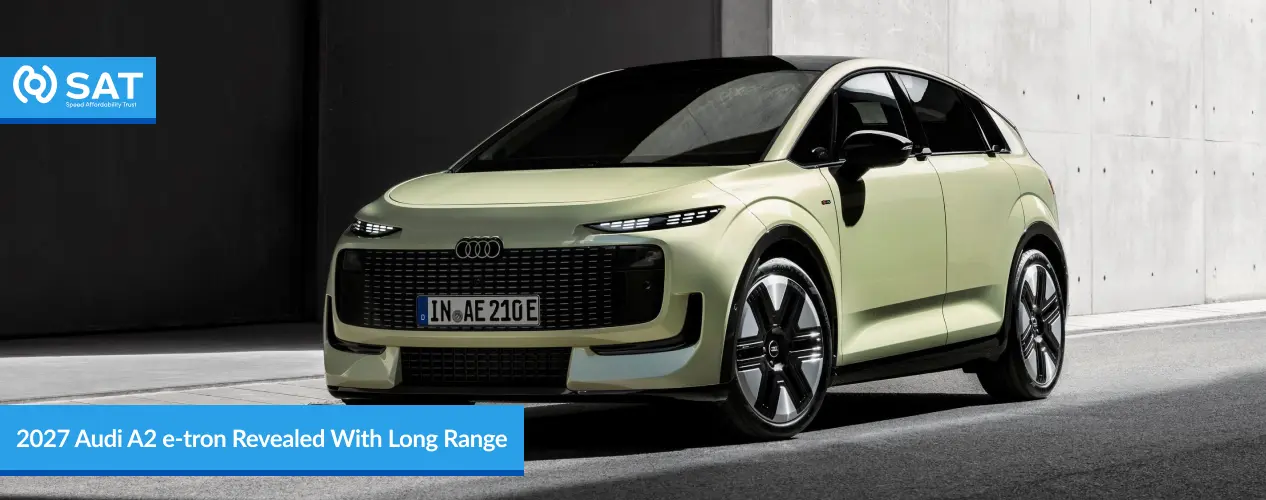
Audi has officially debuted the all-new A2 e-tron, one of its most recognizable nameplates now in electric form. Audi revealed the new A2 e-tron in Paris on September 7. The car focuses more on efficiency, practicality, and digital technology than on more power or a bigger battery.
The new electric Audi delivers up to 646 km (401 mi) of WLTP range, up to 84 kWh of battery capacity, and up to 183 kW of DC fast charging. According to Audi, it's the most efficient model in its history, consuming no more than 12.8 kWh per 100 km in a specific configuration.
The A2 e-tron revives the A2 nameplate as a compact, efficient model, which Audi first used in the early 2000s. The new version reflects that philosophy in the electric age, and Audi has consciously focused on aerodynamic design, interior versatility, and smart resource management.
Audi claims it targets a new group in the compact electric market and was built with the European user in mind. Audi will build it at its flagship plant in Ingolstadt, Germany.
It's an important moment for Audi. The firm is seeking to build up its presence in the smaller car segment, which has become more competitive in Europe, Reuters reports. The company also saw a year-over-year dip in sales globally, and a 7% drop in the first half of 2026.
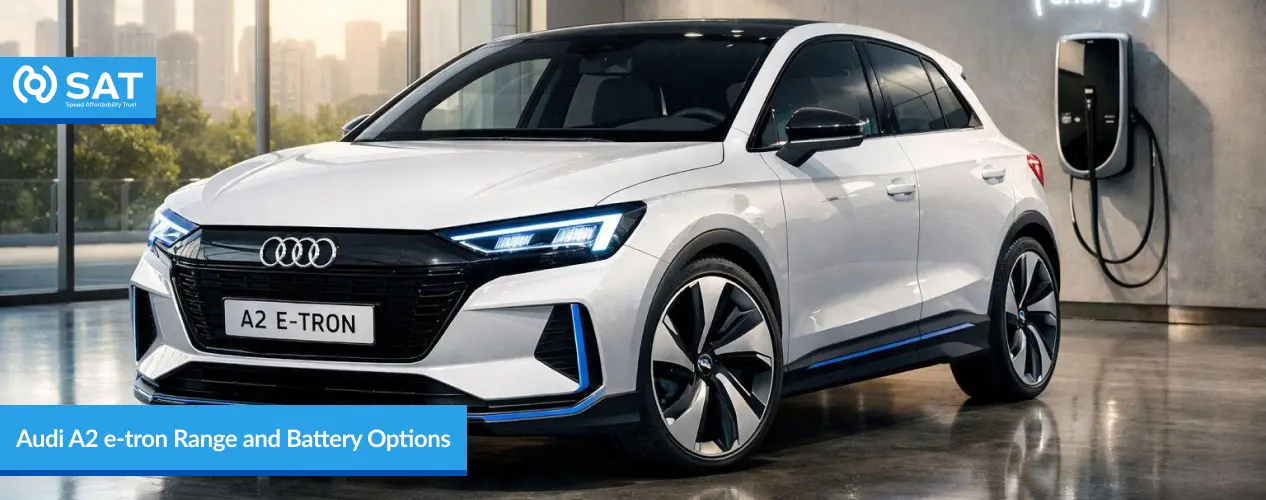
One of the most compelling points of discussion about the new electric A2 is range. The A2 e-tron will be available in a variety of power and range options, including the 52 kWh, 61 kWh, and 84 kWh gross battery capacities. The 170 kW version with the 84 kWh battery can deliver up to 646 km (WLTP), and the flagship 240 kW version up to 630 km (WLTP).
Powered by a 125-kW motor, it delivers 170 PS and a range of up to 423km. The 140-kW version delivers 190 PS and up to 515 km of range, while the 170-kW version offers 231 PS. The range-topping 240-kW version has 326 PS and 545 Nm and takes only 5.7 seconds to hit 0-100 km/h.
Significantly, the headline efficiency and maximum range figures are for two different setups. The 12.8km/100km rating is for the 140kW version, and the 846km maximum range is for the 170kW version with the optional efficiency pack.
The larger battery, with a capacity of 84 kWh, supports charging up to 183 kW, meaning it can charge from 10% to 80% in about 29 minutes. The smaller batteries have capacities of 100 kW and 105 kW, respectively.
The technology adds another dimension to Audi's growing e-tron electric-car lineup. Vehicle-to-Load can supply power to external devices, and Vehicle-to-Home can use the vehicle as a home energy storage system with appropriate equipment and in markets where this is supported.
Audi claims V2H will come first in Germany, Austria, and Switzerland, where compatible DC wall boxes are available.
The A2 e-tron has been developed with aerodynamic efficiency in mind. It has a 0.24 drag coefficient, the lowest of all the other models in the compact segment.
It features a mostly enclosed underbody, adjustable cooling-air vents, and aerodynamic wheel & wheel-arch gap reducers. The small overhangs and relatively long 2.77 m wheelbase are designed to offer generous cabin space without consuming too much exterior space.
It's similar to the original A2, which focused on efficient use of space, but the new car brings that philosophy into the modern electric era.
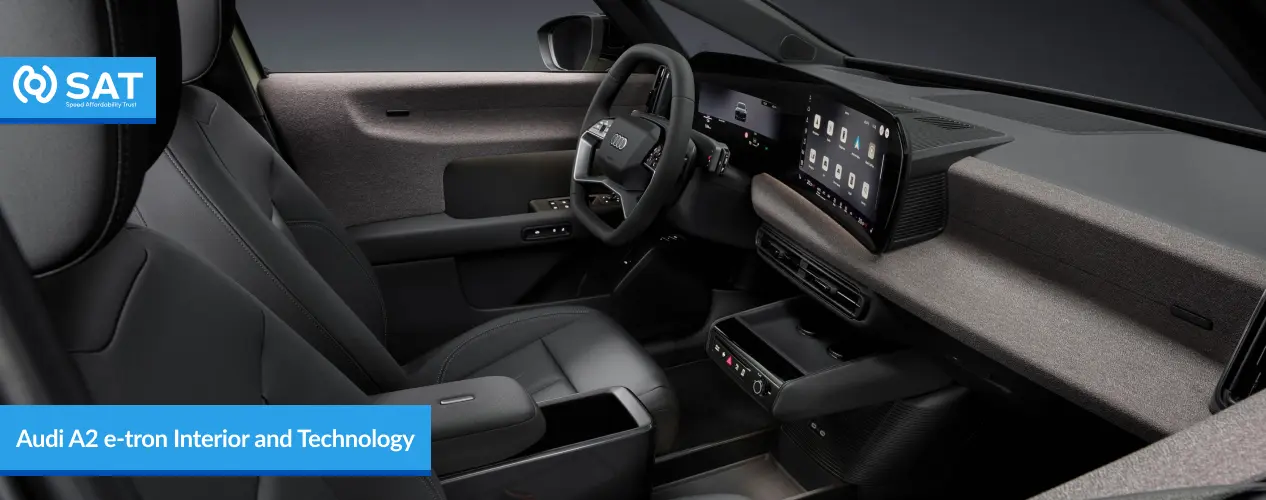
The A2 e-tron comes with a technology package that wouldn't have been possible in the original A2! An 11.9-inch Audi virtual cockpit plus and a 12.8-inch curved MMI touchscreen are standard equipment and part of the Audi panoramic display concept. This will also include an AI-assisted Audi assistant, the Audi route planner e-tron, and other connected functions.
Flexibility is the theme of the cabin, and a 1.6 square-meter panoramic glass roof is available to make it even more spacious. Audi will also use a new FiDlock magnetic fastening system as standard, making it easy to attach compatible accessories and storage units to the interior of the car.
Technologies that assist the driver are also a key focus. Audi's standard systems include emergency brake assist, evasive assist, attention assist, adaptive cruise control, parking system plus, and a reversing camera.
The A2 e-tron's base price in Germany is €38,200 for the 125-kW version and the 52-kWh battery. The 61-kWh model starts at €41,900, while the 170-kW/84-kWh version costs €48,900 and the 240-kW flagship starts at €51,200.
Audi claims orders will open in Germany on September 10, 2026, with first deliveries starting in December. Order books open in the UK in October, with deliveries starting in early 2027 and prices from £32,200 on the road.
The new A2 e-tron is more than just a rebranded badge. It's a new path in the development of an all-electronic powertrain for Audi - smaller, more efficient, and more intelligent than just bigger batteries and increased performance.
The A2 e-tron has a maximum WLTP range of 646km, 183kW charging, bidirectional energy transfer, and a highly digital interior environment, giving Audi a strong entry point into the European EV market. Real-world efficiency and pricing will decide its success. For buyers comparing Audi's growing electric lineup, platforms such as SAT Japan also provide an opportunity to explore other Audi models and see how the brand's electric vehicles compare across different segments.
Ultimately, real-world efficiency, pricing, availability, and customer response will determine how successful the A2 e-tron becomes. For now, Audi has made efficiency one of the defining priorities of its latest electric model.
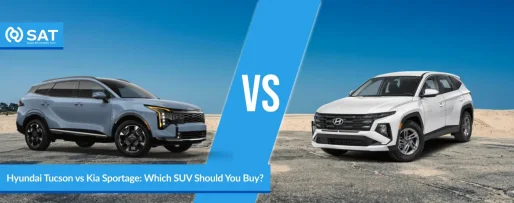
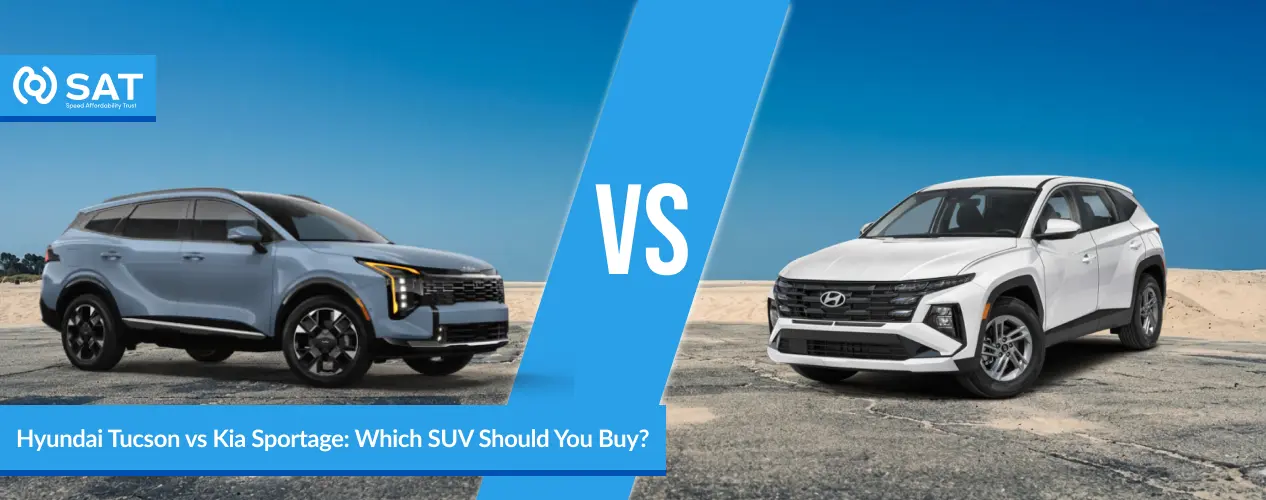
If you want to compare Kia Sportage vs Hyundai Tucson for 2026, the choice is closer than it first looks. Their gas engines have the same power; both come with hybrid and plug-in hybrid options; their cabins are similarly roomy; and even their prices stay close.
Look harder, and the better buy starts to change with the version. The Tucson makes a stronger case as a calm, comfortable gas SUV. The Sportage becomes much harder to beat once you reach the hybrid.
This comparison covers 2026 U.S.-spec Hyundai Tucson vs Kia Sportage models. My pick for most people is the Sportage Hybrid, but the Tucson still wins a few areas that matter.
The Sportage starts at a lower price.
The gas models are mechanically very close.
The Sportage Hybrid is the best buy of the group.
The Tucson has the softer ride and better control layout.
Tucson can tow slightly more.
Sportage X-Pro has the more useful off-pavement upgrades.
Here are the numbers that actually help separate them.
Category | Kia Sportage | Hyundai Tucson | Edge |
Starting Price | $28,790 | $29,700 | Sportage |
Gas Horsepower | 187 hp | 187 hp | Tie |
Gas Fuel Economy | Up to 28 mpg combined | Up to 28 mpg combined | Tie |
Hybrid Available | Yes | Yes | Tie |
Plug-In Hybrid Available | Yes | Yes | Tie |
Cargo Space Behind Rear Seat | Up to 39.6 cu ft | Up to 41.2 cu ft | Tucson |
Gas-Model Maximum Towing | 2,500 lb | 2,750 lb | Tucson |
Basic Warranty | 5 yr/60,000 mi | 5 yr/60,000 mi | Tie |
Hyundai also gives an SAE cargo measurement of 38.7 cubic feet, so the headline 41.2-cu-ft figure should not be treated as a perfect direct comparison with Kia's 39.6-cu-ft measurement.
Choose the Kia Sportage if: price and value sit near the top of your list, especially if you want a hybrid. It also makes more sense if you want an adventure-style trim that offers more than just black wheels and body cladding.
Choose the Hyundai Tucson if: comfort matters more than outright value. The Tucson is easy to settle into, its controls are better thought out, and its extra towing capacity may matter if you regularly pull a small trailer.
The Kia Sportage and Hyundai Tucson are closely related, and their specifications show just how similar they are. Both use a 108.5-inch wheelbase, while their gas models make 187 hp and 178 lb-ft with an eight-speed automatic.
That is why many Kia Sportage vs Hyundai Tucson specs are so similar. The main differences come from ride comfort, interior design, features, and pricing.
Kia gives the Sportage the louder personality. Its exterior looks tougher, the dashboard is more appealing, and trims such as X-Line and X-Pro lean hard into the outdoor theme.
The Tucson takes the calmer route. Its cabin design is cleaner, its physical controls are easier to reach, and road tests consistently praise its soft ride. Kia's Sportage is comfortable too, but the Tucson is the one that feels more interested in making a bad road disappear.
If you are thinking about waiting another model year, see what we know about the 2027 Hyundai Tucson.
If you are thinking about which one is a better deal, here’s the clear winner: Kia Sportage.
The Sportage LX starts at $28,790. The Tucson SE starts at $29,700, leaving a $910 gap before destination charges.
Move into hybrids, and Kia stays cheaper. The Sportage Hybrid LX begins at $30,490, while the Tucson Hybrid starts at $31,300. Plug-in hybrids almost meet in the middle at $40,490 for the Kia and $40,675 for the Hyundai.
None of those gaps is huge. The important part is that Kia costs less without using a weaker engine or giving you a smaller SUV.
Both base SUVs now cover the basics well. A 12.3-inch touchscreen, wireless Apple CarPlay and Android Auto, LED lighting, and useful driver aids are no longer equipment you need to climb halfway through the range to get.
Hyundai does better with some standard safety equipment. IIHS lists blind-spot detection and rear automatic braking as standard on the 2026 Tucson. On the Sportage, those systems are optional on lower versions.
So Kia wins on price. Hyundai claws some of that money back in equipment.
Winner: Kia Sportage.
For a cheap Sportage, the LX makes sense because it already gets the same 187-hp engine and big center screen. The EX is the version I would look at if you want more comfort without paying for every possible gadget.
Hyundai's SEL is the sensible Tucson. It moves away from the basic feel of the SE without jumping anywhere near the $39,675 Limited.
At the top, I prefer the Tucson Limited to a fully loaded gas Sportage. If the reason you are spending close to $40,000 is comfort and technology, Hyundai's cabin suits that job better.
For the rugged trims, Sportage X-Pro wins easily. More on that later.
Sometimes. Just not because it is more expensive. The Tucson is worth paying extra for if its ride, standard safety kit and easier controls matter to you. If they do not, I struggle to find a strong reason to spend more for essentially the same gas-engine performance.
Winner: Kia Sportage Hybrid.
This is the point where the Sportage pulls ahead. Kia gets 232 hp and 271 lb-ft from its hybrid system. Hyundai produces 231 hp. One horsepower is obviously not deciding anything. Fuel economy might.
The FWD Sportage Hybrid LX is rated at 42 mpg combined. Hyundai's FWD Tucson Hybrid reaches 38 mpg combined. Kia also starts $810 cheaper.
And unlike the gas Sportage, this one actually moves. Independent testing recorded 6.9 seconds to 60 mph for the 2026 Sportage Hybrid. That is not just a number for bragging rights. It means motorway entries and quick passes stop feeling like jobs that need advance planning.
The AWD comparison is closer because the Sportage's economy falls to around 35 mpg combined in several AWD versions, while Tucson Hybrid AWD trims range from 36 to 38 mpg combined depending on trim.
Expert Tip: If AWD is not necessary where you live, the FWD Sportage Hybrid LX is unusually hard to argue against. You get the best fuel figure and the lowest hybrid starting price at the same time.
Take a driver covering 12,000 miles a year with gasoline at $3.50 per gallon.
At 28 mpg, the gas Sportage would use about $1,500 in fuel each year. At 42 mpg, the Sportage Hybrid comes out to near $1,000.
The base hybrid costs about $1,700 more than the base gas model, so this example recovers the difference in roughly 3.4 years.
That is not a promise. Someone driving 6,000 miles per year will wait much longer. A high-mileage city driver could get there sooner.
Winner: Kia Sportage PHEV, but barely.
This one is almost a draw. Both produce 268 hp and 271 lb-ft, both have a 13.8-kWh battery, both use six-speed automatics, and both come with AWD.
Kia gives you 34 miles of EPA-rated electric range and 83 MPGe. Hyundai lists 32 miles of electric range, although its current official pages differ on the combined MPGe figure. Their starting prices are separated by just $185.
Two extra miles of electric range do not transform the ownership experience, but they are enough to give Kia a small advantage in a comparison this close.
A PHEV makes sense if you have somewhere to charge and most weekday trips fit inside that electric range.
A regular hybrid makes more sense if the car will spend its life parked away from a charger. A PHEV that rarely gets plugged in becomes an expensive way to carry a large battery.
Your Driving Situation | Best Choice |
Low annual mileage | Gas |
Heavy city driving | Hybrid |
Long daily commute | Hybrid |
Mostly highway driving | Hybrid or gas |
Home charging available | PHEV if daily trips suit EV range |
Lowest purchase price matters most | Gas |
For most people, I would stop in the middle and buy the regular hybrid. It improves performance and fuel use without asking you to build your week around a charger.
Hyundai Tucson vs Kia Sportage reviews often point to comfort as one of the biggest differences between them.
Winner: Hyundai Tucson for comfort.
Independent testing has recorded 0–60 mph in 8.8 seconds for the Tucson and 9.1 seconds for the Sportage. The 0.3-second gap is small, and neither gas model feels particularly quick, but the Tucson has a slight advantage in straight-line acceleration.
The Tucson's biggest strength is that it requires little effort. Steering is light and direct, visibility is good, and the suspension takes sharp road edges without making the body feel loose afterward.
The Sportage is hardly uncomfortable. It just does not smooth poor roads quite as convincingly, especially on larger wheels.
With the gas engine, both need more patience than I would like. A gap that looks easy in a stronger turbo SUV can suddenly feel quite short here.
The hybrids fix most of that. The Sportage Hybrid's tested 6.9-second 0–60 mph time is more than three seconds quicker than the roughly 10.2-second result recorded for a gas version in independent testing. These were different tests and versions, but the size of the gap still shows how much stronger the hybrid feels.
If highway use is a big part of your week, I would not buy the gas version unless the price difference really matters.
Tucson wins.
Hyundai's softer suspension handles potholes and broken pavement well, and the car settles quickly after the initial bump. The Sportage still rides well, but its larger-wheel versions give the road more chances to reach the cabin.
This is also why I would not automatically pay extra for the biggest wheels. They look good in photos. The road does not care.
Not really.
Their steering is accurate enough, and body control is sensible, but neither rewards you for taking the long way home. Even some buyers describe the Sportage's road manners as unengaging, while Tucson reviews make much the same point in softer language.
That is not a serious flaw in a family SUV. It just means the word "Sportage" is doing more work than the chassis.
With the gas engine, Tucson.
With hybrid power, Sportage.
The Tucson's chassis is nicer than its base engine. The Sportage Hybrid finally gives this pair the powertrain their size deserves.
Winner: Hyundai Tucson, narrowly.
The Sportage has 41.4 inches of front legroom and 41.3 inches in the rear. Tucson uses the same 108.5-inch wheelbase and also gives adults a genuinely roomy second row.
Dimension | Kia Sportage | Hyundai Tucson |
Length | 184.4 in | 182.7 in |
Width | 73.4 in | 73.4 in |
Wheelbase | 108.5 in | 108.5 in |
Rear Legroom | 41.3 in | 41.3 in |
Both are much better at carrying four adults than the "compact SUV" label suggests.
Neither is a bad option.
Large rear doors and generous legroom leave enough space for bulky child seats without pushing the front passenger into the dashboard. Both have LATCH anchors, and IIHS rates LATCH ease of use as Acceptable in each SUV.
I give Tucson the small win because lower trims include more blind-spot and rear-braking safety equipment that families are likely to appreciate.
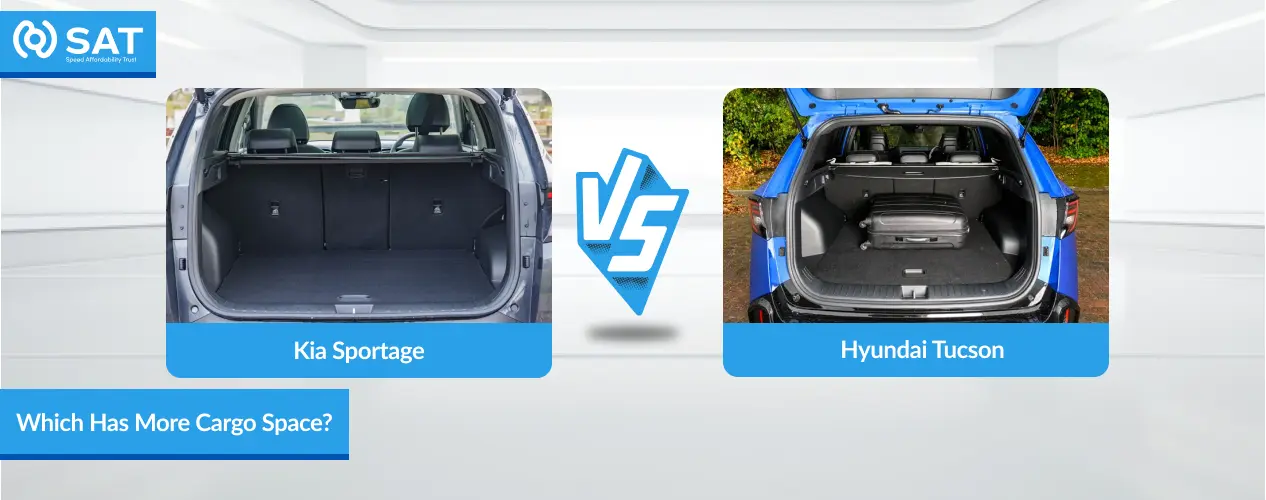
For the gas Tucson, Hyundai quotes 41.2 cubic feet behind the rear seat and 80.3 cubic feet with it folded. It also gives SAE measurements of 38.7 and 74.8 cubic feet.
Kia lists 39.6 cubic feet with the cargo floor in the lower position and 74.1 cubic feet with the seats folded.
On the highest published figures, Tucson has the advantage, although the different measurement methods make this less straightforward than the headline numbers suggest.
Winner: Hyundai Tucson.
The Sportage is the one that tries harder to impress you in the first 30 seconds. Its wide display layout and dashboard design look expensive for the class.
Tucson is more restrained. Then you start using it.
The materials feel good, the main controls are easy to find, and the dashboard does not ask you to learn a clever trick before changing the temperature. That matters more after six months than it does during a showroom visit.
Neither feels tight, but Tucson's cleaner dashboard gives the front seats a slightly more open feel.
The rear is essentially a draw. There is enough knee room for adults in both, and neither forces a tall passenger into an awkward seating position.
Tucson gets my vote. Independent testing has praised its front seats for soft cushioning, support, and power adjustment. Sportage seats are supportive too, but the Hyundai's comfort-first character works particularly well on longer journeys.
Kia adds more visual interest to the center console. Hyundai makes the whole area easier to understand.
That sounds like a tiny thing until you own the car. Phones, charging cables, keys, drinks, and receipts have a strange ability to take over every free surface. Both cope well, but Tucson asks less thought.
Winner: Tucson
Sportage has the flashier presentation. Tucson has the controls I would rather use every morning.
Both start with a 12.3-inch central touchscreen, and wireless Apple CarPlay and Android Auto are standard. Higher trims can add digital gauges, navigation, and upgraded audio systems.
Hyundai wins because it remembered that some controls are better as controls.
The Tucson brought physical switchgear back for key climate and audio functions. Buyers specifically praise those buttons and knobs for making common adjustments quicker.
Kia's touch panel looks cleaner. I would still rather have the Hyundai setup when I am trying to change something without taking my eyes off the road.
Tucson. Not because the software is better. It simply gives the screen less work to do.
Spend more, and both can pile on the clever stuff: surround-view cameras, blind-view cameras, digital key functions, wireless charging, and parking aids.
Hyundai's Limited even offers Remote Smart Parking Assist, while upper Sportage trims offer their own strong camera and driver-assistance package.
Those are useful upgrades. They are not a reason to pay thousands for a trim full of other features you do not want.
Both earn 2026 IIHS Top Safety Pick+ awards.
There is a difference hiding deeper in the results. The Sportage receives an Acceptable rating for whiplash prevention. The Tucson gets Poor. Kia's award applies to vehicles built after May 2025 because rear-seatbelt changes were made for the updated moderate-overlap test.
That is a more useful distinction than simply saying both are safe and moving on.
Both perform well in IIHS front crash-prevention tests, and both include lane-departure prevention.
Tucson has the equipment advantage lower in the range. Blind-spot detection and rear automatic braking are standard according to IIHS, while both are optional on the Sportage.
At higher trims, the difference becomes small. Both offer enough cameras and sensors to make tight parking much easier.
This is one area where I would compare the actual two trims sitting on your shortlist rather than the model ranges as a whole.
Yes. Tucson offers more standard assistive equipment. Sportage has the better current IIHS whiplash result.
Neither advantage is fake, so I would call safety a tie rather than inventing a winner.
Winner: Hyundai Tucson.
Hyundai lists 2,750 pounds with trailer brakes for the gas Tucson. Kia rates the gas Sportage at 2,500 pounds.
A 250-pound difference will not matter to everyone. If your trailer already sits close to 2,500 pounds loaded, it matters a lot.
Winner: Kia Sportage X-Pro.
Both SUVs offer AWD and rugged styling, but the Sportage X-Pro goes further. It gets 17-inch wheels with all-terrain tires, along with Snow, Mud and Sand terrain modes. The Tucson XRT can also be equipped with AWD and terrain modes, but it uses regular road-focused tires.
Neither is a serious off-roader, but the Sportage X-Pro has the more useful hardware if gravel roads, snow, or rough tracks are part of your driving.
Coverage | Kia Sportage | Hyundai Tucson |
New Vehicle Warranty | 5 yr/60,000 mi | 5 yr/60,000 mi |
Powertrain Warranty | 10 yr/100,000 mi | 10 yr/100,000 mi* |
Hybrid/Battery Coverage | 10 yr/100,000 mi | 10 yr/100,000 mi |
Roadside Assistance | 5 yr/60,000 mi | 5 yr/unlimited mi |
Hyundai confirms its 10-year/100,000-mile powertrain warranty for the original owner. Transfer terms matter, so a used Tucson should not automatically be treated as having the same remaining powertrain protection as the first owner.
Purchase price is only part of the cost. Fuel, servicing, depreciation, and warranty coverage can make a cheaper SUV more expensive to own over several years.
There is not enough here to pick one SUV. What matters more is sticking to the service schedule, keeping records and checking exactly what a dealer's advertised maintenance package includes. Complimentary servicing can vary by model year and offer period, so I would not base a long-term ownership decision on it.
Here the Sportage Hybrid earns back some attention.
At 12,000 miles a year and $3.50 per gallon, a 28-mpg gas model uses about $7,500 of fuel over five years. A 42-mpg Sportage Hybrid lands around $5,000. A 38-mpg Tucson Hybrid comes to roughly $5,526.
Nobody has five years of 2026 resale history. Both are established models from brands with large U.S. dealer networks and mature used markets. That is useful. It still does not justify pretending we know their exact 2031 values.
There is no proven 2026 winner.
That may be a less exciting answer, but it is the responsible one. Their shared engineering means many of the mechanical risks are related, and neither 2026 model has been on the road long enough for a meaningful long-term reliability record.
A long warranty helps. It does not turn future repairs into known facts.
Sportage Hybrid. The reason is not a vague promise about reliability. It starts at a lower price than the Tucson Hybrid and, in FWD form, uses less fuel on the EPA cycle. That is money you can actually calculate today.
Want the lowest entry price.
Plan to buy the regular hybrid.
Want the slightly longer PHEV electric range.
Prefer a more useful rugged trim.
Like Kia's bolder styling.
You can also check a current Kia Sportage listing to see how mileage, condition, specifications, and vehicle details are shown before buying.
Put ride comfort high on the list.
Prefer normal buttons for common controls.
Need the extra towing capacity.
Want more safety equipment standard on lower trims.
Care more about calm family use than acceleration.
If the Tucson is closer to what you want, it is also worth comparing the Hyundai Tucson vs Toyota RAV4.
Buy the FWD Sportage Hybrid. At 42 mpg combined, it beats the equivalent Tucson Hybrid's 38 mpg while also starting for less. This is probably the clearest win in the whole comparison.
I would select the Tucson. Not because it suddenly has much more rear room. It does not. The advantage comes from its soft ride, straightforward cabin controls, useful cargo area, and standard safety equipment.
I would avoid buying more complexity than you need.
For many people, that points to the regular hybrid rather than the PHEV. It saves fuel without needing a charging routine and avoids paying for a large plug-in battery that may spend most of its life unused.
Between the two brands, there isn't enough 2026 reliability data to declare a long-term winner today.
Still comparing options? Our Kia Sportage vs Honda CR-V comparison shows how the Kia stacks up against another major compact SUV.
If You Care Most About | Better Choice | Why |
Lowest Purchase Price | Sportage | Lower starting MSRP |
Best Value | Sportage | Similar hardware for less |
Gas Model | Tucson | Better ride and towing |
Hybrid | Sportage | 42 mpg FWD and lower price |
Plug-In Hybrid | Sportage | Slight EV-range edge |
Family Use | Tucson | Comfort and safety kit |
Cargo Space | Tucson | Slight published advantage |
Interior Comfort | Tucson | Softer and calmer |
Technology | Tucson | Better control layout |
Ride Comfort | Tucson | Handles rough roads well |
Safety | Tie | Different strengths |
Snow/Bad Weather | Tie | Both offer useful AWD |
Towing | Tucson | 2,750-lb maximum |
Long-Term Ownership | Sportage Hybrid | Strong fuel-cost case |
Anyone importing a Kia Sportage or Tucson from Japan needs to separate those cars from the U.S.-spec models discussed above. Engines, trims, safety equipment, and even model names can differ by market.
SAT Japan lists vehicle sourcing, inspection, shipping, and customs support among its services. Check the actual vehicle's grade, mileage, condition, and documents before treating a Japanese listing as equivalent to a U.S. model.
The Kia Sportage is the better buy overall, but the hybrid is doing much of the work behind that verdict. The gas Tucson is more comfortable and can tow more. Once hybrid price, performance, and fuel use enter the comparison, the Sportage makes the stronger case.
Best Gas SUV: Hyundai Tucson
Best Hybrid: Kia Sportage Hybrid
Best Plug-In Hybrid: Kia Sportage PHEV
Best Value: Kia Sportage
Best Family SUV: Hyundai Tucson
Best Overall: Kia Sportage
I would buy the Sportage Hybrid.
The base gas engines are the weak link in both SUVs. Spending a little more on the Kia Hybrid gets you a much stronger 232-hp powertrain and, in FWD LX form, an EPA rating of 42 mpg combined. It also starts below the Tucson Hybrid. Those are useful gains, not brochure decoration.
Tucson still has a case. Its ride is better, its cabin controls make more sense, and anyone pulling a trailer should notice that 2,750-pound tow rating.
But most compact-SUV owners are not towing every weekend. They are commuting, carrying children, buying groceries and paying for fuel. On those jobs, the 2026 Sportage Hybrid makes the most sense of the two.
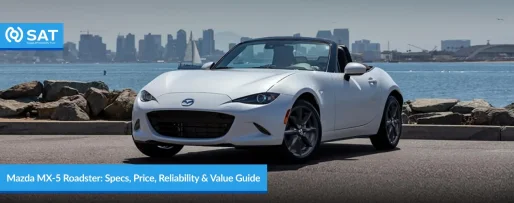
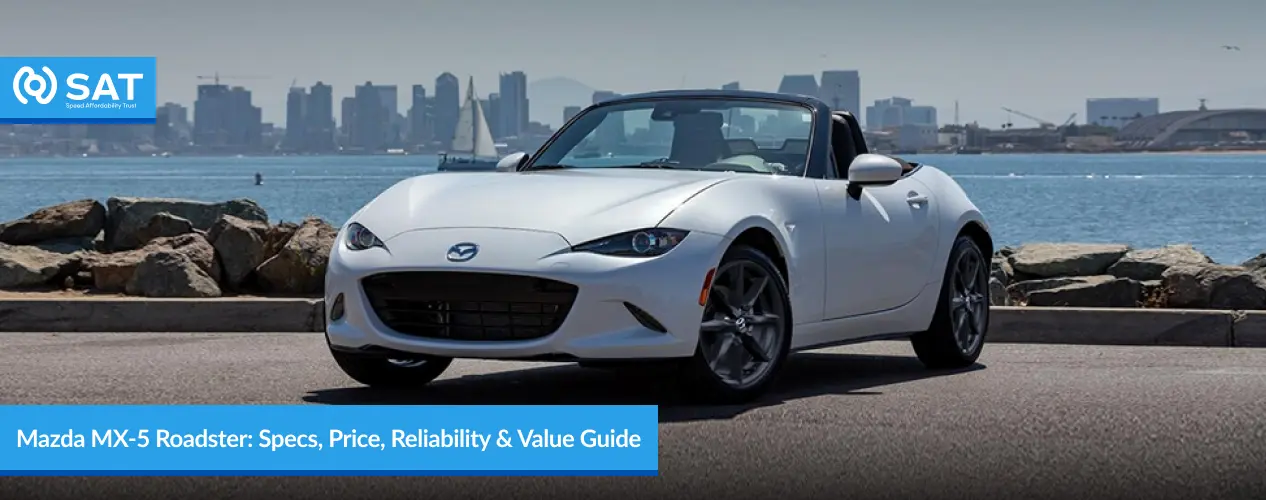
A great sports car doesn't have to impress you; it has to mean every mile. The Mazda MX-5 Roadster extends that idea to two seats, rear-wheel drive, and a driver-centric design.
But horsepower isn't the only thing to consider when choosing the right MX-5. The prices you can expect and the reliability you get depend on the engine, transmission, roof, condition, service history, and generation.
This guide offers you real-world usefulness, automatic vs. manual, parts and accessories, maintenance, and tips for buying an MX-5 Roadster.
The Mazda MX-5 Roadster is a two-seater sports car with just one vision: “the driver should feel attached to the car”. The MX-5's appeal isn't just in its compact size. Mazda has engineered deliberate choices to preserve its character. They explored various options, including front-, rear-, and mid-engine configurations, before settling on rear-wheel drive for its ability to deliver a more agile driving experience and linear handling characteristics.
The engineers also turned down a 2+2 cabin. Instead, they decided on a two-seat layout and a soft top that could be opened and closed manually. All these choices were made to maintain simplicity and excitement, but not to address the overarching weight-control issue.
There's another detail buyers should know. “Lightweight” was no hype word for Mazda. To enhance weight control, steering accuracy, and mechanical feel, the original frame was made out of a rigid powerplant frame; an aluminum hood and a stainless-steel exhaust were also used.
After all, that's the true essence of the MX-5: less hardware, more involvement. It's a roadster built to put normal roads in a class of their own, but without the extreme performance.
Key detail | Mazda MX-5 Roadster |
First introduced | 1989 |
Generations | NA, NB, NC, ND |
Layout | Front-engine, rear-wheel drive |
Seats | 2 |
U.S. launch engine | 1.6L naturally aspirated four-cylinder |
2026 U.S. engine | 2.0L SKYACTIV-G |
2026 U.S. output | 181 hp / 151 lb-ft |
2026 U.S. transmissions | 6-speed manual; 6-speed automatic on Grand Touring |
Roof/body configurations | Soft top and MX-5 RF |
2026 U.S. starting MSRP | $30,430 for Sport soft top |
When comparing an MX-5 Roadster for sale, first confirm the market, generation, model year, engine, transmission, and body style. These details can change the car's equipment and asking price, so comparing listings by badge alone can be misleading.
The MX-5's specifications include several figures that are important for buyers. In the current U.S. specification, Mazda lists a 13.0:1 compression ratio, an 83.5 mm bore, and a 91.2 mm stroke. The longer stroke relative to the bore helps explain the engine’s design, while variable valve timing manages airflow across its operating range.
Fuel capacity is 11.9 gallons, while the recommended fuel is premium unleaded with a 91 AKI rating. Mazda states that regular 87 AKI fuel can be used, but maximum engine performance may be reduced. That is useful information when estimating everyday fuel costs.
Cargo capacity is equally specific. The soft-top MX-5 provides 4.59 cubic feet of trunk space, while the RF offers 4.48 cubic feet. That small difference matters less than the shape of the space, so compact bags are more practical than large suitcases.
The MX-5 also uses a four-wheel disc brake setup with ventilated front and solid rear rotors, rather than mixing front discs with rear drums. Club models equipped with the available Brembo package gain Brembo front brakes, adding another specification worth checking when comparing used listings.
Fuel requirements, ground clearance, luggage space, and brake hardware can all affect day-to-day ownership.
Generation | Production era | Engine options | Key specification change |
NA | 1989–1997 | 1.6L, later 1.8L | Original lightweight two-seat RWD roadster |
NB | 1998–2005 | 1.6L, 1.8L | Revised body, chassis and engine range |
NC | 2005–2015 | 1.8L, 2.0L | Larger platform and increased equipment |
ND | 2015–present | 1.5L, 2.0L | Smaller, lighter modern platform |
Availability varies from country to country, and model year to model year. When quoting an exact vehicle, please use Mazda's official historical and regional specifications.
In a critical aspect, the North American car is different. Mazda's 2026 MX-5 Miata U.S. specifications include a 7,500-rpm redline, 181 hp at 7,000 rpm, and 151 lb-ft of torque at 4,000 rpm from a 2.0-liter, four-cylinder SKYACTIV-G engine.
The six-speed manual transmission is standard across the U.S. range, while the six-speed automatic is available only on the Grand Touring trim. The Sport and Club models are strictly manual-only. If you're looking at an automatic MX-5, that's a significant factor. Not all countries, generations, trims, and model years offer transmission options.
Mazda's U.S. owner's documentation lists the current MX-5 at 3,915 mm (154.1 inches) long and 1,735 mm (68.3 inches) wide, with a 2,310 mm (90.9 inches) wheelbase. The height varies by configuration and wheel size and is quoted here as 1,235 mm to 1,245 mm for the U.S./Canada models.
Those dimensions help explain the MX-5's practicality. This is indeed a compact sports car, not a big 2-seater grand tourer. The short wheelbase and narrow body also make it easier to park on narrow roads and in parking spaces.
Body style and transmission variations cause weight changes. The specifications differ between the hardtop and soft-top versions, and in the Japanese-documented Mazda RF specification sheet, they are listed as 1,110-1,130 kg, depending on grade and transmission.
If you're looking for a reference in the U.S. market, Mazda's manual MX-5 Miata Soft Tops weigh 2,366 lb while the six-speed automatic is 2,405 lb for the Grand Touring Soft Top.
This difference is useful when comparing the two transmissions. The automatic version isn't just another transmission option, either; in the aforementioned U.S. specification, it also adds 39 lb to the curb weight.
The original NA featured double-wishbone suspension at both front and rear, a conscious engineering decision made to achieve dynamic control. To enhance drivetrain response and feedback, Mazda also created a rigid powerplant frame between the transmission and differential.
New models include electronic chassis technology. Mazda's U.S. paperwork explains that Kinematic Posture Control (KPC) is a software-controlled system that uses the rear suspension and brakes to minimize body roll during high-g cornering. The system does this without increasing vehicle weight, Mazda claims.
It's a valuable used-car lesson: factory chassis hardware and the vehicle's current condition are not the same. If the dampers, bushings, tires, and alignment are worn on a used MX-5, the suspension may feel just like it did on a new one, even if the suspension is the same design.
The Mazda documentation currently lists various factory tire sizes depending on configuration, such as 195/50R16 and 205/45R17. This can be very important. The tires are a component of the car's handling system. When examining the tread depth on a used MX-5, make sure to check the brand, model, age, any uneven wear, and whether all four tires are matched.
The best specification for the MX-5 is thus not just one horsepower number. It is the vehicle's full factory setup and condition. These checks help determine whether a used MX-5 has the factory setup and condition you want.
Choosing an MX-5 is not just about choosing an older or cheaper vehicle. The decision depends on your budget, preferred generation, mileage, equipment, and maintenance needs.
With a new Mazda Roadster, you know the specifications, and there is no history of its previous ownership. While a used car may offer you the opportunity to buy at lower prices, its condition can be more important than its age or mileage.
It makes the most sense to buy a new MX-5 if you're looking for the latest spec, factory warranty, and predictable ownership from the get-go. You can also pay for the exact trim, transmission, color, and available equipment instead of settling for what's already available in the used market.
The main drawback is the higher purchase price of a new car. While the most recent model may seem like the best option, if you're more interested in the most MX-5 for your money, it can make more sense to choose a used model carefully.
The greatest benefit of the used purchase is choice through generations. Your budget will open the door to an NA, NB, NC, or ND, each with different engines, chassis, size, equipment, and driving character.
Not every 100,000-mile MX-5 is a poor choice. On the other hand, a car with low mileage but years of poor care and/or modifications should be thoroughly checked.
Begin with Vehicle History and Maintenance records. Check for signs of routine maintenance, past repairs, crashes, changes of ownership, and extensive engine repairs.
As evidence of completed service, Mazda recommends that owners keep maintenance records, receipts, and repair orders. This is particularly important when considering a used example.
Then, check the vehicle itself. Investigate the engine, transmission, manual clutch, brakes, tires, suspension, steering, underbody, lights, fluids, and convertible roof.
In the U.S., the Mazda MX-5 Miata begins at a $30,430 MSRP for the Sport soft top and goes up from there. The Club begins at $33,930, and the Grand Touring begins at $35,730. These figures do not include Mazda's $1,315 destination charge, taxes, title/license, and options.
2026 version | Starting MSRP |
MX-5 Miata Sport 6MT | $30,430 |
MX-5 Miata Club 6MT | $33,930 |
MX-5 Miata Grand Touring 6MT | $35,730 |
MX-5 Miata Grand Touring 6AT | $36,650 |
MX-5 Miata RF Grand Touring 6MT | $38,450 |
MX-5 Miata RF Grand Touring 6AT | $39,420 |
MX-5 Miata RF Club | $41,900 |
The quoted price is the starting price. Destination, taxes, registration, dealer fees, financing, insurance, fuel, tires, scheduled maintenance, and unexpected repairs are all items that can be part of your final purchase price.
Before you make an offer, you should compare at least five things: Generation, Model year, Mileage, Condition, and Specification. Then adjust your estimate for service history and immediate repair needs. When comparing the cost of ownership between two cars with very similar asking prices but one requiring tires, brakes, and suspension work, the true cost of ownership of the car with the required work might be significantly higher.
There is no single “best” MX-5. You will need to choose a suitable generation depending on whether you want a classic character, a more affordable one, contemporary performance, or the latest technology. While the four generations are quite different, basing a purchase on price may not yield the right car.
It is the NA that began the modern history of the MX-5. It was introduced with a pop-up headlight and a two-seater, Rear Wheel Drive. The first U.S. model was fitted with a 1.6-liter engine, and later they switched to a 1.8-liter engine.
If you want the original MX-5 experience and fancy owning a classic, then the NA is most appropriate. But its age alters the buying scenario. The condition, corrosion, previous repairs, and maintenance history are more important than the lowest price!
The NB was introduced in 1998 as the NA's successor and used fixed headlights instead of the NA's pop-up units. In various markets, Mazda also provided 1.6- and 1.8-liter engines – the 1.8-liter with a 6-speed manual transmission in Japan. On applicable models, the soft top has a glass rear window fitted with a rear defroster.
The NB is a good option if you enjoy the older MX-5 design, but are looking for a car that falls somewhere between the original NA and newer generations. Like all older MX-5s, do not take it for granted that age is a good indicator of this vehicle's condition.
The NC launched in 2005 with a newly developed 2.0-liter MZR engine in its North American launch specification. Mazda also worked on weight reduction, weight distribution, and more modern safety and environmental needs to create the NC.
The NC is also significant as the first generation to feature Mazda's Power Retractable Hard Top. This gave buyers a retractable hardtop option within the MX-5 range.
The ND is the fourth generation and is designed in line with Mazda's philosophy of “Innovate to preserve”. According to Mazda, development emphasized the vehicle's sports-car character while meeting many more stringent requirements today for safety and the environment.
In the U.S. market, it's currently powered by a 2.0-liter SKYACTIV-G engine that generates 181 hp and 151 lb-ft of torque. The current Mazda U.S. lineup consists of Sport, Club, and Grand Touring trim levels, with the new retractable-fastback body adding a new level to the lineup.
Do not fall into the trap of thinking the lowest price is the best price. A low-cost NA or NB may need a lot of work; a higher-cost ND may not need work right away. When comparing NC and ND cars, the same rule applies.
If using a used vehicle, add the purchase price to the immediate repairs, tires, brakes, and overdue maintenance. That provides you with a much clearer idea of value than the seller's asking price alone.
The manual MX-5 is the better choice if driving involvement is your priority. The automatic makes more sense if you spend a lot of time in traffic and want easier daily driving. For 2026 U.S.-market cars, Mazda pairs the 181-hp 2.0-liter engine with a six-speed manual across the range, while the six-speed automatic is available only on the Grand Touring.
The six-speed manual transmission leaves the driver in control of every transmission operation. It's a natural preference for people who like driving along curvy roads, switching gears often, and varying engine speed.
There's even a trim-level benefit. The manual version of the 2026 Grand Touring gets performance parts from the Club, such as Bilstein dampers, a front shock tower brace, DSC-Track mode, and an asymmetric limited-slip differential.
The six-speed automatic uses steering-wheel-mounted paddle shifters, giving the driver manual control when desired. It is offered on the 2026 U.S. Grand Touring rather than the Sport or Club.
That makes the automatic especially relevant for buyers who want the MX-5's compact size and open-air character without having to operate a clutch in stop-and-go traffic. The Grand Touring automatic also includes Mazda Radar Cruise Control with Distance and Speed Alert.
The smartest choice is not based on which transmission is “better.” Choose the manual if changing gears is part of the enjoyment for you. Choose the automatic if convenience matters more. With the 2026 U.S. lineup, remember that choosing an automatic also means choosing the Grand Touring trim.
Yes, the MX-5 has been a good car for resale value, but this depends on generation, condition, mileage, and body style. This is particularly appealing to individuals who are concerned about depreciation when purchasing the MX-5. After the Nissan Z, the standard MX-5 placed second among 18 two-seat cars for 5-year car resale value.
Age may not be the only factor. Before setting an asking price, a buyer should consider service records, mileage, accident history, corrosion, roof condition, tire condition, suspension, and modifications.
Generation also matters. An NA with original features may be more appealing to a different buyer than an NC or a nearly new ND. Other factors, such as equipment, transmission, body style, and local demand, may also affect the market value.
Be careful here. An MX-5 can be fun to own with a suspension kit, exhaust, wheels, or engine tuning, but doesn't necessarily translate to more value for any other buyer.
Maintenance, quality repairs, good condition, and desirable factory specifications are better assets than expensive modifications intended to boost resale value, and these have been documented.
Always retain all service invoices and repair records. Prevent issues that can cause significant expense. Avoid poor-quality modifications, keep the soft top or roof (RF) in good shape, and maintain the tires and suspension.
When putting the car on the market, show buyers how it has been cared for rather than just how it looks.
The MX-5 retains surprisingly well over the past five years, but doesn't promise to hold its value. The best advice for any buyer is to look for the right generation, specifications, condition, and maintenance history, rather than assuming that all MX-5s are equal in terms of retained value.
Not all parts of an MX-5 are created equal. Mazda's recommended maintenance plan includes checking steering linkages, suspension, ball joints, wheel bearings, dust boots on the driveshaft, brakes, and the exhaust system. These checks are important because deterioration in these areas affects not only the car's appearance but also its performance.
Pay special attention to tires. Mazda advises adhering to the specified tire size and not mixing different tire types. Mazda cautions that if a vehicle is fitted with a limited-slip differential and the tires are not the correct size or are out of balance, the differential may be subjected to continuous strain. This makes replacing tires a handling and drivetrain problem rather than just a routine purchase.
Another part that is unique to the MX-5 that needs protection is the soft top. Mazda offers separate maintenance instructions for the fabric roof and for the retractable hardtop for RF models. Cleaning and maintaining these parts in proper condition can help avoid costly roof repairs.
Mazda has set replacement frequencies for certain parts as part of routine service. The spark plugs are recommended at 75,000 miles, and the manual transmission oil is recommended at 60,000 miles for normal U.S. operation. Some intervals may be considerably shortened due to heavy use.
The most useful Mazda MX-5 accessories are those that address problems that can arise from the car's small size and open-air design. One of the most beneficial is a windblocker. It lessens rear wind blast as the roof is lowered, resulting in more comfortable open-top driving without altering the car itself.
The cargo tray is also quite a good idea for regular drivers. Mazda has one that will keep the trunk clean from spills and dirt. A matching cargo net will prevent small objects from moving around in the car at high speeds.
If the car is parked outside, a weather-resistant car cover can help protect the vehicle's exterior. The Mazda splash guard protects paint from road debris. These accessories are mainly intended to protect the car rather than change its appearance.
All-weather floor mats are a practical choice, particularly for those who drive in rainy or muddy conditions. Another useful item on Mazda's list is a roadside assistance kit for situations where you're stranded on the side of the road.
Cosmetic improvements require more consideration. Sport pedals, air-vent bezels, spoilers, and exterior trim are available but do not significantly alter either the look or the cabin feel. Mazda's accessory range also shows the difference between practical protection and personal styling.
For many owners, protection and comfort are more useful than cosmetic upgrades. Purchase the correct accessory, not the one that looks expensive.
There is no single reliability verdict that applies to every MX-5. Even though the Miata is a great car, buyers should verify the evidence to make sure it is the right car for them, especially for the model year in question.
See the recent recalls for proof. Mazda has issued a voluntary recall for some 2024-2025 MX-5 models due to a software issue that could prevent the traction control or stability control warning light from coming on when a fault is detected.
The problems with earlier vehicles have been documented, too. The 2024 safety recall by Mazda covers 2016-2023 MX-5s due to the possibility that the airbag control module software may respond to a minor crash with an incorrect deployment. The U.S. had approximately 77,670 cars impacted.
Those recalls do not by themselves mean that every MX-5 is unreliable. It shows model year studies are important. Buyers will want to look for open recalls before purchase, and should verify that recall work has been completed and documented.
Maintenance records provide another hard piece of evidence. Mazda's warranty paperwork states that owners must maintain service records, receipts, repair orders, and invoices as evidence of required maintenance.
So it's not only age or mileage that provides the best reliability signal. It's a particular vehicle that has been properly maintained and has undergone recall service.
The Mazda MX-5 Roadster is part of a small group of inexpensive rear-wheel-drive sports cars, though the cars most similar to the Roadster are not the same as it. The Toyota GR86 and Subaru BRZ are 4-seater, fixed-roof coupes. The MX-5 is open-top and has a much smaller footprint, sacrificing those rear seats. Before comparing the horsepower, the difference should be considered.
The GR86 and BRZ are more convincing options for those who frequently use the rear seats. They also feature a larger 2.4-liter four-cylinder boxer engine. They are a different sort of sports car, more functional and with more power in a straight line.
The MX-5 goes another way. It currently has a manual model in the U.S. that tips the scales at approximately 2,366 lb, and Mazda reports a 53:47 front-to-rear weight distribution on the soft-top model. The RF is heavier, but the basic principle is still the same: keep the car compact, have the chassis do more work.
The roof configuration is another important difference between the MX-5 versions. The MX-5 is offered in a classic soft-top roadster and a retractable hardtop roadster (RF). Mazda claims the opening and closing of the roof take around 13 seconds.
This makes the purchase decision pretty easy. Opt for the MX-5 if open-air driving, compactness, and mass are your top priorities. When more seats and a fixed-roof coupe layout are more beneficial, select the GR86 or BRZ.
The Mazda MX-5 Roadster has a distinct character on its own. Its compact design creates both its strengths and its limitations. Which makes its strengths and weaknesses result from the same choices. Let's take a look at the Mazda MX-5 advantages and disadvantages that you should consider.
The chassis is driver-oriented with a 51:49 front-to-rear weight distribution, independent suspension, and rear-wheel drive. Mazda also employs Kinematic Posture Control technology to help reduce body roll during cornering.
There is the classic soft top as well as a retractable hardtop. It takes approximately 13 seconds to open and close the RF roof, providing the owner with greater versatility between the roadster and coupe styles.
Manual Club models are equipped with Bilstein dampers, DSC-Track, and an asymmetric limited-slip differential. These are working enhancements and not appearance packages.
The two-seat layout limits its usefulness for families or buyers who regularly carry additional passengers.
The cargo space in the current MX-5 is only 4.48 cu.ft. Moving items or large bags, as well as shopping, can become hard.
Performance equipment may not be identical across trims. When looking at used MX-5s, it is important to find out the exact trim and equipment on the car you are considering buying, as cars do not drive the same way.
The Mazda MX-5 Roadster is easiest to understand when you look beyond the headline numbers. Its real strength is decision simplicity: choose the roof, transmission, and trim that match your roads, then spend your budget on condition and ownership costs.
For a new car, compare the final drive-away price, not only MSRP. Mazda’s 2026 pricing confirms that trim and transmission can change the starting point by thousands of dollars. For used cars, build a repair and service reserve before deciding that a cheaper listing is truly cheaper. That saves money.
If you are checking used Mazda through SAT Japan, treat the listing as a research starting point. Verify the exact chassis, model year, grade, equipment, condition, export paperwork, and total landed cost before comparing it with a local car. iSeeCars also reports strong five-year value retention, supporting the MX-5’s long-term appeal.
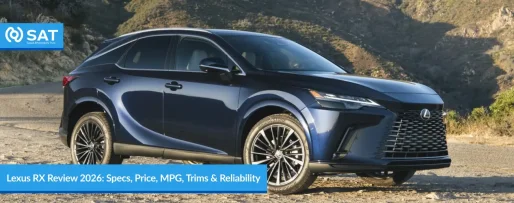
The Lexus RX is a wildly understated choice in a class full of loud German rivals. It is the SUV that effectively created the luxury crossover segment, and it still plays to those founding strengths of silence, smoothness, and visible build quality. Think of it as the well-made watch rather than a flashy one.
It is comfortable, generously well equipped, and genuinely easy to drive, with sharper styling than the slightly dull models that came before. Owners consistently praise the smooth, quiet ride, strong fuel economy, and more comfortable cabin. This Lexus RX review takes an honest look at how it performs, what it costs to operate, and whether it is worth your money.
Short on time? Here is the Lexus RX in five quick lines. Each point captures something that defines this luxury SUV.
Four powertrains, from a 275-hp turbo four to a 366-hp performance hybrid
The 350h hybrid returns 36 mpg combined, exceptional for a midsize luxury SUV
An exceptionally quiet, beautifully built cabin is the RX’s defining strength
Cargo space of 29.6 cubic feet trails most direct rivals, and there is no seven-seat option
Prices run from about $52,775 to $73,410
The Lexus RX 2026 makes several changes, and refines the 2023 redesign to perfect it. The 2026 model specifically adds:
Wireless phone charging, now standard across every model in the range.
A new Appearance Package, available on F Sport Handling and F Sport Performance grades.
A new Premium grade introduced on the RX 450h+ plug-in hybrid.
Seven grades in total: Standard, Premium, Premium+, Luxury, F Sport Handling, F Sport Performance, and F Sport Design.
The Lexus RX specs vary by powertrain. The range runs from an efficient self-charging hybrid to a performance model with nearly 370 horsepower, and every hybrid gets all-wheel drive as standard.
Specification | RX 350 | RX 350h | RX 450h+ | RX 500h |
|---|---|---|---|---|
Engine | 2.4L turbo four | 2.5L four hybrid | 2.5L four plug-in hybrid | 2.4L turbo hybrid |
Horsepower | 275 hp | 246 hp | 304 hp | 366 hp |
Torque | 317 lb-ft | 233 lb-ft | Not published | 406 lb-ft |
Transmission | 8-speed automatic | CVT | CVT | 6-speed automatic |
Drivetrain | FWD or AWD | AWD standard | AWD standard | AWD standard |
0 to 60 mph | About 7.2 sec (AWD) | About 7.4 sec | About 6.2 sec | About 5.9 sec |
Combined mpg | 24 to 25 | 36 | 38 on gas, 85 MPGe | 27 |
Electric range | None | Short bursts only | Up to 38 miles | None |
Fuel capacity | 17.8 gal | 17.2 gal | 14.5 gal | 17.2 gal |
Max towing | 3,500 lbs | 3,500 lbs | 3,500 lbs | 3,500 lbs |
The Lexus RX measures 192.5 x 75.6 x 67.3 inches placing it squarely in the midsize luxury class, large enough to feel substantial and manageable on a day-to-day basis. It seats five passengers across two rows, compared with rivals that offer seven-seater options.
Length: 192.5 inches
Width: 75.6 inches
Height: 67.3 inches
Wheelbase: 112.2 inches
Ground Clearance: About 8.2 inches
Curb Weight: 4,155 lbs (RX 350)
Buyers who find the RX larger than they should opt for its smaller sibling instead, and our complete guide to the Lexus NX vs. Lexus RX reveals all the differences in detail.
For most buyers, the RX 350h hybrid is the one to choose. It delivers 36 mpg combined, standard all-wheel drive, and the same quiet, well-built cabin as every other version, all for a price close to the entry point of the range. Nothing else in the lineup balances cost and running economy as well.
RX 350: Choose it if you want the lowest entry price or prefer a conventional turbocharged engine with a normal automatic gearbox.
RX 350h: The sensible default, and the best all-round buy for the majority of owners.
RX 450h+: Worth it only if you can charge at home, since up to 38 electric miles covers most daily commutes without using fuel.
RX 500h: The quickest at 5.9 seconds to 60 mph, but it costs far more and does not feel meaningfully different to drive.
Premium+ hits the sweet spot across the seven available grades. It adds the comfort and convenience features most owners actually use without the steep jump in price that the Luxury and F Sport grades bring. The full range runs Standard, Premium, Premium+, Luxury, F Sport Handling, F Sport Performance, and F Sport Design.
The F Sport grades are worth considering only if you want the sharper styling and the adaptive suspension, since they do not transform how the car drives. Luxury is the pick if cabin materials matter more to you than the drive, adding the richest trim in the range.
The starting price for the Lexus RX is about $52,775, giving it a significant advantage over its competitors.
RX 350: $52.775
RX 350h: $55,075
RX 450h+ Premium: $66,780
RX 500h F Sport Performance: $68,450
Current pricing on the used market is easy to check.
Expert Tip: The 350h sits at the sweet spot. A hybrid with a sleek look, 36 mpg fuel economy, plus All Wheel Drive, fitted into a neat package that is reasonably priced.
Lexus RX performance heavily depends on the trim you select, but the character remains consistent across all trims. This car is optimized for an effortless experience, rather than a blunt or inconsistent one.
Every hybrid RX is well suited for driving around town. Two decades of hybrid development reflect how unnoticeable the shifts in the system are when shifting from petrol to electric. Of course, all thanks to its superior sound deadening. Also, short electric-only bursts are possible in this self-charging hybrid, and up to 38 miles with the plug-in.
The RX is genuinely excellent for motorway driving, and this is where it makes the most sense. Refinement is superb, the adaptive cruise control works smoothly, and the seats stay comfortable over long distances. Wind and road noise are kept remarkably low, which makes covering big miles feel effortless rather than tiring.
The calm does break a little under hard acceleration. The CVT sends revs soaring on a slip road, and none of the four-cylinder engines sound especially strained while doing so. There is enough punch that the noise does not last long. Though of course, a six-cylinder rival might be more attractive here.
Buyers wanting a sports SUV should look elsewhere. Body control is decent and the steering is accurate, but the powertrains never encourage you to push, and even the 366-hp 500h does not feel different enough from the standard hybrid to justify its premium despite adaptive suspension, rear-wheel steering, and bigger brakes. A sport mode sharpens the responses without changing the fundamental character.
The RX is the cheapest of its main rivals to buy and the most efficient to run, but it trails them on cargo space, driving engagement, and seating flexibility. It competes in one of the toughest classes on the market, where each alternative has a clear strength of its own. The table below shows where the RX stands.
Model | Starting MSRP | Key strength | Where it beats the RX |
|---|---|---|---|
Lexus RX | $52,775 | Quiet cabin, 36 mpg hybrid, reliability | Fuel economy, price, and dependability |
Acura MDX | $53,250 | Three rows of seating as standard | Passenger capacity and value |
Genesis GV80 | $59,195 | Luxury feel for the money | Cabin design and standard equipment |
Volvo XC90 | $62,445 | Safety focus and three-row layout | Practicality and cabin space |
Audi Q7 | $63,395 | Standard third row and interior tech | Seating flexibility and cargo room |
BMW X5 | $69,750 | Six-cylinder power and sharp handling | Driving engagement and engine refinement |
The pattern is clear. If you want driving thrills, the German options are great. If you need a third row, the MDX, Q7, and XC90 have your back. But on price, quietness, and running costs, the RX remains difficult to beat, since it sells at a lower price in comparison to all its competitors.
The Lexus RX is quite practical with its roomy cabin that comes with smart storage, though its trunk capacity remains modest. Also, the driving position is quite easy to get right thanks to the electric adjustment system for both the seat and steering wheel. Storage is optimized as well, with a deep central console, spacious door bins, and lined cubbies that stop items from rattling.
Rear legroom of 37.4 inches is about average for the class, plus the headroom is generous if you ignore the panoramic roof, which is great for views but reduces headroom. Three adults can fit into the back seats, but it's a squeeze because the sloping roof makes the space feel tighter. Child seats are easy to install, thanks to anchor points and wide door openings.
The RX offers 29.6 cubic feet behind the rear seats, expanding to 46.2 cubic feet with the rear seats folded. Both follow closely behind rivals, some of which offer five or more additional cubic feet behind the second row and much more with the seats down.
The floor is low and usable, and the rear seats fold electrically at the touch of a button, but outright capacity is this car's weakest practical point. People looking for more space than the Lexus RX offers should consider the larger Lexus LX, which trades efficiency for genuine three-row space.
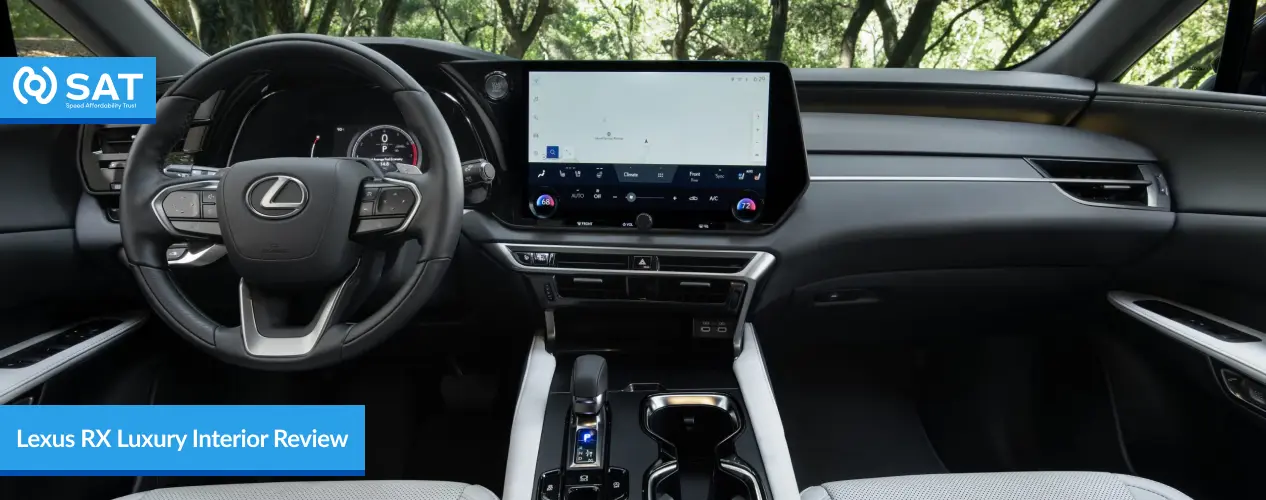
This is where the RX justifies its badge. Material quality is excellent throughout, including the lower cabin areas where rivals typically use scratchy plastics. Entry cars get synthetic leather, higher trims move to proper leather, and the top trim adds real wood inlays and a suede-like headliner.
The seats are the standout, offering tremendous adjustment and enough comfort for genuinely long journeys, though some passengers find them firm. Ambient lighting, a wireless charging pad, heated and ventilated seats feature on higher trims, and the overall effect is calm and expensive rather than showy.
The RX comes with a standard 9.8 inch screen-inch with two physical climate dials, which is quite nice. The higher trims get an upgrade of a 14-inch touchscreen with bright and responsive displays, and it includes wireless smartphone connectivity and multiple USB-C ports.
The interface itself is frustrating. Menus sit far from the driver, so reaching across while driving is awkward, and simple actions take too many taps. The unmarked steering wheel controls add to this, since you must hover a finger and read the head-up display to know what you are about to change.
Expert Tip: Pair your phone on day one and use CarPlay or Android Auto for navigation. The built-in system is the cabin's weakest element, and some connected features require a subscription once the initial period ends.
The RX 350h returns an excellent 36 mpg combined, while the standard RX 350 manages 24-25 mpg. That gap is the single strongest argument for the hybrid. It is rated at 38 mpg city and 34 mpg highway, and testers regularly record real-world figures close to those numbers, with Lexus hybrids often beating their quoted in-town economy.
Fuel economy at a glance:
RX 350: 25 mpg combined with front-wheel drive, 24 mpg with all-wheel drive.
RX 350h: 36 mpg combined, the efficiency leader of the range.
RX 500h: 27 mpg combined, modest given its hybrid badge, and nearer 25 in testing.
RX 450h+: about 85 MPGe, with roughly 35 mpg once the battery is depleted.
The plug-in quite literally rewards discipline. Charge it regularly on a home wallbox, which takes under three hours, and many drivers will rarely touch the petrol engine on a daily commute. Neglect the charging, and you’ll burn through your petrol faster.
Yes, comfort is the RX's core strength, with a smooth ride and outstanding noise cancellation. The suspension absorbs big bumps and shrugs off minor imperfections, which is impressive given that some versions run on 21-inch wheels. Wind and road noise are kept remarkably low. This is a car built for comfort, with no rushing, and it delivers that better than most rivals at any price.
Yes, the Lexus RX proves that safety is its genuine strength. The RX comes standard with a comprehensive suite of driver aids and performs strongly in independent crash testing, earning five stars in side-impact tests and four stars in frontal and rollover assessments, according to NHTSA safety ratings.
Standard safety equipment includes:
Pre-collision warning with pedestrian detection.
Lane departure warning, lane-keeping assist, and sway warning.
Adaptive cruise control and adaptive high beam.
Blind-spot monitoring with rear cross-traffic alert and braking.
Road sign assist, parking sensors, and safe exit assist for the electronic doors.
Safety equipment and ratings vary by trim and model year. Verify what is fitted on the specific vehicle.
Lexus RX reliability is among the strongest arguments for buying one. Lexus has a long-standing reputation for dependability, and the RX has been one of its most consistently reliable models for decades. Its hybrid technology is well-proven, refined over many generations rather than newly introduced, and the model has had very few recalls throughout its history.
Warranty coverage is competitive without being the class leader. The RX carries a 4-year or 50,000-mile basic warranty and a 6-year or 70,000-mile powertrain warranty, with the hybrid battery covered for 10 years or 150,000 miles. Sharing many components with mainstream models also tends to keep servicing costs below those of European alternatives.
Definitely yes, since its depreciation does the hard work for you while its reliability record stays intact. A well-kept model offers most of the new-car experience for considerably less money.
Run through this checklist before you buy:
Confirm a full service history, ideally with hybrid system inspections completed.
Check the hybrid battery health report and the remaining warranty coverage.
Verify which connected features are still active, since some expire after a set period.
Inspect the large alloy wheels and tires, as 21-inch replacements are expensive.
Test every screen function and check that the electric-folding rear seats operate correctly.
Ready to put that checklist to use? The Lexus RX models at SAT Japan have been inspected, with condition reports available for each. Take a look at the service history and mileage on a few before narrowing down your shortlist.
Here is a quick list of pros and cons, drawn from expert road tests and owner feedback. Weigh these trade-offs against how you actually plan to use the car day-to-day.
Pros | Cons |
+ Quiet, comfortable, sleek cabin finish | - Less cargo space in comparison to competitors |
+ Outstanding 36mpg economy | - No seven-seat trim |
+ Strong reliability and proven hybrid tech | - Not engaging to drive even in 500h |
+ Competitive starting price | - Infotainment is a bit clunky and complex |
+ Four powertrains, including a plug-in hybrid | - Four-cylinder engines become strained under hard acceleration |
+ Comfortable, even on larger wheels | - 500h costs more, but isn’t much different |
+ Generous standard safety and equipment levels | - Optional panoramic roof reduces rear headroom |
Whether you choose the standard hybrid or the plug-in, where you make your purchase matters just as much as what you buy. With SAT Japan, this process is straightforward, with the website displaying transparent condition reports and well-inspected vehicles. Take a look at our available stock for Lexus, and reach out whenever the time feels right.
This Lexus RX review leaves the RX with a strong recommendation, though for a specific kind of buyer. Its biggest strengths are cabin quality, quietness, and the 350h hybrid's remarkable 36 mpg economy, all backed by a dependable long-term reputation.
Its biggest weaknesses are modest cargo space, an awkward infotainment interface, and a driving experience that stays comfortable rather than engaging.
The 350h is the version most buyers should choose, pairing the full luxury experience with the best efficiency and standard all-wheel drive. The 500h adds pace, but not character, and the plug-in suits those who can charge at home regularly. If you want a quiet, luxury SUV that will not let you down, the RX remains one of the safest bets in its class.

The BMW X3 makes more sense for most buyers in 2026, but the Audi Q5 has a few strong reasons to choose it instead. The Audi is slightly quicker in standard form, offers a sliding second-row bench, and puts more emphasis on comfort and cabin refinement. The BMW fights back with a lower starting price, much better fuel economy, more cargo space, and a better driving experience. This Audi Q5 vs BMW X3 comparison is close, but the differences become much clearer once you look past the badges.
Better all-round choice: BMW X3. It costs less to start, uses less fuel, carries more cargo, and still drives very well.
Better value at base price: BMW X3. The X3 30 xDrive starts at $51,300, while the Audi Q5 starts at $52,800 before destination charges.
Better standard performance: Audi Q5. Its 268-hp engine is stronger on paper, and Audi claims a quicker 5.8-second 0-60 mph time.
Better fuel economy: BMW X3. The X3 30 xDrive is rated at 27 mpg city and 33 mpg highway, well ahead of the Q5.
Better for comfort: Audi Q5. Its softer road manners, quiet highway behavior, and adjustable rear bench make it easier to relax in.
Better for luggage and family gear: BMW X3. It has 31.5 cu. ft. behind the rear seats compared with 27.6 cu. ft. in the Q5.
The Audi Q5 vs BMW X3 specs show two SUVs that look similar in size and power, but they are for two different buyers.
Specification | 2026 Audi Q5 | 2026 BMW X3 30 xDrive | Edge |
Starting MSRP | $52,800 | $51,300 | BMW |
Engine | 2.0L turbo 4-cylinder | 2.0L turbo 4-cylinder with 48V mild hybrid | BMW |
Horsepower | 268 hp | 255 hp | Audi |
Torque | 295 lb-ft | 295 lb-ft | Tie |
Transmission | 7-speed S tronic dual-clutch | 8-speed automatic | Depends on preference |
Drivetrain | quattro AWD | xDrive AWD | Tie |
0-60 mph | 5.8 sec, manufacturer claim | 6.0 sec, manufacturer claim | Audi |
City fuel economy | 21 mpg | 27 mpg | BMW |
Highway fuel economy | 29 mpg | 33 mpg | BMW |
Length | 185.7 in | 187.2 in | BMW is larger |
Width | 74.8 in | 75.6 in | BMW is wider |
Wheelbase | 110.9 in | 112.8 in | BMW |
Cargo behind rear seats | 27.6 cu. ft. | 31.5 cu. ft. | BMW |
Maximum cargo space | 56.9 cu. ft. | 67.1 cu. ft. | BMW |
Turning circle | 38.7 ft | 40.0 ft | Audi |
New vehicle warranty | 4 yr/50,000 mi | 4 yr/50,000 mi | Tie |
Included scheduled maintenance | 3 yr/30,000 mi | 3 yr/36,000 mi | BMW |
The table gives BMW more wins, but that doesn't make the Q5 the wrong choice. Audi's advantages are more evident in how the SUV feels day-to-day.
If you're still deciding between the two brands, our broader Audi vs BMW comparison looks at how they compare across performance, comfort, technology, and ownership.
The Audi Q5 vs BMW X3 price difference is minor. The BMW X3 30 xDrive begins at $51,300, while the 2026 Audi Q5 starts at $52,800. That puts the BMW ahead by $1,500 before destination charges and options.
Neither is cheap, of course. These are compact luxury SUVs, and the final price can rise quickly once larger wheels, driver-assistance packages, premium sound systems, or appearance packages are added to your receipt.
Both can become expensive, but Audi's trim and package ladder can push the Q5 well into the $60,000 range.
Audi's own U.S. site shows a 2026 Q5 Prestige with the S line black optic package at $63,495 before destination. BMW lists the much more powerful X3 M50 xDrive at $66,500, though that is a different performance model rather than simply an optioned X3 30. The smarter move with either SUV is to choose the one that meets your needs.
Expert Tip: Don't spend thousands on a larger wheel package just for the look. Bigger wheels can cost more to replace and may also make the ride firmer.
For most drivers, the BMW X3 is the more interesting SUV to drive. The Audi Q5 is the easier one to relax in. That is the main Audi Q5 vs BMW X3 performance split.
The Q5 gets a 268-hp 2.0-liter turbo four-cylinder with 295 lb-ft of torque. Audi quotes 5.8 seconds from 0-60 mph.
On the other hand, the X3 30 xDrive uses a 255-hp 2.0-liter turbo four-cylinder with 48-volt mild-hybrid technology. Torque is also 295 lb-ft, and BMW quotes 6.0 seconds to 60 mph.
Clear Winner: Audi wins the numbers.
The gap is only two-tenths of a second, though. That is not enough to make the X3 feel slow. Independent testing of the current-generation models recorded 5.8 seconds for the Q5 and 6.2 seconds for the X3 30 xDrive.
This is where the personalities separate. The X3 has stronger steering weight and responds more eagerly when the road starts to bend. Some buyers praised its balance between ride and handling, although the X3 can still feel firm over rough surfaces.
The Q5 is less interested in pretending to be a sports car. Its steering has been criticized for lacking feel, but the ride is comfortable, and the cabin stays calm at speed.
Here’s our take: BMW is for the driver. Audi is for the passenger. That is the simple version.
For a deeper look at the BMW on its own, read our full 2026 BMW X3 review, including its specs, features, pricing, and performance.
The BMW wins the Audi Q5 vs BMW X3 fuel economy comparison by a clear margin. The X3 30 xDrive is rated at 27 mpg city and 33 mpg highway.
Audi lists the 2026 Q5 at 21 mpg city and 29 mpg highway in its current U.S. technical information.
The BMW X3 should use less fuel, especially for drivers covering a lot of miles. Its advantage is greatest around town, where the mild-hybrid system and efficient four-cylinder powertrain help the X3 stretch a gallon further.
A driver doing only a few thousand miles per year may not care. A 15,000-mile-a-year commuter probably will. Fuel prices change. The MPG difference does not.
The Audi wins here, although neither cabin is perfect. The Audi Q5 vs BMW X3 interior battle has also changed because both brands now rely heavily on screens.
Both SUVs provide supportive front seats and plenty of adjustment.
The X3 comes with power-sport seats, while the Q5 offers a comfortable driving position with good adjustability. Neither has a clear space problem for front passengers. For a long trip, the Q5's calmer ride gives it a small advantage.
This one is more interesting than the exterior size suggests. The Q5 offers about 38.0 inches of rear legroom, while published specifications for the X3 list 36.3 inches.
Audi also fits a rear bench that can slide by about four inches and change its backrest angle. Push it back when people need more room. Move it forward when luggage matters more. That flexibility is genuinely useful.
Audi's cabin has a cleaner, more luxurious feel, but the latest Q5 is also much more screen-heavy than older versions.
The X3 is more controversial. Some buyers liked the quality of its screens but criticized the dashboard materials and illuminated plastic trim for feeling cheaper than expected for this price. Audi has not escaped criticism either. Independent reviewers have said the latest Q5's materials are less special than buyers may expect from the badge.
Neither car has a perfect cabin. Audi gets the edge, but only just.
To see BMW's approach higher up its luxury range, take a look at our BMW 7 Series guide.
The BMW X3 is the more useful cargo carrier. The Audi Q5 is cleverer with passenger space.
Almost, but the BMW is slightly bigger.
The X3 measures 187.2 inches long and 75.6 inches wide. The Q5 is 185.7 inches long and 74.8 inches wide. The BMW's wheelbase is also longer at 112.8 inches compared with 110.9 inches for the Audi.
These are small differences on a driveway. They matter more once you start driving them.
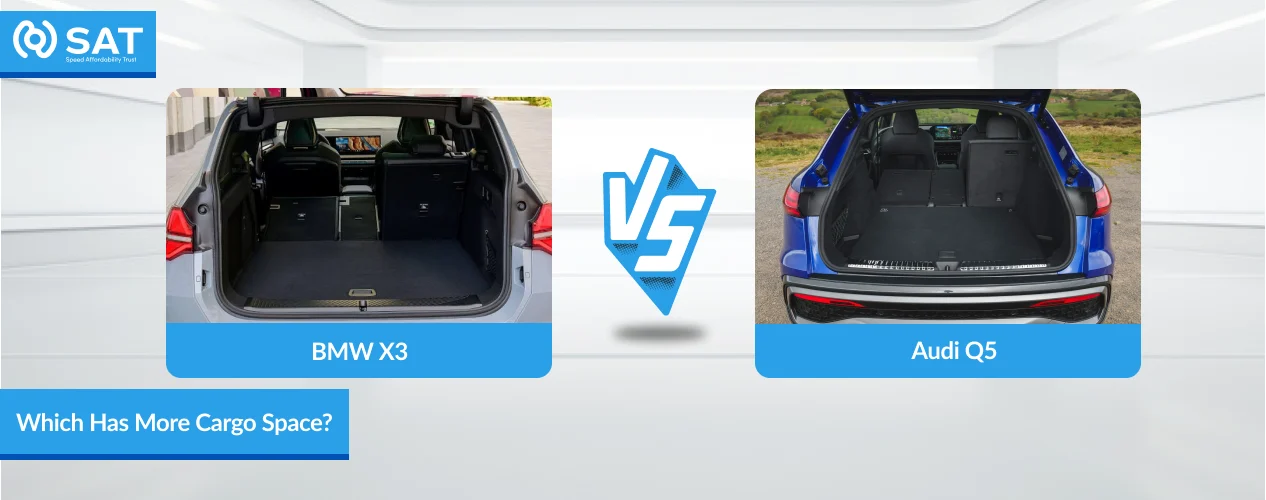
The BMW X3 wins easily.
It provides 31.5 cu. ft. behind the rear seats and 67.1 cu. ft. with them folded. The Audi Q5 provides 27.6 cu. ft. behind the rear seats and 56.9 cu. ft. with them folded.
That is nearly 10 extra cubic feet for the BMW with the seats down. For suitcases, sports equipment, moving boxes, or a big stroller, that extra room can be more useful than another luxury feature.
The Audi Q5 has the advantage if you plan to tow. The Audi Q5 has the advantage if you plan to tow. It can tow up to 4,400 pounds when properly equipped, compared with up to 4,001 pounds for the BMW X3 30 xDrive with the factory-installed trailer hitch.
The BMW X3 is the better family SUV if cargo space is the priority.
The Audi fights back with its sliding rear seat. A family carrying older children or adults in the second row may prefer that flexibility.
For everyday usability, the Audi gets our vote in this round. Mainly because Audi listened to criticism and brought back a proper steering-wheel scroll control for 2026.
The Q5 uses an 11.9-inch digital instrument display and a 14.5-inch central MMI touchscreen. A 10.9-inch passenger screen is available.
The X3's curved display combines a 12.3-inch instrument screen with a 14.9-inch touchscreen running BMW Operating System 9.
BMW gives you slightly more central-screen area. That does not automatically make it easier to use.
Both support Apple CarPlay and Android Auto.
Audi provides wireless smartphone integration and has expanded how phone navigation, media, and calls appear across its displays for 2026. BMW also supports smartphone apps via Apple CarPlay and Android Auto, as well as voice control and remote software updates.
Nobody needs to choose between these SUVs because of CarPlay.
We give the Audi system a small edge for everyday use in 2026. Audi redesigned the MMI interface and returned the steering-wheel scroll wheel after criticism of touch-sensitive controls. That sounds small until you use the same control every day.
BMW's system looks sharp, but too many basic controls still live inside the touchscreen. Independent testing has also criticized some menu structures as needlessly complicated.
Both SUVs offer a strong range of driver-assistance technology. The BMW X3 comes standard with features including Active Blind Spot Detection, Lane Departure Warning, Frontal Collision Warning with City Collision Mitigation, Active Protection, and Active Driving Assistant.
The Audi Q5 also offers advanced assistance systems, including available adaptive cruise assist with lane guidance and a top-view camera system.
Both provide useful safety technology, so crash-test results are the better place to look if you want to separate them further.
There is not enough long-term 2026 data to honestly declare either SUV more reliable. That matters because the current X3 generation only arrived for the 2025 model year, and the current U.S. Q5 generation is also still new.
Any firm 2026 Audi Q5 vs BMW X3 reliability winner would be guesswork.
Audi gives the Q5 a 4-year/50,000-mile New Vehicle Limited Warranty. Roadside assistance is also included for four years.
For 2026, Audi now includes Signature Care scheduled maintenance for the first 3 years or 30,000 miles. That removes some routine service costs early in ownership.
BMW provides the X3 with a 4-year or 50,000-mile new-vehicle warranty. BMW Ultimate Care covers scheduled maintenance for 3 years or 36,000 miles.
That gives the BMW 6,000 more miles of included scheduled-maintenance coverage than the Audi.
Again, warranty and free maintenance are not the same thing as long-term reliability.
Warranty coverage is basically a tie. BMW wins the included-maintenance comparison because its mileage limit is higher.
Once both SUVs are outside warranty, service history becomes far more important. These are complex, turbocharged luxury SUVs with all-wheel drive and extensive electronics.
Expert Tip: If you're buying used, a complete service record is worth more than a slightly lower asking price. Check recall work, software updates, fluid leaks, warning lights, tires, brakes, and the condition of every electronic feature before buying.
If you're shopping pre-owned, you can compare current used BMW cars for sale and used Audi cars for sale before deciding which brand offers better value.
Numbers decide plenty in this comparison. They do not decide everything.
The Audi Q5 should be slightly easier to place in tight spaces. It is shorter and narrower than the X3 and has a tighter 38.7-foot turning circle, compared with 40.0 feet for the BMW. The difference is not huge, but city drivers may notice it in narrow garages and tight parking lots.
Both SUVs are well isolated at highway speeds. Independent testing measured the Q5 at 67 dBA during a 70-mph cruise, while separate testing of the X3 recorded 64.9 dB at the same speed.
Because those results came from different tests, they should not be treated as a direct head-to-head comparison. The bigger difference is character. The Q5 feels more focused on relaxed cruising, while the X3 combines good refinement with a more driver-focused feel.
Audi Q5 | |
Pros | Quicker standard acceleration, comfortable ride, quiet cabin, flexible sliding rear seat, smaller turning circle |
Cons | Higher base price, much weaker fuel economy, less cargo space, steering gives less feedback |
BMW X3 | |
Pros | Lower starting price, excellent fuel economy, larger cargo area, better steering, longer included maintenance mileage |
Cons | Firmer ride, less quoted rear legroom, screen-heavy controls, some cabin materials feel cheaper than expected |
Buy the Audi Q5 if comfort matters more to you than maximum practicality.
It suits buyers who want a quiet daily SUV, regularly carry adults in the back, drive in tight urban areas, and prefer a calmer feel behind the wheel. The sliding rear bench is a small feature with a real benefit. So is the tighter turning circle. There is also more standard horsepower than in the X3 30 xDrive.
If you don't need SUV space, our 2026 Audi A5 review covers another Audi option worth considering.
Skip the Q5 if fuel economy and cargo space sit near the top of your list. The BMW beats it clearly in both.
Buy the BMW X3 if you want the stronger all-rounder. It starts for less, uses less fuel, gives you more luggage space, and feels more interested in what the driver is doing. That combination is difficult for the Audi to beat.
The X3 makes particular sense for families carrying lots of gear, commuters covering high mileage, and buyers who still want some driving enjoyment from a compact luxury SUV.
Skip it if your roads are rough and ride softness matters more than steering feel.
If you're exploring more of the BMW range before deciding, you can also read our BMW 6 Series guide.
If you are ready to compare available options, SAT Japan makes it easy to browse both models in one place. Check the latest Audi Q5 cars for sale or explore available BMW X3 cars for sale to compare prices, model years, mileage, and specifications before making your choice.
The BMW X3 wins the Audi Q5 vs BMW X3 comparison for 2026. Not because it dominates every category. It doesn't.
The Audi Q5 is quicker, quieter, slightly easier to park, and more comfortable. Its sliding rear seat also makes the cabin unusually flexible.
If neither gives you enough room, our Audi Q7 vs Q8 comparison looks at Audi's larger SUV options.
But the X3 wins more of the differences that cost owners money or affect everyday use. It starts $1,500 lower, gets far better fuel economy, carries more luggage, and still has the better chassis.
For most buyers, the BMW X3 30 xDrive is the smarter choice.
Choose the Audi Q5 instead if comfort, rear-seat flexibility, and a calmer driving character matter more to you than fuel economy and cargo volume.
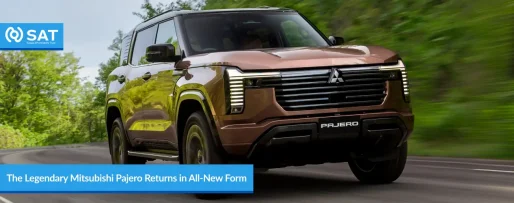
Mitsubishi Motors has reinvented the Pajero in a new iteration of its flagship 4WD SUV, equipped with the 2.4-litre diesel engine and advanced four-wheel drive systems, but with a greater emphasis on comfort.
The new Mitsubishi Pajero is based on three concepts: Confidence, Comfort, and Prestige. Confidence is the SUV's off-road performance and reliability, while Comfort is about how the SUV treats its passengers and how it drives. Prestige represents a step up in level of quality for a new flagship model.
The all-new Pajero made its world debut in Tokyo on September 2. Thailand will be the first market, followed by Japan and Australia during FY2026. Mitsubishi plans to expand the model to about 100 countries from fiscal 2027.
The new Pajero has the traditional formula that made it popular, but Mitsubishi has shifted the balance between toughness and comfort. One major milestone for the new SUV was the company's commitment to “off-road comfort.” Its aim was to keep its ability on rough roads, but also to make it more comfortable for the passengers.
The new Pajero inherits the traditional recipe that made the brand popular, and even revised the ratio of toughness and comfort. Off-road comfort was an important milestone for development, the company claims. This implies that the Pajero was not designed to withstand rough going. Mitsubishi also desired passengers to be comfortable when the road gets rough.
For this, the company strengthened the body mounts to reduce unwanted vibration. The ladder frame is also made of more high tensile steel and larger frame sections, which enhance the torsional and bending rigidity.
The Pajero's ladder frame is based on the Triton architecture, with model-specific development for the cabin and suspension. That's an important detail for buyers considering Pajero stock, as the new SUV is not simply a Triton underneath an SUV body.
The new Pajero also has a bigger role inside Mitsubishi. The company claims it is the first model to make its "Mid- to Long-Term Vision" for the 2030s a reality.
This means the Pajero is more than just a re-branded nameplate. It is being marketed as a standout for the rest of the brand, and will form the basis for the next generation of Mitsubishi's SUVs, representing the brand's ideas on capability, comfort and premium quality.
A special 2.4-litre clean-diesel engine with a wide-range single variable-geometry turbocharger is used in the Pajero. It produces up to 480Nm of torque and is paired with a newly developed eight-speed automatic transmission with Sport mode. According to Mitsubishi, the engine, transmission and air conditioning system are designed to deliver responsive acceleration from low speeds up to the highway.
Mitsubishi have not specified a maximum HP in the primary, worldwide launch statement. Some specifications may also differ according to market so the confirmed 480Nm peak torque is the safer headline figure for now.
The Pajero uses a double-wishbone independent suspension at the front and a five-link rigid axle at the rear. That combination is important. The front suspension helps provide natural steering and road manners, while the rigid rear axle supports the SUV's off-road requirements and helps keep the wheels following uneven terrain.
Mitsubishi combines the 52:48 distribution with its suspension tuning to support vehicle balance. The Pajero has 230mm of ground clearance, a 30.4-degree approach angle, 22.6-degree breakover angle and 25.8-degree departure angle.
These are not just brochure numbers. They determine how easily the SUV can clear an obstacle before its body or underbody becomes the limiting factor.
Mitsubishi has retained its Super Select 4WD-II system, with 2H, 4H, 4HLc and 4LLc settings. 4LLc engages the low-range gearing with the center differential locked. That provides the driver with more control when driving at low speed on challenging surfaces.
Super-All-Wheel Control (S-AWC) has been added to the system. It combines Active Yaw Control, Active Stability and Traction Control, and ABS to control forces at all four wheels during cornering, acceleration, and braking.
The vehicle can be adjusted for different surfaces with 7 operating modes: Normal, Eco, Gravel, Snow, Mud, Sand, and Rock.
A real-time view around a vehicle is generated from four cameras, and based on a 3D model. The system also has a forward underfloor view that shows terrain that is normally hidden from the driver's view when the vehicle is running on the road, but essential when the vehicle is off the road.
The view automatically appears when 4HLc or 4LLc is selected. It can also be turned on by hand so that the driver can inspect rocks, ruts and steep terrain first before driving on.
Mitsubishi has also reintroduced the Pajero's famed multi-gauge idea in digital format. The new Multi Meter can display altitude, compass heading, outside temperature, vehicle pitch and roll angles, and AYC control status.
That information will provide the driver with a better understanding of the vehicle's position and behavior on challenging terrain. It is a modern interpretation of a feature that helped define the Pajero's adventure-focused character.
The Pajero features a three-row, seven-seat cabin, offering ample space for larger families and groups. The second row has a 150mm sliding range, offering greater flexibility in passenger and cargo space.
The high-end version follows with a 12-speaker Dynamic Sound Yamaha Ultimate system and dual amplifiers. Noise compensation modifies the vehicle's sound to ensure consistent sound quality regardless of changes in road noise levels.
The new Pajero also features a wider range of safety and driver-assistance equipment. Mitsubishi has fitted the SUV with Forward Collision Mitigation, Predictive Forward Collision Warning, Emergency Assist for Pedal Misapplication, Emergency Lane Assist and Front Cross Traffic Alert.
At intersections, the junction assist system provides assistance, and the Forward Collision Mitigation system can detect pedestrians, cyclists and motorcyclists. Emergency Lane Assist identifies lane markings and other vehicles in front of the car using a forward camera and radar to warn the driver and offers steering support in case of potential lane departure.
The SUV is also equipped with Mitsubishi's highway single-lane driving assistance system, called MI-PILOT. It combines Adaptive Cruise Control and Lane Keep Assist to maintain a specific following distance and center the car in its lane on highways, alleviating driver workload in long-distance driving.
Mitsubishi has also installed eight airbags in the Pajero, including the first SRS center airbag. The purpose of the center airbag is to decrease the chance of injury to front occupants due to contact during a side impact.
For the new Pajero, the mechanical strength of its ladder-frame chassis and four-wheel-drive systems is complemented by these safety systems to ensure a more comprehensive safety package.
The name Pajero first appeared in 1982 and was strongly linked to serious off-road driving. Mitsubishi claims that the car has been sold in over 170 countries and regions, and that over 3.29 million units have been produced across the first four generations.
In some markets, the Pajero nameplate has been sold under the Montero name. The fifth-generation Pajero thus comes back with more than just a name. The mechanical mix that Mitsubishi has maintained is what you'd expect in an off-road-capable vehicle, but one of the biggest hurdles for an off-road-capable SUV has been making serious off-road equipment comfortable enough for day-to-day driving.
The Pajero's return also gives Mitsubishi the name it once had in the Japanese market. SAT Japan lists Mitsubishi vehicles among its available stock for international buyers.
The combination of capability and comfort with new driver-assistance and digital technology is now the core of the Pajero's comeback.
_1733298329.webp)
The Hyundai Palisade has been one of the most favored family cars in the petrol-head community. The Palisade has been known to blend style, efficiency, agility, and performance, all in one car. Coming in 7 different trims, with 4 diverse driving modes, this vehicle holds the solutions to all your adventure troubles, with a comfortable cabin, ample cargo space, and an innovative infotainment system. Moving into 2025, the 2025 Hyundai Palisade is introduced with some fresh updates making the SUV even more favorable for drivers.
Written below are all the incoming updates and changes to the 2025 Hyundai Palisade.
The 2025 Hyundai Palisade has a 3.8 Liter V6 engine that is paired with an 8 speed automatic transmission which delivers an output of 291 horsepower. This vehicle’s powertrain also features a manual control option for the transmission to give the driver more control. All trims come with a front-wheel drive, with an optional all-wheel drive upgrade to kick things up a notch.
The 2025 Hyundai Palisade’s 0-60 miles per hour driving time was tested to be 6.4 seconds, which is impressive for an SUV its size. Additionally, the front wheel drive Palisade has a fuel-economy of 19 mpg in the city and 26 mpg on the highway.
This three-row SUV is one of the most stylish of its kind; with a bold cascading grille, flanked by powerful and elongated LED lights, and sharp lines throughout the exterior for aerodynamic manipulation. The Palisade has a muscular stance giving it a sporty and intimidating look. The Palisade also comes with convenient exterior features such as a power liftgate, additional roof rails, folding third-row seats, and a panoramic sunroof.
The 2025 Hyundai Palisade has an opulent interior with a spacious cabin lined with the finest materials. The interior has a 12.3-inch touchscreen display featuring a dynamic digital cluster, Android Auto, Apple CarPlay, a premium sound system, dual Bluetooth connectivity, and an innovative remote controlling feature by the Hyundai Blue Link app, which gives you lock control from a distance.
The new model of the 2025 Hyundai Palisade has a starting price of $38,215 and it goes all the way up to the highest trim costing $55,515. The base trim, the SE model costs $38, 215; the second SEL model costs $40,965. The XRT trim comes in at about $44,065 while the SEL Premium trim costs $45,565. The Limited trim of the 2025 Hyundai Palisade costs $49,615 and the Caligraphy model costs $52,015. Last but certainly not least, the Calligraphy Night Edition of the Hyundai Palisade costs $55,515.
The 2025 Hyundai Palisade will be featuring 4 diverse driving modes including comfort, Eco, Sport, and Smart driving modes for an optimized and engaging drive:
Comfort: The comfort mode is set to deliver a seamless and smooth driving experience. The suspension and transmission are tuned for daily commuting driving.
Eco: The Eco mode in the 2025 Hyundai Palisade prioritizes the engine’s fuel efficiency, This mode may not deliver the most powerful performance, but the powertrain is adjusted to consume the least amount of gasoline for the more long-lasting output. This keeps the fuel economy high and decreases fuel costs.
Sport: The Sport mode focuses primarily on the speed and performance of the 2025 Hyundai Palisade. The steering and powertrain are tuned to create the maximum output while maintaining the vehicle’s agility.
Smart: The Smart driving mode is an intuitional setting that analyzes your driving style and switches the driving mode accordingly, giving you maneuverability and balance. This driving mode essentially also helps in fuel efficiency.
In comparison to other latest models, the 2025 Hyundai Palisade is relatively more affordable to maintain. The annual repair and maintenance cost for this vehicle begins at $352 and rises every year because of depreciation and can reach up to $739 in the first five years after purchase. Additionally, with high fuel efficiency, annual fuel costs are calculated to be up to $2,380 per year. All-in-all, you can rest assured that the 2025 Hyundai Palisade has a low maintenance and upkeep cost. Here are some factors contributing to this:
Hyundai Durability: Hyundai, like most other Japanese automakers, has a business model of constant improvement and innovation. These vehicles are engineered to be optimized for long-term usage. This rhombus engineering keeps your 2025 Hyundai Palisade away from the mechanic for a long while.
Expected Maintainance: You can rest assured that even if you were to take your Palisade to the mechanic, it would be out of routine, rather than from an unexpected mechanical breakdown. Routine check-ups such as oil changes and tuning will help maintain the longevity of your vehicle.
Visit Now 2025 Hyundai Elantra.
SAT Japan is the ultimate destination for those searching for well-maintained and certified Used Cars for Sale. We offer impressive deals on a wide range of luxury and economy vehicles. Our expert staff on board is dedicated to your ease and our customer-centric services will make the entire process unbelievably simpler. Our convenient services such as our insurance services, 24-month installment payment plan, and doorstep delivery, keep our customers stress-free. We recognize our responsibility to present the best course of action according to your preferences.
Although there are no revolutionary switch-ups in the design or performance of the 2025 Hyundai Palisade, it is one of the most reliable upcoming full-size SUVs in the automotive market. It is no easy feat searching through the endless sea of options to reach a final decision. Our expert staff and customer-centric services at SAT Japan help you make the right decision at every step of the purchasing process. Hence, SAT Japan is the ultimate car enthusiast website where you can find a plethora of well-maintained options for your potential next ride. Head on over to SAT Japan’s website and scroll through our vast inventory to find the perfect Hyundai car for you.

The modern cars coming in the market are capable of remarkable speeds and give you a highly smooth and comfortable experience. The latest cars are also much safer and come up with advanced and autonomous systems that can stop and steer the vehicle for you in an emergency. However, all the safety and advanced features will not do anything if you have bad tires. For example, inside tire wear is an issue that can affect the tires of many cars rolling on the road. It is not just about purchasing low-quality tires; it is also about not ensuring their proper maintenance.
Tire wear is a common problem that can affect your vehicle’s handling, safety, and performance. Although inner tire wear might seem harmless, it can lead to various serious issues, including reduced traction, poor steering response, and even blowouts.
But why do tires wear out from the inside, and how can you prevent it?
By understanding the factors that contribute to inner tire wear, you can increase the life of your tires and keep them performing at their best.
There are several reasons why your tire can wear from the inside. Below we discuss some of the reasons in detail.
Misaligned wheels can lead to irregular tire wear. When the bottom part of the tire is leaning towards the outside, it is called a negative camber. Positive camber is when the top part of the tire is leaning towards the outside.
When there is improper alignment in the tires, the inner part of the tire makes more contact with the road surface. Because of that, you might observe the inside of the front tires wearing down.
Poor wheel alignment can also mess up your camber. You can verify this by cruising on a flat section of asphalt. If your vehicle is not moving straight even after pointing the wheels at a 12 o’clock position, it means your wheels are not aligned properly.
Driving your vehicle aggressively puts a lot of stress on your tires. It can also overheat various components of the tires and wear the thread at a faster pace because of abrasion. Aggressive riding includes running your vehicle at maximum acceleration, hard cornering, and pushing brakes for prolonged periods. Tire wire showing is an indication of your tires being severely damaged.
It is essential to note that, unlike race cars, standard vehicles are not designed to be driven aggressively all the time. The tires in race cars are specifically designed to give maximum gain and resolve steering on the road. However, other tires cannot keep up with constant beating from drifting and fast driving.
For more insights into premium tire options, check out our detailed comparison: Bridgestone vs. Michelin Tires.
The suspension components of a vehicle are designed to not only absorb road shocks and vibration but also to make sure that the vehicle’s shock ride height remains the same. It is important because camber angles are directly affected by it, and it can increase inside tire wear.
Suspension components such as springs can sag through regular use. Faulty or defective springs fail to absorb shocks and vibrations, which can damage other suspension components of the vehicle as well.
Also, the defective spring can lower the vehicle’s stock ride height, which can change the camber angles.
These components are made of rubber or elastomer and serve to link the chassis and steering knuckles. These bushings eliminate excess free movement within the vehicle, which can have a negative effect on camber angles. As a result of frequent use, the control arm bushing wears down gradually, leading to increased movement and more tire wear on the inside.
It is crucial to fix the inner tire wear to avoid further damage to the vehicle’s components, such as ball joints and springs, and ensure more safety.
Get your wheel balanced after every one or two years. If you have installed new tires in the vehicle, you should get them balanced immediately to protect them from wearing out.
If you notice uneven tire wear, check your suspension system. Damage to the suspension system can accelerate the inner tire wear, resulting in future problems such as a decrease in vehicle speed and expensive repairs.
Innerwear on tires occurs when the driver does not maintain their tires regularly. Just like your vehicle, your tires require extra care to give you a safe ride.
Regularly check the tire pressure of your vehicle. It is an important practice because understated tires can cause the sidewall to flex, which can lead to instability at higher speeds. Also, underinflation can cause other problems, including cracked rubber, tread separation, bulges, and more. If the tires are overinflated, they can bulge in the center, causing increased wear in that area.
Therefore, it is preferable to check the tire pressure once every month, especially after large temperature changes.
If you notice damage on any of the suspension components, it is important to get your vehicle inspected by a professional mechanic. Doing that will resolve the issue and your car will also stay safe.
Tire wearing on the inside can also occur as a result of overloading. It is important to adhere to the vehicle weight limits mentioned by the manufacturers. Overloading includes passing extra passengers, carrying excessive cargo, or towing large tailors, which can put stress on the components of the tire.
Tires wearing on the outside and inside can seriously affect the handling and safety of your vehicle. You can avoid internal tire damage with a routine inspection of your suspension system and alignment and by taking proper care of your tire. It is also important to get your vehicle inspected by a professional mechanic every once in a while.

There are a lot of parts that go into making your vehicle run fast and look its best. The engineers have spent years and years tuning car emission systems to personalize the sound a vehicle makes when it’s on the road. However, when it comes to riding, not everyone wants to have a quiet ride, and for that, you can modify your vehicle’s straight pipe exhaust system and alter the sound your engine produces.
A very exciting modification for car owners currently is the straight exhaust system, particularly for people who want to improve the performance of their ride. One reason car owners choose it is its greater functionality in compression compared to stock exhaust. The reduced backpressure supports greater functionality, resulting in increased engine performance.
If you are wondering if a straight-pipe exhaust system is right for you, keep reading to learn the pros and cons of installing one in your vehicle.
Straight pipe exhaust is becoming one of the most common modifications among car fans who enjoy the roar of their engine along with the additional power of their vehicles. Unlike standard exhaust systems, straight-pipe exhaust systems do not have a resonator, muffler, or catalytic converter. You can witness this type of exhaust in racing cars and other high-performance vehicles.
The exhaust system allows the fumes to flow freely from the engine’s exhaust headers, allowing them to go into the atmosphere directly through the exhaust tip. They increase the horsepower of your engine because there are no restrictions on the exhaust, and the gases to flow freely.
Explore our in-depth guide on the straight pipe exhaust system to enhance your car's performance and sound quality.

There are many reasons for considering a straight pipe exhaust for your vehicle, including:
Increased Performance
The prime reason why many people choose straight pipe exhaust is because these systems increase your vehicle’s horsepower and torque. These systems also reduce the back pressure from the engine, allowing the exhaust gases to move freely and assisting the engine to perform without any hindrances. This mode is particularly designed for sports vehicles as it does not hinder gas flow and enhances the car’s performance.
Engine’s Original Sound
The straight pipe lets the true sound of the engine come out. Normally, there are mufflers, catalytic converters, resonators, and other similar components present to reduce the sound of the engine. However, straight pipe exhaust allows the raw and pure sound of the engine to come out.
Less Weight
When a vehicle’s weight is reduced, it becomes faster and more efficient. Mufflers and catalytic converters weigh a lot, and if you love racing, you surely would want to have a lighter vehicle. A straight pipe exhaust weighs much less than the original exhaust.
Aesthetic Appeal
Straight pipes also give an aesthetic look to your vehicle and make it stand out. To make the vehicle look more appealing, you can apply a chrome finish to the exhaust tip. To give additional colors to the tip, various types of welding methods are used. You can even go for a twin-pipe setup for even better aesthetics.
Remarkable Fuel efficiency
Without mufflers and a catalytic converter, the engine creates low back pressure, leading to better combustion. This also means lower fuel consumption.
Straight-pipe exhaust systems also have their own cons, including:
Rampant Emissions
It’s true that straight pipes make a remarkable sound, but they are not great for the environment. In the late 20th century, catalytic converters came into the market to control the harmful gas emissions from cars into the environment. Removing catalytic converters can be really bad for the environment.
Expensive
Installing straight pipes can be expensive. New pipes are not cheap, and finding them at a good price is not easy, so most car enthusiasts go for custom-built exhaust pipes. Also, after installing a straight pipe exhaust system, you have to tune your car according to certain standards to get the most out of it.
It Might Not be Legal
Modifying a vehicle to a straight-pipe exhaust system and removing mufflers and catalytic converters is not legal in many states in the US. However, it varies from state to state. Therefore, before installing an exhaust pipe in your exhaust, you should go through your state’s rules.
Effects Resale Value
Customizing your vehicle can also make it harder to sell it at a high price in the future. An average buyer might not find pipe exhaust to be as valuable as you do. So, you might be forced to spend extra money on reinstalling a standard exhaust system or accept a low price when selling your vehicle.
The total cost of pipe exhausts depends on various factors, including the model of the vehicle, the materials used, and the length of the exhaust. Overall, you might have to pay around $200 to $1000 with a labor cost of about $100 to $600.
Keep in mind that depending upon the customization and the mechanic, the cost can go much higher. Generally, it is preferable to get quotes before choosing a professional.
Subscribe to SAT Japan to get all the latest car news, tips, and tricks for a smooth ride.

Seeing warning signals light up on your dashboard can raise some immediate anxiety. The Service Engine Soon Light and the Check Engine Light are two of the most frequent warning lights on the dashboard. Understanding the difference between these two lights saves the driver time, stress, and most importantly, money.
In this blog! We are here to help you understand the lights and symbols on your vehicle's dashboard. We will break down what each one means so you can drive with confidence and stay safe on the road. What settings to adjust to disable or stop the alerts, and how to minimize the risk of these alerts lighting up. A Service Engine Soon light blinking and a Check Engine Light flashing are issues we will propose solutions for.
The service engine soon light acts as more of a reminder for scheduled maintenance, rather than a warning of an emergency. When a vehicle reaches a certain mileage or time threshold, the dashboard lights up with the service engine soon light. The dashboard is set with certain thresholds by the manufacturer.
There are modern vehicles that operate on sophisticated computer systems. These systems notify owners of scheduled services that are due: oil changes, filter replacements, and scheduled maintenance inspections. In these cases, the service engine soon light acts as a reminder.
Each car may vary in its timing of alerts; however, the triggers usually include:
An oil change reminder. Vehicles usually change oil between 3,000 to 7,500 miles.
An air filter for the car.
A vehicle's transmission fluid service.
A vehicle's scheduled multi-point anti-malfunctions.
It differs from emergency alerts, in fact, one would claim this light signal allows a driver a safe distance to actuate their next service before the car breaks down.
The check engine light, unlike others, provides a very specific purpose. This is done through the vehicle's onboard computer, diagnosing a possible engine, emissions, or engine-related issue.
Your vehicle detects and alerts you anytime there's any fault in fuel, performance, or emissions. However, there can be several problems going unattended, or sensor issues not looked after.
Common causes of Check Engine Light activation include:
Faulty oxygen sensors
Loose or damaged gas caps
Catalytic converter problems
Mass airflow sensor issues
Spark plug or ignition coil failures
Emissions system malfunctions
The urgency of addressing a Check Engine Light depends on whether it's solid or flashing. A steady light suggests a less urgent issue, while a Check Engine Light flashing typically indicates a more serious problem requiring immediate attention.
Understanding the fundamental differences between these two warning systems helps you respond appropriately when either appears on your dashboard.
Indicator | Meaning | Action Required |
Service Engine Soon Light | Maintenance reminder for scheduled services | Schedule routine maintenance within a reasonable timeframe |
Check Engine Light (Steady) | Engine or emissions system issue detected | Diagnose and repair when convenient, but don't delay |
Check Engine Light (Flashing) | Serious engine problem with potential damage | Stop driving immediately and seek professional help |
The service engine soon light operates on a preventive maintenance schedule, while the Check Engine Light responds to actual detected problems. This distinction makes the Check Engine Light generally more urgent than its service-oriented counterpart.
A blinking service engine soon light pattern usually suggests the need to pay attention to urgent maintenance requirements or shift from one service of maintenance to another. Some cars have blinking patterns that serve as codes to denote different maintenance priorities or that the user has passed the recommended service interval.
If you notice your service engine soon light blinking, consider these steps:
Check your owner's manual for specific blinking pattern meanings
Review your recent maintenance history
Schedule service sooner rather than later
Monitor other dashboard warnings for additional clues
Some manufacturers have the blinking pattern intensify as the service deadline draws near or is exceeded. It's like a reminder system.
A "Check Engine Light flashing" represents the most serious dashboard warning you can encounter. This rapid blinking indicates that your engine is misfiring or experiencing severe problems that could cause permanent damage.
When you see a Check Engine Light flashing:
Pull over safely as soon as possible
Turn off the engine immediately
Do not continue driving
Contact a professional mechanic or towing service
Avoid attempts at self-diagnosis for flashing lights
Continuing to drive with a flashing Check Engine Light can result in costly engine damage, including potential catalytic converter destruction or complete engine failure.
Learning "how to reset the service engine soon light" can save you trips to the dealership for simple maintenance reminders. The reset process varies by vehicle manufacturer, but common methods include:
Method 1: Manual Reset Sequence
Turn the ignition to the "on" position without starting the engine
Press and hold the trip odometer button
Turn the ignition off and on again while holding the button
Release the button when the light resets
Method 2: OBD Scanner Reset
Connect an OBD-II scanner to your vehicle's diagnostic port
Navigate to the maintenance reset menu
Select the appropriate service interval
Confirm the reset command
Method 3: Battery Disconnect
Disconnect the negative battery terminal
Wait 10-15 minutes
Reconnect the terminal and start the vehicle
Always consult your owner's manual for manufacturer-specific reset procedures, as methods can vary significantly between different car brands and models. If you're experiencing persistent issues, it's worth reviewing the Spoon Engines Common Problems to identify any recurring faults specific to your setup.
Most manuals, however, should be used as a basic starting point for the reset vendor since there are different instructions involving different makes and models that are often different.
Professional maintenance is recommended, as self-maintenance of a car can lead to issues, given that modern vehicles rely on computerized systems that enable complex functions.
At SAT Japan, we recommend establishing a relationship with a qualified automotive technician who can:
Perform comprehensive diagnostic scans
Interpret error codes accurately
Provide appropriate repair recommendations
Reset maintenance lights properly after service completion
Regular professional maintenance not only keeps your warning lights functioning correctly but also helps prevent more serious problems from developing.
Understanding the difference between Service Engine Soon and Check Engine Light can help you prepare to take the right action whenever you see your dashboard warning lights. While the service engine soon light helps in reminding you of a maintenance schedule, the Check Engine Light warns you of issues that you need to solve.
Do not forget that both lights are in place to help you maintain a safe and properly functioning vehicle. Service engine soon light reminders allow you to prevent many Check Engine Light issues by addressing them.
If you are not sure what to do, speak to automotive specialists who can get you the right information and provide you with the solutions you need for your vehicle.

In an optimum situation, when your vehicle runs smoothly, it does not release much smoke from its exhaust pipe. Your vehicle’s emission control systems are designed to manage most of the exhaust emissions. However, if you notice black smoke from the exhaust, it means that there is a problem that needs to be addressed.
There are many possible explanations for why there is black smoke blowing from your exhaust. Let’s discuss the different aspects of black smoke emission in detail.

An improper air-to-fuel ratio might result in black smoke production. Sensors typically manage the mixture of air and fuel, providing information that fuel injectors and intake valves use to create the ideal combustion environment.
If one part of the system is broken or faulty, it can cause too much air in the combustion chamber, making your car run lean. Symptoms showing that your vehicle is running lean include
Loss of power
Stalling
Check engine light
Difficulty in starting the engine
Similarly, if the fuel system component is faulty, it can produce too much oil, a situation called running rich. In a running rich situation, along with black smoke, you may also notice
Engine performance issues
Sooty spark plugs
Unusual idling
Low fuel efficiency
It does not matter if black smoke comes out of your exhaust when idling or accelerating; there can be the same causes behind its emission. Here are some reasons why your exhaust may emit black smoke.
You can find fuel injectors at the head of the engine block. Through them, the fuel flows directly into the cylinder head. However, if any of the injectors start to leak, you can end up with a lot of oil in the cylinder, resulting in black smoke.
The function of piston rings is to stop the engine oil from entering the combustion chamber. The rings apply the correct pressure to the cylinder wall to ensure the coating of a thin film of grease on the surface.
Damage to the piston rings allows the oil to enter the combustion chamber. So, burning engine oil and fuel can produce thick black smoke. You can diagnose if the piston rings are damaged by doing the exhaust diagnostic test. If you're noticing different colors of exhaust emissions, understanding the causes of White Smoke From Exhaust can help diagnose potential engine issues
The role of the oxygen sensor is to regulate the air-fuel ratio. It does that by sending information to the engine control unit or ECU about how much-unburned oxygen is present in the combustion chamber. It lets the ECU know if the engine is running rich or lean.
A faulty sensor cannot perform its job properly, resulting in your vehicle burning much more oil than required. When there isn’t enough oxygen supply, it can lead to incomplete combustion, causing an outpouring of black smoke from the exhaust.
Dirty or clogged air filters do not allow the correct amount of air to enter the combustion chamber. When less air reaches the chamber, it causes a higher concentration of fuel to burn, producing a large amount of black smoke.
If the cause behind the black smoke from the exhaust is dirty air filters, you will have to replace them. Replacing air filters after every 15,000 to 30,000 miles is a good practice.
A combustion engine allows fuel pressure, heat, and oxygen to form carbon deposits. These deposits can affect the engine’s performance by building up and making their way into vital components such as fuel injectors. You can protect the engine from damage and clean it using fuel additives.
The role of the MAF sensor is to measure the air entering the combustion chamber. A dirty MAF can command the ECU to add excessive fuel into the chamber, creating black smoke.
If you observe black smoke coming out of your exhaust pipe, here is what you can do to fix the issue.
In the internal combustion process, the correct amount of air is required to burn the fuel completely. Not receiving enough air will cause the fuel to burn, leading to black smoke from the exhaust.
The fuel needs to burn properly so it only releases water and carbon dioxide. Using the correct combination of air and fuel is important to prevent black smoke. Check your air cleaner system to see it is dirty or clogged, as it can prevent air from coming inside. If the air cleaning filter is clogged, you must clean or replace it.
The debris and deposits from the combustion chamber will gradually build up in the cylinder chamber. This build-up can affect the fuel economy and reduce the engine’s performance, leading to the emission of black smoke from the exhaust pipe. The good thing is that you can get rid of these harmful deposits by mixing the diesel fuel with a detergent additive. The black smoke will also disappear within a few days of doing this.
Black smoke is quite common in new diesel-powered vehicles. Therefore, recent diesel-powered vehicles have a rail fuel injector system, which, in simple words, is a high-pressure injection that provides fuel directly to the solenoid valves.
Through the high-tech injection system, you will not see black smoke coming from the exhaust. So, if you are purchasing a diesel vehicle, choose the one with a common rail fuel injector. This way, you will not have to worry about black smoke from the exhaust.
When accelerating, a damaged piston ring can cause black smoke from the exhaust. As a result, it is better to inspect and replace them as needed to eliminate black smoke. Also, ensure regular maintenance of your vehicle, and if you are driving for a long time, give your vehicle some rest.
Black smoke from the exhaust is not something that should be taken lightly. In this article, we dived deep into the various causes of black smoke from the exhaust and how you can fix this issue. Hence, be cautious if you ever come across such a problem and don’t hesitate to reach out to a professional to resolve the issue.

Car fans are not just people who love cars and auto-related activities but people whose lives revolve around them. They are individuals who passionately enjoy the automobile, appreciate classic designs, and follow emerging trends. SAT Japan appreciates this passion and is a reliable source for automobile lovers worldwide. It provides a wide variety of Japanese cars that are quite satisfying and meet high standards. Using SAT Japan, a car fan can easily make their dream car come true, knowing they will get the best from the best.
Being a Real Fan of Car
Knowledge and Passion: Car fans are generally driven by an insatiable passion and an urge to learn more about automobiles. They pay particular attention to the automobile industry, following breaking news, blog posts, and even trending topics on social media.
Community Engagement: A car fan believes it is extremely important to be a community member with others who share their interests. They always look forward to meeting other people who may also be interested in cars. This can involve affiliation with local car clubs as well as participation in online car forums, car shows, and car meets.
Hands-On Experience: As every real car enthusiast knows, there is nothing wrong with getting one’s hands dirty. They enjoy focusing on the realistic side of using vehicles, from changing an oil filter to restoring a car to its original appearance. Real-life exercises help them broaden their practical experience and research automotive mechanics, enhance necessary skills, and appreciate the art and science of creating every automobile.
Muscle cars drag racing: America, for instance, has a unique auto culture dominated by muscle cars and the fast and furious sport of drag racing. Car fans appreciate these legendary automobiles, with historic cars such as the Ford Mustang and Chevrolet Camaro to modern-day race cars.
Key events: Woodward Dream Cruise is another popular event held on Woodward Avenue in Michigan, with thousands of cars in parades of cruisers, and the SEMA show is a trade-only event held annually in Las Vegas, with products from the latest trends in the automotive aftermarket.
Street racing, drifting, and car customization: Street racing and complex car tuning are inherent to Japanese car culture. Fans are attracted by high-stakes street racing and the precise control demonstrated in drift racing events. Furthermore, Japan boasts a highly active community of car modifier enthusiasts who are always looking to create the next big trend.
Key event: Tokyo Auto Salon perfectly reflects Japan’s love for cars, and visitors from all over the world can observe the latest trends in JDM tuning and stylization.
Precision engineering, luxury brands: Europe is known for accurate manufacturing and the exquisite art of car manufacturing, such as Ferrari, Porsche, BMW, etc. Whether on the tricky turns of the Alps or the cruising speed of the German autobahns, those who drive have always appreciated the power and sophistication of cars made in Europe.
Key events: The annual Goodwood Festival of Speed, held in England, presents motorsport vehicles that reflect tradition and progress.
Substantial rise in emissions has been one of the main concerns in the current society, and the automotive industry has greatly recorded the shift to electric vehicles (EVs). These types of vehicles are electric motor and battery-operated vehicles; hence, they do not emit any gases and thus do not depend on fossil fuels. Some prominent models leading to the EV change include Tesla electric cars like the Model S, Model 3, and Model X; Ford Mustang Mach-E; and the Porsche Taycan, among others, the cars coming with high performance and luxury.
Self-driving cars are capable of traveling on the roads completely on their own, with minimal human interference. Modern cars already have some self-driving features like adaptive cruise control and lane-keeping assist, but such cars are still in the testing phase. These technologies improve safety and comfort by allowing vehicles to adopt specific speeds.
It is no longer a secret that most car owners love to give their automobiles a unique look. Over the years, this has led to high-end car customization. Whether it’s a performance enhancement or adding personal touches, fans can modify their vehicles to their heart’s content.
For those interested in cars, it would be very advisable to look out for or even join a car club, whether online or local. These clubs give a point of contact for fans to come together and socialize while being able to arrange meets. Joining a car club helps you feel like you belong to a community of people who share a common love for cars and are able to get even more involved in the car culture.
Meetings, exhibitions, competitions, and races are indispensable for all car enthusiasts. These events present a spectrum of vehicles and can be career and knowledge advancement opportunities and inspiration. Car events offer a perfect opportunity to explore new ideas, learn important information, and communicate with like-minded people.
Car enthusiasts, for example, insist on practical experiences with vehicles as they are the most appropriate. It might be useful to learn simplified car maintenance procedures and advance to more complex projects later on. Whether changing the oil or fixing a car, practical experience enables one to gain better insight into the cars and more proficiency in the hobby.
To stay up to date with the latest car news, read the right sources. Follow car-related social media accounts, YouTube channels, books, and magazines that interest car enthusiasts.
Therefore, being a car fan is not just an interest but much more than that. It is a lifestyle that is associated with a love for automobiles. In this guide, the different aspects of car enthusiasts have been considered, as well as information about car culture around the globe and about the tendencies in the automotive industry. Car enthusiasts like you have accepted a social culture that cherishes cars’ design, performance, and technology. To sum up, being a car enthusiast is fun, people are friendly, and it is always great to be surrounded by like-minded individuals who share the same passion and love for cars.
_1733297922.webp)
Trucks have carved their distinct niche in the automotive industry. Originally built for durability, utility, and off-road duties, these vehicles have evolved over the decades to incorporate some of the finest luxury features that were once exclusive to sedans and SUVs. Two highly sought-after trucks in this category are the Ford Ranger and the Toyota Tacoma. These trucks have a global cult and offer some of the best features and amenities that have skyrocketed their popularity making them a great choice for both urban and off-roading purposes. The Ford Ranger and Toyota Tacoma are midsize trucks with their unique strengths and capabilities. This blog will dive deep into the comparison of these two trucks based on performance, specs, features, and overall value.
Ford Ranger
The Ford Ranger made a comeback in 2019 after eight years and soon became a formidable competitor in the mid-size truck segment acquiring a reputation for balance between off-road capability, towing capacity, and modern technology. It runs on a turbocharged engine and is available in various trims and configurations to suit different needs. Whether you need it for rugged off-roading or daily commutes, the Ranger serves well for multiple purposes.
Toyota Tacoma
The Toyota has, for years, redefined the standard of durability and reliability setting the benchmark in the mid-size truck category. With a robust build quality, this truck is an absolute beast both on and off the road. The Tacoma serves as a perfect workhorse that needs to tackle even the toughest terrains and daily driving challenges.
Ford Ranger
Ford mounts the Ranger with a 2.3L turbocharged four-cylinder engine that produces 270 horsepower and 310 lb-ft of torque. With a 10-speed automatic transmission, the Ranger has a smooth ride in both highway cruising and off-road adventures. The turbocharged engine is great for acceleration, and the 10-speed transmission promises gentle shifting and improves fuel economy.
The Ranger can tow up to 7,500 pounds and has a payload capacity of 1860 pounds which is quite an impressive feat. Whether you’re hauling a boat, trailer, or heavy equipment, you can count on the Ranger to get the job done.
Toyota Tacoma
The Toyota Tacoma comes with a 2.7L inline-four-cylinder engine and a more powerful 3.5L V6 engine. The 2.7L engine makes only 159 horsepower and 180 lb-ft of torque, which should be sufficient to perform light-duty tasks but may feel somewhat inadequate when towing heavier loads. On the other hand, the 3.5L V6 delivers much better performance and capacity for towing.
The driving experience of the Tacoma is averagely impressive, mainly due to its 6-speed automatic or manual transmission. It feels very archaic in terms of driving when compared to its rival, the Ranger's 10-speed automatic. The V6 Tacoma's towing capacity is around 6,800 pounds and a payload capacity of 1685 pounds which isn’t bad at all.
Ford Ranger: Ranger models equipped with the FX4 Off-Road Package come fitted with skid plates, off-road tires, a terrain management system, and a trail control feature that's basically like off-road cruise control. Such a package combined with higher torque and lighter weight makes the Ranger highly agile off-road.
Toyota Tacoma: The Tacoma doesn’t lag in offroad prowess. The TRD Off-Road and TRD Pro variants are equipped with such features as crawl control, multi-terrain select, and advanced suspension, to take on extreme terrains seamlessly. For years now, it has been one of its biggest selling points.
Ford Ranger
The Ford Ranger's convenience is underscored by its quiet, modern interior and technology. This infotainment interface called SYNC 3 is very easy to use with an 8-inch touchscreen, Apple CarPlay, Android Auto, and FordPass Connect that allows you to use your smartphone to control some of the vehicle's functions. The cabin materials are not the best; however, the front seats provide a good amount of support for long trips.
The Ranger offers ample storage space and a center console for accommodating large items. The rear seats are a bit tighter and might not be very comfortable for three passengers on longer journeys.
Toyota Tacoma
The Toyota Tacoma has a more rugged, utilitarian interior, so it may not be the most comfortable in comparison to the more modern-looking Ranger. There is a 7-inch screen infotainment system that comes as standard in the Tacoma, and the 8-inch in higher trim, and supports Apple CarPlay and Android Auto, though the interface seems a bit less modern in comparison to the Ranger’s. The cabin interior is decent but not very premium.
The Tacoma offers adequate seating comfort but it's high floor height and less legroom compromise a bit on comfort.
Ford Ranger
The Ranger provides the best modern style with a hint of ruggedness. Its sleek design and improved aerodynamics lead to better performance and efficiency. With the angular and slim hexagonal grille together with slimmer headlights, it exhibits a futuristic look. Its clean lines together with its wider stance give it a refined yet muscularly designed appearance at the same time. The exterior design of the Ranger is intended to appeal to those seeking a modern, sporty truck with a dash of tough capability.
Toyota Tacoma
The Toyota Tacoma offers a more muscular, utilitarian look with a wide grille, square headlights, and an aggressive posture. The Tacoma portrays strength and toughness, making it the most appropriate vehicle for adventure lovers.
Ford Ranger
The Ranger offers advanced technology like the Ford Co-Pilot360 which is a standard feature on most trim levels. It includes automatic emergency braking with pedestrian preemption, adaptive cruise control, and lane-keeping assist, along with blind-spot monitoring. The SYNC 3 infotainment system provides easy operation with voice controls and smoother smartphone connectivity.
Toyota Tacoma
Toyota Tacoma is also equipped with advanced safety features like Toyota Safety Sense which includes pre-collision braking, lane departure alert, automatic high beams, and adaptive cruise control. But as for tech, the Tacoma can't quite catch up with the Ranger's offerings, especially when the responsiveness and graphics of its infotainment system are concerned.
Ford Ranger
The Ford Ranger offers a great combination of power and fuel efficiency. It has an impressive fuel economy of 21 mpg in the city, 25 mpg on the highway, and a combined average of 22 mpg.
Toyota Tacoma
The V6 engine Toyota Tacoma gives 20 mpg in the city and 26 mpg on the highway making an average of 23 mpg. The Tacoma also boasts impressive figures that are not much different from the Rangers. Conversely, the 2.7L is more fuel-efficient, but that engine does not give power to drive and haul heavy loads or tow.
Ford Ranger
The base XL variant of the Ford Ranger starts at around $27,400 and goes around $41,000 for higher trims such as the Lariat. Considering its tow rating, high-tech features, and turbocharged powerplant, the Ranger represents great value for money.
Toyota Tacoma
The Toyota Tacoma starts at around $28,400, with the TRD Pro and top variants going up to $47,000. Yes, the base model of the Tacoma is more expensive only because of the good name for reliability attached to the brand; some may find higher trims too steep when compared to similarly equipped peers from the Ranger.
These trucks have their strengths and drawbacks, however, both are quite capable. For a more modern-looking versatile truck with the latest state-of-the-art technology, the Ford Ranger is the winner. A turbocharged engine and even greater towing capability combined with better fuel efficiency make this truck a balanced selection for any driver who needs an able driver for regular daily use but sometimes wants the option to venture into off-road conditions.
However, if your main priority is ruggedness, reliability, and off-roading the Tacoma has an edge ove the Ranger. TRD trims of the model proudly boast some of the best off-road features within this segment making the Tacoma an ideal choice for adventure-seekers. Ultimately, your choice will depend on what you want in a truck.
_1733297746.webp)
Ever wonder why the Kia Sportage and Hyundai Tucson are the top two searched compact SUVs? It's not just their badges. Together, these SUVs have sold millions of units worldwide and are still popular among first-time buyers, families, used-car buyers, and long-term value-seeking vehicle importers.
At first, both cars are from the same car company and share several engineering aspects. But, in the real world, buying decisions are not quite as easy. Depending on where you live and what you plan to do with it, one may be a better option than the other.
In this 2026 Hyundai Tucson vs Kia Sportage comparison, we will explain key differences to help you make an informed, confident decision before you invest your money.
Category | Kia Sportage | Hyundai Tucson |
Vehicle Class | Compact SUV | Compact SUV |
Starting MSRP (2026)* | Around $28,000 | Around $29,000 |
Available Powertrains | Petrol, Hybrid, Plug-In Hybrid | Petrol, Hybrid, Plug-In Hybrid |
Maximum Horsepower | Up to 268 hp (PHEV) | Up to 268 hp (PHEV) |
Cargo Space Behind Rear Seats | Up to 39.6 cu-ft | Up to 38.7 cu-ft |
Maximum Cargo Capacity | Up to 74.1 cu-ft | Up to 74.8 cu-ft |
Available Drivetrain | FWD / AWD | FWD / AWD |
Maximum Towing Capacity | Up to 2,500 lbs | Up to 2,000 lbs |
Warranty Coverage | 5-Year/60,000-Mile Basic Warranty | 5-Year/60,000-Mile Basic Warranty |
Powertrain Warranty | 10-Year/100,000-Mile | 10-Year/100,000-Mile |
The 2026 Kia Sportage and Hyundai Tucson have their priorities set. Kia is making key changes to the Sportage; they're more obvious in the exterior styling, better technology, more hybrid options, and improved driver assistance. While Hyundai builds on the recent redesign of the Tucson, the focus is on polishing existing elements rather than making significant changes.
That difference is significant not just for looks. If there is strong demand for a newly refitted model, it can increase the resale value. A model with not so many modifications between years, though, has a more established manufacturing system, and software updates and manufacturing enhancements have been released over the years.
The Sportage is an advantage for those who love the newest design and technology. The Tucson is a more stable option for those who prefer a model that is already established in production.
Not exactly. The Kia Sportage and Hyundai Tucson share engineering, including chassis, engine family, transmissions, and safety structure, as they are built on the Hyundai Motor Group's N3 platform. Although sharing resources can lower development expenses, manufacturers still fine-tune each vehicle to offer a different driving experience.
The more tech-focused cabin and bolder styling and trims make the Kia Sportage the more expressive SUV. The Hyundai Tucson promises a more relaxed, comfort-oriented driving experience, featuring a cleaner dashboard and more straightforward controls.
Many people don't realize that the specifications of the market can differ. Depending on the country of origin, two Sportage or Tucson versions with the same trim level can differ in terms of safety, lighting, infotainment, or engine. It's not really about the platform for used and import buyers; it's about market-specific equipment.
Both the Kia Sportage and Hyundai Tucson offer front-wheel drive or all-wheel drive and are powered by the same engines (the 187-hp 2.5-liter petrol, 231-hp hybrid, and 268-hp plug-in hybrid). Their performance on paper seems to be almost the same. In the cockpit, it's a different story.
The distinction is due to the tuning of the vehicles. The Sportage has a more connected steering and throttle response in most trims, making it a more responsive experience when merging onto the highway and navigating corners. The Tucson takes its focus on ride comfort seriously, and with it also comes lighter steering and suspension tuning that eases out more road imperfections, making long journeys a more comfortable experience.
The hybrid options are also said to be “faster to ride” in normal driving conditions as their electric motors produce maximum torque at very low speeds. While the official horsepower ratings are comparable, that instant reaction enables the SUVs to get away from the traffic lights smoothly.
At first look, Kia Sportage and Hyundai Tucson look just about the same, with a considerable amount of common original equipment components and architecture. The hybrid models, however, show a more significant difference.
Powertrain | Kia Sportage | Hyundai Tucson |
2.5L Petrol (FWD) | Up to 28 mpg combined | Up to 28 mpg combined |
Hybrid | Up to 43 mpg combined | Up to 38 mpg combined |
Plug-In Hybrid | Up to 35 miles EV range | Up to 33 miles EV range |
The Sportage Hybrid's fuel economy advantage may seem small on paper, but on the 15,000-plus miles range that most people drive annually, this can translate to dozens of gallons annually in fuel savings versus the Tucson Hybrid. It is more apparent for those who drive much in stop-and-go traffic.
The single most important choice is not Sportage vs. Tucson but petrol vs. hybrid. Moving from a 28 mpg petrol model to a 43 mpg hybrid can improve efficiency by more than 50%, which has a much greater impact on fuel use than the difference between the two brands.
The Kia Sportage is the winner of this category, owing to the improved hybrid efficiency and marginally greater electric-only driving range. But if fuel economy is a priority, consumers should think carefully about their powertrain options, just as much as they should think about the Sportage vs Tucson.
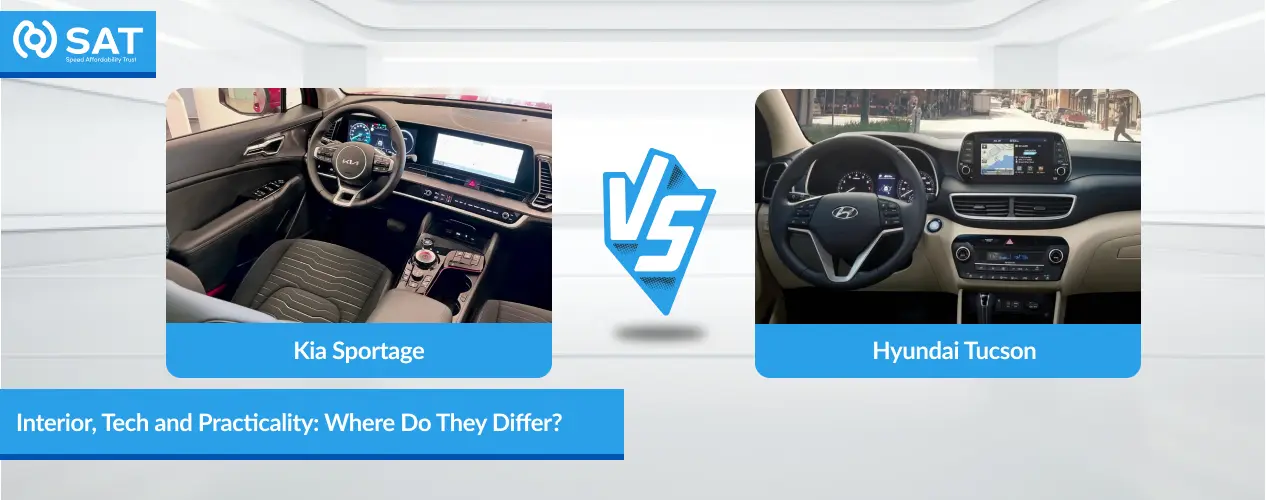
While the Kia Sportage and Hyundai Tucson have more in common in their engineering, the approach taken to the cabin is quite different. This is one of the most obvious feature differences between the two SUVs, and it can make a significant difference in ownership experience.
The Sportage is designed to make a lasting impression. The higher trims offer a curved panoramic display layout that makes several displays appear as a single, modern cockpit-like display. Opting for a simpler, less flashy dashboard design, the Tucson offers a more subdued look that emphasizes functionality and usability.
It's not a matter of which has the most technology in the SUV. It's about the way that technology is provided. Kia prioritizes digital interaction and customization, whereas Hyundai prioritizes simplifying things and making the cabin feel like home from the start.
One of the often-neglected factors is cognitive load. The Sportage's technology-oriented design might attract those who like to delve into features and settings. A simpler presentation, such as the Tucson, may be more convenient for those drivers who do not want to be distracted in their daily driving experience.
Aesthetically, the Sportage is a car that will catch the eye as soon as you enter, whereas the Tucson is an intuitive car that will be a pleasure to own for years to come. That's what makes two cars with the same underpinnings appeal to different audiences.
The Kia Sportage (39.6 cu-ft) and Hyundai Tucson (38.7 cu-ft) are just under 1 cubic foot apart on paper. In practice, that small difference doesn't make a lot of difference. It isn't the size that matters; it's the shape of the space. The side cargo opening and the square cargo floor are designed to accommodate strollers, large suitcases, and bulky shopping bags. The Tucson just slips slightly ahead with the rear seats folded, and is better for carrying longer objects. Most reviews fail to mention this one aspect: most families use the area behind the second row more than the maximum cargo capacity. For everyday use, the Sportage will be a bit better, but the Tucson will be great for flexible long load storage.
The Kia Sportage and Hyundai Tucson are two of the safest compact SUVs, with the NHTSA giving them a good safety rating and the IIHS giving them excellent crash-test ratings in recent model years. Both have advanced driver-assistance technologies such as Forward Collision-Avoidance Assist, Lane Keeping Assist, Blind-Spot Collision Warning, and Smart Cruise Control to help prevent accidents. Many buyers forget that the trim is as important as the model when it comes to safety. The features may change from year to year, market to market, and trim to trim, particularly on used and imported vehicles. Always inspect safety equipment that has been installed before purchase. The safest is not necessarily the one with the best crash test score, but rather the one with the most comprehensive driver-assistance system.
The Kia Sportage and Hyundai Tucson are engineered on the same DNA, and as such, their long-term reliability is quite similar and not as far apart as many think. They both have the same engines, transmissions, and most mechanical parts, so neither has an edge unless both are well-maintained. Most of the reported problems are related to the infotainment system and driver-assistance sensors, with a few instances of transmission hesitation on certain model years, but nothing serious with the engine. Regular oil changes, software updates, and sticking to the service schedule do more for reliability than the choice of badges.
The running costs are also comparable, as many parts are shared among both types of SUVs and parts are readily available in most markets, making repairs easier and quicker. Both models are also covered under an excellent basic 5-year/60,000-mile warranty and a 10-year/100,000-mile powertrain warranty in the U.S. (Warranty coverage for used or imported models varies by country and local policies.)
The most common mistake a buyer makes is assuming the greatest reliability risk comes from the previous owner, not the model. A clean Sportage or service record will nearly always outlast a dirty Tucson and vice versa. When purchasing, look for maintenance history, accident records, recall completion, tire condition, and regular maintenance. The info there will give you much more insight into the future ownership than the front badge.
There are many buyers who just have an eye on the buying price and neglect it at the time of selling later. That's why depreciation is important. Leading the value is that the Kia Sportage and Hyundai Tucson both have modern technology, high safety ratings, and fuel-efficient hybrid options. Here's something most comparison articles don't mention: buyers aren't paying more for a badge; they're paying more for confidence. Whether it's Hyundai or Toyota, a model with a full service record, no accident history, and desirable features such as AWD or a hybrid powertrain will often sell faster than a neglected model. If you're looking for long-term value, you'll want to purchase the vehicle in the best condition, but no one said it had to be the one with the better resale reputation.
The price that you pay for a vehicle is important, but the true cost of a vehicle is what happens after you drive it off the lot. In fact, over the years, maintenance, repair, insurance, and depreciation can be more significant than the sticker price.
Due to the common engineering parts and components shared by the Kia Sportage and Hyundai Tucson, the maintenance costs are quite similar. Service contract costs like oil services, brake pads, air filters, tires, and fluid changes typically hover around the same price for both SUVs.
But one of the major ownership misconceptions is that the biggest expense is maintenance. But often depreciation and neglect by the previous owner have a bigger financial impact. A poorly maintained SUV can quickly erase any savings gained from a lower purchase price.
The other one is the shared parts ecosystem. Both cars are available worldwide and share a lot of parts, making it easier to get replacement parts for them than for less common cars. This can help to minimize repair delays and to keep repair costs in check in the long term.
The decision on whether to opt for the Kia Sportage or the Hyundai Tucson is not always the most important, but rather the choice of trim is. Frequently, buyers pay thousands more for top trims but only use a few of the additional features. The best trim for most is one that offers comfort, technology, safety, and value.
Buyer Priority | Kia Sportage | Hyundai Tucson |
Best Budget Choice | LX | SE |
Best Value for Money | EX | SEL |
Best Hybrid | Sportage Hybrid EX | Tucson Hybrid SEL |
Adventure Style | X-Line / X-Pro | XRT |
Premium Experience | SX Prestige | Limited |
The Sportage EX is the most versatile model to suit most consumers. It delivers some of the things that people with daily driving require, such as increased size, extra comfort, and high-tech driving assistance, but at a more affordable price than the most expensive trims. The Sportage Hybrid EX offers excellent value for buyers who are seeking hybrid efficiency.
The Tucson SEL is based on the same concept. It provides a perfect balance of technology, comfort, and value with a simple and easy-to-understand trim range. The Tucson's trim structure simplifies the purchase process if you're looking for a straightforward buying experience with fewer options.
One thing many comparison articles neglect to mention is that the best trim is often the one that's easiest to resell. These vehicles appeal to the used car market by combining the desired features with a price point that is more in line with what customers are willing to pay for a vehicle.
Recommendation: If value, features, and resale value are the priorities, the Kia Sportage EX is the best choice. If you're looking for a simple, comfortable, and very practical Hyundai Tucson with a reasonable price tag, the SEL will be your choice. These middle-of-the-range options offer the best value for the money for most purchasers.
Considering a used Kia Sportage? The bright side is that there aren't many of the most typical complaints about major mechanical issues. Rather, most problems are typically electronic, software, or limited to specific model years.
Infotainment and connectivity issues: A few Sportage owners have complained that their touchscreen is delayed, the system freezes at times, or their phone cannot connect to the system. Typically, these are not disabling to the vehicle.
Electrical sensor warnings: Some model years have had intermittent warning lights for driver-assistance or monitoring systems. In many instances, the problem has been solved by software fixes or by a recalibration of the sensor.
Low-speed transmission hesitation: Some drivers have reported a lack of response when operating at low speeds. A test drive will be of great benefit when purchasing gearbox equipment, as the buyer must be alert to any unusual gearbox performance.
Interior wear on high-mileage vehicles: With older vehicles, seat bolsters, steering wheels, and often common-use controls may be more worn than mechanical parts.
Outstanding recalls or software updates: Check that all recalls have been done and software is up to date before buying.
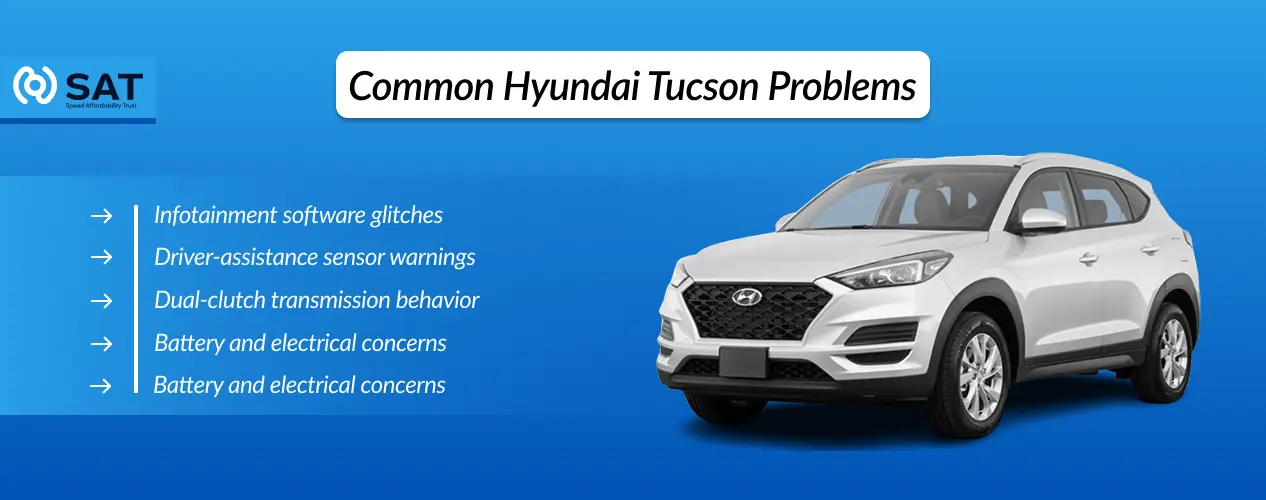
Purchasing a used Hyundai Tucson? While most models have been reliable in Tucson, there are some common problems that you should look for before making a final purchase.
Infotainment software glitches: A few have mentioned that the touchscreen freezes, responds slowly, or occasionally has a problem connecting with their smartphone. They're typically software and not serious hardware issues.
Driver-assistance sensor warnings: Some Tucson models have given erratic warnings from driver assistance systems, sometimes necessitating sensor calibration or software updates.
Dual-clutch transmission behavior: Few reported delays or lag in transmission response at low speeds, especially when driving in stop-and-go situations on some turbocharged variants.
Battery and electrical concerns: A few battery or electrical system problems have been reported, particularly in models with a lot of electronics.
Recall and update history: If recalls and manufacturer software updates have been done, make sure they have been recalled and updated before purchasing.
Kia Sportage Pros | Kia Sportage Cons |
Combined up to 43 mpg in hybrid mode | Conservative buyers may not like bold styling |
Slightly larger 39.6 cu-ft cargo area behind rear seats | It may be confusing if there are more complex trim levels |
When equipped, up to 2500 lbs of towing capacity is available | There are some features that are available in higher trims |
Wide variety of trim and package combinations, such as X-Line and X-Pro | For some, the technology-rich cabin might not be the ideal choice |
Great value-to-feature ratio throughout the line | Higher trims are expensive |
Hyundai Tucson Pros | Hyundai Tucson Cons |
Clean and simple design is timeless | The Tucson Hybrid is slightly less efficient than the Sportage Hybrid |
Easier to navigate, simpler trim structure | Reduced max tow capacity in many scenarios |
Convenient and easy-to-use cabin design | Less specialized trims options |
High levels of safety and driver-assistance equipment | Cargo advantage only comes with folded rear seats |
Competitive ownership and maintenance costs | Premium trims can approach the price of larger SUVs |
The most common error people make when comparing the Kia Sportage and Hyundai Tucson is thinking there is one clear winner. There isn't. These SUVs share the same DNA but serve different kinds of owners. The best option is not the one that boasts the most features on its SUV list. It's the one that seamlessly integrates into your standard driving routine without requiring you to alter your driving habits.
A question that will help you make your decision much easier:
At the end of a long day, what do you want your SUV to do for you?
If you're looking for a solution, the Sportage is for you: "make every drive a little more exciting. If your answer is "help me get home feeling relaxed," then the Tucson might be a better fit.
You enjoy a more confident and responsive driving feel.
The ideal driving experience includes the best hybrid fuel economy, up to 43 mpg in hybrid mode.
You enjoy a bold, contemporary aesthetic that will stand the test of time.
You frequently have camping gear, sports equipment, or luggage and need a little more cargo space behind the seats.
With a higher available towing capacity, you can tow a small trailer or recreational equipment.
More options for trim, such as adventure gear like the X-Line and X-Pro.
What you want is a cabin that feels modern, digital, and filled with technology.
The Sportage is designed for the buyer who likes choices. It is designed to reward drivers who have a preference for a different trim, powertrain, and feature as opposed to a one-size-fits-all.
You prefer a comfy ride over sporty handling.
You want a clean, easy-to-understand dashboard.
You drive for hours to get to work, and you need a relaxing cabin.
You enjoy a light and easy steering in town traffic.
You want an SUV that you feel comfortable in after just a few minutes of driving.
You like to have a shorter range of trims that you don't have to compare with numerous packages.
You want a design that will not quickly become outdated.
The Tucson is designed for those who do not often consider the car when in transit. Everything runs on its own accord, and you're able to concentrate on driving rather than the technology.
The most surprising result of this comparison is how little separates these two SUVs. Years ago, buyers often chose between Kia and Hyundai based on price or styling alone. Today, both vehicles have matured into highly refined compact SUVs that compete on much more than value.
What ultimately sets them apart is not capability but character. The Sportage feels aimed at buyers who enjoy having more choice and a stronger sense of individuality, while the Tucson focuses on delivering a straightforward experience with fewer decisions to make. Neither approach is objectively better—they simply appeal to different types of owners.
For import buyers, the real challenge is no longer finding a good vehicle but finding the right example. A well-maintained vehicle with a documented history will almost always be a smarter purchase than a poorly maintained alternative.
If you're sourcing a Sportage or Tucson from Japan, SAT Japan can help by providing access to inspected vehicles and export support, making it easier to find a quality example that matches your requirements.
Final Winner: Kia Sportage, but only by the narrowest of margins.

When it comes to leading car companies, Lexus is one of the first names that comes to mind. Lexus is known for producing premium SUVs, sedans, and other performance vehicles that are known for their reliability and class. In this blog, we will compare two of Lexus’ famous brands – Lexus RX vs Lexus NX.
Both these models provide a similar level of class and comfort and are great options individually. Let us break down the RX vs NX battle.
This luxury SUV was originally produced in 1997 in Japan and its export sales began in 1998. The vehicle is currently in its 5th generation, with many modifications occurring over the years, and has been a best-selling SUV globally due to its exceptional features.
The Lexus NX is a luxury SUV that came out in 2014. This vehicle instantly gained recognition after its launch and is now one of the top-selling Lexus models in Europe, currently still flourishing in its 2nd generation.
The Lexus RX offers a heated leather seating capacity of five people. In the latest 2024 version of the vehicle, the Lexus RX offers a boot space of 621 L with the rear seats up and up to 1678 L if the rear seats are folded.
Similar to the Lexus RX, the Lexus NX also features heated leather seats for five people. The latest version offers a boot capacity of 475 liters, expanding to 1520 liters with the rear seats down.
The vehicle provides several safety features in the latest generation, such as the ten airbags for passengers’ safety in case of any accidents, and a child lock feature and ISOFIX child seat anchors, so children cannot open their door from inside. Other latest safety features include:
Anti-lock braking system
Traction control
Vehicle stability control
Hill start assist control
Immobilizer
Moving onto the NX, the vehicle has a total of six airbags and five seatbelts. Just like the Lexus RX, this vehicle is also equipped with a child lock feature and ISOFIX child seat anchors for the safety of your children. More safety features may be:
Anti-lock braking system
Vehicle stability control
Hill start assist control
Traction control
Immobilizer
Now, let’s have a look at the comfort and luxury features that come with this vehicle. The latest versions of the Lexus RX are equipped with:
Air conditioner, Heater, Defogger, Climate Control:
This gives the passengers an option of customizing the temperature inside the car and enjoying their journey, regardless of the weather outside.
Power Windows, Power Steering, Power Mirrors, Power Locks, Power Boot:
This allows the driver to gain complete control of the car with just a push of buttons. The RK takes a win in the Lexus NX vs RK debate here with its power boot that the NX lacks.
Front and Back Cameras:
These make it easy for the driver to drive in congested places, safely.
Smart Keyless Entry
Front and Rear Power Outlets
Cupholder
Armrest
Interior Lighting
Sunroof and Moonroof
This vehicle also has several comfort and luxury features that increase its worth and induce temptations for its customers. The Lexus NX comes with:
Air conditioner, Heater, Defogger, Climate Control
Power Windows, Power Steering, Power Mirrors, Power Locks
Rear Wiper: Here, the NX takes the Lexus RX vs. Lexus NX lead as it boasts of the rear wiper not present in the RK.
Smart Keyless Entry
Front and Rear Power Outlets
Cupholder
Armrest
In this section, we will look at the exterior of the Lexus RX. This SUV carries exterior dimensions of 4.89m x 1.90m x 1.69m, with a kerb weight of 2085 kilograms. It features 20-inch alloy wheels and 235/55/R20 tires, plus a 19-inch spare tire.
As for the Lexus NX, its dimensions are 4.64m x 2.13m x 1.87m, with a kerb weight of 1896 kilograms. Similar to the RK, it also features 17-inch alloy wheels and 225/65/R17 tires, including a 17-inch spare tire.
The Lexus RX is an automatic car with a 72-liter petrol tank. Its engine has six cylinders and delivers a top speed of 240 km/h. The 3456 cc engine produces 296 horsepower at 6300 RPM. The city mileage is 7 km/l, and the highway mileage is 8 km/l.
The Lexus NX , on the other hand, is an automatic car with a 56-liter petrol tank. Its engine has four cylinders and delivers 194 horsepower at 5700 RPM. The city mileage is 13 km/l, and the highway mileage is 14 km/l, making it more fuel-efficient than the RX.
Read more: Click here to learn about high-mileage oil for old engines.
Both cars share many similarities in terms of size, comfort, and class. However, the Lexus RX has slightly more comfort and luxury features than the Lexus NX. But when it comes to petrol consumption, the Lexus NX provides a better average for petrol consumption than the Lexus RX. Hence, the consideration of your personal needs is required before making a decision between these two top-sellers. SAT Japan is the leading used cars for sale marketplace where you can check all used cars and also read the info about the cars’ tricks and tips.
The decision to pick an appropriate family SUV is not a simple task particularly when two powerful alternatives have been identified. Honda Pilot versus Toyota Highlander is the debate that many families have to deal with nowadays. The two SUVs are both promising in terms of space, safety as well as comfort in daily driving and over-long driving. Yet they do it in their own way.
The Honda Pilot is aimed at the spacious interior and the family-friendly design. The Toyota Highlander is inclined to efficiency and clean performance. In this side-by-side comparison, we will look at the pricing, the interior size, exterior design and real life usability of both SUVs. At the end, you will be in a position to know which SUV best suits your family and its budget.
In case you wish to have a brief answer before going into details, then here is a quick comparison that makes it easy.
Feature | Honda Pilot | Toyota Highlander |
Starting Price | $40,200 | $47,240 |
Price Range | $40,200–$54,580 | $47,240–$54,895 |
Seating Capacity | Up to 8 passengers | Up to 7 passengers |
Third-Row Space | More legroom and headroom | Best for kids or short trips |
Fuel Economy | Good but lower overall | Better fuel efficiency |
Towing Capacity | Up to 3,500 lbs | Up to 5,000 lbs |
Drivetrain | Front-wheel drive standard | All-wheel drive available |
Best For | Road trips and big families. | Every day commuting and savings. |
Honda Pilot has been a favorite among its customers who require space, comfort, and reliability. It is large and not difficult to drive. A complete crew can be accommodated in it and you can still carry luggage and backpacks. A Honda Pilot price is one of the things most buyers would love to know, and it begins relatively low compared to other competitors. It is cheaper to the pocket of families that want value without compromising quality.
The Pilot is friendly and comfortable to reside in. The features such as the easy controls and a lot of cup holders appeal to parents. Children like the spacious chairs and large windows. Comparing this SUV to the others, it becomes a good family choice that only makes sense.
Discussing the Honda Pilot price, which is between $40,200 and 54,580, is a thrilling experience, as you are getting a lot out of what you spend. The Pilot begins at a price that most families will find easy to buy compared to other big SUVs. This will be an intelligent choice because it can offer space, comfort and power at a reasonable price.
With the increase in the level of trim, the price increases as well as you attain more features. Those involve enhanced technology, increased comfort, and additional safety features. Most parents report that they feel that the Pilot is worth every cent that they pay.
The Honda Pilot is frequently noticeable when you are looking to buy a family SUV and are price-sensitive. It leaves you some space and the assurance that you have made a good decision.
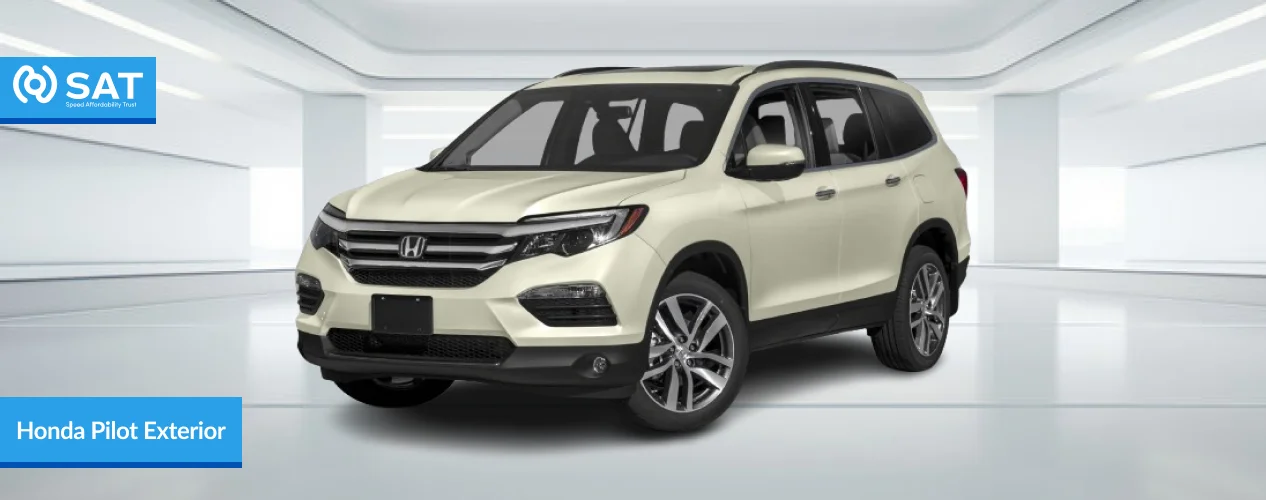
The minute you see a Honda Pilot, you can tell that it is a strong, confident looking car. The design is provocative without being excessively flashy. This SUV is clearly prepared to take the family on a holiday, run to school, and have some fun on weekends. The grille before the front is broad and lovely enough to make you feel like the Pilot is inviting you to an adventure.
The headlights are crisp and bright which makes the night driving safer. The shape of the body provides enough space inside and also appears smooth at the outside. People are fond of the fact that the Pilot does not make too much effort to impress. It appears intelligent, strong and reliable.
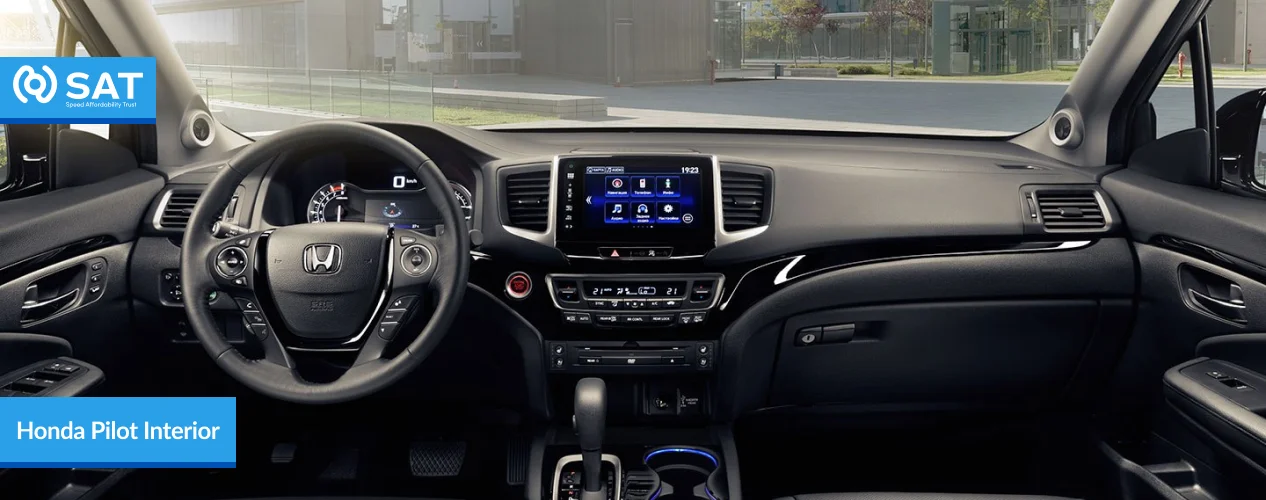
Get into Honda Pilot and you can have a feel of the spaciousness. The seats are very comfortable, and people have enough room. Children are able to stretch their legs and even adults do not feel squeezed even during long journeys. The second and third rows are readily accessible, and this is excellent when one is loading car seats or assisting children to get in.
The dashboard is basic and user-friendly. Touchscreen and controls are at the right place. You will not have to guess the way things work. All the cup holders, storage bins, and USB are at the right place. It is simple to keep drinks cold and gadgets charged.
The cargo space is one of the most advantageous. You can carry plenty of luggage, sports equipment or groceries. The Pilot simplifies life in the family since one does not struggle in the quest to secure space. It is like a place where you can live, not a single visit to the shop. At first glance, families will be fond of the thoughtful and comfortable interior.
The Toyota Highlander is something that seems to be a SUV created to be used in the real life. It is comfortable, easy to drive and suitable to both daily errands and long family trips. As soon as you get into it, you realize how comfortable and silent it is. This makes all the ride feel less stressful even when the traffic is busy.
Many buy the Highlander as it is such a good balance between power and efficiency. It achieves good fuel economy, which implies that it will not need to visit the gas station as often and will save more money in the long-term. The security and ease of use of the technology within the family are also appreciated.
Families stop to smile when discussing the Toyota Highlander price, which is between $47,240 and $54,895. The Highlander can be slightly more expensive than the competitors, yet the majority of individuals believe it is worth each cent. It offers a splendid combination of comfort, technology, and fuel efficiency that allow you to enjoy easy and enjoyable daily driving.
The higher the trim level, the cost, but the highest, the more features. You are able to take better seating, additional safety equipment, and larger screens. It implies that you will have the option of the version that suits your needs and budget.
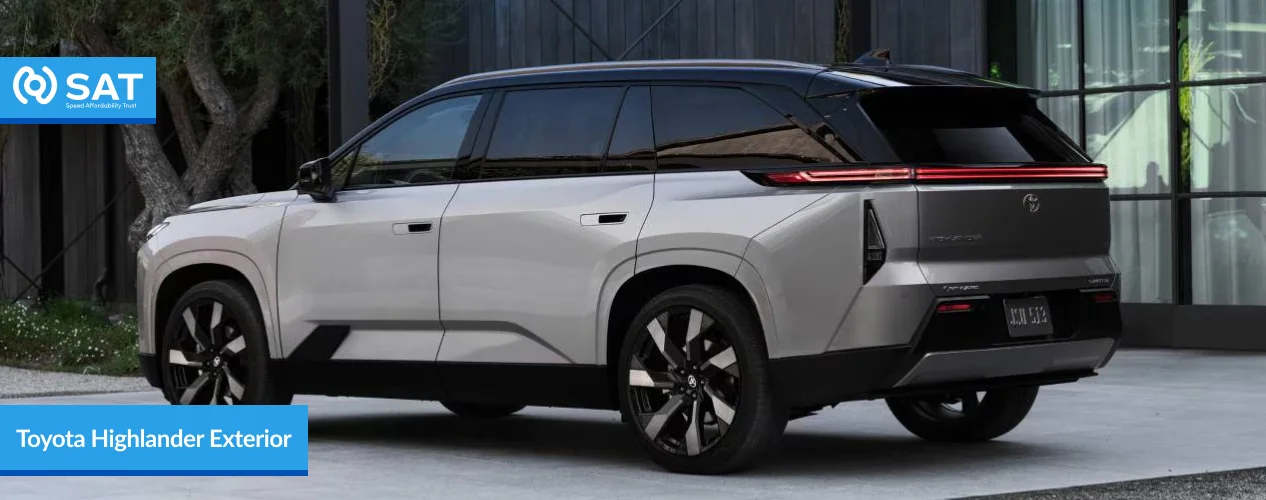
The appearance of the Toyota Highlander is both powerful and elegant. It is not flashy on the road. The front grille will also make it have a bold impression and the smooth lines will make the SUV appear smooth and elegant.
The Headlights are sharp and bright, which is beneficial during the dark or bad weather. The design of the body aims at maximizing the interior space and yet appear smooth on the exterior. Wide doors and roof rails ensure that it is easy to load items such as gear and children stuff.
The Toyota Highlander exterior is in general very practical and appealing. It is an SUV that is seemingly prepared to the family adventures but at the same time makes the heads turn in the neighbourhood.
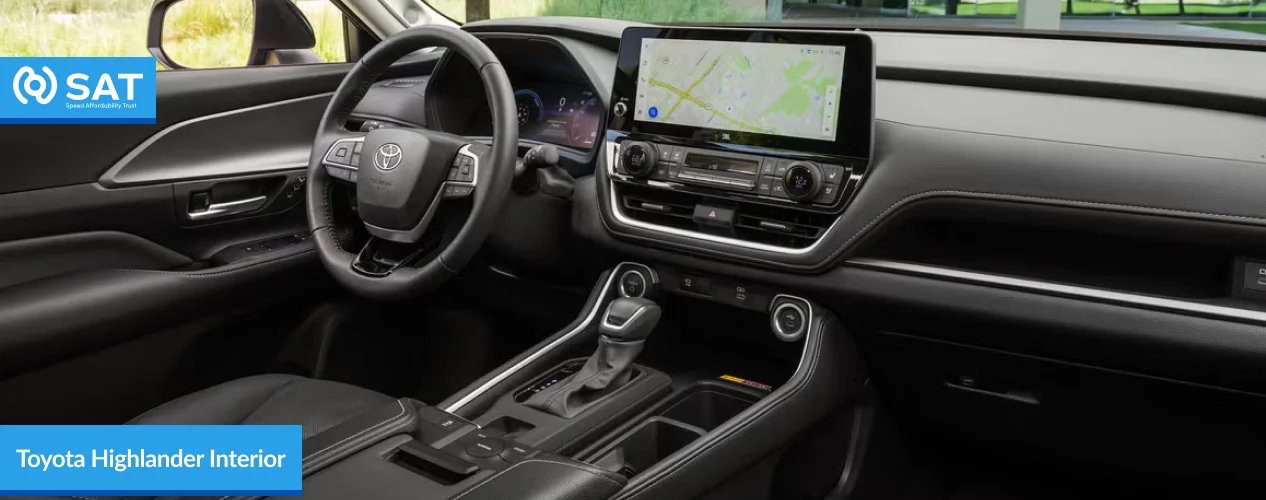
When you enter the Toyota Highlander, the first thing you would notice is the comfort and the well-designed highlander. The seats are comfortable and supportive and long journeys seem comfortable. It has room to carry seven people and during a short trip, even adults can comfortably fit in the third row.
The Toyota Highlander Interior is modern and friendly. The touchscreen is smooth and controls are readily accessible. Families will be pleased with the several USB ports, cup holders and ingenious snacks, gadget and toy storage areas.
Cargo space is generous too. It could be groceries, sports goods or baggage to a weekend vacation, the Highlander drives it with a breeze. In general, the interior is very functional, comfortable, and aimed to simplify and enjoy the family life.
Comparing Honda Pilot vs Toyota Highlander, the two SUVs provide good performance but slightly differently. Honda Pilot has a V6 engine which is smooth and powerful which is suitable to be used on highways and family trips. It makes it easy to merge or pass as it manages the bigger SUV.
The Toyota Highlander is more efficient oriented. The engine is also tuned to achieve a better fuel economy with a reasonable amount of power. You will have made fewer visits to the gas station and this is a huge positive about commuting to work or driving long distances on a daily basis.
Both vehicles have comfortable rides, although the Highlander has a little more comfortable feeling on the road. Both are responsive when it comes to steering and the two SUVs can turn corners surprisingly well with their size. It is usually a matter of deciding between the two and it is either that you need strength and space or you need fuel saving and efficiency.
Regarding family life, the Honda Pilot vs Toyota Highlander have features that simplify every trip. Car-seat compatibility, storage and entertainment are just some of the strengths that parents will find in each SUV. The following is a brief comparison of them:
Feature | Honda Pilot | Toyota Highlander |
Seating Capacity | Up to 8 passengers | Up to 7 passengers |
Third-Row Comfort | More legroom for adults | Best for kids or short trips |
Cargo Space | Big back the first and second row. | Generous yet marginally less than Pilot. |
Car Seat Friendly | Easy LATCH access | Uncomplicated and safe LATCH system. |
Infotainment | Touchscreen is user-friendly, entertainment on rear seat. | Smooth touchscreen, Apple CarPlay/Android auto standard. |
USB Ports & Outlets | Several ports all over cabin. | Numerous ports, rear seats included. |
Safety Features | Blind spot monitor, emergency braking, lane assist. | Toyota Safety Sense, Blind spot, lane departure alert. |
Towing & Trips | Towing capacity of 3,500 lbs, suitable to small trailers. | Towing 5,000 lbs, ideal with boats or campers. |
In the decision of choosing between the Honda Pilot and Toyota Highlander, it is useful to consider the advantages and disadvantages of both. The two SUVs will have a lot to offer, though they are applicable to various family requirements.
Large interior and lots of room in the third row.
Seat capacity of 8 passengers.
V6 engine with a lot of power to move on highways.
Ease of use infotainment and plenty of USBs.
Good value for the price
Less fuel efficiency than the Highlander.
Less towing capacity than Highlander.
Third row better with shorter trips in adults.
Higher fuel efficiency, particularly over long journeys.
Increasing towing power of trailers or boats.
Modern interior design, smooth, and quiet ride.
Sophisticated safety options are included.
Trustworthy and durable SUV.
Sits up to 7, hence less spacious to bigger families.
The third row is tighter to the adults during the long journeys.
A little more expensive initial cost than the Pilot.
The best family SUV is definitely up to what you need the most. The Honda Pilot is an excellent choice in case you have to find extra passenger space and lower entry price. It is ideal in everyday driving and in long trips due to its spacious interior, home-friendly third row, and family-friendly interior. Besides, Honda Pilot is usually cheaper at the pocket, which in itself is a huge advantage to a good percentage of the families.
The Toyota Highlander on the other hand is the choice when it comes to fuel efficiency, towing capability and a comfortable and quiet ride. It would be a little more costly, but it does have tremendous value and dependability in the long term.
Finally, these two SUVs are great. Families needing space and affordability can be tempted to the Pilot whereas those paying attention to efficiency and versatility can be attracted to the Highlander.
The Honda Pilot and Toyota Highlander are both good family vehicles and you can hardly make a bad decision between them. The Pilot is the best option when you want to have additional seating, third row spacious, and low starting price. It is practical, spacious, and to manage the usual family routine.
The Highlander, however, is excellent provided you are interested in high fuel efficiency, a quiet and smooth ride, and more towing power. It is contemporary, stable, and willing to go out on a weekend or cover long distances.
The ultimate SUV is what the family requires at the end of the day. In case space and affordability are the most important, choose the Pilot. Highlander is the right choice in case efficiency and versatility is what you consider important. Both will ensure that your family is safe, comfortable and happy in each adventure.

The 2026 Honda Civic and Toyota Corolla remain two of the strongest compact cars for buyers who care about reliability, fuel economy, and everyday usability. The Civic is roomier and more engaging to drive, especially as a hybrid, while the Corolla starts cheaper, offers hybrid AWD, and keeps a slight edge in long-term running costs.
In this Honda Civic vs Toyota Corolla comparison, here’s where I landed: Civic is the car I enjoyed driving more, while the Corolla makes the stronger case if I’m being careful with my spending. That difference wouldn’t have been as pronounced as it is now if I hadn’t driven it personally.
The 2026 Honda Civic is the better all-round car in terms of performance, interior space, cargo room, and driving feel. The 2026 Toyota Corolla is the better value if you prioritize a lower starting price, hybrid AWD, lower average repair costs, and longer hybrid-battery coverage.
For gas models, the Corolla has the stronger base engine at 169 hp, compared to the Civic's 150 hp. For hybrids, the advantage flips dramatically: the Civic Hybrid produces 200 hp compared with the Corolla Hybrid's 138 hp.
At $23,125, the Corolla LE is the cheaper way into either lineup.
The biggest difference from the driver’s seat is between the hybrids. The Civic Hybrid makes 200 hp, while the Corolla Hybrid has 138 hp.
The 2026 Civic earned an IIHS Top Safety Pick. The Corolla didn’t, after its rear-seat result was rated "Marginal".
The Corolla Hybrid can be ordered with AWD. The Civic doesn’t offer AWD on any trim.
Category | Honda Civic | Toyota Corolla |
Starting price | $24,695 (LX) | $23,125 (LE) |
Body styles | Sedan, hatchback | Sedan, hatchback (gas only) |
Engine options | 2.0L I4, 1.5L turbo (Si), 2.0L turbo (Type R) | 2.0L I4 |
Hybrid availability | Yes, Sport Hybrid, Sport Touring Hybrid | Yes, LE, SE, XLE Hybrid |
Gas engine power | 150 hp | 169 hp |
Hybrid system power | 200 hp | 138 hp |
Performance models | Si: 200 hp / Type R: 315 hp | No direct equivalent |
Torque | 133-310 lb-ft by trim | 105-151 lb-ft by trim |
Transmission | CVT; 6-speed manual (Si, Type R) | CVT |
Drivetrain | FWD only | FWD, optional AWD (hybrid) |
Fuel economy (combined) | Up to 36 mpg gas, 49 mpg hybrid | Up to 35 mpg gas, 50 mpg hybrid |
Passenger capacity | 5 | 5 |
Passenger space | 99 cu-ft | 88.6 cu-ft |
Cargo capacity | 14.8 cu-ft sedan / 24.5 cu-ft hatch | 13.1 cu-ft sedan |
Infotainment | 7-9-in touch, Google built-in (top trim) | 8-10.5-in touch |
Safety systems | Honda Sensing, standard | Toyota Safety Sense 3.0, standard |
Warranty | 3yr/36k basic, 5yr/60k powertrain | 3yr/36k basic, 5yr/60k powertrain |
Ownership cost | ~$368/yr avg repairs | ~$362/yr avg repairs |
Best use case | Space and power | Low cost and simplicity |
The Civic Hybrid makes 62 hp more than the Corolla Hybrid.
AWD is available on the Corolla Hybrid, while the Civic range stays FWD.
The Civic has roughly 10.4 cubic feet more passenger space inside.
IIHS gave the 2026 Civic a Top Safety Pick. The Corolla missed the award.
Toyota covers the hybrid battery for two years and 50,000 miles longer than Honda.
If you regularly carry bulky items, the Civic hatchback offers more usable space.
A few automotive sites still rank the Corolla slightly higher for reliability.
Category | Winner | Why |
Price | Toyota Corolla | Cheaper at every matching trim |
Reliability | Toyota Corolla | Higher RepairPal rank, lower repair cost |
Fuel Economy | Toyota Corolla | Higher peak combined mpg on hybrid |
Performance | Honda Civic | Much stronger hybrid and available Si/Type R models |
Handling | Honda Civic | Sharper steering, less body roll |
Interior | Honda Civic | More premium materials and ergonomics |
Rear-Seat Space | Honda Civic | 2.6 inches more rear legroom |
Cargo Space | Honda Civic | Bigger trunk and hatchback option |
Technology | Honda Civic | Google built-in on top trim |
Safety | Honda Civic | 2026 IIHS Top Safety Pick award |
Warranty | Toyota Corolla | 10-year hybrid battery coverage |
Maintenance Cost | Toyota Corolla | Lower average annual repair cost |
Resale Value | Toyota Corolla | Slightly stronger 5-year retention |
Hybrid | Honda Civic | 62 more horsepower, roomier cabin |
Overall Value | Toyota Corolla | Lowest total cost of ownership |
Before making any decision, review the spec sheets for both vehicles.
Spec | Honda Civic | Toyota Corolla |
Engine displacement | 2.0L base / 1.5L turbo (Si) / 2.0L turbo (Type R) | 2.0L gas / 1.8L hybrid |
Engine type | Inline-4, naturally aspirated or turbo | Inline-4, naturally aspirated |
Hybrid system | 2-motor Atkinson hybrid | Toyota Hybrid System (THS) |
Horsepower | 150–315 hp | 138–169 hp |
Torque | 133–310 lb-ft | 105–151 lb-ft |
Transmission | CVT; 6-speed manual (Si/Type R) | CVT (ECVT hybrid) |
Drivetrain | FWD | FWD, optional AWD (hybrid) |
Fuel tank | 12.4 gallons | 13.2 gallons (gas) or |
Wheelbase | 107.7 in | 106.3 in |
Length | 184.8 in | 182.3 in |
Width | 70.9 in | 70.1 in |
Height | 55.7 in | 56.5 in |
Passenger volume | 99 cu-ft | 88.6 cu-ft |
Cargo volume | 14.8 cu-ft (sedan) | 13.1 cu-ft (sedan) |
Wheel sizes | 16–19 in | 15–18 in |
The Civic LX starts at $24,695. From there, the Sport is $26,695, the Sport Hybrid is $29,395, and the Sport Touring Hybrid reaches $32,395. The manual-only Si starts at $31,495. Type R is a much bigger jump at $47,395 before destination, and a comparable hatchback usually costs a few hundred dollars more than the sedan.
The 2026 Corolla LE starts at $23,125. The SE rises to $25,565, while the XSE starts at $28,840. Hybrid pricing begins at $24,975 for the Hybrid LE, followed by $26,375 for Hybrid LE AWD, $27,415 for Hybrid SE, $28,815 for Hybrid SE AWD, and $29,340 for Hybrid XLE.
Pricing note: Manufacturer base MSRPs are shown before destination charges, taxes, registration, accessories, and dealer-specific fees. Prices checked August 2026.
Available Trims
Civic: The LX keeps things basic and affordable, while the Sport is mostly about a sharper look. Sport Hybrid and Sport Touring Hybrid get the 200-hp hybrid setup along with more comfort features. The Si is the manual choice for enthusiasts, and the Type R is the full-on hot hatch.
Corolla: LE is the base trim level. SE adds some sportier styling and more tech, while XSE gets the nicer cabin materials and the biggest screen. The hybrid range follows the same basic order with LE, SE, and XLE trims.
Type | Honda Civic | Toyota Corolla |
Base gas | LX - $24,695 | LE - $23,125 |
Sport-oriented gas | Sport - $26,695 | SE - $25,565 |
Higher gas trim | - | XSE - $28,840 |
Entry hybrid | Sport Hybrid - $29,395 | Hybrid LE - $24,975 |
Higher hybrid | Sport Touring Hybrid – $32,395 | Hybrid XLE - $29,340 |
Performance model | Si - $31,495 | No direct equivalent |
High-performance model | Type R - $47,395 | No direct equivalent |
Price winner: Toyota Corolla. It starts $1,570 below the Civic in base form, and its entry hybrid is more than $4,000 cheaper than the Civic Sport Hybrid. The Civic asks more money but gives hybrid buyers substantially more power.
The standard 2.0L four-cylinder makes 150 hp and 133 lb-ft and runs through a CVT. In the Sport Hybrid and Sport Touring Hybrid, the two-motor setup brings output to 200 hp and 232 lb-ft. The Si uses a 1.5L turbo with 200 hp and a 6-speed manual. Type R sits in a different league, with a 2.0L turbo making 315 hp and 310 lb-ft, and it’s manual-only.
The gas Corolla uses a 2.0L four-cylinder engine with 169 hp and 151 lb-ft of torque, paired with a CVT. The Hybrid uses a 1.8L engine with an electric motor and makes 138 hp through Toyota’s ECVT. On Hybrid LE and SE trims, Electronic On-Demand AWD is available.
The base Corolla has more power than the base Civic, 169 hp against 150, and there’s a little more shove when you’re joining a fast road. The hybrids are a completely different story. The Civic makes 200 hp, the Corolla 138, and you don’t need a stopwatch to notice that 62-hp gap when you floor them.
Civic | Corolla | Winner | |
Gas | 150 hp | 169 hp | Corolla |
Hybrid | 200 hp | 138 hp | Civic |
Performance | 200–315 hp | No equivalent | Civic |
Clear Winner: Corolla for the base gas engine. For hybrid power, I'd give it to the Civic without much debate.
Same story. The base Corolla's 151 lb-ft edges the base Civic's 133. The Civic Hybrid's 232 lb-ft dwarfs anything Toyota offers here.
The Civic Hybrid has more in reserve during normal driving. It gets up to speed with less effort and feels less strained when you ask for more. The Corolla Hybrid gives some of that performance away, but it posts a slightly better EPA figure and can be had with AWD, which Honda doesn’t offer here.
Clear Winner: If I were choosing on hybrid performance alone, I’d take the Civic. Anyone who genuinely needs AWD has a good reason to pick the Corolla Hybrid instead.
Acceleration:
The standard gas Corolla has the power advantage on paper, with 169 hp against the Civic's 150 hp. The story reverses with the hybrids: the Civic Hybrid's 200-hp system delivers substantially stronger acceleration than the 138-hp Corolla Hybrid.
Ride Quality: The Civic deals with broken pavement a little better and settles down nicely once the road opens up. The Corolla isn’t uncomfortable, but you feel more of the surface through the cabin, especially in the firmer XSE.
Handling: This is the part where the Civic separates itself. There is more feel through the steering; it keeps body movement in check, and it doesn't mind being pushed through a corner. The Corolla XSE leans more and runs out of front-end grip sooner.
Braking: Both stop with confidence. The Corolla's regenerative braking can feel grabby at low speed at first. The Civic's pedal feel is a touch more linear.
If your question is which one is more fun to drive, I’d pick the Civic. It responds better when you actually want to enjoy the road, and the Si and Type R take that much further. The Corolla is calmer and more predictable, which will suit plenty of people who simply want an easy daily car.
These are the fuel figures I'd keep an eye on:
Civic: The LX is rated at 32 mpg city, 41 highway, and 36 combined. Sport drops to 34 combined, while the hybrid trims can reach 50/47/49.
Corolla: LE is around 32/41/35 mpg. Hybrid LE in FWD form reaches 53/46/50, the best figure anywhere in this comparison.
Trim | City | Highway | Combined |
Civic LX (gas) | 32 | 41 | 36 |
Civic Sport Hybrid | 50 | 47 | 49 |
Corolla LE (gas) | 32 | 41 | 35 |
Corolla Hybrid LE (FWD) | 53 | 46 | 50 |
As expected, the hybrid models are not as fuel-hungry.
Both hybrids are highly efficient, and the official difference is tiny: up to 49 mpg combined for the Civic Hybrid and 50 mpg for the Corolla Hybrid. The bigger difference is how they achieve it. The Civic combines near-50-mpg efficiency with 200 hp, while the Corolla prioritizes maximum economy with 138 hp and available AWD.
A 12.4-gallon tank and a 49-mpg combined fuel economy on the Civic Hybrid provide enough range to cover 600 miles in the right conditions. The Corolla Hybrid usually ranges from 550 to 600 miles, depending on the trim.
Civic: Reliability ratings for the Honda Civic are great, with some websites giving it a 4.5/5. Another website ranked it third among 36 compact cars. On average, the repair costs for the Civic come to around $368/year.
Corolla: For the Corolla, the reliability rating is the same, a 4.5/5, though among the same list of 36 compact sedans, the Corolla is rated first. On average, yearly repair costs are a little lower at around $362.
On average, a Civic owner will be expected to keep $368 aside; however, for the Corolla, the cost is a little lower at $362. However, it is to be noted that the Toyota comes with two years, or 25,000 miles, of scheduled maintenance.
The usual maintaince for both models is quite similar; however, the Hybrid servicing can cost a little extra. The Corolla is cheaper to buy by a small margin, and that included maintenance plan widens the gap early on.
Over the years, the expenses would be more than just the fuel and repairs. Amongst the long list of things, insurance, financing, depreciation, etc., the Corolla comes out to be slightly cheaper. This is because of its overall lower price, cheaper repairs, and scheduled maintenance. However, the Hybrid Civic can actually close part of that gap, but not all of it.
So, if you’re thinking about which car will save more money over a span of 5 years, the answer is the Corolla, though not by a huge margin.
The Civic has a good resale record, but the recent five-year figures used here still favor the Corolla slightly. The Civic retains about 59% of its value, compared with roughly 61% for the Corolla.
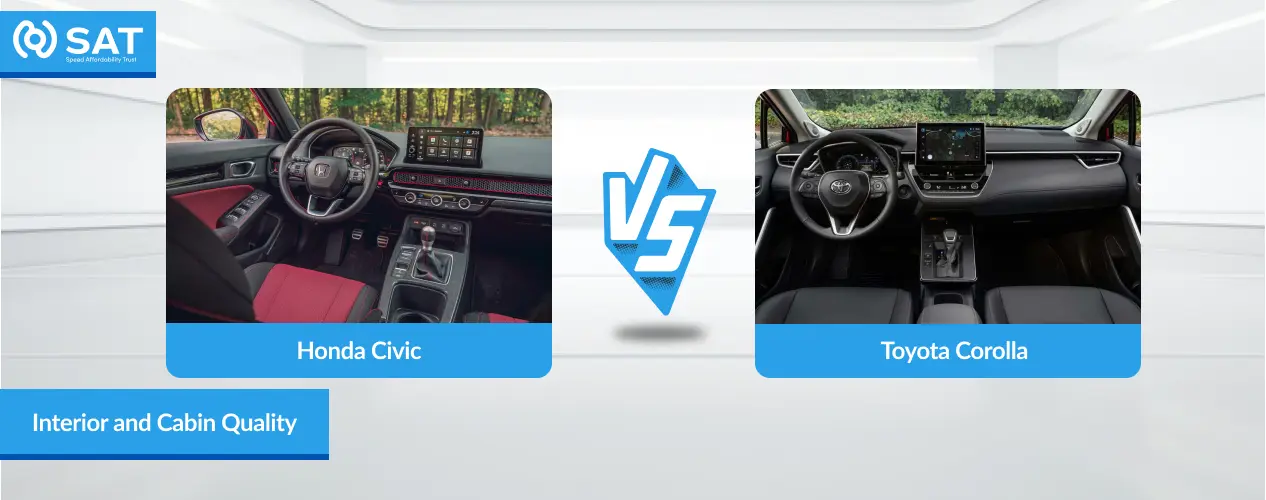
The Civic cabin feels a little more expensive than it really is. The layout is simple, visibility is good, and Sport trims and above use nicer materials without ditching physical climate controls. The Corolla's cabin is more straightforward. It still feels solid and practical, and higher trims dress things up more than the base car suggests.
Clear Winner: My pick here is the Civic. Reviewers consistently point to better materials and a more thoughtful control layout than the Corolla's simpler cabin.
Front-seat space: The Civic gives you about an inch more headroom and a little more legroom. I wouldn’t call either car cramped up front, even for taller drivers.
Rear-seat space: The gap is much more obvious in the back. The Civic has 37.4 inches of rear legroom, compared with 34.8 inches in the Corolla. That extra 2.6 inches is noticeable when adults are sitting there.
Seat comfort: Though for short commutes there isn’t much of a difference, the extra space on the Civic’s rear seat becomes a blessing on longer trips.
Incase adults are using the backseat often, it is recommended to opt for the Civic, since the extra room will save you from a lot of complaints later on.
Which Has More Cargo Space, Civic or Corolla?
Civic: The sedan provides a maximum of 14.8 cubic feet of trunk space, whereas the hatchback proves to be more useful, providing a total of 24.5 cubic feet of space.
Corolla: The sedan offers up to 13.1 cubic feet of trunk space, whereas the hatchback offers 17.8 cubic feet.
The Civic sedan has 14.8 cu-ft against the Corolla’s 13. The difference does not seem significant on paper, but is very obvious when carrying large or bulky items.
Both cabins include the basics like cupholders, door pockets, and a center console, so neither one feels awkward in daily use. I’d still give the Civic the win in terms of practicality considering its trunk is larger, and the hatchback handles bulky items better. Plus, the cabin provides ample room for storage of small items as well.
Civic: It measures 184.8 inches long, 70.9 inches wide, and 55.7 inches tall, with a 107.7-inch wheelbase.
Corolla: It measures 182.3 inches long, 70.1 inches wide, and 56.5 inches tall. The wheelbase is 106.3 inches, and the turning circle is a tighter 35.6 feet.
The larger-sized Civic makes its size difference quite visible when you’re behind the wheel. Its longer wheelbase and the added width mean that narrow parking spots will require more attention from you. Corolla, on the other hand, is a little easier to handle with its shorter body and smaller turning circle.
The Civic looks sharper to my eye, mainly because of its cleaner roofline and angular LED taillights. The Corolla plays it safer, although the XSE adds sportier bumpers and can be had with a two-tone roof. Both get larger wheels and stronger-looking fascias on sport trims, but the Civic Sport and Si carry a little more attitude. Color choices run similar on both, roughly eight to nine options each.
Civic wheels run 16-19 inches by trim; Corolla runs 15-18 inches. Both use standard disc brakes front and rear, with sport trims adding larger rotors. Tire sizing scales with trim on both, and sportier grades trade some ride comfort for grip on either side.
Civic offers a 7-inch screen on lower trims, up to a 9-inch Google-built-in system on top trims. The Corolla starts with an 8-inch screen, while SE and higher trims can get a 10.5-inch display. Apple CarPlay and Android Auto come standard on both.
Upper trims on both get multiple USB-C ports and wireless charging. The Civic's top trim uses Bose audio, while the Corolla gets JBL. Honda's Google built-in brings native maps and unlimited data; Toyota runs its own connected suite.
Clear Winner: The Civic, mainly for Google built-in on top trim, though the Corolla's larger available screen is a real point lower in the lineup.
Both can be had with keyless entry, push-button start, and remote start. Higher trims bring dual-zone climate control and heated seats, with a moonroof available too. Power seats and ambient lighting appear on the higher grades of both.
One of the clearest differences here. Under IIHS's tougher 2026 criteria, the Civic Sedan and Hatchback both earned Top Safety Pick, scoring "Good" across the small-overlap front, updated moderate-overlap front, and updated side tests. The Corolla scored "Good" in most categories but came up "Marginal" in the updated moderate-overlap front test for rear passenger protection, missing the award this year.
Honda Sensing is standard across the Civic lineup: adaptive cruise control, lane-keeping assist, and collision mitigation braking. Toyota Safety Sense 3.0 is standard on every Corolla, with adaptive cruise control, lane-tracing, pre-collision tech, and 10 standard airbags.
Who wins? The Civic, based on its 2026 IIHS Top Safety Pick, an award the Corolla didn't earn this year due to that rear-seat result.
Coverage | Honda Civic | Toyota Corolla |
Basic warranty | 3yr/36,000 mi | 3yr/36,000 mi |
Powertrain warranty | 5yr/60,000 mi | 5yr/60,000 mi |
Corrosion coverage | 5yr/unlimited | 5yr/unlimited |
Roadside assistance | Length of basic warranty | 2yr/unlimited |
Hybrid component warranty | 8yr/100,000 mi | 8yr/100,000 mi |
Hybrid battery warranty | 8yr/100,000 mi | 10yr/150,000 mi |
Complimentary maintenance | 1yr/12,000 mi | 2yr/25,000 mi |
Toyota, and it's not close on the hybrid side. Its 10-year/150,000-mile hybrid battery warranty and two years of complimentary maintenance beat Honda's 8-year/100,000-mile hybrid battery coverage and one year of complimentary maintenance. Honda does offer a few extras, but for hybrid shoppers, Toyota's warranty package is stronger.
Civic standard: Honda Sensing, CarPlay/Android Auto, LED headlights, multi-angle camera.
Corolla standard: Toyota Safety Sense 3.0, wireless CarPlay/Android Auto, Blind Spot Monitor, 10 airbags.
Both offer heated seats, a moonroof, wireless charging, dual-zone climate control, and premium audio as you climb the trim ladder.
Civic-only: hatchback body style, manual Si, and Type R. Corolla-only: optional hybrid AWD and a larger available screen on mid trims.
Owner discussions tend to reinforce the same split seen in the specifications. Civic owners often praise its driving feel, interior space, and smoother road manners, while Corolla buyers frequently point to lower purchase costs, simple maintenance, and long-term dependability. Insurance can also matter: some owners specifically recommend getting quotes for both cars before buying because premiums can differ significantly by model, trim, and driver.
City driving is easy in either. Highway driving tips toward the Civic for composure and, on hybrids, more passing power. Parking edges toward the Corolla for its tighter turning circle. Fuel economy is close enough in daily use that it rarely decides this on its own.
Price: Corolla Hybrid starts about $2,000 lower across matching trims.
Power: Civic's 200 hp and 232 lb-ft significantly outmuscle Corolla's 138 hp and 105 lb-ft.
Fuel economy: Corolla posts the higher EPA number, 50 combined versus 49, though Civic delivers that with far more power.
Performance: Civic feels noticeably quicker.
Interior space: Civic carries over the standard car's roomier cabin.
Reliability: Both dependable; Toyota's system has the longer track record.
Battery warranty: Toyota clearly wins, 10yr/150k vs. 8yr/100k.
So, which hybrid is better?
Civic Hybrid, if performance and space matter most.
Corolla Hybrid, if you want the strongest warranty, the highest EPA number, or AWD.
New buyers get full warranty coverage and the latest safety tech, at the cost of the steepest first-year depreciation. Used buyers skip that hit and can often find a two- or three-year-old car with much of its factory warranty remaining.
Both are strong used-car choices. The Corolla makes the stronger case if reliability, lower running costs, and simple everyday ownership are your priorities. The Civic is the better option if you want more cabin space, better driving dynamics, and stronger performance.
With a used car, though, condition matters more than the badge. Mileage, service history, previous repairs, and overall condition should all be checked before choosing between two individual cars.
For the current Corolla, models from 2021 onward benefit from a well-established platform and give used buyers plenty of choice.
For the Civic, the current generation launched for 2022, making 2022 and newer models the most relevant choices if you want the newer design, cabin, and safety technology.
For either car, check the service history, mileage, accident or repair records, tire and brake condition, warning lights, and signs of poor maintenance. Hybrid buyers should also check the condition of the hybrid system and battery before purchase.
Availability varies by model year, trim, and auction cycle, so there isn't one permanent winner. When comparing Japanese used examples, look at the auction grade, mileage, condition, repair history, and inspection records rather than choosing on the model name alone.
SAT Japan lets buyers compare available Civic and Corolla listings by model year, mileage, grade, and condition, making it easier to compare real cars before deciding.
Pros
| Cons
|
Pros
| Cons
|
Buy the Civic if you're prioritizing performance, handling, interior space, cargo capacity, or overall driving feel. It's the better pick for hybrid shoppers who want real power, and for families who want extra rear-seat room and this year's stronger safety score.
Buy the Corolla if reliability reputation, fuel economy, a lower price, mechanical simplicity, and long-term peace of mind top your list. It's also the only option here if you need hybrid AWD for winter.
Toyota Corolla: The Civic's longest-running rival, trading power and space for a lower price and reliability reputation.
Hyundai Elantra: Roomy and value-packed, often undercutting both on price with a longer standard warranty.
Kia K4: A similar value pitch to the Elantra, with sharp styling and a generous features list.
Mazda3: The enthusiast's cross-shop, upscale interior and sharper handling at the cost of back-seat space.
Here's the crux of it. The Civic is the better all-round car: it is roomier, stronger as a hybrid and more enjoyable to drive. The Corolla is the better value: it costs less upfront, has slightly lower average repair costs, offers hybrid AWD and carries a longer hybrid battery warranty.
For most buyers who can afford the difference, I'd choose the Civic. For buyers who primarily want inexpensive, efficient, and dependable transportation, the Corolla remains difficult to beat.
Weighing a Civic or a Corolla but want more flexibility on trim, generation, or budget? SAT Japan makes it possible to import a well-maintained Japanese-market Honda or Toyota directly, often for less than the price of a new domestic purchase. Every vehicle comes with a documented auction sheet and inspection history, so you know its condition before it ships. Whether you're in the UK, Uganda, Ghana, or anywhere else SAT Japan serves, our team can help you compare real listings against everything in this guide.

If you are comparing Honda’s small SUVs, the choice usually comes down to the HR-V and the CR-V. The choice becomes easier once you stop staring at their badges. The HR-V makes more sense if you want a cheaper, smaller SUV that’s easy to park and affordable to live with. Choose the CR-V if you want more space, stronger performance, and a hybrid option that suits family use. This guide compares the Honda HR-V vs Honda CR-V, including key differences, specs, features, and real-world value.
Here’s a quick comparison between the two models.
Feature | Honda HR-V | Honda CR-V | Winner |
Starting price | $26,500 | $30,920 | HR-V |
Engine | 2.0L 4-cylinder | 1.5L turbo 4-cylinder | CR-V |
Horsepower | 158 hp | 190 hp gas / 204 hp hybrid | CR-V |
Hybrid option | No | Yes | CR-V |
Fuel economy | 26 city / 32 highway | 28 city / 33 highway gas | CR-V |
Best hybrid MPG | Not offered | 43 city / 36 highway | CR-V |
Cargo behind rear seats | 24.4 cu.ft. | Up to 39.3 cu.ft. | CR-V |
Rear legroom | 37.7 in. | 41.0 in. | CR-V |
Towing | Not rated | Up to 1,500 lbs | CR-V |
Best for | City buyers | Families | Depends |
The company lists the 2026 HR-V for $26,500. The 2026 CR-V starts at $30,920, while the CR-V Hybrid starts at $35,630. So yes, the HR-V is clearly cheaper at the start.
But that table also says something else. The CR-V wins in most areas that people notice day to day. Power. Cargo. Fuel economy. It costs more, but it can be worth it if you need the extra space and power.
The major difference between the two is size and purpose. The HR-V is a compact, affordable, and easier-to-handle vehicle. The CR-V is larger, more powerful, more spacious, and better for big families. Both entail five seats. Both come with Honda Sensing. So safety is not the real fight here. It is a win instead.
Here’s the thing: the HR-V is for the buyer who wants a clean and simple SUV. Commute. Groceries. Tight parking. Maybe a weekend bag in the back.
The CR-V is for the buyer carrying more life around. Kids. Luggage. Sports gear. Long drives. That’s where it starts to make sense.
The HR-V stands out because of its lower price, which makes it an easier entry point into Honda’s SUV lineup.
The 2026 Honda HR-V starts at around $26,500. That makes it an easier way into Honda’s SUV lineup.
2026 Honda HR-V trim | Starting MSRP |
LX | $26,500 |
Sport | Around $28,000 |
EX-L | Around $30,000 |
Many shoppers may prefer the Sport trim for its sharper look, added comfort, and extra features.
The 2026 Honda CR-V starts at $30,920. The CR-V Hybrid starts at $35,630. That jump is not tiny. Especially if you are shopping on a monthly payment plan.
2026 Honda CR-V trim | Starting MSRP |
LX | $30,920 |
EX | Low $33,000 |
EX-L | Mid $35,000 |
Sport Hybrid | $35,630 |
Sport-L Hybrid | Upper $38,000 range |
Sport Touring Hybrid | Low $42,000 range |
So what does the extra money buy? More cargo room. Better long-trip comfort. And if you go hybrid, much better gas mileage.
This is the part most buyers miss. The HR-V looks much cheaper on the sticker. But long-term ownership can narrow the gap. According to ownership estimates, the HR-V costs about $35,756 over five years, while the CR-V costs around $37,534.
That’s a gap of about $1,778 after fuel, insurance, maintenance, depreciation, and other ownership costs.
The HR-V is better if you want the lowest payment.
The CR-V is better if you plan to keep the SUV for years and use the extra space. Families will get more value out of the CR-V. City drivers may not.
In short, the HR-V saves money now. The CR-V gives more back over time.
Here is how the two SUVs compare on key specs.
Spec | Honda HR-V | Honda CR-V gas | Honda CR-V Hybrid |
Engine | 2.0L 4-cylinder | 1.5L turbo 4-cylinder | 2.0L hybrid system |
Horsepower | 158 hp | 190 hp | 204 hp combined |
Transmission | CVT | CVT | e-CVT |
Drivetrain | FWD / AWD | FWD / AWD | FWD / AWD |
Seating | 5 | 5 | 5 |
Rear legroom | 37.7 in. | 41.0 in. | 41.0 in. |
Cargo behind rear seats | 24.4 cu.ft. | Up to 39.3 cu.ft. | 36.3 cu.ft. |
Max cargo | 55.1 cu.ft. | 76.5 cu.ft. | 76.5 cu.ft. |
Length | 179.8 in. | 184.8 in. | 184.8 in. |
Towing | Not rated | Up to 1,500 lbs | Less than gas CR-V |
The HR-V’s 158-hp 2.0L engine is fine for daily use. The CR-V gas model makes 190 hp, and the hybrid makes 204 combined hp. That extra power matters when passing on the highway. Honda’s official CR-V specs list a 204-hp hybrid setup and strong MPG ratings for 2026.
What matters here is not speed. It’s the effort. The CR-V just works less hard.
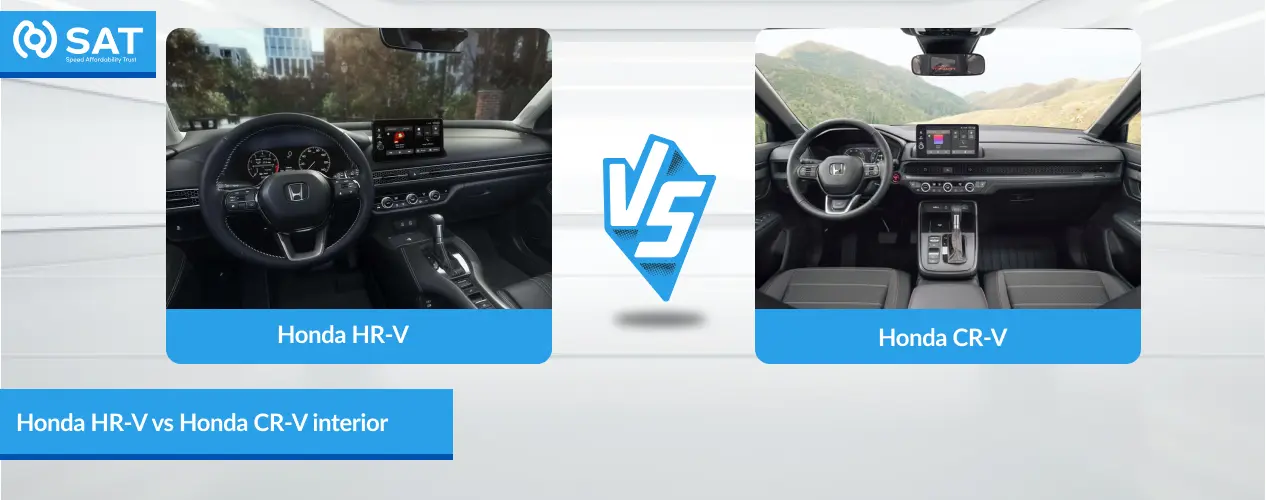
The CR-V starts to pull ahead here, with more room everywhere it counts.
The HR-V is 179.8 inches long. That’s easier to handle in traffic and parking lots. The CR-V is 184.8 inches long. It feels more planted on the highway and more refined overall. The HR-V is easier to park.
The CR-V feels better when life gets busy.
Both seats hold five, but the back seat tells the truth. The HR-V gives 37.7 inches of rear legroom, while the CR-V gives 41.0 inches. Adults will feel that difference right away.
Which has more? The HR-V has slightly more front legroom, at 41.9 inches. So if you mostly drive alone, it won’t feel tiny. However, the CR-V easily wins for back-seat space.
The HR-V has enough cargo space for groceries, gym bags, a suitcase, or a weekend run. The CR-V offers much more space for a stroller, sports bags, and airport luggage.
The CR-V fits 11 carry-on suitcases behind the rear seat. The HR-V fits seven. That’s not a small gap. That’s a “somebody has to hold a bag” gap.
Let’s be honest for a moment. We all expect the smaller SUV to win on fuel, right? But that’s not the case. Here is the fuel economy comparison.
Model | Combined MPG | Annual fuel cost at 15,000 miles and $3.50/gal |
HR-V FWD | 28 mpg | About $1,875 |
CR-V gas FWD | 30 mpg | About $1,750 |
CR-V Hybrid FWD | 40 mpg | About $1,313 |
So the bigger gas CR-V is actually a little better on fuel than the HR-V. That’s a little awkward for the HR-V. The hybrid? Different story. It beats both clearly.
The CR-V is more fuel-efficient. Gas CR-V beats HR-V slightly. CR-V Hybrid beats both by a lot. CR-V Hybrid is a clear winner in fuel efficiency.
The CR-V Hybrid is an expensive upgrade. The HR-V starts at $26,500. The CR-V Hybrid starts at around $35,630. That is about $9,130 more before fees, taxes, and options. That’s a lot, but the hybrid gives you more than better MPG. It offers smoother power, better city driving, more cabin and cargo space, and a larger CR-V body.
At 15,000 miles per year, the CR-V Hybrid uses about 375 gallons at 40 mpg. The HR-V uses about 536 gallons at 28 mpg. That saves about 161 gallons annually.
Fuel costs matter daily, but how these SUVs actually feel on the road matters just as much.
The HR-V is easy. It turns neatly, parks without drama, and feels light in traffic. For city driving, that’s exactly what you want. Still, the 158-hp engine can feel weak at highway speeds.
Its driving feel is calm and relaxed. The CR-V’s 190-hp turbo engine feels smoother in everyday traffic.
The CR-V drives better overall, with more power, more calmness, and more confidence at highway speeds.
The HR-V is better in tight spaces—smaller body. Easier parking. Less stress.
Overall, the HR-V is best for city streets and the CR-V for almost everything else.
The 2026 HR-V includes a 9-inch touchscreen, wireless Apple CarPlay, wireless Android Auto, Honda Sensing, and available AWD. That’s solid for the money. The CR-V gets better with each trim. It gives you a better cabin feel, more tech, and more comfort features.
Safety is close. Both offer Honda Sensing features like Collision Mitigation Braking, Road Departure Mitigation, Adaptive Cruise Control, and Lane Keeping Assist.
No SUV is perfect. These two just have different jobs.
HR-V pros
| HR-V cons
|
CR-V pros
| CR-V cons
|
Forget the numbers for a minute. Think about your actual week. That usually gives the answer.
Best for City Driving
The HR-V wins because it is smaller, cheaper, and easier to park. If you commute daily, live in a busy area, or want your first SUV, this one fits.
Best for Families
Here, the CR-V wins because it offers more rear legroom, cargo space, and power.
Best for Long Trips
The CR-V is the clear winner here. It offers much better highway comfort and improved MPG if you pick a hybrid. On the other hand, the HR-V is better for short city drives and quick weekend trips.
Families with multiple kids
Buyers wanting strong highway acceleration
People needing lots of cargo
Tight urban drivers
Buyers with strict monthly budgets
People who rarely use the rear seats
The best choice depends on your budget and your daily lifestyle. Here’s a crystal-clear answer.
Choose the HR-V if you want the lower payment, easy parking, simple commuting, and a compact Honda SUV. It’s the clean choice for city buyers.
Choose the CR-V if you want more cargo room, more rear-seat space, more power, better highway comfort, and a hybrid option. It’s the better all-around SUV.
Buyers looking for a practical family SUV with strong fuel economy and everyday comfort often lean toward the Honda CR-V because of its balance of space, performance, and long-term usability. If you are planning to buy a Honda CR-V, check out the latest listings at SAT Japan.

The history of automobiles is vast and filled with surprises. When was the first car ever made? Many people have wondered about this question, and it has been a controversial topic for over a century. It can be quite challenging to track down the first car ever made in the history of automobiles. Let’s take a closer look at the evolution of vehicles and find the answer to when the first car in the world was manufactured and who may have truly invented it.
When we look at the old resources of automobile history, we find out that many inventions before the first car in the world ran on fuel. For most of the 19th century, there were many cars powered by gas or steam. The first record we have is from 1968, when an astronomer invented a car around 2 feet long, which was a toy for an emperor of China.
The 1700s saw the development of steam engines, and many steam engine vehicles were launched. Amedee Bollee manufactured the first practical steam-driven car in 1878 at Le Mans in France. However, these vehicles had many disadvantages. Firstly, these vehicles could not be used until their furnaces had boiled the water. Secondly, when traveling, these vehicles needed a constant supply of water to turn water into steam and more fuel to heat the furnace. Lastly, they were extremely heavy to manage.
People at that time were also looking for engines smaller than steam engines so they could use them for the Industrial Revolution. Later, in wars, the need to make better cylinders for cannons increased the possibility of making an engine where fuel was burnt inside the cylinder. This way, the first practical vehicle powered by internal combustion engines was invented.
Gottlieb Daimler, in 1885, made the first practical vehicle powered by internal combustion engines – a motorcycle.
Karl Benz produced the first practical car in 1886 in Mannheim, Germany. His vehicle was a three-wheeler, Patent Motorwagen, which was very similar to the current cycle design. The vehicle received power from a single-cylinder engine that produced about 600 watts and used benzene as fuel. This vehicle had one seat and was steered by a tailor.
Later that year, Motorkutsche produced the first four-wheeled car. Though it was an open car, it had two seats. Benz’s 1898 Velo was the first car in the world produced on a production line. It was a four-wheeled open single-seater.
The first automobile that resembled the modern cars today was the 1901 Mercedes, manufactured by the DMG corporation that Daimler had helped to establish. It costed five times as much as the Velo, which Mercedes still sells. It had a four-cylinder engine that produced ten times as much power as the Velo. This vehicle was named after the daughter of the bank, who pressured DMG to produce cars that are faster and can be used in long distances.
The first practical car left a lasting mark in the auto industry. Here is what we know about the first car in the world.
The first ever car was the original collector item, and only 25 versions of the 1886 Patent Motorwagen were manufactured. This all happened right before Benz almost gave up on his masterpiece. But then his wife, Bertha, went on an important road test drive of about 12 hours, which led to the installation of brakes, a two-speed transmission, and other upgrades in this vehicle.
After years of experimentation with two-stroke engines, Benz developed the Patent Motor Car by combining easily accessible technologies, such as the engine, lightweight steel chassis, completely constructed two-seat velocipedes, and driving components, into a single unit. Production lasted from 1886 to 1893 when the Benz Velo supplanted it.
Benz was not totally happy with the four-wheel steering system that was available in 1886, so he went for a three-wheel system. Two rear wheels provided the power, and a front solitary wheel was assigned with steering duties.
This two-seater vehicle had a simple drive system with a 62-inch wheelbase. It also had a pair of chain drives coupled with a basic beam axle that provided power to the back axle. The transmission system consisted of a large leather strap with a single speed. The flywheel in this vehicle was placed horizontally, as Benz had an idea that spinning a heavy mass would generate too much inertia make steering difficult.
Though vehicles were made before the Patent Motorwagen, including automobiles powered by electricity and steam, this was the first with an internal combustion engine. It was also the first vehicle to be ever introduced commercially. This vehicle was powered by a 945cc single cylinder with a stock iron block and head engine. This vehicle was capable of producing 0.9 hp. Building on the foundation of early internal combustion engines, the development of the V8 engine represents a significant milestone in automotive engineering, offering enhanced power and efficiency. Learn more about the fascinating V8 Engine History.
In modern times, starting your vehicle is super easy as you do not even need to turn a key. In some cars, you just need to press a button or use a remote starter. However, things were quite different back in the day. For instance, to start a Benz Patent Motorwagen, you had to spin the large flywheel manually. So, you had to vigorously turn the flywheel at the rear after activating the ignition from the switch under the seat. Then, using the handwheel, you had to regulate the air supply.
It seems like Bertha Benz, the wife of Benz, was more familiar with the vehicle’s designs as she pointed out several improvements in the car’s design in her first test drive. Though the car was already remarkable, Bertha understood the needs and requirements of the real world more closely, which led to various improvements in the design.
She was also the one who took the Benz Patent-Motorwagen to the world’s first long-distance drive. She covered about 11 miles round trip with her two sons, in which the car broke many times, which she fixed each time, and added upgrades like the world’s first brake pad.
The parts and features of this vehicle might be short-lived, but the basic idea behind this vehicle led to the foundation through which all modern cards are built. The parts and details added to the engine of this vehicle formed the essentials of a modern internal combustion engine.
The company, the foundation of which was led by Carl Benz, is still around today and manufactures some of the most well-known and finest cars in the world. With its design, the original car made it possible to revolutionize the automotive industry with hundreds of vehicles manufactured daily. The successor company takes the crown for the most consequential development of auto manufacturing, including superchargers, multi-valve engines, anti-lock braking systems, and so much more.
Carl Benz's invention of the Patent Motorwagen automobile in 1886 marks the emergence of vehicles based on internal combustion engines. With steam and electric-powered motors being experimented on before Benz’s innovations, the first commercially sold vehicle with an internal combustion engine was developed. His pioneering efforts created the foundation for automotive engineering resulting in modern vehicles that are safer, more efficient, and powerful. Today SAT Japan is still continuing this legacy by further advancing innovation

When selecting a car for your family, you want something comfortable, affordable, and, most importantly, reliable. The car must perform well in all conditions, provide enough space for the family, and offer safety and fuel efficiency. This is the reason we provide listings for Used Nissan Cars For Sale. Nissan is famous worldwide for its durable cars and innovative technology on a budget. Whether driving the kids to school, going on a road trip, or commuting to work, a used Nissan can be your ideal partner.
At SAT Japan, we offer high-quality used Japanese Nissan cars for sale with financing options and worldwide delivery. Here are our top 10 family-friendly cars suitable for families of all sizes.

The X-Trail SUV adds comfort to all family trips, including long rides and deeply rooted school runs. Advanced safety gear like bonnet lifting systems, along with a driver assistance technology alert system, is a must for new school families. Adding to these features, it comes in family size, integrating a fuel-efficient engine, nailing the target on adventure-loving families. With its appearance of four-wheel drive and strong safety measures, the appeal of the vehicle augments.

This greatly enhances fuel economy while assisting families needing space and reliability. Nissan Serena encapsulates every goal working for larger families by dynamically positioning fuel-efficient hybrid train power mechanisms that ease everyday driving chores. There also comes a captain's nailing children parting slides, allowing for convenience in getting youngsters in and out of the vehicle. These are in addition to the car's flexible seating arrangement to shield three extra families from broader sight.

A compact hatchback, the Nissan Note is surprisingly spacious and fuel-efficient for its class. Additionally, it provides easy maneuverability for small families living in urban areas. Note that e-POWER models have hybrid efficiency capabilities without losing power. Passengers have plenty of legroom, and the cargo space is generous for a vehicle of this size.

The Nissan Cube's spacious interior and quirky design combine practicality and style, making it stand out from the rest. It is ideal for families that appreciate comfort and individuality. Cube's generous headroom and adjustable seat configuration make it ideal for transporting kids' gear. City driving is a breeze for this fuel-efficient compact, and the rear swing door adds convenience.
.webp)
The Nissan Rogue, or X-Trail in some regions, is an imposing SUV with a striking design and is perfect for a family. Nissan's Safety Shield technologies, which come equipped in the car, include blind-spot spot warning, rear cross-traffic alert, and forward-collision war car. The Rogue has a large, spacious cabin, great fuel economy, superb resale value, and, best of all, it is perfectly suited for growing families.

For a family looking for an efficient compact, the Nissan Dayz has unbelievable features for a kei car. Thanks to its tiny dimensions, navigating through the city becomes much simpler. Along with an impressive fuel economy and low maintenance costs, the Dayz accommodates young families seeking a cost-efficient solution. The model's tall roof guarantees a roomy cabin, while the digital display, advanced climate control, and lane-keep assist add modernity.

A member of one of the more affluent vehicle categories, the Nissan Elgrand is a luxury MPV and makes a great car for those looking for more comfort and ease when traveling as a family. The car can accommodate 7 to 8 passengers, depending on the version, while offering soft, comfortable seating and cruising. Ideal for commuting and long-distance travel, the Elgrand also boasts high-end features like leather seats, dual-zone climate control, and an advanced infotainment system. This vehicle fits a family's transportation needs, but at the same time, it has a touch of class.

Regarding sporty, appealing families, the Nissan Juke is the go-to vehicle. That's because it combines bold design features without compromising practicality. This compact crossover is fun to drive and allows for easy navigation through city traffic. To outperform the competition, the rear seats conveniently fold to expand cargo space, and other practical features have also been added, such as rearview cameras and a control traction system. Compact families will appreciate the Juke due to its unmatched aesthetic appeal without sacrificing performance.

The leg seating space is generous, and the handling is smooth, making driving for both day-to-day activities and excursions during the weekends much easier and enjoyable. The Nissan Tiida is family-oriented because of its dependable hatchback or compact sedan. With respect to its fuel economy, the Tiida offers economic practicality, a feature appreciated by many family buyers, alongside comfort, reliability, and affordability.

Lastly, Lafesta's seat configuration enables up to seven people to be seated, in addition to the sliding rear doors. This makes the Lafesta a compact MPV tailored for convenience and practicality for family needs. The Lafesta is also known for its ease of use in urbanized settings while maintaining good fuel efficiency. It's a practical automobile for families who want more space but don't require a full-sized van yet find a sedan too compact.
SAT Japan focuses on one domain: selling the most reliable used Nissan cars at the most convenient prices. This is especially true when the cars are imported from Japan. Regarding the cars in their inventory, there is assurance that strict inspection was done on performance, mileage, and internal condition. Whether it's a compact hatchback or a spacious SUV for the family, SAT Japan possesses the right vehicle.
They provide global car delivery and easy financing options to other services; they work to ensure your satisfaction every step of the way and guide you throughout the purchase process.
| Model | Body Type | Seats | Fuel Economy (km/L) | Best For |
| Nissan X-Trail | SUV | 5-7 | 12–16 | Road trips, large families |
| Nissan Serena | Minivan | 7–8 | 15–20 | Spacious family use |
| Nissan Note | Hatchback | 5 | 20–25 | City driving, small families |
| Nissan Cube | Hatchback | 5 | 17–22 | Style and practicality |
| Nissan Rogue | SUV | 5 | 12–16 | Safety and style |
| Nissan Dayz | Kei Car | 4 | 25–30 | Urban, fuel efficiency |
| Nissan Elgrand | MPV | 7–8 | 9–13 | Luxury family travel |
| Nissan Juke | Crossover | 5 | 15–20 | Sporty and compact |
| Nissan Tiida | Sedan/Hatch | 5 | 14–18 | Daily commuting |
| Nissan Lafesta | MPV | 7 | 13–18 | Compact family van |
When selecting a family vehicle, comfort, safety, and overall price are extremely important. That is why SAT Japan has a trusted selection of used Nissan cars for sale. From generous SUVs such as the X-Trail to compact city-friendly cars like the Note, you will not be left lacking, as Nissan has something available for everyone.
Visit SAT Japan today to check out the wide range of cars available and drive home the perfect family vehicle.

Cars are complex mechanisms that work on strict principles of chemistry and mechanization. Introducing foreign elements into such a sensitive system will do much harm, and salt is the most dangerous. Although it seems unimaginable to do so, knowing the possible risks and results of putting salt in gas tank could actually be very important information for car owners. This guide will explain salt’s dangers in a gas tank, providing a person with the associated risks and the kind of damage that it can cause, whether out of curiosity or concern.
Salt is a chemical compound—sodium chloride—which can easily dissolve in water and create a saline solution. Salt, when it gets into your gas tank, initiates terror on your vehicle’s fuel system.
Below are the things that can happen when putting salt in gas tank or fuel system :

Salt is well known for its corrosive properties. Dissolved in water, it may enhance the corrosion of metal parts in your fuel system. This includes severe rusting or corrosion in components like the gas tank, fuel lines, fuel injectors, Water Enters your Gas Tank, and even the engine. Eventually, this will cause fuel leaks, lead to clogged injectors, and destroy engine internal components.

Salt particles, and later on the saline solution, may accumulate in this fuel filter. The fuel filter entraps all particles of dirt before they can enter the engine. However, with the addition of salt, the filter fills up quickly and chokes, thereby blocking the fuel supply to the engine. A clogged fuel filter will lead to erratic running, stalling, and might finally make the engine stop running altogether if not taken care of in time.

When salt is introduced to a gas tank, it dissolves in the water that might be present in the fuel. While gasoline and water do not directly mix, the inclusion of water in a fuel tank might be through the presence of condensation or just through low-quality fuel. Once the saltwater solution has been formed, it could then be sucked into the fuel system and contaminate the gas. It thereby reduces its ability to burn. The rest is a problem of loss of power and higher emissions due to inefficient combustion. For a similar destructive effect, consider How Bleach Can Destroy Your Car Engine.
Fuel injectors are made in a way that they need to give out a fine mist of fuel inside the engine’s combustion chambers. Salt particulates are likely to eat out such delicate components of fuel delivery, leading them to fail. This can give way to problems like inferior performance, lowered fuel productivity, and other major problems together with rather costly repairs or overhauling.
The most damaging result of pouring salt into a gas tank is the potential for harm caused to the engine. If the contaminated fuel makes it to the engine, this can cause internal damage through corrosion and wrong combustion. To this extent, the engine may most likely fire out of sequence, run rough, or just not start at all. In the cases like Worst Liquid to Put in Car Gas Tank, engine damage from salt is irreversible; this clearly calls for a new or total engine build.
Even though the idea of putting salt in a gas tank might seem far-fetched, it could happen in a few instances:
A very common reason a gas tank is found with salt could be vandalism. Various harm-intending individuals can pour salt into the gas tank of the vehicle causing destruction. This kind of gross damage calls for big repair expenses for the vehicle owner, who will be disturbed by many inconveniences.
Sometimes, for a joke or due to a completely bizarre misunderstanding of what would happen, salt is put into a gas tank. Again, this is highly dangerous and irresponsible: the results could be major damage to the vehicle.
There have been myths, such as using unconventional elements to repair automotive problems. For instance, some myths suggest that placing salt in a gas tank might just clean the fuel system or somehow rectify a given problem. The same is not true and will only lead to potential damage to the motor vehicle.
Most importantly, the best prevention against the dangers of salt in your gas tank is to prevent vandalism by taking care and being well-protected. Always park your vehicle in a safer place—for instance, in a garage or under a very luminous location— and consider having a locking gas cap to block possible access to your fuel tank from unwanted hands.
You should recognize the symptoms in case you suspect the introduction of salt in your gas tank. These could be poor engine performance, difficulty in engine starting, reduced fuel economy, or noise from the engine. If any of the symptoms are named appear, one should act urgently.
If you believe you have had salt poured into your fuel tank, do not start the engine. Starting the engine may move contaminated fuel throughout the entire system, causing even greater damage. Instead, have your vehicle towed to an auto repair facility equipped to drain your fuel tank, clean the fuel system, and check for other damages. This is similar to the Impact of Coke on your Car Engines, where foreign substances can lead to severe engine damage.
Any salt residue in the fuel system will have to be very carefully flushed by a mechanic from the gas tank, fuel lines, and injectors. In severe cases, components such as the fuel pump, fuel injectors, or even the engine may need repair or replacement. It can be costly, but surely preventive further on in your vehicle’s security.
The dangers of salt in your gas tank are uncountable. That salty-looking substance in the gas tank has the potential for wide distribution in your fuel system, all the way through the engine, costing you a lot of money in repairs and long periods of downtime. Salt in a gas tank, whether put in there through the act of vandalism, a silly prank, or a misunderstanding between the solution to another problem—either way—should not be counted. Take further preventive measures and act promptly if salt is suspected in the vehicle in order to protect it from this kind of dangerous situation and its very costly results. For expert advice on car maintenance and issues, trust SAT Japan to guide you.

The Toyota Camry is one of the popular midsize sedans that, by far, has set standards in reliability, comfort, and efficiency levels. A fresh redesign, advanced specifications, and improved performance metrics of the 2025 Toyota Camry Hybrid promise to elevate these attributes to a whole new level. With consumers shifting toward hybrid vehicles for sustainability benefits and improved fuel efficiency, the outlook for the 2025 Camry Hybrid promises to be an exciting proposition on the changing automotive landscape. In this detailed blog, we talk about an expected redesign, key specs, range, acceleration, and everything new and exciting about the 2025 Toyota Camry Hybrid.
The 2025 Camry Hybrid has adopted a sleek, sporty design while optimizing aerodynamics. It has an aggressive front grill flanked by sharp LED headlights that add to visibility while giving a glamorous look.
The side profile is very curvaceous and positioned slightly lower than the outgoing model to create an overall dynamic appearance more attractive to the eyes. New wheel designs are available from 17 inches to 19 inches giving buyers an option to further modify their car.
The rear is also quite captivating with LED taillights extending around the edges; it is a great look and improves rear visibility perfectly.
Inside the 2025 Camry Hybrid, you’re welcomed with a futuristic blend of comfort and technology. The interior has a premium quality finish with soft-touch surfaces, ambient lighting, and a spacious five-seating capacity. Toyota looks forward to perfecting the user experience with a better-than-ever infotainment system with an enlarged touchscreen of 12.3 inches and a convenient Head-up display.
The car is also equipped with standard systems including Apple CarPlay and Android Auto, for smartphone connectivity. A premium audio system and navigation will also be included for the proper satisfaction of audiophiles and tech enthusiasts. Toyota prioritizes convenience and safety and includes Advanced Driver Assistance Systems (ADAS) to make driving fun and safe.
There are two powertrains available in the Toyota 2025 Camry, one powering the front wheels and one driving all four. The front-wheel drive models combine a 2.5-litre four-cylinder engine with two electric motors giving out 225 horsepower. The all-wheel drive model adds a third electric motor that increases the output to 232 horsepower. The entire hybrid setup ensures smooth transitions between electric and gasoline power, thus optimizing fuel efficiency and performance.
The Camry Hybrid will likely come with an eCVT electronically controlled continuously variable transmission offering smooth acceleration and deceleration, which enables better energy usage by providing improved fuel economy levels and much lower noise. Coming to its enhanced dynamic handling, Toyota Used Cars for Sale will probably install in the 2025 edition a sport-tuned suspension to offer better cornering and stability.
This year, the 2025 Camry Hybrid will be available in the same dimensions as its predecessors- which implies a roomy interior and truck capability that has won customers over the midsize sedan. Its trunk capacity is about 15.1 cubic feet and there’s more room for luggage, groceries, or sports equipment. Its practicality matched with performance will add more to its appeal.
Another impressive feature of any hybrid automobile is fuel efficiency. In response, the 2025 Toyota Camry Hybrid is not an exception. Estimates put the fuel average for the Camry Hybrid at approximately 52 mpg in a city cycle and about 53 mpg on a highway trip. Such estimates make it among leaders in its class and promise such a car to be a worthwhile choice while saving on fuel expenses without losing any speed.
Beyond these impressive economies, the 2025 Toyota Camry Hybrid will likely boast a relatively modest electric-only range. As of now, the figures for this are still speculative, but early reports suggest it could go as high as 40 miles on a full electric charge. Such complete routes will be available for shorter commutes or errands with purely electric power, making it an overall better efficiency.
The 2025 Camry Hybrid strikes a good balance between efficiency and performance. Comparing it to a sports car may not be justifiable but its top-of-the-line variant accelerates from 0 to 60 mph in just under 7 seconds. So it definitely can merge onto highways and drive through city traffic with a lot of confidence.
To further enhance the driving experience, the 2025 Camry Hybrid offers multiple driving modes including eco, EV, and sport. Fuel efficiency remains the focus of the eco mode. The EV mode would permit electric-only operation at slower speeds and the sport mode would provide a more spirited ride with tighter throttle response and better steering feel.
The 2025 Camry Hybrid will reportedly debut with Toyota’s newest infotainment system that will boast, indeed, an interface to be answered through voice commands as well as touch inputs. Among its upgraded features are:
Navigation by real-time traffic updates
Bluetooth connectivity for handsfree calling
SiriusXM satellite radio and HD radio
Multiple USB ports for charging and keeping devices charged
Safety will be high on the list of priorities for the Toyota ranks, and, therefore the 2025 Camry Hybrid will feature a clutch of additional safety provisions as standard. Some of the most obvious technologies that should be featured are:
Adaptive Cruise control
Lane departure alert with lane-keeping assistance
Pre-collision system with pedestrian detection
Blind-spot monitoring with rear cross-traffic alert
All these features boost even greater driver confidence further solidifying Toyota’s continued commitment to safety in vehicles.
There is a much more simplified trim line in the 2025 Toyota Camry, and it only provides you with four choices:
Interior features include dual-zone automatic climate control, an 8-inch touchscreen, and a high-efficiency hybrid powertrain on the base model.
The 2025 SE brings sporty looks from front and rear black grilles and wheels. There are also standard SofTex seats and a sport-tuned suspension underneath.
This comes with more premium upgrades including a 12.3-inch touch screen, heated front leather seats, and much more to come.
Top of the line for the XSE has the benefit of the suspension that is sport-tuned like in the SE, however many of the premium features are added to this XLE design.
The 2025 Toyota Camry is a testament to cutting-edge technology and premium craftsmanship providing an exhilarating driving experience. It is well-positioned to cater to the evolving demands of consumers with its impressive performance, high-tech features, and excellent fuel efficiency. SAT Japan brings you a fresh inventory of new and used vehicles with comprehensive services, from the initial search for your car to its timely delivery. To experience a seamless and hassle-free car-buying journey, consulting SAT Japan would be a wise move.
Diverse Inventory: Discover a wide range of new and used models, from sedans and hatchbacks to luxury SUVs and trucks. SAT Japan offers a variety of cars to meet every customer’s taste and style.
Quality Assurance: Every car listed on the website undergoes strict inspection to ensure top quality and dependability. With SAT Japan, you can be confident that your purchase will be in immaculate condition.
Personalized Guidance: At SAT Japan, customer satisfaction is a top priority. They provide personalized attention to understand each client’s needs and preferences fully.
Global Shipping: With an extensive network across 200 countries, SAT Japan ensures timely delivery of your vehicle, no matter where you are.
SAT Japan is your trusted partner in finding your ideal car effortlessly. Visit their website to explore a variety of cars or contact their team to get your 2025 Toyota Camry Hybrid.

For several decades, the Honda Accord has been one of the most iconic midsize sedans that offer a perfect balance of reliability, impressive performance, and dynamic driving. Now, heading into 2025, the all-new Honda Accord will get a major revamp, changes that promise to spice things up in an increasingly competitive segment, slowly shifting toward hybrid and electric vehicles. This blog will highlight the design overhaul, key specifications, driving range, and speed of the 2025 Honda Accord and why it’s such a hit.
The 2025 Honda Accord boasts a modern, aesthetic look that is completely different from its predecessors. In front, it boasts a more aggressive grill, and more angular LED headlights, for a sporty character and improved aerodynamics.
The side profile has become refined, and smooth lines are presented in a more dynamic silhouette. Also quite striking is the rear, with redesigned LED taillights and a subtle lip spoiler, which boosts its sporty stance. New color options and wheel designs are expected so the buyers can personalize their flavor.
Inside, the 2025 Accord promises to be spacious and luxurious. Upper trims in the cabin will feature premium materials, especially soft touch, while leather trims can be opted for to make the feel of the ride exceptional. There is also the much-anticipated infotainment touchscreen of 12 inches with wireless Apple CarPlay and Android Auto. The updated system promises a seamless connection and easy-to-navigate interface to enhance the driving experience.
Like previous models, The 2025 Accord promises ample headroom and legroom for both front and rear passengers. These Honda Cars for Sale are a great bet for families and long-distance travelers. The trunk will also be spacious with about 16.7 cubic feet of cargo or luggage space.
They will be much at par with the previous model in terms of overall dimensions so combining spaciousness with agility. This will be maintained with a length of about 195 inches and a width of about 73 inches, making the Accord look nothing less than a commander on the road.
The 2025 Honda Accord should offer a variety of powertrains. The base model will more than likely carry on the tiny engine, which is likely to be a 1.5-liter turbocharged four-cylinder engine producing 192 horsepower. There is a hybrid variant that offers more power with the 2.0-liter four-cylinder engine and two electric motors that combine for 204 horsepower, and it’s the only powertrain offered in Sport, EX-L, Sport-L, and Touring models. Both of the engines will probably be paired with a CVT inherently smooth and thrifty way of imparting the torque.
There are several options prepared to make the new 2025 Honda Accord deliver performance that by its very nature is balanced-that suits both common drivers and enthusiasts. The standard 1.5-liter engine could be expected to bring acceleration from 0 to 60 mph in about 7.5 seconds. In contrast, the 2.0-liter turbocharged hybrid version does that in 6.5 seconds.
Like the Honda brand, the new 2025 Accord promises to be as entertaining to drive as it is functional. At its core, that means a sport-tuned suspension with improved abilities and stability both when cornering and overall. The Accords might also include different driving modes to tailor one’s experience towards fuel efficiency, comfortability, or sportiness.
With impressive fuel economy, the 2025 Honda Accord will be a stunner, particularly with its hybrid version. The gasoline engine version will likely achieve around 29 mpg in the city and 35 mpg on the highway. However, the hybrid variant’s projections are much more optimistic, with a combined estimate of around 48 mpg.
This hybrid model will most likely feature a battery pack that can support a healthy electric-only range. Figures remain still quite speculative, but it’s fair to assume the Accord Hybrid can easily generate about 40 miles of electric-only range on a full charge before dipping into a little gasoline, thus being good enough for short commutes or errands.
The 2025 Accord is equipped with the most advanced technology. The infotainment system will offer:
12.0-inch touchscreen display
Wireless Apple CarPlay and Android Auto
Built-in Bluetooth connectivity
Premium audio system options
This guarantees that drivers are always connected while still offering a ride that will bring entertainment and convenience to the users.
Safety comes first, and it is at the core of Honda’s design philosophy, and the new 2025 Accord will be no different. Equipped with one of the latest overall suites of Honda Sensing technologies that may include:
Collision Mitigation Braking System
Road Departure Mitigation
Adaptive Cruise Control
Lane Keeping Assist System
These features provide the driver with maximum awareness while taking good care of safe driving and constitute a strong reason for the Accord’s reputation for reliability and safety.
The 2025 Honda Accord will be offering a range of variants with unique specs and features to meet the varied preferences of its consumers. Let’s take a look at what each of these variants offers.
The base model will have a 1.5-liter turbocharged four-cylinder producing an estimated 192 horsepower. The transmission will feature a Continuously Variable Transmission (CVT). It will have a standard Honda Sensing suite, a 7-inch touchscreen infotainment system, and advanced safety features.
This has a 1.5-liter turbocharged four-cylinder producing an estimated 192 horsepower. It has a CVT transmission and upgraded interior materials, a large round touchscreen of approximately 12 inches, sporty styling elements, and upgraded audio.
The EX-L’s turbocharged 2.0-liter I4 gives out 252 power output and has a 10-speed automatic transmission. Its interior features leather upholstery, a premium sound system, and more advanced navigation.
The hybrid comes with electric motors alongside a 2.0-litre inline engine that produces a combined 212 horsepower. It has an electric Continuously Variable Transmission (e-CVT) offering excellent fuel efficiency, regenerative braking, and all the features of the LX and above.
The hybrid sport features a 2.0-litre inline four-cylinder hybrid with about 212 horsepower. It also has an eCVT, high-tech features, sporting suspension, styling, and a much better infotainment touchscreen.
This has a massive 2.0-litre turbocharged engine with a 10-speed transmission
It has about 252 hp and accommodates the most luxurious features, advanced driver-assistance technologies, high-quality premium audio, and added comfort features.
The 2025 Honda Accord is all geared to be a strong contender in the midsize sedan market through its bold redesign, innovative technology, and great performance metrics. It offers diverse powertrains across hybrid variants that can suit most consumer preferences, especially with the ever-growing popularity of eco-friendly vehicles, which is another aspect of what makes the next Honda Accord special.
As always the 2025 Honda Accord will be the center of attention and carry on the legacy of its predecessors. With improved specs and technology, you can expect this car to provide an exhilarating driving experience. To experience this masterpiece firsthand, head over to SAT Japan. Being a global exporter of Japanese cars, SAT Japan enjoys a solid reputation in the industry and is a true haven for motoring enthusiasts with a diverse inventory of car makes and models. You will find a variety of options that meet the varied styles and preferences of customers. Moreover, once you get in touch with us, our expert will help you through tailored guidance to get you your ideal car at the best price. You can explore more options on our website and get the first glimpse of the 2025 Honda Accord.

The BMW 3 series has been dominating the automotive world since its release and has been one of the most iconic luxury sedan series on the market. The BMW 3 series, other than stylish grace, offers impressive agility and performance due to its precise engineering. Moving into 2025, the BMW 3 series was bound for a fresh update with a revamp. BMW Cars for Sale takes the opportunity to redefine the already impressive 3-series sports sedan for an even more dynamic driving experience.
Written below are all the incoming updates and changes to the BMW 3 series 2025.
When it comes to the exterior, the BMW 3 Series presents a fresh and unique look, giving the car a favorable demeanor. This modern compact sedan has an aesthetic exterior with an aggressive grille and aerodynamic elements surrounding the stylish vehicle. The side profile has been upgraded a notch with more intense aerodynamic indentations. The model is not available in two new colors, Arctic Race Blue and Vegas Red Metallic. BMW 3 series 2025 reviews rave about these fresh additions given that the exterior is already a selling point for preceding 3 series models.
BMW has not skimped out on additional details for the interior, especially in the cockpit where it matters the most. The redesign offers improved driving positions with excellent road visibility and a stable and intuitive functioning of the cockpit. The BMW 3 series review mentions two distinctive wheeling options in the new model, the 330i model has a two-spoke polygonal steering wheel and the M340i features a three-spoke flat-bottomed M steering wheel giving the ride a sporty touch. The multifunctional and easy-to-use controls provide ease in the driving experience and make it more pleasant.
When it comes to the overall dimension of the model, BMW 3 series reviews deem it at par with previous models. Although the focus of updates has remained mainly on the performance aspect, the pre-existing dimensions of the 3 series provide a spacious and comfortable drive with further improved agility.
The BMW 3 series 2025 review predicts that there is significant variation in the new update. Two new turbocharged engine technologies are available that utilize 48-volt MHEV technology to decrease the response time and result in quicker engine response. The M340i and M340i xDrive are both utilizing this technology and have been given two additional cylinders for an even more powerful drive. Hence, the new six-cylinder engine technology paired with an eight-speed automatic transmission has boosted the BMW 3 series performance for it to glide on the streets looking and performing its best.
There are a few diverse options introduced to upgrade the new BMW 3 series 2025 to deliver its best performance yet. BMW 3 series is designed to deliver a comfortable and effortless drive for any kind of driver, common drivers, and car aficionados alike. The base engine is a 2.0 Liter mild hybrid option that delivers 255 horsepower and 295 torque. The M340i offers a 3.0 liter inline-6 engine that kicks things up a notch with 382 horsepower and 369 lb-ft torque. Several suspension setups with adaptive dampers are available for your preferred extent of performance refinement.
Following in the steps of the BMW legacy, the BMW 3 series review promises that the drive is leveling up in terms of engagement and entertainment. The custom suspension setups are there to improve the ability of your BMW 3 series model on the road and during sharp turns. You can now choose which pace you want to drive at and how much responsiveness you require from the car. For those seeking a compact SUV with dynamic handling and modern tech, the 2025 BMW X1 model offers spirited performance, advanced driver assistance, and a bold design that complements BMW’s driving legacy.
The new BMW 3 series will be powered specifically through premium unleaded fuel which is a requirement for its powertrain. The BMW 3 series review mentions that it provides a fuel economy of 28 mpg on the road and 35 mpg on the highway. This model has a maximum fuel tank capacity of 15.6 gallons. For a luxury model, this can be deemed a highly optimistic level of fuel conservation.
With the efficient powertrain and engine working simultaneously, the BMW 3 series review estimates that the BMW 3 series 2025’s range on a full tank of gas will be 436.8 miles in the city and 546 miles on the highway. This makes this model ideal for long journeys without making too many costly fuel stops.
This luxurious sedan is equipped with the most progressive technology to make every ride feel like an adventure. The 2025 BMW 3 series infotainment offers:
15-inch infotainment display.
10 speakers and 2 subwoofers
Wireless Android Auto and Apple CarPlay connectivity
Keyless Ignition
Touch-sensitive steering wheel controls
These exciting features and many more are what make the BMW 3 series 2025 review claim the maximized convenience and entertainment in the newer model.
The safety features for any ride are of the utmost importance and BMW does not skimp away from innovation when it comes to safety features and technology.
Tactical airbag placement
Collision mitigation system
Dynamic cruise control
Child safety attachments
Braking assist and mitigation
Intuitive LED lights
Remote anti-theft alarm system
These features help you stay aware on the road and precautionary measures introduced to the safety system keeps your mind at ease while on the road.
SAT Japan is the ultimate destination for those searching for well-maintained and certified Used Cars for Sale. We offer impressive deals on a wide range of luxury and economy vehicles. Our expert staff on board is dedicated to your ease and our customer-centric services will make the entire process unbelievably simpler. We recognize our responsibility to present the best course of action according to your preferences.
SAT Japan offers several financing options that help cushion the burden of becoming a car owner.
SAT Japan offers insurance services for any damage that may occur at the time of overseas shipment or delivery. You must report the damage within two weeks of receiving your vehicle after which the technical experts here at SAT Japan will verify the damages. Once the damage has been confirmed, SAT Japan is willing to reimburse any costs of the damage that occurred, up to the value of the vehicle.
When one purchases a car, they spend many nights tossing and turning thinking of the neverending costs of the car purchasing process. Whether you are a first-time car owner or a car purchasing veteran, paying a large lump sum of your hard-earned money can make even the best of us wince from the losses. To help our customers avoid such difficulties, SAT Japan offers convenient financing and installment plans, up to 24-month installments.
SAT Japan takes responsibility for safely delivering your vehicle to your doorstep without you having to be involved in the verification and shipment processes. The customs clearance process can be entirely daunting without having someone’s opinion to guide you and one blunder can lead to massive delays in the process. Our expert task force and local agents present at the customs office will take care of all details after you provide them with the relevant documentation and information required. SAT Japan helps you avoid any setbacks in your car purchasing process and makes everything simpler.
SAT Japan offers exceptional storage and delivery services to keep your vehicle in safe surveillance until it reaches you. In other instances, if you are not available in the area of delivery because of traveling, you do not need to fret about coordination. SAT Japan stores your vehicle in our temperature and ventilation-controlled storage facilities for free for the first 30 days after purchase, after which the next 30 days of storage will cost. This means that you can have your mind at peace for the time that you are traveling, to then come home to your vehicle in pristine condition.
If you fancy curated and vintage pieces or just want to stand out from the crowd when you step out in your used vehicle, SAT Japan offers auction services for its highly classified vehicles tailored to your taste and preference. Our staff will guide you through the auction and bidding process, advising you on the best course of action to gain a solid deal on your dream car. Have a distinctive car-buying experience through our auction bidding events and enjoy the curated list of selected vehicles for sale.
It is no easy feat searching through the endless sea of options to finally shave down your desires to reach a final decision. Our expert staff and customer-centric services at SAT Japan help you make the right decision at every step of the purchasing process. Hence, SAT Japan is the ultimate car enthusiast website where you can find a plethora of well-maintained options for your potential next ride. Head on over to SAT Japan’s website and scroll through our vast inventory to find the perfect family sedan for you.

Importing used cars from Japan to Sri Lanka requires a good understanding of taxes, customs, country regulations, and a bit of patience. But you don’t have to worry much about the import process if you pick an exporter like SAT Japan that takes care of most of the steps. We have a highly professional sales team that ensures you get personalized service when importing your Japanese car to Sri Lanka. With experience handling shipments specifically to Sri Lanka, SAT Japan is well-versed in local procedures and makes the entire process more efficient for you.
Japanese vehicles are some of the most reliable vehicles in the world. They are of high standards, affordable, of exceptional quality, and advanced engineering. Japan has a really advanced automobile industry with a wide range of vehicle choices. Here’s why you should consider importing Japanese vehicles to Sri Lanka:
Exceptional quality and reliability
Cost-effective options
Fuel-efficient vehicles
Easy availability of spare parts
Better resale value
Honda, Nissan, Mazda, Toyota, you name it, all the big automotive brands are housed in Japan. They are all widely recognized worldwide for producing vehicles that last a lifetime. In Sri Lanka, the top-selling used Japanese cars are:
Honda Vezel
Nissan Roox
Suzuki Wagon R
Toyota Raize
Suzuki Alto
Suzuki Every
Toyota Aqua
These vehicles are favored for their low maintenance costs, advanced features, and high resale value. Moreover, the Japanese practice of regular vehicle inspections keeps the cars well-maintained, which is a top reason why they are so in-demand in Sri Lanka.
While most Sri Lankan buyers choose used vehicles due to their affordability and relaxed age restrictions, importing brand-new cars from Japan is also a viable option. This is particularly true for those looking for the latest models, full warranties, and advanced features.
The best part is that you can access the latest models that are not yet available locally. What’s even better is that they have a higher resale value compared to used cars. Having access to technology and newer features through brand-new vehicles is truly a win-win.
You can choose from over 200,000 cars weekly. Yes! Buying Japanese cars through Auction is a popular choice for Sri Lankan buyers due to their reliability and affordability. You can choose from a wide range of vehicles, from compact cars to luxury models. These auctions serve you with a detailed inspection report containing everything from mileage to condition and more. Can there be any more cost-effective and reliable option than this for buyers worldwide?
| Tax Type | Rate |
| Duties | 5% to 35% |
| Motor Vehicle | 25% |
| Ports and Airport Levy (PAL) | 5% of the CIF value, or at a rate between 0% and 2.5% |
| VAT | 12% |
| Ad valorem rates | 1%- 45% (of the CIF value) |
| Nation Building Tax | 2% of the sum of the (CIF value x 110%) excise duty, cess, customs duty, and PAL. |
Only right-hand-drive vehicles are permitted to be imported to Sri Lanka from Japan. No left-hand-drive vehicles will be allowed entry into the country.
Cars: Should be a maximum of 2 years old.
Buses, Jeeps, Motor Cars, Ambulances, Motorbikes, All-Terrain Vehicles: Up to 3 years old.
Single and Double Cabs, Trucks, Lorries, Refrigerated Trucks: 4 years
Vehicles are typically shipped to Sri Lanka via the ports of Colombo and Hambantota.
A seaworthiness certificate from the Japan Auto Appraisal Institute (JAAI) is required for used vehicles imported from Japan.
Register the vehicle within 90 days of the Bill of Entry.
You will need the following import documents for customs clearance:
Bill of Lading: Proof of shipment.
Export Documents: Vehicle's registration details from Japan.
Owner’s passport: Identification of the importer.
Purchase Invoice: Proof of purchase and vehicle value.
Original Registration Certificate: Must include an English translation.
Import License: Authorization to import the vehicle.
Letter of Credit: Proof of payment through a licensed bank
Delivery Order issued by the Shipping Agent
Value Declaration Form: Declaration of the vehicle's value.
Pre-shipment inspection certificate: Issued by an approved inspection agency, such as JAAI.
After clearing customs, the vehicle must be registered with the Department of Motor Traffic within 90 days of the Customs Declaration (CUSDEC) date. Failure to register within this period may result in penalties.
As per the Sri Lankan Ministry of Finance, imported vehicles must be registered within 90 days. Failing to do so will result in a 3% fine on the unregistered vehicle's value, with the penalty capping at 45%. Moreover, if an importer fails to register at least 25% of their imported vehicles within six months, their importation privileges may be suspended.
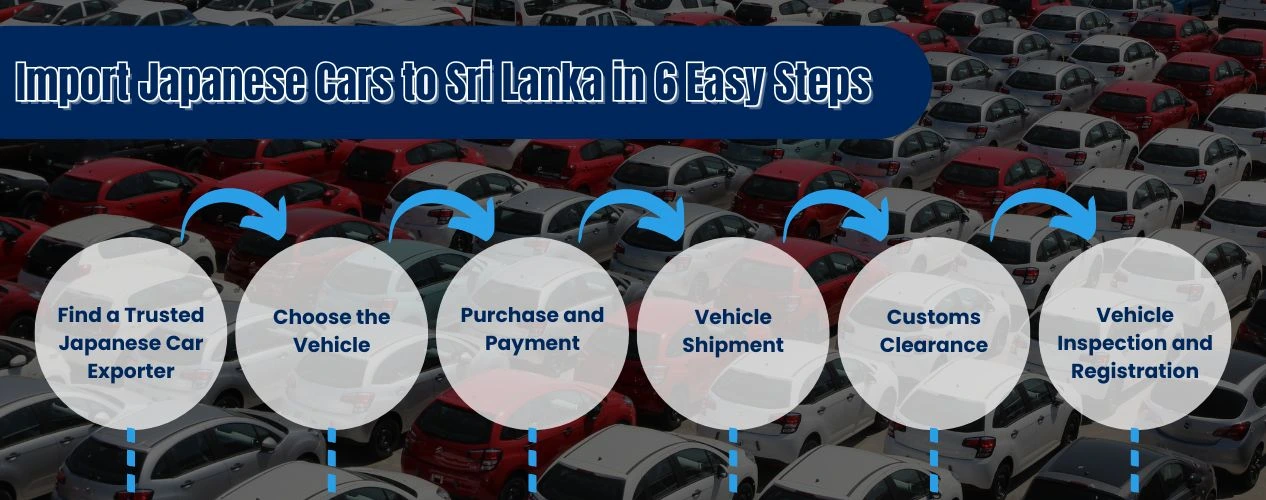
Follow these steps to import Japanese cars to Sri Lanka:
Start by selecting a reputable exporter who can import a Japanese car from Japan to Sri Lanka. For instance, you can rely on SAT Japan for reliable services and extensive inventories of Japanese used cars.
Go through SAT Japan’s online inventory to find a car that suits your preferences and budget. Ensure the vehicle meets Sri Lanka's import regulations, like:
Passenger cars should be no more than 2 years old.
Only right-hand drive (RHD) vehicles are permitted.
The vehicle must pass a roadworthiness inspection by the Japan Auto Appraisal Institute (JAAI).
Once you have your eyes on a vehicle, we will provide you with an invoice detailing the cost of the vehicle. You can open an LC (letter of credit) through your bank to facilitate secure payment. Finally, you can complete the payment as per the agreed terms.
The exporter will arrange for the vehicle to be shipped to Sri Lanka, typically via RoRo vessels to the ports of Colombo or Hambantota. This usually takes 2 to 4 weeks. Meanwhile, you can track your shipment to get real-time updates.
Prepare all the necessary documents mentioned above for the arrival of your vehicle and customs clearance. Be aware of all the applicable charges.
Once you have the Japanese-imported vehicle with you, get it inspected thoroughly to ensure compliance with Sri Lankan standards. Then, register your vehicle with the Department of Motor Traffic within 90 days to avoid any penalties.
There you have it; the best way to import cars from Japan to Sri Lanka, without much hassle.
There’s no doubt that importing a vehicle from Japan to Sri Lanka is worth it and a thoroughly rewarding experience. But it’s always better to stay on top of your preparation to prevent any mishap. Here’s what you can do:
Incomplete or missing documents can result in significant delays during the import process. That said, it’s better to double-check all the required documents and prepare a copy of each to tackle any last moment misplacements.
Logistical issues are another common problem that causes delays in shipments. Since we always provide you with tracking details, you can monitor your vehicle and have peace of mind. However, you need to ensure all the documentation is prepared well on your end to prevent hold-ups at customs.
Importing a Japanese used vehicle to Sri Lanka involves tax and duties that impact the overall cost of shipping. That’s why it’s recommended to familiarize yourself with all the different kinds of taxes and regulations of your country.
Considering the rise in online fraud, we understand it can be difficult to trust a dealership for one of your life’s biggest investments: your car. This is why, at SAT Japan, we provide guidance every step of the way, ensuring transparency. This is done to help you bid with confidence so you get your desired vehicles at the lowest possible prices. You can explore more reviews at Trustpilot and Google to see how we've assisted others in making informed car purchases and how our customers view our brand.
Japanese used cars are popularly sold around the world for their reliability and cost-effectiveness. You, too, can make your dream of having a Japanese car come true by following the right import process.
Visit SAT Japan and choose your vehicle from our wide array of listings. Stay updated on all the regulations and required documents, and stay in touch with our professionals to ensure a smooth and successful vehicle import journey.

Importing a used car from Japan to South Africa is a very reasonable choice, as the vehicles are typically compliant with the South African standards. The import process involves a few basic steps you must take carefully, like clearing the car through customs, obtaining necessary permits, and more. Once you have a checklist of all the required documents, it becomes easier to import a vehicle. So, let’s have a look at the detailed guide that can help you with the import process.
Importing a Japanese vehicle is often more affordable, and you can access unique models that would otherwise be unavailable in your country. Cars from Japan also match South Africa’s road system since both countries use right-hand-drive vehicles. Since Japanese cars come with better features and options, and are often more reliable.
In addition, detailed inspection reports and a wide variety of models help buyers find exactly what they’re looking for, whether a compact city car or a tough 4x4.
Several used Japanese models are especially popular in South Africa. Among the top choices are:
Honda FREED
Nissan MARCH
Nissan SERENA S Hybrid
Nissan JUKE 4WD
Nissan ELGRAND
Toyota HIACE VAN 4WD
Toyota COROLLA AXIO
Toyota PASSO
These vehicles are known for their low maintenance costs, long-lasting engines, and good resale value. These cars are often found in great condition at Japanese auctions, so they remain best-sellers in the South African used car market.
Used Japanese cars are not the only viable option. There is also an option to import new Japanese cars to South Africa, which is truly a great opportunity to source models that are unavailable in the country.
The best part about these vehicles is the high resale value compared to used cars and models. This way, you can have better access to newer models, advanced features, and tech, that too, at such affordable rates.
If you are looking for a vehicle at a price you like, you have the option of car auctions. Japanese car Auctions offer access to over 200,000 vehicles each week. These auctions are a popular choice for many South African buyers because they provide a wide selection, from compact cars to vans and luxury models.
Each vehicle usually comes with a detailed inspection report, which includes information like mileage, condition, and previous use. This helps buyers make informed decisions. Compared to local markets, auction cars from Japan can often be more affordable and better maintained. This is what makes them a practical option for those looking to import a vehicle safely and with more clarity.
| Tax Type | Rate |
| Customs Duty | 30% of vehicle value (20% if the car is more than 20 years old) |
| Ad Valorem Duty Exemption | Vehicles valued below R130,000 are exempt from ad valorem duty |
| Cumulative Tax Estimate | Approx. 70% of the vehicle's market value for a car valued at R200,000 |
| VAT | 15% of the total cost, including CIF and customs duty |
| Ad valorem duty | Based on a sliding scale (0.75% to 20%) depending on vehicle value and engine size |
| Valuation Requirement | If the original invoice is not available, three written valuations are required from Japanese car exporters |
You need to stay compliant with the South African rules and regulations before importing a Japanese car. Here’s what you need to be cautious about:
South Africa follows the right-hand-drive (RHD) system, meaning all vehicles driven on public roads must have the steering wheel on the right side. This is an important regulation when importing a car from Japan, as Japan also uses RHD vehicles.
You must obtain a Letter of Authority (LOA) from the National Regulator for Compulsory Specifications (NRCS). This document ensures that the imported vehicle meets South African safety and technical standards. It should be secured well before the vehicle arrives in the country because without it, you cannot register the vehicle for road use.
To legally import a car from Japan into South Africa, you must apply for an import permit from the International Trade Administration Commission (ITAC). This is done for all the used vehicles being imported to South Africa. The aim is to monitor the number of used vehicles in South Africa.
After the vehicle is cleared through customs and duties, the next step should be registering it with the local traffic department. After the customs clearance, you will receive a Customs Release Notification form, which is needed for the vehicle registration.
You will need the following import documents for customs clearance in South Africa:
Import Permit – Legal entry approval
Letter of Authority (LOA) – Safety & standards clearance
Cancellation Certificate – Japan registration canceled
Bill of Lading – Shipping and delivery record
Commercial Invoice – Purchase and price details
Letter of Authorization – Agent permission document
Identification Document – Passport or valid ID
Permanent Resident Permit - Issued by the Department of Home Affairs (for immigrants only)
Inspection Certificate – Vehicle condition verification
Import permit – Legal entry approval
To import a vehicle in South Africa, you must register with the South African Revenue Service (SARS). This will leave you with an importer’s code. You can visit SARS eFiling to register as an importer. Gather the required documents and complete the form (DA 185) at a SARS office. Once done, you will soon be registered and receive an importer’s code for customs clearance.
First, to clear your car at customs, submit a Customs Clearance Declaration (CCD) with all the needed documents. Then, do a self-check of your payment and paperwork. Customs will look at your documents, like the invoice and shipping papers. They’ll then calculate the taxes and duties you need to pay. Sometimes, they may inspect the car. Once everything is okay, your vehicle is cleared and ready to go.
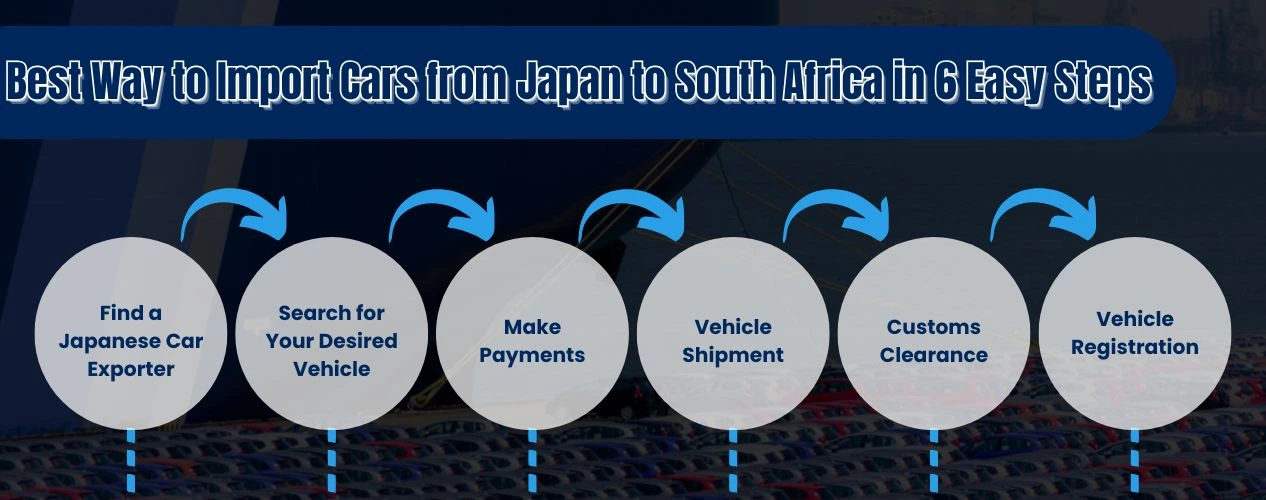
Follow these steps to import a high-quality car from Japan to South Africa.
Start by choosing a trusted exporter in Japan. This is super important! A good exporter like SAT Japan will give you real photos and honest details and help you through the whole process. A dealership with a proper website, contact information, and good reviews tends to be more reliable. Make sure they have experience shipping to South Africa. A friendly and helpful exporter makes everything smoother, and some research goes a long way in avoiding future problems.
Now is the time to browse SAT Japan’s stock online through the listings. You can find the vehicle of your choice by selecting the specific make, model, and year. Compare different available options and finalize the one you think is the right fit for you.
Once done, contact our team to inquire about the car, its photos, and more.
After selecting your vehicle, we will send you an invoice with all costs, including the price of the car and shipping fees. Payments are usually done through a bank transfer. Always keep payment records and ask for confirmation once the money is received. This is really important!
After confirming the payment, our team will make the necessary arrangements to send your chosen vehicle to South Africa. You’ll receive documents like the Bill of Lading that are required at customs. The shipping time may vary, but it usually takes 6 to 8 weeks. You can get shipping updates throughout the process.
Clearing through customs can be a hefty process if you don’t have the right documents prepared at the right time. That’s why it’s important you have all the payments cleared, as it may include checking import duties, paperwork, VAT, and others. Our team will help you with that, as we fully understand the local regulations.
Once you have cleared the vehicle through customs, you need to register it in South Africa. Depending on the local registration process, you may require documents such as customs documents, an ID card, an address, and more.
Avoid the hassle of the import process with these simple tips:
Importing a vehicle from another country is a big step that requires a big investment. So, make sure you buy a car from a trusted exporter only. A reliable exporter will provide you with the pictures of your selected car, inspection sheets, and keep you updated about shipping. You can easily avoid scams by ensuring the company is well-known and has a good reputation. In that case, SAT Japan will prove to be your trusted export partner.
Nothing is as important as being informed during vehicle shipment. Since every country has its own regulations for importing vehicles, you need to do a quick check to save yourself a big headache and lots of money later. For instance, some allow only left-hand drives, others need low mileage, or certain model years. Check age limits, taxes, and paperwork before you buy.
Paperwork may not be fun, but it’s super important. Ensure you get the bill of lading, inspection, and export certificate. That’s because these are the most important documents for imports. You may need additional ones depending on the country or port from which you receive your vehicle.
Shipments need to clear customs before they make their way to you. That’s why you should be prepared well with all the necessary documents and any pending payments. You will need papers for customs and registrations, so make sure you have copies of these documents.
Japanese vehicles are known for their safety and reliability, and for that very reason, hundreds of cars are imported to South Africa every year. However, some fraudulent dealers and scammers trap people in the name of low prices. It’s better you cross-check a dealer before finalizing any purchase. Most of all, consider importing your vehicles through SAT Japan, as we have a long history of successful car imports around the world.
Meanwhile, here’s what you can do to avoid fraud:
Verify the contact details, address, and location of the company to ensure you are dealing with real people with real business.
Always check for reviews on websites like Trustpilot and Google to learn about the company’s credibility.
Prices that seem too good to be true are often a trap. It’s recommended to always check the market price and compare well before making any final decision.
Japan brings high-quality innovative vehicles to the market every time. Unfortunately, not all vehicles make it to South Africa. In such a case, there is no better option than to import your favorite car.
The import process becomes easier with SAT Japan, where you can have your vehicle with you in 6 to 8 weeks. The best part? There is a wide selection of vehicles to choose from. You just need to stay updated on the rules and regulations to have a smooth import experience.

Importing a car from Japan to Pakistan appears to be a complex process, and for many, it indeed is. The paperwork, customs regulations, and finding a reliable exporter make the whole process thoroughly overwhelming. What’s saddening is that many buyers give up before they even get started. But it doesn’t have to be that way.
Thanks to more consumer-friendly import policies introduced by the Government of Pakistan and expert assistance from exporters like SAT Japan, importing a vehicle from Japan to Pakistan has become smoother and far more accessible. SAT Japan handles the tough part so you don’t have to stress.
This Pakistan Japanese car import guide contains everything you need to know. Continue reading till the end.
There is one thing about Japanese cars: they are built to last. Their precise engineering makes the vehicles last long and maintain a high standard of performance for the years to come. Japanese cars are also more affordable due to the country's large economy of scale. Their preference for new and innovative models turns even one-year-old used cars into a valuable asset in the used-car market. Contrary to this, the rising fuel costs in Pakistan have made Japanese hybrid and compact models ideal for every other person.
Imported Japanese cars usually have better resale value due to their condition and brand reputation. Moreover, from sedans and hatchbacks to SUVs and kei cars, Japanese markets offer options to suit every budget and need. All this makes Japanese cars an excellent investment for Pakistani buyers.
Several used Japanese models are especially popular in Pakistan. Among the top choices are:
Daihatsu Mira
Toyota Vitz
Toyota Passo
Toyota Aqua
Toyota Land Cruiser Prado
Suzuki Alto
Toyota Prius
Nissan Dayz
Suzuki Wagon R
Toyota Raize
These vehicles are popularly sold in Pakistan due to their exceptional fuel efficiency, compact size suited for urban roads, and affordable maintenance costs. They are popular and ideal for city driving, offering excellent mileage and making them budget-friendly options.
Not just used cars—many buyers in Pakistan are now importing high-end new models from Japan, such as:
Lexus LX and RX series
Toyota Land Cruiser and Prado
Nissan Elgrand
Honda Odyssey
Mitsubishi Pajero
These models are often loaded with luxurious features and superior technology, making them attractive choices for those looking to stand out.
Do you know what’s the smartest way to buy a Japanese car at affordable rates? Auction.
The Japanese used car auction system is a goldmine for finding quality vehicles at competitive prices. From daily drivers to luxury sedans, there are so many vehicles listed on auctions. Each vehicle has a grading system and an auction sheet for transparency. The best part is that the cost of vehicles at auctions is generally cheaper compared to local dealers.
But how can someone buy used Japanese cars in Pakistan through an Auction? Well, you need to buy through trusted exporters like SAT Japan that offer auction access and bidding services. You can begin by making a deposit to secure your bidding limit. Once done, go ahead and choose from various makes, models, years, and mileage. Meanwhile, you can review the auction sheet to inspect the condition of your chosen vehicle and grading. SAT Japan will bid on your behalf, and once everything is finalized, the company will take care of the logistics and shipping.
Engine Capacity | Customs Duty (CD) |
Up to 850cc | 30% |
851cc–1,000cc | 35% |
1,001cc–1,500cc | 40% |
1,501cc–1,800cc | 45% |
Above 1,800cc | 50% |
Note: Customs Duty is only one component of vehicle import taxation in Pakistan. Additional Customs Duty, Regulatory Duty, Sales Tax, Federal Excise Duty and Income Tax may also apply depending on the vehicle's PCT classification and import conditions.
Engine Capacity | Duty & Taxes |
Up to 800cc | US$4,800 |
801–1,000cc | US$6,000 |
1,001–1,300cc | US$13,200 |
1,301–1,500cc | US$18,590 |
1501cc -1600cc | US$22,550 |
1,601–1,800cc (Excluding Jeeps) | US$27,940 |
Note: For eligible used Asian-made cars imported under Pakistan's Personal Baggage, Gift, or Transfer of Residence schemes, depreciation in duties and taxes is allowed at 1% per month based on the vehicle's age. Cars must generally not be more than three years old.
Depreciation Rule | Allowance |
Each completed month of vehicle age | 1% per month |
Maximum depreciation for cars | 60% |
Depreciation is calculated at 1% for each completed month, generally from 1 January of the year following the vehicle's manufacturing year up to the shipment date, subject to the applicable maximum limit.
Hybrid Engine Capacity | Exemption |
Up to 1,800cc | 50% |
1,801cc–2,500cc | 25% |
Scheme | Eligibility & Features |
Transfer of Residence | Minimum 850 days abroad during the past 3 years. The vehicle must be imported from the same country where the overseas Pakistani resides. |
Gift Scheme | Minimum 850 days abroad during the past 3 years. The vehicle can be gifted to an eligible family member normally resident in Pakistan. |
Note: The Personal Baggage scheme for vehicle imports was removed in January 2026. Vehicles imported under the Gift or Transfer of Residence schemes cannot be transferred for one year from the date of import.
Under the Gift and Transfer of Residence schemes, passenger cars can generally be imported if they are not more than three years old. Vehicle age is calculated according to the applicable import rules, so buyers should confirm the manufacturing year and shipment date before purchasing a car.
Most vehicles imported from Japan are right-hand drive, which is suitable for Pakistan’s left-side driving system. Buyers should confirm the applicable import and registration requirements before purchasing a left-hand-drive vehicle.
There are currently two government-approved schemes for overseas Pakistanis importing used vehicles:
Transfer of Residence: Allows an eligible overseas Pakistani returning to Pakistan to import a vehicle. The vehicle must be imported from the same country where the overseas Pakistani resides.
Gift Scheme: Allows an eligible overseas Pakistani to gift a vehicle to a qualifying family member who normally resides in Pakistan.
The Personal Baggage scheme for vehicle imports was removed in January 2026. Applicants under the Gift or Transfer of Residence schemes must have stayed abroad for at least 850 days during the preceding three years.
A person who has imported, gifted, or received a vehicle during the applicable three-year eligibility period cannot import or receive another vehicle under these schemes. Vehicles imported under the Gift or Transfer of Residence scheme also remain non-transferable for one year from the date of importation.
You must provide accurate vehicle and import details, submit the required documents, and pay all applicable customs duties and taxes. Used vehicles imported under the Gift or Transfer of Residence schemes must also meet the applicable safety, environmental, and regulatory standards notified by the Ministry of Industries and Production and the Engineering Development Board. Incorrect declarations or tampering with vehicle identification details may result in action by Pakistan Customs.
For used vehicles imported under the Gift or Transfer of Residence schemes, the main documents include:
Goods Declaration (GD): Filed for customs clearance.
Export Certificate: Official vehicle export document from the country of export.
Vehicle Purchase Receipt: Proof of purchase of the vehicle.
Bill of Lading (B/L): Shipping document issued for the vehicle.
Attested Copy of Passport or Pakistan Origin Card: Used to verify the overseas Pakistani importer.
CNIC of the Recipient: Required when importing under the Gift Scheme.
Bank Encashment Certificate or Foreign Remittance Evidence: Proof that applicable duties and taxes are being paid through eligible foreign exchange remittance.
Scheme Eligibility Evidence: Documents showing that the applicant meets the current Gift or Transfer of Residence requirements, including the applicable overseas stay conditions.

Follow these steps to import a high-quality car from Japan to Pakistan.
Begin by searching for reliable and verified Japanese car exporters. Companies like SAT Japan are popular due to their transparency and vast car inventory. Check customer reviews, export experience, auction access, and if they provide complete documentation. Working with a trustworthy exporter ensures a smooth and safe buying experience.
Browse through SAT Japan’s stock or Japanese auction listings. Select a vehicle that suits your needs, whether it's fuel efficiency, family comfort, or off-road capabilities. Make sure the car is within Pakistan’s import regulations (right-hand drive, less than 3 years old, etc.). Finally, don’t forget to request the auction sheet to check the car's condition, mileage, and history.
Once you finalize the vehicle, SAT Japan will send a Proforma Invoice. You’ll need to transfer the payment. Ensure all payments are properly documented and keep receipts for customs purposes in Pakistan.
After payment confirmation, the exporter arranges the shipment usually by Ro-Ro (Roll-on/Roll-off) or container shipping. You’ll receive the Bill of Lading, Export Certificate, and Invoice, as these are essential for customs clearance. Shipping to Pakistan typically takes 6 to 8 weeks, depending on the port and weather conditions.
When your car arrives at a Pakistani port (like Karachi), you’ll need to get it cleared by Pakistan Customs. You or your customs agent must submit documents including:
Bill of Lading
Import Permission
GD (Goods Declaration) Form
Identity documents
Proof of payment
Export certificate
Duties and taxes will be calculated based on engine capacity, year, and car type. A customs clearance agent can help simplify this process.
Once cleared from customs, the final step is registering the car with your local Excise and Taxation Department. Submit documents like:
NIC
Sales invoice
Custom clearance certificate
Registration application form
Proof of address
You’ll get a registration number and vehicle plates. After this, your imported car is legally ready to drive on Pakistani roads!
The best approach when importing a vehicle is to work with verified exporters that have a good public reputation, such as SAT Japan. This is because verified sellers give you real information, proper papers, and clean deals. Nobody would want their dream car to turn into a nightmare with shady dealers.
Auction sheets are more like a vehicle’s report card. They tell you if it’s been in an accident, its mileage, and overall condition. So, if you are looking for a vehicle from a Japanese auction, you must know how to read an auction sheet. If not, it’s better to get some help.
Some cars are easy to maintain in Pakistan, others not so much. Before buying, see if spare parts are available and if mechanics know the model. A popular car is easier to fix and sells faster if you ever want to upgrade.
Import rules change like the weather! Stay updated with FBR and customs websites so you don’t break any laws. Knowing the rules helps avoid fines, delays, or losing your car. Be smart and always check before you ship.
Pakistan allows cars up to 3 years old for personal use. Anything older is a big no! If you pick an over-aged car, it might get stuck at the port or even be sent back. Stick to the age rule and stay stress-free!
Thousands of Pakistanis, unfortunately, fall for auction sheet fraud when buying a used Japanese car. This type of fraud is more prevalent in Pakistan than you might think. It's because getting away with fraud is easier in Pakistan due to the lack of a legal framework and an official monitoring authority. So here's what fradsters typically do.
Several sellers fabricate the Auction sheet by altering the mileage figures on the sheet. For them, doing this is easy because they only need a basic understanding of Photoshop or Canva to edit the values seamlessly. However, catching them is not an easy job. Simply because if you call the fraudsters out, they’ll show up with the fake, altered verification sheet to cover their fraud. Fake Auction sheet fraud is not the only way fraudsters exploit their customers. There are more.
Another common practice is for sellers to completely change the mileage values in the car. Well, how do they do that? Fraudsters simply remove the vehicle's ECU, connect it to a monitor, and then reverse the mileage. This tricks the buyer into believing in the wrong values. Even if you call the seller out, he would likely come up with a fake or altered verification sheet to cover up his fraud.
Many dealers and sellers also commit paint fraud. What they do is repainted their car locally and claim it to be a genuine body. If you want to detect this kind of fraud, you have to compare the car’s appearance with the auction sheet. If there is a visible difference, then it means that you’ve been successful in catching a Color code scam.
Since millions of sellers engage in this kind of activity, it is nearly impossible to keep a check on everyone. However, there are certain precautionary measures that you can take to protect yourself from such fraudsters.
A rule of thumb is to verify your car from the SAT Japan auction sheet verification. In case the car is not auctioned, you cannot do much about it except for trusting your instinct. SAT Japan’s vehicle inspection system conducts a thorough, detailed inspection to verify whether the mileage on the meter is accurate or not. We’re doing our best to prevent such fraudsters.
To protect yourself from potential fraud, avoid paying your seller in full at once. Legitimate sellers usually accept partial payments or offer secure payment methods. Avoid paying through untraceable services and use services like PayPal or international bank transfers, which involve a legitimate third party.
It is essential to verify the credibility of your seller before initiating the process. Check for red flags, such as a deal that appears too good to be true, or if you notice a lack of documentation. Double-check the vehicle registration and shipping details, and most importantly, ask questions. If a seller is reluctant to answer questions, that is definitely alarming and you should not buy from them.
Importing a vehicle from Pakistan to Japan is indeed an exciting option, particularly for those looking for durability and reliability along with modern tech features. However, the import process is typically lengthy and requires the support of experts to avoid fraud and scams. That’s why we have partnered with some top companies to help our customers navigate the customs process in a matter of a few days.
So, what is holding you back? Choose the vehicle of your choice from SAT Japan’s listings today and start the import process right away!

Japan remains a leading supplier of used cars in Ireland's import market, surpassing the UK, which previously held the top spot. According to Cartell, Japanese imports have increased tenfold in the last decade. This rising figure can be easily attributed to the ease of importing from Japan and the high quality of Japanese import cars.
While the offer seems quite alluring, the complex process of importing a vehicle from another country, and sometimes even a different continent, can deter many people. That’s why we are here to help you understand how to import a car from Japan to Ireland in some easy steps.
So, let’s get into it.
Looking for reliability, affordability, and advanced features in your next vehicle? Japanese used cars offer unmatched value and performance! Importing directly through trusted exporters like SAT Japan allows you to handpick your car from thousands of options, making the process more cost-effective than buying locally.
Japanese owners typically service their cars regularly, and strict domestic regulations mean you're getting top-tier quality. Brands like Toyota, Honda, and Nissan are known for their durability and efficiency. Plus,importing a car from Japan to Ireland gives you access to low-mileage, well-maintained vehicles at competitive prices.
You must know the difference between the actual cost and the purchase cost of the car. The final cost depends on the taxes and valuation methods. So, proper estimation is very necessary.
One easy way is through this simple formula:
Total Cost = Price of the Vehicle + Shipping + VAT + VRT + NOx Levy + Other Fees.
The combined value of the vehicle and the shipping is subject to VAT, and the VRT is computed independently of that combined value and is calculated using the Open Market Selling Price (OMSP) as determined by the Irish authorities. The NOx levy is added depending on emissions.
There are some costs that influence your budget, but sometimes some buyers overlook these hidden costs.
Although you have done good planning, exchange can affect the final price, especially when international transactions are involved. Delays at the port can result in you having to pay storage fees.
Insurance is another important factor that you must not ignore. On some imported models and specifications, you can be charged a premium. Additionally, VRT depends on the official valuation, so it is not the exact amount.
When you look at these costs individually, they do not seem high; when you add them, they have a huge impact on the overall investment.
| Type | Cost (USD) |
| Shipping fee | $756 to $972, depending on the size of the vehicle |
| VAT (If applicable) | 21% of the purchase cost and shipping |
| Customs duty (If applicable) | 10% the purchase cost of the vehicle and shipping |
| Vehicle Registration Tax | 7% to 41% of OMSP (Open Market Selling Price), based on CO2 emissions |
| National Car Test (NCT) | $59 to $65 |
VRT is based on the Open Market Selling Price (OMSP), which depends on the vehicle's market value, model, engine size, year, and roadworthiness.
Since July 2008, VRT has been based on CO2 emissions rather than engine size.
Customs duty and VAT are applicable to both the vehicle purchase cost and shipping charges.
Exemptions:
Certain exemptions from paying Vehicle Registration Tax (VRT) may apply depending on specific conditions or categories (e.g., returning residents or diplomatic vehicles).
Car importation is not about transferring a car to ensure that all legal, tax, and compliance requirements are fulfilled. Understanding of the processes helps protect against any hidden costs.
When your car reaches Ireland, you have to be fast. You have to register the car within 30 days and make a quick appointment with the National Car Testing Service (NCTS). If you fail to do so, you have to pay penalties.
Japan is not a member of the EU, so the vehicles are considered non-EU. There is a need for a customs declaration. EU must pay up to 23% VAT, including shipping charges. In certain cases, this may be subject to customs duty, and it depends on where the car is manufactured. Proof of payment is important to continue the process of registration.
All imported cars must have VRT before they can be lawfully driven. It is computed on the basis of the Open Market Selling Price (OMSP), which has been established in Ireland, CO₂ emissions, and the type of vehicle. This fee is paid during NCTS registration and is often among the most expensive expenses.
Proper documentation is the key to a successful registration. You will normally require:
Original certificate of export or registration.
Purchase invoice
Bill of Lading
Evidence of customs clearance.
Any inappropriate or missing documentation may slow or even stop registration.
The vehicle must meet the Irish and EU standards before it goes on the road. You have to take approval from the National Car Test (NCT) where necessary, and all the information of the vehicle, including VIN and the specifications of the engine, should match the government records. Usually, a vehicle will fail to register until these standards are met.
Pros | Cons |
Often more affordable than the Irish market, even after taxes. | VAT and VRT can greatly decrease total savings. |
Less mileage and typically well-maintained cars. | The history of service may be limited or more difficult to check. |
Good construction and durability. | There might be some vehicles that need to be modified so that they are compliant. |
High-spec, rare, or Japan-only models. | Specifications variations with EU models may have an impact on usability. |
Increased car selection and options. | It is a long process that needs planning and detail. |
Possibility of increased long-term value. | Parts are less readily available, and insurance is more difficult. |
When importing a used car to Ireland, ensure you have:
Original registration certificate
Purchase invoice
Bill of lading or shipping documents
Customs clearance (if from outside the EU)
Proof of identity and address
VRT appointment confirmation
If you are importing a car from outside the EU (e.g., Japan), you must:
Complete a Customs Declaration through the Automated Import System (AIS).
Pay Customs Duty (typically 10%) and VAT (21%) based on the vehicle’s customs value, which includes the purchase price, shipping, and insurance.
Provide proof of ownership, purchase invoice, and shipping documents.
Every imported used car must be registered with Revenue and is subject to VRT, which is calculated based on:
The Open Market Selling Price (OMSP) as estimated by Revenue.
The vehicle’s CO₂ emissions, fuel type, and engine capacity.
Registration must be completed within 30 days of the vehicle’s arrival in Ireland. Failure to register on time may result in penalties.
Dreaming of driving a luxury car that stands out in Ireland? Japan is a hub for premium vehicles like the BMW 3 SERIES, Lexus RX, and Volkswagen GOLF, all loaded with top-of-the-line features. Many of these models are Japan-exclusive or released earlier in Asian markets. Importing a high-end new car from Japan not only saves you money compared to Irish dealership prices but also lets you enjoy cutting-edge tech and superior craftsmanship. Work with reliable exporters who offer full documentation, inspection, and shipping support to make the process seamless, from the showroom to Irish roads.
It is the selection of the appropriate car that makes importing really worth it. The most appropriate ones are those that are low in taxes, are reliable, and have high resale value in Ireland.
The most economical option is hybrid cars. Models like the Toyota Prius and Toyota Aqua are popular due to low emissions, better fuel economy, and lower VRT.
Small hatchbacks like the Honda Fit and Mazda Demio are affordable, simple to maintain, and in high demand, and thus they are good for daily use.
SUVs such as the Toyota Harrier and the Toyota C-HR offer comfort and features to buyers who require more space, but this might attract higher taxes.
Did you know you can score amazing deals on top-quality cars by bidding in Japanese auctions? It’s the smartest way to import a car from Japan to Ireland.
Auctions feature thousands of vehicles weekly, ranging from compact hybrids to luxury SUVs, all with detailed inspection reports. With expert support from exporters like SAT Japan, you can bid safely, set budgets, and even gain access to live auctions. After you win the bid, the exporter handles shipping, customs, and documentation. You can also request an Auction Sheet for a better understanding of the vehicle. It’s a transparent and cost-effective route for Irish buyers looking for variety, value, and control over their import choices.

Importing a car from Japan to Ireland is a great way to access high-quality vehicles at competitive prices. With the right knowledge and planning, the process can turn out to be really smooth and efficient.
Follow these six easy steps:
Start by selecting a reputable exporter, such as SAT Japan. Here’s what you need to look for in the exporter:
Verified exporters with a strong track record
Transparent pricing and detailed car listings
Auction access for better deals
Vehicle inspection reports and shipping assistance
Next, visit the listings at SAT Japan and browse the available stock or participate in real-time Japanese car auctions through the exporter. After selecting your vehicle:
Request a pro forma invoice
Pay via secure bank transfer
Confirm shipping arrangements (typically RO-RO or container shipping)
Once payment is complete, SAT Japan will ship the vehicle to Ireland (usually Dublin or Cork port). You will receive essential documents, including:
Bill of Lading
Export certificate (Deregistration Certificate)
Commercial invoice
English-translated inspection report
Upon arrival of the vehicle, file a customs declaration using Ireland’s Automated Import System (AIS) and pay applicable customs duty (10%) and VAT (21%) based on CIF value (Cost + Insurance + Freight). That’s the best part of using a Japanese exporter like SAT Japan: you don’t need to hire a separate customs broker. The exporter will help you with all such tasks.
Register the vehicle with Revenue via the NCTS within 30 days of arrival. For that, you will need:
VRT appointment through NCTS
Original documents received from the exporter
ID and proof of address
Payment for Vehicle Registration Tax (VRT)
Before you can legally drive your imported vehicle, make sure to take the National Car Test (NCT) if the vehicle is over 4 years old and secure motor insurance (many insurers specialize in imports). Also, don’t forget to pay your motor tax online or at your local office.
In the RoRo vs container shipping debate, your decision directly affects cost and protection, so it is worth making the right one.
The most popular one is RoRo (Roll-on/Roll-off). The car is loaded onto the ship and fastened, and the procedure is quick, effective, and inexpensive. RoRo is a good value when affordability and simplicity are your priorities.
Container shipping offers a greater degree of protection. The vehicle is enclosed in a container, which protects it against weather and outside handling. This is ideal in high-value or luxury cars, but it is more expensive.
In the RoRo vs container shipping decision, it ultimately comes down to your priorities. Select RoRo to be cheaper and easier, or choose container shipping if maximum security and peace of mind are more important.
The typical timeframe to import a car from Japan to Ireland is 6 to 8 weeks. This includes the entire process from purchasing the vehicle, arranging shipping, and clearing customs, to completing registration in Ireland.
Once the vehicle is purchased through a trusted exporter like SAT Japan, it usually takes 4 to 6 weeks for the car to be shipped via Roll-on/Roll-off (RO-RO) or container shipping to Irish ports such as Dublin or Cork.
After arrival, customs clearance, Vehicle Registration Tax (VRT) appointment, and registration with Revenue can take an additional 1 to 2 weeks, depending on how quickly documents are processed.
Delays may occur due to port congestion, incomplete paperwork, or scheduling issues with inspections. However, planning ahead and working with experienced exporters can help you complete the process smoothly within the 6- to 8-week window, ensuring your vehicle is legally ready for Irish roads.
Focusing only on the purchase price: Most buyers overlook the total cost. After adding VAT and VRT, it can be much more than what they expected.
Misunderstanding VRT: Many buyers, especially first-time buyers, misunderstand VRT. It depends on the Irish market value of the car, not on the amount you paid.
Skipping proper vehicle checks: Some buyers forget to check and verify auction reports or history, which may result in expensive repairs in the future.
Choosing the wrong car: More expensive cars with high emissions or less desirable models might be harder to resell.
Missing key deadlines: You may have to pay extra fines if you delay booking the VRT inspection.
Master the hassle of importing a vehicle from Japan with these few tips:
Selecting a certified exporter is the foundation of a successful import. Companies like SAT Japan ensure accountability, transparency, and quality service. A reliable exporter provides genuine auction access, vehicle inspection reports, and complete documentation, which are important for smooth customs clearance and legal registration in Ireland.
Before importing, familiarize yourself with Irish laws regarding customs, VAT, and Vehicle Registration Tax (VRT). Import rules differ for vehicles from outside the EU, so ensure compliance with National Car Testing Service (NCTS), registration deadlines, and emissions standards.
Ensure you receive the Bill of Lading, Export Certificate, Commercial Invoice, and Auction Sheet from the exporter. These documents are required for customs clearance and VRT registration in Ireland. Missing paperwork can delay the process and may result in penalties or refusal of vehicle registration.
Irish law requires that your imported car be registered within 30 days of arrival. Book a VRT inspection with the NCTS as soon as your car lands. Late registration can incur penalties. Having all documents in order will help pass the inspection without issues.
Before shipping, request a third-party inspection or a comprehensive report from your exporter to ensure the quality of the vehicle. Once the car arrives, check its mechanical condition, lights, emissions, and tires. If the vehicle is over four years old, it must pass the National Car Test (NCT) before it can be driven legally on public roads.
Scams and frauds are everywhere, and there is no denying that. Since imports and exports bring big money to scammers, fraud is pretty common here. However, you can follow these tips below to avoid fraud when importing a car from Japan.
If a deal looks too good to be true, it likely is. Be cautious of extremely low-priced vehicles or sellers offering discounts for immediate payment. Scammers often use such tactics to lure buyers. Always compare market prices and consult with trusted dealers or exporters before transferring funds.
Visit the official website of the exporter and look for client testimonials. Genuine exporters like SAT Japan offer detailed listings, clear contact details, and evidence of previous exports to countries like Ireland.
Ask for the vehicle's auction sheet, chassis number, and maintenance records. Use online tools to verify the car’s history, including mileage, accident reports, and ownership. A trustworthy exporter will always provide full transparency and documentation, ensuring that you are not purchasing a damaged or stolen vehicle.
Dealing with unauthorized agents in Ireland increases fraud risk. Scammers may pretend to be import consultants or claim they have connections with certain Japanese exporters. Always deal directly with the exporter or use official company channels. Verify identities and check for business registration if in doubt.
Japanese cars are very reliable, which is why many people opt to import these vehicles instead of purchasing local ones. Since the import process has also become pretty straightforward due to reliable exporters like SAT Japan, there’s nothing that could set a car enthusiast back.
So, equip yourself with all the right knowledge about the customs, regulations, and other rules of importing a car and get started with vehicle import right away!

The UK market continues to value Japanese vehicles due to their reliability and high-quality engineering. For automotive enthusiasts seeking a rare model or those in search of a well-maintained daily vehicle, importing a car from Japan stands out as a prudent decision. This Japanese car import guide for the UK will assist you with everything from vehicle selection and exporter liaison to tax obligations, DVLA registration, avoiding scams, and more.
For those interested in used cars for sale in the UK, importing new Japanese cars to the UK, or information on how to buy a used Japanese car in the UK, this guide details every step for a secure and uncomplicated import process. More buyers in the UK are turning to Japan for cars compared to the traditional search for used cars for sale in the UK, and we would like to help you smoothly navigate the process of confidently and seamlessly importing Japanese cars to the UK.
Japanese engines have earned a stellar reputation for their engineering excellence, fuel efficiency, and reliability. For UK customers, especially those exploring used cars for sale in UK, importing directly from Japan opens doors to higher-maintained, lower-mileage vehicles at more competitive prices than many used cars for sale in UK listings offer. Japan's strict inspection system guarantees that most vehicles are in high-quality mechanical and aesthetic condition, making them the best options for British roads.
Moreover, considering that Japan and the UK both have right-hand-drive automobiles, the transition is seamless. This UK-Japanese automobile import manual provides car consumers a convenient way to access rare models, luxurious trims, or newer-generation vehicles not always available through traditional dealers for sale in used UK listings. Whether you're looking to shop for used Japanese automobiles in the UK or considering importing a new Japanese car to the UK, the benefits are both economic and practical.
| Vehicle Model | Avg. Price in Japan (Import) | Avg. Price in UK (Domestic) | Savings When Imported |
| Nissan Elgrand | £6,500 | £9,000 | £2,500 |
| Toyota Alphard | £7,200 | £10,500 | £3,300 |
| Mazda Bongo | £4,200 | £6,700 | £2,500 |
| Honda Stepwgn | £5,800 | £8,300 | £2,500 |
| Subaru Impreza WRX | £9,000 | £12,500 | £3,500 |
The UK market sees a consistent inflow of popular Japanese models each year, thanks to their reliability and value for money. Among the top-selling imported models are:
Nissan Elgrand
A luxurious MPV known for its spacious interior, comfort, and advanced features, ideal for large families or executive conveyance.
Toyota Alphard
A premium people carrier offering plush interiors, hybrid options, and smooth performance, ideal for both long drives and urban use.
Honda Step wgn (Stepan)
A family-friendly minivan with versatile seating configurations, great fuel economy, and a reputation for long-term durability.
Mazda Bongo
A compact camper-style van that's popular for conversions, offering practicality, reliability, and value in a unique package.
Subaru Impreza WRX
A performance-oriented sedan with turbocharged power, AWD grip, and rally-bred handling, appealing to driving enthusiasts.
These automobiles cater to a range of preferences, from spacious family MPVs to performance-oriented sedans. Buyers searching for used cars in UK for sale or those browsing vehicles for sale in the UK are increasingly turning to Japanese imports due to the attractive combination of pricing, high quality, and specific trim options. As detailed in this UK-Japanese automobile import guide, these vehicles aren't just low-priced but also offer brilliant fuel economy, low emissions, and a better standard of indoor comfort. This shift is making importing Japanese vehicles to the United Kingdom market an appealing alternative for individuals who want something specific and dependable.
Importing a luxury or high-end car from Japan to the UK is a great way to get a top-quality vehicle at a better price. Japanese cars are renowned for their advanced technology, exceptional comfort, and smooth performance. Models like the Toyota Century, Lexus LS, and Nissan GT-R are often more affordable in Japan than in the UK.
To start, you can search for a trusted export company or a Japan-based car dealer. They’ll help you choose a car, handle paperwork, and ship it safely. Once the car arrives in the UK, you’ll need to pay VAT, and if it’s a new model, you may also need to pay import duty. The car must also pass safety tests and be registered with the DVLA.
Although the process has steps, many car enthusiasts opt for this route to drive something truly special. For more details, visit the UK government’s import guide.
Pros:
Lower Prices: Even after shipping, Japanese used cars are often more affordable than UK models because of strict inspections in Japan, which result in well-maintained, low-mileage motors entering the market early.
Unique Models: Access rare or high-spec cars that aren't typically available in the UK.
Better Condition: Thanks to everyday servicing and Japan's milder weather, those cars tend to be in terrific mechanical and aesthetic condition.
Cons:
Insurance Costs: Premiums may be more favorable for imported automobiles due to the availability of class and coverage options.
Parts Availability: Some models may experience longer wait times for replacement components, particularly for rare trims or discontinued styles.
While the advantages often outweigh the drawbacks, it's sensible to consider these points before deciding to import a vehicle from Japan.
Do you know that Japan has one of the biggest car auction markets in the world, with thousands of vehicles listed every week. You’ll find all kinds of cars from small fuel-savers to sporty coupes and luxury sedans.
To begin, use a trusted auction site like Japan Partner or work with a Japanese export agent. You’ll need to make a small deposit to start bidding. Each auction listing includes a report showing the car’s condition, mileage, and history. That helps you make a smart choice.
If you win a bid, the auction house helps ship the car to the UK. After it arrives, you’ll go through customs, pay VAT or duty (if needed), and register the car.
Japanese auctions are exciting and offer great value, especially for well-maintained used vehicles. Just make sure to research and use a trusted service!
| Type | Cost (Approx.) |
| Shipping agency fees (based on $12,700 car value) | Starting from $1,270 |
| Import duty (if applicable) | 10% of vehicle value |
| VAT (if applicable) | 20% of vehicle value |
| DVSA inspection fee for Individual Vehicle Approval (IVA) | $250 to $375 |
| Vehicle Age | EU Origin | Non-EU Origin | Previously Owned in Destination Country |
| Less than 30 years | 20% VAT, No Import Duty | 20% VAT, 10% Import Duty | No VAT or Import Duty |
| 30 years or older | 5% VAT, No Import Duty | 5% VAT, No Import Duty | No VAT or Import Duty |
You must comply with UK rules and regulations before importing a Japanese car. Here’s what you need to be cautious about:
The UK drives on the left side of the road, and like Japan, vehicles in the UK are right-hand-drive (RHD). This makes Japanese cars naturally compatible with UK roads, and generally removes the need for steering conversions.
Most imported vehicles from Japan must go through IVA testing (for modified or unique vehicles) or Mutual Recognition if they meet EU/UK type approval standards. This process ensures that the car complies with UK road safety and environmental standards. Some models are exempt depending on their age and classification.
Once the car arrives in the UK, you are required to notify HM Revenue & Customs (HMRC) within 14 days using the Notification of Vehicle Arrival (NOVA) system. This is a mandatory step before you can register your vehicle with the DVLA.
You will need to pay import duties and VAT, unless the vehicle qualifies for relief (e.g., for classic cars over 30 years old, or if you're relocating to the UK with the vehicle). The typical VAT rate is 20%, calculated on the total cost of the car, including shipping and insurance.
After customs clearance and NOVA notification, you must register the vehicle with the Driver and Vehicle Licensing Agency (DVLA). You'll need documents like:
Completed V55/5 form
Proof of identity
Proof of address
Japanese export certificate with translation
IVA/MOT certificate (if applicable)
Proof of insurance
Once the DVLA processes your application, they'll issue a UK registration number, and you can fit UK number plates on the vehicle.
.webp)
Begin by selecting a reputable exporter or dealer in Japan. Look for companies with good reviews, clear processes, and prompt communication. For instance, sites like SAT Japan are trusted by many buyers worldwide due to the ease of communication and straightforward importing process with them.
Browse listings and select the car you want. Check details like mileage, model year, and condition. Japanese cars are known for being clean and well-maintained.
Once you’ve picked your car, your exporter will guide you through the buying process. Payments are usually made by bank transfer.
The exporter arranges shipping to a port in the UK. Shipping takes about 6 to 8 weeks, depending on the location.
When your car arrives in the UK, you must pay VAT (20%) and any import duty (10% if applicable) before it’s released.
Your car must pass a safety inspection (IVA or MOT) and be registered with the DVLA before you can legally drive it.
Importing a car from Japan to the UK can be simple if you follow the right steps and stay organized. First, research and choose a reliable exporter. Look for companies with good reviews and clear contact details. Websites like SAT Japan are trusted in the industry.
Before buying, understand all the costs involved—shipping, taxes (VAT and import duty), port fees, and registration charges in the UK. Ask the exporter for a full cost breakdown upfront.
Stay in touch with your exporter or agent during the entire process. They should give you regular updates, shipping documents, and guide you through the next steps once the car arrives.
When the car lands in the UK, you’ll need to handle customs clearance, inspection (IVA or MOT), and DVLA registration. It’s helpful to hire a customs agent or import specialist for this stage.
Finally, make sure your car is fully insured before driving it. It’s also a good idea to check the vehicle history and service records if available.
With good planning and a trustworthy exporter, importing your dream car from Japan can be an exciting and smooth journey!
While many Japanese exporters are honest and professional, some scams do exist, especially online. Here’s how to stay safe:
1. Work with trusted exporters: Choose companies with years of experience, positive reviews, and proper contact details. Check if they are verified by industry bodies or listed on major platforms like Tradecarview or CarFromJapan.
SAT Japan UK – Trusted & Verified Exporter:
For complete peace of mind, consider working with SAT Japan UK, a trusted and reliable Japanese car exporter. You can visit their UK office in person or contact them directly to verify all details before purchasing:
Address: 181 Forest Rd, Ilford IG6 3HZ, United Kingdom
Business Name: SATJAPAN UK
2. Be cautious of deals that look too good to be true: If a car is priced far below market value, it may be a scam or have hidden issues. Always ask for recent photos, auction sheets, and inspection reports.
3. Never send money to personal accounts: Only pay to official company bank accounts. Avoid paying through untraceable methods like Western Union or cryptocurrency.
4. Get everything in writing: Ensure your purchase agreement includes details like the car's chassis number, condition, shipping schedule, and refund policy.
5. Watch out for fake websites: Some scammers create look-alike sites. Double-check the domain name and look for security signs like “https.”
By taking your time and verifying each step, you can avoid fraud and enjoy a safe and successful import experience from Japan.
Bringing a Japanese car into the UK is an enticing prospect, offering the opportunity to acquire a one-of-a-kind vehicle that is often well-maintained, high-spec, and competitively priced. The process can be streamlined and beneficial if one works with a reputable exporter, follows the correct procedures, and is updated on customs and registration progress. Whether you wish to import a Japanese new car to the UK or are looking at used cars for sale in the UK, investing adequate time in research will prevent expensive missteps. Reliable platforms can facilitate the purchase of used Japanese cars in the UK, provided the proper paperwork is in place, and help you enjoy years of dependable service. Consider this UK Japanese car import guide as the starting point to owning your dream vehicle from Japan.
_1753871285.webp)
Japanese cars are the second most imported product in Australia. Yes, you heard it right. In 2023, Australia imported $8.53 billion worth of cars from Japan. These statistics demonstrate that Japanese cars retain their value in the Australian market. It might be your chance if you’ve been dreaming of owning a new or used Japanese vehicle like the Subaru Sambar or the Toyota Land Cruiser.
This guide educates you on everything you must know before importing a car from Japan to Australia. The Australian government has set specific laws and regulations on the types of vehicles individuals are allowed to import. It is essential to note that you can only import a car to Australia if it meets the following conditions:
listed on the SEVS (Specialist and Enthusiast Vehicle Scheme) list
more than 25 years old
You’ve owned and used it overseas for at least a year.
Reputed Japanese car dealers in Australia offer high performance Japanese models which are not available in the local market. Moreover, purchasing from a Japanese car importer is usually more economical than buying from a domestic dealer. Over the years, the Japanese car market has served Australians with high-standard cars through imports, earning them trust, which in turn has resulted in great resale value.
For individuals seeking to purchase their first car or a high-performance vehicle, importing a vehicle from Japan is often the best option.

Australians seeking reliable and well-maintained vehicles often opt for Japanese car imports. However, it is essential to understand the steps you need to follow to import your vehicle successfully. This guide breaks it down for you.
You need to begin by choosing the right car for yourself. You have the option of either importing through Japanese exporters, dealers, or through auctions. It is essential to verify that your seller is legitimate and provides proper documentation, such as the Export certificate and service history.
As mentioned above, you must ensure that your vehicle type aligns with Australian import laws. You cannot just import any car. The vehicle you choose to buy must fall into one of the following categories:
Listed on the SEVS (Specialist and Enthusiast Vehicle Scheme)
Be 25 years or older for the Historic Vehicle Scheme
Or qualify for personal import (if you’ve owned it overseas for 12+ months)
Or qualify for personal import (if you’ve owned it overseas for 12+ months)
How to apply for import approval? Before the car leaves Japan, go to the ROVER portal and apply for Import Approval. Without seeking import approval, you won’t be able to bring your car into Australia.
Either of the following options are usually available and you need to decide between the two
RoRo (Roll-On and Roll-Off)
Container shipping
Container shipping is comparatively safer but a bit more costly. It is safer than RoRo, because in RoRo, the car is exposed, unlike container shipment. Your vehicle will usually arrive in 3-5 weeks.
Your car is supposed to go through customs and biosecurity checks once it reaches Australia. The vehicle is to be checked for pests, its condition, and to ensure that there's no asbestos. Asbestos is a group of minerals that Australia has now banned. With that, you will also need to submit an import declaration and pay taxes.
The Australian government has Australian Design Rules (ADR) that must be met. Your car may need some changes to meet the ADR. Along with this, you'll need to get a roadworthiness certificate from any local mechanic. The roadworthiness certificate confirms that your vehicle has passed a test conducted by an authorised roadworthy inspector, a requirement of the Australian government.
Once you get your car and it passes inspection and compliance, register it with your local state authority. These authorities include NSW, VIC, or QLD. To register, please bring your ID, proof of ownership, import approval, and inspection results.
It is always advisable for buyers to get their new vehicle insured. Why? Because once you get your vehicle insured, you don't have to worry about future accidents, damage, or theft. There are different types of insurance; however, you'll need Compulsory Third Party (CTP) insurance to drive in Australia legally. Once you've got your insurance sorted, Congratulations! You've passed all steps to enjoy your new Japanese imported vehicle on Aussie roads.
All car enthusiasts dream of importing high quality Japanese used cars. Some of the most popular used car models include the Nissan Skyline GT-R, Corolla Hiace, and Land Cruiser Prado. A good reason for their popularity in imports is that these are very seldom available locally. Japanese used cars are less costly than local cars because Japanese prefer selling their cars at a cheaper price. This is because of Japan’s strict vehicle inspection system that makes maintenance of cars very costly.
Many buyers prefer container shipment because this method provides extra protection during transit. However, one thing you’ll have to do from your end is to ensure that the vehicle meets SEVS (Specialist and Enthusiast Vehicle Scheme) regulations.
Japanese cars have, over the years, also gained popularity among Aussies who are into racing their cars. These vehicles have special features which are not easy to find in local cars. Japanese cars are for those who are looking to buy a car that stands out and offers amazing performance on the road.
Among the best-selling Japanese Used Car models in Australia are the Mazda MX-5, Toyota Prius, and Honda CR-V. Japanese Used cars remain Australians’ first choice because all the new features, not available locally, are seen in Japanese new cars. Japanese cars lead the new car market in Australia because they offer the best mileage and emission-free vehicles at much cheaper costs than local vehicles. Recently, importing a Japanese car has become more accessible with the emergence of reliable digital platforms, such as SAT Japan.
The following are ten Japanese car models that are loved by Australian Car Buyers.
Honda Civic Type R
Mazda RX7 FD
Subaru Sambar
Toyota Estima
Nissan X-Trail
Toyota Hiace
Honda CR-V
Lexus IS F
Toyota Hilux
Suzuki Swift
All of these vehicles have gained the trust of Australian buyers over the years. Thanks to some of them being hybrid, they offer fuel efficiency and high performance especially on hilly regions. Something that makes them attractive is Japan’s strict roadworthiness checks, also known as “Shaken”. This is one of the many reasons why Aussie importers and dealers trust Japanese vehicles over others.
SAT Japan directly links you to Japanese auction sites, giving you access to thousands of premium-quality used cars. The auction bidding process takes place every week, and it is simple. You first browse the live auction listings, and then select your car and place your bid before the deadline. You need to pay a 10% deposit of your bid amount to confirm your bid.
When importing a car to Australia, it is essential to note that Australia registers Right-Hand Drive (RHD) vehicles. If you are looking to import a high-performance vehicle that is left-hand drive, you might face restrictions while registering these cars in Australia. Therefore, it is essential to always confirm the vehicle's drive side before bidding or purchasing.
Japanese cars have been a global favorite for a very long time. Australians are impressed by the contemporary yet durable designs of Japanese cars. Along with their looks, Japanese cars are well-maintained – they have a strict inspection system called the Shaken. Japanese cars have the best resale value, which tends to hold up well over time. Additionally, import prices for Japanese cars are significantly lower than those charged by local dealers, making Japanese cars a viable option for Australian buyers.
However, importing a car from Japan is not a straightforward process. To begin with, you must ensure that the vehicle you are ordering complies with Australia's compliance policies, especially for older models. Sometimes, it may be challenging to source certain parts, which can lead to repair difficulties. While importing a Japanese car to Australia is a common practice, the process of ensuring your car shipment might be more challenging than you expect. Pricier models have more expensive insurance. Therefore, it's essential to do your homework and determine precisely what you need before selecting a model to import.
It is essential to note that importing a car from Japan to Australia incurs costs beyond the vehicle's purchase price. There are additional costs, including shipping, taxes, compliance, and paperwork. Following is a breakdown of what you should be expecting before you decide to import a car from Japan
| Type | Cost (Approx.) |
| Shipping Agency fee | Starting from $3500 AUD |
| Import Duty | 10% of vehicle value |
| GST | 10% of the total cost |
| Import Approval & Compliance Fee | Around $2,000 AUD |
| Vehicle Model | Avg. Price in Japan (Import) | Avg. Price in Australia (Domestic Used) | Estimated Savings When Imported |
| Honda Civic Type R | AUD 18,000-22,000 | AUD 32,000-44,000 | AUD 12,000-22,000 |
| Subaru Sambar (Kei van) | AUD 3,800 | AUD 16,000-17,000 | AUD 12,000-13,000 |
| Nissan X-Trail | AUD 37,000 | AUD 65,000-90,000 | AUD 25,000-50,000 |
| Mazda RX-7 (FD) | AUD 37,500 | AUD 65,000-90,000 | AUD 25,000-50,000 |
| Honda Fit (Jazz) | AUD 9,000-10,000 | AUD 12,000-18,000 | AUD 5,000-8,000 |
| Toyota Estima (MPV) | AUD 15,000 | AUD 18,000-25,000 | AUD 2,000-12,000 |
| Toyota Hiace (Van) | AUD 18,000 | AUD 20,000-30,000 | AUD 2,000-12,000 |
It is beneficial to understand the complete cost upfront, so it does not come as a surprise later. Carefully weigh the options between your shipping methods (RoRo vs. container) to determine which one best fits your needs. Japanese car imports to Australia may seem daunting if it's your first time; however, with careful planning, it can be smooth and rewarding.


