Menu

 Find Your
Car
Find New
Car
Local
Pages
Find Your
Car
Find New
Car
Local
Pages
 Pakistan
 Antigua
 Anguilla
 Armenia
 Australia
 Azerbaijan
 Bahamas
 Bangladesh
 Botswana
 Burundi
 Canada
 Chile
Chile
 Costa Rica
 Cyprus
 Dominican Republic
 Fiji
Fiji
 Georgia
 Ghana
Ghana
 Guatemala
 Guyana
 Ireland
 Jamaica
 Kenya
Kenya
 Kyrgyzstan
 Lesotho
 Malawi
 Micronesia
 Mongolia
 Mozambique
 Namibia
 New Zealand
 Nigeria
 Papua New Guinea
 Paraguay
 DR Congo
 Russia
 Rwanda
 Samoa
Samoa
 Solomon Islands
 Somalia
 South Africa
 South Sudan
 Sri Lanka
 Tanzania
 Tonga
Tonga
 Uganda
 Ukraine
 USA
USA
 Zambia
 Zimbabwe
Car
Services
Company
Overview
Reviews
Blogs Categories
Help
Explore Stock
Explore Stock
Explore By Price
Explore By Price
Explore By Make
Explore by
Type
Explore by Year
Explore by
Discount
Inventory
Location
Inventory
Location
Other Categories
Other Categories
Zimbabwe
Car
Services
Company
Overview
Reviews
Blogs Categories
Help
Explore Stock
Explore Stock
Explore By Price
Explore By Price
Explore By Make
Explore by
Type
Explore by Year
Explore by
Discount
Inventory
Location
Inventory
Location
Other Categories
Other Categories


Purchasing a Japanese car can seem like a good deal, but then you realize that the dealership you're considering might not have the right car for you. The final price can vary due to the age, first registration date, emissions, customs, VAT, shipping to Limassol, inspection, and registration. What's worse, a low-dollar auction vehicle can turn into a high-dollar vehicle when a buyer isn't savvy about the vehicle's history or condition.
In this Cyprus Car Import Guide, you can find all the steps you need to follow before bidding on a car, determining its true landed cost, and registering it in Cyprus. You will also discover how to read Japanese auction sheets, how to avoid costly mistakes, and how to import with confidence.
Yes. You can import a Japanese used car into Cyprus for personal use or resale, but the car must meet Cyprus import and registration rules. The first check is its first registration date. Cyprus-focused guidance states that used vehicles must be within the 5-year limit; do not rely solely on the model year shown in an auction listing.
The car will also require Cyprus Customs clearance, a pre-registration roadworthiness inspection, and registration with the Department of Road Transport before it can be driven on the road. Japan's right-hand-drive cars are a natural fit because Cyprus drives on the left.
The main reason to import Japanese cars to Cyprus is that Japanese vehicles enter the local market in a manner that is quite unusual. Japan's right-hand-drive cars are a natural fit for Cyprus, which drives on the left. In addition, you can find thousands of vehicles for auction and stock, rather than simply those waiting on the island.
If you intend to bid on a Japanese car, you should be aware that it can be registered in Cyprus. This quick stop is one you don't want to make.
Begin with the car's first registration, category, chassis number, emissions, and technical specifications. Don't solely depend on the model year indicated by Japanese used car exporters. Cyprus has its own regulations for the importation of used vehicles from outside the EU, and the Road Transport Department administers these vehicles in its third-country registration procedure.
Most Japanese cars sold domestically are RHD, and Cyprus is a car-driving nation. However, steering position is not enough to qualify as an eligible car. Used cars brought into Cyprus must also be approved for use under Single Vehicle Approval (SVA) in accordance with Cyprus technical specifications. The Road Transport Department acknowledges that SVA applies to used vehicles from third countries.
As Japan is not part of the EU, the vehicle will have to go through Cyprus Customs upon import. The duty charged varies depending on the vehicle, its customs classification, its value, and whether it is eligible for preferential duty under the EU-Japan Economic Partnership Agreement. Don't expect all car imports from Japan to have the same duty rate. It's not always a question of what matters, but of proof of origin.
A Cyprus third-country used M1 passenger car will need to be registered by an authorized importer.
Be ready to submit the following documents:
Japanese registration/export documents
Get an invoice/packing list for purchase.
Customs documentation
Vehicle Approval Documents as required.
Roadworthiness or emissions documents (where applicable)
Insurance certificate
Other documents requested by the Road Transport Department
Requirements for translation of foreign registration document may apply if the document is not in Greek or English.
Once the car passes Customs, it's not ready for the road! Importations from Japan may require technical approval, inspection, emissions testing, and other compliance actions before registration. The procedure for importing used vehicles from third countries is an SVA procedure in Cyprus.
The auction price is only the starting point. Your final Cyprus cost includes Japan-side fees, freight, insurance, Customs duty, VAT, clearance, inspection, and registration.
Cyprus Customs applies a standard import duty of 10% to passenger cars imported from outside the EU. The duty is calculated based on the customs value, which includes the vehicle value, transport costs, and insurance. In addition, Cyprus charges 19% VAT on imports.
There is an important exception for qualifying Japanese-origin cars.
Under the EU-Japan Economic Partnership Agreement, the preferential duty on qualifying Japanese-origin passenger cars will be 0% from 1 February 2026. However, the vehicle must meet the agreement's rules of origin and have acceptable proof of origin. A car simply bought or shipped from Japan does not automatically qualify.
Suppose the car costs €10,000 and freight and insurance cost €1,500.
Customs value = €11,500
If the car qualifies for 0% preferential duty
Import duty: €11,500 × 0% = €0
VAT: €11,500 × 19% = €2,185
Total so far: €13,685
This excludes Cyprus port, clearance, inspection, and registration costs.
If the standard 10% duty applies
Import duty: €11,500 × 10% = €1,150
VAT: (€11,500 + €1,150) × 19% = €2,403.50
Total so far: €15,053.50
This also excludes Cyprus-side costs.
If you are searching to import Japanese cars for sale, SAT Japan can make the process easier. We have a good stock of Japanese vehicles available in Cyprus, so you can find the one you think is best for you. You can also check its auction information, arrange the purchase, and prepare it for export to Cyprus. We can also help with shipping arrangements and the documents needed for the next stage. Below are the steps for a smooth car import from Japan to Cyprus.
Before bidding, confirm the vehicle's first registration date, category, technical specifications, supporting documents, and eligibility for Cyprus registration. If there is any doubt, resolve it before buying.
Another smart check many buyers overlook is the chassis/VIN to see if any outstanding manufacturer recalls have been issued. Guidance from Cyprus Road Transport mentions vehicles registered in third countries, including Japan, and advises vehicle owners to call the local manufacturer's representative when checking for recalls.
When the car looks like it's ready to go, begin researching Japanese auctions and exporters. Avoid the lowest-cost vehicle that you can get. Check out the mileage, auction status, repair history, engine, fuel type, and condition. A car with a clean record may be a great deal more expensive than a car that requires repairs when it arrives in Cyprus, but it will be a better deal.
Think about how you will use the car in Cyprus, too. A small hybrid might be better to drive around in every day than a big engine, and resale value may be important if you're thinking about selling the car later.
The Japanese auction sheet tells you much more than a couple of pretty pictures. It includes the auction inspector's opinion of the vehicle and can include its overall grade, interior condition, mileage, and repair history. It can also indicate scratches, dents, replaced panels, or other issues.
This is where a good deal can easily turn bad. Have the sheet checked by someone who can read the Japanese auction notes, or by someone who can understand the inspection marks if they can't. Don't bid just because the pictures seem clear.
Once you've identified the perfect vehicle, select an exporter who will provide a thorough breakdown of the purchase and shipping process. Request a written estimate detailing the costs you will be charged. Be aware of whether or not the price contains auction fees, inland transport, export documents, shipping charges, and other charges on the Japan side.
Before paying, calculate the full landed cost using the method explained above. Use the landed-cost method above before committing to the purchase. Please note that not all vehicles coming from Japan automatically qualify. Review rules and proof of origin before calculating the final price.
After winning the auction, relax! Carefully check the chassis number, vehicle details, invoice, and Japanese export documents. All paperwork should be consistent with the information. Retain copies of all communications.
Usually, your Japanese exporter handles the export. The car is taken from the auction or seller to the port, the export documents are generated, and the car is booked for shipping.
When the car is being exported, make sure to get copies of the shipping and export documents beforehand. Ensure the vehicle identification information is accurate and store it in a secure place.
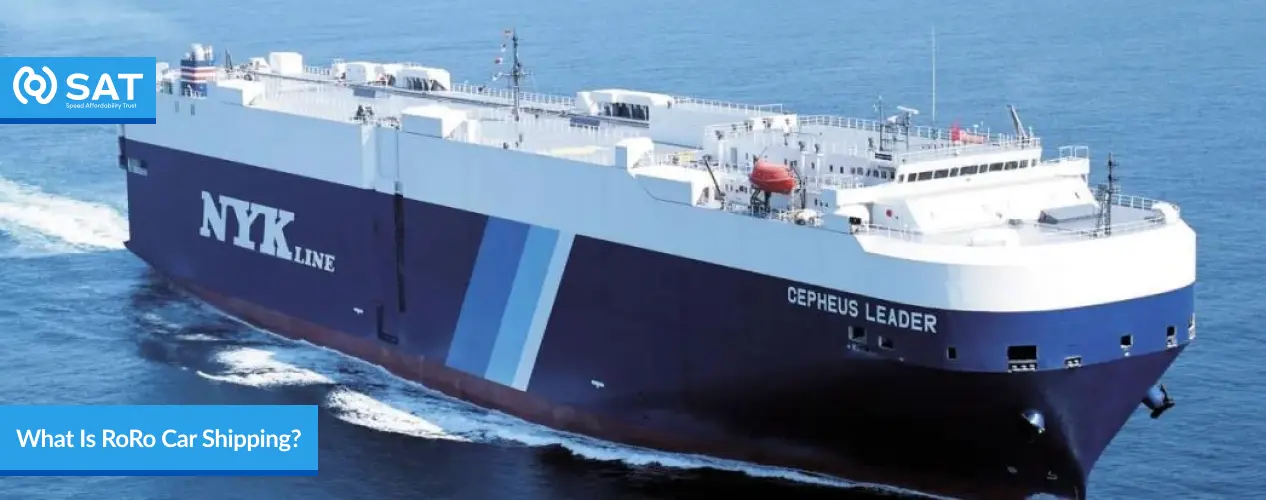
RoRo shipping is a viable solution for many normal passenger cars, since the cars are driven on board and locked for the trip. Another alternative is container shipping, which could be suitable for some vehicles.
Save your Bill of Lading and other shipping documents. They will be necessary when the car arrives and passes through customs.
Customs must release the vehicle in Cyprus before it can be used on the road. Customs value, vehicle classification, origin, and supporting documents are what matter here.
Even if the car is cleared customs, you will not be able to drive it away yet. The Cyprus Road Transport Department states that, for a used M1 vehicle imported from a third country, completion must be done online by an authorized importer. District Road Transport Department office will then process the registration applications after the necessary documents are submitted.
Road Transport requirements may change, so don't use an old Japanese exporter checklist; use the latest Department guidance.
The right documents can save you from costly delays when your Japanese car reaches Cyprus. Customs requires the purchase invoice, Japanese registration/export certificate, Bill of Lading, and proof of freight and insurance expenses. These documents are used by Customs to determine the vehicle's customs value.
For any advantages provided by the EU-Japan agreement, be sure to check for Japanese origin. The export certificate issued by Japan cannot be used as proof of origin.
Do not alter any original documents; ensure there are no differences in the chassis number; correct errors before the car leaves Japan.
The import time is approximately 6-10 weeks from purchase to delivery, though no specific time is guaranteed, as it may vary by season. The sea journey is just the beginning.
Once purchased, allow time for export documents, internal transport, paperwork, and port clearance in Japan. The transportation time for RoRo shipping from Japan to Limassol is approximately 4–6 weeks, depending on the sailing schedule and transshipment.
As soon as all documents are ready, Cyprus Customs can clear the car within 2- 5 business days. If inspection, approval, and missing paperwork delay the registration process, the time may be longer.
The final selection will depend on your budget, driving requirements, fuel consumption, and resale plans. Japanese exporters now include several models on their list of popular models in Cyprus, such as the Yaris, Note, Aqua, March, Fit, X-Trail, and RAV4.
Toyota Aqua: Great for low-cost city driving & hybrid fuel savings.
Honda Fit: The smart small car that has surprisingly good cargo space.
Nissan Note: Realistic, compact, and e-POWER hybrid model.
Toyota Yaris/Vitz: A good general-purpose vehicle for everyday driving in Cyprus.
Nissan X-Trail: Better suited to families wanting extra space.
Toyota RAV4: This is a popular SUV option; however, do note that it has a higher landed cost.
Mazda CX-3: Consider if you are interested in having a small SUV with a more upscale feel.
There are two car shipping methods: RoRo and container shipping. The first shipping option to consider for most normal-running Japanese cars is RoRo (Roll-on/Roll-off). The car is placed on the dedicated vessel, secured, and unloaded at Limassol. This is a common mode of transporting vehicles from Japan to Cyprus, and the service is typically less costly than a full container. The current estimated price for RoRo is approximately US$1200-1700, but this can vary depending on the size of the car, departure port, and the sailing schedule.
Container shipping is the shipping of the car in a container. It may be preferable for a valuable classic, modified vehicle, non-runner, or multiple cars. A current estimate of the cost of a 20' container is approximately $2,500-$3,200. For a standard Toyota, Honda, Nissan, or Mazda, RoRo is typically the better option.
While it's a good idea to import vehicles from Japan, you can lose all your savings if you make just one mistake. The majority of issues occur before the vehicle reaches Cyprus. Here are some errors to avoid.
The term “2022 model” does not always mean a 2022 first-registration car. This difference can be important when assessing age limits for imports into Cyprus. Check the date of the original Japanese registration/export document before bidding.
Shiny cars can mask an ugly past. Inspectors' grades, mileage, damage marks, and repair history are recorded on the Japanese auction sheet. Request a copy of the original sheet and compare it with the chassis number. Any discrepancy between the auction sheet and the seller's listing is a serious red flag.
A big slip-up in 2026. Even if you ship a car from Japan, it doesn't necessarily mean it's Japanese. To benefit from the EU-Japan agreement, acceptable proof of origin is required, including a statement of origin or knowledge of the qualifying importer.
Often, a very low quote feels attractive, but ask what it covers. Check exporter fees, auction costs, inland transportation, export documentation, and shipping arrangements. Double-check the company's information and checking account information before transferring money.
Don't attempt to purchase a car that is close to an age limit and presume the ship will show up when expected. Shipping schedules may change, documents may be late, and Customs or registration may take longer than anticipated. Plan for a margin of error.
The safest import is scheduled in advance of the bid. Make sure to examine the car, review the paperwork, calculate the complete landed cost, and verify the Cyprus requirements before beginning the process. With some simple research in Japan, weeks of frustration and thousands of Euros can be saved.
While purchasing from Japan can help save cash, a hasty settlement can make a wonderful deal into a nightmare. Four things to check before wiring money: the person, the car, the papers, and the payment method.
Before bidding, make sure:
The chassis number is the same on the auction sheet.
There is no variation in the reported mileage.
The auction quality and repair record are obvious.
The photos are representative of the actual vehicle.
A professional exporter will have company information and an invoice. Be careful if the seller:
Puts pressure on you to pay right away.
Avoids answering questions about the auction.
Makes abrupt changes to bank accounts.
Asks you to pay a personal account.
Never rely on new payment instructions from any source other than a trusted one.
If a seller refuses to let you verify the chassis number, auction record, invoice, or payment details independently, do not send the money. If the seller will not let you verify the car and documents, do not send the money.
Japanese vehicle imports are already a significant source for Cyprus. In 2025, 44.1% of the motor vehicles registered in Cyprus were from Japan.
More choice: Japanese auctions have a much broader selection of models, grades and specifications.
The RHD advantage: Japanese right-hand drive cars are ideal for Cyprus' left-side driving.
Better hybrid options: Japan has numerous hybrid vehicles with high fuel efficiency.
Auction sheets: Genuine auction sheets can provide mileage, condition, and repair information.
Potential savings: A good car can still be cheaper after all import costs.
Newer models: You may be able to find a newer car with more features within your budget.
You can't check it out yourself: Rely on auction records, photos, and exporters.
Registration risk: Buying the vehicle might mean it is not suitable for registration in Cyprus.
Wait time: Usually weeks for shipping and registration.
Unexpected repairs: If the car requires repairs upon arrival, the small saving may disappear.
The Simple Test
Compare:
Real saving = price of an equivalent Cyprus car − fully landed and registered Japan car.
Importing is a great option if the saving is significant, the registration is transparent, and you have enough time to wait for the process to complete.
If the savings are modest or the documents are confusing or unclear, it could make sense to purchase it locally.
If your total Cyprus budget is €15,000, the calculator works backward to estimate the maximum amount you should spend on the vehicle after reserving money for shipping, taxes, and Cyprus-side costs. Calculate the landed cost before you bid, not after the car reaches Limassol.
Importing a car from Japan to Cyprus can be a rewarding choice when you approach it with patience and clear planning. The smartest buyers do more than chase a good-looking auction listing. They ask the right questions, verify every detail, and understand what they are committing to before making a payment. If something feels unclear, stop and check it first. A careful decision today can save you from stress, unexpected costs, and disappointment later. With the right car, the right partner, and a well-planned process, your Japanese car can become something you genuinely enjoy owning.

Carefully considering the rules before purchasing a Japanese import to Kenya can save money. First-time buyers often waste time and end up paying extra due to the various importation conditions in Kenya, vehicle age restrictions, or customs duties. This Car Import Guide from Japan to Kenya covers all important aspects of the car import process, from selecting the best used cars from Japan and understanding the Kenya car import regulations, shipping, and clearance. With expert guidance and practical tips based on the real import process, you'll be better prepared to import cars from Japan to Kenya with confidence and avoid costly mistakes.
Japanese vehicles are trusted by Kenyan drivers because they are long-lasting, come with modern features, and are affordable. If you import cars from Japan to Kenya, you will find thousands of well-maintained cars, and sometimes they are cheaper than locally made ones. Japanese cars are well maintained, and the roads are smooth; this is why cars are in excellent condition before shipping.
Another plus is buying from reliable Japanese used car exporters without intermediaries. This provides you with greater options, clear pricing, and access to pre-checked, auction-quality cars with inspection reports. Always verify if the car fits Kenya vehicle import requirements. Also, planning ahead will help you estimate the Kenya import duty on the car and prevent unforeseen costs upon arrival. Knowing what to expect from the process enables you to import used cars to Kenya with confidence.
Before you purchase your car, it's important to be familiar with the rules and regulations of importing cars into Kenya. Many buyers focus only on the vehicle price, but Kenyan authorities do much more. To pass through the Port of Mombasa, the vehicle must comply with a set of tight age, safety, inspection, and documentation regulations before it can be road-registered.
The age limit applies to the year of manufacture, not the year of first registration. To prevent the vehicle being rejected at port, it is necessary to verify the build date in the vehicle's chassis number or export certificate against the vehicle's actual chassis number.
There are no normally registered left-hand drive (LHD) vehicles for importation in Kenya. RHD cars offer better visibility, enhance safety on the road, and are used on left-side traffic. The requirement is already fulfilled with most Japanese domestic vehicles.
All imported cars have to be checked by a KEBS-approved inspection firm like JEVIC or QISJ before departing the country. It verifies the vehicle is roadworthy, checks for accidents, confirms the vehicle odometer reading, and verifies if it conforms to Kenyan quality standards prior to shipment.
When being cleared in Kenya, the customs officials pay close attention to the Vehicle Identification Number (VIN) and chassis number. Delays, further inspections, or vehicle rejection may result from any indication of tampering, altered identification numbers, or document mismatches. Please ensure that all documentation corresponds to the vehicle in question.
On export, vehicles that have significant structural damage, poor accident repair, or high levels of safety defects may fail the test. To mitigate this risk, it is recommended to deal with a trusted Japanese used car exporter like SAT Japan, as we conduct comprehensive inspections before shipping the used cars.
Import taxes aren't limited to just the Price. The Current Retail Selling Price (CRSP) issued by the Kenya Revenue Authority (KRA) is the reference price for determining taxes and duties to be levied by Kenya customs. That's why two comparable models of vehicles with different specs can have different costs. Before you purchase the car, review the estimated taxes to avoid any potentially costly surprises
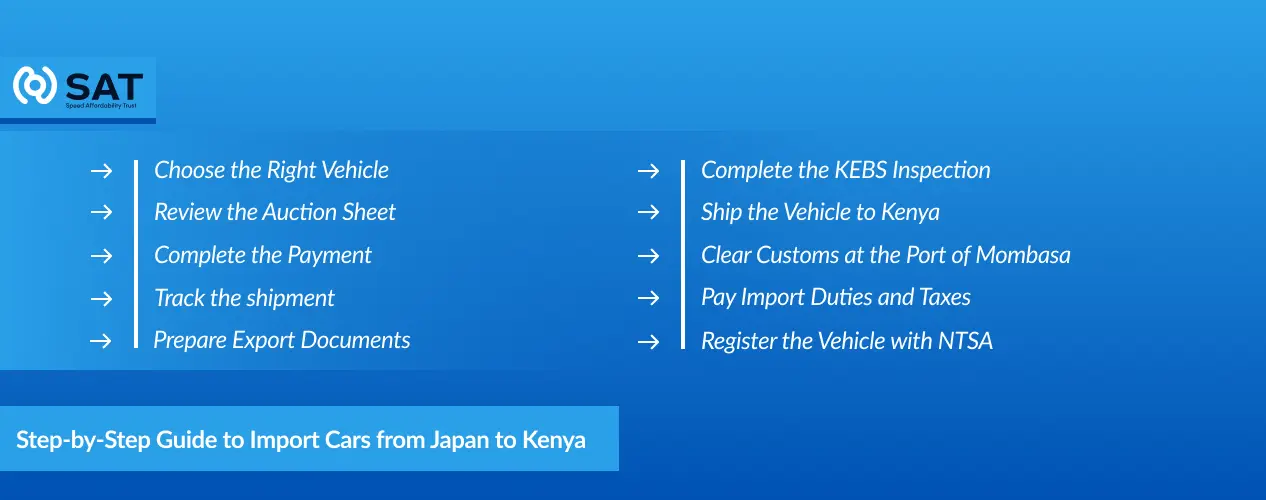
Although the process of importing a car might sound complicated at first, it's actually quite easy once you know what to do. The biggest errors occur even before the car leaves Japan. The wrong vehicle or the wrong document can be far more expensive than shipping. Here are some steps you can use to import cars to Kenya with confidence.
First, choose a car that complies with all the strict vehicle import requirements in Kenya. Please ensure it is right-hand drive (RHD) and made in the last 8 years (2019 or later for calendar year 2026). By purchasing from a trusted Japanese used car dealer, you can enjoy verified vehicle information, auction reports, and clear pricing.
Do not purchase cars only by looking at the images. The Japanese auction sheet shows the actual condition of the car, including rust, damage to the interior, mileage, repair and accident history. Except for the fact that lower grades require additional scrutiny before you bid on a car, a grade 4 or higher is typically a well-kept car.
After selecting the vehicle, the payment shall be made by a secure international bank telegraphic transfer (TT). We at SAT Japan make things easy for you by providing you with a detailed Proforma Invoice with the vehicle price, shipping charges, and export fees. It is recommended to always maintain payment records because they are needed during customs clearance.
Your exporter will prepare all the documents for shipment, such as the Japanese Export Certificate (De-registration certificate), Bill of Lading, and Commercial Invoice. These documents will now need to be submitted to the clearing agent in Kenya, who will submit a request for the Import Declaration Fee (IDF) through the KRA Integrated Customs Management System (iCMS) before the shipment is made.
The vehicle must undergo a required pre-export inspection before it is exported from Japan. This shall be done by the current KEBS-approved inspection company, QISJ (Quality Inspection Services Japan). Roadworthiness, mileage, emissions, and structural condition are inspected. Heavy fines or port rejection can be avoided if a valid QISJ Certificate of Roadworthiness (CoR) is provided.
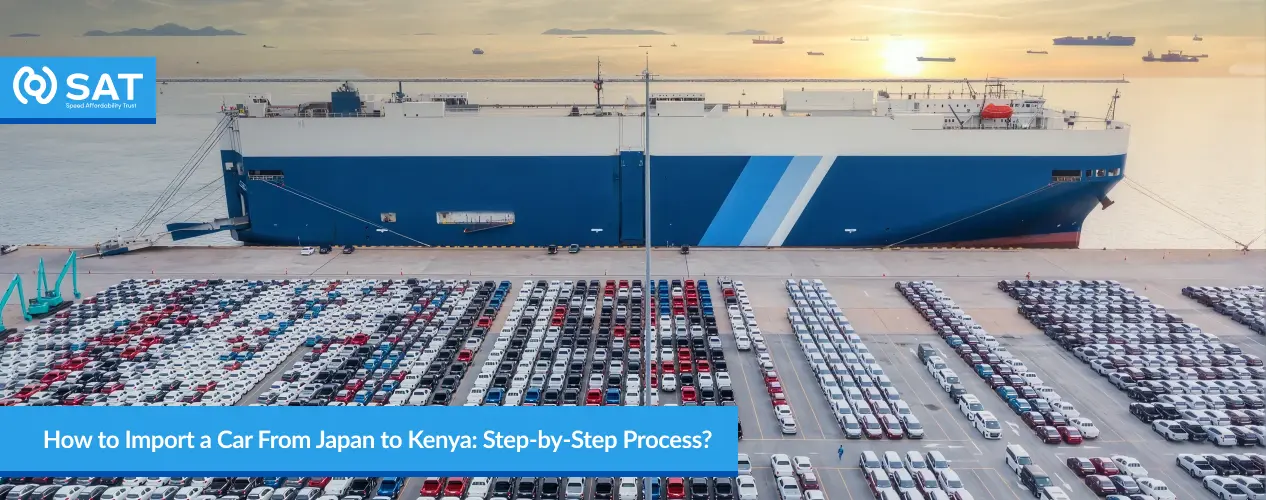
Next comes car shipping from Japan to Kenya. Roll-on/Roll-off (RoRo) is the most popular choice among buyers for standard vehicles, as it is the least expensive. If you are transporting something valuable, classic, or luxurious, it will be more secure in a container. Most shipments arrive through the Port of Mombasa in 5-7 weeks.
As the ship approaches, your licensed customs clearing agent will submit your documents to the Kenya Revenue Authority (KRA). KRA verifies your paperwork, including the QISJ certificate and original export documents. Any missing paperwork or incorrect vehicle information can delay the release of your car and incur high port storage fees (demurrage).
When the ship arrives, your customs clearance agent will then submit your paperwork to the Kenya Revenue Authority (KRA). KRA checks your documents, such as the QISJ certificate and original export documents. If you do not have all the documentation or information relating to your vehicle, your car will be delayed, and a high demurrage fee will be charged at the port.
The last step is to register your vehicle with the National Transport and Safety Authority (NTSA). After you get your documents approved and register your car, you will be able to drive your car legally on Kenyan number plates. You've now completed your journey from Japan to Kenya, and your car is now ready to go.
Many car buyers believe that the price they pay for cars is the most expensive when importing cars to Kenya from Japan. In fact, import taxes can add up to a high cost in your end-to-end landed cost. Many first-time importers will find themselves surprised at this. If you want to purchase vehicles in Kenya without being hit by unforeseen costs, it is best to know how car import duty is calculated in Kenya before you actually buy a vehicle.
Kenya doesn't tax you just according to how much you paid for the car. The Kenya Revenue Authority (KRA) uses the Current Retail Selling Price (CRSP) list, an official list used to estimate the market value of various vehicle models. This is the price that will be used to calculate your import taxes, rather than the invoice price. If the CRSP values of two cars are different, then they might have different taxes on the same price of the car.
Import Duty is the first major tax you pay when importing a vehicle into Kenya. As of 2026, passenger vehicles generally attract an Import Duty of 25%, calculated on the vehicle's Customs Value (CIF), which includes the cost of the vehicle, insurance, and freight. KRA derives the customs value using its Current Retail Selling Price (CRSP) valuation system rather than relying only on the invoice price.
After Import Duty, Excise Duty is applied. For many passenger vehicles, it is 20% or 25%, depending on factors such as engine capacity and vehicle classification. Larger-engine vehicles generally attract higher excise duty than smaller, fuel-efficient models. Because excise rules can change, always verify the latest rate before importing.
Kenya charges 16% VAT on imported vehicles. VAT is calculated after adding the customs value, Import Duty, and Excise Duty together. Since VAT is applied after the other taxes, it becomes one of the biggest contributors to your final landed cost.
Every imported vehicle must have an Import Declaration Form (IDF) before customs clearance. As of 2026, the IDF is 3.5% of the Customs Value (CIF) and must be paid before your vehicle can be released from the Port of Mombasa.
Imported vehicles are also subject to the Railway Development Levy (RDL), which is 2% of the Customs Value (CIF). This levy helps fund Kenya's transport infrastructure, including railway development projects.
Note: Import taxes are calculated using KRA's Current Retail Selling Price (CRSP) and applicable customs rules. Tax rates and valuation methods may change, so always confirm the latest requirements with KRA or your clearing agent before importing.
It is at the point of car shipping from Japan to Kenya that planning really pays off. Knowing what type of shipping you need, having the right paperwork, and knowing exactly when it will arrive can save you weeks in delays and additional expenses. The journey begins when you drive away from the vehicle auction yard in Japan.
Most Japanese cars for Kenya are shipped from Yokohama, Nagoya, Osaka, Kobe, and Hakata. They are considered trusted ports, as they export thousands of vehicles monthly and have regular sailings to Mombasa port. Regular departures minimize waiting time and facilitate quicker vehicle arrival in Kenya. Usually, ocean transportation takes 4 to 7 weeks, but this may depend on the weather, vessel schedules, and port congestion.
Once you've bought the car, the exporter will transport it to a secure shipping yard close to the port. This is followed by export customs clearance, document clearance, and pre-export inspection by KEBS. Upon approval, the shipping line would issue the Bill of Lading as the official shipping document, and you would be able to pick up your vehicle when it arrives in Kenya.
While many buyers will compare shipping rates, they fail to ask what's included. A lower quote may not include marine insurance, destination handling charges, port charges, or inland transport charges once at Mombasa. Avoid opting for the lowest shipping price and insist on an all-in price.
Yet another wise move is to select an exporter who offers shipment tracking. SAT Japan provides the shipping company, Bill of Lading, and the expected arrival date, so you can arrange the customs documents prior to the vessel's arrival. This will reduce storage charges at the port and speed up the clearance process.
We make the entire process smooth. Whether you're booking the vessel, arranging export papers, monitoring your shipment, or assisting with customs clearance, you can rely on us to ensure your vehicle arrives safely, on time, and ready for registration in Kenya.
There are normally two kinds of shipping of cars from Japan to Kenya: Roll-on/Roll-off (RoRo) or Container Shipping. It is important to consider the coverage level, the value of the car, and your budget when choosing the right car insurance. The choice of RoRo or container is generally determined by price: most buyers of everyday vehicles prefer to import by RoRo, while collectors and those who buy luxury cars prefer to import by container for extra security.
Feature | RoRo (Roll-on/Roll-off) | Container Shipping |
Cost | Lower shipping cost | Higher shipping cost |
Vehicle Protection | Good protection inside the vessel | Maximum protection inside a sealed container |
Transit Time | Usually 4–7 weeks | Usually 4–8 weeks |
Loading Method | Vehicle is driven onto the ship | Vehicle is loaded into a container |
Best For | Daily drivers and budget-friendly imports | Luxury, classic, rare, or high-value vehicles |
Personal Items | Not allowed inside the vehicle | May be allowed, subject to shipping regulations |
Availability | More frequent sailings | Limited availability on some routes |
RoRo shipping is the most cost-effective and reliable shipping method for most car importers from Japan to Kenya. It's the most popular option because it's quicker to set up and much less expensive than shipping goods in containers.
For rare classics, luxury SUVs, and high-value sports cars, you may want to opt for container shipping, as the additional investment is worth it. The vehicle remains in the container during transport, which helps minimize the risk of damage from weather, dust, and handling.
Selecting the right car is as crucial as comprehending the import procedure. The most reliable Japanese cars used in Kenya are those that are fuel-efficient, easy to maintain, and highly resale-worthy. Do not purchase the lowest-priced car; select a car that suits your everyday driving needs, your budget, and the roads you drive most frequently.
Toyota Land Cruiser Prado: The Toyota Prado is one of the most reliable SUVs in Kenya for a reason. It is excellent for driving on rough roads, long-distance driving, and off-road driving and can be used with ease. Due to its high resale value and easily accessible parts, it is a popular choice among families and businesses.
Toyota Corolla Fielder: For anyone who requires a reliable daily driver, the Fielder is tough to beat. It has good fuel efficiency, a big trunk, and many common parts with the Toyota Corolla, so it's easy to find parts in almost any part of Kenya. Very common among families, taxi drivers, and small businesses.
Mazda Demio: The Demio is one of the most economical used cars for sale in Japan. It's compact, so driving in the city and parking are convenient, and it's easy to maintain. This makes it a smart choice for first-time car buyers and commuters who want to minimize expenses.
Subaru Forester: For those who frequently drive on rough roads or in rainy weather, the Subaru Forester is an excellent choice. Its all-wheel-drive system provides excellent stability and traction. This makes it a great choice for both urban and rural areas. If purchasing one, make sure it is in good condition and has a documented service history.
Honda Fit: If you're looking for a low-priced car that offers great comfort without being too expensive on fuel, then Honda Fit might be the perfect choice. It is compact yet surprisingly spacious and offers flexible cargo space. It is one of the most sensible options for Kenya's daily driving, with its reliability, ease of maintenance, and high resale demand.
No one car is the "best" for everyone. For fuel efficiency, the Honda Fit and the Mazda Demio are the better options. For a family SUV, the Toyota Prado, Toyota Harrier, or Nissan X-Trail are great choices. The all-wheel-drive systems of the Subaru Forester and Subaru XV provide an added boost in confidence for drivers who frequently encounter bad road conditions.
Smart buyers do not just look at the price when they are buying a vehicle. They evaluate mileage, parts availability, maintenance fees, resale value, and auction condition before deciding. This makes it easy for you to purchase a car that not only gets to Kenya safely but will also operate without any hitches for quite some time.
For many Kenyan buyers, Japanese used cars are the top option due to their reliability, cost-effectiveness, and value. Many are driven on well-maintained roads and serviced regularly in Japan. Therefore, they may come in better condition than similar used cars from other markets. Another benefit is the availability of spare parts. Popular brands have a good service infrastructure throughout Kenya, and parts are available.
There is also a low rate of depreciation in Japanese cars. If your models have a good service record and high auction grades, they will have greater demand in the future and be easier to resell. When purchasing directly from trusted Japanese used car exporters, you can also enjoy thousands of quality vehicles, auction reports, and competitive rates.
Verify the exporter's reputation: Make sure that the company is registered as a business, has export experience, and has real customer reviews. Generally, a long history is a good indicator of reliability.
Ask for the original auction sheet: The original auction sheet displays vehicle condition, mileage, accident history, and inspection grade. Do not solely rely on pictures or the seller's description.
Request a recent video of the vehicle: A walkaround video of the car with the engine running is a great way to get a good idea of how the car is being handled and that the exporter owns the vehicle.
Compare prices before buying: If the price is drastically lower than other like cars, it should be a red flag. Low prices can be misleading and may cover other issues such as flood damage, accident damage, and fixes.
Use secure payment methods: Pay in the export company's main business bank account. Don't engage in personal communication, cash payments, or transactions with cryptocurrencies without proper documentation.
Check all shipping documents carefully: Ensure that the Bill of Lading, the Export Certificate, Commercial Invoice, and chassis number (VIN) are identical. Small mistakes can cause delays in the customs clearance process in Kenya.
Choose exporters who provide shipment tracking: Trusted exporters will give you the name of the vessel, the Bill of Lading number, and the estimated arrival date; you can track your vehicle until it arrives at the Port of Mombasa.
Never rush your decision: A careful buyer takes time to verify the exporter and the vehicle before making payment. An extra day to look things over could save you thousands of dollars and weeks of stress.
Purchasing an imported vehicle can seem quite overwhelming, particularly if it's your initial car purchase from overseas. From beginning to end, we make it simple, transparent, and stress-free. With thousands of listings to choose from, you would need to do a lot of work to find quality Japanese used cars for sale, but with this service, you get access to a large inventory of cars sourced directly from Japanese auctions and dealer networks that you can trust.
Carefully reviewing auction reports, verify vehicle history, and assist you in selecting a car that adheres to all the requirements for importation into Kenya before it is shipped. We also provide export documentation, car shipping from Japan to Kenya, and shipment tracking information so you always know where your car is.

A used car isn't cheap due to its age, but because you purchase it at a low price. UK prices fluctuate as dealer inventories change and with seasonality. This translates to a significant variation in the cost of two identical cars produced only a few weeks apart. Here's a 2026 guide on the best time to purchase a used car UK, why dealers are more ready to negotiate at particular times, and how to take advantage of the actual market trends and save money without buying a lower-quality car. Recent market activity also highlights the need for buyers of used cars to make good timing more critical than ever.
If Your Goal Is | Best Time to Buy | Why It Works |
Get the lowest prices | November–January | Selling old inventory, and buyer demand is weak. |
Find the biggest selection | March & September | A thousand cars are available for part-exchange following a plate change. |
Negotiate the best deal | End of the month or quarter | Sales staff may have quotas to meet and be more flexible with price |
Buy an SUV or 4x4 | Spring or early summer | This is typically a time of reduced demand that can benefit value |
Buy a convertible | Autumn or winter | There is a lack of demand for open-top vehicles, and this creates softness in the prices |
Buy an electric vehicle | After March or September plate changes | The more EV trade-ins, the more choice and opportunity for EV buyers. |
If you know the best time to purchase a car, you can save hundreds or even thousands of pounds. There is no ideal time for everyone to purchase a used car, but certain months offer better deals, lower prices, or a larger selection. Understanding market changes is the key, not following the calendar. Here's what to expect each month.
January is one of the best times of the year to be a bargain hunter. People are not buying cars after Christmas because they are recovering from holiday spending. But dealers still have to clear last year's car inventory. This allows for additional leeway in price negotiation and may yield better prices than during the busy months. January is a good month to purchase if you are on a budget.
February is a double-edged month. Dealers are starting to get ready for the March plate change, so some may be willing to wait for trade-ins. But if you do see a car parked on the forecourt for a few weeks, it may still be possible to secure a good discount before new cars arrive.
The first brand-new registration plates of the year arrive in March. Thousands of drivers decide to get rid of their old cars and buy brand-new ones, resulting in a surplus of used cars on the market. Because demand is high, prices can remain steady, but there's a much greater choice for buyers. This is a great month when the right model is more important than the lowest price.
April can be one of the best months to purchase. Many part-exchange vehicles have been issued to dealers since the March plate change, and they want to sell them fast before the storage costs increase. That's because you will have a better choice and greater negotiating power, and April is also one of the best-value months of the year.
June isn't all that busy, but it does have one secret. Many dealers will strive to meet quarterly sales milestones, with the end of the quarter falling in June. A salesperson might be more inclined to accept the lower price if they are close to closing a sale and need to make another one before the end of the quarter.
June may not attract much attention, but it offers a hidden advantage. Many dealerships work toward quarterly sales targets that end in June. If a salesperson is close to reaching their goal, they may be more willing to accept a lower offer to secure another sale before the quarter closes.
July is another steady month, with no significant buying surges, and it still has decent stock. Often, families plan summer vacations rather than shop for cars so competition may be reduced. With a bit of confidence and some shopping on weekdays, you might get deals that many buyers don't realize.
August is typically a waiting month. The September plate change is approaching, and dealers anticipate a high volume of trade-ins. If you're looking to have a car, it's worth waiting a few weeks so you can get fresher choices and stock after the plate change.
September is also a big plate-change month, like March. Used cars from part exchanges quickly fill dealer forecourts, providing plenty of options for buyers. But popular models can still sell out quickly, as many people are shopping at the same time. Buyers in September must be cautious when making an offer, given current prices.
October is one of the least popular times to purchase used cars. The September change of plates has passed, but there are still plenty of dealers out there with inventory they'd like to get rid of. October can be a great time to buy, as inventory is high and competition from buyers is low.
Many people believe that November is one of the best months to purchase a used car. Dealers are looking to shed inventory as they approach the end of the year, while sales begin to slow. Cars that sit unsold for months tend to be more negotiable, and prepared buyers have an edge.
December may be one of the best months to save money. Many dealerships strive to meet their annual sales goals and clear stock before the new year starts. Fewer people are at showrooms during the Christmas season, which allows serious buyers to get more attention from sales staff and a better chance to negotiate a lower price. December could be the best time of the year to buy a car in the UK if you are willing to be flexible and willing to move into action.
The best time to buy a used car also depends on the type of vehicle you want. While most buyers consider only the month, smart buyers also consider the season. Sellers are often more flexible when demand for their car is lower.
Purchase your convertible in the fall or winter. When the weather is cooler, people don't think of driving with the roof down as much, and prices tend to be a little less stiff. In contrast, SUV and 4x4 sales typically increase as spring and early summer approach, when demand is higher than in winter.
Looking to purchase a family hatchback or MPV? Shop after the summer holidays or in January when fewer families are active. For those considering an EV, keep an eye out for a surge in EV trade-ins at dealerships following March and September plate changes. This can provide you with more options and negotiating leverage.
You can take one simple tip from many car buyers and make it the rule to purchase a vehicle out of season, not when everyone else is. It is one of the simplest ways to save money without sacrificing quality, and is a good idea if you want to get the best deal on a used car UK or the best deal on a second-hand car.
The ideal time of year to buy a car in the UK is typically late autumn and winter, particularly between November and January. Compared with the same time of year, sales drop off after Christmas, making it easier for dealers to cut prices to clear inventory. Another savvy time is just before new UK registration number plates are introduced in the system in March or September, when many dealerships are trying to move out older models to make way for the new ones. When you're looking for the widest choice, you can shop around directly after the plate change, but if you're looking for the lowest bang for your buck, you should consider shopping around during quieter months where buyers are less likely to be looking.
Overall, the UK used car market is strong in 2026, but it is important to understand this market correctly. Demand remains strong, and the supply of 3-7-year-old cars remains tight due to fewer new cars sold during the pandemic. This means that cars in good condition will still hold their value, and popular family models will go far.
However, there are still good deals to be found if you know where to look. The price of used EVs has fallen, and there is increasing interest from buyers. Meanwhile, thousands of part-exchanged cars are entering the market in March and September, providing buyers with options. To find out when the best time is to buy a used car UK, you should concentrate on these periods of high demand for used cars and compare prices before the demand increases again.
The ideal month to purchase a used car UK is not necessarily the month of the calendar. Smart buyers look for signs that dealers may be in a rush to sell and that the market favours them. The more of these signs you have, the higher the chances of you getting a great deal.
Vehicles that have been sitting on the forecourt for a long time are usually offered at a lower price by a dealer because the longer they remain there, the more they cost the dealer.
Sales teams might be looking to meet quotas, so they're eager to cut costs or add value-added features, such as a warranty or service.
Many part-exchanged cars come to dealerships after the registration plate change for March and September. The more choices you have, the better your bargaining position will be.
If the price has dropped recently, it's likely a sign that the seller is serious about selling. It's a good time to make a fair offer supported by market research.
Don't do the first deal in a hurry. If two or more vehicles are available with the same mileage and specifications, you know you have other choices and an advantage in negotiating.
A last reminder that many competitors fail to remember: Watch the stock, not the price. If this model keeps appearing on the internet over several weeks, supply has increased. When buyers have many options, dealers are less likely to hold firm on price, which is another good indicator that now is the best time to purchase a used car.
While you may be aware of the best time to purchase a used car UK, a single bad move could set you back hundreds or even thousands of pounds. Many potential customers consider only pricing, but the best customers consider condition, history, and running costs as well. Avoid these common mistakes to make a more confident purchase.
Clean and shiny paint can make you fall in love too quickly. Stay calm, compare the car to others, and don't let feelings take over.
Before agreeing to purchase, always check the MOT history, service records, Outstanding finance, Accident history, and recalls. A low-cost vehicle can prove very costly if unexpected issues arise afterwards.
Drive on different types of roads and listen for unusual noises. Test the brakes, steering, clutch, and electronics, rather than driving around the block for a few minutes.
It's not just the purchase price. Do some research on insurance costs, road tax, fuel efficiency, tyre costs, and possible repairs before you decide.
Many buyers don't negotiate even though many dealers do. Do some research on similar cars and make a reasonable offer based on the car's condition and market prices.
A reputable seller should allow sufficient time to review the documents and answer questions. When a person is pressured into making a purchase, it is better to back out than to regret it later.
Finding the best time to buy a used car UK is only half the job. Before you hand over your money, take a few extra minutes to inspect the car properly. A careful check today can save you from expensive repairs tomorrow. Use this simple checklist every time you view a used car.
Check the MOT history. Look for repeated advisories or failures. The same problem appearing year after year could mean the car hasn't been properly maintained.
Verify the V5C logbook. Make sure the registration number, VIN, engine number, and seller's details all match the vehicle. A genuine V5C is one of the first signs of a legitimate sale.
Run a vehicle history check. Confirm there is no outstanding finance, theft record, or insurance write-off. Spending a small amount on a history check can prevent a costly mistake.
Review the service history. A full service record shows the previous owner cared for the car. Missing services can be a warning sign.
Inspect the tyres and bodywork. Uneven tyre wear, rust, or mismatched paint may indicate poor maintenance or prior accident damage.
Take a proper test drive. Drive on different roads and check the brakes, clutch, steering, gearbox, suspension, air conditioning, and all dashboard warning lights.
Compare the asking price. Search for similar models with the same age, mileage, and specification. If the price is much lower than average, ask why before making an offer.
While determining the most suitable time to purchase a used car UK is crucial, the way in which you do it can make a big difference. There are decisions that can be made before and during the buying process that significantly impact the final price. Follow these pros' tips for saving more money.
Wait until the end of the month or quarter to buy. Dealers may be motivated to make a sale, which means they'll be more willing to negotiate the price or offer an extended guarantee or servicing.
Do some research before going. Make comparisons between similar cars of the same age, mileage, and trim level. The market value gives you confidence and helps prevent you from paying too much.
Discuss the entire arrangement, not the actual cost. If the dealer refuses to reduce the price, request a free service, new tyres, MOT, or extended warranty. These extras can help you save a hundred pounds or more down the road.
Be careful not to give out your budget prematurely. Allow the seller to make the first offer. When you're familiar with their price, you will have a better bargaining position.
Be prepared to leave. This is a very powerful negotiating tool. When sellers know you have other options, they are more inclined to offer you a better deal.
Consider more than just the cost. When choosing insurance, fuel, road tax, servicing and anticipated repairs, make sure to compare these figures before making your decision. If you can find a more expensive car that is less to operate, you can save a lot over the next several years.
Understanding the optimum time to purchase a used car UK provides you with an edge, yet the smartest purchasers additionally choose a reliable dealer. When you put your timing, research, and careful examination into practice, you can discover a vehicle that delivers real value instead of hidden issues.
SAT Japan offers plenty of choice in quality Japanese imports from Japanese auctions. Each listing has detailed photos and auction information, making it easier for you to make an informed decision before purchasing. We are also available physically in UK. SAT Japan also offers advice on UK import regulations, inspections, and shipping, ensuring a streamlined and hassle-free purchase.
You can easily access us online. You can locate us at Purfleet-on-Thames, Grays RM20 3NL, United Kingdom.
Shop around; don't make hasty decisions. Today, the right car at the right time can save you money and give you years of reliable driving down the road.

If you want to know how to import cars from Japan to Canada, the process starts with understanding the rules before you choose a vehicle. Your car needs to be at least 15 years old from its month and year of manufacture; you'll clear it through the Canada Border Services Agency and the Registrar of Imported Vehicles program.
Your car generally needs to be at least 15 years old from its month and year of manufacture. You'll clear it through the Canada Border Services Agency before completing the required provincial inspection, registration, and insurance. Your total landed cost usually lands somewhere between $9,000 and $30,000 CAD, depending on the vehicle, shipping method, and province. Everything else in this guide is the detail that keeps you from getting burned.
This Canada car import guide works whether you're a first-time importer nervous about paperwork, a JDM enthusiast chasing a specific chassis code, or a dealer building out inventory. Each section stands on its own, so skip to what you need. The Japan-to-Canada car import process starts with confirming the build date and ends with provincial registration and insurance.
Step | What Happens | Typical Cost | Typical Time |
Sourcing | Find and win a car at auction or through a dealer | $3,000–$40,000+ (vehicle price) | 1–4 weeks |
Export docs | Exporter arranges deregistration and export certificate | Usually included in the export fee | 1–2 weeks |
Shipping | RoRo or container from a Japanese port to Canada | $1,850–$6,000 | 2–5 weeks |
CBSA clearance | Border agency reviews documents and admissibility | Brokerage fee ~$300 | Days to 2 weeks |
Provincial inspection | Safety and, in some provinces, emissions check | $100–$300 | Days to 2 weeks |
Registration & insurance | Plates, RHD insurance, final paperwork | Varies by province | 1–3 days |
Yes. It's completely legal, and Canada is one of the friendliest countries in the world for it. Compare that to the United States, where importing a JDM car means waiting 25 years unless it qualifies for a "Show or Display" exemption. Canada only asks for 15, and that gap is the entire reason the JDM import industry here is as big as it is.
Right-hand drive is not a legal grey area either. Thousands of Japanese imported vehicles, including RHD Skylines, Silvias, and kei trucks, are registered and driven across Canada every year. You just need to get used to reaching for the wiper stalk when you meant the turn signal.
The federal rule is simple:
A vehicle becomes eligible for import once it's at least 15 years old, counted from its month and year of manufacture. A car built in April 2011 becomes eligible in April 2026, not January. Check the build date, not just the model year, on the listing. Vehicles that are 15 years old or older are age-exempt from Canada's federal vehicle import requirements and are not required to enter the RIV Program. The vehicle's age is based on its month and year of manufacture. There's also no upper age limit. A 1970s Skyline or a 1990s Silvia is just as importable as one built in 2011.
Clearing your car through customs is a federal matter. Getting it on the road is provincial, and provinces don't all play by the same rules.
Most provinces mirror the federal 15-year standard for registration. Quebec and Prince Edward Island do not. Quebec requires a right-hand-drive vehicle to be 25 years old before the SAAQ will register it, even though CBSA would clear the same car at 15 years. PEI has its own separate RHD restrictions that don't follow the same age threshold. Check your home province before you bid on anything.
Province | Registration Age Rule | Inspecting Body | Provincial Tax | RHD Insurance Notes |
Ontario | 15 years (matches federal) | Safety Standards Certificate via a licensed garage, then ServiceOntario | 13% HST | Several specialty insurers active; shop around |
British Columbia | 15 years (matches federal) | ICBC registration; DOT-approved tires and headlights required | 12% (7% PST + 5% GST) | ICBC plus private insurers for RHD; tire/headlight swap is a common cost surprise |
Alberta | 15 years (matches federal) | Out-of-province inspection via "Request for Inspection" form | 5% GST only, no PST | No provincial sales tax is a real cost advantage here |
Quebec | 25 years for RHD vehicles | SAAQ | 5% GST + 9.975% QST | RHD under 25 years cannot be registered, full stop |
PEI | RHD vehicles generally prohibited on public roads, with limited exceptions | Provincial inspection | 5% GST + 10% PST | Confirm current exceptions with the PEI registry before importing |
Atlantic provinces (NB, NS, NL) | 15 years (matches federal) | Provincial safety inspection | HST varies 13–15% | Fewer RHD-specialist mechanics and parts suppliers nearby |
Ontario and BC tend to be the easiest provinces for a first import, since specialist shops and insurers already exist there in numbers. Quebec and PEI are where good deals go to die if you didn't check the rules first.
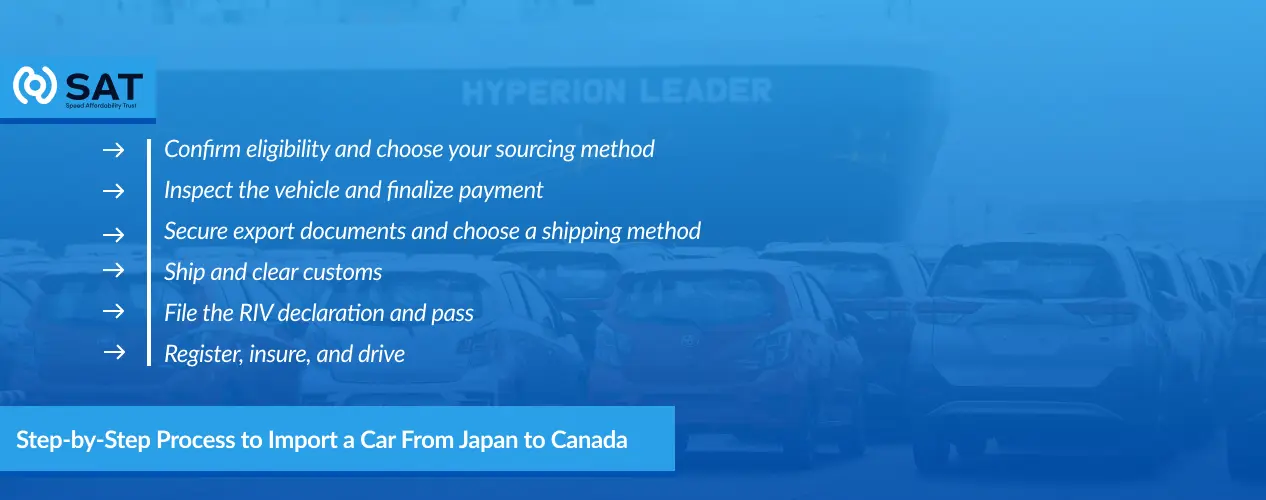
Most of these steps are handled in parallel by your exporter and broker while you wait. The steps that actually need your attention are eligibility, payment, and the provincial inspection.
For a Japan car import to Canada, buyers can choose between auctions and dealer stock. Auctions give you access to a massive rotating inventory at wholesale-adjacent prices. Dealers offer you a fixed price and less risk of an unpleasant surprise.
Method | Cost | Control Over Condition | Risk | Timeline |
Live auction (via agent) | Lowest average price; add auction and agent fees | High, if you can read the auction sheet well | Higher, no test drive, sheet-dependent | Bid results in hours, car secured same day |
Dealer stock | Higher average price, often 10–20% more | Moderate; more photos and sometimes video are available | Lower, the dealer has already inspected the car | Can secure immediately |
My best deal ever came from an auction, a clean Legacy GT wagon most bidders skipped because the listing photos were rough. My worst surprise also came from an auction, on a car whose sheet I misread as a beginner. Dealers cost more because someone else already took on that risk for you. If it's your first import, that premium is often worth paying.
Look for a company with a verifiable track record: years in business, a real physical address in Japan, and confirmable export licensing.
Ask for a live video walkaround of the specific car before you wire anything; a legitimate exporter does this without hesitation.
Payment should go through a traceable wire transfer or an escrow-style trade protection service, never informal cash apps or crypto with no paper trail.
Watch for red flags: a price noticeably below every comparable listing usually signals a problem the seller hasn't mentioned yet, and so does pressure to wire funds immediately before you've reviewed the auction sheet.
Auction sheets are graded by an independent inspector, not the seller, so the grade reflects the car's actual condition. The overall grade runs from R (accident-repaired) up through 3.5, 4, 4.5, 5, and 6 for near-showroom cars. Anything below a 4 deserves a hard look at what dragged the score down. Interior condition gets its own letter grade (A is excellent, B is average wear, C means noticeable damage) and is graded separately from the exterior for a reason: a beautiful body with a trashed interior is common.
The sheet also includes a diagram of the body panels marking dents, scratches, and repairs. Watch for the word modified, which can mean anything from a stereo swap to a full engine change, worth clarifying with your agent before you bid.
When you import vehicles from Japan, keep the following documents ready before the shipment reaches Canada.
Japanese Export/Deregistration Certificate, the car's title, original plus a certified English translation
Bill of Lading, issued by the shipping line, doubles as your right to claim the car at the Canadian port
Bill of Sale/Invoice, proof of what you paid, used for duty and tax calculations
Vehicle title/registration from Japan, supporting document confirming ownership history
Vehicle Import Form 1, where applicable for recording the vehicle's import status
Required CBSA customs accounting documentation
Certificate of Origin, needed to claim the reduced CPTPP duty rate on Japan-origin vehicles
Missing even one of these can hold your car at the port while you scramble for a replacement, so keep digital and physical copies of everything in one folder from day one.
RoRo (Roll-on/Roll-off) means your car is driven onto a car-carrier ship and driven off at the other end, parked alongside hundreds of others for the crossing. It's cheaper by a wide margin and what most standard imports use. Container shipping seals your car inside a steel box, whether shared or alone, and is the better call for anything rare, low-mileage, or high in value.
Method | Cost | Protection | Timeline | Best For |
RoRo | $1,850–$3,500 CAD | Exposed to weather during loading/unloading; secure once stowed | 2–3 weeks to Vancouver | Standard daily-driver imports, budget-focused buyers |
Container (shared or 20ft) | $4,000–$6,000 CAD | Fully sealed, no weather exposure | 3–5 weeks | Rare, low-mileage, or high-value cars |
Vancouver is Canada's RoRo hub and the fastest route in. Halifax and Montreal handle more container traffic and run a longer transit window. SAT Japan ships into the Port of Nanaimo, with typical transit running 1–2 weeks, though timing can vary with sailing schedules and seasonal port conditions. Save the money and go RoRo unless the car is rare or high-value enough that you'd lose sleep over it in transit, then pay for the container.
CBSA handles customs clearance, including reviewing import documents, determining admissibility, and collecting applicable duties and taxes. For first-time buyers, importing a car from Japan to Canada can be easier when a customs broker reviews the paperwork before the vehicle arrives.
Vehicles that are 15 years old or older are age-exempt and are not required to enter the RIV Program. Provincial inspection and registration requirements still apply after the vehicle enters Canada.
Total Landed Cost = Purchase Price + Duty + 5% GST + Provincial Tax + $100 AC Excise + Fuel-Inefficiency Excise (if applicable) + Shipping + Port/Terminal Fees + Brokerage + Inland Transport + Provincial Inspection/Registration
Duty on a Japan-origin passenger vehicle is 6.1% under standard MFN rates, but drops to 0% under CPTPP once you've filed a proper Certificate of Origin, a document that can save you well over a thousand dollars. Kei cars and mini trucks get a partial 2.2% rate instead of 6.1%. GST is a flat 5% federally, and provincial tax stacks on top, from Alberta's 0% PST up to Quebec's added QST.
Two smaller taxes catch people off guard: a flat $100 federal excise tax on any vehicle with air conditioning (nearly all of them in 2026), and a fuel-inefficiency excise tax that kicks in if your car's combined rating sits at 13 liters per 100 kilometers or worse.
Example: Eligible Japanese used passenger car, purchase price approximately C$21,175:
Cost Component | Amount (CAD) |
Vehicle Price | $21,175 |
Duty (0% under CPTPP, if origin requirements are met) | $0 |
GST (5%) | $1,059 |
Provincial Tax (13% HST, Ontario) | $2,753 |
AC Excise Tax | $100 |
Shipping (RoRo estimate) | $2,400 |
Port/Brokerage Fees | $500 |
Inspection/Registration | $250 |
Estimated Total Landed Cost | $28,587 |
Duty basically disappears once your Certificate of Origin is filed correctly, and shipping method is the single biggest lever you control.
Import duty for kei cars and mini trucks depends on the vehicle's tariff classification and whether it qualifies for preferential treatment under CPTPP.
The catch is provincial, not federal: some provinces restrict kei trucks and kei cars to off-highway or private-road use, while others register them for regular street use. I've driven a Honda Acty at highway speed exactly once and don't recommend repeating that experiment; these vehicles top out well below typical Canadian highway speeds.
Once vehicles clear the 15-year mark, a handful of chassis account for most of the import demand in Canada:
Demand is highest for the Nissan Skyline GT-R (R32, R33, R34), the most-searched JDM import by a wide margin. R34 prices have climbed sharply over the past several years, thanks to its GT-R badge and AWD platform
Drift enthusiasts consistently look for the Nissan Silvia (S13, S14, S15), valued for its RWD chassis and swap potential
Sedan buyers often go for the Toyota Chaser / Mark II (JZX90, JZX100), popular for its 1JZ/2JZ engine options and sleeper looks
Interest is growing in the Toyota Supra (JZA80) as later production years cross the 15-year line
For a practical daily driver, many buyers choose the Subaru Legacy GT wagon, whose turbocharged EJ255 delivers most of an STI's power at a fraction of the insurance cost, pairing real performance with wagon usability
AWD performance in a smaller footprint draws buyers to the Subaru Impreza WRX STI
Rotary fans continue to seek out the Mazda RX-7 (FD3S), known for its engine and pop-up headlight styling
Small-business and hobbyist buyers favor the Honda Acty, a compact kei truck
The Suzuki Carry remains another kei-class workhorse in steady demand
A niche but growing collector interest exists for the Nissan Cima / Toyota Century, both luxury JDM sedans
As newer model years clear the 15-year threshold, more late-2000s and early-2010s JDM models will become eligible for import.
Insuring an RHD car isn't automatic. Standard insurers sometimes decline outright because their systems aren't built to quote a right-hand-drive vehicle. To insure an imported Japanese car, companies may ask for import documents, current photos, and sometimes an appraisal.
Specialty and RHD-friendly insurers exist in every province and typically underwrite these cars individually. Expect to provide your import paperwork, photos of the vehicle, and sometimes an appraisal. Premiums can run a bit higher, mostly because parts and repair costs are less standardized, but it's rarely the dealbreaker new buyers fear.
Start to finish, plan for two to three months, though a smooth import can land closer to six weeks. Sourcing takes one to four weeks. Export preparation in Japan adds one to two weeks. Ocean transit runs two to three weeks to Vancouver, or three to five weeks through Halifax. CBSA clearance takes a few days to three weeks, depending on port congestion and paperwork. Provincial inspection and registration wrap up in a few days to two weeks.
Add it up, and you're looking at roughly nine to sixteen weeks from winning an auction to driving on Canadian plates.
A broker handles auction access, sheet translation, payment logistics, shipping arrangements, and customs paperwork, usually for a fee built into the total cost. Self-importing saves that fee, but means you're reading auction sheets in a language you may not speak, wiring money overseas without a local contact, and filing federal paperwork correctly on your first try.
I've done it both ways. My self-imported cars took longer and taught me more. My broker-assisted imports were faster and considerably less stressful. If this is your first import, or the car matters enough that a mistake would hurt, pay for the broker.
Buying before confirming build-date eligibility.
Ignoring provincial rules. Federal eligibility at 15 years means nothing in Quebec if your car is RHD and under 25, and PEI has its own separate RHD restrictions that can block registration regardless of age.
Underestimating total landed cost. The purchase price is the smallest number once shipping, tax, and fees stack up.
Skipping exporter vetting. A below-market price on a car you've never seen video of is a warning, not a deal.
Forgetting the AC and fuel-inefficiency excise taxes.
Assuming RHD insurance is automatic. Call your insurer before the car ships.
JDM: Japanese Domestic Market; a vehicle originally built and sold for Japan's home market.
RHD: Right-Hand Drive, standard configuration for Japanese domestic vehicles.
CBSA: Canada Border Services Agency, the federal body that clears imports at the border.
RIV: Registrar of Imported Vehicles, the federal program tracking import declarations and compliance.
CMVSS: Canadian Motor Vehicle Safety Standards, the compliance rules that vehicles over 15 years old are exempt from.
CPTPP: Comprehensive and Progressive Agreement for Trans-Pacific Partnership, the trade deal behind Japan's 0% duty rate.
Form 1: The Vehicle Import Form filed with RIV.
B3-3: The CBSA customs accounting document.
Certificate of Origin: Document proving a vehicle's Japan origin, required to claim the CPTPP duty rate.
Auction Sheet Grade: The condition score (R through roughly 6) assigned by a Japanese auction inspector.
Yes, if you go in with real numbers instead of a dream number. The 15-year rule makes Canada one of the easiest countries on earth to bring home a car you can't get any other way. But the process rewards people who check the build date twice, read the auction sheet before the price, and budget for the whole formula instead of just the sticker price. The people who successfully import cars from Japan usually confirm eligibility, costs, and provincial rules before placing a bid.
The federal side of this is generous. The provincial side is where deals get complicated, so know your own province's rules before you fall for a car online. Get your Certificate of Origin filed correctly, and that 6.1% duty basically disappears. Call an insurer before the car ships, not after.
SAT Japan sources directly from Japanese auctions and dealer networks, handles export documentation, and ships directly to the Port of Nanaimo, with transit typically taking 1–2 weeks. If you need help with a Japan auto import to Canada, buyers can rely on SAT Japan to source a vehicle, handle export documents, and arrange shipping.

Tema Port or Takoradi Port. That's where every one of these stories either goes right or goes very, very wrong. If you're planning to import used cars from Japan to Ghana, you'll find Japanese models are still the default choice for buyers across Accra, Kumasi, and Takoradi, and honestly, that's not changing anytime soon.
But most of the trouble I've watched friends run into has nothing to do with the car itself. It's the duty math, the paperwork, and one steering-side rule that trips up more people than it should. Working with a reliable exporter like SAT Japan can make the process easier, but you still need to understand the rules before you send money. This guide walks through what actually happens between an auction win in Japan and a plate number in Ghana: duties, documents, real costs, and the models actually worth your money in 2026.
Ghana allows left-hand-drive Japanese used cars up to 10 years old from the date of manufacture. Combined duties, VAT, NHIL, and GETFund typically add 35% to 45% to the CIF value. Shipping and clearance usually take six to eight weeks from auction win to plate, with vehicles typically delivered through Tema Port or Takoradi Port, depending on your shipping arrangements.
Vehicle age | 10 years old or newer is recommended to avoid overage penalties. |
Steering side | Left-hand-drive (LHD) vehicles are required for standard imports. |
Delivery port | Vehicles ordered through SAT Japan are typically shipped to Tema Port. |
Duties | Import Duty, VAT, NHIL, and GETFund are calculated on the customs-assessed CIF value. |
Required documents | Bill of Lading, Commercial Invoice, Export Certificate, CCVR, TIN/Ghana Card, and GSA Certificate of Conformity. |
A Japanese used car import to Ghana starts long before the ship docks at Tema; it starts with understanding why these vehicles dominate the market in the first place. Toyota, Nissan, Honda, Mazda. Everywhere. There's a reason for that, and it isn't just habit.
Japan's domestic inspection system, called shaken, which requires regular roadworthiness checks, usually after the first three years for a new passenger car and then every two years after that. Once a car gets close to that renewal date, a lot of owners just trade it in rather than pay again. That's how Japan ends up with a steady supply of used cars that are mechanically sound and, more often than not, still fairly young by African market standards.
Auction houses like USS, TAA, and JU grade every vehicle before bidding starts: mileage, body condition, interior wear, all documented on a sheet you can actually read before you buy.
If you buy from SAT Japan, you can also browse our Japanese used cars for sale in Ghana before bidding, making it easier to compare available models and inspection reports. Look at Accra, Tema, and Kumasi after three decades of Japanese imports, and you’ll see a market that knows how to repair these cars quickly. That's the real reason Japanese imports still run this country's roads.
No, not as a standard import. Ghana requires left-hand-drive vehicles for standard imports. For anyone bringing in a car under the normal import procedure.
Here's the part people get wrong. There's a narrow policy dispensation that allows a right-hand-drive vehicle to be dismantled and refitted to a left-hand configuration, but that approval rests with the Minister of Trade and Industry, not with a broker, not with a shipping agent, and definitely not with the seller or shipping agent. It's a case-by-case approval, not a workaround you can plan around from the start.
I've seen listings, including a few pages ranking for this exact search, that make it sound like RHD conversion is a routine option anyone can request. It isn't. If you're sourcing new cars through SAT Japan or any reputable exporter, ask about steering configuration before you bid, not after the ship has left Yokohama. Assume LHD is required. Anything else is the exception, not the rule.
Ghana runs one of the stricter import regimes in West Africa, and three rules decide whether your car clears smoothly or sits at the port racking up demurrage, meaning extra port storage charges.
Ten years. That's the ceiling, counted from the year of manufacture, not the registration date or the year you bought it.
For anything landing in 2026, that means the vehicle needs a 2016 manufacture year or newer; it is generally the safer target, but confirm the exact age calculation with GRA or a clearing agent to avoid the overage penalty framework entirely. A car built in late 2015 and registered in January 2016 still counts as a 2015 model in GRA's eyes. I've watched a buyer lose that argument at Tema. It didn't go well. Confirm the manufacture year off the chassis plate or auction sheet before you bid, not after the vehicle's already on the water. That single number decides whether your import stays affordable or turns into a penalty exercise.
Left-hand drive is the rule. Right-hand drive is the exception, and a narrow one at that.
As covered above, only the Minister of Trade can approve a dismantle-and-refit case for RHD vehicles, and it's not something exporters can promise on your behalf. Most Japanese domestic-market cars are factory RHD, which is exactly why exporters like SAT Japan maintain separate LHD stock specifically built for markets like Ghana, the US, and mainland Europe. Buy from that LHD stock. Don't gamble on an exception that isn't guaranteed to land in your favor.
Every vehicle needs to pass a roadworthiness check before it's registered, and Ghana now requires imported used vehicles to meet conformity requirements before clearance. Older, higher-emission engines increasingly attract additional environmental levies on top of standard duty.
A pre-shipment inspection in Japan, checking exhaust condition, chassis integrity, and general roadworthiness, saves you from a nasty surprise once DVLA gets its hands on the car locally. That's not a step to skip, even if it costs a little extra upfront. Skipping it usually costs more later.
Ghana charges combined duty, VAT, NHIL, and GETFund that together add roughly 35% to 45% on top of your CIF value. That's where most first-time importers get the biggest shock, and it's rarely because the numbers are secret. It's because nobody added them up before the car left Japan.
CIF stands for Cost, Insurance, and Freight, and the figure used to calculate Ghana’s duties and levies. Not your auction price. Not what you actually paid.
Ghana’s ICUMS platform, the Integrated Customs Management System, uses a reference value for vehicle assessment. If that assessed value comes in higher than what you actually paid at auction, customs uses their number, not yours. Freight and insurance costs are then added to produce the final CIF figure. That's the base every duty percentage below gets applied to, so an inflated HDV assessment doesn't just annoy you; it inflates every single levy that follows.
Ghana taxes vehicles under the ECOWAS Common External Tariff, and the base import duty depends on engine size. Import duty generally ranges from 5% to 20%, depending on engine size and vehicle category. Confirm the exact rate in ICUMS before purchase. Vehicles between 1,500cc and roughly 2,500 to 3,000cc land closer to 10%. Anything above that climbs to 20%.
That's just the starting point, though. VAT applies at 15% on the CIF-plus-duty figure. Then NHIL, the National Health Insurance Levy, adds 2.5%. GETFund adds another 2.5%, and it funds education projects nationally. Stack those together, and most everyday imports land somewhere between 35% and 45% of CIF in combined charges, before you've paid a single cedi in port or agent fees. Budget the higher end of that range. You'll thank yourself later.
Numbers land better with a real example, so here's one based on a 2018 Toyota Axio bought through auction in Japan, a genuinely common import.
Item | Amount (USD) |
Auction Price | $6,500 |
Freight to Tema | $1,200 |
Insurance | $150 |
CIF Value | $7,850 |
Import Duty (5%, under 1,500cc) | $393 |
VAT (15%) | $1,236 |
NHIL (2.5%) | $206 |
GETFund (2.5%) | $206 |
Total Landed Cost | ≈ $9,891 |
This example only shows the main tax calculation. Port charges, clearing agent fees, handling costs, and possible valuation differences can push the final landed cost closer to the 35% to 45% range many buyers experience.
Total landed cost usually runs 35% to 45% above your auction price once freight, duty, VAT, and levies are added.
Auction Price vs Total Landed Cost
Here's the thing most first-time buyers miss: the auction hammer price is maybe 55% to 65% of what you'll actually pay once the car reaches Ghanaian soil. Freight, insurance, duty, VAT, NHIL, GETFund, port charges, and your agent's fee all add to that initial number.
A $6,500 auction win doesn't stay a $6,500 car. By the time it's plated and parked in your driveway, you're realistically closer to $10,000 to $11,000 all-in, depending on engine size and how the ICUMS valuation lands. That's not a scary number. That's just how the math works once every levy gets applied in sequence. Budget from the total landed cost, never the auction price. That habit alone will save you from a bad surprise.
When it comes to car shipping from Japan to Ghana, Roll-on Roll-off (RoRo) is the cheaper and more common option for standard sedans and SUVs heading to Tema. Your car gets driven onto the vessel, secured, and driven off at the other end. Transit typically runs somewhere in the range of three to five weeks, depending on the sailing schedule out of Japan.
Feature | Ro-Ro Shipping | Container Shipping |
Cost | Lower | Higher |
Best for | Standard sedans, SUVs, pickups | Premium vehicles, luxury cars, multiple vehicles |
Protection | Basic protection during transit | Better protection from weather, salt, and handling |
Transit | Vehicle is driven onto and off the ship | Vehicle is secured inside a shipping container |
Spare Parts | Cannot usually be shipped inside the vehicle | Spare parts and accessories can be shipped together |
Recommended for Ghana | Most everyday imports | High-value vehicles or combined shipments |
Container shipping is often noticeably more expensive, but it protects the vehicle from salt exposure and rough handling, and lets you consolidate spare parts or a second vehicle in the same box. For an everyday Corolla or Axio, RoRo makes financial sense every time. For something higher-value, or if you're shipping parts alongside it, a container earns its extra cost. Pick a shipping method based on what you'd lose if something went wrong, not just the invoice.
For more details, read our guide: RoRo vs Container Shipping.
Missing paperwork is the single biggest reason cars sit at Tema longer than they should. None of these documents are optional in practice, and customs won't process a vehicle without all of them in hand.
Bill of Lading: Proof that the vehicle was legally shipped and who it's consigned to.
Commercial Invoice: The purchase price declaration from the exporter.
Export Certificate or Certificate of Title: Proof of legal ownership transfer out of Japan
CCVR (Customs Classification and Valuation Report): Generated through ICUMS to confirm duty classification.
TIN or Ghana Card: Your tax identification, required to register anything with GRA
GSA Certificate of Conformity: Confirms the vehicle meets Ghana Standards Authority requirements.
A good exporter like SAT Japan should help prepare the Bill of Lading, Export Certificate, and Commercial Invoice once the vehicle ships. Your job is making sure your TIN, Ghana Card, and CCVR are sorted on the Ghana side before the vessel even docks. Get every document ready before arrival, and clearance becomes a formality instead of a bottleneck.
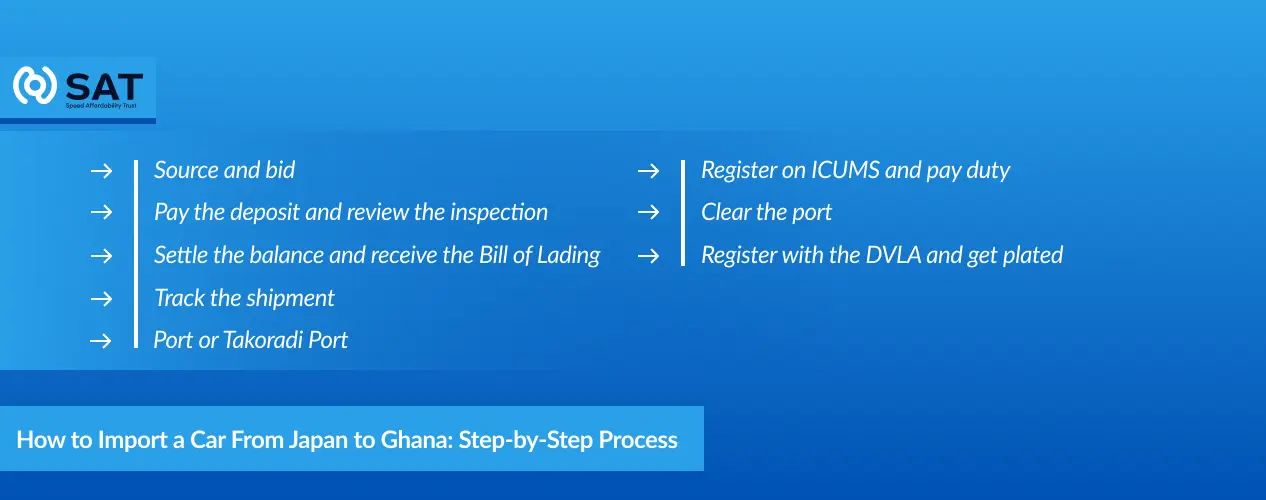
Here's the full Japan to Ghana car import process, from bid to plate, laid out the way it actually happens, not the simplified version.
Source and bid: Choose an exporter you can verify through JUMVEA, a physical Japanese address, and clear business records. At SAT Japan, you can bid live at auction or select from ready stock. Confirm the steering side and the manufacture year before you commit.
Pay the deposit and review the inspection: Most exporters ask for a deposit. Before bidding, review the auction sheet, photos, grade, mileage, and any accident notes.
Settle the balance and receive the Bill of Lading: Once full payment clears, your exporter arranges shipping and forwards the Bill of Lading, invoice, and export documents.
Track the shipment: If you order from SAT Japan, your car is usually shipped to Tema Port or Takoradi Port by RoRo or container, depending on the shipping schedule and your preferred destination. Most sailings take three to five weeks.
Register on ICUMS and pay duty: Submit your documents, get your CCVR generated, and pay the assessed duty, VAT, NHIL, and GETFund before the vehicle physically clears.
Clear the port: A licensed clearing agent handles the physical release once duty is paid and documentation checks out.
Register with the DVLA and get plated: A roadworthiness inspection, registration, and plate issuance complete the process.
Nothing here is complicated on its own. What trips people up is skipping a step out of order, trying to pay or clear the vehicle before the valuation and CCVR process is properly completed. Follow the sequence exactly, and a car can go from auction win to plated in six to eight weeks.
Choosing the right exporter matters as much as choosing the right car. SAT Japan helps Ghana buyers source Japanese used cars, check inspection details, confirm left-hand-drive availability, arrange shipping, and prepare key export documents before the vehicle leaves Japan.
This is useful because most problems happen before the car reaches Tema Port or Takoradi Port. A wrong steering side, missing document, unclear auction sheet, or incorrect manufacture year can turn a good deal into a costly delay. With SAT Japan, buyers can compare available models, review vehicle details, and move through the Japan-to-Ghana import process with more confidence.
If you're planning to buy used cars from Japan in Ghana, these are the models worth considering, based on common import demand, parts availability, and resale value.
The Toyota Axio is still the smart default. I ran one for two years. It was cheap to fuel, parts were easy to find in Accra, and it simply refused to break. The Honda Fit is nearly as strong a pick, slightly more fun to drive, though parts pricing runs a touch higher than Toyota's network. Not the most exciting car you'll ever own. It just works, every single day, without complaint.
The Toyota RAV4 handles Ghana's rougher stretches better than most compact SUVs its size, and ground clearance matters more here than most buyers realize until they hit a bad patch of road outside the city. The Nissan X-Trail is the value alternative, with less resale strength, but a genuinely comfortable ride for the price. Honestly, this is where it gets interesting: the RAV4's resale value alone can offset a chunk of what you paid in duty.
The Toyota Hilux remains the benchmark for anyone running a trade or transport business. I've watched one take a beating on unpaved roads outside Kumasi and keep going without complaint. The Nissan Navara comes in as a capable, more affordable alternative if the Hilux's premium doesn't fit your budget. For pure workhorse duty, nothing on this list beats the Hilux, and that's not close.
Avoid working with unverified exporters. Scam listings often target buyers who do not check JUMVEA membership or confirm a real Japanese business address. Once the money is sent, recovery is almost impossible.
Do not underestimate total levies. Many buyers only budget for the auction price and later get shocked by the extra 35% to 45% added during clearance.
Check the ten-year vehicle age limit. Importing a car that is over 10 years old can be expensive. A 12-year-old vehicle may attract a 20% CIF penalty, which can cancel out any savings from the auction.
Never skip pre-shipment inspection. Relying only on photos is risky. A proper mechanical check helps confirm the actual condition of the car before shipping.
Do basic due diligence before sending money. Spending 15 minutes verifying the exporter, costs, vehicle age, and inspection details can save you from major losses later.
Yes, but only if you go in with the real numbers, not the auction price. Japanese used cars still beat the alternatives on reliability, parts access, and resale value across Accra, Kumasi, and Takoradi, and that hasn't changed heading into 2026.
What separates a smooth import from an expensive headache isn't luck. It's knowing the age cutoff, the steering rule, the duty stack, and the paperwork before you bid, not after. Buyers who work with a reliable exporter and verify the numbers early usually have a smoother experience, make a few of the mistakes listed above the first time around, and learn that the process rewards patience far more than it rewards a bargain-priced auction. Do the homework before you bid, and Ghana's Japanese car market still delivers real value in 2026, just don't expect the hammer price to be the last number you pay.
Some of the cleanest used cars on Nigerian roads started their lives in Japan. Better maintenance, detailed auction records, and strong reliability have made Japanese imports a favorite among Nigerian buyers for years. That is why demand for Japanese used cars in Nigeria remains strong among buyers who want cleaner condition and better auction transparency.
The catch? Nigeria's import rules are stricter than many people realize. One mistake with drive side, vehicle age, or customs paperwork can turn an affordable purchase into an expensive headache.
If you're planning to import used cars from Japan to Nigeria in 2026, this guide walks through the rules, costs, paperwork, and common mistakes that catch first-time buyers off guard.
The most important Nigeria car import regulations involve drive side, vehicle age, customs documentation, and port clearance. Nigerians can import Japanese vehicles in 2026 provided the vehicle is Left-Hand Drive (LHD), meets current age requirements, complies with customs regulations, and is cleared through Nigerian ports using Form M and PAAR documentation.
Yes, thousands of Nigerians do it every year. The difficulty isn't importing from Japan; it's that most Japanese domestic cars are right-hand drive, and Nigeria requires left-hand drive. You're not shopping from Japan's general used car market. You need export stock specifically sourced as LHD vehicles.
Most established exporters now keep dedicated LHD inventory for African buyers. That's where your search starts. Today, many buyers prefer to buy Japanese cars online in Nigeria through exporters that list LHD stock, inspection details, and shipping support.
Nothing causes more confusion among first-time importers. Nigeria adopted a left-hand traffic system decades ago, and vehicles are expected to be left-hand drive. Importing a right-hand-drive vehicle is not a shortcut. It creates registration and compliance problems that can become expensive very quickly.
Nigeria's move to left-hand traffic dates back to 1972, and the left-hand-drive requirement remains the standard today. The Federal Road Safety Corps (FRSC) enforces roadworthiness and registration requirements that favor LHD vehicles. For most importers, there is no practical legalization route for a right-hand-drive vehicle intended for normal road use.
That's why experienced importers treat drive side as a deal-breaker. If the vehicle isn't LHD, they move on.
Some buyers assume they can simply convert a right-hand-drive car after arrival. Technically, conversion is possible in some cases. Is it practical? Usually not.
A proper conversion requires steering, dashboard, pedal assembly, wiring, airbag systems, and safety components to be modified correctly. Poor conversions often create reliability and safety issues.
Key Takeaway: Confirm that the vehicle is Left-Hand Drive and eligible for Nigerian registration before discussing price, mileage, or shipping. One verification can prevent the most expensive mistake in the entire import process.
This is where things get interesting. Official guidance widely cited across the industry points to a 12-year age limit. Under that interpretation, the oldest vehicle generally eligible in 2026 would be a 2014 model.
However, multiple reports from importers and clearing professionals indicate stricter enforcement around a 10-year threshold at certain ports. Because enforcement can change, buyers should verify the latest position before purchasing.
Import Year | 12-Year Interpretation | 10-Year Enforcement Reports |
2026 | 2014+ | 2016+ |
2025 | 2013+ | 2015+ |
2024 | 2012+ | 2014+ |
The challenge is that a vehicle may appear eligible when purchased but become problematic if enforcement policies change before it reaches the port.
Factor | Japan | United States | Europe |
Vehicle Condition | Excellent | Good | Good |
Auction Transparency | Very High | Moderate | Moderate |
Service Records | Strong | Varies | Varies |
LHD Availability | Limited but available | Excellent | Excellent |
Parts Familiarity in Nigeria | Excellent | Excellent | Moderate |
Price | Strong | Moderate | Moderate |
Japan's auction system is the real selling point. Grading is detailed, condition reports are honest, and the cars reflect a maintenance culture that shows in the results. The downside is that LHD stock is a smaller slice of what's available; you need an exporter who specifically handles it.
US and European markets have easier LHD availability but less auction transparency. Parts for Japanese brands are well stocked in Nigeria, regardless of where you source them.
Reliable Japanese used car dealers can be easier for first-time buyers because pricing is fixed and the paperwork is usually prepared before payment.
Auction: cheaper, bigger selection, better deals if you're patient. You need a good agent who can bid and inspect properly.
Dealer stock: fixed pricing, faster, no bidding. You pay a bit more and skip the process.
Worth knowing: the cheapest purchase price isn't always the cheapest import. A slightly more expensive car with clean paperwork and confirmed spec can land at a lower total cost than a bargain with complications.
Either way, get these in writing before paying:
Drive side
Model year
Chassis number
Auction grade (if applicable)
Mileage
Export eligibility
Most vehicles enter through Apapa Port or Tin Can Island in Lagos.
RORO | Container | |
Cost | Lower | Higher |
Security | Good | Excellent |
Spare parts with vehicle | No | Yes |
For most buyers, shipping cars from Japan to Nigeria usually means choosing between RORO and container shipping. RORO is standard for most imports; cheaper, straightforward, works fine for a single vehicle. Container costs more but offers better protection and lets you include spare parts in the same shipment. Transit from Japan runs roughly four to eight weeks.
Customs duties and import-related charges are often the largest component of the total landing cost. Nigerian customs duty on imported cars is calculated using customs assessment rules, vehicle type, and CIF value.
Nigeria uses multiple customs charges rather than a single duty. Depending on vehicle type and customs assessment, total statutory charges often land between roughly 35% and 45% of the vehicle's CIF value.
Charge | Typical Rate |
Import Duty | Variable |
Levy | Variable |
VAT | 7.5% |
ETLS | 0.5% |
CISS | 1% |
Additional Charges | Applicable |
Electric vehicle policies and customs incentives can change over time. Buyers considering EV imports should confirm the latest duty concessions and exemptions before making a purchase.
Duty calculations can vary significantly depending on the vehicle type, fuel system, and current government policies.
Nigeria Customs now relies heavily on VIN valuation rather than invoice values alone. Under-declaring purchase prices generally does not produce the savings many buyers expect. Buyers can verify current import procedures, valuation methods, and customs requirements through the official Nigerian Customs Service.
Item | Amount |
Vehicle CIF Value | ₦10,000,000 |
Estimated Customs Charges | ₦3,500,000–₦4,500,000 |
Port & Agent Costs | Additional |
Total Landing Cost | Depends on Final Assessment |
Always obtain a current duty estimate before purchasing.
Documentation matters just as much as the vehicle itself.
Document | Purpose |
Form M | Import authorization |
PAAR | Customs assessment |
Bill of Lading | Shipping record |
Commercial Invoice | Proof of purchase |
Export Certificate | Export compliance |
Vehicle Title | Ownership proof |
Insurance Documents | Cargo protection |
Form M and PAAR matter most at the customs stage. A licensed clearing agent handles this — don't try to do it yourself the first time.
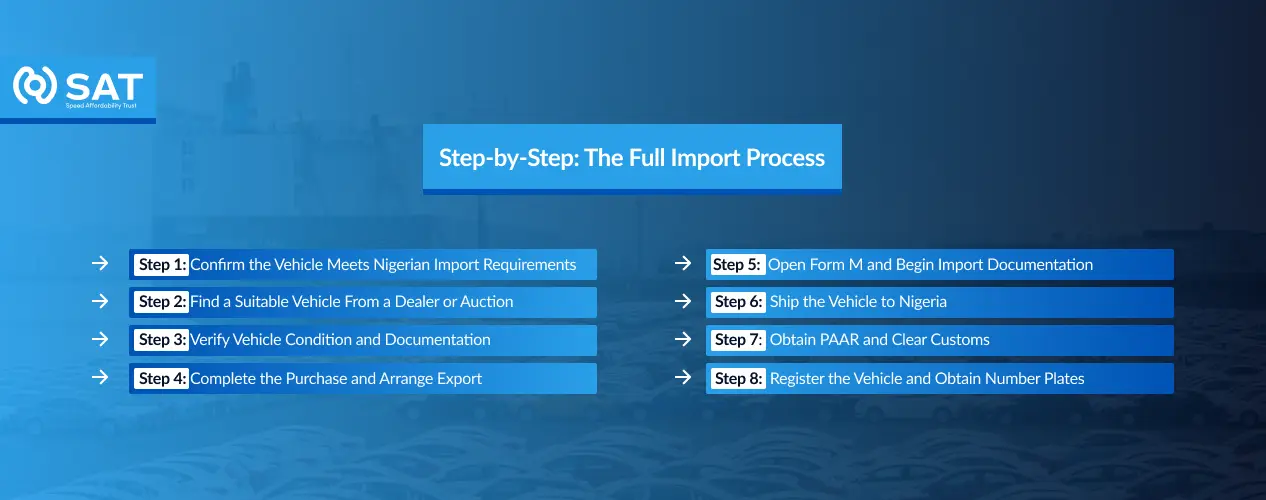
Before spending any money, verify that the vehicle is left-hand drive and falls within Nigeria's current age requirements. Also confirm the VIN, mileage, and export eligibility. This is where most costly mistakes can be avoided.
Choose between dealer stock and a Japanese car auction. Dealer inventory offers fixed pricing and faster purchasing, while auctions provide a larger selection and the possibility of lower prices.
Request the auction sheet, chassis number, service records, and inspection reports. A few minutes spent verifying documents can save thousands of dollars later.
Once the vehicle has been selected, complete payment and obtain the commercial invoice, export certificate, title documents, and shipping instructions from the exporter.
Form M must be processed through an authorized Nigerian bank before customs clearance can proceed. This document forms the foundation of the import process.
Choose between Roll-On Roll-Off (RORO) and container shipping. Most importers use RORO because it is more affordable, while containers offer additional protection and flexibility.
If you're unsure which method suits your vehicle and budget, read our detailed guide on RoRo vs Container Shipping
Step 7: Obtain PAAR and Clear Customs
After the vehicle arrives at Apapa Port or Tin Can Island Port, your clearing agent will use the PAAR, Bill of Lading, and supporting documents to complete customs procedures and calculate applicable duties.
Once customs clearance is completed, register the vehicle with the relevant authorities and obtain number plates before putting the vehicle on Nigerian roads.
Stage | Estimated Time |
Vehicle Search | 1–7 Days |
Purchase & Documentation | 3–10 Days |
Shipping From Japan | 4–8 Weeks |
Customs Clearance | 3–14 Days |
Registration | 1–5 Days |
Total Estimated Time: Approximately 5–10 weeks from purchase to registration, depending on shipping schedules and customs processing.
Delays during customs clearance can trigger storage and demurrage charges at the port. Having Form M, PAAR, and supporting documents ready before the vehicle arrives can help avoid unnecessary costs.
The same online marketplaces that help buyers find vehicles can also expose them to fraud and costly mistakes.
Verify the VIN before paying anything.
Request auction sheets when available.
Get LHD confirmation in writing.
Check the model year yourself.
Work with exporters who have a track record.
Don't under-declare values; customs VIN checks make this less effective than it used to be.
Don't make decisions from photos alone.
Most problems start before the car leaves Japan, which is also when they're easiest to avoid.

SAT Japan is worth considering if you prefer a more structured import process. The platform lists vehicles with photos, specs, and inspection details. Their Nigeria page also spells out what the import actually requires: left-hand drive vehicles, Form M, Bill of Lading, marine insurance, and the rest of the paperwork stack.
That last part matters more than it sounds. Nigeria has specific rules about what can come in, and buying a car that doesn't meet them before it ships is an expensive mistake. SAT Japan's value is mostly in letting you check stock, confirm vehicle details, and sort out export logistics before anything leaves Japan.
Once the required documents are understood, the import process becomes much easier to manage. You pick a vehicle from stock or auction listings, verify the details, request an invoice, pay, arrange shipping, then receive your export documents. They also cover inspection support, export procedures, and customs-clearance help on the auction side.
For Nigerian buyers, here's how it typically runs:
Find a Left-Hand Drive vehicle that fits your budget.
Check the model year, mileage, chassis number, and inspection grade.
Request a pro forma invoice.
Pay through the agreed channel.
Confirm RORO or container shipping to Lagos.
Collect your export documents: Bill of Lading, export certificate, invoice.
Pass those to your Nigerian clearing agent and work through Form M, PAAR, customs duty, and port clearance.
Register the vehicle after it clears customs.
SAT Japan handles post-sale documentation and provides shipment tracking, which takes some pressure off the Nigerian end of things.
The main advantage is having sourcing, documentation, and shipping support handled through a single provider. Finding a seller, an auction agent, a shipping contact, and a document handler separately is where many buyers run into problems. SAT Japan puts those pieces under one roof.
Their stock covers a wide range of used Japanese cars, with inspection details listed upfront. Export paperwork, shipping coordination, car carrier services, and customer support are part of the same process. They operate in 200+ countries and offer 24/7 support, which is worth confirming directly but is useful if accurate.
For Nigerian buyers, the practical difference comes down to a few things:
Vehicle inspection details are available before you pay, not after.
Export paperwork has support built in rather than being your problem to chase.
Shipping to Lagos RORO or container is coordinated through the same channel.
Documentation arrives in a format your clearing agent can actually work with.
You're not buying from an unknown seller with no paper trail.
You'll still need a solid clearing agent on the Nigerian side. Customs doesn't get easier just because the export side was organized. But fewer moving parts on the Japan end means less that can go wrong before the car even ships.
A low price can save money upfront, but clear documentation can prevent far more expensive problems later. Ask directly: can you supply a Left-Hand Drive vehicle for import into Nigeria? A competent exporter answers that immediately with documentation to back it up. Hesitation on drive side, model year, or export paperwork is a reason to keep looking.
Good Japanese used car exporters should confirm LHD availability, model year, auction grade, and export paperwork before asking for final payment. Companies like SAT Japan work with buyers importing to Nigeria and handle sourcing, inspection reports, export paperwork, and shipping coordination. The standard applies regardless of who you use: When importing a vehicle internationally, accurate documentation should always take priority over the lowest advertised price.
_1776750706.webp)
Every year, thousands of Zambians import cars from Japan, and for good reason. If you are wondering how to import a car from Japan to Zambia, this guide covers every step, from choosing the right vehicle to clearing customs and registering it on Zambian roads.
The total government charges alone range from approximately ZMW 81,000 for a small hatchback to over ZMW 149,000 for a midsize SUV, and the entire process takes roughly 6 to 9 weeks from purchase to delivery. The appeal is simple: you receive a low-emission, well-kept automobile at a fraction of the new car price in the region.
The dominance of Toyota, Nissan, Honda, Mazda, and Subaru on Zambian roads is a direct result of their longevity, affordability, and fuel economy. This guide discusses all aspects of the process, with correct duty amounts checked against the ZRA duty schedule for 2025.
In Japan, cars undergo rigorous testing known as shaken every two years. Most owners dispose of their cars rather than pay high renewal fees. This saturates the market with low-mileage cars that are in good condition and available at low prices.
The most popular models among Zambian consumers include the Toyota Hiace, Toyota Vitz, Toyota Allion, Nissan X Trail, Honda Fit, and Mazda Demio. These models have a wide range of spare parts that are common in Zambia, making the cost of ownership low.
It is this affordability, reliability, and low-cost maintenance that make Japanese used cars grow in popularity year after year, and why they dominate the Zambian market.
Choosing the right engine size and vehicle age before you buy can save you tens of thousands of Kwacha in import duties.
This is more important than most people think. In Zambia, import duties are charged according to engine capacity. A car with less than 1500cc will incur much less in duties compared to a 2500cc car.
The Carbon Emission Surtax alone jumps from ZMW 50,000 for engines under 1500cc to ZMW 100,000 for engines between 1500cc and 2000cc.
There are no laws in Zambia prohibiting older cars, but the ZRA imposes a surcharge duty on cars older than five years. For example, a 2020 and a 2016 model of the same car will differ significantly in total duty amounts.
Stick to popular Toyota, Nissan, Honda, and Mazda models. These brands have the best parts networks in Zambia. A cheap car with no local parts availability is not a bargain.
Your exporter defines the quality of your car, the precision of your paperwork, and the ease of the entire process. A trusted Japanese used car dealer checks cars prior to purchase, coordinates JEVIC certification, prepares shipping, and keeps you informed.
Look for an organization with:
A large stock of vehicles with clear, well-taken photographs
Full vehicle history and specifications
Positive reviews from African customers
Responsive and helpful customer service
Trusted exporters such as SAT JAPAN check all these boxes and have established a good reputation among Zambian customers who frequently import Japanese cars.
Avoid unverified auction websites or social media sellers. The small savings are not worth the risk of unfinished paperwork or a misrepresented vehicle.
Zambia requires right-hand-drive vehicles, a mandatory JEVIC inspection before export, and ASYCUDA preclearance at least 5 days before border arrival.
Zambia drives on the left side of the road, so only right-hand drive cars are allowed. Exceptions exist for ambulances and fire engines. All Japanese vehicles are right-hand drive by default.
There are no age restrictions on car imports. The Zambia Revenue Authority (ZRA), however, imposes increased rates of duty on vehicles that are more than 5 years old.
All Japanese vehicles must be certified by JEVIC (Japan Export Vehicle Inspection Center) before leaving Japan. Other acceptable inspection bodies include Bureau Veritas and EAA. Customs will not clear your car without a valid certificate.
As of May 2024, every vehicle must be precleared using the ASYCUDA World system at least five days before arriving at the border. Failure to do so will result in a penalty of ZMW 500.10.
You need seven core documents for customs clearance, plus an Interpol clearance certificate for vehicle registration after clearance.
Lack of paperwork leads to delays and penalties. You will need the following:
Original vehicle title and registration from Japan
Commercial invoice with the purchase price and vehicle description
JEVIC inspection certificate
Shipping company Bill of Lading
Customs Declaration Form CE 20 (filed through ASYCUDA World)
Your passport or Zambian national ID
Marine insurance certificate
You will also need an Interpol clearance certificate (ZMW 200) for registration after customs clearance. A reliable exporter will submit all export paperwork in time, enabling your clearing agent to start work without delay.
Most Zambian importers use RoRo (Roll on, Roll off) shipping because it is the cheapest option. Container shipping costs more but offers full protection.
Your vehicle is loaded onto the ship, parked, and driven off at the destination port. This is the most affordable option and is preferred by most Zambian importers.
Container shipping is more expensive but offers complete protection within a steel container. Consider this for more valuable cars, or if you need to transport spare parts along with the vehicle.
Since Zambia is landlocked, vehicles arrive at either Durban (South Africa) or Dar es Salaam (Tanzania). From there, they proceed by road through border crossings such as Nakonde, Kasumbalesa, or Chirundu.
Stage | Estimated Duration | Notes |
Sea freight (Japan to port) | 4 to 6 weeks | Durban or Dar es Salaam |
Overland transport to Zambia | 1 to 3 weeks | Via Nakonde, Kasumbalesa, or Chirundu |
Total delivery time | 6 to 9 weeks | End-to-end estimate |
Total government charges range from approximately ZMW 81,000 for a small hatchback (1000cc) to over ZMW 149,000 for a midsize SUV. This includes ZRA duties and the Carbon Emission Surtax.
This is where the majority of online guides fail. Multiple blogs claim that Zambia levies a percentage of the CIF value as customs duty (25% to 30%), yet that is not how the system works in practice for used vehicles.
The ZRA employs a special duty table. Instead of computing percentages, the ZRA sets a standard total duty amount in Kwacha based on the type of vehicle, engine capacity, and age bracket (2 to 5 years old or 5 years and above). This total already includes customs duty, excise duty, VAT, motor vehicle fee, ASYCUDA fee, and motor vehicle surtax in a single figure.
Vehicle Type | Engine Size | Age: 2 to 5 Years | Age: Over 5 Years |
Sedan | Up to 1000cc | ZMW 39,461 | ZMW 25,138 |
Sedan | 1500cc to 2500cc | ZMW 61,225 | ZMW 33,844 |
SUV | Up to 1500cc | ZMW 36,508 | Contact ZRA |
Over and above the ZRA duty schedule, you must pay the Carbon Emission Surtax separately.
Engine Capacity | Surtax Amount |
Up to 1500cc | ZMW 50,000 |
1500cc to 2000cc | ZMW 100,000 |
2000cc to 3000cc | ZMW 150,000 |
Above 3000cc | ZMW 200,000 |
Vehicle | Engine | ZRA Duty | Surtax | Total Govt Charges |
2019 Toyota Vitz | 1000cc | ZMW 31,869 | ZMW 50,000 | ~ZMW 81,869 |
2017 Toyota Harrier | 2000cc, 5+ yrs | ZMW 49,078 | ZMW 100,000 | ~ZMW 149,078 |
That difference demonstrates precisely why engine size and vehicle age are so important. Always use the official ZRA Motor Vehicle Tax Calculator to obtain exact figures for your particular vehicle.
After ASYCUDA preclearance and arrival at the border, submit all original documents to ZRA officials. After payment, take the vehicle to RTSA for registration.
When the vehicle is at the border, present all original documents to ZRA officials. They will check these against the physical vehicle, verify chassis and engine numbers, and compute the duties to be paid. The ZRA will issue a Customs Clearance Certificate after payment.
Most first-time importers hire a licensed clearing agent (USD 150 to 400). The ZRA has a list of authorized agents on its website.
After clearance, take the vehicle and documents to the Road Transport and Safety Agency (RTSA). They will inspect the car, verify the details, and register it in your name. You receive the White Book (Motor Vehicle Registration Card) and Zambian number plates. Registration costs ZMW 238.
You need at least third-party coverage before you can drive legally. For long-distance driving, comprehensive insurance is recommended. Popular providers include Madison General, ZSIC, and Hollard Zambia.
Failing to complete ASYCUDA preclearance leads to a penalty of ZMW 500.10
Skipping the JEVIC inspection means your vehicle will be detained at the border
Underestimating the total landed cost by focusing only on the car price
Selecting an unreliable exporter with no credible track record
Not factoring in engine size, as a 2500cc engine attracts ZMW 100,000 or more in extra duties and surtax over a 1300cc engine
Attempting a first import without a clearing agent often leads to unnecessary delays and fines
SAT JAPAN is a reputable platform for purchasing Japanese used cars for export to Zambia. The company offers a large stock of quality vehicles with accurate photographs and specifications. JEVIC certification, shipping, and documentation are managed by the team.
You can browse the full inventory online or visit the local office in Zambia for in-person assistance.
SAT JAPAN Zambia Office: Plot Number 36333, Kaufe Road, Lusaka, Zambia (Next to Spot Mall)
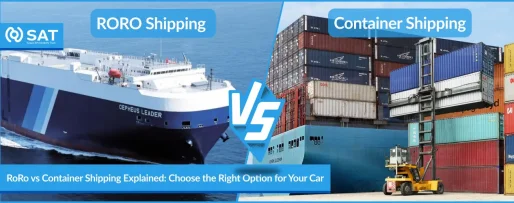
Selecting the mode through which you transport the car internationally is a major part of moving it. The cost, logistics, safety, and everything else depend on the service you select. There are two ways you can ship your vehicle internationally: either through roll-on/roll-off (RoRo shipping) or container shipping.
Both methods have been operational for decades. However, both of them are very different from each other. In this article, we’ll do a RoRo vs container shipping comparison to help you make a correct decision, because if you take the wrong decision here, it might cost you thousands of dollars.
RoRo shipping is a famous car shipping method that was designed for vehicles that can be driven to the port. Cars are moved to the vessels, where they keep the cars in a secure way in an open deck bay and move them toward the destination port. There are fixed routes and selected ports on which RoRo is available.
RoRo is ideal in case the route is a busy trade route because it is fast, easier, and affordable. Hence, RoRo is the best choice for international car transport when your car can get on and off the vessel without any help.
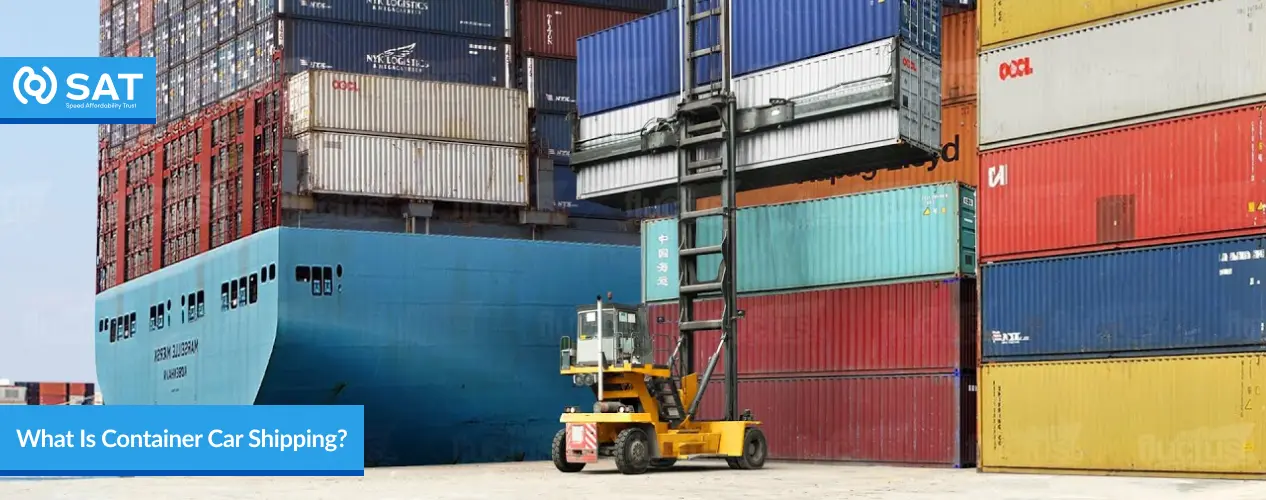
In container car shipping, you place your car inside a sealed container. Once locked inside the container, the car remains protected from weather or dust. It does not matter if your car can move or not; this shipping method is possible anyway.
You have the option to either select full container load, in case you desire the complete container only for your car, or want Less than Container Load (LCL), in which you have a shared container, if you are moving only one car, and to keep the cost low.
Below is a clear picture of how the two car shipping methods are different from each other.
Feature | RoRo Shipping | Container Shipping |
Cost | RoRo shipping has a lower per-unit cost | The container shipping option can be expensive when shipping multiple cars |
Risk of Damage | There is a greater chance of damage in RoRo shipping when the cars are loaded and unloaded. | Container shipping is relatively safer because the cars are placed in a sealed container. |
Versitality | A RoRo vessel has a large stowage bay, which is perfect when you want to move vehicles of different sizes. | Containers are of fixed sizes and can’t accommodate vehicles of different sizes. |
Journey Time | RoRo ships take a longer time because of the specific routes and slow sailing in the sea. | Container shipping takes less time to deliver the consignment because they follow direct global schedules. |
Cost is the main factor when selecting one from RoRo or container shipping. RoRo shipping is cheaper when it comes to transferring heavy equipment or vehicles. Since RoRo shipping doesn’t require containers and has minimal handling time, this option becomes much more affordable. It is ideal for businesses or for people shipping multiple vehicles.
On the contrary, container shipping is a bit expensive because it involves the cost of containers, complex ways of loading and unloading, and packing. But it offers extra protection to the vehicle, making it the best option when shipping expensive vehicles.
Safety and security measures are different in each shipping option. RoRo vessels expose the vehicles to the sea environment. Rough weather can sometimes damage the vehicles. Furthermore, non-containerized vehicles are at risk of being stolen at the port during the waiting time.
Container shipping provides more security to the shipment by offering sealed containers, which protect the vehicle from bad weather, theft, or any kind of damage. Moreover, the loading and unloading of the vehicles is done by a crane, which is a secure way to place the vehicles inside the container without any external damage.
This is the most influential factor when deciding which shipping method is right. RoRo shipping does not involve complex processes to load or unload the vehicle from cranes or the difficult process of handling containers. But RoRo shipping has fewer routes, and RoRo carriers are not well supported worldwide. This increases the travel time. However, RoRo has a dependable departure time, which makes it a relatively fast shipping method. Depending upon distance, it may take somewhere between 3 to 4 weeks to reach.
Container shipping involves complex loading and unloading processes, which require a bit longer time, but it has a high sailing frequency and more routes are available. It does not come with reliable dates of departure, which makes it slower compared to RoRo. However, in private container shipping, there is no waiting time, which makes it the fastest shipping method. It will take 2 to 3 weeks for the cargo to reach its destination.
Shared container shipping, however, takes longer to reach the destination because it involves a longer wait time, as the container will only move to the destination once it is full.
Loading and unloading are fast in RoRo shipping. It will only take a few minutes to load the vehicles into the RoRo ships.
The reduced time also lowers the storage and harbour costs. No expensive packaging is required, which makes RoRo shipping affordable.
RoRo shipping does not require port infrastructure or heavy machinery to load or unload, hence it is relatively flexible in utilizing smaller ports.
RoRo is good for rolling cargo only. For non-rolling cargo, you have to opt for special roll trailers.
Not every port supports RoRo shipping, which means there are very few ports available for the shipping.
Container shipping provides better protection because the vehicle is kept inside the sealed container throughout the process.
You can keep additional items inside the vehicle in container shipping.
Unlike RoRo, container car shipping has a wide network worldwide.
Containers come in multiple sizes, making them suitable for different-sized vehicles.
Container shipping involves fees for container and crane handling, which makes it an expensive option.
Loading and unloading are done by cranes, which require time. This can delay the shipment time by days.
RoRo is good for your vehicle if it matches certain criteria and if you want budget-friendly shipping.
Roro shipping requires your car to be in a condition to be driven or can be safely towed without the need for any special handling.
If you are looking for an affordable shipping method, RoRo will suit you because you don’t have to book a whole specified container on your own.
If you want to transport your car quickly without delays, then RoRo is best for you. Vehicles easily roll on RoRo vessels, which saves transit time.
Below are some key scenarios to give you a better understanding of when you should select container car shipping.
If you have expensive and exotic vehicles, you should choose container car shipping because it offers better protection from rough weather conditions.
If your car cannot be driven or is damaged, then container shipping is the best option for you.
If you want to pack some other items inside the car, then container shipping allows you to keep them inside the car.
It is always suggested to book your shipment earlier because last-minute booking will cost you more. If you plan earlier, you’ll also get the time to compare prices.
Be flexible with delivery dates, it will help you save some cost. Shipping companies have different schedules. If you can adapt their timings, you may get a discount.
If you ship your car in non-peak season, you can save a significant amount because in high peak season, the demand is high and so are the prices.
The choice between RoRo car shipping and container car shipping depends on the vehicle you want to ship, affordability, and destination requirements. If you want to transport a vehicle, RoRo car shipping is the best option, while if businesses with diverse vehicles want transport service, then container shipping is worth considering.
SAT Japan can provide expert shipping guidance according to your shipment needs. We provide marine insurance services to make sure that your car gets delivered to you safely.

Operating as a car dealer is not like buying groceries; it's stressful and requires lots of pre-planning. From sourcing good-quality cars to negotiating prices, the process involves lots of micromanagement. We, at SAT Japan, understand this, which is why we designed our Dealer Program to make the journey easier for you. We have designed each process keeping in mind our buyers’ best interests. SAT Japan not only gives you a wide inventory to choose from, but it also provides a trustworthy, global network.
Japan has been leading the global automobile market for the past sixty years. Toyota, Nissan, and Honda consistently rank among the top-selling car brands. To put it simply, Toyota sold over 10.8 million vehicles in 2024. These figures testify to Japanese cars' reliability. Japanese cars are widely known for being fuel-efficient, easy to maintain, and long-lasting. These are the reasons why Japanese cars are in such high demand worldwide.
Japanese cars are also a good option because of their low mileage. Thanks to Japan’s high maintenance costs, Japanese people sell their cars early to avoid these costs. “Shaken” is Japan’s vehicle inspection system, and it is very expensive. So, before the next inspection cycle, the Japanese sell their car while it is still in excellent condition. This is why Japanese used cars have low mileage. With new car dealers entering the market every year, importing a car from Japan is now easy. You can even buy cars in bulk from Japanese car dealers and often at discounted prices.
AT SAT Japan, we give you the option of registering yourself as a dealer. As our member, you enjoy exclusive discounts and benefits. We have a wide range of inventory, which you can browse by make, model, and type. In addition to bundle discounts, you also receive discounts on your final shipment. We have customised our Dealer Program for our customers’ best interest. With SAT Japan, you can import all kinds of vehicles from Japan.
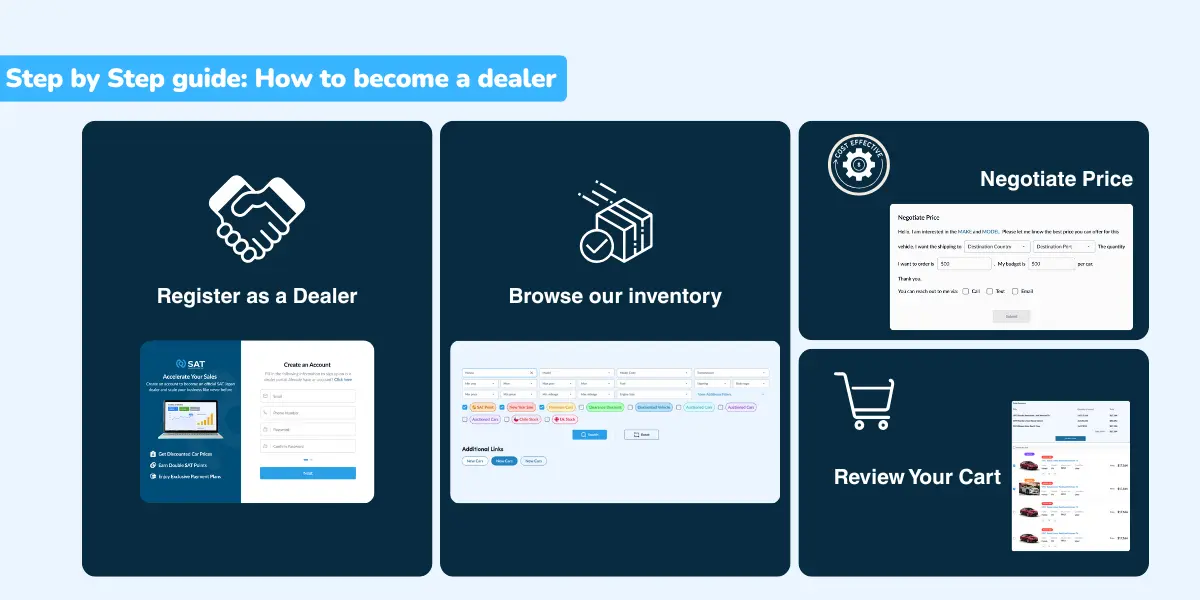
If you’re starting your journey of dealing with Japanese cars and are looking for a source to import, you’ve come to the right place. We have designed our dealer program for businesses and dealerships that prefer placing their orders for Japanese cars from the comfort of their home. Now you don’t have to spend your time and energy negotiating with unreliable suppliers because we’ve made the negotiation process simple for you.
The following steps walk you through the process of signing yourself as a dealer, and then eventually buying your favorite vehicles at discounted prices.
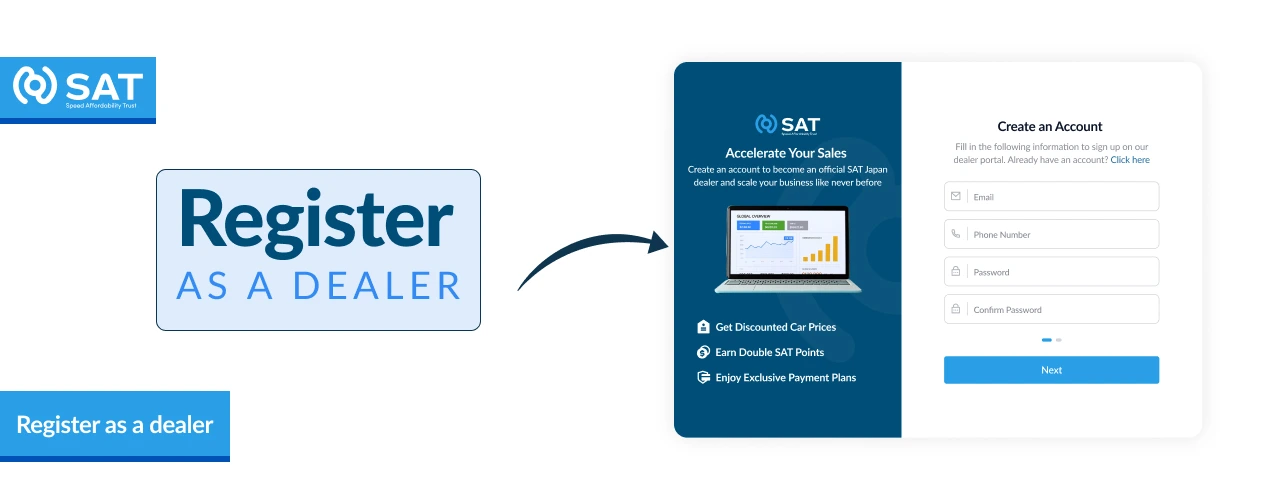
To begin with, you need to register yourself as a verified dealer on SAT Japan. The process is fairly easy. Log on to satjapan.com and click the Become a Dealer button at the top of the page. After doing this, you’ll see a window where the website asks you to give some of your basic details, such as your name, your business information, and your email. This process only takes you a few minutes, and there are no membership costs.
Once you’ve submitted your information now what's next? Now you just have to wait for a bit before our team quickly reviews and verifies your information. Successfully creating your account on our website means that you’ve now successfully completed the first step of buying as a dealer. This part of the process now unlocks some dealer-exclusive benefits for you: exclusive discounts, bulk order discounts, and smatter shipping.
Once you’ve registered as a dealer, the gates officially open for you. You can browse SAT Japan’s never-ending range of vehicles. We have a total inventory of around 1,011,610 vehicles. We’ve made it easier for you by sorting them by car types (SUV, Sedan), makes (Toyota, Honda), model by years, stock, and Price ranges. You can use the search tool on our website to make browsing easier.
Through our search tool, you can simply enter your desired make, model, type, steering side, and production year. With the help of this tool, you can easily narrow down your search results to find a list of vehicles that match your preferences. In case you already know the car you’re looking for, you can search by Stock ID. Once you’ve figured out what type of cars you want, it's now time to negotiate the price.
On the right side of each car model, you’ll see the negotiate button. When you click on the negotiate button, you’ll see a window where you’ll have to enter some relevant information. It's a negotiating form which goes like “Hello, I am interested in the Toyota Probox Van”.
We give our dealers the option of quoting their prices themselves. You can enter your negotiating price in Japanese JYD, along with the country you want your car to be shipped to and the desired port. Please let us know your preferred method for contact (Email, Call, or Text). You’ll then have to simply submit the request. Our sales team will review your request and get back to you via email. After we accept your request and reach a deal, you’ll add your items to the cart. The add to cart button is just below the negotiate button.
After adding all your items to your cart, we think it's important that you review your cart. Inside the cart, you’ll see your order’s summary. Your order summary has the quantity of the cars you ordered, along with the price. You can see your total price at the bottom right of the order summary. You probably assume that it's the final price, but it's not.
The Get Best Quote option is part of SAT Japan’s dealer-exclusive benefits. Here, our team will review your order summary and get back to you with the best possible discounted price. It does not end here.
We understand that shipping costs can be heavy on one’s pocket, so we get you the best shipping deal. To put it simply, if we believe that your cars can be shipped in one container, you will only be charged for that single container. This means more cars, more savings. The Get Best Quote Feature optimises both pricing and logistics and makes sure that you maximise your profit margins.
At the SAT Japan dealer program, we bring to our dealers what's in their best interest. We strive to offer competitive prices and save you time. Instead of managing multiple Japanese used car dealers, you deal with one partner. We have made it cost-friendly by decreasing the deposit amount for our dealers. One of the things that sets the dealer program apart is the Price Negotiation and cheaper container costs. This way, you can focus on selling more cars instead of worrying about individual shipping costs. The following is a quick comparison of dealer vs. normal user benefits.
Benefits | Dealer | Normal User |
Discounted Car Prices | Yes | Yes |
Free Inspection on First Order | Yes | Yes |
Flexible Payment Options | Yes | No |
Cheaper Container Costs | Yes | No |
Price Negotiation on Orders | Yes | No |
Priority Sales Support | Yes | No |
Bidding Deposits | 5% | 10% |
As a car dealer or businessman, we understand how daunting it can be to source your inventory. We’ve wanted to make our car-buying process exclusive for our dealers. This is the reason why we came up with our SAT Dealer Program. Finding a reliable and transparent used or new car dealer is the first step towards importing a new or used car from Japan. With SAT Japan, you’re not just buying cars; you’re laying your business’s foundation on opportunity and trust.

From Sedans to Station Wagons, you’ll see all kinds of cars on the road. With such a diverse encyclopedia of cars available, it is important for you to know the difference between all of them, especially before buying your first car. It is true that some cars are for domestic use while others are for off-road adventures with families. Some are for commercial purposes – transporting goods from one point to another. After reading this blog, you’ll get a clear idea of the most common car types and why people around the world choose them.
Sedan
SUV
Coupe
Hatchback
Pickup
Bus
Van
Minivan
Truck
Convertible
Crossover
Station Wagon
Sports Car
Micro Car
Electric Vehicle
 Think of the word car and picture it in your head. What came to your mind is most probably a Sedan. Why? It's because the Sedan is the most common type of car. Think of the traditional car that has four doors and a separate trunk.
Sedans typically have three subcategories:
Compact Sedans
Mid-size Sedans
Full-size sedans
Toyota Corolla is the world’s best-selling compact Sedan, while Toyota Camry is the best-selling mid-size sedan.
People generally buy Sedans when they need an affordable car for their families. The following are features of a Sedan.
Practical for city drives and paved roads
Low ground clearance
They are fuel-efficient due to their lightweight bodies.
SUVs are the second most common type of vehicle. They have become increasingly popular over the recent decades. Recent trends show that they have also replaced sedans in various markets such as the US and Europe. SUVs are popular because they offer versatility and a range of uses. They come in the following types:
Compact SUVs
Subcompact SUVs
Mid-size SUVs
Full-size SUVs.
They have a high ground clearance that makes them suitable for both on-road and off-road conditions. The following are the most noticeable features in an SUV.
Seating of 5-7, with some models offering a third row
High Ground Clearance
Big tires that have great traction.
People who buy SUVs are those who frequently travel off-road and need a car that can withstand all kinds of road conditions. However, one drawback of SUVs is their lack of fuel efficiency due to their heavy weight and large engines.
You can learn about the difference between an SUV and a Sedan by reading our blog.

Traditionally, Coupes were vehicles having two doors. These two-door coupes include the Ford Mustang and Chevrolet Camaro. However, over the years, four-door coupes emerged, widening the definition of a coupe. Some of the four-door coupes include the Toyota Crown and Mazda RX-8. The following are the main features of a coupe.
Two Doors
Sloping Roofline
Compact Size
Smaller Trunk
Sporty Performance
A coupe is a car type catering to the younger generation who want a sporty look in their car. Single people or couples generally buy for couples. There is one feature of a coupe that excites people the most: The sloping roof line. It adds a flair of speed and gives a sporty impression on the road. One drawback of buying a coupe is that it has a small trunk space, making it less spacious. Modern four-door coupes like the Audi A7 have a hatch-style opening instead of a conventional trunk. You can learn about the difference between a Coupe and a Sedan by reading our blog.
Think of a subcompact sedan and add a hatch door to it. That's basically a hatchback. By appearance, hatchbacks resemble sedans but have easy access to the trunk. Hatchbacks are for those who are looking for ample cargo space in their car. Typically, buyers are individuals with large families who require more passenger space. Hatchbacks have the following features.
Hatch door at the back that swings upwards when you touch the sensor.
Fordable rear seats
Connected trunk area
Fuel Efficient
Easy to park in tight spaces
The most popular Japanese hatchbacks are the Toyota Yaris and the Toyota Aqua. The Volkswagen and Kia Rio are among the most popular Japanese hatchbacks.
A pickup truck is a vehicle that has an enclosed cabin and an open area at the back. It has a cargo bed at the back that can be pulled down for loading and unloading. These kinds of vehicles are extremely popular in the US, Africa, and many parts of Asia. You’ve probably seen people carry things on a Toyota Hilux and Nissan Navara. Both of them are Pickups that are used for both commercial and personal use. One drawback of Pickups is their heavy body. The following are the main features of a pickup.
Open Cargo Bed
Enclosed Cabin
Tailgate
Strong Suspension and large tyres
Bus is a shortened version of the Latin word “Omnibus”, which means “for all”. A bus is typically used commercially for transporting a large number of people from one point to the other. Buses are very diverse, as there are various types of buses. Of them, the Transit/ city bus is the most common type of bus. The following features differentiate buses from other car types.
Passenger Capacity of 20-100
Multiple rows of seating
Large Windows
Used for Public Transport
High roof and spacious interior
A van is one of the most versatile vehicles to exist. They are larger than a car but smaller than a bus. There are two main types of vans
Cargo vans
Passenger vans.
The following features differentiate a van from other car types.
boxy shape with a high roof
Sliding side doors
Seats 8-15 passengers
Spacious cargo area
Larger than a sedan and smaller than a bus
Businesses use cargo vans while making deliveries, while passenger vans are for public and private transport, often seating up to 15 people. People usually carpool to the office and schools, and use vans to save on fuel. The most popular Japanese van models are the Toyota Hiace and Nissan Caravan.
A minivan is an ideal family car. It is a smaller version of a full-sized van. They have a lower ground clearance than SUVs, making it easier for passengers to step in and out. The following are its main features.
Sliding Doors
Smaller than a full-size van
Low ground clearance so passengers can step in easily
Unlike sports cars, here the main focus is functionality rather than performance. The most popular and best-known Minivans include the Toyota Sienna and Toyota Alphard.
Unlike pickups, Trucks are larger cargo vehicles that are used to carry heavy loads. Pickups are for both personal and commercial use; however, trucks are solely for commercial purposes.
Heavy-duty and Large body
Big tyres that are suited for both off-road and paved roads
Open or enclosed cargo area
Powerful engines are required because of the heavy load, which needs a high torque
. There are different types of trucks
Light trucks
Medium trucks
Heavy-duty trucks.
Light trucks are usually those that transport within the city. Unlike medium and heavy-duty trucks, they cannot travel long distances with a heavy cargo. You probably saw oil tankers near the gas station; they are an example of heavy-duty trucks. Such trucks are built for transporting things cross-country. An example of a light truck is the Mitsubishi Fuso Canter.
Ever wondered what the most objectively stylish car type that exists? It's for sure a convertible. Think of Regina George confidently driving hers in the movie Mean Girls. That image captures the freedom and glamor a convertible represents.
So what is a convertible car? It's the one that has a roof that can be folded or removed. It has the following features.
Removable Roof
Sporty design
Sears two to four
Smaller trunk space
Either soft ot hard top
You've probably seen convertibles in many movies because they've been in fashion for years. They are widely considered luxury vehicles because they prioritise style over being practical.
Among the popular Japanese convertibles are the Mazda MX-5 Miata and the Honda S2000.
Think of a crossover as a vehicle that combines the features of a sedan and an SUV. It has features of a traditional car, like a sedan or a hatchback, but has the ground clearance of an SUV.
Its features included the following.
Lighter than SUVs
Compact to mid-size body
Trunk is connected
Fuel-efficient compared to SUVs
Popular for city driving and light off-road conditions
A common example of a crossover is the MG HS. Crossovers are more fuel efficient than SUVs because of their lighter body. People use them for city drives and also light off-road travelling. Nissan X-Trail and Honda Vezel are also among the most common Japanese Crossovers.
Sedan is everyone’s first choice, but imagine it coming with an extra storage space. A station wagon looks like a regular sedan from the front, but it's different from the back. It has:
a large cargo area at the back.
Rear hatch door
Foldable rear seats
They are more fuel-efficient than an SUV because they are lightweight.
Used for transporting people along with their cargo
The vehicle really lives up to its name as it transports people and their cargo from one corner to the other. It could also be about moving from a train station to the countryside. Hence, because of the space they provide, station wagons are really useful. Toyota Corolla Fielder and Subaru Levorg are among the most popular Station Wagons.

A sports car is a high-performance vehicle that accelerates very rapidly. It can go from 0 to 60mph in just a few seconds. The Ford Mustang is the most popular sports car in the world. The following are the key features of a sports car.
It has a high power-to-weight ratio, allowing for quick acceleration
High Performance Brakes
Limited seating. Sports cars have a seating of a maximum of two
They have a stiff suspension
They come in a wide range of prices
Let's talk about the most interesting type of car body. A microcar, as you can tell from its name, is a very small automobile. It has an engine displacement of less than 700 CC. It became popular in the 1950s-60s, following World War II, when people needed a cost-effective commute. In the present, those people who have shorter distances to travel want a cost-friendly commute. It has the following features:
Small size and weight
Very small engines
Seating Capacity of one or two
Cost friendly
Special licensing in some areas
With fuel prices skyrocketing, Hybrid and Electric Cars have become increasingly popular in modern times. An EV is a car that has a motor and a large rechargeable battery. A hybrid car, on the other hand, has both an internal combustion engine and an electric motor. There are various types of EVs and Hybrid cars. The Prius was the first widely produced hybrid car.
Battery Electric Vehicles (BEVs)
Hybrid Electric Vehicles (HEVs)
Plug-In Hybrid Electric Vehicles (PHEVs)
Fuel-Cell Electric Vehicles
You can learn more about the types of Electric Vehicles on our blog.
At SAT Japan, you can filter our wide range of inventory by its type, making buying a car easier for you. At SAT Japan, buying a Japanese car is simple due to our smooth buying process. Now, you can easily import a car to Japan from the comfort of your home. Cars come in an endless variety, which might feel overwhelming at first. But with just the right research, you can narrow down your choices and choose what suits you best.

Japanese cars are the most imported product in Tanzania. Yes, you heard it right. In 2024, Tanzania imported 46,944 used cars from Japan. These statistics indicate there's a growing market of used Japanese cars in Tanzania. Tanzania’s Dar es Salaam Port is the main entry point for all vehicles that come from Japan. It might be your chance if you’ve been dreaming of owning a used or new Japanese vehicle like the Subaru Sambar or the Toyota Land Cruiser.
This guide provides you with all the information you need to know before importing a car from Japan to Tanzania.
The Tanzanian government has set clear laws and regulations for importing cars. Only vehicles that comply with those laws can be brought into the country. The following are the main conditions:
Key requirements for importing a car into Tanzania:
Maximum 8 years old
Vehicles must be Japan Export Vehicle Inspection Center (JEVIC) inspected before shipping.
It must undergo JAAI inspection (Japan Auto Appraisal Institute)
Custom Clearance with Tanzania Revenue Authority (TRA).
Right-hand drive (RHD) only
Buying from a Japanese Car Importer is usually more economical than buying from a local dealer. When you import cars directly, there is no middleman, which means lower prices. Japanese cars are very popular in African countries, especially in Tanzania.
There are reasons why Japanese cars are always Tanzanian’s first choice. Whether Japanese cars are used or unused, they always come in excellent condition, hence offering good value for money. The prices are competitive, which means people throughout the East African countries prefer Japanese cars.
Japanese people prefer to sell their cars when they are in excellent condition and have low mileage. Why? The reason is simple. The Shaken, which is Japan's vehicle inspection system, is very costly and becomes more expensive as the car ages. To avoid these growing expenses, many Japanese owners sell their vehicles relatively early, often while they’re still in mint condition. Hence, People in Tanzania prefer Japanese cars because they arrive with lower mileage compared to the locally available cars.
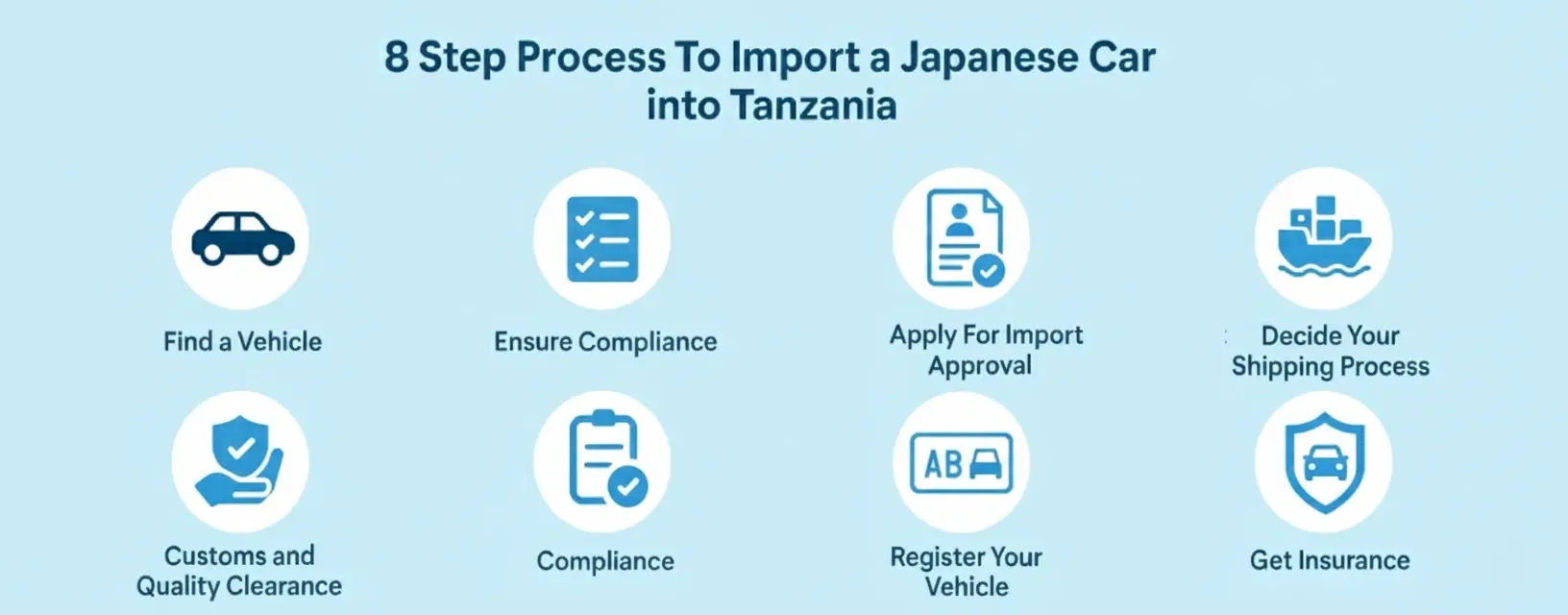
Most car buyers in Tanzania prefer to import their cars through a Japanese car dealer. This is because the local car dealers are unreliable and charge much higher than what online dealers do.
If you’re looking to import a Japanese used cars or new car to Tanzania, we are here to guide you on the steps that you must follow. Before your car reaches the Dar es Salaam port, there are several important steps you need to follow.
Begin your process of importing a car to Tanzania by choosing the right vehicle for your needs. Log onto SAT Japan’s website https://satjapan.com. Use filters like make, model, and type to browse through available inventories. Once you pick a model for yourself, make sure you’re dealing with a trusted seller. Always verify that they provide proper documentation, such as the export certificate and the car’s service history. It’s also a good idea to cross-check these details with the auction sheet to confirm that the car is authentic.
As mentioned above, you should make sure that your model complies with Tanzanian import laws. You cannot just import any car. The vehicle you choose to buy must meet all of the following conditions:
Right Hand Drive
All cars must pass JEVIC (Japan Export Vehicle Inspection Center) or EAA inspection
Cars older than 8 years are not allowed to be imported
Customs Compliance: Importers must declare the correct CIF (Cost+Insurance+Freight)
Pay all Taxes set by the Tanzanian Revenue Authority. TRA has set the following duties and taxes on imported cars.
Once you’ve picked your car and are sure that it complies with Tanzania’s regulations, it's time for import approval. Applying for import approval probably sounds complicated. In Tanzania, it's just about making sure that your paperwork is done before the car arrives.
Appoint a CFA
The first step that you should take is to appoint a licensed Clearing and Forwarding Agent (CFA). These agents work directly with the Tanzania Revenue Authority (TRA) and will do all the Import Approval paperwork for you. They will submit all your documents through the Tanzania Customs Integrated System (TANCIS). It is a good option to appoint an agent, as the import approval process is a lengthy one. Please note that you must submit your documents at least 7 days prior to your cargo's arrival at the Dar es Salaam Port.
The following are the documents that you need to apply for import approval.
Certificate of Conformity (CoC), which is issued by the Tanzania Bureau of Standards (TBS). This document attests that your vehicle meets Tanzania’s roadworthiness and safety standards.
Bill of Landing
Export Certificate
Final Invoice
Packing list
With CFAs, the process becomes stress-free. These experts know all the right steps, so you don’t have to run around doing everything yourself. Custom clearance is one of the most crucial steps of your vehicle-import journey. So you should be careful while dealing with it.
Once your car is cleared for import, it's time for you to decide between the following shipping methods.
RoRo (Roll-On, Roll-Off): RoRo is the most common option for Tanzanian Buyers. Why? Because it's pocket-friendly and reliable. In Roll-On, Roll-Off, the car is exposed.
Container Shipment: In a container shipment, your car rests in an enclosed container. So this option is much safer than RoRo. The only drawback is that it is costlier.
Whichever method you choose, your car usually arrives in 305 weeks.
Your vehicle will go through customs clearance and quality checks once it arrives at the Dar es Salaam Port. The following is a step-by-step roadmap that outlines the process at the port.
Firstly, the Tanzania Bureau of Standards (TBS) will verify your Certificate of Conformity. CoC is issued in Japan during the JEVIC or EAA inspection.
Next, the Tanzania Revenue Authority (TRA) will double-check all the abovementioned documents that include the Bill of Lading, Export Certificate, Commercial Invoice, and the Import Declaration Form (IDF).
TRA will calculate your import duty, VAT, excise duty, and other fees based on the documents.
There are certain import duties that you need to pay while importing a car to Tanzania. The amount you have to pay depends on the type and engine capacity of the vehicle you want to import.
For example, someone chooses a car with a 2000 cc engine capacity. It is entitled to an import duty of 25% and 20% VAT. Its total duty amounts to 50% of the car's value. A car with an engine capacity exceeding 2000 cc is subject to an import duty of 25%, a 20% VAT, and a 10% excise duty. For this car, the total duty is 65% of the total value.
Vehicle Type | Import Duty | Excise Duty | VAT | Final Duty |
<2000cc | 25% | 10% | 20% | 50% |
>2000cc | 25% | 0 | 20% | 65% |
Van/ Pickup/ Lorry/ Bus | 15% | 0 | 20% | 32% |
In Tanzania, the import duty is 25% of the CIF value (cost, Insurance, Freight). For example, if your vehicle has a CIF value of USD 10,000 (equivalent to TZS 25,000,000) then the following applies:
Import Duty= 25% x 25,000,000= TZS 6,250,000
After completing all these steps, customs will release your vehicle, and you can then register your car.
VAT in Tanzania is 20% and it is calculated on the CIF+ Import Duty+ Excise (if any)
For example: If CIF is TZS 25,000,000, Import Duty is TZS 6,250,000, and no excise duty applies (car under 2000cc), then:
VAT = 20% × (25,000,000 + 6,250,000) = 20% × 31,250,000 = TZS 6,250,000
Excise duty applies to your car depending on engine size.
0% if under 2000cc
10% if over 2000cc
For example
CIF= 25,000,000 Import Duty= 6,250,000
Then Excise Duty would be= 10% x 25,000,000= 2,500,000
Then VAT is recalculated on (25,000,000+6,250,000+2,500,000)= 33,750,000
As mentioned above, it is important that you double-check if your vehicle complies with Tanzania’s import standards and regulations. Following is a checklist for your ease.
Right Hand Drive
JEVIC or EAA inspection
Less than 8 years old
Customs Compliance
Pay all Taxes set by the Tanzanian Revenue Authority.
Once you get your car in your hands, it is your responsibility to get it registered. To get it registered, visit your nearest Tanzanian Revenue Authority (TRA) office. Before going, make sure you have the following documents with you.
Your ID or Passport (serves as proof of identity)
Proof of car ownership
The Certificate of Conformity (CoC)
Tax payment receipts
We always advise car buyers to get their car insured. Why? Once you have your vehicle insured, you no longer have to worry about future accidents, damage, or theft.
Unlike other countries, Tanzania has made third-party insurance compulsory for people who own vehicles. Third-party insurance covers damage to your car and any injuries you may cause to others in the event of an accident. It is not legal to drive in Tanzania without insurance.
Many car owners opt for comprehensive insurance because it offers a wider range of risks, including theft and fire. Although they cost more, they’re safer, especially if your car has a high value.
Insurance is the final step before you start driving your car on the roads of Tanzania.
It usually takes several weeks for the cargo to reach Tanzania from Japan. It all depends on the shipping schedules and clearance. The following is an estimate. The entire paperwork takes 5-10 days after you make your purchase. Once the ship leaves Japan, it takes 4-6 weeks for the cargo to reach Dar es Salaam Port.
After the car reaches Dar es Salaam Port, the car has to got custom clearance and TRA Tax assessment. This stage can take around 1-2 weeks. It all depends on how quickly you submit your documents and make your payment.
Toyota Land Cruiser
Toyota Harrier
Toyota Corolla
Toyota RAV4
IST
Nissan XTrail
Mazda CX-5
Toyota Hilux
Toyota Rav4
Mitsubishi Pajero
Model | CIF Value (USD) | CIF (TZS) | Total Tax (approx) | Final Cost (TZS) |
Toyota Harrier (SUV) | $12,000 | 30,000,000 | 48%- 14,400,000 | 44,400,000 |
Toyota Vitz (Hatch) | $4,000 | 10,000,000 | 43%- 4,300,000 | 14,300,000 |
Nissan X-Trail (SUV) | $15,000 | 37,500,000 | 53%-- 19m875,000 | 57,375,000 |
From choosing your car to customs to shipping it to Daressalam Port, this guide covers it all. We advise buyers to research every step of this guide before purchasing their car. It is important that you collaborate with expert Japanese car importers who have an in-depth knowledge of Japanese Car imports in Tanzania. Shortlisting a reliable exporter makes the entire car-buying journey stress-free. With proper support, importing a car to Tanzania can be a fruitful experience. Happy Importing!
_1757594451.webp)
Selling your phone needs a lot of pre-planning, so we can only imagine how stressful it is to sell a car. At SAT Japan, we understand how draining and time-consuming it can be to sell your car online. One major challenge for sellers is finding buyers who agree to the quoted price. To solve this, SAT Japan connects hundreds of car buyers to sellers online through its Sell with SAT service.
That's why we’ve created this guide to show you the best way to sell a car yourself. Currently, the “Sell my Car” feature is only available in the following countries: Singapore, South Korea, Thailand, UAE, Australia, UK.
Most of the time, sellers are not aware of reliable online platforms where they can list their car. Selling through trusted platforms just makes the experience smooth and hassle-free. Secondly, people often overlook the necessary precautions and fail to follow the steps when selling their car. They fail to research and instead repeat the same mistakes. Without proper research, sellers sell their vehicle at a below-market value price.
This guide shares some tips on how to sell a used car easily with SAT Japan. At SAT Japan, we provide our sellers with a user-friendly process that lets them list their cars at fair prices.
It is important to inspect your car thoroughly and look out for any damage on the outside and inside. If your car is in good condition, its value will drastically increase. Following is a checklist that you can use to make sure that your car is ready to be listed.
Your car’s exterior will determine the buyer’s first impression of the car. So make sure that everything, starting from the paint to the windscreen, is free of dents and scratches. Get touch-ups from your mechanic if you notice any scratches because this will improve your car’s resale value.
Next, it's good to check the inside: dashboard, AC, and seats. Get your car serviced because a clean car signals good ownership. Fixing and repairing any of these cosmetic issues can help you get more for your car when it comes to selling it.
The following are the things you should get checked by the car mechanic, especially when you’re selling a used car.
Engine Oil
Brake Fluid
Gear Shift
Unusual Engine Noise
Tyre Pressure
Upholstery
How to Sell Your Used Car
It is also important that you double-check your odometer reading with the data on your service records to ensure transparency. Once you’re confident that your car is in good condition, the next step is to decide on the price. Refer to multiple sources to explore the market price.
Now that your car is in mint condition, your next step is to set a fair price. Finding a balance between the market’s demand and your car’s condition is the best approach. Check SAT Japan’s listings of similar used cars and see their prices. You can easily filter results by make, model, year, mileage, and engine type. A lower mileage means a slightly higher price.
You should know that buyers usually negotiate, so it is advised that you add a 2-5% margin above the price that you want. Be specific in your research- if you’re targeting a specific country, research your used vehicles in that region.
Once your car has received the right makeover, it's time for a photo shoot. Edmund’s research concludes that listings with high-quality images can get you up to 20% higher prices compared to those with low-quality images. Take at least 15-20 pictures that clearly show every part of the car. There are some steps that you need to follow to make your car appealing to buyers.
Choose a clean background and make sure it is not busy
Take pictures from all angles. Capture the front, back, sides, interior, dashboard, engine, and tyres.
Take landscape/wide-angle shots
Highlight all technological features that include screen display, steering, and leather seats.
Make sure to show any dents and scratches. Buyers value honest sellers.

You give your car’s first impression through photos and Ad Description. To attract buyers, it is important that you strategically write your car’s ad description. You’re basically introducing your car through a good description. It tells your buyers why your vehicle is worth considering.
Basic Details: Start by adding the basic details, including the year, make, model, trim, mileage, and transmission.
Condition: Additionally, inform buyers about your vehicle’s condition and provide a rating. You can also use SAT Japan’s suggested phrases to strengthen your listing.
Examples of SAT Japan’s suggested phrases include:
Everything is in genuine condition
Authorized workshop maintained
All service history logs are maintained
Non-accidental
New tyres installed recently
Token or tax up to date
Highlight Key Features: All cars have specific features that add value. Mention those- they may include safety features, single-owner status, fuel efficiency, or an infotainment system. Mentioning the specifications will improve your car’s visibility in the buyer searches.
Writing Style: Remember to keep your writing simple and easy to read. We advise you to use short sentences and bullet points. This helps make your writing more readable.
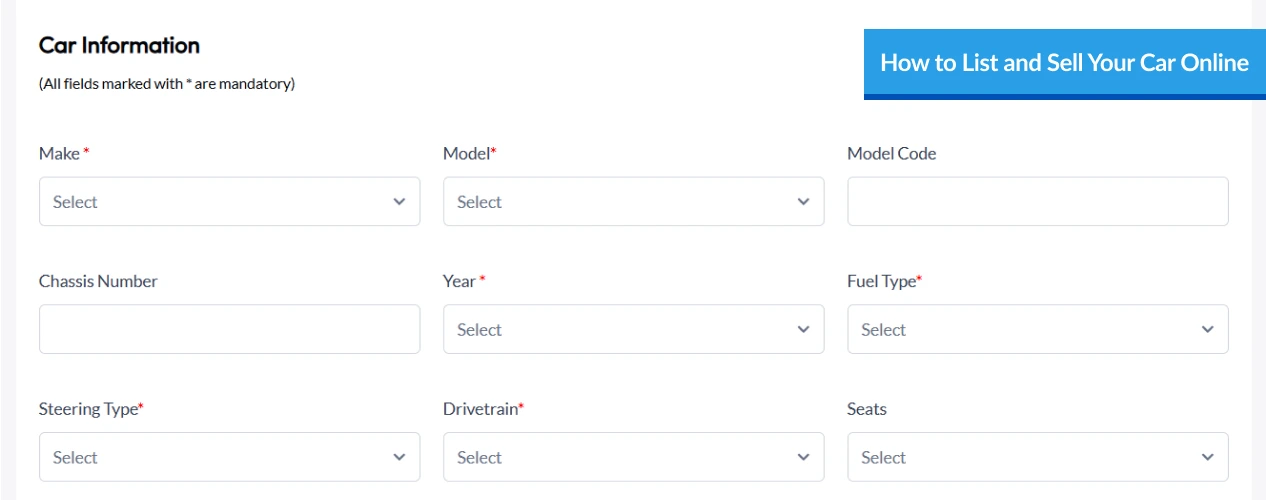
Once you’re sure that your car is ready to be put out there for sale, the next step is to post your ad. SAT Japan makes this process simple through its Sell My Car service on the website. After logging in to your SAT Japan account, just click on Sell My Car and enter your car details. For a successful ad posting, make sure you carry out all the important steps that follow.
Enter Car Information
Write down your Ad description
Upload clear photos from every angle
Select all the features that your car has
Enter your contact information (Phone number and Email)
Wait for Ad Verification
Once you successfully fill in the details on Sell my Car, you will receive a confirmation email from our team. Our team will double-check your car information and the price to see if it matches our criteria. Our team is available to support you throughout the car-selling process. Once the information is there, it will take the team 1-2 days to get back to you. We appreciate the patience of our customers as well, as we are handling multiple requests simultaneously. Once our sales team approves your advertisement, the ad will go live on our website. Buyers from around the world will view it and we will inform you when someone is interested in buying your car and handle all the selling procedures for you.
We advise our sellers to be honest about the car’s condition or flaws, as this saves time. It is true that being transparent builds buyers’ trust. Buyers appreciate it when they know about scratches and dents beforehand, as it keeps them from wasting inquiries. A clear description shows that you are a reliable seller.
Choosing the right selling platform defines your selling experience. SAT Japan is a trusted name in the automotive industry since 2002, connecting sellers with genuine buyers from over 200 countries. Unlike other platforms, SAT Japan targets an international audience. This increases the chance of selling faster and often at a much better price because some models have a higher demand abroad than at home. These are the reasons why SAT Japan is the best place to sell a used car online.
_1753871285.webp)
Japanese cars are the second most imported product in Australia. Yes, you heard it right. In 2023, Australia imported $8.53 billion worth of cars from Japan. These statistics demonstrate that Japanese cars retain their value in the Australian market. It might be your chance if you’ve been dreaming of owning a new or used Japanese vehicle like the Subaru Sambar or the Toyota Land Cruiser.
This guide educates you on everything you must know before importing a car from Japan to Australia. The Australian government has set specific laws and regulations on the types of vehicles individuals are allowed to import. It is essential to note that you can only import a car to Australia if it meets the following conditions:
listed on the SEVS (Specialist and Enthusiast Vehicle Scheme) list
more than 25 years old
You’ve owned and used it overseas for at least a year.
Reputed Japanese car dealers in Australia offer high performance Japanese models which are not available in the local market. Moreover, purchasing from a Japanese car importer is usually more economical than buying from a domestic dealer. Over the years, the Japanese car market has served Australians with high-standard cars through imports, earning them trust, which in turn has resulted in great resale value.
For individuals seeking to purchase their first car or a high-performance vehicle, importing a vehicle from Japan is often the best option.
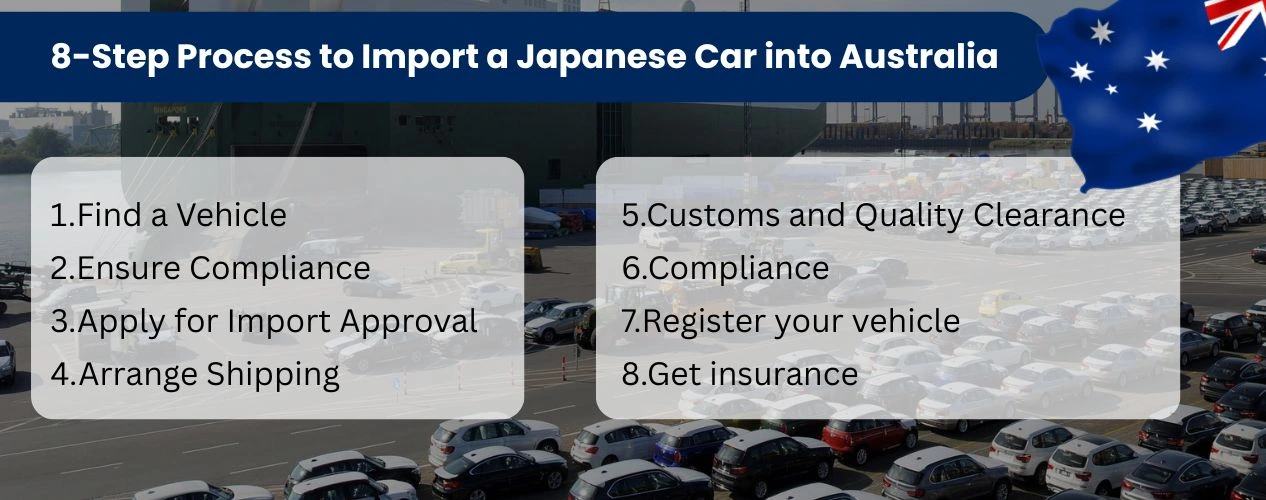
Australians seeking reliable and well-maintained vehicles often opt for Japanese car imports. However, it is essential to understand the steps you need to follow to import your vehicle successfully. This guide breaks it down for you.
You need to begin by choosing the right car for yourself. You have the option of either importing through Japanese exporters, dealers, or through auctions. It is essential to verify that your seller is legitimate and provides proper documentation, such as the Export certificate and service history.
As mentioned above, you must ensure that your vehicle type aligns with Australian import laws. You cannot just import any car. The vehicle you choose to buy must fall into one of the following categories:
Listed on the SEVS (Specialist and Enthusiast Vehicle Scheme)
Be 25 years or older for the Historic Vehicle Scheme
Or qualify for personal import (if you’ve owned it overseas for 12+ months)
Or qualify for personal import (if you’ve owned it overseas for 12+ months)
How to apply for import approval? Before the car leaves Japan, go to the ROVER portal and apply for Import Approval. Without seeking import approval, you won’t be able to bring your car into Australia.
Either of the following options are usually available and you need to decide between the two
RoRo (Roll-On and Roll-Off)
Container shipping
Container shipping is comparatively safer but a bit more costly. It is safer than RoRo, because in RoRo, the car is exposed, unlike container shipment. Your vehicle will usually arrive in 3-5 weeks.
Your car is supposed to go through customs and biosecurity checks once it reaches Australia. The vehicle is to be checked for pests, its condition, and to ensure that there's no asbestos. Asbestos is a group of minerals that Australia has now banned. With that, you will also need to submit an import declaration and pay taxes.
The Australian government has Australian Design Rules (ADR) that must be met. Your car may need some changes to meet the ADR. Along with this, you'll need to get a roadworthiness certificate from any local mechanic. The roadworthiness certificate confirms that your vehicle has passed a test conducted by an authorised roadworthy inspector, a requirement of the Australian government.
Once you get your car and it passes inspection and compliance, register it with your local state authority. These authorities include NSW, VIC, or QLD. To register, please bring your ID, proof of ownership, import approval, and inspection results.
It is always advisable for buyers to get their new vehicle insured. Why? Because once you get your vehicle insured, you don't have to worry about future accidents, damage, or theft. There are different types of insurance; however, you'll need Compulsory Third Party (CTP) insurance to drive in Australia legally. Once you've got your insurance sorted, Congratulations! You've passed all steps to enjoy your new Japanese imported vehicle on Aussie roads.
All car enthusiasts dream of importing high quality Japanese used cars. Some of the most popular used car models include the Nissan Skyline GT-R, Corolla Hiace, and Land Cruiser Prado. A good reason for their popularity in imports is that these are very seldom available locally. Japanese used cars are less costly than local cars because Japanese prefer selling their cars at a cheaper price. This is because of Japan’s strict vehicle inspection system that makes maintenance of cars very costly.
Many buyers prefer container shipment because this method provides extra protection during transit. However, one thing you’ll have to do from your end is to ensure that the vehicle meets SEVS (Specialist and Enthusiast Vehicle Scheme) regulations.
Japanese cars have, over the years, also gained popularity among Aussies who are into racing their cars. These vehicles have special features which are not easy to find in local cars. Japanese cars are for those who are looking to buy a car that stands out and offers amazing performance on the road.
Among the best-selling Japanese Used Car models in Australia are the Mazda MX-5, Toyota Prius, and Honda CR-V. Japanese Used cars remain Australians’ first choice because all the new features, not available locally, are seen in Japanese new cars. Japanese cars lead the new car market in Australia because they offer the best mileage and emission-free vehicles at much cheaper costs than local vehicles. Recently, importing a Japanese car has become more accessible with the emergence of reliable digital platforms, such as SAT Japan.
The following are ten Japanese car models that are loved by Australian Car Buyers.
Honda Civic Type R
Mazda RX7 FD
Subaru Sambar
Toyota Estima
Nissan X-Trail
Toyota Hiace
Honda CR-V
Lexus IS F
Toyota Hilux
Suzuki Swift
All of these vehicles have gained the trust of Australian buyers over the years. Thanks to some of them being hybrid, they offer fuel efficiency and high performance especially on hilly regions. Something that makes them attractive is Japan’s strict roadworthiness checks, also known as “Shaken”. This is one of the many reasons why Aussie importers and dealers trust Japanese vehicles over others.
SAT Japan directly links you to Japanese auction sites, giving you access to thousands of premium-quality used cars. The auction bidding process takes place every week, and it is simple. You first browse the live auction listings, and then select your car and place your bid before the deadline. You need to pay a 10% deposit of your bid amount to confirm your bid.
When importing a car to Australia, it is essential to note that Australia registers Right-Hand Drive (RHD) vehicles. If you are looking to import a high-performance vehicle that is left-hand drive, you might face restrictions while registering these cars in Australia. Therefore, it is essential to always confirm the vehicle's drive side before bidding or purchasing.
Japanese cars have been a global favorite for a very long time. Australians are impressed by the contemporary yet durable designs of Japanese cars. Along with their looks, Japanese cars are well-maintained – they have a strict inspection system called the Shaken. Japanese cars have the best resale value, which tends to hold up well over time. Additionally, import prices for Japanese cars are significantly lower than those charged by local dealers, making Japanese cars a viable option for Australian buyers.
However, importing a car from Japan is not a straightforward process. To begin with, you must ensure that the vehicle you are ordering complies with Australia's compliance policies, especially for older models. Sometimes, it may be challenging to source certain parts, which can lead to repair difficulties. While importing a Japanese car to Australia is a common practice, the process of ensuring your car shipment might be more challenging than you expect. Pricier models have more expensive insurance. Therefore, it's essential to do your homework and determine precisely what you need before selecting a model to import.
It is essential to note that importing a car from Japan to Australia incurs costs beyond the vehicle's purchase price. There are additional costs, including shipping, taxes, compliance, and paperwork. Following is a breakdown of what you should be expecting before you decide to import a car from Japan
| Type | Cost (Approx.) |
| Shipping Agency fee | Starting from $3500 AUD |
| Import Duty | 10% of vehicle value |
| GST | 10% of the total cost |
| Import Approval & Compliance Fee | Around $2,000 AUD |
| Vehicle Model | Avg. Price in Japan (Import) | Avg. Price in Australia (Domestic Used) | Estimated Savings When Imported |
| Honda Civic Type R | AUD 18,000-22,000 | AUD 32,000-44,000 | AUD 12,000-22,000 |
| Subaru Sambar (Kei van) | AUD 3,800 | AUD 16,000-17,000 | AUD 12,000-13,000 |
| Nissan X-Trail | AUD 37,000 | AUD 65,000-90,000 | AUD 25,000-50,000 |
| Mazda RX-7 (FD) | AUD 37,500 | AUD 65,000-90,000 | AUD 25,000-50,000 |
| Honda Fit (Jazz) | AUD 9,000-10,000 | AUD 12,000-18,000 | AUD 5,000-8,000 |
| Toyota Estima (MPV) | AUD 15,000 | AUD 18,000-25,000 | AUD 2,000-12,000 |
| Toyota Hiace (Van) | AUD 18,000 | AUD 20,000-30,000 | AUD 2,000-12,000 |
It is beneficial to understand the complete cost upfront, so it does not come as a surprise later. Carefully weigh the options between your shipping methods (RoRo vs. container) to determine which one best fits your needs. Japanese car imports to Australia may seem daunting if it's your first time; however, with careful planning, it can be smooth and rewarding.

The UK market continues to value Japanese vehicles due to their reliability and high-quality engineering. For automotive enthusiasts seeking a rare model or those in search of a well-maintained daily vehicle, importing a car from Japan stands out as a prudent decision. This Japanese car import guide for the UK will assist you with everything from vehicle selection and exporter liaison to tax obligations, DVLA registration, avoiding scams, and more.
For those interested in used cars for sale in the UK, importing new Japanese cars to the UK, or information on how to buy a used Japanese car in the UK, this guide details every step for a secure and uncomplicated import process. More buyers in the UK are turning to Japan for cars compared to the traditional search for used cars for sale in the UK, and we would like to help you smoothly navigate the process of confidently and seamlessly importing Japanese cars to the UK.
Japanese engines have earned a stellar reputation for their engineering excellence, fuel efficiency, and reliability. For UK customers, especially those exploring used cars for sale in UK, importing directly from Japan opens doors to higher-maintained, lower-mileage vehicles at more competitive prices than many used cars for sale in UK listings offer. Japan's strict inspection system guarantees that most vehicles are in high-quality mechanical and aesthetic condition, making them the best options for British roads.
Moreover, considering that Japan and the UK both have right-hand-drive automobiles, the transition is seamless. This UK-Japanese automobile import manual provides car consumers a convenient way to access rare models, luxurious trims, or newer-generation vehicles not always available through traditional dealers for sale in used UK listings. Whether you're looking to shop for used Japanese automobiles in the UK or considering importing a new Japanese car to the UK, the benefits are both economic and practical.
| Vehicle Model | Avg. Price in Japan (Import) | Avg. Price in UK (Domestic) | Savings When Imported |
| Nissan Elgrand | £6,500 | £9,000 | £2,500 |
| Toyota Alphard | £7,200 | £10,500 | £3,300 |
| Mazda Bongo | £4,200 | £6,700 | £2,500 |
| Honda Stepwgn | £5,800 | £8,300 | £2,500 |
| Subaru Impreza WRX | £9,000 | £12,500 | £3,500 |
The UK market sees a consistent inflow of popular Japanese models each year, thanks to their reliability and value for money. Among the top-selling imported models are:
Nissan Elgrand
A luxurious MPV known for its spacious interior, comfort, and advanced features, ideal for large families or executive conveyance.
Toyota Alphard
A premium people carrier offering plush interiors, hybrid options, and smooth performance, ideal for both long drives and urban use.
Honda Step wgn (Stepan)
A family-friendly minivan with versatile seating configurations, great fuel economy, and a reputation for long-term durability.
Mazda Bongo
A compact camper-style van that's popular for conversions, offering practicality, reliability, and value in a unique package.
Subaru Impreza WRX
A performance-oriented sedan with turbocharged power, AWD grip, and rally-bred handling, appealing to driving enthusiasts.
These automobiles cater to a range of preferences, from spacious family MPVs to performance-oriented sedans. Buyers searching for used cars in UK for sale or those browsing vehicles for sale in the UK are increasingly turning to Japanese imports due to the attractive combination of pricing, high quality, and specific trim options. As detailed in this UK-Japanese automobile import guide, these vehicles aren't just low-priced but also offer brilliant fuel economy, low emissions, and a better standard of indoor comfort. This shift is making importing Japanese vehicles to the United Kingdom market an appealing alternative for individuals who want something specific and dependable.
Importing a luxury or high-end car from Japan to the UK is a great way to get a top-quality vehicle at a better price. Japanese cars are renowned for their advanced technology, exceptional comfort, and smooth performance. Models like the Toyota Century, Lexus LS, and Nissan GT-R are often more affordable in Japan than in the UK.
To start, you can search for a trusted export company or a Japan-based car dealer. They’ll help you choose a car, handle paperwork, and ship it safely. Once the car arrives in the UK, you’ll need to pay VAT, and if it’s a new model, you may also need to pay import duty. The car must also pass safety tests and be registered with the DVLA.
Although the process has steps, many car enthusiasts opt for this route to drive something truly special. For more details, visit the UK government’s import guide.
Pros:
Lower Prices: Even after shipping, Japanese used cars are often more affordable than UK models because of strict inspections in Japan, which result in well-maintained, low-mileage motors entering the market early.
Unique Models: Access rare or high-spec cars that aren't typically available in the UK.
Better Condition: Thanks to everyday servicing and Japan's milder weather, those cars tend to be in terrific mechanical and aesthetic condition.
Cons:
Insurance Costs: Premiums may be more favorable for imported automobiles due to the availability of class and coverage options.
Parts Availability: Some models may experience longer wait times for replacement components, particularly for rare trims or discontinued styles.
While the advantages often outweigh the drawbacks, it's sensible to consider these points before deciding to import a vehicle from Japan.
Do you know that Japan has one of the biggest car auction markets in the world, with thousands of vehicles listed every week. You’ll find all kinds of cars from small fuel-savers to sporty coupes and luxury sedans.
To begin, use a trusted auction site like Japan Partner or work with a Japanese export agent. You’ll need to make a small deposit to start bidding. Each auction listing includes a report showing the car’s condition, mileage, and history. That helps you make a smart choice.
If you win a bid, the auction house helps ship the car to the UK. After it arrives, you’ll go through customs, pay VAT or duty (if needed), and register the car.
Japanese auctions are exciting and offer great value, especially for well-maintained used vehicles. Just make sure to research and use a trusted service!
| Type | Cost (Approx.) |
| Shipping agency fees (based on $12,700 car value) | Starting from $1,270 |
| Import duty (if applicable) | 10% of vehicle value |
| VAT (if applicable) | 20% of vehicle value |
| DVSA inspection fee for Individual Vehicle Approval (IVA) | $250 to $375 |
| Vehicle Age | EU Origin | Non-EU Origin | Previously Owned in Destination Country |
| Less than 30 years | 20% VAT, No Import Duty | 20% VAT, 10% Import Duty | No VAT or Import Duty |
| 30 years or older | 5% VAT, No Import Duty | 5% VAT, No Import Duty | No VAT or Import Duty |
You must comply with UK rules and regulations before importing a Japanese car. Here’s what you need to be cautious about:
The UK drives on the left side of the road, and like Japan, vehicles in the UK are right-hand-drive (RHD). This makes Japanese cars naturally compatible with UK roads, and generally removes the need for steering conversions.
Most imported vehicles from Japan must go through IVA testing (for modified or unique vehicles) or Mutual Recognition if they meet EU/UK type approval standards. This process ensures that the car complies with UK road safety and environmental standards. Some models are exempt depending on their age and classification.
Once the car arrives in the UK, you are required to notify HM Revenue & Customs (HMRC) within 14 days using the Notification of Vehicle Arrival (NOVA) system. This is a mandatory step before you can register your vehicle with the DVLA.
You will need to pay import duties and VAT, unless the vehicle qualifies for relief (e.g., for classic cars over 30 years old, or if you're relocating to the UK with the vehicle). The typical VAT rate is 20%, calculated on the total cost of the car, including shipping and insurance.
After customs clearance and NOVA notification, you must register the vehicle with the Driver and Vehicle Licensing Agency (DVLA). You'll need documents like:
Completed V55/5 form
Proof of identity
Proof of address
Japanese export certificate with translation
IVA/MOT certificate (if applicable)
Proof of insurance
Once the DVLA processes your application, they'll issue a UK registration number, and you can fit UK number plates on the vehicle.
.webp)
Begin by selecting a reputable exporter or dealer in Japan. Look for companies with good reviews, clear processes, and prompt communication. For instance, sites like SAT Japan are trusted by many buyers worldwide due to the ease of communication and straightforward importing process with them.
Browse listings and select the car you want. Check details like mileage, model year, and condition. Japanese cars are known for being clean and well-maintained.
Once you’ve picked your car, your exporter will guide you through the buying process. Payments are usually made by bank transfer.
The exporter arranges shipping to a port in the UK. Shipping takes about 6 to 8 weeks, depending on the location.
When your car arrives in the UK, you must pay VAT (20%) and any import duty (10% if applicable) before it’s released.
Your car must pass a safety inspection (IVA or MOT) and be registered with the DVLA before you can legally drive it.
Importing a car from Japan to the UK can be simple if you follow the right steps and stay organized. First, research and choose a reliable exporter. Look for companies with good reviews and clear contact details. Websites like SAT Japan are trusted in the industry.
Before buying, understand all the costs involved—shipping, taxes (VAT and import duty), port fees, and registration charges in the UK. Ask the exporter for a full cost breakdown upfront.
Stay in touch with your exporter or agent during the entire process. They should give you regular updates, shipping documents, and guide you through the next steps once the car arrives.
When the car lands in the UK, you’ll need to handle customs clearance, inspection (IVA or MOT), and DVLA registration. It’s helpful to hire a customs agent or import specialist for this stage.
Finally, make sure your car is fully insured before driving it. It’s also a good idea to check the vehicle history and service records if available.
With good planning and a trustworthy exporter, importing your dream car from Japan can be an exciting and smooth journey!
While many Japanese exporters are honest and professional, some scams do exist, especially online. Here’s how to stay safe:
1. Work with trusted exporters: Choose companies with years of experience, positive reviews, and proper contact details. Check if they are verified by industry bodies or listed on major platforms like Tradecarview or CarFromJapan.
SAT Japan UK – Trusted & Verified Exporter:
For complete peace of mind, consider working with SAT Japan UK, a trusted and reliable Japanese car exporter. You can visit their UK office in person or contact them directly to verify all details before purchasing:
Address: 181 Forest Rd, Ilford IG6 3HZ, United Kingdom
Business Name: SATJAPAN UK
2. Be cautious of deals that look too good to be true: If a car is priced far below market value, it may be a scam or have hidden issues. Always ask for recent photos, auction sheets, and inspection reports.
3. Never send money to personal accounts: Only pay to official company bank accounts. Avoid paying through untraceable methods like Western Union or cryptocurrency.
4. Get everything in writing: Ensure your purchase agreement includes details like the car's chassis number, condition, shipping schedule, and refund policy.
5. Watch out for fake websites: Some scammers create look-alike sites. Double-check the domain name and look for security signs like “https.”
By taking your time and verifying each step, you can avoid fraud and enjoy a safe and successful import experience from Japan.
Bringing a Japanese car into the UK is an enticing prospect, offering the opportunity to acquire a one-of-a-kind vehicle that is often well-maintained, high-spec, and competitively priced. The process can be streamlined and beneficial if one works with a reputable exporter, follows the correct procedures, and is updated on customs and registration progress. Whether you wish to import a Japanese new car to the UK or are looking at used cars for sale in the UK, investing adequate time in research will prevent expensive missteps. Reliable platforms can facilitate the purchase of used Japanese cars in the UK, provided the proper paperwork is in place, and help you enjoy years of dependable service. Consider this UK Japanese car import guide as the starting point to owning your dream vehicle from Japan.

Japan remains a leading supplier of used cars in Ireland's import market, surpassing the UK, which previously held the top spot. According to Cartell, Japanese imports have increased tenfold in the last decade. This rising figure can be easily attributed to the ease of importing from Japan and the high quality of Japanese import cars.
While the offer seems quite alluring, the complex process of importing a vehicle from another country, and sometimes even a different continent, can deter many people. That’s why we are here to help you understand how to import a car from Japan to Ireland in some easy steps.
So, let’s get into it.
Looking for reliability, affordability, and advanced features in your next vehicle? Japanese used cars offer unmatched value and performance! Importing directly through trusted exporters like SAT Japan allows you to handpick your car from thousands of options, making the process more cost-effective than buying locally.
Japanese owners typically service their cars regularly, and strict domestic regulations mean you're getting top-tier quality. Brands like Toyota, Honda, and Nissan are known for their durability and efficiency. Plus,importing a car from Japan to Ireland gives you access to low-mileage, well-maintained vehicles at competitive prices.
You must know the difference between the actual cost and the purchase cost of the car. The final cost depends on the taxes and valuation methods. So, proper estimation is very necessary.
One easy way is through this simple formula:
Total Cost = Price of the Vehicle + Shipping + VAT + VRT + NOx Levy + Other Fees.
The combined value of the vehicle and the shipping is subject to VAT, and the VRT is computed independently of that combined value and is calculated using the Open Market Selling Price (OMSP) as determined by the Irish authorities. The NOx levy is added depending on emissions.
There are some costs that influence your budget, but sometimes some buyers overlook these hidden costs.
Although you have done good planning, exchange can affect the final price, especially when international transactions are involved. Delays at the port can result in you having to pay storage fees.
Insurance is another important factor that you must not ignore. On some imported models and specifications, you can be charged a premium. Additionally, VRT depends on the official valuation, so it is not the exact amount.
When you look at these costs individually, they do not seem high; when you add them, they have a huge impact on the overall investment.
| Type | Cost (USD) |
| Shipping fee | $756 to $972, depending on the size of the vehicle |
| VAT (If applicable) | 21% of the purchase cost and shipping |
| Customs duty (If applicable) | 10% the purchase cost of the vehicle and shipping |
| Vehicle Registration Tax | 7% to 41% of OMSP (Open Market Selling Price), based on CO2 emissions |
| National Car Test (NCT) | $59 to $65 |
VRT is based on the Open Market Selling Price (OMSP), which depends on the vehicle's market value, model, engine size, year, and roadworthiness.
Since July 2008, VRT has been based on CO2 emissions rather than engine size.
Customs duty and VAT are applicable to both the vehicle purchase cost and shipping charges.
Exemptions:
Certain exemptions from paying Vehicle Registration Tax (VRT) may apply depending on specific conditions or categories (e.g., returning residents or diplomatic vehicles).
Car importation is not about transferring a car to ensure that all legal, tax, and compliance requirements are fulfilled. Understanding of the processes helps protect against any hidden costs.
When your car reaches Ireland, you have to be fast. You have to register the car within 30 days and make a quick appointment with the National Car Testing Service (NCTS). If you fail to do so, you have to pay penalties.
Japan is not a member of the EU, so the vehicles are considered non-EU. There is a need for a customs declaration. EU must pay up to 23% VAT, including shipping charges. In certain cases, this may be subject to customs duty, and it depends on where the car is manufactured. Proof of payment is important to continue the process of registration.
All imported cars must have VRT before they can be lawfully driven. It is computed on the basis of the Open Market Selling Price (OMSP), which has been established in Ireland, CO₂ emissions, and the type of vehicle. This fee is paid during NCTS registration and is often among the most expensive expenses.
Proper documentation is the key to a successful registration. You will normally require:
Original certificate of export or registration.
Purchase invoice
Bill of Lading
Evidence of customs clearance.
Any inappropriate or missing documentation may slow or even stop registration.
The vehicle must meet the Irish and EU standards before it goes on the road. You have to take approval from the National Car Test (NCT) where necessary, and all the information of the vehicle, including VIN and the specifications of the engine, should match the government records. Usually, a vehicle will fail to register until these standards are met.
Pros | Cons |
Often more affordable than the Irish market, even after taxes. | VAT and VRT can greatly decrease total savings. |
Less mileage and typically well-maintained cars. | The history of service may be limited or more difficult to check. |
Good construction and durability. | There might be some vehicles that need to be modified so that they are compliant. |
High-spec, rare, or Japan-only models. | Specifications variations with EU models may have an impact on usability. |
Increased car selection and options. | It is a long process that needs planning and detail. |
Possibility of increased long-term value. | Parts are less readily available, and insurance is more difficult. |
When importing a used car to Ireland, ensure you have:
Original registration certificate
Purchase invoice
Bill of lading or shipping documents
Customs clearance (if from outside the EU)
Proof of identity and address
VRT appointment confirmation
If you are importing a car from outside the EU (e.g., Japan), you must:
Complete a Customs Declaration through the Automated Import System (AIS).
Pay Customs Duty (typically 10%) and VAT (21%) based on the vehicle’s customs value, which includes the purchase price, shipping, and insurance.
Provide proof of ownership, purchase invoice, and shipping documents.
Every imported used car must be registered with Revenue and is subject to VRT, which is calculated based on:
The Open Market Selling Price (OMSP) as estimated by Revenue.
The vehicle’s CO₂ emissions, fuel type, and engine capacity.
Registration must be completed within 30 days of the vehicle’s arrival in Ireland. Failure to register on time may result in penalties.
Dreaming of driving a luxury car that stands out in Ireland? Japan is a hub for premium vehicles like the BMW 3 SERIES, Lexus RX, and Volkswagen GOLF, all loaded with top-of-the-line features. Many of these models are Japan-exclusive or released earlier in Asian markets. Importing a high-end new car from Japan not only saves you money compared to Irish dealership prices but also lets you enjoy cutting-edge tech and superior craftsmanship. Work with reliable exporters who offer full documentation, inspection, and shipping support to make the process seamless, from the showroom to Irish roads.
It is the selection of the appropriate car that makes importing really worth it. The most appropriate ones are those that are low in taxes, are reliable, and have high resale value in Ireland.
The most economical option is hybrid cars. Models like the Toyota Prius and Toyota Aqua are popular due to low emissions, better fuel economy, and lower VRT.
Small hatchbacks like the Honda Fit and Mazda Demio are affordable, simple to maintain, and in high demand, and thus they are good for daily use.
SUVs such as the Toyota Harrier and the Toyota C-HR offer comfort and features to buyers who require more space, but this might attract higher taxes.
Did you know you can score amazing deals on top-quality cars by bidding in Japanese auctions? It’s the smartest way to import a car from Japan to Ireland.
Auctions feature thousands of vehicles weekly, ranging from compact hybrids to luxury SUVs, all with detailed inspection reports. With expert support from exporters like SAT Japan, you can bid safely, set budgets, and even gain access to live auctions. After you win the bid, the exporter handles shipping, customs, and documentation. You can also request an Auction Sheet for a better understanding of the vehicle. It’s a transparent and cost-effective route for Irish buyers looking for variety, value, and control over their import choices.
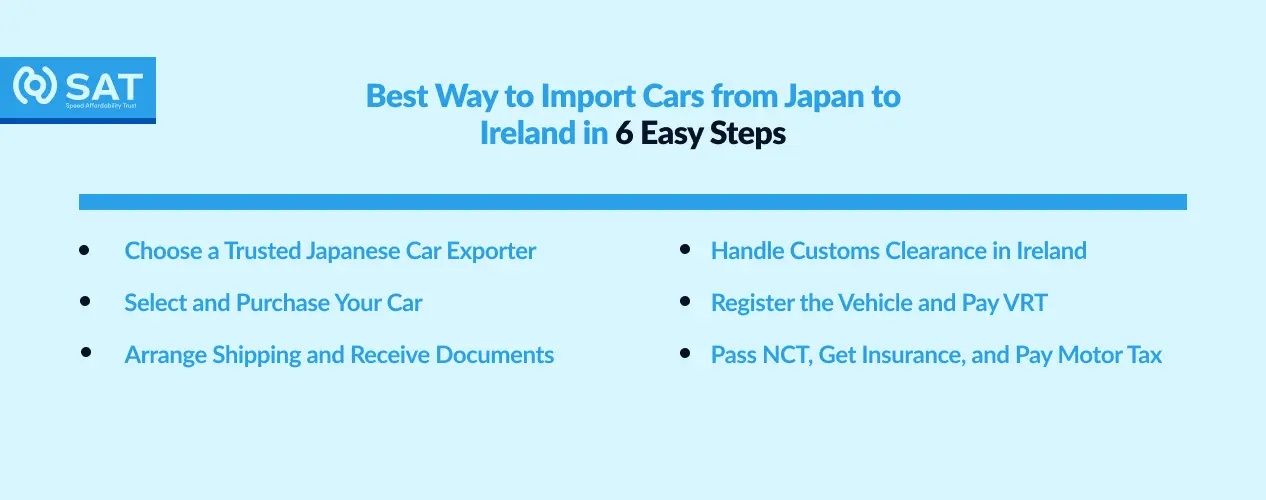
Importing a car from Japan to Ireland is a great way to access high-quality vehicles at competitive prices. With the right knowledge and planning, the process can turn out to be really smooth and efficient.
Follow these six easy steps:
Start by selecting a reputable exporter, such as SAT Japan. Here’s what you need to look for in the exporter:
Verified exporters with a strong track record
Transparent pricing and detailed car listings
Auction access for better deals
Vehicle inspection reports and shipping assistance
Next, visit the listings at SAT Japan and browse the available stock or participate in real-time Japanese car auctions through the exporter. After selecting your vehicle:
Request a pro forma invoice
Pay via secure bank transfer
Confirm shipping arrangements (typically RO-RO or container shipping)
Once payment is complete, SAT Japan will ship the vehicle to Ireland (usually Dublin or Cork port). You will receive essential documents, including:
Bill of Lading
Export certificate (Deregistration Certificate)
Commercial invoice
English-translated inspection report
Upon arrival of the vehicle, file a customs declaration using Ireland’s Automated Import System (AIS) and pay applicable customs duty (10%) and VAT (21%) based on CIF value (Cost + Insurance + Freight). That’s the best part of using a Japanese exporter like SAT Japan: you don’t need to hire a separate customs broker. The exporter will help you with all such tasks.
Register the vehicle with Revenue via the NCTS within 30 days of arrival. For that, you will need:
VRT appointment through NCTS
Original documents received from the exporter
ID and proof of address
Payment for Vehicle Registration Tax (VRT)
Before you can legally drive your imported vehicle, make sure to take the National Car Test (NCT) if the vehicle is over 4 years old and secure motor insurance (many insurers specialize in imports). Also, don’t forget to pay your motor tax online or at your local office.
In the RoRo vs container shipping debate, your decision directly affects cost and protection, so it is worth making the right one.
The most popular one is RoRo (Roll-on/Roll-off). The car is loaded onto the ship and fastened, and the procedure is quick, effective, and inexpensive. RoRo is a good value when affordability and simplicity are your priorities.
Container shipping offers a greater degree of protection. The vehicle is enclosed in a container, which protects it against weather and outside handling. This is ideal in high-value or luxury cars, but it is more expensive.
In the RoRo vs container shipping decision, it ultimately comes down to your priorities. Select RoRo to be cheaper and easier, or choose container shipping if maximum security and peace of mind are more important.
The typical timeframe to import a car from Japan to Ireland is 6 to 8 weeks. This includes the entire process from purchasing the vehicle, arranging shipping, and clearing customs, to completing registration in Ireland.
Once the vehicle is purchased through a trusted exporter like SAT Japan, it usually takes 4 to 6 weeks for the car to be shipped via Roll-on/Roll-off (RO-RO) or container shipping to Irish ports such as Dublin or Cork.
After arrival, customs clearance, Vehicle Registration Tax (VRT) appointment, and registration with Revenue can take an additional 1 to 2 weeks, depending on how quickly documents are processed.
Delays may occur due to port congestion, incomplete paperwork, or scheduling issues with inspections. However, planning ahead and working with experienced exporters can help you complete the process smoothly within the 6- to 8-week window, ensuring your vehicle is legally ready for Irish roads.
Focusing only on the purchase price: Most buyers overlook the total cost. After adding VAT and VRT, it can be much more than what they expected.
Misunderstanding VRT: Many buyers, especially first-time buyers, misunderstand VRT. It depends on the Irish market value of the car, not on the amount you paid.
Skipping proper vehicle checks: Some buyers forget to check and verify auction reports or history, which may result in expensive repairs in the future.
Choosing the wrong car: More expensive cars with high emissions or less desirable models might be harder to resell.
Missing key deadlines: You may have to pay extra fines if you delay booking the VRT inspection.
Master the hassle of importing a vehicle from Japan with these few tips:
Selecting a certified exporter is the foundation of a successful import. Companies like SAT Japan ensure accountability, transparency, and quality service. A reliable exporter provides genuine auction access, vehicle inspection reports, and complete documentation, which are important for smooth customs clearance and legal registration in Ireland.
Before importing, familiarize yourself with Irish laws regarding customs, VAT, and Vehicle Registration Tax (VRT). Import rules differ for vehicles from outside the EU, so ensure compliance with National Car Testing Service (NCTS), registration deadlines, and emissions standards.
Ensure you receive the Bill of Lading, Export Certificate, Commercial Invoice, and Auction Sheet from the exporter. These documents are required for customs clearance and VRT registration in Ireland. Missing paperwork can delay the process and may result in penalties or refusal of vehicle registration.
Irish law requires that your imported car be registered within 30 days of arrival. Book a VRT inspection with the NCTS as soon as your car lands. Late registration can incur penalties. Having all documents in order will help pass the inspection without issues.
Before shipping, request a third-party inspection or a comprehensive report from your exporter to ensure the quality of the vehicle. Once the car arrives, check its mechanical condition, lights, emissions, and tires. If the vehicle is over four years old, it must pass the National Car Test (NCT) before it can be driven legally on public roads.
Scams and frauds are everywhere, and there is no denying that. Since imports and exports bring big money to scammers, fraud is pretty common here. However, you can follow these tips below to avoid fraud when importing a car from Japan.
If a deal looks too good to be true, it likely is. Be cautious of extremely low-priced vehicles or sellers offering discounts for immediate payment. Scammers often use such tactics to lure buyers. Always compare market prices and consult with trusted dealers or exporters before transferring funds.
Visit the official website of the exporter and look for client testimonials. Genuine exporters like SAT Japan offer detailed listings, clear contact details, and evidence of previous exports to countries like Ireland.
Ask for the vehicle's auction sheet, chassis number, and maintenance records. Use online tools to verify the car’s history, including mileage, accident reports, and ownership. A trustworthy exporter will always provide full transparency and documentation, ensuring that you are not purchasing a damaged or stolen vehicle.
Dealing with unauthorized agents in Ireland increases fraud risk. Scammers may pretend to be import consultants or claim they have connections with certain Japanese exporters. Always deal directly with the exporter or use official company channels. Verify identities and check for business registration if in doubt.
Japanese cars are very reliable, which is why many people opt to import these vehicles instead of purchasing local ones. Since the import process has also become pretty straightforward due to reliable exporters like SAT Japan, there’s nothing that could set a car enthusiast back.
So, equip yourself with all the right knowledge about the customs, regulations, and other rules of importing a car and get started with vehicle import right away!

Importing a car from Japan to Pakistan appears to be a complex process, and for many, it indeed is. The paperwork, customs regulations, and finding a reliable exporter make the whole process thoroughly overwhelming. What’s saddening is that many buyers give up before they even get started. But it doesn’t have to be that way.
Thanks to more consumer-friendly import policies introduced by the Government of Pakistan and expert assistance from exporters like SAT Japan, importing a vehicle from Japan to Pakistan has become smoother and far more accessible. SAT Japan handles the tough part so you don’t have to stress.
This Pakistan Japanese car import guide contains everything you need to know. Continue reading till the end.
There is one thing about Japanese cars: they are built to last. Their precise engineering makes the vehicles last long and maintain a high standard of performance for the years to come. Japanese cars are also more affordable due to the country's large economy of scale. Their preference for new and innovative models turns even one-year-old used cars into a valuable asset in the used-car market. Contrary to this, the rising fuel costs in Pakistan have made Japanese hybrid and compact models ideal for every other person.
Imported Japanese cars usually have better resale value due to their condition and brand reputation. Moreover, from sedans and hatchbacks to SUVs and kei cars, Japanese markets offer options to suit every budget and need. All this makes Japanese cars an excellent investment for Pakistani buyers.
Several used Japanese models are especially popular in Pakistan. Among the top choices are:
Daihatsu Mira
Toyota Vitz
Toyota Passo
Toyota Aqua
Toyota Land Cruiser Prado
Suzuki Alto
Toyota Prius
Nissan Dayz
Suzuki Wagon R
Toyota Raize
These vehicles are popularly sold in Pakistan due to their exceptional fuel efficiency, compact size suited for urban roads, and affordable maintenance costs. They are popular and ideal for city driving, offering excellent mileage and making them budget-friendly options.
Not just used cars—many buyers in Pakistan are now importing high-end new models from Japan, such as:
Lexus LX and RX series
Toyota Land Cruiser and Prado
Nissan Elgrand
Honda Odyssey
Mitsubishi Pajero
These models are often loaded with luxurious features and superior technology, making them attractive choices for those looking to stand out.
Do you know what’s the smartest way to buy a Japanese car at affordable rates? Auction.
The Japanese used car auction system is a goldmine for finding quality vehicles at competitive prices. From daily drivers to luxury sedans, there are so many vehicles listed on auctions. Each vehicle has a grading system and an auction sheet for transparency. The best part is that the cost of vehicles at auctions is generally cheaper compared to local dealers.
But how can someone buy used Japanese cars in Pakistan through an Auction? Well, you need to buy through trusted exporters like SAT Japan that offer auction access and bidding services. You can begin by making a deposit to secure your bidding limit. Once done, go ahead and choose from various makes, models, years, and mileage. Meanwhile, you can review the auction sheet to inspect the condition of your chosen vehicle and grading. SAT Japan will bid on your behalf, and once everything is finalized, the company will take care of the logistics and shipping.
Engine Capacity | Customs Duty (CD) |
Up to 850cc | 30% |
851cc–1,000cc | 35% |
1,001cc–1,500cc | 40% |
1,501cc–1,800cc | 45% |
Above 1,800cc | 50% |
Note: Customs Duty is only one component of vehicle import taxation in Pakistan. Additional Customs Duty, Regulatory Duty, Sales Tax, Federal Excise Duty and Income Tax may also apply depending on the vehicle's PCT classification and import conditions.
Engine Capacity | Duty & Taxes |
Up to 800cc | US$4,800 |
801–1,000cc | US$6,000 |
1,001–1,300cc | US$13,200 |
1,301–1,500cc | US$18,590 |
1501cc -1600cc | US$22,550 |
1,601–1,800cc (Excluding Jeeps) | US$27,940 |
Note: For eligible used Asian-made cars imported under Pakistan's Personal Baggage, Gift, or Transfer of Residence schemes, depreciation in duties and taxes is allowed at 1% per month based on the vehicle's age. Cars must generally not be more than three years old.
Depreciation Rule | Allowance |
Each completed month of vehicle age | 1% per month |
Maximum depreciation for cars | 60% |
Depreciation is calculated at 1% for each completed month, generally from 1 January of the year following the vehicle's manufacturing year up to the shipment date, subject to the applicable maximum limit.
Hybrid Engine Capacity | Exemption |
Up to 1,800cc | 50% |
1,801cc–2,500cc | 25% |
Scheme | Eligibility & Features |
Transfer of Residence | Minimum 850 days abroad during the past 3 years. The vehicle must be imported from the same country where the overseas Pakistani resides. |
Gift Scheme | Minimum 850 days abroad during the past 3 years. The vehicle can be gifted to an eligible family member normally resident in Pakistan. |
Note: The Personal Baggage scheme for vehicle imports was removed in January 2026. Vehicles imported under the Gift or Transfer of Residence schemes cannot be transferred for one year from the date of import.
Under the Gift and Transfer of Residence schemes, passenger cars can generally be imported if they are not more than three years old. Vehicle age is calculated according to the applicable import rules, so buyers should confirm the manufacturing year and shipment date before purchasing a car.
Most vehicles imported from Japan are right-hand drive, which is suitable for Pakistan’s left-side driving system. Buyers should confirm the applicable import and registration requirements before purchasing a left-hand-drive vehicle.
There are currently two government-approved schemes for overseas Pakistanis importing used vehicles:
Transfer of Residence: Allows an eligible overseas Pakistani returning to Pakistan to import a vehicle. The vehicle must be imported from the same country where the overseas Pakistani resides.
Gift Scheme: Allows an eligible overseas Pakistani to gift a vehicle to a qualifying family member who normally resides in Pakistan.
The Personal Baggage scheme for vehicle imports was removed in January 2026. Applicants under the Gift or Transfer of Residence schemes must have stayed abroad for at least 850 days during the preceding three years.
A person who has imported, gifted, or received a vehicle during the applicable three-year eligibility period cannot import or receive another vehicle under these schemes. Vehicles imported under the Gift or Transfer of Residence scheme also remain non-transferable for one year from the date of importation.
You must provide accurate vehicle and import details, submit the required documents, and pay all applicable customs duties and taxes. Used vehicles imported under the Gift or Transfer of Residence schemes must also meet the applicable safety, environmental, and regulatory standards notified by the Ministry of Industries and Production and the Engineering Development Board. Incorrect declarations or tampering with vehicle identification details may result in action by Pakistan Customs.
For used vehicles imported under the Gift or Transfer of Residence schemes, the main documents include:
Goods Declaration (GD): Filed for customs clearance.
Export Certificate: Official vehicle export document from the country of export.
Vehicle Purchase Receipt: Proof of purchase of the vehicle.
Bill of Lading (B/L): Shipping document issued for the vehicle.
Attested Copy of Passport or Pakistan Origin Card: Used to verify the overseas Pakistani importer.
CNIC of the Recipient: Required when importing under the Gift Scheme.
Bank Encashment Certificate or Foreign Remittance Evidence: Proof that applicable duties and taxes are being paid through eligible foreign exchange remittance.
Scheme Eligibility Evidence: Documents showing that the applicant meets the current Gift or Transfer of Residence requirements, including the applicable overseas stay conditions.
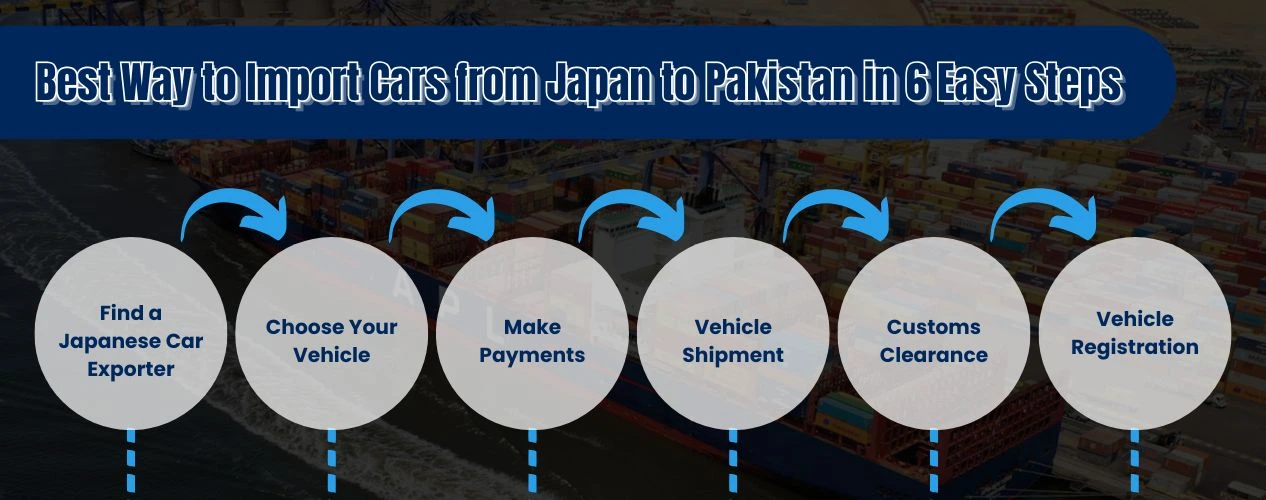
Follow these steps to import a high-quality car from Japan to Pakistan.
Begin by searching for reliable and verified Japanese car exporters. Companies like SAT Japan are popular due to their transparency and vast car inventory. Check customer reviews, export experience, auction access, and if they provide complete documentation. Working with a trustworthy exporter ensures a smooth and safe buying experience.
Browse through SAT Japan’s stock or Japanese auction listings. Select a vehicle that suits your needs, whether it's fuel efficiency, family comfort, or off-road capabilities. Make sure the car is within Pakistan’s import regulations (right-hand drive, less than 3 years old, etc.). Finally, don’t forget to request the auction sheet to check the car's condition, mileage, and history.
Once you finalize the vehicle, SAT Japan will send a Proforma Invoice. You’ll need to transfer the payment. Ensure all payments are properly documented and keep receipts for customs purposes in Pakistan.
After payment confirmation, the exporter arranges the shipment usually by Ro-Ro (Roll-on/Roll-off) or container shipping. You’ll receive the Bill of Lading, Export Certificate, and Invoice, as these are essential for customs clearance. Shipping to Pakistan typically takes 6 to 8 weeks, depending on the port and weather conditions.
When your car arrives at a Pakistani port (like Karachi), you’ll need to get it cleared by Pakistan Customs. You or your customs agent must submit documents including:
Bill of Lading
Import Permission
GD (Goods Declaration) Form
Identity documents
Proof of payment
Export certificate
Duties and taxes will be calculated based on engine capacity, year, and car type. A customs clearance agent can help simplify this process.
Once cleared from customs, the final step is registering the car with your local Excise and Taxation Department. Submit documents like:
NIC
Sales invoice
Custom clearance certificate
Registration application form
Proof of address
You’ll get a registration number and vehicle plates. After this, your imported car is legally ready to drive on Pakistani roads!
The best approach when importing a vehicle is to work with verified exporters that have a good public reputation, such as SAT Japan. This is because verified sellers give you real information, proper papers, and clean deals. Nobody would want their dream car to turn into a nightmare with shady dealers.
Auction sheets are more like a vehicle’s report card. They tell you if it’s been in an accident, its mileage, and overall condition. So, if you are looking for a vehicle from a Japanese auction, you must know how to read an auction sheet. If not, it’s better to get some help.
Some cars are easy to maintain in Pakistan, others not so much. Before buying, see if spare parts are available and if mechanics know the model. A popular car is easier to fix and sells faster if you ever want to upgrade.
Import rules change like the weather! Stay updated with FBR and customs websites so you don’t break any laws. Knowing the rules helps avoid fines, delays, or losing your car. Be smart and always check before you ship.
Pakistan allows cars up to 3 years old for personal use. Anything older is a big no! If you pick an over-aged car, it might get stuck at the port or even be sent back. Stick to the age rule and stay stress-free!
Thousands of Pakistanis, unfortunately, fall for auction sheet fraud when buying a used Japanese car. This type of fraud is more prevalent in Pakistan than you might think. It's because getting away with fraud is easier in Pakistan due to the lack of a legal framework and an official monitoring authority. So here's what fradsters typically do.
Several sellers fabricate the Auction sheet by altering the mileage figures on the sheet. For them, doing this is easy because they only need a basic understanding of Photoshop or Canva to edit the values seamlessly. However, catching them is not an easy job. Simply because if you call the fraudsters out, they’ll show up with the fake, altered verification sheet to cover their fraud. Fake Auction sheet fraud is not the only way fraudsters exploit their customers. There are more.
Another common practice is for sellers to completely change the mileage values in the car. Well, how do they do that? Fraudsters simply remove the vehicle's ECU, connect it to a monitor, and then reverse the mileage. This tricks the buyer into believing in the wrong values. Even if you call the seller out, he would likely come up with a fake or altered verification sheet to cover up his fraud.
Many dealers and sellers also commit paint fraud. What they do is repainted their car locally and claim it to be a genuine body. If you want to detect this kind of fraud, you have to compare the car’s appearance with the auction sheet. If there is a visible difference, then it means that you’ve been successful in catching a Color code scam.
Since millions of sellers engage in this kind of activity, it is nearly impossible to keep a check on everyone. However, there are certain precautionary measures that you can take to protect yourself from such fraudsters.
A rule of thumb is to verify your car from the SAT Japan auction sheet verification. In case the car is not auctioned, you cannot do much about it except for trusting your instinct. SAT Japan’s vehicle inspection system conducts a thorough, detailed inspection to verify whether the mileage on the meter is accurate or not. We’re doing our best to prevent such fraudsters.
To protect yourself from potential fraud, avoid paying your seller in full at once. Legitimate sellers usually accept partial payments or offer secure payment methods. Avoid paying through untraceable services and use services like PayPal or international bank transfers, which involve a legitimate third party.
It is essential to verify the credibility of your seller before initiating the process. Check for red flags, such as a deal that appears too good to be true, or if you notice a lack of documentation. Double-check the vehicle registration and shipping details, and most importantly, ask questions. If a seller is reluctant to answer questions, that is definitely alarming and you should not buy from them.
Importing a vehicle from Pakistan to Japan is indeed an exciting option, particularly for those looking for durability and reliability along with modern tech features. However, the import process is typically lengthy and requires the support of experts to avoid fraud and scams. That’s why we have partnered with some top companies to help our customers navigate the customs process in a matter of a few days.
So, what is holding you back? Choose the vehicle of your choice from SAT Japan’s listings today and start the import process right away!
Importing a used car from Japan to South Africa is a very reasonable choice, as the vehicles are typically compliant with the South African standards. The import process involves a few basic steps you must take carefully, like clearing the car through customs, obtaining necessary permits, and more. Once you have a checklist of all the required documents, it becomes easier to import a vehicle. So, let’s have a look at the detailed guide that can help you with the import process.
Importing a Japanese vehicle is often more affordable, and you can access unique models that would otherwise be unavailable in your country. Cars from Japan also match South Africa’s road system since both countries use right-hand-drive vehicles. Since Japanese cars come with better features and options, and are often more reliable.
In addition, detailed inspection reports and a wide variety of models help buyers find exactly what they’re looking for, whether a compact city car or a tough 4x4.
Several used Japanese models are especially popular in South Africa. Among the top choices are:
Honda FREED
Nissan MARCH
Nissan SERENA S Hybrid
Nissan JUKE 4WD
Nissan ELGRAND
Toyota HIACE VAN 4WD
Toyota COROLLA AXIO
Toyota PASSO
These vehicles are known for their low maintenance costs, long-lasting engines, and good resale value. These cars are often found in great condition at Japanese auctions, so they remain best-sellers in the South African used car market.
Used Japanese cars are not the only viable option. There is also an option to import new Japanese cars to South Africa, which is truly a great opportunity to source models that are unavailable in the country.
The best part about these vehicles is the high resale value compared to used cars and models. This way, you can have better access to newer models, advanced features, and tech, that too, at such affordable rates.
If you are looking for a vehicle at a price you like, you have the option of car auctions. Japanese car Auctions offer access to over 200,000 vehicles each week. These auctions are a popular choice for many South African buyers because they provide a wide selection, from compact cars to vans and luxury models.
Each vehicle usually comes with a detailed inspection report, which includes information like mileage, condition, and previous use. This helps buyers make informed decisions. Compared to local markets, auction cars from Japan can often be more affordable and better maintained. This is what makes them a practical option for those looking to import a vehicle safely and with more clarity.
| Tax Type | Rate |
| Customs Duty | 30% of vehicle value (20% if the car is more than 20 years old) |
| Ad Valorem Duty Exemption | Vehicles valued below R130,000 are exempt from ad valorem duty |
| Cumulative Tax Estimate | Approx. 70% of the vehicle's market value for a car valued at R200,000 |
| VAT | 15% of the total cost, including CIF and customs duty |
| Ad valorem duty | Based on a sliding scale (0.75% to 20%) depending on vehicle value and engine size |
| Valuation Requirement | If the original invoice is not available, three written valuations are required from Japanese car exporters |
You need to stay compliant with the South African rules and regulations before importing a Japanese car. Here’s what you need to be cautious about:
South Africa follows the right-hand-drive (RHD) system, meaning all vehicles driven on public roads must have the steering wheel on the right side. This is an important regulation when importing a car from Japan, as Japan also uses RHD vehicles.
You must obtain a Letter of Authority (LOA) from the National Regulator for Compulsory Specifications (NRCS). This document ensures that the imported vehicle meets South African safety and technical standards. It should be secured well before the vehicle arrives in the country because without it, you cannot register the vehicle for road use.
To legally import a car from Japan into South Africa, you must apply for an import permit from the International Trade Administration Commission (ITAC). This is done for all the used vehicles being imported to South Africa. The aim is to monitor the number of used vehicles in South Africa.
After the vehicle is cleared through customs and duties, the next step should be registering it with the local traffic department. After the customs clearance, you will receive a Customs Release Notification form, which is needed for the vehicle registration.
You will need the following import documents for customs clearance in South Africa:
Import Permit – Legal entry approval
Letter of Authority (LOA) – Safety & standards clearance
Cancellation Certificate – Japan registration canceled
Bill of Lading – Shipping and delivery record
Commercial Invoice – Purchase and price details
Letter of Authorization – Agent permission document
Identification Document – Passport or valid ID
Permanent Resident Permit - Issued by the Department of Home Affairs (for immigrants only)
Inspection Certificate – Vehicle condition verification
Import permit – Legal entry approval
To import a vehicle in South Africa, you must register with the South African Revenue Service (SARS). This will leave you with an importer’s code. You can visit SARS eFiling to register as an importer. Gather the required documents and complete the form (DA 185) at a SARS office. Once done, you will soon be registered and receive an importer’s code for customs clearance.
First, to clear your car at customs, submit a Customs Clearance Declaration (CCD) with all the needed documents. Then, do a self-check of your payment and paperwork. Customs will look at your documents, like the invoice and shipping papers. They’ll then calculate the taxes and duties you need to pay. Sometimes, they may inspect the car. Once everything is okay, your vehicle is cleared and ready to go.
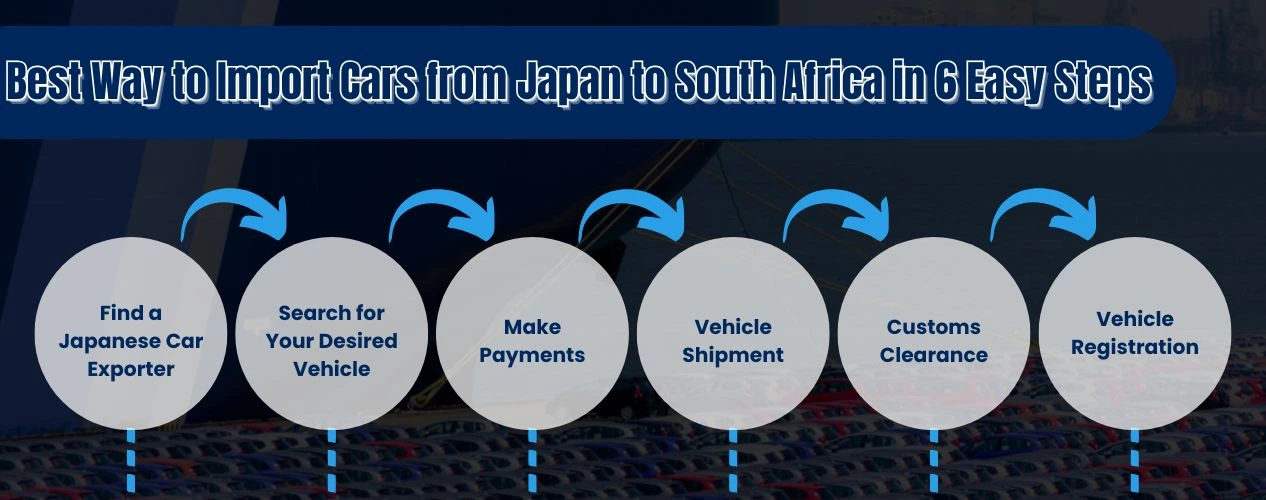
Follow these steps to import a high-quality car from Japan to South Africa.
Start by choosing a trusted exporter in Japan. This is super important! A good exporter like SAT Japan will give you real photos and honest details and help you through the whole process. A dealership with a proper website, contact information, and good reviews tends to be more reliable. Make sure they have experience shipping to South Africa. A friendly and helpful exporter makes everything smoother, and some research goes a long way in avoiding future problems.
Now is the time to browse SAT Japan’s stock online through the listings. You can find the vehicle of your choice by selecting the specific make, model, and year. Compare different available options and finalize the one you think is the right fit for you.
Once done, contact our team to inquire about the car, its photos, and more.
After selecting your vehicle, we will send you an invoice with all costs, including the price of the car and shipping fees. Payments are usually done through a bank transfer. Always keep payment records and ask for confirmation once the money is received. This is really important!
After confirming the payment, our team will make the necessary arrangements to send your chosen vehicle to South Africa. You’ll receive documents like the Bill of Lading that are required at customs. The shipping time may vary, but it usually takes 6 to 8 weeks. You can get shipping updates throughout the process.
Clearing through customs can be a hefty process if you don’t have the right documents prepared at the right time. That’s why it’s important you have all the payments cleared, as it may include checking import duties, paperwork, VAT, and others. Our team will help you with that, as we fully understand the local regulations.
Once you have cleared the vehicle through customs, you need to register it in South Africa. Depending on the local registration process, you may require documents such as customs documents, an ID card, an address, and more.
Avoid the hassle of the import process with these simple tips:
Importing a vehicle from another country is a big step that requires a big investment. So, make sure you buy a car from a trusted exporter only. A reliable exporter will provide you with the pictures of your selected car, inspection sheets, and keep you updated about shipping. You can easily avoid scams by ensuring the company is well-known and has a good reputation. In that case, SAT Japan will prove to be your trusted export partner.
Nothing is as important as being informed during vehicle shipment. Since every country has its own regulations for importing vehicles, you need to do a quick check to save yourself a big headache and lots of money later. For instance, some allow only left-hand drives, others need low mileage, or certain model years. Check age limits, taxes, and paperwork before you buy.
Paperwork may not be fun, but it’s super important. Ensure you get the bill of lading, inspection, and export certificate. That’s because these are the most important documents for imports. You may need additional ones depending on the country or port from which you receive your vehicle.
Shipments need to clear customs before they make their way to you. That’s why you should be prepared well with all the necessary documents and any pending payments. You will need papers for customs and registrations, so make sure you have copies of these documents.
Japanese vehicles are known for their safety and reliability, and for that very reason, hundreds of cars are imported to South Africa every year. However, some fraudulent dealers and scammers trap people in the name of low prices. It’s better you cross-check a dealer before finalizing any purchase. Most of all, consider importing your vehicles through SAT Japan, as we have a long history of successful car imports around the world.
Meanwhile, here’s what you can do to avoid fraud:
Verify the contact details, address, and location of the company to ensure you are dealing with real people with real business.
Always check for reviews on websites like Trustpilot and Google to learn about the company’s credibility.
Prices that seem too good to be true are often a trap. It’s recommended to always check the market price and compare well before making any final decision.
Japan brings high-quality innovative vehicles to the market every time. Unfortunately, not all vehicles make it to South Africa. In such a case, there is no better option than to import your favorite car.
The import process becomes easier with SAT Japan, where you can have your vehicle with you in 6 to 8 weeks. The best part? There is a wide selection of vehicles to choose from. You just need to stay updated on the rules and regulations to have a smooth import experience.
Importing used cars from Japan to Sri Lanka requires a good understanding of taxes, customs, country regulations, and a bit of patience. But you don’t have to worry much about the import process if you pick an exporter like SAT Japan that takes care of most of the steps. We have a highly professional sales team that ensures you get personalized service when importing your Japanese car to Sri Lanka. With experience handling shipments specifically to Sri Lanka, SAT Japan is well-versed in local procedures and makes the entire process more efficient for you.
Japanese vehicles are some of the most reliable vehicles in the world. They are of high standards, affordable, of exceptional quality, and advanced engineering. Japan has a really advanced automobile industry with a wide range of vehicle choices. Here’s why you should consider importing Japanese vehicles to Sri Lanka:
Exceptional quality and reliability
Cost-effective options
Fuel-efficient vehicles
Easy availability of spare parts
Better resale value
Honda, Nissan, Mazda, Toyota, you name it, all the big automotive brands are housed in Japan. They are all widely recognized worldwide for producing vehicles that last a lifetime. In Sri Lanka, the top-selling used Japanese cars are:
Honda Vezel
Nissan Roox
Suzuki Wagon R
Toyota Raize
Suzuki Alto
Suzuki Every
Toyota Aqua
These vehicles are favored for their low maintenance costs, advanced features, and high resale value. Moreover, the Japanese practice of regular vehicle inspections keeps the cars well-maintained, which is a top reason why they are so in-demand in Sri Lanka.
While most Sri Lankan buyers choose used vehicles due to their affordability and relaxed age restrictions, importing brand-new cars from Japan is also a viable option. This is particularly true for those looking for the latest models, full warranties, and advanced features.
The best part is that you can access the latest models that are not yet available locally. What’s even better is that they have a higher resale value compared to used cars. Having access to technology and newer features through brand-new vehicles is truly a win-win.
You can choose from over 200,000 cars weekly. Yes! Buying Japanese cars through Auction is a popular choice for Sri Lankan buyers due to their reliability and affordability. You can choose from a wide range of vehicles, from compact cars to luxury models. These auctions serve you with a detailed inspection report containing everything from mileage to condition and more. Can there be any more cost-effective and reliable option than this for buyers worldwide?
| Tax Type | Rate |
| Duties | 5% to 35% |
| Motor Vehicle | 25% |
| Ports and Airport Levy (PAL) | 5% of the CIF value, or at a rate between 0% and 2.5% |
| VAT | 12% |
| Ad valorem rates | 1%- 45% (of the CIF value) |
| Nation Building Tax | 2% of the sum of the (CIF value x 110%) excise duty, cess, customs duty, and PAL. |
Only right-hand-drive vehicles are permitted to be imported to Sri Lanka from Japan. No left-hand-drive vehicles will be allowed entry into the country.
Cars: Should be a maximum of 2 years old.
Buses, Jeeps, Motor Cars, Ambulances, Motorbikes, All-Terrain Vehicles: Up to 3 years old.
Single and Double Cabs, Trucks, Lorries, Refrigerated Trucks: 4 years
Vehicles are typically shipped to Sri Lanka via the ports of Colombo and Hambantota.
A seaworthiness certificate from the Japan Auto Appraisal Institute (JAAI) is required for used vehicles imported from Japan.
Register the vehicle within 90 days of the Bill of Entry.
You will need the following import documents for customs clearance:
Bill of Lading: Proof of shipment.
Export Documents: Vehicle's registration details from Japan.
Owner’s passport: Identification of the importer.
Purchase Invoice: Proof of purchase and vehicle value.
Original Registration Certificate: Must include an English translation.
Import License: Authorization to import the vehicle.
Letter of Credit: Proof of payment through a licensed bank
Delivery Order issued by the Shipping Agent
Value Declaration Form: Declaration of the vehicle's value.
Pre-shipment inspection certificate: Issued by an approved inspection agency, such as JAAI.
After clearing customs, the vehicle must be registered with the Department of Motor Traffic within 90 days of the Customs Declaration (CUSDEC) date. Failure to register within this period may result in penalties.
As per the Sri Lankan Ministry of Finance, imported vehicles must be registered within 90 days. Failing to do so will result in a 3% fine on the unregistered vehicle's value, with the penalty capping at 45%. Moreover, if an importer fails to register at least 25% of their imported vehicles within six months, their importation privileges may be suspended.
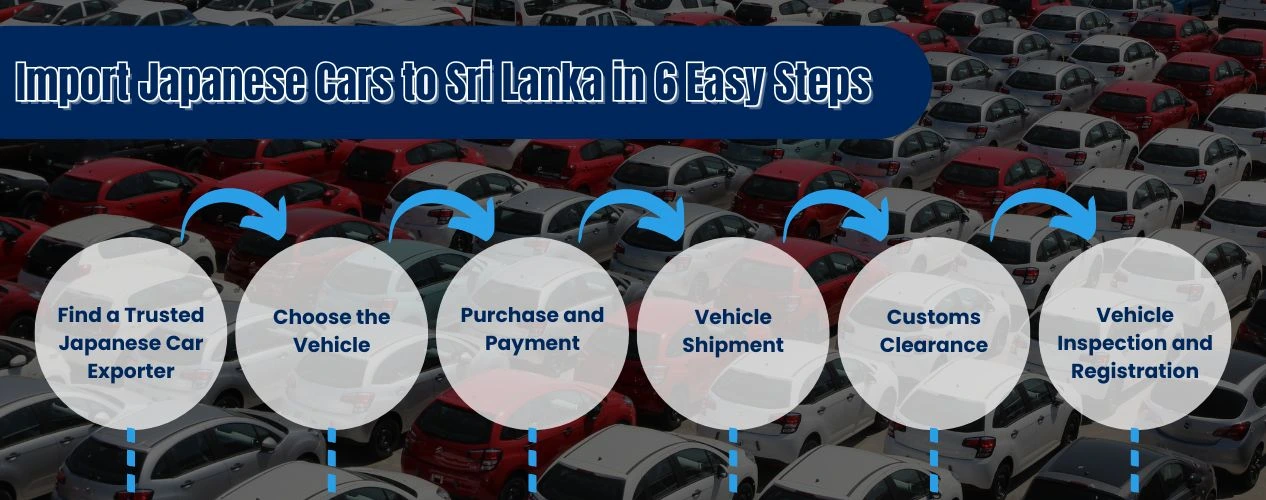
Follow these steps to import Japanese cars to Sri Lanka:
Start by selecting a reputable exporter who can import a Japanese car from Japan to Sri Lanka. For instance, you can rely on SAT Japan for reliable services and extensive inventories of Japanese used cars.
Go through SAT Japan’s online inventory to find a car that suits your preferences and budget. Ensure the vehicle meets Sri Lanka's import regulations, like:
Passenger cars should be no more than 2 years old.
Only right-hand drive (RHD) vehicles are permitted.
The vehicle must pass a roadworthiness inspection by the Japan Auto Appraisal Institute (JAAI).
Once you have your eyes on a vehicle, we will provide you with an invoice detailing the cost of the vehicle. You can open an LC (letter of credit) through your bank to facilitate secure payment. Finally, you can complete the payment as per the agreed terms.
The exporter will arrange for the vehicle to be shipped to Sri Lanka, typically via RoRo vessels to the ports of Colombo or Hambantota. This usually takes 2 to 4 weeks. Meanwhile, you can track your shipment to get real-time updates.
Prepare all the necessary documents mentioned above for the arrival of your vehicle and customs clearance. Be aware of all the applicable charges.
Once you have the Japanese-imported vehicle with you, get it inspected thoroughly to ensure compliance with Sri Lankan standards. Then, register your vehicle with the Department of Motor Traffic within 90 days to avoid any penalties.
There you have it; the best way to import cars from Japan to Sri Lanka, without much hassle.
There’s no doubt that importing a vehicle from Japan to Sri Lanka is worth it and a thoroughly rewarding experience. But it’s always better to stay on top of your preparation to prevent any mishap. Here’s what you can do:
Incomplete or missing documents can result in significant delays during the import process. That said, it’s better to double-check all the required documents and prepare a copy of each to tackle any last moment misplacements.
Logistical issues are another common problem that causes delays in shipments. Since we always provide you with tracking details, you can monitor your vehicle and have peace of mind. However, you need to ensure all the documentation is prepared well on your end to prevent hold-ups at customs.
Importing a Japanese used vehicle to Sri Lanka involves tax and duties that impact the overall cost of shipping. That’s why it’s recommended to familiarize yourself with all the different kinds of taxes and regulations of your country.
Considering the rise in online fraud, we understand it can be difficult to trust a dealership for one of your life’s biggest investments: your car. This is why, at SAT Japan, we provide guidance every step of the way, ensuring transparency. This is done to help you bid with confidence so you get your desired vehicles at the lowest possible prices. You can explore more reviews at Trustpilot and Google to see how we've assisted others in making informed car purchases and how our customers view our brand.
Japanese used cars are popularly sold around the world for their reliability and cost-effectiveness. You, too, can make your dream of having a Japanese car come true by following the right import process.
Visit SAT Japan and choose your vehicle from our wide array of listings. Stay updated on all the regulations and required documents, and stay in touch with our professionals to ensure a smooth and successful vehicle import journey.