Menu

 Find Your
Car
Find New
Car
Local
Pages
Find Your
Car
Find New
Car
Local
Pages
 Pakistan
 Antigua
 Anguilla
 Armenia
 Australia
 Azerbaijan
 Bahamas
 Bangladesh
 Botswana
 Burundi
 Canada
 Chile
Chile
 Costa Rica
 Cyprus
 Dominican Republic
 Fiji
Fiji
 Georgia
 Ghana
Ghana
 Guatemala
 Guyana
 Ireland
 Jamaica
 Kenya
Kenya
 Kyrgyzstan
 Lesotho
 Malawi
 Micronesia
 Mongolia
 Mozambique
 Namibia
 New Zealand
 Nigeria
 Papua New Guinea
 Paraguay
 DR Congo
 Russia
 Rwanda
 Samoa
Samoa
 Solomon Islands
 Somalia
 South Africa
 South Sudan
 Sri Lanka
 Tanzania
 Tonga
Tonga
 Uganda
 Ukraine
 USA
USA
 Zambia
 Zimbabwe
Car
Services
Company
Overview
Reviews
Blogs Categories
Help
Explore Stock
Explore Stock
Explore By Price
Explore By Price
Explore By Make
Explore by
Type
Explore by Year
Explore by
Discount
Inventory
Location
Inventory
Location
Other Categories
Other Categories
Zimbabwe
Car
Services
Company
Overview
Reviews
Blogs Categories
Help
Explore Stock
Explore Stock
Explore By Price
Explore By Price
Explore By Make
Explore by
Type
Explore by Year
Explore by
Discount
Inventory
Location
Inventory
Location
Other Categories
Other Categories
_1757594451.webp)
Selling your phone needs a lot of pre-planning, so we can only imagine how stressful it is to sell a car. At SAT Japan, we understand how draining and time-consuming it can be to sell your car online. One major challenge for sellers is finding buyers who agree to the quoted price. To solve this, SAT Japan connects hundreds of car buyers to sellers online through its Sell with SAT service.
That's why we’ve created this guide to show you the best way to sell a car yourself. Currently, the “Sell my Car” feature is only available in the following countries: Singapore, South Korea, Thailand, UAE, Australia, UK.
Most of the time, sellers are not aware of reliable online platforms where they can list their car. Selling through trusted platforms just makes the experience smooth and hassle-free. Secondly, people often overlook the necessary precautions and fail to follow the steps when selling their car. They fail to research and instead repeat the same mistakes. Without proper research, sellers sell their vehicle at a below-market value price.
This guide shares some tips on how to sell a used car easily with SAT Japan. At SAT Japan, we provide our sellers with a user-friendly process that lets them list their cars at fair prices.
It is important to inspect your car thoroughly and look out for any damage on the outside and inside. If your car is in good condition, its value will drastically increase. Following is a checklist that you can use to make sure that your car is ready to be listed.
Your car’s exterior will determine the buyer’s first impression of the car. So make sure that everything, starting from the paint to the windscreen, is free of dents and scratches. Get touch-ups from your mechanic if you notice any scratches because this will improve your car’s resale value.
Next, it's good to check the inside: dashboard, AC, and seats. Get your car serviced because a clean car signals good ownership. Fixing and repairing any of these cosmetic issues can help you get more for your car when it comes to selling it.
The following are the things you should get checked by the car mechanic, especially when you’re selling a used car.
Engine Oil
Brake Fluid
Gear Shift
Unusual Engine Noise
Tyre Pressure
Upholstery
How to Sell Your Used Car
It is also important that you double-check your odometer reading with the data on your service records to ensure transparency. Once you’re confident that your car is in good condition, the next step is to decide on the price. Refer to multiple sources to explore the market price.
Now that your car is in mint condition, your next step is to set a fair price. Finding a balance between the market’s demand and your car’s condition is the best approach. Check SAT Japan’s listings of similar used cars and see their prices. You can easily filter results by make, model, year, mileage, and engine type. A lower mileage means a slightly higher price.
You should know that buyers usually negotiate, so it is advised that you add a 2-5% margin above the price that you want. Be specific in your research- if you’re targeting a specific country, research your used vehicles in that region.
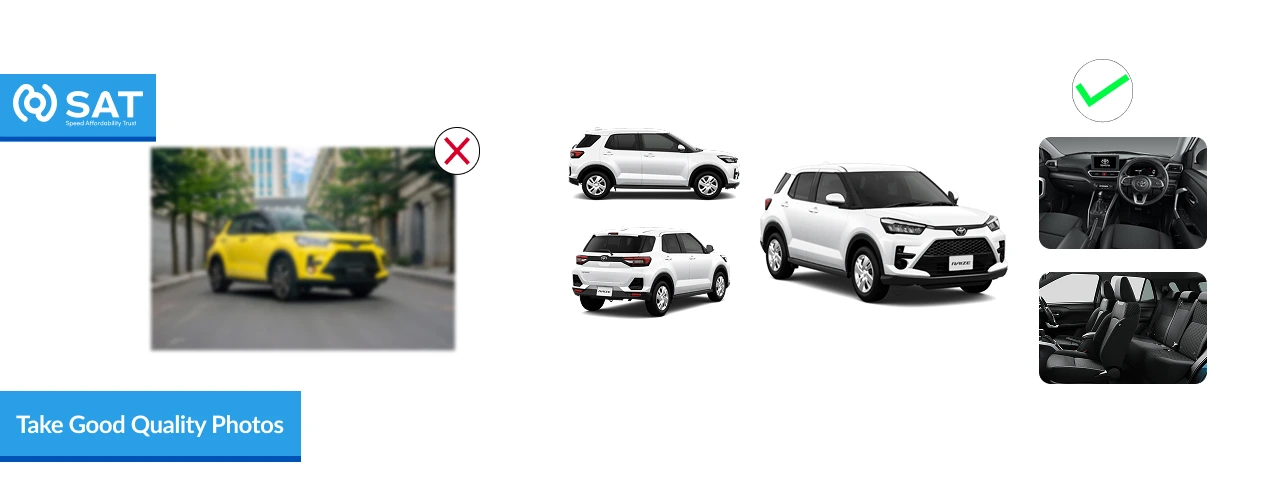
Once your car has received the right makeover, it's time for a photo shoot. Edmund’s research concludes that listings with high-quality images can get you up to 20% higher prices compared to those with low-quality images. Take at least 15-20 pictures that clearly show every part of the car. There are some steps that you need to follow to make your car appealing to buyers.
Choose a clean background and make sure it is not busy
Take pictures from all angles. Capture the front, back, sides, interior, dashboard, engine, and tyres.
Take landscape/wide-angle shots
Highlight all technological features that include screen display, steering, and leather seats.
Make sure to show any dents and scratches. Buyers value honest sellers.

You give your car’s first impression through photos and Ad Description. To attract buyers, it is important that you strategically write your car’s ad description. You’re basically introducing your car through a good description. It tells your buyers why your vehicle is worth considering.
Basic Details: Start by adding the basic details, including the year, make, model, trim, mileage, and transmission.
Condition: Additionally, inform buyers about your vehicle’s condition and provide a rating. You can also use SAT Japan’s suggested phrases to strengthen your listing.
Examples of SAT Japan’s suggested phrases include:
Everything is in genuine condition
Authorized workshop maintained
All service history logs are maintained
Non-accidental
New tyres installed recently
Token or tax up to date
Highlight Key Features: All cars have specific features that add value. Mention those- they may include safety features, single-owner status, fuel efficiency, or an infotainment system. Mentioning the specifications will improve your car’s visibility in the buyer searches.
Writing Style: Remember to keep your writing simple and easy to read. We advise you to use short sentences and bullet points. This helps make your writing more readable.
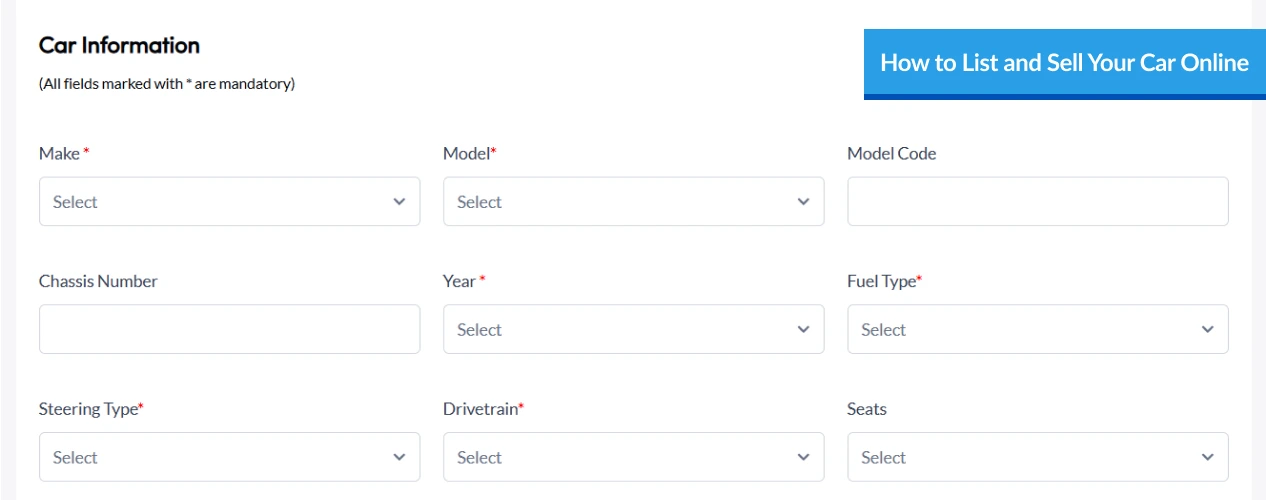
Once you’re sure that your car is ready to be put out there for sale, the next step is to post your ad. SAT Japan makes this process simple through its Sell My Car service on the website. After logging in to your SAT Japan account, just click on Sell My Car and enter your car details. For a successful ad posting, make sure you carry out all the important steps that follow.
Enter Car Information
Write down your Ad description
Upload clear photos from every angle
Select all the features that your car has
Enter your contact information (Phone number and Email)
Wait for Ad Verification
Once you successfully fill in the details on Sell my Car, you will receive a confirmation email from our team. Our team will double-check your car information and the price to see if it matches our criteria. Our team is available to support you throughout the car-selling process. Once the information is there, it will take the team 1-2 days to get back to you. We appreciate the patience of our customers as well, as we are handling multiple requests simultaneously. Once our sales team approves your advertisement, the ad will go live on our website. Buyers from around the world will view it and we will inform you when someone is interested in buying your car and handle all the selling procedures for you.
We advise our sellers to be honest about the car’s condition or flaws, as this saves time. It is true that being transparent builds buyers’ trust. Buyers appreciate it when they know about scratches and dents beforehand, as it keeps them from wasting inquiries. A clear description shows that you are a reliable seller.
Choosing the right selling platform defines your selling experience. SAT Japan is a trusted name in the automotive industry since 2002, connecting sellers with genuine buyers from over 200 countries. Unlike other platforms, SAT Japan targets an international audience. This increases the chance of selling faster and often at a much better price because some models have a higher demand abroad than at home. These are the reasons why SAT Japan is the best place to sell a used car online.

Complete Guide to Car Body Types, Features, and Styles

How to Import a Car from Japan to Cyprus: Step-by-Step Guide
_1753871285.webp)
How to Import a Car from Japan to Australia: Detailed Guide

Mason Turner
I’m Mason Turner, a specialist in new and pre-owned car sales with expertise in vehicle procurement, pricing, and customer relations. Passionate about the automotive industry, I help buyers and sellers make informed decisions for smooth, successful transactions. I also write and share insights to guide others in navigating the market.
To sell your car, visit SAT Japan’s website http://www.satjapan.com/sell and create an account. After your account is made, click on “Sell my Car” and enter your car information and pictures.
You can sell your car easily on SAT Japan’s Sell My Car service, where your listing reaches buyers in over 200 countries. It’s a safe, simple, and global platform to connect with genuine buyers at your chosen price.
You can sell a car privately by listing it on a trusted platform, writing a clear ad, and dealing directly with buyers.
You can buy a used car from a private seller by inspecting the car, checking the documents like registration and service history, and agreeing on a fair price.
You can sell a used car on SAT Japan by setting a fair price and listing it. Make sure that you fully inspect and service your car before you list it.
The best way to sell a used car is through a trusted online platform like SAT Japan, where your listing reaches global buyers.
To sell a used car privately, thoroughly inspect and service your car, then set a fair price and advertise it with clear photos. Always meet in a safe, public location and confirm payment before handing over the keys.
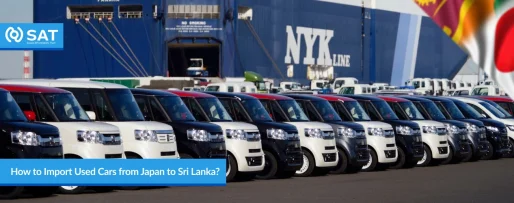
Importing used cars from Japan to Sri Lanka requires a good understanding of taxes, customs, country regulations, and a bit of patience. But you don’t have to worry much about the import process if you pick an exporter like SAT Japan that takes care of most of the steps. We have a highly professional sales team that ensures you get personalized service when importing your Japanese car to Sri Lanka. With experience handling shipments specifically to Sri Lanka, SAT Japan is well-versed in local procedures and makes the entire process more efficient for you.
Japanese vehicles are some of the most reliable vehicles in the world. They are of high standards, affordable, of exceptional quality, and advanced engineering. Japan has a really advanced automobile industry with a wide range of vehicle choices. Here’s why you should consider importing Japanese vehicles to Sri Lanka:
Exceptional quality and reliability
Cost-effective options
Fuel-efficient vehicles
Easy availability of spare parts
Better resale value
Honda, Nissan, Mazda, Toyota, you name it, all the big automotive brands are housed in Japan. They are all widely recognized worldwide for producing vehicles that last a lifetime. In Sri Lanka, the top-selling used Japanese cars are:
Honda Vezel
Nissan Roox
Suzuki Wagon R
Toyota Raize
Suzuki Alto
Suzuki Every
Toyota Aqua
These vehicles are favored for their low maintenance costs, advanced features, and high resale value. Moreover, the Japanese practice of regular vehicle inspections keeps the cars well-maintained, which is a top reason why they are so in-demand in Sri Lanka.
While most Sri Lankan buyers choose used vehicles due to their affordability and relaxed age restrictions, importing brand-new cars from Japan is also a viable option. This is particularly true for those looking for the latest models, full warranties, and advanced features.
The best part is that you can access the latest models that are not yet available locally. What’s even better is that they have a higher resale value compared to used cars. Having access to technology and newer features through brand-new vehicles is truly a win-win.
You can choose from over 200,000 cars weekly. Yes! Buying Japanese cars through Auction is a popular choice for Sri Lankan buyers due to their reliability and affordability. You can choose from a wide range of vehicles, from compact cars to luxury models. These auctions serve you with a detailed inspection report containing everything from mileage to condition and more. Can there be any more cost-effective and reliable option than this for buyers worldwide?
| Tax Type | Rate |
| Duties | 5% to 35% |
| Motor Vehicle | 25% |
| Ports and Airport Levy (PAL) | 5% of the CIF value, or at a rate between 0% and 2.5% |
| VAT | 12% |
| Ad valorem rates | 1%- 45% (of the CIF value) |
| Nation Building Tax | 2% of the sum of the (CIF value x 110%) excise duty, cess, customs duty, and PAL. |
Only right-hand-drive vehicles are permitted to be imported to Sri Lanka from Japan. No left-hand-drive vehicles will be allowed entry into the country.
Cars: Should be a maximum of 2 years old.
Buses, Jeeps, Motor Cars, Ambulances, Motorbikes, All-Terrain Vehicles: Up to 3 years old.
Single and Double Cabs, Trucks, Lorries, Refrigerated Trucks: 4 years
Vehicles are typically shipped to Sri Lanka via the ports of Colombo and Hambantota.
A seaworthiness certificate from the Japan Auto Appraisal Institute (JAAI) is required for used vehicles imported from Japan.
Register the vehicle within 90 days of the Bill of Entry.
You will need the following import documents for customs clearance:
Bill of Lading: Proof of shipment.
Export Documents: Vehicle's registration details from Japan.
Owner’s passport: Identification of the importer.
Purchase Invoice: Proof of purchase and vehicle value.
Original Registration Certificate: Must include an English translation.
Import License: Authorization to import the vehicle.
Letter of Credit: Proof of payment through a licensed bank
Delivery Order issued by the Shipping Agent
Value Declaration Form: Declaration of the vehicle's value.
Pre-shipment inspection certificate: Issued by an approved inspection agency, such as JAAI.
After clearing customs, the vehicle must be registered with the Department of Motor Traffic within 90 days of the Customs Declaration (CUSDEC) date. Failure to register within this period may result in penalties.
As per the Sri Lankan Ministry of Finance, imported vehicles must be registered within 90 days. Failing to do so will result in a 3% fine on the unregistered vehicle's value, with the penalty capping at 45%. Moreover, if an importer fails to register at least 25% of their imported vehicles within six months, their importation privileges may be suspended.
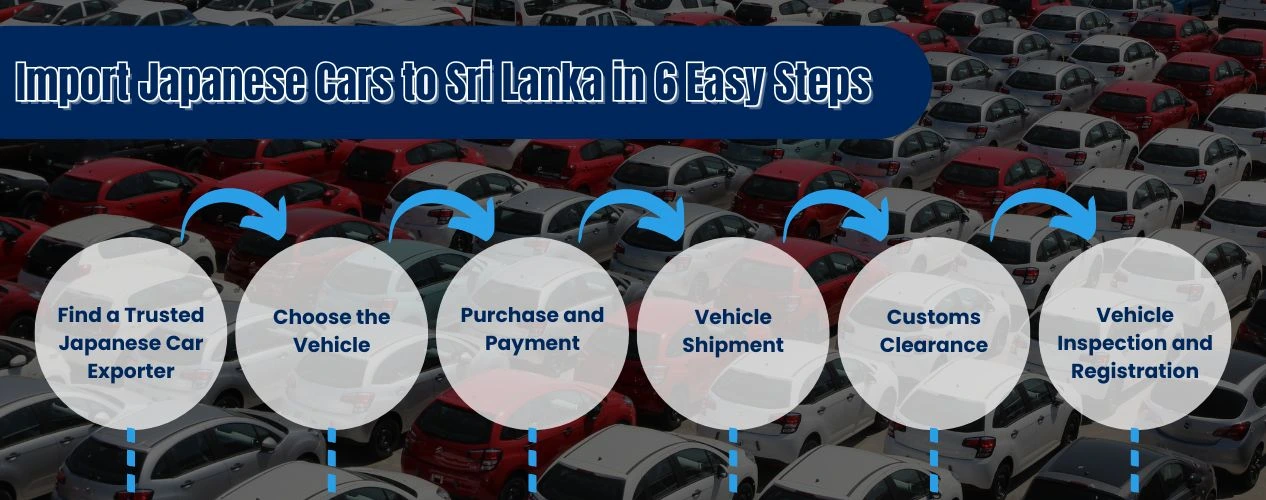
Follow these steps to import Japanese cars to Sri Lanka:
Start by selecting a reputable exporter who can import a Japanese car from Japan to Sri Lanka. For instance, you can rely on SAT Japan for reliable services and extensive inventories of Japanese used cars.
Go through SAT Japan’s online inventory to find a car that suits your preferences and budget. Ensure the vehicle meets Sri Lanka's import regulations, like:
Passenger cars should be no more than 2 years old.
Only right-hand drive (RHD) vehicles are permitted.
The vehicle must pass a roadworthiness inspection by the Japan Auto Appraisal Institute (JAAI).
Once you have your eyes on a vehicle, we will provide you with an invoice detailing the cost of the vehicle. You can open an LC (letter of credit) through your bank to facilitate secure payment. Finally, you can complete the payment as per the agreed terms.
The exporter will arrange for the vehicle to be shipped to Sri Lanka, typically via RoRo vessels to the ports of Colombo or Hambantota. This usually takes 2 to 4 weeks. Meanwhile, you can track your shipment to get real-time updates.
Prepare all the necessary documents mentioned above for the arrival of your vehicle and customs clearance. Be aware of all the applicable charges.
Once you have the Japanese-imported vehicle with you, get it inspected thoroughly to ensure compliance with Sri Lankan standards. Then, register your vehicle with the Department of Motor Traffic within 90 days to avoid any penalties.
There you have it; the best way to import cars from Japan to Sri Lanka, without much hassle.
There’s no doubt that importing a vehicle from Japan to Sri Lanka is worth it and a thoroughly rewarding experience. But it’s always better to stay on top of your preparation to prevent any mishap. Here’s what you can do:
Incomplete or missing documents can result in significant delays during the import process. That said, it’s better to double-check all the required documents and prepare a copy of each to tackle any last moment misplacements.
Logistical issues are another common problem that causes delays in shipments. Since we always provide you with tracking details, you can monitor your vehicle and have peace of mind. However, you need to ensure all the documentation is prepared well on your end to prevent hold-ups at customs.
Importing a Japanese used vehicle to Sri Lanka involves tax and duties that impact the overall cost of shipping. That’s why it’s recommended to familiarize yourself with all the different kinds of taxes and regulations of your country.
Considering the rise in online fraud, we understand it can be difficult to trust a dealership for one of your life’s biggest investments: your car. This is why, at SAT Japan, we provide guidance every step of the way, ensuring transparency. This is done to help you bid with confidence so you get your desired vehicles at the lowest possible prices. You can explore more reviews at Trustpilot and Google to see how we've assisted others in making informed car purchases and how our customers view our brand.
Japanese used cars are popularly sold around the world for their reliability and cost-effectiveness. You, too, can make your dream of having a Japanese car come true by following the right import process.
Visit SAT Japan and choose your vehicle from our wide array of listings. Stay updated on all the regulations and required documents, and stay in touch with our professionals to ensure a smooth and successful vehicle import journey.
Importing a used car from Japan to South Africa is a very reasonable choice, as the vehicles are typically compliant with the South African standards. The import process involves a few basic steps you must take carefully, like clearing the car through customs, obtaining necessary permits, and more. Once you have a checklist of all the required documents, it becomes easier to import a vehicle. So, let’s have a look at the detailed guide that can help you with the import process.
Importing a Japanese vehicle is often more affordable, and you can access unique models that would otherwise be unavailable in your country. Cars from Japan also match South Africa’s road system since both countries use right-hand-drive vehicles. Since Japanese cars come with better features and options, and are often more reliable.
In addition, detailed inspection reports and a wide variety of models help buyers find exactly what they’re looking for, whether a compact city car or a tough 4x4.
Several used Japanese models are especially popular in South Africa. Among the top choices are:
Honda FREED
Nissan MARCH
Nissan SERENA S Hybrid
Nissan JUKE 4WD
Nissan ELGRAND
Toyota HIACE VAN 4WD
Toyota COROLLA AXIO
Toyota PASSO
These vehicles are known for their low maintenance costs, long-lasting engines, and good resale value. These cars are often found in great condition at Japanese auctions, so they remain best-sellers in the South African used car market.
Used Japanese cars are not the only viable option. There is also an option to import new Japanese cars to South Africa, which is truly a great opportunity to source models that are unavailable in the country.
The best part about these vehicles is the high resale value compared to used cars and models. This way, you can have better access to newer models, advanced features, and tech, that too, at such affordable rates.
If you are looking for a vehicle at a price you like, you have the option of car auctions. Japanese car Auctions offer access to over 200,000 vehicles each week. These auctions are a popular choice for many South African buyers because they provide a wide selection, from compact cars to vans and luxury models.
Each vehicle usually comes with a detailed inspection report, which includes information like mileage, condition, and previous use. This helps buyers make informed decisions. Compared to local markets, auction cars from Japan can often be more affordable and better maintained. This is what makes them a practical option for those looking to import a vehicle safely and with more clarity.
| Tax Type | Rate |
| Customs Duty | 30% of vehicle value (20% if the car is more than 20 years old) |
| Ad Valorem Duty Exemption | Vehicles valued below R130,000 are exempt from ad valorem duty |
| Cumulative Tax Estimate | Approx. 70% of the vehicle's market value for a car valued at R200,000 |
| VAT | 15% of the total cost, including CIF and customs duty |
| Ad valorem duty | Based on a sliding scale (0.75% to 20%) depending on vehicle value and engine size |
| Valuation Requirement | If the original invoice is not available, three written valuations are required from Japanese car exporters |
You need to stay compliant with the South African rules and regulations before importing a Japanese car. Here’s what you need to be cautious about:
South Africa follows the right-hand-drive (RHD) system, meaning all vehicles driven on public roads must have the steering wheel on the right side. This is an important regulation when importing a car from Japan, as Japan also uses RHD vehicles.
You must obtain a Letter of Authority (LOA) from the National Regulator for Compulsory Specifications (NRCS). This document ensures that the imported vehicle meets South African safety and technical standards. It should be secured well before the vehicle arrives in the country because without it, you cannot register the vehicle for road use.
To legally import a car from Japan into South Africa, you must apply for an import permit from the International Trade Administration Commission (ITAC). This is done for all the used vehicles being imported to South Africa. The aim is to monitor the number of used vehicles in South Africa.
After the vehicle is cleared through customs and duties, the next step should be registering it with the local traffic department. After the customs clearance, you will receive a Customs Release Notification form, which is needed for the vehicle registration.
You will need the following import documents for customs clearance in South Africa:
Import Permit – Legal entry approval
Letter of Authority (LOA) – Safety & standards clearance
Cancellation Certificate – Japan registration canceled
Bill of Lading – Shipping and delivery record
Commercial Invoice – Purchase and price details
Letter of Authorization – Agent permission document
Identification Document – Passport or valid ID
Permanent Resident Permit - Issued by the Department of Home Affairs (for immigrants only)
Inspection Certificate – Vehicle condition verification
Import permit – Legal entry approval
To import a vehicle in South Africa, you must register with the South African Revenue Service (SARS). This will leave you with an importer’s code. You can visit SARS eFiling to register as an importer. Gather the required documents and complete the form (DA 185) at a SARS office. Once done, you will soon be registered and receive an importer’s code for customs clearance.
First, to clear your car at customs, submit a Customs Clearance Declaration (CCD) with all the needed documents. Then, do a self-check of your payment and paperwork. Customs will look at your documents, like the invoice and shipping papers. They’ll then calculate the taxes and duties you need to pay. Sometimes, they may inspect the car. Once everything is okay, your vehicle is cleared and ready to go.
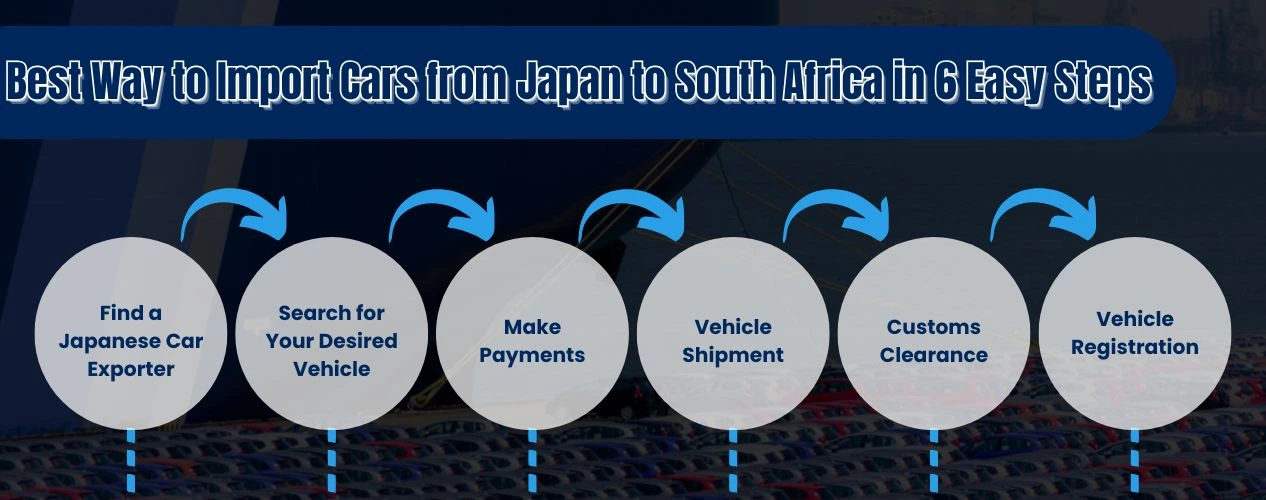
Follow these steps to import a high-quality car from Japan to South Africa.
Start by choosing a trusted exporter in Japan. This is super important! A good exporter like SAT Japan will give you real photos and honest details and help you through the whole process. A dealership with a proper website, contact information, and good reviews tends to be more reliable. Make sure they have experience shipping to South Africa. A friendly and helpful exporter makes everything smoother, and some research goes a long way in avoiding future problems.
Now is the time to browse SAT Japan’s stock online through the listings. You can find the vehicle of your choice by selecting the specific make, model, and year. Compare different available options and finalize the one you think is the right fit for you.
Once done, contact our team to inquire about the car, its photos, and more.
After selecting your vehicle, we will send you an invoice with all costs, including the price of the car and shipping fees. Payments are usually done through a bank transfer. Always keep payment records and ask for confirmation once the money is received. This is really important!
After confirming the payment, our team will make the necessary arrangements to send your chosen vehicle to South Africa. You’ll receive documents like the Bill of Lading that are required at customs. The shipping time may vary, but it usually takes 6 to 8 weeks. You can get shipping updates throughout the process.
Clearing through customs can be a hefty process if you don’t have the right documents prepared at the right time. That’s why it’s important you have all the payments cleared, as it may include checking import duties, paperwork, VAT, and others. Our team will help you with that, as we fully understand the local regulations.
Once you have cleared the vehicle through customs, you need to register it in South Africa. Depending on the local registration process, you may require documents such as customs documents, an ID card, an address, and more.
Avoid the hassle of the import process with these simple tips:
Importing a vehicle from another country is a big step that requires a big investment. So, make sure you buy a car from a trusted exporter only. A reliable exporter will provide you with the pictures of your selected car, inspection sheets, and keep you updated about shipping. You can easily avoid scams by ensuring the company is well-known and has a good reputation. In that case, SAT Japan will prove to be your trusted export partner.
Nothing is as important as being informed during vehicle shipment. Since every country has its own regulations for importing vehicles, you need to do a quick check to save yourself a big headache and lots of money later. For instance, some allow only left-hand drives, others need low mileage, or certain model years. Check age limits, taxes, and paperwork before you buy.
Paperwork may not be fun, but it’s super important. Ensure you get the bill of lading, inspection, and export certificate. That’s because these are the most important documents for imports. You may need additional ones depending on the country or port from which you receive your vehicle.
Shipments need to clear customs before they make their way to you. That’s why you should be prepared well with all the necessary documents and any pending payments. You will need papers for customs and registrations, so make sure you have copies of these documents.
Japanese vehicles are known for their safety and reliability, and for that very reason, hundreds of cars are imported to South Africa every year. However, some fraudulent dealers and scammers trap people in the name of low prices. It’s better you cross-check a dealer before finalizing any purchase. Most of all, consider importing your vehicles through SAT Japan, as we have a long history of successful car imports around the world.
Meanwhile, here’s what you can do to avoid fraud:
Verify the contact details, address, and location of the company to ensure you are dealing with real people with real business.
Always check for reviews on websites like Trustpilot and Google to learn about the company’s credibility.
Prices that seem too good to be true are often a trap. It’s recommended to always check the market price and compare well before making any final decision.
Japan brings high-quality innovative vehicles to the market every time. Unfortunately, not all vehicles make it to South Africa. In such a case, there is no better option than to import your favorite car.
The import process becomes easier with SAT Japan, where you can have your vehicle with you in 6 to 8 weeks. The best part? There is a wide selection of vehicles to choose from. You just need to stay updated on the rules and regulations to have a smooth import experience.

Importing a car from Japan to Pakistan appears to be a complex process, and for many, it indeed is. The paperwork, customs regulations, and finding a reliable exporter make the whole process thoroughly overwhelming. What’s saddening is that many buyers give up before they even get started. But it doesn’t have to be that way.
Thanks to more consumer-friendly import policies introduced by the Government of Pakistan and expert assistance from exporters like SAT Japan, importing a vehicle from Japan to Pakistan has become smoother and far more accessible. SAT Japan handles the tough part so you don’t have to stress.
This Pakistan Japanese car import guide contains everything you need to know. Continue reading till the end.
There is one thing about Japanese cars: they are built to last. Their precise engineering makes the vehicles last long and maintain a high standard of performance for the years to come. Japanese cars are also more affordable due to the country's large economy of scale. Their preference for new and innovative models turns even one-year-old used cars into a valuable asset in the used-car market. Contrary to this, the rising fuel costs in Pakistan have made Japanese hybrid and compact models ideal for every other person.
Imported Japanese cars usually have better resale value due to their condition and brand reputation. Moreover, from sedans and hatchbacks to SUVs and kei cars, Japanese markets offer options to suit every budget and need. All this makes Japanese cars an excellent investment for Pakistani buyers.
Several used Japanese models are especially popular in Pakistan. Among the top choices are:
Daihatsu Mira
Toyota Vitz
Toyota Passo
Toyota Aqua
Toyota Land Cruiser Prado
Suzuki Alto
Toyota Prius
Nissan Dayz
Suzuki Wagon R
Toyota Raize
These vehicles are popularly sold in Pakistan due to their exceptional fuel efficiency, compact size suited for urban roads, and affordable maintenance costs. They are popular and ideal for city driving, offering excellent mileage and making them budget-friendly options.
Not just used cars—many buyers in Pakistan are now importing high-end new models from Japan, such as:
Lexus LX and RX series
Toyota Land Cruiser and Prado
Nissan Elgrand
Honda Odyssey
Mitsubishi Pajero
These models are often loaded with luxurious features and superior technology, making them attractive choices for those looking to stand out.
Do you know what’s the smartest way to buy a Japanese car at affordable rates? Auction.
The Japanese used car auction system is a goldmine for finding quality vehicles at competitive prices. From daily drivers to luxury sedans, there are so many vehicles listed on auctions. Each vehicle has a grading system and an auction sheet for transparency. The best part is that the cost of vehicles at auctions is generally cheaper compared to local dealers.
But how can someone buy used Japanese cars in Pakistan through an Auction? Well, you need to buy through trusted exporters like SAT Japan that offer auction access and bidding services. You can begin by making a deposit to secure your bidding limit. Once done, go ahead and choose from various makes, models, years, and mileage. Meanwhile, you can review the auction sheet to inspect the condition of your chosen vehicle and grading. SAT Japan will bid on your behalf, and once everything is finalized, the company will take care of the logistics and shipping.
Engine Capacity | Customs Duty (CD) |
Up to 850cc | 30% |
851cc–1,000cc | 35% |
1,001cc–1,500cc | 40% |
1,501cc–1,800cc | 45% |
Above 1,800cc | 50% |
Note: Customs Duty is only one component of vehicle import taxation in Pakistan. Additional Customs Duty, Regulatory Duty, Sales Tax, Federal Excise Duty and Income Tax may also apply depending on the vehicle's PCT classification and import conditions.
Engine Capacity | Duty & Taxes |
Up to 800cc | US$4,800 |
801–1,000cc | US$6,000 |
1,001–1,300cc | US$13,200 |
1,301–1,500cc | US$18,590 |
1501cc -1600cc | US$22,550 |
1,601–1,800cc (Excluding Jeeps) | US$27,940 |
Note: For eligible used Asian-made cars imported under Pakistan's Personal Baggage, Gift, or Transfer of Residence schemes, depreciation in duties and taxes is allowed at 1% per month based on the vehicle's age. Cars must generally not be more than three years old.
Depreciation Rule | Allowance |
Each completed month of vehicle age | 1% per month |
Maximum depreciation for cars | 60% |
Depreciation is calculated at 1% for each completed month, generally from 1 January of the year following the vehicle's manufacturing year up to the shipment date, subject to the applicable maximum limit.
Hybrid Engine Capacity | Exemption |
Up to 1,800cc | 50% |
1,801cc–2,500cc | 25% |
Scheme | Eligibility & Features |
Transfer of Residence | Minimum 850 days abroad during the past 3 years. The vehicle must be imported from the same country where the overseas Pakistani resides. |
Gift Scheme | Minimum 850 days abroad during the past 3 years. The vehicle can be gifted to an eligible family member normally resident in Pakistan. |
Note: The Personal Baggage scheme for vehicle imports was removed in January 2026. Vehicles imported under the Gift or Transfer of Residence schemes cannot be transferred for one year from the date of import.
Under the Gift and Transfer of Residence schemes, passenger cars can generally be imported if they are not more than three years old. Vehicle age is calculated according to the applicable import rules, so buyers should confirm the manufacturing year and shipment date before purchasing a car.
Most vehicles imported from Japan are right-hand drive, which is suitable for Pakistan’s left-side driving system. Buyers should confirm the applicable import and registration requirements before purchasing a left-hand-drive vehicle.
There are currently two government-approved schemes for overseas Pakistanis importing used vehicles:
Transfer of Residence: Allows an eligible overseas Pakistani returning to Pakistan to import a vehicle. The vehicle must be imported from the same country where the overseas Pakistani resides.
Gift Scheme: Allows an eligible overseas Pakistani to gift a vehicle to a qualifying family member who normally resides in Pakistan.
The Personal Baggage scheme for vehicle imports was removed in January 2026. Applicants under the Gift or Transfer of Residence schemes must have stayed abroad for at least 850 days during the preceding three years.
A person who has imported, gifted, or received a vehicle during the applicable three-year eligibility period cannot import or receive another vehicle under these schemes. Vehicles imported under the Gift or Transfer of Residence scheme also remain non-transferable for one year from the date of importation.
You must provide accurate vehicle and import details, submit the required documents, and pay all applicable customs duties and taxes. Used vehicles imported under the Gift or Transfer of Residence schemes must also meet the applicable safety, environmental, and regulatory standards notified by the Ministry of Industries and Production and the Engineering Development Board. Incorrect declarations or tampering with vehicle identification details may result in action by Pakistan Customs.
For used vehicles imported under the Gift or Transfer of Residence schemes, the main documents include:
Goods Declaration (GD): Filed for customs clearance.
Export Certificate: Official vehicle export document from the country of export.
Vehicle Purchase Receipt: Proof of purchase of the vehicle.
Bill of Lading (B/L): Shipping document issued for the vehicle.
Attested Copy of Passport or Pakistan Origin Card: Used to verify the overseas Pakistani importer.
CNIC of the Recipient: Required when importing under the Gift Scheme.
Bank Encashment Certificate or Foreign Remittance Evidence: Proof that applicable duties and taxes are being paid through eligible foreign exchange remittance.
Scheme Eligibility Evidence: Documents showing that the applicant meets the current Gift or Transfer of Residence requirements, including the applicable overseas stay conditions.
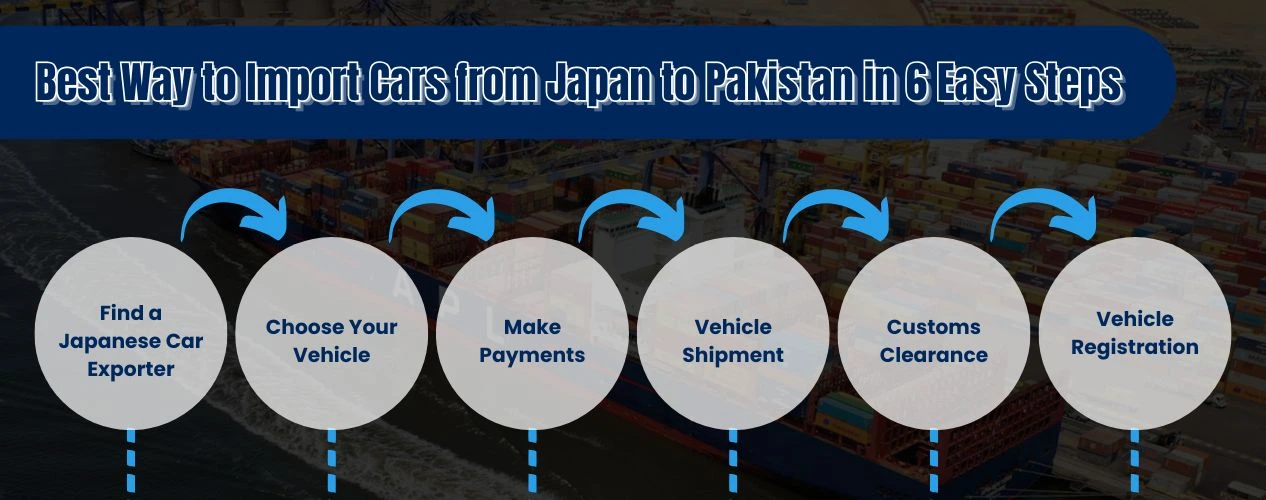
Follow these steps to import a high-quality car from Japan to Pakistan.
Begin by searching for reliable and verified Japanese car exporters. Companies like SAT Japan are popular due to their transparency and vast car inventory. Check customer reviews, export experience, auction access, and if they provide complete documentation. Working with a trustworthy exporter ensures a smooth and safe buying experience.
Browse through SAT Japan’s stock or Japanese auction listings. Select a vehicle that suits your needs, whether it's fuel efficiency, family comfort, or off-road capabilities. Make sure the car is within Pakistan’s import regulations (right-hand drive, less than 3 years old, etc.). Finally, don’t forget to request the auction sheet to check the car's condition, mileage, and history.
Once you finalize the vehicle, SAT Japan will send a Proforma Invoice. You’ll need to transfer the payment. Ensure all payments are properly documented and keep receipts for customs purposes in Pakistan.
After payment confirmation, the exporter arranges the shipment usually by Ro-Ro (Roll-on/Roll-off) or container shipping. You’ll receive the Bill of Lading, Export Certificate, and Invoice, as these are essential for customs clearance. Shipping to Pakistan typically takes 6 to 8 weeks, depending on the port and weather conditions.
When your car arrives at a Pakistani port (like Karachi), you’ll need to get it cleared by Pakistan Customs. You or your customs agent must submit documents including:
Bill of Lading
Import Permission
GD (Goods Declaration) Form
Identity documents
Proof of payment
Export certificate
Duties and taxes will be calculated based on engine capacity, year, and car type. A customs clearance agent can help simplify this process.
Once cleared from customs, the final step is registering the car with your local Excise and Taxation Department. Submit documents like:
NIC
Sales invoice
Custom clearance certificate
Registration application form
Proof of address
You’ll get a registration number and vehicle plates. After this, your imported car is legally ready to drive on Pakistani roads!
The best approach when importing a vehicle is to work with verified exporters that have a good public reputation, such as SAT Japan. This is because verified sellers give you real information, proper papers, and clean deals. Nobody would want their dream car to turn into a nightmare with shady dealers.
Auction sheets are more like a vehicle’s report card. They tell you if it’s been in an accident, its mileage, and overall condition. So, if you are looking for a vehicle from a Japanese auction, you must know how to read an auction sheet. If not, it’s better to get some help.
Some cars are easy to maintain in Pakistan, others not so much. Before buying, see if spare parts are available and if mechanics know the model. A popular car is easier to fix and sells faster if you ever want to upgrade.
Import rules change like the weather! Stay updated with FBR and customs websites so you don’t break any laws. Knowing the rules helps avoid fines, delays, or losing your car. Be smart and always check before you ship.
Pakistan allows cars up to 3 years old for personal use. Anything older is a big no! If you pick an over-aged car, it might get stuck at the port or even be sent back. Stick to the age rule and stay stress-free!
Thousands of Pakistanis, unfortunately, fall for auction sheet fraud when buying a used Japanese car. This type of fraud is more prevalent in Pakistan than you might think. It's because getting away with fraud is easier in Pakistan due to the lack of a legal framework and an official monitoring authority. So here's what fradsters typically do.
Several sellers fabricate the Auction sheet by altering the mileage figures on the sheet. For them, doing this is easy because they only need a basic understanding of Photoshop or Canva to edit the values seamlessly. However, catching them is not an easy job. Simply because if you call the fraudsters out, they’ll show up with the fake, altered verification sheet to cover their fraud. Fake Auction sheet fraud is not the only way fraudsters exploit their customers. There are more.
Another common practice is for sellers to completely change the mileage values in the car. Well, how do they do that? Fraudsters simply remove the vehicle's ECU, connect it to a monitor, and then reverse the mileage. This tricks the buyer into believing in the wrong values. Even if you call the seller out, he would likely come up with a fake or altered verification sheet to cover up his fraud.
Many dealers and sellers also commit paint fraud. What they do is repainted their car locally and claim it to be a genuine body. If you want to detect this kind of fraud, you have to compare the car’s appearance with the auction sheet. If there is a visible difference, then it means that you’ve been successful in catching a Color code scam.
Since millions of sellers engage in this kind of activity, it is nearly impossible to keep a check on everyone. However, there are certain precautionary measures that you can take to protect yourself from such fraudsters.
A rule of thumb is to verify your car from the SAT Japan auction sheet verification. In case the car is not auctioned, you cannot do much about it except for trusting your instinct. SAT Japan’s vehicle inspection system conducts a thorough, detailed inspection to verify whether the mileage on the meter is accurate or not. We’re doing our best to prevent such fraudsters.
To protect yourself from potential fraud, avoid paying your seller in full at once. Legitimate sellers usually accept partial payments or offer secure payment methods. Avoid paying through untraceable services and use services like PayPal or international bank transfers, which involve a legitimate third party.
It is essential to verify the credibility of your seller before initiating the process. Check for red flags, such as a deal that appears too good to be true, or if you notice a lack of documentation. Double-check the vehicle registration and shipping details, and most importantly, ask questions. If a seller is reluctant to answer questions, that is definitely alarming and you should not buy from them.
Importing a vehicle from Pakistan to Japan is indeed an exciting option, particularly for those looking for durability and reliability along with modern tech features. However, the import process is typically lengthy and requires the support of experts to avoid fraud and scams. That’s why we have partnered with some top companies to help our customers navigate the customs process in a matter of a few days.
So, what is holding you back? Choose the vehicle of your choice from SAT Japan’s listings today and start the import process right away!